Lively, entertaining reviews of, and essays on, old and newer films and everything relating to them, written by professional author William Schoell.

Thursday, March 15, 2018

BRIGADOON (1966)

Peter Falk, Robert Goulet and Sally Ann Howes
BRIGADOON (1966 ABC television special). Produced and directed by Fielder Cook. Music and lyrics by Alan Jay Lerner and Frederic Loewe.

In this television adaptation of the famous Broadway musical, American friends Tommy Albright (Robert Goulet) and Jeff Douglas (Peter Falk) stumble upon an 18th century Scottish village that only appears every hundred years (the logistics of this are impossible to really figure out so don't even try). Jean (Linda Howe) has decided to marry Charlie (Thomas Carlisle) over Harry (Edward Villella), putting him in a funk that leads to tragedy. While milkmaid Meg (Marlyn Mason) pitches woo at Jeff, the also unmarried Fiona (Sally Ann Howes) develops feelings for Tommy and vice versa. But is Tommy willing to make what might seem to any reasonable person an insane sacrifice for love that can never be rescinded? Even this shortened and adapted version of Lerner's libretto gets across the intense romance (in every sense of the word) of the story, as well as both the poetic and nightmarish aspects of Brigadoon and the curse that hangs over it. Peter Falk [Luv] is terrific in this, but thank goodness he doesn't have to do any singing. That's left to Howes [Dead of Night], who has a beautiful voice, and Carlisle, who is also a splendid singer. Goulet has a fine voice as well, but although he appeared in Broadway shows (such as Lerner and Loewe's Camelot), he sings in a typically sixties pop style that doesn't quite ruin such superb numbers as "Almost Like Being in Love" and "There But for You Go I" but doesn't compliment them, either. (The original Broadway cast album has the best versions of these songs.) Marlyn Mason [That Certain Summer] is excellent as Meg, and does a fine rendition of "My Mother's Wedding Day." Interestingly the last two lines of the song -- "It was a mess beyond compare/I ought to know 'cause I was there" -- which were cut from the original cast album were reinstated for this TV special. Ballet dancer Edward Villella does a very nice job as the jilted Harry and dances a sword dance as well. The Lerner and Loewe score is one of their finest, and can almost be described as American opera. The 1957 feature film was a big disappointment.

Verdict: Interesting adaptation of this enduring and beautiful musical. ***.

LES BONNES FEMMES

Bernadette Lafont and Stephane Audran
LES BONNES FEMMES (aka The Good Girls/1960). Director: Claude Chabrol.

Four Parisian shop girls work as clerks, try to have fun when they aren't working, and hope to find love or some fulfillment of their dreams. Rita (Lucile Saint-Simon) is engaged to the condescending Henri (Sacha Briquet), who thinks she isn't cultured enough for his parents. Jane (Bernadette Lafont) has a soldier boyfriend but dallies with a married man named Marcel (Jean-Louis Maury), who is a bit of a jackass. Ginette (Stephane Audran of Les Biches) secretly sings -- rather badly -- in a revue and is terrified that anyone should find out about it. And Jacqueline (Clotilde Joano) is obsessed with a man on a motorcycle, Andre (Mario David), who follows her all over Paris. The owner of the shop, Mr. Belin (Pierre Bertin), is a creepy old lech who breathes all over the gals while doling out supposed advice. Les Bonnes Femmes, a prime example of what was called the French New Wave, is almost anti-romantic in the downbeat but fascinating way it puts sentimentality on its head. The cashier in the shop, Madame Louise (Ave Ninchi), has a "fetish" that she shows to Jacqueline and which turns out to be a grotesque memento that foreshadows the very grim ending of the movie. Chabrol keeps the picture, which might seem uneventful and undramatic by Hollywood standards, moving, makes good use of Parisian locations, and fills the film with interesting details and performances. The young ladies are all quite attractive, while the men they get involved with are generally quite average looking, but this is not necessarily unrealistic. Henri Dacae's cinematography is topnotch, and the unusual and effective score is by Pierre Jansen and Paul Misraki. Chabrol married Stephane Audran four years after this film was released. 

Verdict: Chabrol's masterpiece. ***1/2.

PERRY MASON RETURNS

Della (Hale) is comforted by Perry (Burr)
PERRY MASON RETURNS (1985). Director: Ron Satlof.

Twenty years after Perry Mason went off the air, Raymond Burr returned as the character in what would turn out to be the first of many telefilms. Della Street (Barbara Hale) is now a private secretary to a difficult wealthy man named Gordon (Patrick O'Neal). In what would become a typical development in these movies, Gordon is killed by a hit man (dressed as a woman) in order to frame Della, who goes on trial for murder with Perry as her defense lawyer. Mason, who is now a judge, quits the bench to come to Della's rescue. The many suspects include members of the dead man's family as well as assorted business rivals and personal enemies. There are good performances from Kerrie Keane [Incubus], Holland Taylor, Richard Anderson, James Kidnie, and William Katt [Carrie], Barbara Hale's real life son who plays the son of investigator Paul Drake. Frankly, there's a little too much of Drake Jr. running around hither and thither, probably to pad the running time, but this still emerges as an entertaining TV flick.

Verdict: It's good to have Perry back. ***.

THE PERRY MASON TV SHOW BOOK

THE PERRY MASON TV SHOW BOOK. Brian Kelleher and Diana Merrill. St. Martin's; 1987.

This heavily illustrated book looks at the creation of Perry Mason, gives us a history of the character on radio and in films, explains how the show came together, and offers backgrounds of the creative team and chapters on Raymond Burr and all of the major players. Over half of the book is given over to brief synopses and limited credits for each and every episode of the 9 year show, some of which -- for shame -- sort of give away the ending! The book explores how the National Association of County and Prosecuting Attorneys were so upset at Hamilton Burger's (William Talman) depiction, that a scene was included in which Mason praises his opponent in no uncertain terms. There is also a section on some of the early Perry Mason telefilms which also starred Burr.

Verdict: The ultimate Perry Mason TV book has yet to be written, but this tome has some good information and lots of photos. ***.

MONSTROUS NATURE: ENVIRONMENT AND HORROR ON THE BIG SCREEN

MONSTROUS NATURE: ENVIRONMENT AND HORROR ON THE BIG SCREEN. Robin L. Murray and Joseph K. Heumann. University of Nebraska Press; 2016.

Ah, here we have another university press film book that reads like a term paper. Monstrous Nature purports to analyze and dissect films that deal with nature-gone-wrong, but it has less to do with looking at actual films than in examining different trendy theories. Monstrous Nature is typical of film books in which the authors are not that "film-aware," and not that interested in how movies are put together, nor the different elements that make these films great or poor. The movies mentioned in the book are only a springboard for discussions on such as climate change (giving examples of what they call "Cli-Fi cinema), feminism, and even cannibalism! It's not that these discussions are necessarily without interest, nor that the authors on occasion don't make interesting observations, but the writing is dry and often pretentious. However, the book may alert you to some films you were unaware of and may want to check out.

Verdict: A college thesis masquerading as a book. **.

Thursday, March 8, 2018

DEATH ON THE NILE

Bette Davis, David Niven, Peter Ustinov
DEATH ON THE NILE 
(1978). Director: John Guillermin.

"It's been my experience that men are least attracted to women who treat them well."

Following the success of the first screen adaptation of Agatha Christie's Murder on the Orient Express, it was decided to do another big-scale, star-studded, somewhat overblown adaptation of a Christie novel with Peter Ustinov taking over the role of the great Belgian detective Hercule Poirot. This has an interesting hook: Having stolen away her friend Jacqueline's (Mia Farrow) boyfriend, Simon (Simon MacCorkindale of Jaws 3-D), Linnet Ridgeway (Lois Chiles) finds herself and her new spouse being followed everywhere by Jackie while on their Egyptian honeymoon. Poirot, also on the same tour, warns Jacqueline that she may be heading for disaster, and indeed there's foul play afoot and more than one murder. In her modest and entertaining novel, Christie was wise enough not to make virtually everyone on board the ship a suspect, but screenwriter Anthony Shaffer makes the mistake of giving almost everyone a motive, as unlikely as that sounds. Death on the Nile is way too long, but it is handsomely produced, well-photographed by Jack Cardiff, and has a very nice score by Nino Rota. Ustinov is not the perfect Poirot, but he is acceptable. Among the very large cast, the stand-outs are Maggie Smith [Clash of the Titans], as Bette Davis' put-upon nurse-servant, and Angela Lansbury as the soused authoress, Salome Otterbourne. Everyone else is competent enough, but unremarkable. Bette Davis doesn't so much give a performance, but play "Grand Lady," one suspects as much for the cast and crew as for the audience. One could argue that Mia Farrow seems to give better performances in Woody Allen movies than in ones she makes with other directors. Christie later used a certain similar plot device in Evil Under the Sun. NOTE: A remake of this film is scheduled for 2019.

Verdict: Quite entertaining mystery is good to look at with a few fun performances and humor. ***.  

LES BICHES

Frustrated players: Audran, Sassard and Trintignant
LES BICHES (1968). Director: Claude Chabrol.

Frederique (Stephane Audran) is a wealthy Frenchwoman who collects and discards artists and lovers. She picks up a starving homeless painter named "Why" (Jacqueline Sassard) off the street and the two enter into a casual relationship with Frederique footing the bills and maintaining control. At her vacation home in St. Tropez, Why meets an architect named Paul (Jean-Louis Trintignant) and sleeps with him. Initially afraid of losing control, Frederique then begins her own relationship with Paul, which apparently becomes serious. Why seems content to live with and love both Frederique and Paul, but the couple may have other ideas ... With its frank, yet frankly unexplored (except in the most superficial sense), look at bisexuality and polyamorous relationships, Les Biches may seem ahead of its time, but by the late sixties even American movies were dealing with more outre sexual subjects. Les Biches does get points for being unpredictable and absorbing, avoiding the tiresome trap of setting lesbian against straight man for the love of a bisexual woman, at least for its main plot. Unfortunately, the characters of Les Biches are under-developed and not very sympathetic and it's easy to over-rate the movie. Two other characters are a gay couple who are underground "artists" and who live in Frederique's villa. Although they are not screaming stereotypes, they are irritating almost from the first, pretty much demolishing any positive statements the film may have been making about homosexual relationships, which it seems not to have been doing in any case, having other things on its mind. The acting is quite good and Pierre Jansen's distinctive and unusual scoring is a plus. The melodramatic wind-up is perhaps more silly than anything else.  Audran was director Chabrol's wife. He also directed Merci pour le chocolat and Story of Women, among many others.

Verdict: Interesting, but ultimately unconvincing. **1/2.

IT'S ALWAYS FAIR WEATHER

Michael Kidd, Dan Dailey and Gene Kelly
IT'S ALWAYS FAIR WEATHER (1955). Directors: Stanley Donen; Gene Kelly.

Three men who were buddies in the army have many drinks at the end of the war and vow to meet in ten years' time at their favorite bar in Manhattan. Now, you might wonder, if they were such good friends, they would certainly have stayed in touch for the past decade, but apparently they haven't, so when they each keep the appointment they discover that they have little in common and don't even like each other very much (surely they could have talked about wartime experiences, at least?). Angie (Michael Kidd), who planned on becoming a great chef, is married, has several kids, and runs a hamburger joint in Schenectady. Doug (Dan Dailey of There's No Business Like Show Business), who'd wanted to become a famous artist, does work on TV shows that sell detergent, and is on the verge of divorce. Ted (Gene Kelly), who figured on a legal career, is now an unmarried manager for a boxer who is planning to take a dive. The ladies in the story include Jackie, (the gorgeous, leggy Cyd Charisse), who works on one of Ted's TV shows; and Madeline (Delores Gray), the star of said show. The gals hope to get the former soldiers on the program as a surprise, unaware that they now actively dislike each other. And some hoods who fixed the fight are out to get even with Ted.

Filmed in startling CinemaScope and color and photographed by Robert Bronner, It's Always Fair Weather presents a striking sound stage Manhattan that is prominently featured in two sequences: when the boys dance under the elevated subway, each wearing a garbage can lid on one foot; and when Kelly does an absolutely smashing dance on roller skates, and even winds up tap dancing while still wearing them ("I Like Myself"). Cyd Charisse [The Unfinished Dance] is featured in a production number in which she dances with flat-faced pugilists in a gym, and Delores Gray gets a chance to shine when she sings and dances to "Thanks, But No Thanks" with a dozen chorus boys. The songs were composed by Andre Previn [The Kissing Bandit] -- the lyrics were provided by Comden and Green -- and are pleasant enough, with "Friends Forever" emerging the prettiest number. The performances by the entire cast are excellent. Michael Kidd appeared in a few films, such as Smile, but was primarily a well-regarded choreographer [Seven Brides for Seven Brothers.]

Verdict: A small degree of pathos counteracts the silliness and Kelly's dancing is simply sensational. ***.

PYRO

Barry Sullivan and Martha Hyer
PYRO (aka Feuge aka Pyro ... The Thing Without a Face/1964). Director: Julio Coli.

"I won't rest until you and all of your family are dead ... my breath on your back will be like a cold wind from Hell." -- Vance.

Vance Pierson (Barry Sullivan of Suspense) travels to Spain with his wife, Verna (Sherry Moreland of Fury of the Congo) and their daughter so he can work on a special project with his associate, Julio (Fernando Hilbeck). Unfortunately, Vance meets up with Laura Blanco (Martha Hyer) when he goes to see a house -- resulting in a very strange and awkward sequence -- and the two begin an affair. Vance admits that he'd marry Laura if only he didn't already have a family. Supposedly wracked with guilt -- although with the cool, disaffected Sullivan it's hard to tell -- Vance breaks off the affair, but Laura is not the type to take no for an answer, leading to more than one tragedy ... Pyro is misnamed, because while there are fires and arxonists aplenty in the movie, there are no genuine pyromaniacs. Pyro has an interesting plot so it holds the attention, but it's not that well-produced or directed, sometimes has the appearance of a travelogue, has a too-weird musical score, and never becomes the fascinating nail-biter it might have been with a master director at the helm and a much better script. As well, certain aspects of the story line defy credibility. Sullivan and Hyer are both competent -- Sullivan is at times better than that -- but Hyer lacks the real acting chops to make her portrayal anything more than another vicious kitten as she was in Picture Mommy Dead. A Spanish film, this was picked up for US release by American International, but it was not a success.

Verdict: This had real possibilities ... **1/2.

THE KEYHOLE

Kay Francis and George Brent
THE KEYHOLE (1933). Director: Michael Curtiz.

"The next time you try to kill yourself, let me know -- I'd love to help you!" -- Anne about Maurice.

Anne (Kay Francis of In Name Only) is married to the much-older Schuyler Brooks (Henry Kolker of Meet the Baron). When she learns from her first husband, Maurice (Monroe Owsley), that their divorce wasn't valid, he blackmails her. Anne gets advice from her sister-in-law, the formidable Portia (Helen Ware), and takes off for Cuba to get Maurice out of the country. Meanwhile Brooks, fearing Anne is unfaithful, hires private dick Neil (George Brent of Dark Victory) to follow her and see if he can tempt her into an affair. Neil's partner, Hank (Allen Jenkins), gets involved with con lady Dot (Glenda Farrell), with both thinking that the other one is wealthy. Will Anne keep putting Neil off, or will she succumb to his charms? Who cares? The Keyhole is a minor comedy-drama that never gets very dramatic and isn't especially funny. The leads are fine, but any fun in the movie is provided by Jenkins, and especially Farrell, who gives the most notable performance. Kolker and Ware are also good, but the movie is not memorable.

Verdict: Smooth but not terribly interesting. **.

DANCE HALL RACKET

Lenny Bruce
DANCE HALL RACKET (1953). Director: Phil Tucker. Screenplay by Lenny Bruce.

An undercover cop hangs out at a certain dance emporium whose owner he suspects of trafficking in shady deals and murder. The owner is Umberto Scalli (Timothy Farrell of Jail Bait) and his rather psychopathic right hand man is Vincent (Lenny Bruce), who stabs people right and left without hesitation. Scalli's secretary, Rose (Honey Bruce Friedman), is Vincent's chief girlfriend (Friedman was married to Lenny Bruce at the time). The two men are marking time until the arrival of fresh-out-of-the pen Victor Pappas, from whom they hope to learn the whereabouts of his stolen loot. This ultra low-budget, oddball movie, barely clocking in at an hour, was scripted by the controversial comic, and his performance as a sleazy if good-looking hood is personality-driven and competent. Farrell is a professional but uninteresting performer, and the rest of the cast veers from the broadly amateurish to the perfectly capable. The names of many of the cast members have been lost to history, but "Maxine" is noteworthy as Scalli's middle-aged former girlfriend, and she does a mean Charleston, too. The main plot, such as it is, is interrupted by supposedly comic intervals, and there's a terrible Swedish funny man (not!) portrayed by an annoying Bernie Jones. Phil Tucker also directed Robot Monster and Lenny Bruce also scripted Rocket Man.

Verdict: Now this is definitely a curiosity if nothing else. **.

Thursday, March 1, 2018

PORTRAIT OF A MOBSTER

Norman Alden, Peter Breck, and Vic Morrow
PORTRAIT OF A MOBSTER (1961). Director: Joseph Pevney.

The ambitious Arnold Flagenheimer rechristens himself "Dutch Schultz" (Vic Morrow) and goes to work for Legs Diamond (Ray Danton) along with his old pal, Bo (Norman Alden). But Dutch isn't content working for Legs and goes off on his own, taking over rackets right and left and incurring the wrath of other mobsters as well as the police. Dutch goes so far as to romance the daughter, Iris (Leslie Parrish), of one of the men he murdered, but he gets competition from Detective Frank Brennan (Peter Breck). Iris dallies with both men, marries one, and pays a heavy price for it. Portrait of a Mobster is superior to other mob movies of the same period if for no other reason than the casting of a terrific Vic Morrow [Curse of the Black Widow], who unlike Danton and David Janssen gets across a sinister and barely restrained menacing quality that makes him seem genuinely ruthless and psychotic. The picture is also well-directed and fast-paced, with an energetic musical score by Max Steiner who downplays the romance for pure and hectic action. There's plenty of gang warfare scenes and even a bit with a bomb in a coffin at the funeral parlor! Ray Danton reprises his role from The Rise and Fall of Legs Diamond, but only has a couple of scenes. Both Breck [I Want to Live!] and Parrish [Missile to the Moon] give very good performances, and there's also good work from Norman Alden and Frank DeKova. The only person Dutch seems to care about aside from himself is Bo. Dutch has a habit of getting up in the nightclubs he owns and singing but his voice is flat and fairly awful.

Verdict: Snappy gangster flick with an excellent lead performance. ***.

SWING IT! THE ANDREWS SISTERS STORY

SWING IT! THE ANDREWS SISTER STORY. John Sforza. University Press of Kentucky; 2000.

Petty squabbles, sibling rivalry, bad marriages, lawsuits and counter suits against each other, and even suicide attempts -- this was all part of the Andrews Sisters' story. However, it is just part of the story. True, two of the sisters, Patti and Maxene, did not even speak or look at one another in the last few years of  their lives -- Maxene died some years before Patti did -- but author Sforza suitably spends more time detailing the careers (both together and as individuals) and personal triumphs of the singing group than their trials and tribulations -- but he leaves nothing out. The author looks at other girl groups and explains why the very versatile Andrews Sisters were at the top of the heap and the reasons for their longevity. The gals were of Greek descent, and one could not say they were raving beauties, but they generally looked much more attractive in real life than in their movies. LaVerne, the oldest, looked like a witch in Hold That Ghost, but still shots in this heavily-illustrated tome show her looking much prettier and with a more becoming hairstyle in later years. The sisters did several films with Abbott and Costello, then a series of mediocre films for Universal, who didn't seem to know just what to do with them, and then there was their work for the USO. When Patti and Maxene did their successful Broadway show, Over Here!, it highlighted the sisters' comedic abilities. Their hit songs included "Rum and Coco-Cola;" "Don't Sit Under the Apple Tree;" "Boogie Woogie Buigle Boy;" and many, many others. The group split up in the early fifties, then forgave each other and reunited, until there was another, longer split between Patti and Maxene (LaVerne had passed away by then) over Over Here! The Andrews Sisters remain the "best-selling female vocal group" of all time, and had more Top Ten Billboard hits than either the Beatles or Elvia Presley! In addition to many great photos, the book also has a lengthy, annotated discography as well as lists of their film, radio and TV appearances.

Verdict: This is an excellent biography and career study of three talented women who became symbols of WW2 but whose careers spanned many decades. ***1/2.

PRIVATE BUCKEROO

Maxene, Patti and LaVerne Andrews
PRIVATE BUCKEROO (1942). Director: Edward F. Cline.

When band leader Harry James, playing himself, is drafted, his singer Lon Prentice (Dick Foran), decides to enlist. His sergeant is "Muggsy" Shavel (Shemp Howard of the Three Stooges), who is engaged to Bonnie (Mary Wickes), who finds herself drawn to another singer and comic, Biff (Joe E. Lewis). Lon finds himself on the outs with his fellow soldiers because he requests and (inexplicably) receives special privileges, which doesn't help when he tries to romance Joyce (Jennifer Holt). Meanwhile the top-billed Andrews Sisters perform both in James' nightclub and on the base, wouldn't you know? Private Buckeroo, which is the name of a song warbled by Foran, is modestly entertaining, without much of a plot, but it has its charms, chief among them the Andrews Sisters performing "Tell It to the Marines" and "Don't Sit Under the Apple Tree." There is also a nifty dance number done by a bunch of talented teenagers, and Dick Foran delivers a fine rendition of "Nobody Knows the Troubles I've Seen." Shemp Howard and Mary Wickes make a winning combo; Dick Foran [Violent Road], who started out as a band singer and eventually became an excellent dramatic actor, has a very nice baritone; and Susan Levine makes an adorable "Tagalong," Joyce's little sister. Donald O'Connor, Peggy Ryan, and Huntz Hall have smaller roles. Harry James plays a mean trumpet, but he proves not to be much of an actor. This is a rare opportunity to see the real singer-comedian Joe E. Lewis, who was played by Frank Sinatra (who looked nothing like Lewis) in The Joker is Wild. Lewis is rather amusing in this as he squares off with rival Shemp Howard.

Verdict: More than passable patriotic Universal musical. **1/2.

THE ANDREWS SISTERS TV SHOW

Patti, Maxene and LaVerne Andrews
THE ANDREWS SISTERS TV SHOW (1951). Director: Jean Yarbrough.

This is the pilot for a sitcom-musical series that wasn't picked up by any network. The Andrws Sisters -- Patti, Maxene, and LaVerne -- basically playing themselves, run a music shop in Hollywood but are always behind on the rent. Patti is dating Willie (that amusing nebbish Marvin Kaplan), and LaVerne has set her cap for a character, Tex, played by Buddy Ebsen [Breakfast at Tiffany's] who is not that far from Jed Clampett. In between the limited plot, the gals do song numbers, including the comic "Hawaii: and "Pennsylvania Polka." Patti does a solo on "I Can Dream, Can't I?" and is excellent at putting across this classic romantic ballad. The sisters do two promos for possible sponsors, singing songs, invoking the name of Bing, and mentioning how they can easily get guest-stars from show business. Donald MacBride [Murder Over New York] angrily (as usual) plays the dyspeptic landlord who wants his rent money. One could certainly quibble about many aspects of this pilot, how it's lame at times and hokey, and the gals are certainly not in the league of say, Lucille Ball as comediennes, but they are otherwise not bad actors, with Patti, as usual, being the most accomplished and effervescent, and the show might have been successful if given a chance.

Verdict: Pleasant sitcom with welcome song numbers. **1/2.

THE FLAMING URGE

Harold Lloyd Jr. 
THE FLAMING URGE (1953). Writer/director: Harold Ericson.

Tom Smith (Harold Lloyd Jr. of Frankenstein's Daughter) moves from town to town because he's always losing jobs by running off to watch fires. The latest town has less fires than usual, so Tom gets a job at a department store, where he is befriended by the owner, Chalmers (Jonathan Hale) --  who also likes to chase fires --and even gets a girlfriend, Charlotte (Cathy Downs of The Amazing Colossal Man). Just as life looks good, a firebug runs amok and the obvious suspect is Tom. The Flaming Urge is a very light-hearted look at the very serious subjects of arson and pyromania, but the cost in lives (although apparently no one ever dies!)  and property is completely glossed over by the superficial screenplay, and most of the movie plays like a comedy. An asset is the casting of Lloyd Jr., a talented and appealing actor with handsome and sensitive looks who makes the most of his rather bizarre role; this is one of the few if only times he was seen to advantage in the movies. Hale is fine but the picture is nearly stolen by Byron Foulger [The Master Key] as Mr. Pender, Tom's fussy supervisor at the store. Even Pierre Watkin shows up as Charlotte's father, and he is typically competent if unremarkable. The movie was filmed in Monroe, Michigan, and unlike a lot of movies made outside Hollywood, is perfectly professional if low-budget. Writer/director Ericson only made this one movie while Lloyd went on to make several more before dying tragically young of a stroke. The movie is seen by some as a "coded gay" film because of the title (reminding one of "flaming queen") and because Lloyd Jr. was gay in real life, but it might be reading too much into things to see his interest in fire as being a metaphor for homosexuality, yet. .. the movie is psychologically dubious in many ways. One of Harold Lloyd Sr.'s films was Fireman Save My Child.

Verdict: Offbeat with a fine lead performance. **1/2.

A BRIEF HISTORY OF COMIC BOOK MOVIES

A BRIEF HISTORY OF COMIC BOOK MOVIES. Wheeler Winston Dixon and Richard Graham. Palgrave Macmillan; 2017.

This is indeed a very brief overview of comic book and comic strip adaptations that comes off more like a long article than a book. Chapters look at characters from the DC Comic universe, such as Superman and Batman; the characters of the Marvel Universe, such as Iron Man and the Fantastic Four; Japanese anime; and independent films such as Teenage Mutant Ninja Turtles. The book is breezily written for the most part, makes some good points about these movies, but in some ways comes off like a well-done term paper. There are no photographs. It's strange that the publisher didn't invest in some pictures and thicken the book's page count.

Verdict: Publish or perish? **1/2.

Thursday, February 22, 2018

ZIEGFELD FOLLIES

Kelly, Astaire and Garland
ZIEGFELD FOLLIES (1945). Director: Vincente Minellli.

9 years after he starred as The Great Ziegfeld, William Powell reprised his role of Flo Ziegfeld -- sort of. In the opening moments of Ziegfeld Follies, the great impresario is seen in Hollywood's idea of heaven pontificating on the Follies, and wondering what they would look like if the Follies still existed today. Voila! First puppetoons are used to depict the original Follies; then suddenly there's a stage and we see a series of acts with contemporary stars such as Lena Horne, Lucille Ball, Kathryn Grayson, Virginia O\Brian, and many others. After about half an hour the movie is almost stopped dead by a long and mostly unfunny skit with Keenan Wynn trying to make a phone call. A later sketch with Victor Moore as a man arrested for expectorating on the subway and Edward Arnold as his lawyer is much better, as is another sketch with Fanny Brice (who was actually in the original Follies) and Hume Cronyn as a couple who have a winning sweepstakes ticket and William Frawley as their landlord. A bit with Red Skelton playing a TV announcer who gets drunk reminds one of the later "Vitavegamin" routine on I Love Lucy. James Melton and Marion Bell sing a duet from La traviata, but are not that impressive. Fred Astaire [Royal Wedding] does two dance numbers with Lucille Bremer [Till the Clouds Roll By], but the highlight of the picture is his dance with Gene Kelly -- the only time the two danced together in the movies. The other highlight is Judy Garland playing an affected star in a production number with several handsome male dancers. Garland also appeared in Ziegfeld Girl.

Verdict: Although this has no story, it still manages to be entertaining. ***.

THE RISE AND FALL OF LEGS DIAMOND

Warren Oates and Ray Danton
THE RISE AND FALL OF LEGS DIAMOND (1960). Director: Budd Boetticher.

After doing a dancing act with his partner, Alice, (Karen Steele), Jack Diamond (Ray Danton) manipulates his way into the camp of roaring twenties' mobster Arnold Rothstein (Robert Lowery) and even romances his woman, Monica (Elaine Stewart of Most Dangerous Man Alive). Rothstein christens Jack "Legs" and is somewhat amused by his rival's all-too-obvious ambition. As Jack becomes a competitor, as well as a murderer many times over, he also manipulates Alice into marrying him, to the consternation of the authorities who'd hoped for her help. Legs brags that he is unkillable -- but is that really the case? Legs Diamond is another film that takes a few facts about a legendary gangster and somehow manages to make the man's life more cliched and less interesting than it actually was. Although Ray Danton [I'll Cry Tomorrow] offers his customary charismatic performance, he is hardly perect casting -- what this needs is the almost manic energy of a Cagney. Robert Lowery [Batman and Robin] scores as Rothstein, and there's some good work from Steele; Stewart; Warren Oates as Legs' brother, Eddie; Joseph Ruskin as Rothstein's bodyguard, Moran; and Judson Pratt as Legs' associate Fats. Simon Oakland is the cop investigating Legs; Dyan Cannon is another bimbo; and Gordon Jones -- the second serial hero in the cast -- is an old Army "buddy" of Legs' who goes to work for him. The Rise and Fall of Legs Diamond is not especially well directed and despite the subject matter even becomes boring after awhile. This is one of the few starring roles handed to Ray Danton, and it's a shame Warner Brothers couldn't have assigned him to a better picture, as he was certainly a dynamic figure. The following year Danton reprised his role of Legs in Portrait of a Mobster about Dutch Schultz, and David Janssen played Rothstein in King of the Roaring 20's, in which the character of Legs did not appear.

Verdict: This study of an unrepentant sociopath should have been much sharper. **.

PICTURE MOMMY DEAD

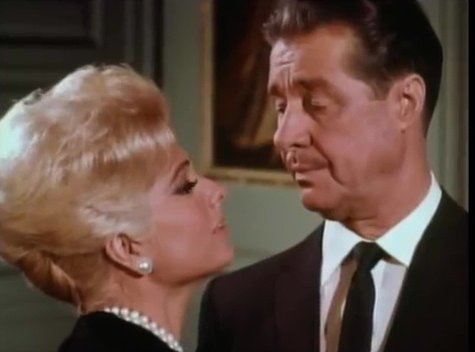
Martha Hyer and Don Ameche
PICTURE MOMMY DEAD (1966). Director: Bert I. Gordon.

Young Susan Shelley (Susan Gordon) gets out of a "convent" for the mentally disturbed three years after the death of her mother, Jessica (Zsa Zsa Gabor), in a fire in their mansion. Her father, Edward (Don Ameche), has been traveling the world with his new viper-like wife, the former governess, Francine (Martha Hyer), and now they are nearly broke. Another member of this highly dysfunctional household is Jessica's cousin, Anthony (Maxwell Reed), who was disfigured in the fire and will inherit money if both Edward and his daughter should happen to die, something which Francine is also happily aware of. But the murder victim may be more unexpected than you imagine. Picture Mommy Dead  -- one of a number of thrillers made by director Gordon, who had previously specialized in movies about giant people and monsters -- isn't that good, but it has a fairly interesting script that just misses the mark. A big problem with the picture is that Susan Gordon, the director's daughter, is too inexperienced (despite 25 previous credits!) to handle such a difficult and demanding role, although she gets an E for Effort. Zsa Zsa appears in a few flashbacks and isn't given anything too demanding to do, while Hyer plays her bitchy part with a little zest but little real skill. Ameche [Slightly French] comes off better, but Maxwell Reed of Daybreak is only somewhat effective. Wendell Corey delivers the goods in his one scene, playing a lawyer who is so tactlessly blunt with everyone that it's a wonder nobody murders him right then and there.

Verdict: Not terrible, but Gordon probably should not have cast his daughter. **1/2.

SNAKES AND LADDERS Dirk Bogarde

SNAKES AND LADDERS. Dirk Bogarde. 1978; Chatto and Windus.

By the time this book came out, Bogarde had already written one autobiography which only went up to age eighteen. I was more interested in this second volume, which covered his career as an actor. Bogarde begins with large sections on his military career, pretty much glosses over his role as Dr. Simon Sparrow in the "doctor" films, and goes into more detail on working with (exasperating) close friend Judy Garland on I Could Go On Singing. He also describes his working relationship with Luchino Visconti, who directed him in The Damned and Death in Venice. Bogarde relates how he decided to star in Victim, about a closeted married gay man being blackmailed, after virtually every other actor turned the role down. Ironically, Bogarde doesn't come out about his own sexuality, but if you read between the lines it is clear that he had a long-time partnership with his theatrical manager Anthony Forwood, who was briefly married to Glynis Johns; Bogarde never married. (Forwood was also an actor who appeared in such films as the British Black Widow.) Snakes and Ladders is very well-written by Bogarde himself, but I just wish there had been a lot more about individual pictures -- there's not one word about one of his best films, Libel, for instance -- his co-workers, on the set anecdotes, and the like. But then, Bogarde was not out to write a "typical" show biz memoir.  One suspects, however, that if he had been more forthright on his sexuality, the book would have had even more depth and resonance. The idea of his starring in Victim when he himself was closeted, is striking in its bravery.

Verdict: Not exactly "dishy," but a pretty good read. ***.

GIRLS TOWN

Mamie Van Doren and Paul Anka
GIRLS TOWN (1959). Director: Charles F. Haas.

Now here's a weird one. Busty Silver Morgan  (Mamie Van Doren) is accused of killing a guy and sent to "Girls Town," which is not a reform school but a home for young ladies who have gotten in trouble with the law and which is run by nuns! There she meets Mother Veronica (Margaret Hayes of House of Women); Vida (Gloria Talbott); tall, gawky Flo (Peggy Moffitt); and Serafina (Gigi Perreau), who has a semi-demented crush on singer Jimmy Parlow (Paul Anka). Talbott practices judo on Van Doren when the latter gets out of line, and Anka delivers a punch to fellow singer/cast member Mel Torme who is, incredibly, cast as a leather jacket-clad borderline thug who goes drag racing at one point! Torme does not sing, but Anka does his "Lonely Boy" and, unfortunately, takes a pitiful stab at "Ave Maria." He fares much better, however, than Cathy Crosby, who makes little impression as the "girl singer." Other cast members include Sheila Graham, who barely appears as another nun; and offspring Jim Mitchum, Harold Lloyd Jr.,( who is killed off early) and Charles Chaplin Jr., who only have minor roles. Elinor Donahue [Freddy's Dead: The Final Nightmare] of Father Knows Best shows off serious acting chops as Silver's younger sister; Van Doren is Van Doren. Anka and Torme give adequate performances. The Platters sing one number, but for some inexplicable reason the lead singer's face is never shown -- we only see his hands and his back! The orchestra leader Ray Anthony plays a private eye investigating Van Doren. She and Torme were both in The Big Operator with Mickey Rooney.

Verdict: You won't want to miss a single second, but maybe you should miss it anyway. **.

PERRY MASON SCREEN TESTS

Burr (right) testing for part of Hamilton Berger 
PERRY MASON SCREEN TESTS.

A special 50th Anniversary DVD of the venerable Perry Mason series features several 1955 screen tests for the actors on the show, introduced by Barbara Hale. Raymond Burr actually tested for the part of Hamilton Berger -- with a different (uncredited) Perry Mason, who is not bad -- and there were other actors auditioned for Perry along with Burr. One test shows William Hopper (Paul Drake) playing Perry with a different Della Street. Then there's Ray Collins playing Lt. Tragg while Hopper again plays Perry. In another test Burr plays Perry while an unknown blond actress plays Della, coming off more like a "B girl" than a private secretary, way too sexy, and not exhibiting much acting ability. A more talented blond actress does a courtroom scene with first Burr as Perry and then Hopper. Judging from these tests, the producers made the right choices for these roles.

Verdict: Interesting "backstage" look at the making of Perry Mason. ***

Thursday, February 15, 2018

NIGHT AND DAY

Cary Grant and Alexis Smith
NIGHT AND DAY (1946). Director: Michael Curtiz.

"Love can be a delight, a dilemma, a disease, or a disaster." -- Monty Woolley.

Over his grandfather's objections, Cole Porter (Cary Grant) decides to leave Yale and pursue a career as a songwriter instead of as a lawyer. Things don't go smoothly at first, with WW1 interrupting things, but eventually he becomes a big success. Unfortunately, his marriage to his neglected wife, Linda (Alexis Smith), hits the rocks, and he has a horse riding accident that requires operations. Will the rather self-centered composer and his wife ever be reunited? Actually, if there was any threat to Porter's marriage, it was because he preferred gentlemen, but the film glosses over this except for one moment when Porter's friend, Monty Woolley, (played by Monty Woolley, who had indeed been a friend of Porter's and was also closeted) tells him he probably shouldn't have gotten married in the first place. The rest of the film is a mix of truths and half-truths and outright fabrication, little of which is very compelling.

Therefore we're left with Porter's music, of which there is quite a lot: "Miss Otis Regrets;" "In the Still of the Night;" 'I've Got You Under My Skin;" "I Get a Kick Out of You;" "You're the Top;" and many, many others. Jane Wyman [All That Heaven Allows] makes a positive impression as performer Gracie Harris, and Ginny Simms [Hit the Ice], who has a lovely voice, made a bid for stardom as another performer, Carole Hill. Mary Martin  plays herself to perform her signature tune "My Heart Belongs to Daddy" and there are several lively, TechniColor production numbers, including one on the lawn of Porter's massive estate.

As for the acting, Alexis Smith [The Sleeping Tiger] actually fares better than Grant, who is adequate, but seems oddly listless and unconvincing; Porter himself was still alive when the film was made and died in 1964. Eve Arden shows up as a French chanteuse to warble one number. I didn't even recognize Dorothy Malone as Porter's cousin, Nancy. Years later Kevin Kline played Porter in a film that was franker, but not necessarily better.

Verdict: The music is all that matters. **1/2.

DR. RENAULT'S SECRET

J. Carrol Naish (center) and cast 
DR. RENAULT'S SECRET (1942). Director: Harry Lachman.

Dr. Larry Forbes (John Shepperd aka Shepperd Strudwick of All the King's Men) has come to a small European village to meet up with his fiancee, Madelon (Lynne Roberts) and her Uncle Robert (George Zucco), who is also a scientist. Others on Robert's large estate include the strange Noel (J. Carrol Naish of The Kissing Bandit), who is a manservant; the butler Henri (Jean Del Val); and the gardener, Rogell (Mike Mazurki). These last two have criminal pasts, but neither of them is as weird as Noel, who is hiding a dreadful secret along with the doctor. Then the brutal strangulation murders begin ... Dr. Renault's Secret was clearly inspired in part by H. G. Wells' "The Island of Dr. Moreau" (itself filmed as Island of Lost Souls) just as both properties inspired Captive Wild Woman and its sequels. While Renault hardly gets points for originality, it is distinguished by brisk and adroit direction, a good score (Emil Newman and David Raksin), excellent cinematography (Virgil Miller), and a terrific lead performance by Naish, who is both pitiable and menacing. The other cast members are all more than adequate, and Zucco is, as usual, perfect. Arthur Shields [South Sea Woman] plays a police inspector and Ray Corrigan is seen in flashbacks as a gorilla. 20th Century-Fox gave the pic a handsome production, and despite its inadequacies and unacknowledged debt to Wells, it is an entertaining horror flick. Harry Lachman also directed the Laurel and Hardy masterpiece Our Relations.

Verdict: One more ape-man never hurts. ***.

EVIL UNDER THE SUN

Peter Ustinov and Maggie Smith
EVIL UNDER THE SUN (1982). Director: Guy Hamilton.

"Even in the old days she would throw her legs up higher than anyone -- and wider." Daphne referring to Arlena.

At a resort run by former showgirl Daphne Castle (Maggie Smith), one of the guests is a former colleague and now star, Arlena Marshall (Diana Rigg of The Avengers). Although married, Arlena is fooling around with Patrick Redfern (Nicholas Clay), who is also married, to the plain-Jane Christine (Jane Birkin of Seven Deaths in the Cats Eye). When Arlena is strangled in an isolated cove, the suspects also include her wannabee biographer Rex Brewster (Roddy McDowall), and the producing team of Myra and Odell Gardener (Sylvia Miles and James Mason). Then there's Arlena's husband, Kenneth (Denis Quilley) and his obnoxious young daughter, Linda (Emily Hone). It is up to the famous Belgian detective Hercule Poirot (Peter Ustinov) to find out who the true murderer is. Evil Under the Sun is another over-produced, not quite "all-star" Agatha Christie adaptation, with a script by Anthony Shaffer that makes some changes but doesn't do too much damage to the novel. Overlong, the movie is very slow-paced and often dull, although some of the actors, especially Maggie Smith [Downton Abbey] and James Mason, do their best to keep things interesting with their performances. Mason and Sylvia Miles certainly make a very odd pair, and Miles is vivid if typically vulgar. McDowall does his usual middle-aged fop act. Ustinov is not the perfect Poirot, but he is amusing at times, and indeed the movie often plays like a parody. The picture only really picks up in the final quarter when Poirot assembles the suspects and reveals the clever solution, which (as usual) works better on the printed page than spelled out in wide screen and TechniColor. Still, it sends the audience out possibly fooled into thinking they've seen a better movie than they actually have. The film has absolutely none of the suspense of the novel, and you probably won't even care who killed Arlena. Rigg is excellent as the victim, and Clay and Birkin also make their mark as her lover and his discarded spouse. Smith's character refers to McDowall's with a stupid comment about "cherchez la fruit." The score consists of adaptations of the songs of Cole Porter. Since Porter's bouncy music is hardly appropriate for an alleged movie of suspense and intrigue, it almost kills the movie, lovely tunes notwithstanding, right there. Ustinov also played Poirot in Dead Man's Folly, which was a better Christie adaptation than this.

Verdict: Read Christie's book instead for a much more entertaining experience. **1/2.

THE HORROR SPOOFS OF ABBOTT AND COSTELLO

THE HORROR SPOOFS OF ABBOTT AND COSTELLO: A Critical Assessment of the Comedy Team's Monster Films. Jeffrey S. Miller. McFarland; 2000.

A serious fan of the horror spoofs of the famous comedy team, Bud Abbott and Lou Costello, author Miller here looks at such films as Abbott and Costello Meet Frankenstein and Abbott and Costello Meet the Mummy along with other "horror" comedies from the team such as Hold That Ghost. Miller's writing is accessible, although he can't resist giving in to an "academic" approach at times (which borders on the pretentious). Fortunately, his enthusiasm for these films comes through on every page. Chapters consist of lengthy, annotated synopses, as well as critical and background production notes and analysis. Miller notes the changes that occurred in both the boys' pictures and their on-screen characterizations over the years. The book is also bolstered by primary interviews.

Verdict: Good show for Abbott and Costello enthusiasts. ***.

MEN ON HER MIND

Mary Beth Hughes
MEN ON HER MIND (1944). Director: Wallace Fox.

Making her debut on the radio, singer Lily Durrell (Mary Beth Hughes) thinks back on her involvement with several men who fell in love with her on her pathway to success. These include a trucker, Joe (Lyle Lytell); a music teacher and aspiring songwriter named Jim (Ted North); a wealthy socialite named Jeff (Edward Norris of Jungle Queen); and a rich patron of the arts named Roland Palmer (Alan Edwards). Along the way Lily also gets involved in murder, an alleged jewel theft, and poses as a phys ed teacher at an all-girls' school. Breaking a number of hearts along the way, she eventually settles on the right man ... Men On Her Mind is an entertaining, if minor, PRC light drama with a winning performance by Hughes [Dressed to Kill], who managed to amass over a hundred credits in films and on television. The beautiful actress also had an excellent singing voice, and does a nice job with both "Ave Maria" and the movie's one new tune, "Heaven on Earth." Hughes was married to Ted North when the film was made, but their union only lasted three years. Wallace Fox also directed Pillow of Death and a number of cliffhanger serials.

Verdict: By PRC standards this isn't too shabby. **1/2.