Lively, entertaining reviews of, and essays on, old and newer films and everything relating to them, written by professional author William Schoell.
Showing posts with label William Powell. Show all posts

Thursday, July 2, 2026

POINTED HEELS

William Powell and Fay Wray
POINTED HEELS (1929). Director: A. Edward Sutherland. Colorized.  

"I was so afraid you were going to be sensible -- and go away." -- Lora.

Broadway producer Robert Courtland (William Powell) is interested in the mildly talented Lora Nixon (Fay Wray of King Kong and Queen Bee) but she leaves the show to marry the wealthy Donald Ogden (Phillips Holmes of Beauty for Sale). Learning of his marriage, Donald's furious mother cuts him off without a penny and he and his new wife move into a dingy flat. Lora's brother, Dash (Richard "Skeets' Gallagher), has an act with his wife Dottie (Helen Kane), and they interest Courtland -- who is still attracted to Lora -- in their show, which they threaten to sink by suddenly deciding to act all "refined." Courtland can't help but notice a rift in the Ogden's marriage -- musician Donald can't quite deal with Lora being the breadwinner -- but will he take advantage of the situation? 

Phillips Holmes
Pointed Heels
 is a charming old musical, an early sound film, that features some good performances from the three leads although it frequently eschews logic. For instance, why would Donald feel out-classed by Lora when his score is being used for the new musical and she only has a supporting part? And one could certainly raise their eyebrows at Courtland's technique for loosening up the Nixons -- he gets them drunk before sending them out on stage on opening night! As well, Donald is working on a "symphony" but the passages we hear don't exactly sound like classical music. The songs in this include "Ain't Ya" and "I Have to Have You." Helen Kane only appeared in eight films but she became famous as the basis of Max Fleischer's cartoon character Betty Boop and even originated the phrase "Boop-boop-deboop." She sued Fleischer but lost, even though Betty Boop was clearly inspired by her. A. Edward Sutherland also directed Follow the Boys and many others. 

Verdict: Minor but fairly nice old musical with interesting players. ***. 

Thursday, January 16, 2025

RECKLESS

RECKLESS (1935). Director: Victor Fleming.

By the time agent Ned Riley (William Powell) realizes he's really in love with his client, singer-dancer Mona Leslie (Jean Harlow), Mona is being swept off her feet by the wealthy Bob Harrison Jr. (Franchot Tone). Harrison even goes so far as to buy out every seat for a performance of the show Mona is in. Mona's wise old grandmother (May Robson) scolds and gives sage advice in equal measure. Rosalind Russell turns up as Harrison's kind of forgotten fiancee, Henry Stephenson is his concerned father, and little Mickey Rooney is his usual charming self as an enterprising youngster befriended by Ned (perhaps the film's most touching sequence has Rooney trying to help out Ned when he thinks he's down and out). If that cast weren't enough, we've also got Allan Jones singing a romantic ballad in his inimitable way, Leon Ames turning up both with and without his mustache, Charles "Ming the Merciless" Middleton playing a district attorney, and Margaret Dumont showing up for one line as a heckler in the theater! Powell, Harlow, and Tone are all just marvelous, and Robson almost manages to steal every scene she's in. The story veers in unfortunately melodramatic directions, but the film still manages to be quite entertaining. And that cast! 

Verdict: Crazy script but a feast of fine actors! ***.

Thursday, March 3, 2022

FOR THE DEFENSE

William Powell and Kay Francis
FOR THE DEFENSE (1930). Director: John Cronwell. 

Bill Foster (William Powell of The Thin Man) is a famous defense attorney known for his flamboyancy and for tricks that keep his clients from going to jail. His main squeeze is Irene Manners (Kay Francis of Give Me Your Heart), who is loyal to him but discovers that he has no intention of marrying her -- for him things are perfect as they are. Irene goes out for a drive with love-smitten Jack De Foe (Scott Kolk), who proposes to her just before she accidentally runs over and kills a man in the road (we never learn a damned thing about this unfortunate fellow). Jack doesn't want to get Irene involved so he lets her run off while he takes the rap, which is exacerbated by the fact that he was drinking. Irene importunes Bill to take Jack's case and keep him from going to jail for manslaughter, but the lawyer suspects that there's more to the story -- and more to Irene's relationship with Jack. 

Scott Kolk with Powell
At a mere 63 minutes, For the Defense moves at a brisk pace and wastes precious little time in true character development, although the actors, especially an excellent Powell, do much to bring these rather stock characters to life. There's a funny/scary bit in an early courtroom scene when Powell decides to test a piece of evidence, a bottle supposedly filled with nitroglycerine, by dashing it to the floor, giving everyone in the room conniption fits! With a far less dynamic role, Francis can do little to steal scenes from Powell, but she is quietly effective as a woman who loves not wisely but well; Kolk is also effective. The movie with its interesting situations is entertaining despite the contrived script. Poor Francis is decked out in a series of hats that remind one of a classic I Love Lucy episode when the boys give the gals some phony French fashions! John Cromwell would go on to direct much better pictures including Caged. Two years later Powell and Francis reteamed for Jewel Robbery. 

Verdict: Powell is always exciting to watch. **3/4. 

Thursday, February 22, 2018

ZIEGFELD FOLLIES

Kelly, Astaire and Garland
ZIEGFELD FOLLIES (1945). Director: Vincente Minellli.

9 years after he starred as The Great Ziegfeld, William Powell reprised his role of Flo Ziegfeld -- sort of. In the opening moments of Ziegfeld Follies, the great impresario is seen in Hollywood's idea of heaven pontificating on the Follies, and wondering what they would look like if the Follies still existed today. Voila! First puppetoons are used to depict the original Follies; then suddenly there's a stage and we see a series of acts with contemporary stars such as Lena Horne, Lucille Ball, Kathryn Grayson, Virginia O\Brian, and many others. After about half an hour the movie is almost stopped dead by a long and mostly unfunny skit with Keenan Wynn trying to make a phone call. A later sketch with Victor Moore as a man arrested for expectorating on the subway and Edward Arnold as his lawyer is much better, as is another sketch with Fanny Brice (who was actually in the original Follies) and Hume Cronyn as a couple who have a winning sweepstakes ticket and William Frawley as their landlord. A bit with Red Skelton playing a TV announcer who gets drunk reminds one of the later "Vitavegamin" routine on I Love Lucy. James Melton and Marion Bell sing a duet from La traviata, but are not that impressive. Fred Astaire [Royal Wedding] does two dance numbers with Lucille Bremer [Till the Clouds Roll By], but the highlight of the picture is his dance with Gene Kelly -- the only time the two danced together in the movies. The other highlight is Judy Garland playing an affected star in a production number with several handsome male dancers. Garland also appeared in Ziegfeld Girl.

Verdict: Although this has no story, it still manages to be entertaining. ***.

Thursday, January 26, 2017

THE THIN MAN GOES HOME

Harry Davenport and Myrna Loy
THE THIN MAN GOES HOME (1945). Director: Richard Thorpe.

Nick Charles (William Powell), his wife Nora (Myrna Loy), and their little dog Asta (Nick Jr. is away at school) travel to Nick's hometown of Sycamore Springs for his unspecified birthday (Powell was 53 at the time). Nick has always had a difficult relationship with his father, Bertram (Harry Davenport), because he didn't become a doctor like his father did, and Nick aches for his approval. But his mother (Lucile Watson) is a peach. Nick gets to prove his skill at detecting when a dead man practically shows up on the Charles' doorstep. Bertram can't believe that one of his old friends might be the killer ... Powell and Loy are excellent, as usual -- Loy is especially notable in this entry -- and the supporting cast, including Davenport [Son of Fury] and Watson (cast against type, like Fay Holden in the Andy Hardy films, as a small-town housewife), could not be bettered. Special mention must go to Anne Revere [Body and Soul], who plays "Crazy Mary," the town's pathetic loony; Anita Sharp-Bolster as  the hilariously weird maid, Hilda; and Donald Meek as Willie Crump, who sells paintings for a living -- the plot revolves around a painting of a windmill that Nora buys for her husband's birthday. Other suspects and persons of interest are well played by Leon Ames, Donald MacBride, Irving Bacon, Morris Ankrum, Helen Vinson, Minor Watson, Lloyd Corrigan, and Gloria DeHaven as a breathlessly pretentious heiress. One very cute bit has Nick and Nora leaving Asta with the coat check girl as if he were a hat, but the funniest scene has Nora unexpectedly doing a wild, zippy dance with a sailor. This was the next to last Thin Man movie -- this was followed by the disappointing Song of the Thin Man.

Verdict: Very satisfying and amusing Thin Man movie. ***.


Thursday, December 29, 2016

SONG OF THE THIN MAN

William Bishop, Myrna Loy, William Powell
SONG OF THE THIN MAN (1947). Director: Edward Buzzell.

The gambling ship, S. S. Fortune, is the sight of the murder of band leader Tommy Drake (Phillip Reed). Suspects include songstress Fran (Gloria Grahame); her ex-boyfriend Buddy (Don Taylor of The Girls of Pleasure Island); gangster Al Amboy (William Bishop); Mr. and Mrs. Talbin (Leon Ames; Patricia Morison); and Phil Brant (Bruce Cowling), whom the police are after for the crime. His fiancee, Janet (Jayne Meadows of Enchantment), comes to Nick Charles (William Powell) for help, and he digs into the case with his usual jaunty style. Nora (Myrna Loy) tags along to no great purpose, while their cute little boy Nick Jr. (Dean Stockwell of The Werewolf of Washington) is left in the charge of Asta and the housekeeper, Bertha (Connie Gilchrist). Song of the Thin Man is not one of the better entries in the series -- in fact it was the last --  although it does have a lively and quite amusing finale. Gloria Grahame is completely wasted in her very small role as Fran, as is Marie Windsor, playing the gangster's wife in just one sequence. This has one of the dumbest murderers ever. The catchy song "You're not so easy to forget" is pleasantly warbled by whoever is dubbing Grahame. Ralph Morgan is Janet's grumpy father, and Morris Ankrum is the police inspector.

Verdict: Talky and dull with few bright spots. **.

Thursday, September 15, 2016

SHADOW OF THE THIN MAN

William Powell and Stella Adler
SHADOW OF THE THIN MAN (1941). Director: W. S. Van Dyke.

Nick and Nora Charles (William Powell; Myrna Loy) are enjoying a relatively quiet life with Asta and little Nicky (Richard Hall) when murder comes a'calling again. This time the victim is a virtually anonymous jockey who's dead practically before the film begins, but soon other bodies begin to pile up. Suspects and victims alike include reporter Paul Clarke (Barry Nelson); his girlfriend, Molly (Donna Reed); her boss, "Link" Stephens (Loring Smith); his mistress, Claire Porter (Stella Adler); and assorted underworld or otherwise shady characters such as Fred Macy (Joseph Anthony); "Rainbow" Benny (Lou Lubin); and "Whitey" Barrow (Alan Baxter). Then there's Major Sculley (Henry O'Neill of Scandal Sheet) and the excitable Lt. Abrahms (Sam Levene of Dial 1119). Gathering the suspects at the climax where everyone has a serious hate on, Nora is afraid that Nick is going to name her as the murderer. This is a typically convoluted, but amusing "Thin Man" movie with very good performances from all. Stella Adler, who is very saucy in this picture, did a lot of theater work, but her film and TV credits were limited to five; she later became best-known as an acting coach. Joseph Anthony later became a director for the stage and of such films as Career.

Verdict: Smooth and entertaining. ***.

Thursday, August 18, 2016

ANOTHER THIN MAN

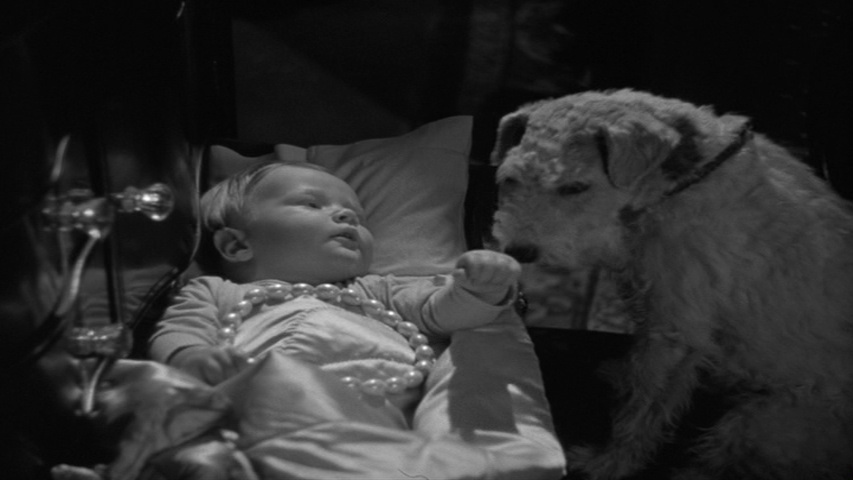
Baby Nicky and li'l Asta
ANOTHER THIN MAN (1939). Director: W. S. Van Dyke II.

Back in New York with their new son, Nicky, and little Asta in tow, Nick and Nora (William Powell and Myrna Loy) are summoned to the Long Island estate of Colonel MacFay (C. Aubrey Smith). MacFay has been receiving weird death threats from an old employee named Church (Sheldon Leonard) and hopes to have Nick's protection. Naturally, as in most of these detective movies, the threatened man is murdered under the disinterested hero's nose, and the rest of the movie is concerned with finding out who done it. Another Thin Man is quite talky, but entertaining, with an intricate script and a denouement that is truly a surprise. Members of the supporting cast (as well as suspects in certain cases) include Virginia Grey [Jeanne Eagels] as MacFay's adopted daughter; Patric Knowles as her secret fiance; Tom Neal [Bruce Gentry] as a man carrying a torch for Grey; Otto Kruger as the detective on the case; Ruth Hussey as a kind of nanny; Muriel Hutchison as Church's paramour, among others, all giving adroit performances. The business with ex-cons being delighted to see Nick even though he sent them up the river gets tiresome, and leads into a party for little Nicky with the hoods each bringing their own baby! (Don't blink or you'll miss Shemp Howard.) Some of the subsequent victims certainly don't deserve to be murdered, but there's never any sympathy for them. However, there's a swell scene with Powell interacting with Marjorie Main [The Law and the Lady] as a landlady, and the ending is a pip! The killer in this is especially conniving and heartless.

Verdict: Things look up for the series with this entry. ***.

Thursday, August 11, 2016

AFTER THE THIN MAN

Myrna Loy and William Powell
AFTER THE THIN MAN (1936). Director: W. S. Van Dyke.

Nick Charles (William Powell) and wife, Nora (Myrna Loy) have returned from New York to California in this first sequel to The Thin Man, but discover that wherever they go murder follows. Nick learns that when it comes to intrigue and craziness, Nora's relatives are not much different from the thugs and ex-cons Nick hangs out with. This time Nora's cousin, Selma (Elissa Landi of The Sign of the Cross), is accused of murdering her philandering husband, Robert (Alan Marshal). The suspects include a nightclub owner named Dancer (Joseph Calleia); a dancer named Polly (Penny Singleton); her "brother," Phil (Paul Fix of The Bad Seed); Dr. Kammer (George Zucco), who thinks everyone is nutty: and David Graham (James Stewart), who has long carried a torch for Selma. Somewhat better than The Thin Man, this is arguably not a whole lot better than a typical mystery from a minor studio, but it is served up with relish, some very good acting, and has an effectively comic-dramatic ending. Singleton, who was billed as "Dorothy McNulty" back then, is vivid as Polly, and Jessie Ralph [David Copperfield] simply walks off with the movie as Nora's formidable Aunt Katherine, a harridan force of nature if ever there were one. Sam Levene is fine as Lt. Abrahms, the detective on the case. Asta has a bit more to do then he did in the first film.

Verdict: Nick Charles is no Perry Mason, but this is fun enough. ***.

Thursday, August 4, 2016

THE THIN MAN

William Powell prepares to question the suspects
THE THIN MAN (1934). Director: W. S. Van Dyke.

Nick Charles (William Powell) retired as a detective when his wife, Nora (Myrna Loy), inherited a fortune from her father. On a trip back to New York, Nick discovers he can't stay away from sleuthing when several people he knows are embroiled in murder. Dorothy Wynant (Maureen O'Sullivan) is worried when her father, Clyde (Edward Ellis), disappears, and things get more complicated when Clyde's mistress, Julia (Natalie Moorhead of The Curtain Falls) is found murdered. More deaths follow as the suspects pile up: Wynant's ex-wife Mimi (Minna Gombell of Babbitt); his weird son, Gilbert (William Henry of Nearly Eighteen); his lawyer, MacCauley (Porter Hall); Mimi's gigolo and second husband, Chris (Cesar Romero); and several other nefarious types. Nick gathers all of the suspects (he pronounces the word with the accent on the second syllable, which is kind of charming in an old-fashioned way) at a dinner party he hosts with an utterly baffled Nora. The Thin Man has good performances from all -- Gertrude Short is snappy in a small role as the shrewish girlfriend of a dead hood -- but one could argue that there's more silliness than humor and it often gets in the way of the not-very-memorable story, although it does manage to build up minor interest and suspense as it goes along. Nobody who watches this will especially care who the killer is. Powell does his usual suave shtick with aplomb; Loy is fine if typically arch; and the little dog Asta almost runs off with the show. There were five sequels to this popular film, most of which, if memory serves me, were superior to this first entry. The title refers to the vanished Wynant, described by police and papers as a "thin man with white hair." Nick, rarely without a drink in his hand, seems half-inebriated throughout the movie. Nat Pendleton is the detective on the case, and Henry Wadsworth is Dorothy's fiance, Tommy.

Verdict: Too self-consciously "cute" by half but not without its moments. **1/2.

Thursday, August 14, 2014

THE GREAT ZIEGFELD

Fanny Brice almost steals the picture
THE GREAT ZIEGFELD (1936). Director: Robert Z. Leonard.

Florenz Ziegfield (William Powell) has a lot of great ideas and enthusiasm for the theater but is generally low on money. He finally hits it big with his Follies, with its beautiful show girls and elaborate production numbers, which had a new edition for 24 years. Powell married the French singer Anna Held (Luise Rainer) -- today it's still not clear if they actually tied the knot or were common-law -- but fell in love with actress Billie Burke (Myrna Loy; Burke herself was 52 at the time of filming). Just when everyone thinks Ziegfeld is washed up, he rebounds with such hits as Show Boat, but then there's the stock market crash to deal with and his own fading health... This biopic of the famous showman is almost as long as Ben-Hur, with an intermission and an entr'acte, and is composed of facts, myths and invention in equal measure. Despite Powell's good performance, Ziegfeld never seems entirely dimensional because he's defined by his shows and libido more than anything else. Luise Rainer won an Oscar, which has generally been attributed to her scene on the telephone when she congratulates Flo on his marriage to Burke even though her heart is clearly breaking; in general Rainer is quite good. Loy doesn't make the mistake of imitating the flighty, downright weird Burke, and also gives a very good performance. Wisely the producers chose to cast the real Fanny Brice as herself, and she almost walks away with the movie. The production numbers, like the movie itself, go on too long, but there are some highlights, such as one number that combines all kinds of different musical styles from jazz to opera in a surprisingly tuneful blend; and a bit with some cute dogs who nearly manage to stay stock still as dancers cavort among them on the stage. Frank Morgan [The Good Fairy] plays a friendly business rival of Ziegfeld's and Virginia Bruce [Pardon My Sarong] is a calculating dancer-turned-star.  Will Rogers is played by A. A. Trimble, while an unimpressive Ray Bolger plays himself. Dennis Morgan [River's End] sings one number but appears to have been dubbed by Allan Jones.

Verdict: Goes on and on and on and on but is often entertaining ... **1/2.

Friday, October 10, 2008

JEWEL ROBBERY

JEWEL ROBBERY (1932). Director: William Dieterle.

The Baroness Teri von Horhenfels (Kay Francis) should be the happiest women in Vienna since her husband has 8.25 million dollars -- and a chronic case of the gout. She has a lover who's begun to bore her and is anxious for some excitement and a new fling. One afternoon when she's at the jewelry store (with both husband and lover!), along comes a nameless robber (William Powell) who steals everything in the shop, including her new diamond, completely sweeping her off her feet. He also passes off drugged cigarettes (joints?) which make the shop owner giddy and do the same for half of the police force. This is an amusing trifle -- emphasis on trifle -- greatly bolstered by sophisticated dialogue and terrific performances. Powell and Francis make a great team. Not exactly a classic but it's worth sitting through just for Kay's wink at the audience at the end. The pretty tune auf wiedersehen plays in the background but sometimes seems to overpower what's happening on the screen.

Verdict: Slight, slightly immoral, and rather charming. **3/4.

Monday, April 14, 2008

CROSSROADS


CROSSROADS (1942). Director: Jack Conway.

Parisian government official David Talbot (William Powell) winds up in the center of a mystery when a man who tried to blackmail him claims that he is actually petty thief Jean Pelletier, who appropriated Talbot's identity after a train crash. As Talbot has amnesia, even he can't be certain that he isn't Pelletier. This situation is complicated by Henri Sarrou (Basil Rathbone) who claims that he and Pelletier committed a robbery that resulted in a man's murder, and Michelle Allaine (Claire Trevor), who says that she and Pelletier -- Talbot -- were once lovers. This last is especially distressing to Talbot's wife Lucienne (Hedy Lamarr). The suspenseful film doesn't reveal the truth about Talbot until nearly the end, and the acting is great. Powell and Lamarr play very well together, Powell a bit more intense than usual and Lamarr giving one of her loveliest interpretations. Rathbone is perfection as the oily Sarrou, and Trevor is tough and saucy as Michelle. Margaret Wycherly nearly steals the picture from everyone as Pelletier's old mother, however.

Verdict: Very engaging mystery. ***.