Lively, entertaining reviews of, and essays on, old and newer films and everything relating to them, written by professional author William Schoell.
Showing posts with label 1933. Show all posts

Thursday, January 30, 2025

CRASHIN' BROADWAY

Rex Bell
CRASHIN' BROADWAY (1933). Director: John P. McCarthy.

In 1902 Tad Wallace (Rex Bell of The Tonto Kid) is a cowboy who has come east to try his hand at a Broadway career even though he can neither sing nor dance. He hooks up with Sally Sunshine (Doris Hill), but even as a couple they get booted off the stage. They decide to join with the other actors and hoofers at the boarding house run by the formidable Mrs. MacTavish (Anne Howard) and head west where they somehow have an engagement near Kansas City as the Bon Ton Players. The money for their fare is given to Sally by a man named Jeffries (Charles King of Jungle Raiders).  Unfortunately when they arrive the theater's owner, Griswold, has some bad news for them, and the cause of his problems seems to be their benefactor, Jeffries. Shakespearean actor J. Talbot Thorndyke may have to use all of his thespian skills to bring the bad guys to heel. 

Gabby Hayes and Vane Calvert
It is no surprise that in Crashin' Broadway handsome star Rex Bell has charm to spare and gives quite a good performance. What is a surprise is that both Griswold and Thorndyke -- who impersonates Griswold at one point -- are both played by Gabby Hayes [Romance on the Range]! Playing Roy Rogers' rather irritating sidekick for so many years hid the fact that Hayes was actually a very gifted and very versatile actor who was apparently not given nearly enough opportunities to show what he could really do. Other notable cast members, besides those already mentioned, include Vane Calvert as a kindly rancher lady, and Lewis Sargent as Griswold's son, Billy. In the amusing ending the participants in a double-wedding ceremony look anything but happy! The movie is an amiable look at old-time theater troupes, but one wishes it had been better directed. 

Verdict: Bell's charming appeal, and Hayes' versatility, lift up this minor but likable old movie. **3/4. 

Thursday, April 25, 2024

WHITE WOMAN

Kent Taylor and Carole Lombard
WHITE WOMAN (1933). Director: Stuart Walker.

Down in Malaysia, Judith Denning (Carole Lombard of In Name Only) is considered notorious because it is said she drove her husband to suicide by taking a lover. She is also a "white woman" who sings in a cafe that caters to the natives. When the rich owner of a rubber plantation, Horace Prin (Charles Laughton), who calls himself the "King of the River," makes her a proposition, she decides to become his wife. On the plantation she comes to realize that Prin is a monster, and also that his overseer, David (Kent Taylor of Western Pacific Agent), is the man for her. It isn't long before the two are making plans to leave together, but Prin will not be so amenable to this decision of theirs. 

Claude King, Charles Laughton, Ethel Griffies
White Woman
 is a weird but intriguing movie, dripping with humid atmosphere, interesting performances, sinister jungle natives who are fond of lobbing lopped-off heads through windows, and the like. The centerpiece, of course, is Laughton, who gives a bizarre account of himself. On one hand he adds great flavor to his portrayal of a man who might be sociopathic, but at other times he is borderline campy, playing it like a vicious and childish "queen." Lombard is perhaps not quite as expressive as one might have hoped for, but she is good, and she plays quite well with Kent Taylor, who gives a very good reason for deserting. Percy Kilbride can't quite get away from Pa Kettle in his portrayal of Laughton's associate, Jakey, but he is effective enough. Others in the cast include Claude King as the administrator who wants Judith to "get out of town," Ethel Griffies as his highly disapproving (of Lombard) wife, and Charles Middleton [Drums of Africa] and Marc Lawrence as other workers on the plantation. Charles Bickford, who is as good as usual, shows up late as the new overseer and certainly keeps Laughton on his toes!

Verdict: Unusual romance with a suspenseful climax. ***. 

Thursday, August 4, 2022

42ND STREET

Is this really a star? Ruby Keeler
42ND STREET (1933). Director: Lloyd Bacon. 

Julian Marsh (Warner Baxter), who has already had one nervous breakdown, is directing his new show, "Pretty Lady." His leading lady, Dorothy (Bebe Daniels), is carrying on with her former dance partner Pat (George Brent) behind the back of her supposed swain and chief angel, the ugly Abner, (Guy Kibbee). Peggy (Ruby Keeler), a show biz hopeful, is taken under the wing of both Pat, and hoofer Billy (Dick Powell). Tormented by her love for Pat, Dorothy drinks too much and has an accident -- but will Peggy be able to carry the whole show on her shoulders?

George Brent and Debe Daniels
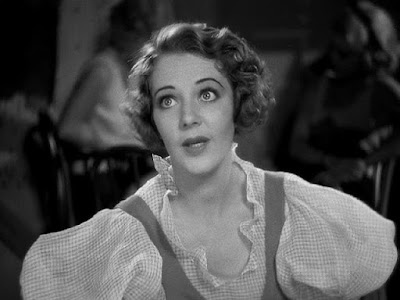
The answer is no, judging from the final moments of 42nd Street. Although I got a favorable impression of Keeler in another film she did that year, Gold Diggers of 1933, and she is perfectly okay in the straight dramatic scenes, when she takes over from Dorothy in "Pretty Lady" she seems leaden-footed and the fact that she has a poor voice -- to put in mildly -- is even inserted into the script. Therefore these sequences are unintentionally comical, as it makes you wonder if, say, Al Capone made Baxter an offer he couldn't refuse. As for Baxter, he gives a fine, old-fashioned-type performance as a man who today we would deem bipolar. Brent is his usual charming self. Former silent movie star Bebe Daniels, who is effective as Dorothy, had only a few more credits after this film. Guy Kibbee is typically excellent, Powell is boyishly sweet, and Ed Nugent makes an impression as another handsome hoofer. 

The production numbers were put together by Busby Berkeley, and of these the most inventive is the title tune. Some of the songs have become standards: "You're Getting to Be a Habit" and "Shuffle Off to Buffalo;" in particular. "Young and Healthy" makes use of a Berkeley invention: creating a kaleidoscope effect of the dancers shot from high overhead. Ginger Rogers has a small role in this and is not photographed flatteringly. It's easy to see why Keeler never really became a major star. 

Verdict: Some great tunes, generally pleasant, but not really a classic. **1/2.

Thursday, July 7, 2022

GOLD DIGGERS OF 1933

Ruby Keeler and Dick Powell
GOLD DIGGERS OF 1933 (1933). Director: Mervyn LeRoy. 

Carol (Joan Blondell), Trixie (Aline MacMahon) and Polly (Ruby Keeler) are roommates and struggling chorus girls. They are excited to learn that Barney Hopkins (Ned Sparks) is putting on another show, but disappointed when they discover he has no financial backer. But neighbor Brad (Dick Powell), an aspiring songwriter, says he has dough and wants to invest. Polly, who has a crush on Brad, is convinced that he is a infamous bank robber, but he's actually the wealthy scion of a stuffy Boston family. When Brad's brother Larry (Warren William) mistakes Carol for Polly and tries to buy her off, she decides to string him along while ruthless Trixie -- the oldest and least attractive of the trio -- sets her cap for Larry's lawyer Peabody (Guy Kibbee). Will true love conquer all? On yes, there are songs and dance numbers as well. 

Ginger Rogers and chorus cuties
The production numbers were put together by Busby Berkeley, and they are inventive and engaging (I especially loved the roller-skating baby!). The songs, by Warren and Dubin, include "We're In the Money" (warbled by Ginger Rogers, who plays a friend of the aforementioned trio); "Torch Song," well-sung by the very likable Powell; "Pettin' in the Park;" "In the Shadows;" and "The Forgotten Man." This last number, which is a poignant salute to forgotten and homeless WW1 veterans, adds some depth to an otherwise frothy, mindless movie and wisely ends the film without the usual clinch or upbeat finale. Trixie is a kind of sleazy character but the movie glosses over that. The cast is good and enthusiastic, putting over the material with aplomb. 

Verdict: All this and Powell, too! ***. 

Thursday, February 3, 2022

TUGBOAT ANNIE

TUGBOAT ANNIE (1933). Director: Mervyn LeRoy. 

Annie Brennan (Marie Dressler) lives and works on her tugboat, along with her often-drunk and lazy husband, Terry (Wallace Beery), whom she dearly loves. The only thing that comes between them is their son Alec (Robert Young), a successful captain of a luxury liner, who is disgraced by his father's behavior and wants his mother to leave him. This causes an estrangement between son and parents that is painful for all. Tugboat Annie features that swell team Dressler and Beery in top form. (Although Young is okay, he's rather one-note and out-classed in this company). Maureen O'Sullivan is excellent as Alec's girlfriend, and Frankie Darro is fine as Alec as a boy in the earlier scenes. Tugboat Annie and its leads never let you forget the pathos underneath the comedy. The only debit is that the climactic storm-at-sea sequence goes on a little too long, and is a bit confusing as well. 

Verdict: Dressler and Beery at their best. ***.

Thursday, October 29, 2020

THE GHOUL (1933)

THE GHOUL (1933). Director: T. Hayes Hunter.

Poor Boris Karloff got stuck in another stinker with this very boring, alleged thriller/horror film. Karloff plays an egyptologist who vows to return from the grave to get back at his enemies, and keeps his promise. There's also two cousins -- one male, one female -- who are caught up in a family feud and get involved because Karloff was their uncle. This has an interesting supporting cast, including Ernest Thesiger from Bride of Frankenstein and Cedric Hardwicke. "No doubt you will succeed in making a painful interview intolerable," Hardwicke says to one character. But it's very disorienting to see the likes of Ralph Richardson in a Boris Karloff horror film. He plays a priest and is as excellent as ever. Karloff and the others are fine but wasted.

Verdict: Might help you go to sleep. *1/2.

Thursday, October 1, 2020

THE ELEVENTH COMMANDMENT

Theodore von Eltz and Alan Hale
THE ELEVENTH COMMANDMENT (1933). Directed by George Melford. 

John Ross (William V. Mong) has been the lawyer to a wealthy woman for many years. When this woman dies, Ross is set to inherit most of the money, but his young associate, Wayne Winters (Theodore von Eltz), wants in on the action. To stymie Ross' plans he digs up two supposed heirs to the estate from an early marriage -- embezzler Charlie Moore (Arthur Hoyt) and dead-common Tessie  (Marie Prevost) who has pretensions of class -- and then there's also Max Stager (Alan Hale) who claims he is the father of the dead woman's daughter. Ross has two daughters: Corinne (Marian Marsh of Svengali), who is in love with Wayne, and Nina (Gloria Shea) who is engaged to Jerry Trent (Lyman Williams of Damaged Lives).  One of them is actually adopted and is Stager's daughter. It's anyone's idea who, if anyone, will wind up with the money if assorted secrets get out. 

Marie Prevost with von Eltz
Based on a stage play, Eleventh Commandment -- "thou shalt not get caught" -- sets up an interesting situation with a few intriguing characters, but it has far too many of them to make this anything but confusing and ultimately unsatisfying. It does present two of the most unethical and unlikable lawyers in the history of the movies. The performances are quite good, however, with von Eltz being pleasantly oily and Alan Hale doing his best with an under-written part. Ethel Wales is effective as the embezzler's wife. Handsome and adept, Theodore von Eltz' career ran from the silent period all the way to 1957. 

Verdict: Passable melodrama but nothing more. **. 

Thursday, October 3, 2019

WHEN LADIES MEET (1933)

Wife vs. mistress: Ann Harding and Myrna Loy
WHEN LADIES MEET (1933). Director: Harry Beaumont. NOTE: Some plot points are given away in this review.

Novelist Mary Howard (Myrna Loy) has had a sort of long-time boyfriend in Jimmie Lee (Robert Montgomery), who is hopelessly in love with her. But Mary has fallen for her married publisher, Rogers Woodruf (Frank Morgan), and is examining the situation in her latest, unfinished novel. She thinks the heroine, who is also having an affair, should intelligently talk things out with her paramour's wife, an idea that the men who read her book, at least, think is crazy. But then Jimmie concocts a scheme where he manages to get both wife, Clare (Ann Harding of The Unknown Man), and mistress -- and eventually the husband -- in the same house during a weekend in the country, and the scenario Mary has envisioned may play out differently than she expects.

Robert Montgomery and Myrna Loy
When Ladies Meet is a frank, interesting and well-played comedy-drama whose best scene is when the two women talk about husbands, affairs, mistresses and infidelity without Clare being aware that Mary is her husband's latest girlfriend, and without Mary knowing that Clare is her lover's wife! Then the husband shows up ... Although Loy never quite seems bright enough to be a serious novelist (yet her character is rather naive) and Harding overplays a couple of moments, both ladies give good (not great) performances. Also notable are the boyish Montgomery as the mischievous Jimmie, and Alice Brady [Three Smart Girls] as the ever-talkative and amusing Bridget, who is hosting the country weekend along with her architect-boyfriend, Walter (Martin Burton).

Frank Morgan: a young woman's dream of bliss? 
A decided weakness of the film is the miscasting of Frank Morgan as the publisher. Not terribly attractive and with a distinctly negative aura in this, Morgan is a bad choice to play a lover boy. It might make more sense if Mary was an aspiring author, and wants Morgan's help and tutelage, but while pretty young woman do on occasion become attached to much less appealing older men, this pairing is a bit much to swallow. Woodruf turns out to be a real pig in any case. Harding has some very good moments coming to some hard conclusions abut her marriage, although Loy underplays her rejection scene way too much. Whatever its flaws, When Ladies Meet is absorbing and entertaining. It was remade eight years later with the same story, much of the same dialogue, but with a completely different cast. Loy and Harding also played rivals in The Animal Kingdom. 

Verdict: Illicit romances never run smoothly. ***. 

Thursday, January 17, 2019

ECSTASY

Hedy Lamarr in her famous nude scene
ECSTASY (aka Ekstase/1933). Director: Gustav Machaty.

Eva (Hedy Kiesler, soon to be known as Hedy Lamarr) marries an older man named Emile (Zvonimir Rogoz) but he proves to be a cold fish. Eva returns to her father (Leopold Kramer) and sues her husband for divorce; Emile is heartbroken. One afternoon Eve takes a nude swim and runs after her horse -- still naked -- where she encounters a handsome engineer named Adam (Aribert Mog). The two fall in love, and an encounter between Adam and Emile leads to tragedy on more than one level.

German hunk Aribert Mog
Ecstasy is best-known as the film that attracted American movie producers to Hedy Lamarr, who caused a bit of a scandal with her nude scenes. First she is seen from the back as she goes into a lake, then there is a shot of full frontal nudity, then the chase after her horse. She is hidden by bushes in subsequent shots, and covers her breasts when she is discovered by an amused Adam. But forget about the nudity, there is so much more to this lovely tone-poem of a movie, which is by no means a sordid melodrama. There is so little dialogue that this is nearly a silent picture, were it not for the beautiful score by Giuseppe Becce, which despite his being Italian-born, is Viennese "schmaltz" at its finest -- intense, romantic, and full of melody, and yes, the Italian influence is also there. The cinematography (by a trio of photographers) is also quite good.

Lamarr and Mog 
Some people can't get into the movie because it's a bit "minimalist," with, as noted, little dialogue and only the broadest of characterizations. But as you are pulled along by the symphonic score, the photography, and the expressive performances of the cast members, it somehow doesn't matter. There is a very touching sequence at a train station, and the wind-up is also moving. There is a sex scene that is powerful and obvious without being graphic. The direction is very good, although Machaty perhaps overdoes the symbolism with the frequent shots of horses and flies. Whatever its flaws, Ecstasy is a worthwhile and very arresting picture. Mog was a popular leading man in Germany who died at 37 fighting the Russians. Gustav Machaty also directed American films such as Jealousy.

Verdict: This Austrio-Czechoslovakian co-production was  Hedy's fifth film and decidedly one of her most interesting and unusual. ***. 

Thursday, January 10, 2019

EX-LADY

Bette Davis and Gene Raymond
EX-LADY (1933). Director: Robert Florey.

Commercial artist Helen Bauer (Bette Davis of Deception) doesn't like the idea of marriage even if her boyfriend is Don Peterson (Gene Raymond of Hit the Deck), the handsome head of a small advertising agency. Nevertheless, after some hesitation the two decide to get hitched, only Helen is convinced that this has spoiled things, only creating jealousy and hurt feelings. They decide to live separately and make dates, even with other people. Don dallies with Peggy (Kay Strozzi), who is married to a man who makes boilers, while Helen goes out with the oily Nick  Malvyn (Monroe Owsley of The Keyhole). But will this arrangement really work in the long run?

Bette Davis and Monroe Owsley
Ex-Lady is an odd pre-code movie that tries to be daring but amounts to very little, daring or otherwise. The only really good points are the performances of Davis and Raymond, who are attractive and charming and play very well together. Helen seems like a confused woman who doesn't know what she wants, and she isn't much addicted to logic. She seems to believe that only a wife can be jealous, but there are many girlfriends and fiancees who would beg to differ. When she and Don choose to have (rather chaste) "affairs," their partners are not nearly as attractive as they are. Frank McHugh plays a poetic urbane type instead of his usual schnook, and although he doesn't quite pull it off, he does suggest that he could have had success with a wider variety of roles.

uncredited opera singer 
At least there are a couple of snappy musical numbers, one playing on the radio at Nick's apartment and the other performed by a group with a dancer in a Havana nightclub. This scene ends with Helen and Don, on their honeymoon, collapsing out of frame into a chair as the dancer sways seductively at the top of the frame. And we mustn't forget the uncredited woman who sings a bit of opera at a party. Although I believe the audience is supposed to think she's awful, she actually doesn't have a bad voice. All in all, despite the welcome touches of early feminist attitudes, this is just another unmemorable early Bette Davis movie, the kind that almost sank her career before it really got started.

Verdict: Bette is always interesting; the picture less so. **. 

Thursday, March 8, 2018

THE KEYHOLE

Kay Francis and George Brent
THE KEYHOLE (1933). Director: Michael Curtiz.

"The next time you try to kill yourself, let me know -- I'd love to help you!" -- Anne about Maurice.

Anne (Kay Francis of In Name Only) is married to the much-older Schuyler Brooks (Henry Kolker of Meet the Baron). When she learns from her first husband, Maurice (Monroe Owsley), that their divorce wasn't valid, he blackmails her. Anne gets advice from her sister-in-law, the formidable Portia (Helen Ware), and takes off for Cuba to get Maurice out of the country. Meanwhile Brooks, fearing Anne is unfaithful, hires private dick Neil (George Brent of Dark Victory) to follow her and see if he can tempt her into an affair. Neil's partner, Hank (Allen Jenkins), gets involved with con lady Dot (Glenda Farrell), with both thinking that the other one is wealthy. Will Anne keep putting Neil off, or will she succumb to his charms? Who cares? The Keyhole is a minor comedy-drama that never gets very dramatic and isn't especially funny. The leads are fine, but any fun in the movie is provided by Jenkins, and especially Farrell, who gives the most notable performance. Kolker and Ware are also good, but the movie is not memorable.

Verdict: Smooth but not terribly interesting. **.

Thursday, November 9, 2017

DAMAGED LIVES

Charlotte Merriam and Lyman Williams
DAMAGED LIVES (1933). Director: Edgar G. Ulmer.

Donald Bradley Jr. (Lyman Williams) is the somewhat haughty son of a shipping magnate and is destined for great things. One night he goes off to a club for a business appointment with Nat (Harry Myers) and winds up bedding the other man's date, Elise (Charlotte Merriam of Night Nurse). Donald confesses his indiscretion to his forgiving fiancee, Joan (Diane Sinclair), and the two are married. Then Donald gets an urgent call from Elise, who tells him she has learned she's "infected" and he might be as well. Some time later Donald and his pregnant wife get rather alarming news from their doctor (Murray Kinnell of The Public Enemy) ... Damaged Lives, a cautionary tale about venereal disease, is not a camp classic like Reefer Madness, but is a serious and rather good drama that builds to a powerful conclusion. Although such diseases as syphilis are certainly no longer talked about like AIDS, they could ruin lives, and if untreated, lead to extremely serious complications, although it's unlikely someone could get infected from, say, a pipe, as the doctor suggests. If the film is taken as a study of the challenges to a young couple's marriage, including infidelity and illness, it works quite well, and there are unexpected developments. Williams and Sinclair are far from perfect, but they play with conviction and strong emotion, and the other actors, especially Charlotte Merriam, are also notable. Williams plays with a sensitivity that doesn't quite disguise a certain hardness underneath, but this is not the kind of movie to build a career on and he never had another starring part; Sinclair did not fare well, either. Classical music is used quite appropriately in the final sequence. Jason Robards Sr. [The Woman Condemned] plays Bill, another doctor and a friend of the Bradleys.

Verdict: Surprisingly effective and frank. ***.

Thursday, July 20, 2017

MEET THE BARON

Edna May Oliver puts Ted Healy and his Stooges in line
MEET THE BARON (1933). Director: Walter Lang.

"I know I'm not good-looking, but what's my opinion against thousands of others." -- Jimmy Durante.

Two men (Jack Pearl, who is not given a name, and Jimmy Durante as "Joe McGoo") are lost in the jungles of Africa when they encounter Baron Munchausen (Henry Kolker of The Crash), who takes all of their water supply and abandons them. Jack and Joe are rescued, and the former is mistaken for the real Munchausen, and hailed as a hero. The two men are brought to Cuddle College where "Munchausen" is to lecture, and they meet the upstairs maid Zasu (Zasu Pitts of Let's Face It), janitor Ted Healy and his Stooges, and Dean Primrose (Edna May Oliver). All is well until the real Baron Munchausen shows up ... Jack Pearl had done his turn as the baron on the radio (and was still doing it on Jackie Gleason's show in the early sixties), but while he's a competent performer, he isn't that funny and his film career never amounted to much. It's easy to see why the Three Stooges (Moe Howard, Curly Howard, and Larry Fine) dumped the completely unimpressive Ted Healy, their nominal leader, and branched out on their own; nevertheless Healy did quite a few movies after Meet the Baron. Zasu Pitts is Zasu Pitts, but the film is stolen by an absolutely excellent comic performance by Edna May Oliver [Lydia], who can put those stooges in their places! A highlight is the MGM Girls doing the production number "Clean as a Whistle," not to mention the smashing final gag.

NOTE: It took me long enough to realize it, but I have been continuously misspelling Zasu Pitts name as Zazu with a "z" when it's Zasu with an "s," for shame! If only the damned lady hadn't appeared in so many movies reviewed on this blog! I have corrected some of the earlier reviews, but you'll probably still come across the misspelling now and then. Let's hope I get it right in the future, Zasu!

Verdict: Minor, but cute, comedy with enthusiastic players. **1/2.

Thursday, July 13, 2017

LADY KILLER

Cagney
LADY KILLER (1933). Director: Roy Del Ruth.

Fired from his job as usher, Dan Quigley (James Cagney) falls in with a gang of con artists who later take to robbing houses. Although Dan doesn't want anybody to get killed, the worst happens, and everyone takes it on the lam to California. There Dan becomes a movie extra, and then a star, until his old gang members show up to cause trouble. Lady Killer is another of those cheerfully amoral comedy-dramas with Cagney -- who is excellent -- playing another of his unpleasant if charismatic characters. The two ladies in his life are gang member Myra (Mae Clarke) and actress Lois (Margaret Lindsay of Dangerous); both women give very good performances, and Douglass.Dumbrille [A Life at Stake] is another cast stand-out as the leader of the gang. A repulsive scene has a bullying Cagney cornering a movie critic in a rest room and forcing him to literally eat his review. Cagney would probably have wanted it to be believed that Lady Killer is more or less his life story, but of course most of this is pure fiction, including the bit with the studio wanting to dump Quigley when news of his past leaks out (the studios tended to cover up for their assets). Dan doesn't turn on the gang because they're bad guys but because they threaten his livelihood, but the picture makes him out to be some kind of hero (not to mention he'd be in serious hot water even if he didn't kill anyone because he helped plan and execute the robberies). Still, this is fast, snappy and for the most part, fun, if morally questionable. One highlight is when the director insists Dan eat garlic before his love scene with poor Lois. Leslie Fenton is also in the cast. Clarke and Cagney were famously teamed in The Public Enemy two years earlier.

Verdict: Cagney is on top of his game even if the script is (literally) all over the lot. **1/2.


Thursday, December 22, 2016

THE TESTAMENT OF DR. MABUSE

Rudolph Klein-Rogge
THE TESTAMENT OF DR. MABUSE (1933). Director: Fritz Lang.

A disgraced cop named Hofmeister (Karl Meixner), who is still involved in criminal activity, desperately tries to get a message to his former employer, Commissioner Lohmann (Otto Wernicke). Hofmeister tries to tell Lohmann that the notorious Dr. Mabuse (Rudolph Klein-Rogge) is behind the latest crime wave. But Mabuse is now an elderly man who has been in an asylum for years -- Mabuse's hypnotic influence has taken over the mind of the institution's head, Dr. Baum (Oscar Beregi, Sr.)! As Lohmann tries to track down the new mastermind behind the scenes, one gang member, Tom Kent (Gustav Diessl) has a crisis of conscience, mostly to do with his beloved, Lilli (Wera Liessen). Tom and Lilli then find themselves trapped in a warehouse by "Mabuse," with a time bomb ticking away and water filling up the room -- the movie's best sequence. Fritz Lang had already made a long silent film about the German master criminal, Mabuse, and this was his follow-up for the sound era. The film has brief spurts of action and interest -- the murder of Dr. Kramm (Theodor Loos) when his auto stops at an intersection, for instance -- bu it's rather slow as well, and the Commissioner, although well-acted by Wernicke, borders on a buffoon. Mabuse in this is essentially an anarchist and terrorist whose main scheme is to set fire to a plant and unleash poisonous gases on the population. Lilli's reaction to the revelation of Tom's murderous past makes her seem like a sap! There are some flavorful supporting performances in this. Lang followed this up many years later with The 1000 Eyes of Dr. Mabuse. Made in 1933, Testament was not released in the US until nearly twenty years later. A remake made by others was alternately titled The Terror of Dr. Mabuse.

Verdict: So-so Mabuse with interesting moments. **1/2.

Thursday, July 9, 2015

WILD BOYS OF THE ROAD

Frankie Darro and Edwin Phillips
WILD BOYS OF THE ROAD (1933). Director: William A. Wellman.

During the depression, two friends, Eddie (Frankie Darro of No Greater Glory) and Tommy (Edwin Phillips), decide to leave town and look for work when it is clear that their desperate parents haven't enough money to provide for them. On the rails the fellows meet a young lady named Sally (Dorothy Coonan) who is hoping to hook up with her aunt. Things don't quite work out as planned for any of them ... Wild Boys of the Road, a rather heavy-handed message film, purports to be a study of the situation of homeless youth in the thirties, but unfortunately it has too much of an Eastside Kids sensibility to be the masterpiece it might have been. The light touch throughout most of the film is at odds with the very grim subject matter, and once the ever-weird Sterling Holloway [Cheers for Miss Bishop] shows up the picture almost loses it completely. On the other hand, the acting is quite good (even if Darro is a little too "gosh darn" at times) and the close relationship between the young men is often touching. A scene when one of the boys is hit by a train is horrifying and very well done. Grant Mitchell makes an impression as Eddie's desperate father, middle-aged and out of work and facing eviction from his home, and there are other able supporting performances. The picture resolves many things a bit too neatly (although there is no assurance of happiness for any of the characters), but this has many very lovely things in it, especially a moving scene between Eddie and his dad when the former sells his beloved old car for needed money. Edwin Phillips was a very talented and attractive actor but he only appeared in three films; he lived until 1981. After appearing in just a few movies Dorothy Coonan married director Wellman the following year, retired from films (aside from one bit credit years later), and had seven children with Wellman. Wellman also directed the original A Star is Born and many, many others.

NOTE: In 1932 William Wyler and John Huston were planning to collaborate on a film about just this situation entitled The Forgotten Boys, but it was shelved when reforestation camps opened to employ these youths that same year and the situation changed. It would have been interesting to see Wyler's version of the story, which probably would have been more powerful.

Verdict: The flaws pale besides the honest sentiment. ***.

Thursday, January 8, 2015

THE STORY OF TEMPLE DRAKE


THE STORY OF TEMPLE DRAKE (1933). Director: Stephen Roberts.

"If I was the old judge I'd marry her off quick!"

This first film version of William Faulkner's "Sanctuary" concerns the flighty young lady Temple Drake (Miriam Hopkins), granddaughter of a judge, who goes out one night with drunken Toddy (William Collier Jr.) and winds up in a dilapidated house occupied by a gang of bootleggers. Although the young and somewhat "slow" Tommy (James Eagles) tries to protect her, she is raped by the brutish if slick "Trigger" (Jack La Rue) after he murders Tommy. A frightened and ashamed Temple goes off with Trigger, and her close friend Stephen (William Gargan) winds up defending Trigger's associate Lee (Irving Pichel) on the charge of murdering Tommy. Can he convince Temple to not think of herself and her reputation and testify as to Lee's innocence? The Story of Temple Drake has little to do with Faulkner's original story -- the ending is completely changed -- but it is well-directed for the most part and features competent (if never outstanding) performances. Hopkins has her moments but is uneven, possibly due to her role. Florence Eldridge plays Lee's wife, and there are appearances by Elizabeth Patterson and Grady Sutton. Photographed by Karl Struss, who has one scene in complete darkness except for the lighted tip of Trigger's cigarette. Remade in 1961 as Sanctuary.

Verdict: Rather unpleasant all told. **1/2.

Thursday, December 11, 2014

TOMORROW AT SEVEN

TOMORROW AT SEVEN (1933). Director: Ray Enright.

A masked murderer who calls himself the Black Ace is stalking people in an old mansion. Neil Broderick (Chester Morris of The She-Creature) investigates, alternately helped and hindered by two cops played by Allan Jenkins and Frank McHugh. Vivienne Osborn is the heroine [a scene on a train when she tells a man she doesn't like the work of a certain author, unaware that he's the writer in question, was repeated in Leave Her to Heaven]. The suspects include Grant Mitchell and Charles Middleton [Daredevils of the Red Circle]. Tomorrow at Seven is unexceptional, but it does boast good performances from Morris, Jenkins, McHugh and Middleton, as well as from Virginia Howell as the housekeeper, and Henry Stephenson as Thornton Drake. As Old Dark House movies go, this one is no better nor worse than most of them, although it could be argued that this one just doesn't make a hell of a lot of sense.

Verdict: Creaky but engaging. **1/2.

Thursday, July 10, 2014

HIS PRIVATE SECRETARY

HIS PRIVATE SECRETARY (1933). Director: Philip Whitman.

Dick Wallace (John Wayne) is a good-natured, girl-happy playboy addicted to gals, parties and late nights. His grumpy father (Reginald Barlow) takes him into his firm but fires him on the first day when he fails to collect money owed by a minister. It seems the cleric uses his funds to help the poor -- and he happens to have a pretty daughter, Marion (Evalyn Knapp). Dick and Marion get married, but the elder Wallace wants nothing to do with them. Marion gets a job as the old man's private secretary and uses it to ingratiate herself with him, but a bigger problem may be Dick's old girlfriend, the slinky and conniving Polly (Natalie Kingston). His Private Secretary isn't as interesting as it sounds, but the likable characters and players help a lot. There's a nice scene when kindly Marion intercedes when Wallace fires dyspeptic employee, Mr. Little (Arthur Hoyt), even though he wasn't all that nice to her. Wayne [Legend of the Lost], Knapp and the others all give very good performances. Knapp starred in the sound-remake of the serial The Perils of Pauline the same year.

Verdict: Minor comedy-drama with very pleasant cast. **.

Thursday, January 30, 2014

ONLY YESTERDAY

ONLY YESTERDAY (1933). Director: John M. Stahl.

"This sort of thing is no longer a tragedy. It isn't even a melodrama. It's just ... something that happened."

A man receives a letter from a woman that he has completely forgotten, but who tells him that she has given him a son he has never known. No, it's not Letter from an Unknown Woman, but a variation that takes place in New York at the time of the stock market crash. Mary Lane (Margaret Sullavan) had shared a night of passion with Jim Emerson (John Boles) some years before, but when she goes to see him when he returns from WW1 he doesn't even remember her. She is determined to raise their son and stick it out until he does remember her, but instead Emerson marries another woman. Years go by, and Mary resists romantic overtures from others [reminding one of Back Street, which both Sullavan and Boles appeared in, albeit in different versions]. This was Sullavan's first movie and she delivers, and Boles is also fine as the object of her affections. Jimmy Butler scores as their young son, as does Billie Burke as Mary's sympathetic and up-to-date Aunt Julia, who sings "Tiptoe through the Tulips." Bramwell Fletcher and Reginald Denny are also in the cast. It all builds to an undeniably moving conclusion. Stahl also directed the Boles-Irene Dunne version of Back Street, as well as Leave Her to Heaven.

Verdict: Good acting helps put this over. ***.