Lively, entertaining reviews of, and essays on, old and newer films and everything relating to them, written by professional author William Schoell.
Showing posts with label Ann Doran. Show all posts

Thursday, September 11, 2025

SEVEN WERE SAVED

Richard Denning and Catherine Craig
SEVEN WERE SAVED (1947). Director: William H. Pine. Colorized version

Captain Jim Wilson (Russell Hayden of Lost City of the Jungle) is looking forward to a future with Lt. Susan Briscoe (Catherine Craig of The Pretender), but their plans hit a snag when she finds out he wants to stay in the service and she wants out. Although engaged, they don't really know each other that well. Later Susan is flying as a nurse in a plane that not only carries her patient and others, but a Japanese prisoner, Colonel Yamura (Richard Loo). Yamura tries to get the pilots to fly him to an island, and the plane winds up hitting the ditch. Now the lifeboat is filled to the brim with, among others, the Hartleys (John Eldredge and Ann Doran), and the amnesiac Smith (Keith Richards), who turns out to have a highly surprising connection to Mrs. Hartley. As various problems confront the castaways hoping for rescue, chief among them Captain Danton (Richard Denning), Captain Wilson is on a desperate search for the woman he loves, but a bout of malaria may prevent this. 

Russell Hayden and Don Castle
Seven Were Saved
 begins with a tip of the hat to the Air and Sea Rescue Service, for which this might be considered an advertisement. Although the movie is by no means in the same league as such films as Lifeboat and similar adventures, there is an attempt to create interest with a couple of intriguing characters and situations. The film might have had more impact with a more stellar cast, but a bigger problem is the cutting back and forth between the inflatable lifeboat and the attempts to find it, and there are too many tedious stretches. However, there is some decent acting in this, and a few nice touches. Star Russell Hayden later directed When the Girls Take Over

Verdict: Rather minor sea crash melodrama. **1/2. 

Thursday, August 14, 2025

BEYOND THE FOREST

"What a dump!" Joseph Cotten and Bette Davis
BEYOND THE FOREST (1949). Director: King Vidor. Colorized version.

"You wear that yourself. No dead cat for me -- mink!" -- Rosa to Jenny. 

Rosa Moline (Bette Davis) lives with her doctor husband, Lewis (Joseph Cotten), in the town of Loyalton, Wisconsin. Growing older, Rosa is desperate to find a more exciting life in Chicago with businessman Neil Latimer (David Brian), with whom she is having an affair. However, Rosa's plans are stymied when she runs off to Chicago and discovers that Neil has a new fiancee. But when Neil comes back to Loyalton for a birthday party for his employee Moose (Minor Watson), Rosa realizes that she still has a chance with Neil. But Moose may throw a monkey wrench into her plans ... 

"If I don't get out of this town I'll die!"
Excoriated for years -- even Davis expressed her hatred for the picture -- Beyond the Forest has come in for reassessment and garnered new fans over the years. What the movie has going for it is Davis' vivid performance, solid supporting performances from most of the cast, fast-paced and dramatic direction from King Vidor, an evocative score by Max Steiner that makes adroit use of the song "Chicago" but also has its own compelling themes, and fine cinematography from Robert Burks. While Rosa is not exactly an admirable woman -- she is rather a pathetic figure, in fact -- Davis gets across her utter desperation, especially in a sequence when she stands by her bedroom window with the fiery smelters in the background. "If I don't get out of this town I'll die. If I don't get out of this town I hope I die."

I'm not just any woman -- I'm Rosa Moline!
Ann Doran as a woman with many children has an interesting exchange with Rosa in the post office. Doran expresses sympathy for Rosa, possibly because she herself feels a bit trapped by the small-town life she lives with half a dozen offspring to look after. "This town has been tough on Rosa," she says, to which a neighbor replies, "Rosa's been tough on the town." Vidor peppers the film with other interesting vignettes as the movie unfolds, a murder occurs, along with a decidedly unwanted pregnancy. Rosa's husband is a perfectly nice man, but he can't give Rosa what she needs and is terrible unexciting. You sense if he slapped her around she would respect him more (or kill him). 

Davis with David Brian
Dona Drake (of Kansas City Confidential)   certainly makes an impression as Jenny, the slovenly, funny maid who works for the Molines and exchanges comical barbs with Rosa, reminding her that if she fires her she, Rosa, will have to do the work. Drake also figures in the bravura climax to the picture, when a fever-wracked Rosa makes up her mind to get to the train to Chicago come Hell or high water. There's an operatic intensity to this sequence as Rosa determinedly if on unsteady legs makes her way to the train station where she meets her ultimate fate. 

Verdict: Think what you will of this, Davis saunters through this saucy film noir, a variation of Madame Bovary, with aplomb. ***. 

Thursday, March 27, 2025

THE BRASS BOTTLE

The genie goes flying!
THE BRASS BOTTLE (1964). Director: Harry Keller.

Harold Ventimore (Tony Randall of No Down Payment) is an architect hoping to get some choice assignments from his boss, Mr. Beever (Philip Ober). He is engaged to Sylvia (Barbara Eden of The Yellow Canary), whose father Anthony (Edward Andrews) heartily disapproves of him, thinking he's a complete kook. This opinion is not revised when Harold acquires a large bottle that turns out to hold an ancient genie, Fakrash (Burl Ives), who in gratitude for being freed after thousands of years wants to do anything and everything he can for Harold. Unfortunately, Fakrash' notions are quite a bit dated and even dangerous ... Eventually Harold tries to convince everyone that Frakrash is exactly who he says it is, but it may be more difficult than he imagines. 

Burl Ives with Kamala Devi
The Brass Bottle
 is an absolutely delightful comedy fantasy with a wonderful performance from Burl Ives as the genie. Perhaps hoping to ground the story a bit more Randell underplays and probably isn't as amusing as he could have been, but this approach works fine. Eden is lovely, as is Kamala Devi, who plays a rather independent female genie named Tezra. Andrews, Ober, and Ann Doran as Eden's mother are all swell, as are Parley Baer as a potential client for Harold, and Richard Erdman and Kathie Browne as a couple who are Harold's unconventional buddies. At one point Fakrash reduces some authorities to tiny stature and has them desperately clinging to a pencil in a pitcher of water! Not much later Eden played a genie herself in I Dream of Jeannie. Harry Keller also directed several melodramas starring George Nader such as The Female Animal

Verdict: Charming, with a very satisfying conclusion! ***1/2. 

Thursday, January 16, 2025

THE HIGH AND THE MIGHTY

THE HIGH AND THE MIGHTY (1954). Director: William A. Wellman.

"The youth of man will never die unless he murders it."

NOTE: Some plot details are revealed in this review.This was a [near] disaster film made before the era of disaster films, based on a novel by the once-popular Ernest K. Gann. On a flight from Honolulu to San Francisco, various passengers share their stories, as some unspecified troubles begin, culminating in the loss of an engine and the possibility that they might not have enough fuel to make it to land --  which means they might wind up in the drink. No one can say with any certainty if the plane will float until help arrives, or break up and sink. On board we have a honeymoon couple, middle-aged couples, a woman who's in love with her boss, an aging gal, Sally (Jan Sterling), meeting her future, younger husband for the first time, and so on. One thing the plane doesn't have is any chivalrous men. When Sally explains how nervous she is about meeting her guy considering she's a bit older than the only picture he has of her, neither the pilot Sullivan (Robert Stack) or another male passenger ever tell her that she's still considerably attractive -- gee, what nice guys! When another woman, May (Claire Trevor), betrays her terror of aging -- "no one's whistled at me in years" -- her male companion offers no compliments, either, despite her own good looks. The younger women, including the pretty and efficient stewardess (Julie Bishop) and the darling Miss Chen (Joy Kim) fare a bit better. 

Sidney Blackmer of Rosemary's Baby is aboard for a little melodrama involving his wife and her alleged lover, David Brian, and there's also Paul Kelly as a disaffected scientist. Loraine Day is a wealthy woman disgusted with her husband's financial decisions, Phil Harris and Ann Doran are disappointed middle-aged tourists; all are fine. William Campbell [Dementia 13] has one of his best roles as an obnoxious younger pilot. The performances and the characterizations are actually pretty good, but The High and the Mighty is only sporadically entertaining and suspenseful, and at nearly two and half hours in length is much too long and in fact fairly tedious for long stretches. But the main problem is that the movie has no pay-off and no real climax. John Wayne -- did I forget to mention him? -- saves the day and that's that. You're happy for the characters but disappointed that there's so little life or death action. Wayne plays an older pilot who is haunted by the death of his wife and boy in a crash that he survived. When he thinks back on this event in a flashback, he furrows his brow to show that he's allegedly "haunted." He's better in scenes when he has to firmly and kindly reassure the passengers; in fact, for the most part he's not bad at all. Dimitri Tiomkin's Oscar-winning music score does most of the work in this movie, however.

Verdict: This is by no means a classic. **1/2.

Thursday, April 25, 2024

HOLIDAY IN HAVANA

Mary Hatcher, Desi Arnaz
HOLIDAY IN HAVANA (1949). Director: Jean Yarbrough.

Bus boy turned bandleader Carlos Estrada (Desi Arnaz of Cuban Pete) wants to sign up singer Lolita Valdez (Mary Hatcher) to be a vocalist with his group. Talking to what he thinks is Lolita through a hotel room door, Carlos is highly insulted by the gal's termagant mother, Mama Valdez (Minerva Urecal of That Other Woman). Hating Lolita for "her" remarks, Carlos attempts to find a new singer with which to enter a competition at a carnival in Havana. Through a sequence of events, Lolita winds up accompanying Carlos and his band to Havana, but he thinks she is a woman named "Delores." Meanwhile two opposing agents, Marge (Ann Doran of Violent Road) and Sam (Ray Walker), are both anxious to sign Lolita to a contract that will bring her to New York. 

Ray Walker, Minerva Urecal, Ann Doran
I asked myself while watching "why is Holiday in Havana so dull?" Desi Arnaz is charming and talented -- I was never crazy about his voice but he does know how to put over a song -- as is his leading lady, Mary Hatcher, and there is fine back up from Urecal, Doran, and Steven Geray and Sig Arno as members of the band. There are also some snappy song numbers -- Hatcher scores with the lovely "I'll Take Romance" while Desi does "The Straw Hat Song" (which he reprised on Lucy) and that exciting bongo-rhumba finale. But then there's everything in-between, silly situations with no real laughs even though the cast is more than game. The movie runs a little over an hour but it seems three times as long. Mercifully, Arnaz found gainful employment, and showcased his considerable talent, on I Love Lucy two years later. Despite her ability, Mary Hatcher's film career -- after only a handful of credits -- was over that same year. Hatcher had a beautiful near-operatic voice and did some Broadway musical productions in addition to film assignments. 

Verdict: Desi has energy to spare but he needs a better script. **1/2. 

Thursday, February 29, 2024

THE MAN THEY COULD NOT HANG

THE MAN THEY COULD NOT HANG (1939). Director: Nick Grinde. 

A young assistant agrees to become part of an experiment with a doctor he works with, Savaard (Boris Karloff), even though the assistant's fiancee, Betty (Ann Doran), begs him not to do it. In essence the young man has to be killed so that Savaard can bring him back to life. Horrified, Betty gets the authorities, who shut Savaard down just before he can revive his assistant, dooming the young man to an early death. Savaard is put on trial for murder, and vows revenge on all those who put him away. The fascinating climax has him trapping everyone in an old house and swearing that every fifteen minutes someone will die! Karloff, not exactly looking fetching with blond, wavy hair, gives one of his best performances in this entertaining and interesting thriller. 

Verdict: One of the better Karloff vehicles. ***.

Thursday, April 2, 2020

THE FEMALE ANIMAL

Heartbroken: Hedy Lamarr
THE FEMALE ANIMAL (1958). Director: Harry Keller.

Tippling unhappy aging actress Vanessa Windsor (Hedy Lamarr) almost has an accident on her film set, but she is saved by handsome extra Chris Farley (George Nader). Entering into a romance with Vanessa, Farley moves into her beach house as a "caretaker," but he bridles at the thought of being seen as a gigolo. He accidentally gets involved with a pretty blond named Penny (Jane Powell) -- also coming to her rescue -- and is unaware that she is actually Vanessa's daughter. The fur will fly when Vanessa finds out she's competing with her own daughter for the man she's falling in love with ...

Jane Powell as a "drunken slut?" 
The Female Animal was forty-four-year-old Lamarr's last picture. It's likely that she wasn't crazy about being cast as Jane Powell's mother,  as Powell was only fifteen years younger, although Lamarr was still quite beautiful. She also gives a good performance in this, vividly bringing to life the sad situation of a successful woman who fears aging and being alone in the twilight years but who is doomed to meeting mostly men who just want to use her. Her emoting makes her character more sympathetic than she might have been. Most of Powell's great pictures [Seven Brides for Seven Brothers] were also behind her at this point, but she was obviously trying to broaden her range -- as a drunken slut, no less! -- and succeeds admirably, giving a terrific performance as a young woman who feels abandoned by her self-centered mother -- Vanessa fears the public even knowing that she has a daughter that age.

George Nader and Hedy Lamarr
George Nader is also good in the film, and there are notable turns from Jan Sterling as a fading actress with a yen for younger men, James Gleason as a bar owner, Jerry Paris as Chris' buddy, Mabel Albertson as Chris' landlady, and Ann Doran as Vanessa's sympathetic nurse. The movie is, in essence, a soap opera, but it works quite well on that level, and features the occasional saucy line, although it does not boast what one might call a brilliant screenplay.  Harry Keller also directed The Unguarded Moment with Nader and Esther Williams (also trying to broaden her range).

Verdict: No Sunset Boulevard, perhaps, but entertaining and generally well-acted. ***. 

Thursday, March 30, 2017

VOICE IN THE MIRROR

Bar mates: Richard Egan and Arthur O'Connell
VOICE IN THE MIRROR (1958). Director: Harry Keller.

"We're all in the same boat, none of us more than one drink away from the gutter for the rest of our lives."

"I spilled more whiskey than you ever drank."

Commercial artist Jim Burton (Richard Egan) claims to have started drinking since the death of his little girl, but his doctor, Leon (Walter Matthau), reminds him that he was drinking before that and would probably have used any excuse. Jim's patient wife, Ellen (Julie London of The Helicopter Spies), is forced to put up with broken promises and wondering if and when he'll come home and what condition he'll be in. Now Leon tells him that his alcoholism may have created serious nerve damage. A fellow drunk named Harry (Harry Bartell) tells him that he thinks the solution to their problem may be through spiritualism, but Jim discovers that the secret may be to help other drunks --  alcoholics can help other alcoholics stay sober. Although set twenty years later, Voice in the Mirror basically appears to be the story of the formation of Alcoholics Anonymous (although the term is never used and there's not as much emphasis on religiosity; AA's famous slogan is used at the end, however.) In any case, the picture is absorbing and generally well-acted, with a moving conclusion. Egan and London are not exactly perfect casting for this film (stolid Egan never quite seems desperate enough for one thing), but both of them have their moments; oddly, London is better in her more emotional and difficult scenes than in her quieter ones. Harry Bartell and Doris Singleton, who plays Jim's sympathetic co-worker, have nice bits; both of them appeared several times on I Love Lucy. Arthur O'Connell nearly steals the picture as one of Jim's sad friends, and Matthau, in an unexpected role as the no-nonsense doctor, is also excellent. Ann Doran and Peggy Converse make their marks, respectively, as a landlady and the mother of a suicidal young drunk played by Troy Donahue. Eleanor Audley [Sleeping Beauty] is fine as a woman at a soup kitchen, and I believe that's Mae Clarke [Frankenstein] playing the first woman member of Jim's group. One of the best scenes depicts Jim's frightening nightmare in which he is caught in a train tunnel as a rushing train threatens to run him down.

Verdict: Imperfect but interesting and affecting drama. ***.

Thursday, November 17, 2016

YOUNG AND DANGEROUS

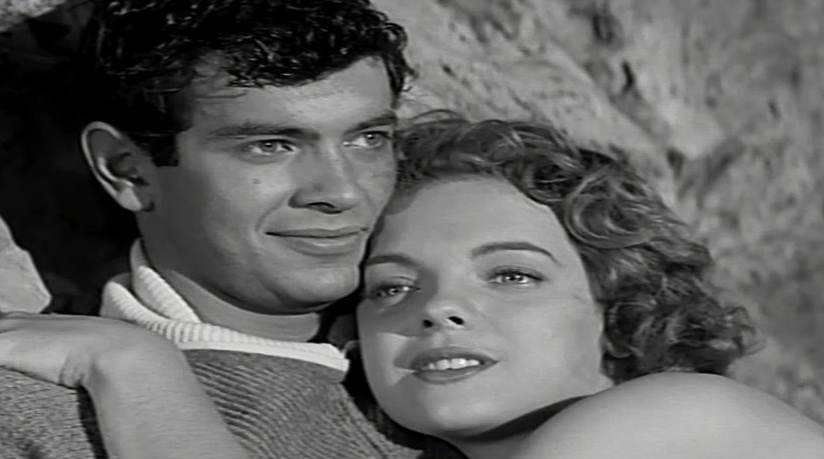
Good-looking couple: Mark Damon and Lili Gentle
YOUNG AND DANGEROUS (1957). Producer/director: William F. Claxton.

19-year-old Tommy Price (Mark Damon) is considered a "bad boy" who spends all of his time chasing bad girls for "all-night petting parties" and showing no signs of doing anything with his life, to the consternation of his father, Dr. Price (Edward Binns). But when Tommy goes on a date with 17-year-old Rosemary (Lili Gentle) -- which initially goes badly -- she brings out some of the inner sensitivity that was always inside of him. But can they convince his parents that he's changed? This mis-titled film sounds like a typical juvenile delinquent-jukebox melodrama, but while it's certainly no East of Eden, it is a well-done and quite well-acted romance. Damon and Gentle not only play together beautifully, but they are very good actors. Gentle married Richard D. Zanuck (son of Darryl) the following year -- their marriage lasted a decade -- and only made two more movies before retiring. Damon made some other teen movies, appeared with Vincent Price in House of Usher and with Boris Karloff in Black Sabbath -- he made several films in Italy -- and is now a successful producer. Handsome and with considerable acting ability, Damon was geared for a major stardom that never quite materialized. Dabbs Greer and Ann Doran offer strong support as Rosemary's parents, and Binns is fine as Tommy's father. One very long sequence, filmed in one shot without cutting, shows Tommy's friends "Weasel" (George Brenlin) and Roscoe (uncredited) in a phone booth trying to make a date with an "old reliable" girlfriend. Meant to be comedy relief, it just stops the picture dead. Produced in widescreen for Regal pictures, this was released by Twentieth Century-Fox.William F. Claxton later directed the lovably notorious creature feature Night of the Lepus.

Verdict: Not bad light drama with very appealing leads. ***.

Thursday, December 24, 2015

VIOLENT ROAD

Dick Foran and Ann Doran
VIOLENT ROAD (1958). Director: Howard W. Koch.

A runaway missile explodes in a small town, causing many deaths, necessitating the move of the local company that fired the missile to another location. Rocket fuel, which is comprised of many dangerous and acidic chemicals which can "burn a man alive," has to be transported over difficult terrain, and six men are chosen to be the drivers. These include George (Efrem Zimbalist, Jr.) whose family was lost in the blast; Frank (Dick Foran), who has a tragically bitter quarrel with his wife (Ann Doran) before leaving; Manuelo (Perry Lopez of The Steel Jungle), who needs the money from the trip to become an engineer; the world-weary Ben (Arthur Batanides); and Mitch (Brian Keith), a foot-loose adventurer without much of a past.  Ken Farley (Sean Garrison), the sixth driver, replaces his sad, drunken brother (John Dennis) when he's too hungover to drive. Along the way there are harrowing incidents, such as a runaway bus, brake failures, tumbling rocks, and acid spills, as well as flashbacks that tell us more about these individuals. Violent Road is clearly an unacknowledged rip-off of the far superior French film The Wages of Fear -- which was also remade as Sorcerer -- but it has its moments if taken on its own terms. One stand-out sequence is a tender and tragic moment between Frank and his wife, with an outstanding performance from Ann Doran [Meet John Doe]. Dick Foran is also excellent, and Keith also makes his mark, as does John Dennis in the early scenes. Sean Garrison also makes an impression as the handsome and cocky Kenny. If there's any problem with the movie it's that it seems to lack a real climax and ends much too abruptly. Peter Brown has a small but effective role as a marine, and Merry Anders is fine as a woman who picks Mitch up on the road.

Verdict: Not that explosive, and highly unoriginal, but tense and absorbing nonetheless. *** out of 4.

Thursday, May 22, 2014

THE ACCUSED

Douglas Dick and Loretta Young
THE ACCUSED (1949). Director: William Dieterle.

"What do you think suicides are? Some little person thinks their little problems are all that matter in the world." -- Dr. Tuttle

College psychology professor Dr. Wilma Tuttle (Loretta Young) is concerned with a brilliant but brash and difficult student named Bill Perry (Douglas Dick). When Bill forces a smooch on her at an isolated spot, she reacts by hitting him repeatedly and killing him. Instead of coming clean, she covers up and hopes his death will be attributed to a bad dive off of a cliff into the water below; he was wearing swimming trunks. Perry's lawyer, Warren Ford (Robert Cummings), who didn't really know Perry that well nor especially like him, comes to town and begins a romance with Wilma even as homicide detective Lt. Ted Dorgan (Wendell Corey) begins to get suspicious ... The Accused features a good lead performance from Young [Because of You], fine support from an especially notable Douglas Dick and the wry, sardonic Corey [The Big Knife], but Bob Cummings is horribly miscast [as he always was in movies like this] and is terrible. Another  problem with the movie is that while Perry does kiss Wilma forcibly and without permission, it doesn't necessarily mean he would have sexually assaulted her, and her viciously hitting him over and over again seems like literal overkill. Sara Allgood and Ann Doran are also in the cast, and Sam Jaffe offers a flavorful performance as Dr. Romley, whom Wilma finds ghoulish. Victor Young's score is a plus, and Ketti Frings' screenplay has some interesting dialogue. Unfortunately The Accused runs out of gas long before it's over. Dieterle directed Dark City and many, many others.

Verdict: Physician, heal thyself. **.

Thursday, August 8, 2013

BEYOND THE FOREST

Rosa and the saw mill: "If I don't get out of here I'll die."
BEYOND THE FOREST (1949). Director: King Vidor.

"There's only one person in this town who does anyone a real favor. That's the undertaker -- carries them out." -- Rosa Moline.

"No more dead cat for me! Mink!" -- ditto.

NOTE: Some plot points are given away in this review. Based on a novel by Stuart Engstrand, this vivid melodrama, a kind of poor man's Madame Bovary, has always polarized Davis fans and general movie-goers alike. Davis plays Rosa Moline, a self-absorbed, aging woman in the small town of Loyalton, Wisconsin, which has one industry -- a sawmill constantly issuing smoke and stench -- and one doctor, Rosa's gentle husband, Louis (Joseph Cotten). Bored Rosa, who wants much more out of life than Louis can give her, is having an affair with wealthy businessman Neil Latimer (David Brian of The Damned Don't Cry). Things run hot and cold with Rosa and Latimer for some time, but just when things look perfect Rosa is confronted by Latimer's caretaker, Moose (Minor Watson), who threatens to divulge information to his boss that will utterly ruin things for Rosa. Before she knows it, Rosa is put on trial for murder ...

Hardly anybody, including me, likes Beyond the Forest the first time they see it, perhaps because Davis and the movie seem overblown and slightly grotesque, but the damn thing grows on you and actually has quite a bit going for it. First there's Vidor's direction, which makes the most of Rosa's claustrophobia and frustration, and pulls the viewer along from the very first moment until the highly dramatic climax. Davis has been criticized for supposedly playing a teenager when she was in her forties, but nowhere is it said in the film that Rosa is that young, and one can't assume she is just because the character was younger in the novel. [The characters in the novel "The Postman Always Rings Twice" may have been teenagers or at least very young, but no one has suggested that Turner and Garfield were playing teens in the movie.] Davis comes off like the middle-aged woman whose opportunities are running out just as time is, and who does her best to look and act much younger, and her performance, despite some odd moments perhaps, is vital and effective. Robert Burks' photography makes the most of the bucolic locations and grim situations. Max Steiner's snappy and attractive score was nominated for an Oscar.

Rosa's dilemma is that she fancies herself a non-conformist, different from and superior to the other townspeople, but she hasn't the gifts that would enable her to get away without latching on to some man. The odd thing about Beyond the Forest is that while it's hard to like Rosa, you can't help but find yourself sympathizing with this somewhat sociopathic female who just has to get to Chicago or die [and this has much to do with Davis' performance]. The ending, in which a feverish, dying Rosa literally drags herself inch by inch and step by step to the train station, is not only operatic, but extremely well-handled by Vidor, superbly acted by Davis, and whatever else you think of the film, is just plain good movie-making. The stylized scene when Rosa gets lost in the big city and encounters weird characters is a bit problematic, but sort of works anyway.

Joseph Cotten (Shadow of a Doubt) perhaps makes Louis even more placid than he needs to be. [Some people writing about this movie don't seem to get that it doesn't matter if Louis is "nice" and "pleasant" and forgiving and so on. To Rosa his placidity is deadly.] Dona Drake (Valentino) is excellent as the Native American maid who is so mistreated by Rosa but gives as good as she gets. Minor Watson, a fine actor, played a very different role from Moose, a studio executive, in his next film with Davis, The Star, and is equally convincing in both pictures. Ruth Roman (Invitation) is lovely as Moose's daughter; Davis has a fine moment putting on Roman's mink and looking at herself in the mirror. David Brian is probably the weakest of the cast members, but he's perfectly competent as the rugged Latimer, who's used to getting what he wants, including Rosa. The ubiquitous Ann Doran is one of Loyalton's disapproving [of Rosa] housewives.

Verdict: Love it or hate it, it plays. ***.

Thursday, April 25, 2013

DEAD OF NIGHT (1977)

DEAD OF NIGHT (1977 telefilm). Director: Dan Curtis.

Curtis followed up his ratings-successful telefilm Trilogy of Terror with this second anthology of horror stories, which was also the pilot for a projected series. In "Second Chance," scripted by Richard Matheson from a Jack Finney story, a man (Ed Begley Jr. of Eating Raoul) restores a car in which a couple was killed years ago, and discovers that it can drive him all the way to the past to prevent their deaths. Ann Doran from It, The Terror from Beyond Space has a supporting role.  "No Such Thing as a Vampire," which Matheson scripted from his own short story, features a fake vampire murder plot, and boasts some very good performances from Patrick Macnee and Horst Buchholz. "Bobby," written by Matheson, also has fine performances from Joan Hackett and Lee H. Montgomery in a story about a grieving mother who thinks she's called her drowned son back from the grave. The story has a good ending, but it is neither frightening nor moving, which you can pretty much say about the movie in general. Curtis remade "Bobby" even less effectively in Trilogy of Terror II. Robert Cobert's score is mediocre and does nothing to help the telefilm.

Verdict: Reasonably entertaining if very minor horror anthology. **1/2.

Thursday, November 8, 2012

THE STRANGE LOVE OF MARTHA IVERS

Heflin, Scott and Stanwyck


THE STRANGE LOVE OF MARTHA IVERS (1946). Director: Lewis Milestone. Screenplay by Robert Rossen. 

"You still look like a scared little kid to me." -- Sam to Walter.

Martha (Barbara Stanwyck), Walter (Kirk Douglas) and Sam (Van Heflin) are childhood friends caught up in melodrama when -- early in the film -- Martha clubs her nasty aunt (Judith Anderson) and kills her right after said Aunt batters Martha's cat with her walking stick. Given Martha's age at the time, and her aunt's actions, probably nothing much would have happened to Martha, but in this movie she marries the witness, Walter, who grows up to become an alcoholic district attorney, and tries to pay off Sam [whom she thinks also witnessed the aunt's death] when he shows up back in town on a trip and chooses a very odd moment to kiss her. The trouble is, Martha and Walter framed an innocent man for the crime and he got the chair. Stanwyck and Heflin are excellent, and in his debut film, Douglas almost steals the film with his intense portrayal of Walter. His odd, clenched-teeth way of speaking takes a little getting used to, but it obviously didn't prevent him from becoming a major star. Lizabeth Scott, who plays an overaged urchin who's been told to get out of town but is befriended by Sam, gives a very odd performance, perhaps because she was trying to play younger than she really was [although she was hardly old at 24]. This was Scott's second film, but she was seen to better advantage in such films as Desert Fury and especially Too Late for Tears/Killer Bait. Well-directed by Milestone and with a nice score by Miklos Rozsa. Familiar faces include Olin Howlin and Ann Doran.

Verdict: Fascinating meller with intense performances from Heflin and Stanwyck and a star turn from Douglas. ***. 

Thursday, October 25, 2012

IT THE TERROR FROM BEYOND SPACE

Peekaboo! The Martian monster on the loose
IT, THE TERROR FROM BEYOND SPACE (1958). Director: Edward L. Cahn. Screenplay by Jerome Bixby.

An expedition to Mars picks up the sole survivor, Lt. Carruthers (Marshall Thompson), of the first team to reach the planet. Carruthers is suspected of murdering his team mates so the food would last longer, but he insists they were actually decimated by a ferocious monster [but what about that bullet hole in a skull? everyone wonders]. Said monster becomes a stowaway on  the voyage back to Earth, and pretty soon this new crew discovers Carruthers was telling the truth. The creature absorbs all of the bodily fluids from his victims via osmosis, and is amazingly strong as well. It, an obvious forerunner of Alien, is a taut, adroit little B movie that builds up suspense as the surviving crew members do everything they can think of to stay alive and destroy the monster. Bixby wrote the classic horror story "It's a Good Life" that was adapted by The Twilight Zone. The competent cast members [who sometimes seem to be holding back laughter]  include Shawn Smith [The Land Unknown], Ann Doran, Kim Spalding as the captain, and Dabbs Greer [The Vampire] as a science officer. Thompson appeared in First Man Into Space and many other films of various genres. Cahn directed 125 movies; Bixby wrote a lot for television but did only a few full-length screenplays.

Verdict: Lively, low-budget sci fi horror. ***.

Thursday, October 11, 2012

MIRAGE

MIRAGE (1965). Director:Edward Dmytryk.

"If we can lie, cheat, steal and kill in broad daylight, but have to wait until it's dark to make love ... what does that have to say about us as a society!"

"If you're not committed to anything, you're just taking up space."

In 1951 Howard Fast published the novel "Fallen Angel" (which was reissued years later in paperback under the title "Mirage") under the pen name Walter Ericson. The book was well-written, but typical of post-WW2 fiction, in that it was grim and fatalistic and occasionally pretentious. "Fallen Angel" was the basis of two films, Mirage and Jigsaw. Mirage is by far the better of the two.

Although there are some changes made, Mirage is pretty faithful to the novel. David Stillwell (Gregory Peck) discovers that he has amnesia on the same day that a man plummets to his death in the same office building in which Stillwell works. Or so he thinks. The office has disappeared; a pretty young woman  named Shela (Diane Baker) claims to know him although to him she's a complete stranger; and worse, people are trying to kill him and demanding he turn over something -- but he has no idea what it is or what they're talking about. Stillwell hires a first-time private eye named Ted Caselle (Walter Matthau) to help him, but the man uncovers more questions than answers.

Mirage is a first-rate suspense film (although it can be argued that it succeeds due to the acting and plot more than to Dmytryck's standard if more-than-competent direction). Peck gives a very good performance, and although Baker isn't quite the femme fatale type the attractive actress nevertheless acquits herself nicely. Matthau, in his pretty much comic turn as the private eye, doesn't really seem to fit into the movie. Of the supporting cast, Robert H. Harris makes the best impression as Dr. Broden, but there are also notable turns by Jack Weston, George Kennedy, Walter Abel, Leif Ericson, Kevin McCarthy, and Anne Seymour. There's an excellent use of New York City locations, and an exciting chase sequence in Central Park. Ann Doran has a bit part as the neighbor of a murdered man who wants to keep her nose clean. Peter Stone's screenplay intelligently adapts the novel, makes things a little clearer than they are in the sometimes murky book, and has some excellent dialogue as well (see above).

Verdict: Classy suspense film with a convoluted but fascinating storyline and very good performances. ***1/2.

Thursday, July 12, 2012

THEM

THEM (1954). Director: Gordon Douglas.

"A Horror Horde of Crawl-and-Crush Giants Clawing Out of the Earth from Mile-Deep Catacombs!" -- Ad copy.

"You just found your missing persons."

In the desert near where atomic testing took place, several people have gone missing, and a catatonic little girl screams about "Them!" when exposed to formic acid. There are oddly shaped footprints in the sand, as well as strange noises in the distance. Of course, due to the advertising campaign, the audience knows long before the principals do that there are monsters on the loose, specifically giant ants. Sgt. Ben Peterson (James Whitmore), FBI agent Bob Graham (James Arness), scientist Harold Medford (Edmund Gwenn) and his daughter Pat (Joan Weldon) are among the people assembled to combat this deadly menace of huge and carnivorous insects. It has to be remembered that Them was the first movie to deal with this subject matter -- not only giant insects, but the mutated results of atomic testing --  and was fresh, original* and frightening for its day. This was the second early fifties "thrill-picture" for Warner Brothers after The Beast from 20,000 Fathoms, and together the two films, both of which were wildly successful, ushered in what became known as the creature/insect cycle of the fifties. [Oddly the ad campaign for Them is just as lurid as the ones used for subsequent big bug movies like The Black Scorpion and Tarantula.] Although there are moments of humor in the film, the general tone is admirably serious [perhaps making it less" fun" than later films in the genre]. Although they are limited in their mobility, the ants look good and scary, and the sound department has turned them into cackling and chittering horrors. The discovery of the missing persons is still gruesome, and the trip down into the giant ant hole is creepy and memorable. An appropriately eerie musical score by Bronislau Kaper adds to the chilling atmosphere. Smaller roles are taken by the likes of Ann Doran [Meet John Doe] as a child psychologist, Sean McClory [Plunder of the Sun; Valley of the Dragons] as a major, Fess Parker as a man who sees the flying queen ants in his plane, Olin Howland [The Blob's first victim] as a patient in a hospital ward, and, Leonard Nimoy [Zombies of the Stratosphere] as an Air Force sergeant. Joan Weldon had a few movie and TV credits, but was essentially a singer. Gordon Douglas had a long list of credits, but Them was his most memorable film.NOTE: For more about this film and others like it, see CREATURE FEATURES: Nature Turned Nasty in the Movies. * The concept of giant insects was first used in fiction by H. G. Wells in his novel "The Food of the Gods," which also had giant rats, chickens, and children!

Verdict: A sci-fi-horror -- and very influential -- classic. ***1/2.


Thursday, April 19, 2012

MEET JOHN DOE

MEET JOHN DOE (1941). Director: Frank Capra.

"For the John Does all over the world, many of whom are homeless and hungry."

When her paper is sold and streamlined and she gets fired, columnist Ann Mitchell (Barbara Stanwyck) decides to fake a letter from a "John Doe" threatening suicide for her last submission. The column causes a big stir, increases circulation, and gets Mitchell her job back -- now they have to find someone who can pretend to be the real John Doe. [Only in a Hollywood movie will the man they choose just happen to be as handsome as a movie star!] The guy who gets the job is unemployed, hungry John Willoughby (Gary Cooper), who gives a speech -- written by Ann -- in which he suggests people should act toward one another as if it were Christmas 365 days a year [not exactly a radical idea]. This leads to the formation of John Doe clubs, neighbors helping neighbors, people finding jobs instead of hand-outs and getting off relief, and so on. Then publisher D. B. Norton (Edward Arnold) wants to start a John Doe party with himself as presidential nominee, which does not sit well with Willoughby. Worse, what happens if perchance "John Doe" is exposed as a phony...?

Meet John Doe takes a while to get going and its simplistic premise is never quite as solid as, say, that of Mr. Smith Goes to Washington, but eventually the movie and its various elements begin to click. Although Robert Riskin's screenplay doesn't really give Cooper a fully dimensional character to play, the actor nevertheless gives one of his best performances. Barbara Stanwyck is as terrific as she always is, impassioned and dynamic in equal measure. The movie has some lovely scenes: editor James Gleason talking about his father dying in front of his eyes during the war; Regis Toomey telling Cooper how he and his wife (an uncredited but excellent Ann Doran) reached out to a grumpy old neighbor and it snowballed into a committee of neighbors helping one another with their problems, and "John Doe" begins to realize what might actually be accomplished by his deception. [On the debit side, Walter Brennan's character, who thinks a man is "free" when he's broke, is an idiot and a pure Hollywood concoction.] Irving Bacon and Spring Byington are also in the cast. Capra wasn't able to use the bittersweet ending that he wanted, but the alternative he came up with works nearly as well. 

Verdict: Despite obvious flaws and perhaps an unreal air about it, this is another Capra winner. ***1/2.

THE GREEN HORNET (1940)

Gordon Jones and Keye Luke
THE GREEN HORNET (13 chapter Universal serial/1940). Directors: Ford Beebe and Ray Taylor.

Britt Reid (Gordon Jones), who has inherited control of the Sentinel newspaper from his father, wages a war against incredible corruption in his city in the disguise of The Green Hornet. With his faithful butler.chauffeur and action partner Kato (Keye Luke) by his side, the Hornet smashes one racket after another in this episodic serial. The two men ride around in a car called Black Beauty and use a gas gun to put opponents quickly to sleep. The police and many of the crooks believe the Hornet is also a criminal eliminating rivals. Sentinel reporter Michael Axford (Wade Boteler) is one of the Hornet's detractors, convinced he's a bad guy, while Reid's secretary Lenore Case (Anne Nagel) insists that the Hornet is a true hero -- neither has any idea that they're working for the very fellow they're arguing about. There are protection rackets, flight school insurance scams where students are deliberately killed for insurance [an especially heartless business], and other nefarious schemes, headed by a guy named Monroe (Cy Kendall) who spends most of his time sitting behind a desk and -- judging from his size -- eating; he is a colorless antagonist. There are no great Republic-type fist fights [this would have been an even better serial had it been made for Republic studios instead of Universal] but there are some lively scenes, including a bit with a runaway bus, and some thrilling business involving an uncoupled train. Jones and Luke are excellent, with the former affecting a more dramatic voice when he puts on the mask of the Hornet [some sources say the Hornet's voice was actually supplied by Al Hodge, who played the character on the radio, but he is uncredited]. Boteler is amusing in his exasperation, and Nagel [The Secret Code] -- although not beautiful in the conventional Hollywood sense -- classes up this production as she does so many others. Alan Ladd and Anne Gwynne [Honeymoon Deferred] have bit parts. Ann Doran [The Man They Could Not Hang, among many others] plays a woman who pretends to be the dead men's fiancee in the flight school chapter. Gene Rizzi makes an impression as one of the mobsters.[NOTE: The Green Hornet first appeared on the radio, then appeared in comic books [as he still does today] then was made into two serials, a TV show, and finally a dreadful Hollywood feature film.

Verdict: More than acceptable serial fun; much better than the 2011 Hollywood version. ***.

Thursday, December 1, 2011

HENRY ALDRICH'S LITTLE SECRET

Charles Smith
HENRY ALDRICH'S LITTLE SECRET (1944). Director: Hugh Bennett.

"I stand here slaving over a hot iron all day and you go out and make dates." -- Dizzy.

Henry (Jimmy Lydon) and his best bud Dizzy (Charles Smith) are in more hot water when they wind up babysitting little Ricky Martin (John David Robb) for a woman (Ann Doran) who leaves town abruptly to try to clear her wrongly imprisoned husband.This doesn't prevent Henry from going out on a date with sexy Jennifer (Tina Thayer), who has a ring Henry desperately wants to get back. Henry takes the baby with him when he takes Jennifer to a night club, and even asks the hat check girl: "I don't suppose you have any place to check a baby?" Lydon and Smith are both excellent -- like Lydon, Smith was a highly talented comic actor -- and this final entry in the Aldrich Family series is one of the very best and funniest.

Verdict: Henry goes out in style. ***.