Lively, entertaining reviews of, and essays on, old and newer films and everything relating to them, written by professional author William Schoell.

Thursday, April 27, 2023

NASTY HABITS

Glenda Jackson and Sandy Dennis
NASTY HABITS (1977). Director: Michael Lindsay-Hogg. 

When the elderly abbess Hildegarde (Edith Evans) passes away, a battle ensues between two factions of nuns in Philadelphia. On one side is Sister Alexandra (Glenda Jackson), who wants to remain aloof as the Prioress Sister Walburga (Geraldine Page) and Mistress of Novices Sister Mildred (Anne Jackson) conspire with the somewhat addle-pated Sister Winifred (Sandy Dennis) to spy upon the other faction and trip them up at every turn. On the other side is the younger Sister Felicity (Susan Penhaligon) who sneaks out into the woods outside the convent for romantic rendezvous and hot sex on a regular basis. She wants all of her nuns to have a steady beau. Both groups are not above using hidden mikes and cameras to find out what the others are up to. When Felicity is excommunicated, she goes public, telling all on The Mike Douglas Show. Is this the end of this oddball Philly faction of possibly Catholic nuns? 

Jackson, Jackson and Page
Frankly, the notion of setting the whole Watergate story in a nunnery is brilliant, and while the execution may be flawed, Nasty Habits emerges as a memorable motion picture. The actors are all wonderful, but Glenda Jackson is simply superb as the quietly ferocious manipulator behind the scenes. One of her best sequences has her addressing the other nuns as to the difference between ladies and the bourgeoisie, but she is wonderful throughout. Nasty Habits may not be a laugh riot a la Night at the Opera, but it is consistently amusing. Keeping it in the family, a few of the cast members' husbands are also in the film: Rip Torn; Eli Wallach, and Jerry Stiller -- all play priests (Stiller's wife Anne Meara is a gum-chewing nun from Joisey.) Vatican scenes with Stiller and Wallach examine whether or not the Philly nuns are a true order or not, a sop to the Catholic Church, of course. Melina Mercouri is also fun as a nun who travels the world as a missionary and advises Sister Alexandra by telephone. 

Verdict: This very funny movie should have been a TV series! ***. 

PARADE On Broadway

All the Wasted Time

PARADE. Book by Alfred Uhry. Music and lyrics by Jason Robert Brown.

Parade, which first debuted on Broadway in 1999, is based on the true story of Leo Frank, a Jewish man married to a Southern Jewish woman and living in Georgia. He is accused of murdering a young girl who worked in the factory where he was superindendent. Due to anti-Semitism and politics, Frank winds up being railroaded for a crime he didn't commit. (Books which examine the case pretty much make it clear that Frank was not guilty.) Parade was revived by City Center's Encore series, where it was so well-received that it moved to Broadway, where I saw it last week.

Diamond and Platt
I consider Parade to be a modern masterpiece of musical theater, with a great and eclectic score that consists of jazz, ballads, love duets (such as the beautiful All the Wasted Time) and the rousing martial The Old Red Hills of Home. There is a large and very talented cast, led by Ben Platt as Leo and Micaela Diamond as his wife, Lucille. Both of them, especially Diamond, give excellent and sensitive performances. (It may have been a fluke during the performance I saw, but Platt seemed a little perfunctory at the climax, but otherwise was fine.) The show was very well-staged and directed, with the orchestra bringing Brown's score to life with vibrant effectiveness. 

The story has been filmed several times: They Won't Forget (1937) starring Claude Rains (although his character is not revealed to be Jewish); The People vs. Leo Frank (2009), and The Murder of Mary Phagan (1988 telefilm), with Peter Gallagher as Frank and Jack Lemmon as the governor, as well as several documentaries on the case. 

Verdict: An exciting, tuneful and moving evening on Broadway. ****. 

IT STARTED IN PARADISE

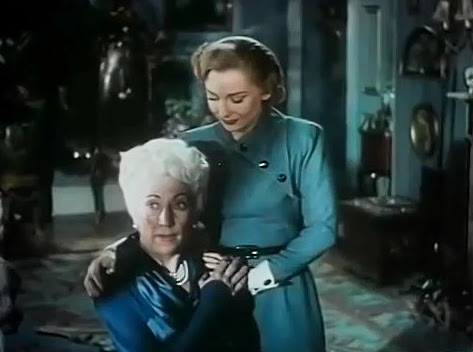
Martita Hunt and Jane Hylton
IT STARTED IN PARADISE (1952). Director: Compton Bennett. 

In the years leading up to WW2, Martha Watkins (Jane Hylton of The Manster) is frustrated that her employer, fashion designer Mme. Alice (Martita Hunt), thinks her designs are far too modern. Martha takes advantage of the situation after she importunes Alice to go off for a rest cure, and makes major changes to the line and even the studio itself. With the backing of her boyfriend, Arthur (Ian Hunter), Martha rises in the world of fashion, but makes the mistake of falling for a supposedly French bounder named Edouard (Terence Morgan). Meanwhile a younger designer, Alison (Muriel Pavlow of Murder She Said) and her boyfriend, Michael (Brian Worth), may prove formidable competition to Martha. Will ruthless Martha come undone?

Paging RuPaul!
If this film had been made in the United States ten years later it might have starred Susan Hayward at her bitchiest and been a lot of fun, but this comparatively dull British flick never really catches fire. Jane Hylton is a more than competent actress but she lacks that intense and fiery presence that might have made her performance more compelling. The others in the cast are all good enough, and Kay Kendall sparkles a bit as a superficial creature who makes an arrangement with Martha to bring in customers in exchange for clothing. The movie has an absolutely hilarious climax in which Alison shows up Martha with her own showing, featuring designs based on Elizabethan clothing. While these outfits might work for a costume party -- or for some drag queens -- the ordinary 20th century female would hardly be caught dead in most of them! Compton Bennett directed much better pictures, such as Daybreak. Malcolm Arnold's score helps just a bit. 

Verdict: Dig those crazy gowns! **. 

EYES OF TEXAS

EYES OF TEXAS (1948). Director: William Witney. 

Thad Cameron (Francis Ford of Charlie Chan at the Circus), who has started a home for boys who lost their fathers in WW2, is overjoyed to discover that his long-lost nephew, Frank, has survived. Before the two are reunited, however, Thad is killed by a pack of bloodthirsty dogs. Roy Rogers, playing himself -- this time he's a Marshall and not an actor -- investigates with the help of the Sons of the Pioneers as well as Doc Cookie Bullfincher (Andy Devine) and his amorous nurse, Penny (Lynne Roberts of Dick Tracy Returns). This time Roy is up against the ruthless lawyer Hattie Waters (Nana Bryant), a tough and clever middle-aged lady, her chief gunsel Vic (Roy Barcroft) and his evil pals, and the ex-con (Danny Morton of The Royal Mounted Rides Again) who pretends to be Thad's real nephew. Then there's those deadly dogs ...    

Pure evil: Barcroft, Morton, and Bryant
Eyes of Texas is a near-perfect "modern" Roy Rogers vehicle. The performances are all on target -- Bryant and Barcroft make especially nasty and effective villains in this -- the comedy relief isn't too pervasive -- Andy Devine is far more palatable than Gabby Hayes -- serial specialist William Witney keeps things moving at a thrilling pace, and Roy even sings a couple of pleasant tunes, "The Texas Trail" and "The Padre of Old San Antone." Then there's the amazing Trigger, who participates in fist fights by kicking out at the bad guys with his hooves and other amazing equine feats! 

Verdict: A prime example of why Roger Rogers movies were so damned popular! ***. 

THE GREAT RUPERT

THE GREAT RUPERT (1950). Director: Irving Pichel. 

Now here's a weird one. A down-on-his-luck entertainer, Joe Mahoney (Jimmy Conlin), with a trained squirrel act, reluctantly lets the squirrel, Rupert, go off on his own when he finds he can't get them bookings. Louie Amendola (Jimmy Durante), another entertainer who can't find work, moves into the apartment vacated by Mahoney with his family, but is unaware that the squirrel has moved back in. When Mrs. Amendola (Queenie Smith) prays for money, it drops from the ceiling into her hands! She is unaware that the landlord, who doesn't believe in banks, stashes his loot in a hole behind his bed, from whence the squirrel promptly throws it out. Despite the title, and the pivotal role that Rupert plays in the fortunes of the Amendola family, the squirrel -- animated through stop-motion -- hasn't much to do in the movie (although he isn't entirely forgotten either), which is decidedly bizarre, utterly original, and even strangely touching. The cast, including Durante, Sara Haden (as the landlord's wife), Chick Chandler (as an agent) and Terry Moore (Durante's daughter) are all fine, although love interest Tom Drake is strangely devoid of charm. 

Verdict: Really not as bad as you might expect, but certainly not for everyone. ***.

Thursday, April 13, 2023

THE LOVE MACHINE

John Phillip Law as Robin Stone, the "Love Machine"
THE LOVE MACHINE (1971). Director: Jack Haley Jr.  

Newscaster Robin Stone (John Phillip Law of The Sergeant) attracts the attention of both Network head Greg Austin (Robert Ryan) and his lustful wife, Judith (Dyan Cannon), leading to him getting more than one promotion both on-camera and in the executive suite. Meanwhile Robin beds numerous ladies, including a model named Amanda (Jodi Wexler) and Judith, both of whom become much too possessive. Recognizing that Robin has become too big for his britches and is a threat both to his job and his power, Austin wonders if a morals clause might be one way to get rid of the threat. It's well known that Stone has had many ladies in his bed, but is he also involved with his good friend, the flamboyantly gay photographer and producer Jerry Nelson (David Hemmings of Deep Red)? Judith causes a scene at a Hollywood party that may have them all out on the street. 

Dyan Cannon and Robert Ryan
Robin Stone was originally to be played by Brian Kelly, but just before filming began he was involved in an accident which ended his acting career (although he went on to become a successful producer). John Phillip Law then took over as Stone but was given a very underwritten role to play. Law is handsome and okay in the part, but he lacks that certain charisma, that all-important X Factor, at least in this picture, and Stone remains a bit of a cypher anyway. In the Jacqueline Susann potboiler that this was based on, Stone not only gets involved with Amanda and Judith, but with an actress named Maggie. This character has been reduced to a bit, well-played by Sharon Farrell. Robert Ryan gives the movie a touch of class as Austin, and manages to maintain his dignity. Hemmings is quite good and sharp as Jerry, although he was understandably criticized for perhaps overdoing the swishiness of his performance. (Jerry is neither gay nor a photographer in the book.)  Dyan Cannon, an actress who for some reason always looks as if she should have a mustache, is also good as Judith. 

Jodi Wexler and David Hemmings
Jodi Wexler was introduced in this film, both her first and last screen credit. I did not think her performance was bad, as she was playing a sweet and naive young lady, but Love Machine was a major bomb that didn't do much good for anyone's career. Jackie Cooper makes the most of his role as Danton Miller, the network head of programming. Shecky Greene is a second-rate comedian basically playing a version of himself, and there are good turns from Maureen Arthur as a promiscuous publicity agent and William Roerick as another executive who councils both Austin and his wife. 

Jackie Cooper and David Hemmings
Both the novel and the film adaptation were utterly excoriated by the critics. The odd thing is that the movie isn't truly awful, it's entertaining and has some vivid performances and sequences. There's Judith discovering Robin in the shower with two nubile and busty twins (the Collinsons of Twins of Evil) and setting fire to the bedroom by pouring vodka all over their clothing, and a four-way fight scene between Robin, Judith, Jerry and a boyfriend, Alfie (Clinton Greyn), over a supposedly incriminating inscribed bracelet that Judith thinks will utterly ruin Robin as they all desperately scrabble to get it and slap, pummel and kick anyone who gets in their way. These scenes are deliberately amusing if not hysterical. While the knocks at the TV industry may not rise to the level of Network, the gay material is a bit tiresome, Stone is never sufficiently developed even though he's the main character, and the film just sort of ends abruptly without any major resolution, much of the picture actually plays quite well.  Law, however, was seen to better advantage in Danger:Diabolik

Verdict: If you take this in the right spirit and don't expect Citizen Kane, but the book is much better ... ***. 

DOCTORS WIVES

DOCTORS' WIVES (1971). Director: George Schaefer.

"I don't appreciate your sleeping with your wife." 

Lorrie Dellman (Dyan Cannon) announces to a group of friends, all of whom are married to doctors as she is, that she intends to sleep with all of their husbands, and has already gotten to two of them. The next day Lorrie is caught in bed with a doctor and shot to death by her husband as everyone wonders which man (who survived the shooting and is fighting for his life in the hospital) was her lover. And this is just in the first ten minutes!

WIVES: McCargo, Williams, Cannon, Rule, Roberts
Unfortunately, anyone hoping for a serious film or just a trash wallow will be disappointed, as Doctors Wives is not a very good picture and sadly isn't quite bad enough to be much fun either. Judging from this movie, doctors, nurses and interns spend almost as much of their time having affairs as they do tending to patients. The wives in the picture consist of Amy (Janice Rule of The Swimmer) who is married to Peter (Richard Crenna), who is having an affair with his head nurse Helen (Diana Sands), whose little boy has an aneurysm. Then there's Della (Rachel Roberts of When a Stranger Calls) who is married to Dave (Gene Hackman) and confesses to him that she also had sex with lusty Lorrie. Maggie (Cara Williams) is separated from Joe (Carroll O'Connor) and drinks too much, while neglected Elaine (Marian McCargo aka Marian Moses) beds an intern-stud named Mike (Anthony Costello) even as her hubby Paul (George Gaynes of One Touch of Venus) is similarly occupied elsewhere. You need a scorecard. (If this makes you want to rush out and buy the DVD, be forewarned.) 

DOCTORS: Gaynes, Hackman, Colicos, O'Connor, Crenna
Others have noted that Doctors Wives comes off more as a racy and frank nighttime TV soap opera than a theatrical movie, and having the competent but bland, strictly small-screen Crenna in the lead doesn't help. Otherwise the cast is game with Roberts, Sands, Cannon and Williams making the best impression. And John Colicos is especially notable as the very cool, near-sociopathic wife killer who  schemes to get out of police custody when he's called to operate on Helen's son, and there are also good turns from Richard Anderson as the D.A. and Ralph Bellamy as Cannon's father. Anthony Costello also scores -- literally as well as figuratively -- as the horny and busy intern. The business with a gal named Sybil recording all of her sexual episodes is stupid, however, as is much of the movie. Several plot elements go unresolved but at least there wasn't a sequel! 

Verdict: For those anxious to see close-up shots of open heart surgery only! Some good performances but otherwise not worthwhile at all. **. 

BELLS OF ROSARITA

Roy Rogers and Dale Evans
BELLS OF ROSARITA (1945). Director: Frank McDonald. 

Sue Farnum (Dale Evans) appeals to her late father's good friend, Slim Phillips (Addison Richards), when she realizes that her father's slimy business partner, Ripley (Grant Withers) is trying to cheat her out of her circus. Slim and his daughter, Patty (Adele Mara) travel west to see what they can do. Almost immediately Slim is kidnapped! Filming nearby Sue's property, Roy Rogers, playing himself, gets involved and tries to find Slim with the help of Gabby Whittaker (Gabby Hayes) and Bob Nolan (also playing himself), head of the vocal group Sons of the Pioneers. 

Elliott, Livingstone, Sunset Carson, Allan Lane, Red Barry
Roy also comes through for Sue when he convinces her to put on a show in the nearby town and enlists the aid of the other Republic Studios western stars: Allan Lane [King of the Mounties], Sunset Carson, Wild Bill Elliot [Footsteps in the Night], Bob Livingstone and Don "Red" Barry. These fellows also help round up the ornery polecats who have kidnapped Slim. This must have been quite a thrill for Western movie fans back in the day. There's also a bunch of pleasant tunes, including Roy's "Build a Fence Around Texas" and the very talented Robert Mitchell Boy Choir. Gabby Hayes wears out his welcome rather quickly, however. 

Robert Mitchell Boy Choir
Bells of Rosarita is another "modern-day" Rogers western. The film-within-a-film that Roy is making is also entitled Bells of Rosarita and has something to do with a woman being forced to marry a man she does not love. Although there are some would-be exciting chases in the film, it can't quite escape being a little dull, although it is fun to see all of those handsome Western heroes in one movie. My mind wandered through the movie and I found myself wondering if the one black child in the choir was treated respectfully by the other white boys. It's good that he was included at all, of course. 

Verdict: A fairly typical Roy Rogers western musical with talented cast members. **1/4.    

BOULEVARD! A HOLLYWOOD STORY (2021)

BOULEVARD! A HOLLYWOOD STORY (2021). Director: Jeffrey Schwarz. 

Finding herself without too many opportunities despite her (Oscar-less) triumph in Sunset Boulevard, Gloria Swanson decided she would turn the movie into a Broadway musical. To that end she hired two young songwriters, pianist and composer Dickson Hughes and lyricist Richard Stapley, who were a romantic couple at the time, to work with her on the project. The fact that she apparently knew the two men were lovers didn't prevent Swanson from developing romantic and sexual feelings for the very handsome Stapley, but these feelings were not reciprocated. (Although Swanson was not unattractive, she had never been a great beauty, what with those teeth and chin, and probably even much younger hetero men might not have wanted to share the sheets with her!) Director Jeffrey Schwarz examines this triangle situation via archive footage (including Swanson doing a number from the show on Steve Allen), a video interview of Stapley taped by a friend, and Schwarz's audio interview with Hughes, as well as commentary from people who knew the two men (now deceased). Interspersed with these is some attractive animated footage illustrating some of the scenarios. 

Richard Stapley
Richard Stapley was an English actor who went to Hollywood in the hopes of becoming a major star. He had a good role in The Strange Door with Boris Karloff and Charles Laughton but wound up in stuff like Jungle Man-Eaters from the Jungle Jim B movie series. The documentary doesn't quite make it clear why he and Hughes broke up, but Stapley went back to England, changed his name to Richard Wyler, got married (his second wife, who seemed to have really been just a beard), became a macho motorcycle racer, and starred in several Eurospy movies as super-spy and super-stud Dick Smart. Swanson was never able to secure the rights to Sunset Boulevard -- in 1974 she starred in the amusing telefilm Killer Bees -- but Andrew Lloyd Webber had no such problem. Once Webber's show debuted in London, Hughes got to work. He couldn't do a show based on the movie, but he could do a show that depicted the attempts to make a show based on the movie. Using the songs that had already been written, and using himself, Stapley and the now-deceased Swanson as the main characters, he mounted "Swanson on Sunset" at a small venue in LA. What happened next is revealed in the documentary.

Hughes, Swanson, Stapley
The most interesting aspect of Boulevard may not be the whole business with Swanson and Sunset Boulevard, but the relationship between the two men, the cruelty of the vagaries of Hollywood, the terrible price often paid by people who relentlessly pursue stardom and deny their own true selves as they do so. Stapley did not age well, but he returned to Hollywood and kept plugging away practically until the day of his death. Hughes didn't get the major Broadway show -- and we don't learn if he had any long-term relationships after Stapley -- but he seems to have been happy enough in his life. One commentator seemed to feel that Stapley's letters to his boyfriend reveal a deep love, but we don't know how Hughes felt, possibly because he didn't want to talk about it. Was he heartbroken when Stapley walked out of his life, or did he feel "goodbye to bad rubbish." There is an implication that Stapley, like a lot of good-looking Hollywood types, could be an opportunist who thought of his career -- what there was of it -- above all else. What we hear of the songs written for the aborted show indicate that they were pleasant and adept show tunes if not quite on the level of, say, Richard Rodgers. Jeffrey Schwarz also directed the superb Vito, and many others. 

Verdict: With Swanson as a springboard, this is an interesting look at Hollywood dreams turned to dust. ***. 

3 FOR BEDROOM C

Gloria Swanson and James Warren
3 FOR BEDROOM C (aka Three for Bedroom C/1952. Director: Milton H. Bren. 

Movie star Ann Haven (Gloria Swanson), who has just won an Oscar, discovers there are no compartments available for her and her daughter, Barbara (Janine Perreau), and she must take a train to Hollywood in a hurry. She simply takes over a compartment and is lucky enough to discover that the true occupant, chemist Dr. Oliver Thrumm (James Warren), finds the two ladies charming. As other arrangements are made with the help of steward Fred (Ernest Anderson), Ann and Oliver find themselves falling for one another. But there are complications when Oliver finds out who Ann is, as well as interference from her manager, Johnny (Fred Clark of White Heat), the press agent Jack Bleck (Hans Conreid of The Twonky) and a declasse theater person, Conde Marlowe (Steve Brodie of Desperate), who is heading for Hollywood. Will the romance between Ann and Ollie run smoothly?                

Conreid, Clark, Brodie
Despite her performance in Sunset Boulevard, Gloria Swanson found herself with few movie offers (or turned them down) after her triumph in that picture. Unfortunately, her choice of this light -- very light -- comedy was not a good one. Her choice of leading man was also odd, as you have to wonder why she didn't go after someone with more box office clout. A former star of low-budget westerns, James Warren was handsome and competent enough, but he was no Cary Grant (who would certainly have turned this script down). Swanson herself is quite good, as are the supporting cast members already mentioned, and there are slightly amusing cameos from Margaret Dumont (who certainly doesn't get enough to do) and Percy Helton. 

As for Ernest Anderson, he plays the role of the intelligent, wise and educated steward with dignity. Anderson also had a good part in In This Our Life. Swanson had only two more theatrical films in her future -- a foreign comedy about Nero and Airport 1975 -- along with a host of TV show guest spots. She did her best to constantly reinvent herself and stay in the public eye. Janine Perreau, another member of the Perreau acting family, is more annoying than cute. 

Verdict: Labored comedy that is easy enough to take but never really gets off the ground. **. 

Thursday, March 30, 2023

THREE LITTLE GIRLS IN BLUE

Blaine, Vera-Ellen and Haver
THREE LITTLE GIRLS IN BLUE (1946). Director: H. Bruce Humberstone.

Three farm sisters in 1902 -- Pam (June Haver), Liz (Vivian Blaine) and Myra (Vera-Ellen) -- learn that they haven't inherited as much from their late aunt as they were expecting. So they go to Atlantic City and book a suite while Pam pretends to be an heiress. with Liz playing her secretary and Myra playing her maid. The plan is to attract a wealthy husband whom she will also, naturally, fall in love with. Pam quickly gets two suitors: Van (George Montgomery of The Brasher Doubloon) and Steve (Frank Latimore of In the Meantime, Darling). Meanwhile Myra finds herself very attracted to hotel employee Mike (Charles Smith of Henry and Dizzy) and vice versa. Of her two gentlemen callers Pam prefers Van, but will the fellow propose before their money runs out? 

Frank Latimore and George Montgomery
If Three Little Girls in Blue sounds familiar it's because it was already filmed at least twice as Three Blind Mice and Moon Over Miami. The plot is creaky but it's been dressed up with enthusiastic players and technicolor. There are several song numbers, with the suspicion being that the forgettable ditties are new while the best songs -- "On the Boardwalk in Atlantic City" and especially "You Make Me Feel So Young" -- are classics. All of the performances are good, with Charles Smith particularly notable as the likable Mike. As usual Vera-Ellen impresses with her dancing skills. Celeste Holm, who made her film debut in this picture, shows up late in the movie as Steve's sister. At times she channels "Oklahoma's" Ado Annie (she was in the Broadway show) and other times is the bitchily genteel Southern belle.

Verdict: Amiable, pleasant and well-played poop. ***. 

HOME IN INDIANA

Lon McCallister and Jeanne Crain
HOME IN INDIANA (1944). Director: Henry Hathaway. 

"If you'd been a boy we'd have been the greatest pals!" 

Orphaned "Sparke" Thornton (Lon McCallister), who got into some unspecified trouble in the big city, comes to live on his aunt and uncle's farm in Indiana. His first impulse is to run out the back door but then he discovers there's a stables and track -- and two pretty girls -- next door. His Uncle "Thunder" Bolt (Walter Brennan) himself has only one old and blind filly left, but Sparke contrives to secretly mate this animal with the neighbor's prize stallion, resulting in a possibly champion racing horse. It isn't long before Sparke, with the help of Thunder, "Char" (Jeanne Crain) and the more glamorous "Cri-Cri" (June Haver) -- not to mention stable boy Mo' (Willie Best) and employee Tuppy (George Reed) -- is off to the races! 

Charlotte Greenwood with McCallister
The performances -- by those named as well as a wonderful Charlotte  Greenwood as Aunt Penny -- greatly help put over this somewhat entertaining but unriveting horse drama. It seems Lon McCallister was too often teamed up with horses (The Boy from Indiana) and mules (Scudda Hoo!, Scudda Hey!, which reteamed him with Haver and Brennan) as often as he was with the ladies. He's earnest and appealing in that "gosh oh golly" way of his. He, Haver and Crain, although all three had had bit parts in previous films, were "introduced" in this movie.  McCallister plays very well with both Crain and Haver, although his switching his affections from one to the other occurs rather abruptly and without any real explanation. The girls' fathers are played by Ward Bond and Charles Dingle. Remade as April Love with Pat Boone.

Verdict: Horse lovers will get more of a kick out of this. **1/2. 

APRIL LOVE

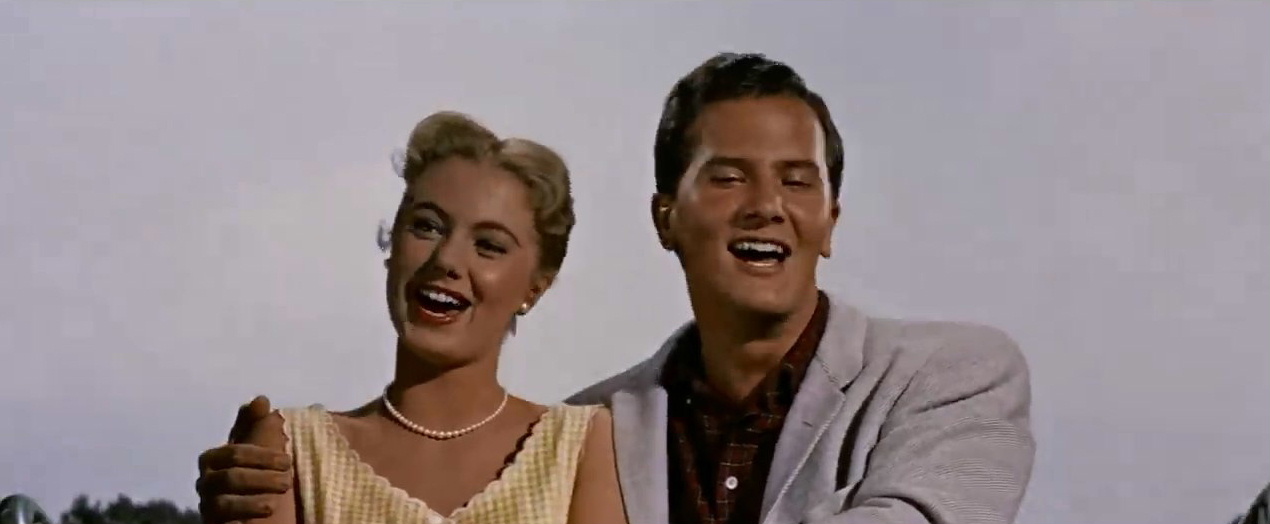
Sing out: Shirley Jones and Patty Boone
APRIL LOVE (1957). Director: Henry Levin. 

Nick Conover (Pat Boone of State Fair) is supposedly a "bad boy" who was sent from Chicago to Kentucky by his mother after his being arrested for taking a joy ride. Living with his Aunt Henrietta (Jeanette Nolan) and grumpy Uncle Jed (Arthur O'Connell of Anatomy of a Murder) on their farm, he fixes the old man's tractor and develops a crush on the neighbor gal, Fran (Delores Michaels). This doesn't sit well with Fran's sister, Liz (Shirley Jones), who develops a yen for Nick herself. And besides, Fran already has a boyfriend in Dan (Matt Crowley). Before a major triangle can develop, however, Nick bonds with a beautiful horse named Tugfire, who used to belong to Jed's son (who was killed in the war), and before you know it he's off to the races! But will his bad behavior back in Chicago catch up with him? 

Off to the races!
Hardly a classic, April Love succeeds on sheer amiability and the likability of its players. With a credible Boone in the lead the film becomes a musical, with him and others warbling several numbers. A couple of these are instantly forgettable but "A Gentle Girl" and the title tune are pleasant numbers, very well-sung by Boone, who now and then reminds one of Crosby. Delores Michaels [The Wayward Bus] was an attractive and talented actress who had a limited number of credits. Second lead Matt Crowley mostly had television credits. Henry Levin was a very busy director who worked with Boone on three films. 

NOTE:  April Love is a remake of Home in Indiana, which has a bit more pathos and sentiment but is not as smooth and entertaining as this. This version turns the two rivals for the hero's affections into sisters, and also gives the uncle a son who died in the war. It eliminates the likable if stereotypical black characters. There are no musical numbers in the original film.  

Verdict: The horse nearly steals the show! ***. 

WHITE MISCHIEF

Greta Scacchi
WHITE MISCHIEF (1987). Director: Michael Radford.

In 1940 beautiful young Diana (Greta Scacchi of Shattered) has married the much-older Jock Broughton (Joss Ackland of Crescendo) and moves with him to Kenya. There the couple are part of a wealthy or would-be wealthy social set that includes rampaging lover boy Joss, Lord Errol (Charles Dance of Alien 3). It isn't long before Diana and Joss begin a highly indiscreet affair that has tongues wagging, and reaches the ears of Jock. Apparently resigning himself to the fact that his wife and Joss are in love, he agrees to step aside and even toasts the couple. But that same night one of these three people is found dead on a highway, and a murder trial ensues ... 

Scacchi with Charles Dance
White Mischief
 is inspired by true events that led to a fictionalized book of the same title. The characters are all one-dimensional, but that may be because they are especially superficial people, the two illicit lovers in particular. The performances, however, are quite good, with Ackland a stand-out. This is another movie which tries to present Charles Dance -- a good actor who is not especially good-looking -- as a male sex symbol. The real Lord Errol was actually better-looking than Dance -- the same is true of the real Broughton and Ackland -- although the glamorized Scacchi is much sexier than the real Diana. 

Old pals: Joss Ackland and Trevor Howard
The movie has a few intriguing scenes, such as a party in which the guests, both men and women, are required to dress in drag. A very bizarre, even gross, scene, has Alice (Sarah Miles) pleasuring herself as she stands over a corpse of a man she once loved. Murray Head plays Alice's boyfriend, and John Hurt is a weird farmer named Colville who is also attracted to Diana. Geraldine Chaplin flits in and out of the action without making much of an impression, and Trevor Howard -- who nearly got fired because of his drinking -- is fine as a dissolute friend of Broughton's. Hugh Grant appears briefly at the beginning of the film as one of Diana's lovers. White Mischief holds the attention but never fully engages the viewer. 

Verdict: Rich Caucasians behaving badly. **1/2. 

RED GARTERS

Rosemary Clooney

RED GARTERS (1954). Director: George Marshall.

The citizens of Limbo County are holding a barbecue to celebrate the death of a hated individual, when said individual's brother, Reb (Guy Mitchell), shows up wanting revenge on whoever murdered him. It doesn't make any difference that Red also hated his brother, it's "the code of the West." Someone who is sick of this code and all of the fighting and killing is saloon singer Calaveras Kate (Rosemary Clooney of White Christmas), who is inexplicably in love with the fat Jason Carberry (Jack Carson), the unofficial leader of the town. She refers to the bloodthirsty townspeople as "Modern-day Romans." While Reb draws closer to Jason's ward, Susan (Pat Crowley), another romance develops between bandit Rafael (Gene Barry) and newcomer-from-Boston Sheila (Joanne Gilbert). Reb and Rafael have also become fast friends, but what will happen when Red learns that it was his buddy who shot and killed his brother?

Guy Mitchell and Pat Crowley
Red Garters is easily both the weirdest musical and western that I have ever seen. For one thing, the movie is so highly-stylized that it often seems like a cartoon. In some westerns there is some attempt to make sets on a soundstage resemble the real thing, but the town in Red Garters is completely artificial. That pretty much matches the farcical absurdity of the screenplay. However, without putting to fine a point on it, the film has a subtext of using logic to reduce violence, personified in the character of the quite sensible Kate (aside from her infatuation for Jason). Similarly Clooney dominates the movie, and gives a terrific performance. Not only is she surprisingly sexy doing such numbers as the title tune, "Code of the West" and especially the splendid "Bad News," but she delivers her songs with more assurance and professionalism than I've ever quite seen from her before. 

Joanne Gilbert and Gene Barry
As for Guy Mitchell, who was essentially a singer, he gives a good performance in Garters, but his lack of good looks probably didn't help him and he made only two movies, this and Those Redheads from Seattle. Joanne Gilbert, also a good singer, was introduced in this film and she is notable as well, but she did mostly television work and her career petered out in the sixties. Gene Barry's turn as a Mexican bandit may be on the stereotypical side, but he is nevertheless excellent. Buddy Ebsen is only given one number but he dances up a storm as expected. Buck-toothed Cass Daley plays an Indian squaw. Reginald Owen and Frank Faylen score as respectively, Sheila's father, the judge, and a cowardly if highly vocal townsperson. Crowley and Carson do their turns professionally. The songs by Livingstone and Evans [Somebody Loves Me] are a mixed bag, some quite forgettable and others rather pleasant.  

Verdict: Like a Western animated movie with flesh and blood players. **3/4.

Thursday, March 16, 2023

LOVER COME BACK (1946)

George Brent and Lucy

LOVER COME BACK (1946). Director: William A. Seiter.

"Jealousy is a particularly crude manifestation of the uncultured."

"Your complete and unashamed lack of principles almost amounts to integrity." 

"That's different -- I'm a man!"

Executive Kay Williams (Lucille Ball) cleverly fobs off a variety of wolves, including her boss, while her husband, Bill (George Brent), a war correspondent, is overseas. When he returns home, Kay discovers that he had a number of dalliances with women, including his photographer Madeline (Vera Zorina of On Your Toes). She decides to get even by pretending that she also saw different men while he was gone -- and after. Madeline waits hopefully in the wings, while Kay's in-laws -- Bill Sr. (Charles Winninger) and his wife (Elisabeth Risdon) -- offer conflicting advice to both parties and bicker with each other. Will the younger couple work out their problems or wind up in Reno? 

Elisabeth Risdon and Charles Winninger
Lover Come Back is a breezy and delightful film bolstered by excellent performances from the entire cast, with Lucy being especially bright-eyed, effective, and resplendent. This is a clear example that Ball's talent did not begin and end with the wonderful I Love Lucy. Brent gives one of his more memorable performances, and one can't say enough about the terrific Winninger and Risdon, who make quite a pair of nattering lovebirds. Then we've got Austrian actor Carl Esmond as dapper and aggressive Paul, who wants to marry Kay; William Wright (of Philo Vance Returns) as photographer Jimmy, who makes frequent passes; Raymond Walburn (of And the Angels Sing) as Kay's amorous boss J. P. Winthrop; Wallace Ford as the lawyer Tubbs, who switches sides in this battle of the sexes after he gets punched; and spirited Louise Beavers as the couple's lovable domestic, Martha. Others in the cast who appear briefly are Franklin Pangborn as a hotel clerk; Ellen Corby as a secretary; and Joan Shawlee as one of Bill's rather bitchy ex-girlfriends.

Lucy!
One could easily argue that Lover Come Back is a slight picture were it not for the feminist sub-text. The picture argues against the double standard that it's acceptable for men to cheat -- "I'm a man, after all!" -- but that it's somehow worse for women to do so. The screenplay by Michael Fessier and Ernest Pagano is also full of good dialogue, and while the flick is not a laugh-riot it is consistently amusing. Brent is a likable enough performer so that his slightly sleazy character -- despite his love for his wife -- is made more palatable. This was the last of nine films for the German actress and dancer Vera Zorina, who has a certain undeniable appeal. As for Lucy, she is just splendid and looks absolutely gorgeous throughout!

Verdict: Lucy leads a cast of pros in an amusing comedy. ***.

GOODBYE TO MR. B.I.G.

Bert I. Gordon
GOODBYE TO "MR. BIG:" BERT I. GORDON (1922 - 2023)

Filmmaker Bert I. Gordon lived to be a hundred and directed his last film. Secrets of a Psychopath, when he was in his nineties! Gordon may not have been a brilliant director along the lines of Hitchcock or Wyler, but his low-budget movies -- especially the giant monster movies which earned him the nickname of Mr. Big (taken from his initials, of course) -- were at their best fun, fast-paced and entertaining. 

Some of Gordon's movies were genuinely good. These included The Amazing Colossal Man with a fine performance from Glenn Langan, The Food of the Gods with Ida Lupino and Ralph Meeker, The Magic Sword with Basil Rathbone and Estelle Winwood, and The Cyclops starring Gloria Talbot and Lon Chaney -- with The Spider and Beginning of the End as runners-up. Considering how low the budgets were it's amazing that some of the movies turned out as well as they did. Gordon even directed no less than Orson Welles (!) in the film Necromancy, a fact that is slightly mind-boggling to contemplate! Imagine the same man who dropped grasshoppers onto photographs to simulate an attack by giant locusts on Chicago advising the great Orson Welles in a movie, although it's probable that he just sat back and let Orson do his thing. 

Thanks Bert for giving many genre fans a big amount of pleasure. (I can't tell you how many times I've watched The Cyclops!)

A DISTANT TRUMPET

Suzanne Pleshette and Troy Donahue

A DISTANT TRUMPET (1964). Director: Raoul Walsh.

"Burning while Rome fiddles?"

Lt. Matt Hazard (Troy Donahue) is sent from the graduating class at West Point to Fort Delivery in Arizona. Doing things by the book, he whips the soldiers into shape -- to their dissatisfaction. When a merchant, Seely Jones (Claude Akins), offering booze and women to the troops, shows up, Hazard contrives to get rid of him. Although he has a fiancee, Laura (Diane McBain), back east -- who eventually appears -- Hazard is romantically drawn to Kitty (Suzanne Pleshette), who is married to Captain Mainwaring (William Reynolds). In addition to a love triangle and resentful soldiers, Hazard has to deal with Indian troubles in the person of Chief War Eagle (uncredited) -- and the U.S. Army itself, which may go back on its promises to Native Americans.

When Ladies Meet: Pleshette with McBain
A Distant Trumpet, the last film for director Raoul Walsh, was excoriated by critics when it was released, and star Troy Donahue along with it. In truth, the picture, although certainly not a forgotten classic, is not terrible and neither is Donahue. Although still a bit stiff in quieter scenes, Donahue plays the lieutenant in an authoritative fashion and has a commanding presence. The two ladies give good performances if only on a soap opera level; McBain is stronger than expected, and Pleshette not as good as one might have hoped. (She was married to Donahue for a grand total of nine months!) All of the leads are a bit too contemporary in style. William Reynolds is good as Mainwaring but he disappears too quickly.

Donahue with James Gregory
Others in the cast are more memorable: Although a trifle too pompous at times, James Gregory scores as General Quaint, who goes to bat for Hazard when he confronts the Secretary of War (Kent Smith) over the treatment of the Indians. Claude Akins is flavorful as the ever-scheming Jones. Larry Ward is effective as the undisciplined Sgt. Krogur, as is Bobby Bare as the alleged deserter Crenshaw. Lane Bradford makes an impression as the nasty Indian-hating Major Miller, who gets a sock in the jaw from Hazard for his trouble. 

Hazard at West Point
A Distant Trumpet can be classified as one of those movies that is good enough that you wish it had been better. Walsh turns in an adept directorial job that keeps things moving and Max Steiner's score, especially the martial theme, is excellent, embellishing every sequence. William H. Clothier contributed the sweeping Panavision cinematography. But A Distant Trumpet is still unsatisfying, probably due to the weaknesses of the script, some unlikable characters (although Hazard is a bit redeemed at the end), and the lack of a dramatic climax. 

Verdict: Reasonably entertaining Western that looks good and has some interesting sequences. **3/4. 

JUDY'S CREAM OF WHEAT

JUDY'S CREAM OF WHEAT

My friend Ed Walters brought this to my attention, a mock commercial for Cream of Wheat featuring Judy Garland and Liza Minelli. This is an affectionate spoof of the larger-than-life lady and her intense dramatic style (both of acting and singing) and I confess I find it hilarious and have watched it over and over again. (You never know what will strike your funny bone!) 

This was put together on youtube by a group called the Punchy Players, who have done quite a few of these spoofs, some more successful than others; this is one of their best. The voices are done to perfection by Jeff Marquis, who co-wrote the short with producer Chris Tassin. Marquis gets across the essence of the ladies personalities as well as Garland's unique singing style.

You can watch the video here

Verdict: Lots of fun! ***. 

THE PERFECT FURLOUGH

Janet Leigh and Tony Curtis

THE PERFECT FURLOUGH (1958). Director: Blake Edwards.

104 lonely men are stationed at an Arctic outpost and a notion is advanced to raise morale. One man will be chosen to go on a "perfect furlough," which is decided will be three weeks in Paris with the sexy movie queen Sandra Roca (Linda Cristal). Manipulating everyone behind the scenes, Corporal Paul Hodges (Tony Curtis) manages to become the winner. But when Colonel Leland (Les Tremayne) discovers that Hodges is an incurable skirt-chaser, he insists that his aide Major Collins (King Donovan) and Army psychologist Lt. Vicki Loren (Janet Leigh), who came up with the idea of the furlough, go along to keep Hodges out of trouble. But when Hodges gets a load of Sandra, this assignment may be more difficult than anyone imagines.

Elaine Stritch with Leigh
The Perfect Furlough could have been a smirking dirty joke but it's generally tasteful and consistently amusing. There are a lot of laughs in watching Hodges' efforts to escape from the MPs so he can hook up with Sandra -- who has a few surprises of her own -- as well as in the interplay between Hodges and a disapproving, yet attracted, Vicki. This is the perfect material for Curtis, who understandably has great chemistry with Leigh as the two were married at the time (1951 - 1962). While no comedian, Leigh is fine in the role, and there are excellent supporting performances from Elaine Stritch as Sandra's keeper; Tremayne and Donovan; Keenan Wynn as Sandra's manager; Alvy Moore as Private Brewer, who almost gets to go to Paris; and Gordon Jones as an MP. 

Argentinian actress Linda Cristal is cute, curvaceous and charming as Sandra, but she had her biggest success on television, starring in The High Chaparrral for several seasons. Troy Donahue [A Summer Place], playing a sergeant who accompanies Donovan and Leigh, is in the background in several scenes but has no dialogue. Another cast member who should be mentioned is the wonderful Jay Novello [The Mad Magician], who plays a French winemaker and lives with his father (Marcel Dalio), who hopes he'll get married. Lilyan Chauvin [Lost, Lonely and Vicious] shows up very briefly as a nurse. 

Verdict: Well-acted and funny fifties service comedy. ***.