Lively, entertaining reviews of, and essays on, old and newer films and everything relating to them, written by professional author William Schoell.
Showing posts with label Pat Boone. Show all posts

Thursday, March 30, 2023

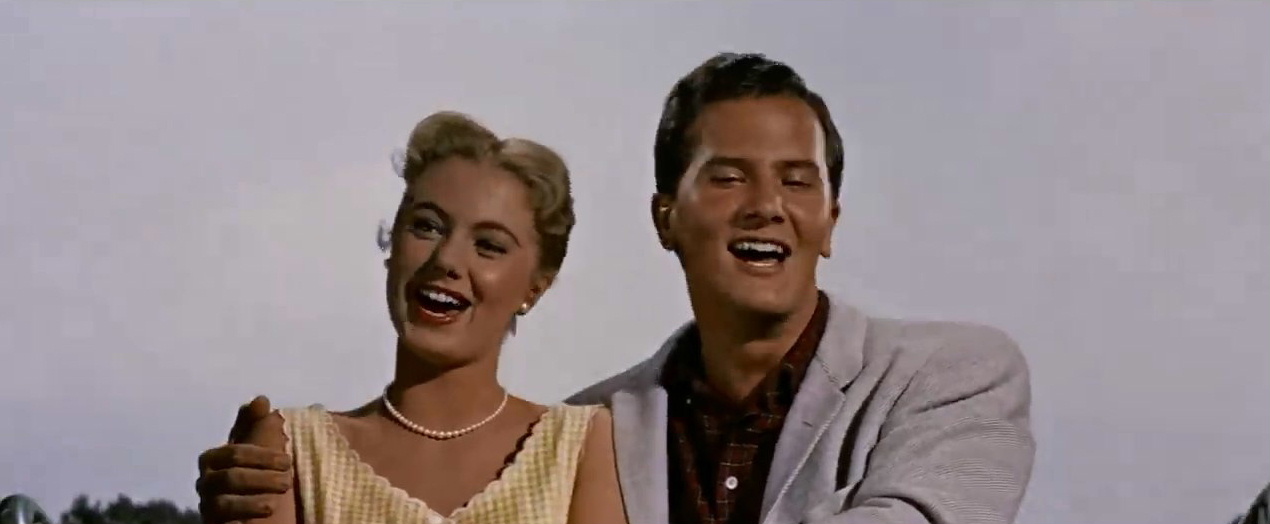
APRIL LOVE

Sing out: Shirley Jones and Patty Boone
APRIL LOVE (1957). Director: Henry Levin. 

Nick Conover (Pat Boone of State Fair) is supposedly a "bad boy" who was sent from Chicago to Kentucky by his mother after his being arrested for taking a joy ride. Living with his Aunt Henrietta (Jeanette Nolan) and grumpy Uncle Jed (Arthur O'Connell of Anatomy of a Murder) on their farm, he fixes the old man's tractor and develops a crush on the neighbor gal, Fran (Delores Michaels). This doesn't sit well with Fran's sister, Liz (Shirley Jones), who develops a yen for Nick herself. And besides, Fran already has a boyfriend in Dan (Matt Crowley). Before a major triangle can develop, however, Nick bonds with a beautiful horse named Tugfire, who used to belong to Jed's son (who was killed in the war), and before you know it he's off to the races! But will his bad behavior back in Chicago catch up with him? 

Off to the races!
Hardly a classic, April Love succeeds on sheer amiability and the likability of its players. With a credible Boone in the lead the film becomes a musical, with him and others warbling several numbers. A couple of these are instantly forgettable but "A Gentle Girl" and the title tune are pleasant numbers, very well-sung by Boone, who now and then reminds one of Crosby. Delores Michaels [The Wayward Bus] was an attractive and talented actress who had a limited number of credits. Second lead Matt Crowley mostly had television credits. Henry Levin was a very busy director who worked with Boone on three films. 

NOTE:  April Love is a remake of Home in Indiana, which has a bit more pathos and sentiment but is not as smooth and entertaining as this. This version turns the two rivals for the hero's affections into sisters, and also gives the uncle a son who died in the war. It eliminates the likable if stereotypical black characters. There are no musical numbers in the original film.  

Verdict: The horse nearly steals the show! ***. 

Thursday, November 14, 2019

BERNARDINE

Pat Boone and Dick Sargent
BERNARDINE (1957). Director: Henry Levin.

Some high school pals in a club imagine the perfect woman and for unaccountable reasons call her "Bernardine." One afternoon Sanford Wilson (Dick Sargent) meets a beautiful young lady named Jean (Terry Moore of Mighty Joe Young), and he is instantly smitten -- she is his Bernardine. The other guys in the club also think Jean is special, but her relationship with Sanford hits the rocks when she meets Langley (James Drury), the handsome older brother of Sanford's friend, Beau (Pat Boone). With a little help from his friends, Sanford tries to win the hand of fair lady.

Terry Moore and Dick Sargent
Although Pat Boone and Terry Moore are top-billed in Bernardine, the main character and the one who gets the most running time, is Dick Sargent's Sanford. Pat Boone, playing a very unlikable person (although most of the boys in the film are unlikable) does have some screen time and gets to warble three numbers, the okay title tune, the highly sexist "Technique," and the more memorable "Love Letters in the Sand," which I believe was a big hit for Boone, who kind of imitates Der Bingle a bit. Terry Moore actually has very little to do in the film considering she is the leading lady. Bernardine asks us to accept Sargent, Boone, Ronnie Burns, and others as high school students when they have clearly left their teenage years far behind them. This makes their behavior at times seem borderline grotesque. They are particularly obnoxious to a nerd named Kinswood (Hooper Dunbar), although eventually he's somewhat accepted by the others.

Janet Gaynor
Natalie Schafer plays Boone's mother in a couple of brief scenes, but the stand-out in this is Janet Gaynor [Sunrise], who plays Sargent's mom and is given a couple of strong moments. "It's crazy, it's wild, it's improbable -- but don't tell me you passed!" she says to Sanford, who is not a great student. Sargent has some good moments, too, but again he's too old, his character isn't very appealing, and the more serious moments when he's dealing with heartbreak are almost worse than the comedy sequences. Although Sargent subsequently appeared with Boone in Mardi Gras, his film career never really developed and he mostly did television. Walter Abel and Dean Jagger are also in the film. This was Pat Boone's first movie and Janet Gaynor's last; she had two television credits after that.

Verdict: In spite of "Love Letters in the Sand," this is so bad it's depressing. *1/2. 

Thursday, November 16, 2017

THE YELLOW CANARY

Patty Boone and Barbara Eden
THE YELLOW CANARY (1963). Director: Buzz Kulik. Screenplay by Rod Serling.

Now here's a strange one. Pat Boone plays a popular singer and neglectful husband, Andy Paxton, who has difficult relationships with his wife, Lissa (Barbara Eden), and associates, Hub (Steve Forrest), his bodyguard, and "Bake" (Steve Harris) his pal and right-hand man. Things get even more complicated when Paxton's baby boy is kidnapped right out of their mansion. While at first it may make sense that the terrified couple are scared that police intervention could kill their child, when days go by it seems utterly absurd for them not to let the authorities handle things. Believability goes completely out the window when the Paxtons set off to rescue the child themselves from dangerous people who have nothing to lose. The picture has unusual casting with Boone going against his pleasant milk-fed image just as Eden [Voyage to the Bottom of the Sea] is contrary to her usual perky demeanor. They offer generally good performances although  at times the script may make too many demands on them. Steve Forrest [Mommie Dearest] is the cast stand-out as Hub, and there is also good work from Harris as the jealous, heavy-drinking buddy and Jeff Corey as a bartender. Jack Klugman [I Could Go On Singing] is pretty awful as the cop assigned to the kidnapping, a performance which isn't helped by the fact that he is often given ridiculous things to say to the parents. Boone does several numbers and has a nice voice. but the poor quality of the film probably jettisoned his chances of establishing himself as a serious dramatic actor after the previous year's appearance in The Main Attraction. Rod Serling's screenplay is one of his least memorable concoctions. Steve Harris was primarily a television actor.

Verdict: This canary just doesn't sing. **.

Thursday, August 4, 2016

STATE FAIR (1962)

Pat Boone and Ann-Margret
STATE FAIR (1962). Director: Jose Ferrer.

In this CinemaScope remake of the 1945 State Fair, the Frake family are off not to a fair in Iowa but in Texas. Mom (Alice Faye) and Dad (Tom Ewell) still want ribbons for their mincemeat and boar, respectively, but now the son Wayne (Pat Boone) races cars while sister Margy (Pamela Tiffin), still restless, is bored with her now-handsome fiance, Harry (David Brandon). At the fair Wayne meets up with entertainer Emily (Ann-Margret) and Margy encounters radio interviewer Jerry (Bobby Darin). Now let's see -- Darin  and Boone [Mardi Gras], of course, simply had decades of experience in musical theater (!) but in spite of this they are not as bad singing show tunes as you might expect. In fact, after Tom Ewell, Boone actually gives the best performance in the movie (credit director Jose Ferrer, perhaps). Boone has a nice voice, and puts over such numbers as "That's for Me" and a new song (Rodgers composed several new numbers for this remake), "Willing and Eager." Darin, usually a very different kind of singer, also delivers when he croons "You're Not an Angel." Faye is given a new number that she sings to her daughter, "Never Say No to a Man" and she and Ewell, who obviously can't sing "I Owe Iowa" anymore, perform "The Littlest Things in Texas" instead. The new songs are perfectly pleasant. Unfortunately, "Isn't It Kind of Nice?" is horrendously staged, first as a weird burlesque and then jazzed up with Ann-Margret [Any Given Sunday] tearing at that lobster again while she sings, although she is better when she relaxes a bit doing "Willing and Eager" with Boone. "It's a Grand Night for Singing" doesn't get a big production nearly as good as the one in the original. Unlike Dana Andrews in the first version, Darin plays the character like a cheap and common playboy, making it improbable that Margy would fall for him or vice versa; Wayne's hasty romance with Emily is only slightly more convincing. Wally Cox [The Night Strangler] is funny as the judge who gets inebriated on mincemeat. Alice Faye is okay as the mother, but there are times when you get the impression she'd rather be anywhere else than in this movie. She's given some funny lines -- "[Ewell] won't be happy until that hog shows up in Who's Who" -- but her delivery is always flat. Faye was to play the daughter's role in the 1945 movie but abruptly retired; this was supposedly her comeback. State Fair was finally turned into a Broadway musical in 1996 using songs from both movies and a couple from lesser-known Rodgers and Hammerstein shows.

Verdict: Has some nice moments but decidedly inferior to the original. **1/2.
Thursday, July 3, 2014

MARDI GRAS

Cadets? -- Dick Sargent, Tommy Sands, and Pat Boone
MARDI GRAS (1958). Director: Edmund Goulding.

A bunch of twenty-something cadets raffle off a date with new French-Hollywood movie star Michelle Marton (Christine Carere). Everyone is dismayed when the winning ticket goes to the most studious and disinterested among them, Paul (Pat Boone). In New Orleans Paul actually spends a very pleasant day with Michelle, who has switched places with her studio helpmate Eadie (Sheree North); he has no idea the young lady is the movie star he is supposed to be squiring. This leads to mostly unamusing complications. Mardi Gras is the most undistinguished of musicals; it has one decent song, "I'll Remember Tonight," and the rest are atrocious. Boone [Journey to the Center of the Earth] isn't bad; Carere is, well, pretty and little else; Gary Crosby essentially plays the same character he plays in every movie he did; Tommy Sands over-sings everything; and Dick Sargent is another over-aged cadet. Sheree North and Fred Clark add little to the tedious proceedings, although there are a couple of funny lines, as well as forgettable  cameos by Robert Wagner and Jeffrey Hunter. This movie in no way captures the excitement of Mardi Gras even though there is some grainy stock footage of it. Hard to believe this treacle was directed by Edmund Goulding.

Verdict: Watch Goulding's The Old Maid instead. *1/2.

Saturday, January 12, 2008

JOURNEY TO THE CENTER OF THE EARTH

JOURNEY TO THE CENTER OF THE EARTH (1959). Director: Henry Levin.

"Oh, goose, goose, goose!" Professor Lindenbrook when his daughter impatiently tells him to come to supper.

One could easily quibble and say that Journey is sometimes too silly for its own good, goes on too long, and that we still haven't gotten the ultimate film version of Jules Verne's fascinating novel, and while all this is true, it is also true that Journey is a very entertaining picture. Professor Lindenbrook (James Mason) is accompanied on the title journey by a student Alec (Pat Boone), a big Icelander named Hans (Peter Ronson), and the widow of a rival professor, Carla (Arlene Dahl). The bickering between Mason and Dahl is amusing (courtesy of screenwriters Walter Reisch and Charles Brackett), and the film works up suspense as our team tries to stay ahead of yet another rival scientist, Count Saknussem (Thayer David) who thinks of himself as the King of the Underworld. One of the most exciting scenes has the expedition encountering gigantic and hungry prehistoric dimetrodons (essentially big lizards) that nearly snack on Dahl. They also come across a section of the lost city of Atlantis [there were monsters in Verne's novel, but no Atlantis.] There are some wonderful sets and art direction; the special effects work is uneven but much of it is quite well done. Mason is excellent; Dahl, snappy; Boone, boyish and perky; and David marvelous as the villain of the piece. Leo Tover's cinematography is first-rate and Bernard Herrmann's beautiful and expressive score is nigh onto perfection. Diane Baker is lovely in a small role as Mason's daughter, Jenny. Verne's basic premise is one of the most compelling in fiction. Very handsome production and even a couple of pleasant tunes sung by Boone.

Verdict: Flawed but fascinating fantasy. ***.