Lively, entertaining reviews of, and essays on, old and newer films and everything relating to them, written by professional author William Schoell.
Showing posts with label Arthur O'Connell. Show all posts

Thursday, January 30, 2025

OPERATION MAD BALL

Mickey Rooney and Jack Lemmon
OPERATION MAD BALL (1957). Director: Richard Quine.

In France at a U.S. Army hospital just after the end of WW2, Private Hogan (Jack Lemmon) wants to do something to give his pal Corporal Berryman (Roger Smith of 77 Sunset Strip) a chance to spend time with his nurse girlfriend, even though she outranks him and shouldn't be fraternizing. Somehow this segues into a "mad ball" held off the base in a restaurant where nurses and men can get together for some dancing, drinking and fun. But there are complications, such as Colonel Rousch's (Arthur O'Connell) brother heading for the base and being the guest of honor at Rousch's own party -- now the nurses won't be allowed any passes (literally and figuratively). However, the fertile mind of Private Hogan will figure a way around this.

Kathryn Grant and Arthur O'Connell
Judging from its title, Operation Mad Ball should be a riotous service comedy, but the only time it really comes to life is in the last few minutes (the party) and when Mickey Rooney shows up and shows "em how it's done. He's a breath of fresh air in a "comedy" that is surprisingly dull for most of its length. Lemmon is okay, but other players make more of an impression, including the wonderful Rooney, Dick York as Corporal Bohun, Kathryn Grant as Lt. Bixby, who ignites Hogan's romantic interest, Jeanne Manet [Slightly French] as Madame LaFour who owns the aforementioned restaurant, and especially Arthur O'Connell as the head officer of the hospital. Ernie Kovacs, one of the three leads, is also okay, but not especially funny. Other soldiers are played by James Darren, William Leslie, and L. Q. Jones. Darren and Grant appeared together in The Brothers Rico.

Verdict: Generally good-natured but distinctly minor. **1/4.

Thursday, March 30, 2023

APRIL LOVE

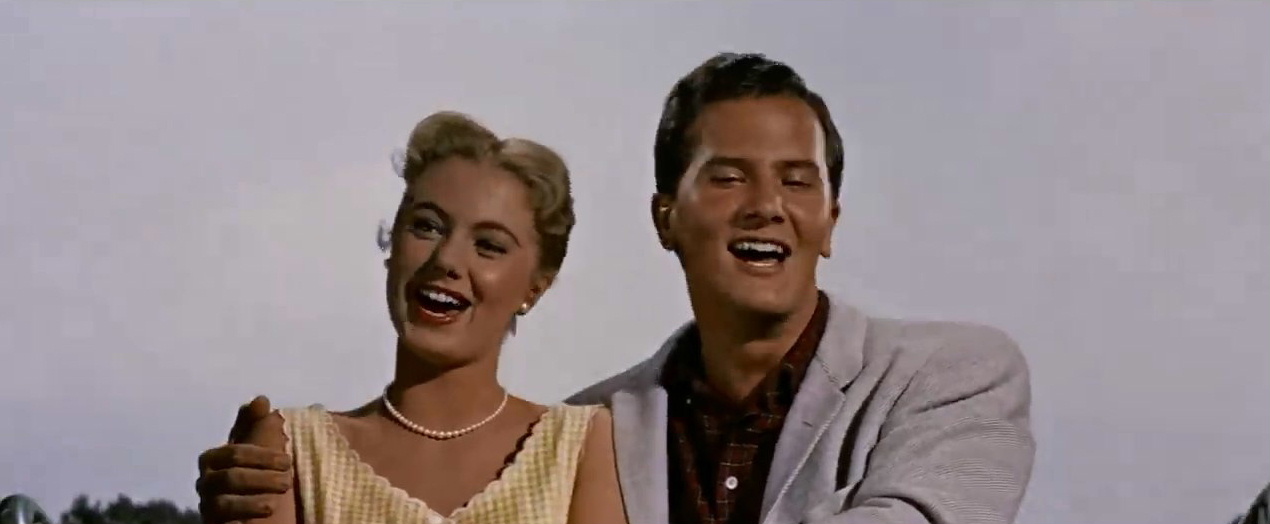
Sing out: Shirley Jones and Patty Boone
APRIL LOVE (1957). Director: Henry Levin. 

Nick Conover (Pat Boone of State Fair) is supposedly a "bad boy" who was sent from Chicago to Kentucky by his mother after his being arrested for taking a joy ride. Living with his Aunt Henrietta (Jeanette Nolan) and grumpy Uncle Jed (Arthur O'Connell of Anatomy of a Murder) on their farm, he fixes the old man's tractor and develops a crush on the neighbor gal, Fran (Delores Michaels). This doesn't sit well with Fran's sister, Liz (Shirley Jones), who develops a yen for Nick herself. And besides, Fran already has a boyfriend in Dan (Matt Crowley). Before a major triangle can develop, however, Nick bonds with a beautiful horse named Tugfire, who used to belong to Jed's son (who was killed in the war), and before you know it he's off to the races! But will his bad behavior back in Chicago catch up with him? 

Off to the races!
Hardly a classic, April Love succeeds on sheer amiability and the likability of its players. With a credible Boone in the lead the film becomes a musical, with him and others warbling several numbers. A couple of these are instantly forgettable but "A Gentle Girl" and the title tune are pleasant numbers, very well-sung by Boone, who now and then reminds one of Crosby. Delores Michaels [The Wayward Bus] was an attractive and talented actress who had a limited number of credits. Second lead Matt Crowley mostly had television credits. Henry Levin was a very busy director who worked with Boone on three films. 

NOTE:  April Love is a remake of Home in Indiana, which has a bit more pathos and sentiment but is not as smooth and entertaining as this. This version turns the two rivals for the hero's affections into sisters, and also gives the uncle a son who died in the war. It eliminates the likable if stereotypical black characters. There are no musical numbers in the original film.  

Verdict: The horse nearly steals the show! ***. 

Thursday, August 8, 2019

BUS STOP

Monroe and Don Murray
BUS STOP (1956). Director: Joshua Logan. Based on the play by William Inge.

"Ain't it wonderful when somebody so terrible turns out to be so nice." -- Cherie.

Bo Decker is a young rancher who has a lot of energy but little experience with life or women. With his foreman and best friend, Virgil (Arthur O'Connell), he travels to Phoenix, Arizona to compete in a rodeo. He is certain that he will meet the right gal for him, and is convinced that that is just what's happened when he runs into nightclub entertainer Cherie (Marilyn Monroe). The trouble is that while Cherie may think Bo is handsome, she has no intention of marrying a complete stranger that she has just met. Bo, unfortunately, simply won't take no for an answer ...

Don Murray as Bo
Bus Stop was based on a stage play by William Inge, and it was opened up by screenwriter George Axelrod. Joshua Logan also directed the film version of Inge's Picnic the same year, although he had not directed the stage version of Bus Stop as he did Picnic. The movie benefits from inspired casting. Marilyn Monroe is simply outstanding as Cherie -- possibly the best performance of her career -- and is able to bring out the pathos and confusion in her character as well as her more comical aspects. Her interpretation of "That Old Black Magic" which she deliberately sings off-key in the saloon is very funny. Don Murray [Advise and Consent], whose first theatrical film this was, is also excellent, just perfect in fact, as Bo, managing to make a man who seems nearly psychotic at times a bit vulnerable and greatly appealing in some instances.

Arthur O'Connell and Monroe
As for the rest of the cast, Arthur O'Connell offers another of his spot-on performances as father surrogate Virgil. Betty Field [Seventeen] makes an impression, and seems to be channeling Mae West a bit, as the coffee shop owner, Grace. Robert Bray [Never Love a Stranger] has possibly his best role as the bus driver, Carl, who has a yen for Grace, and who has a fateful encounter with Bo. Eileen Heckart and Hope Lange are also effective in smaller roles as, respectively, Cherie's friend and co-worker and a young woman on the bus who befriends Cherie. Like Picnic, this romance has a bittersweet conclusion. Murray was nominated for an Oscar (supporting); Monroe should have been. The TV series Bus Stop was very loosely based on this movie.

Verdict: Very entertaining and well-acted comedy drama. ***. 

Thursday, July 25, 2019

PICNIC

An iconic image from Picnic by James Wong Howe
PICNIC (1956). Director: Joshua Logan. NOTE: Logan also directed the stage play. This review gives away some important plot points.

Hal Carter (William Holden) is a drifter and failed, wannabee actor who winds up in Kansas where he looks up an old buddy named Alan (Cliff Robertson), hoping to find work. Alan's father gives Hal a job, but things are complicated at the Labor Day picnic when Hal and Alan's fiancee, Madge (Kim Novak), find themselves attracted to one another. Alan is furious, but Madge's mother (Betty Field) is horrified at the fate in store for her daughter if she runs off with Hal. Meanwhile Madge's younger sister, Millie (Susan Strasberg), is suffering growing pains, and their border, spinster schoolteacher Rosemary (Rosalind Russell), is having a crisis of her own.

William Holden and Kim Novak
Picnic is based on the Pulitzer prize-winning stage play by William Inge, and screenwriter Daniel Taradash has intelligently opened up the drama without apparently losing much of the original's meat. Both of the two leads, Holden and Novak, are too old for their roles -- Novak was twenty-three and Holden thirty-eight looking older -- and Holden is really not the right type for Hal at all, but he still manages to give quite a good performance, as does Novak, whom I've always believed could be quite accomplished with the right role and director. Betty Field and Susan Strasberg score as mother and younger daughter, and Rosalind Russell, while she tends to overplay in some sequences, has a terrific moment when she's begging her steady beau, Howard (Arthur O'Connell, carried over from the stage version), to marry her. Cliff Robertson gives one of his best performances as Alan, a nice guy who is treated badly even as he treats Hal badly out of jealousy. There are also nice turns by Verna Felton (the tough maid on I Love Lucy) as a very sympathetic neighbor who takes to Hal right off the bat, and Reta Shaw and Phyllis Newman in smaller roles.

William Holden
Just as straight writers composed stories that revolved around female objects of desire, some gay writers did the same thing with male figures as the centerpiece. Tennessee Williams comes to mind with his "Orpheus Descending," which debuted on the stage four years after Picnic (although Williams' first version, "Band of Angels," dates back to 1940. Meanwhile "Orpheus" was filmed as The Fugitive Kind with Marlon Brando three years after Picnic hit screens.) Both Picnic and Fugitive Kind deal with sexy bad boys and drifters who burst into town and inflame passions among women; the plays and movies were too soon before Stonewall to deal upfront with any gay influences. This is not to say that the characters were all meant to be male.

Rosalind Russell and William Holden
However, both plays have more on their minds than just virile rough trade. Picnic is basically a study of small-town desperation and loneliness; the film has persistent undercurrents of both. It is made clear that Hal is just as lonely in his own way as Rosemary is, culminating in a painful sequence when Rosemary humiliates Hal after he, in her mind, rejects her advances. The film also looks at the pain of growing older and the anguished jealousy it can engender when a middle-aged person is confronted by someone with youth and promise and more overt attractiveness and sensuality.


Cliff Robertson and William Holden
Picnic has many memorable sequences. There is the amusing montage of scenes at the picnic, with crying babies, cute dogs, and silly games, and -- in contrast -- the sort of sexy slow dance that Hal and Madge do together on the bandstand. James Wong Howe's cinematography is outstanding, and George Duning has contributed a sensitive score. Picnic has to be considered an anti-romantic film. Playwright Inge probably meant the ending to indicate that Madge is giving full range to her feelings and taking a chance on life and love and perhaps getting away from a stifling small-town environment, but in the bittersweet conclusion she's also going off with a man she has known for only one day. (Paging Dr. Phil!) And does anyone really think the relationship between Rosemary and Howard will work?

The play starred Ralph Meeker as Hal, Paul Newman as Alan, Janice Rule as Madge, Eileen Heckart as Rosemary, and Arthur O'Connell as Howard. Aron Copeland's beautiful opera The Tender Land, which debuted around the same time as the stage version of Picnic, also dealt with a young woman who falls in love overnight with a drifter and wants to run away with him.

Verdict: Despite some problems, this is an excellent picture. ***1/2. 

Thursday, May 16, 2019

ANATOMY OF A MURDER

James Stewart
ANATOMY OF A MURDER (1959). Produced and directed by Otto Preminger.

"Get off the panties! You've done enough damage." -- Judge Weaver.

Folksy former D. A. Paul Biegler (James Stewart) is importuned by his soused buddy, Parnell (Arthur O'Connell), to defend an Army lieutenant, Manion (Ben Gazzara), after the man shoots and kills a bar owner who allegedly raped his wife, Laura (Lee Remick). The trouble is that Laura seems rather sluttish, Manion has a hair-trigger temper, and the defense that Biegler comes up with -- an irresistible impulse that Manion couldn't control -- may not fly with the jury. And a hot shot prosecutor from out of town, Claude Dancer (George C. Scott), may put the lie to Laura's story in any case.

Eve Arden and Arthur O'Connell
Anatomy of a Murder is a frustrating picture. On one hand, it is very entertaining, frank, suspenseful and fast-paced, its nearly three hour length flying by in short order. There are also some excellent performances from Stewart (who in one interview did not seem to see his character as any kind of hero, which he isn't); Remick (who offers one of her best performances, in fact); Gazzara; a splendid Scott, who makes the most of his comparatively brief scenes; and especially O'Connell, who is superb as Parnell -- Stewart, O'Connell and Scott all received Oscar nominations, the last two in support. Eve Arden is also on hand as Biegler's seriously underpaid secretary, and she also makes the most of her scenes with her customary aplomb. Murray Hamilton also scores as a bartender, along with Kathryn Grant as the daughter of the victim, and Don Ross [Walk the Dark Street] makes his mark as a jailbird who testifies against Manion. Sam Leavitt's [Advise and Consent] cinematography was also rightly nominated for an Oscar, although I didn't especially care for Duke Ellington's jazz scoring.

Ben Gazzara
On the other hand, if you're expecting a neat and tidy story where all of the loose ends are tied up as in a Perry Mason episode, be forewarned that Anatomy of a Murder is not only ambiguous in its plot line but morally ambiguous as well. This last is no surprise, as the film is based on a novel written by the defense attorney who actually represented someone similar to Lt. Manion and fictionalized the true case. The result in real life was the same as in the movie. Frankly, some people may want to throw something at the TV screen when the film is over, while others will ruefully note that the justice system is imperfect and some people never quite get the justice they deserve.

George C. Scott and Lee Remick 
Another problem with the picture is that at times it is off-puttingly light-hearted, almost playing like a parody of a courtroom drama. You're gratified when the judge finally tells people that this is a serious matter, although it seems to take him forever to do so. Stewart's "aw shucks" manner becomes a little grating at times. And what on earth is up with that flamboyant cigarette holder than Manion uses in the court room? Judge Weaver is played by an actual judge, Joseph N. Welch, who later became an actor and had three credits. Although his performance is okay, for better or worse he does add to the almost comical tone of some sequences in the picture. Otto Preminger also directed the terrific Angel Face.

Verdict: Your call. Quite absorbing and well-acted, one of Preminger's better directorial jobs, thought-provoking, but it may have you gritting your teeth. ***. 

Thursday, March 30, 2017

VOICE IN THE MIRROR

Bar mates: Richard Egan and Arthur O'Connell
VOICE IN THE MIRROR (1958). Director: Harry Keller.

"We're all in the same boat, none of us more than one drink away from the gutter for the rest of our lives."

"I spilled more whiskey than you ever drank."

Commercial artist Jim Burton (Richard Egan) claims to have started drinking since the death of his little girl, but his doctor, Leon (Walter Matthau), reminds him that he was drinking before that and would probably have used any excuse. Jim's patient wife, Ellen (Julie London of The Helicopter Spies), is forced to put up with broken promises and wondering if and when he'll come home and what condition he'll be in. Now Leon tells him that his alcoholism may have created serious nerve damage. A fellow drunk named Harry (Harry Bartell) tells him that he thinks the solution to their problem may be through spiritualism, but Jim discovers that the secret may be to help other drunks --  alcoholics can help other alcoholics stay sober. Although set twenty years later, Voice in the Mirror basically appears to be the story of the formation of Alcoholics Anonymous (although the term is never used and there's not as much emphasis on religiosity; AA's famous slogan is used at the end, however.) In any case, the picture is absorbing and generally well-acted, with a moving conclusion. Egan and London are not exactly perfect casting for this film (stolid Egan never quite seems desperate enough for one thing), but both of them have their moments; oddly, London is better in her more emotional and difficult scenes than in her quieter ones. Harry Bartell and Doris Singleton, who plays Jim's sympathetic co-worker, have nice bits; both of them appeared several times on I Love Lucy. Arthur O'Connell nearly steals the picture as one of Jim's sad friends, and Matthau, in an unexpected role as the no-nonsense doctor, is also excellent. Ann Doran and Peggy Converse make their marks, respectively, as a landlady and the mother of a suicidal young drunk played by Troy Donahue. Eleanor Audley [Sleeping Beauty] is fine as a woman at a soup kitchen, and I believe that's Mae Clarke [Frankenstein] playing the first woman member of Jim's group. One of the best scenes depicts Jim's frightening nightmare in which he is caught in a train tunnel as a rushing train threatens to run him down.

Verdict: Imperfect but interesting and affecting drama. ***.

Thursday, December 25, 2014

THE GREAT RACE

Blink and you'll miss her: Vivian Vance
THE GREAT RACE (1965). Director: Blake Edwards.

Near the turn of the century, rival daredevils Professor Fate (Jack Lemmon) and the Great Leslie (Tony Curtis), among others, embark on a race from New York to Paris (they go way up north and head for Siberia to make their way into Europe). They are joined by Maggie Dubois (Natalie Wood), a suffragette and wannabee reporter. Along the way -- the very longgg way -- they have assorted misadventures ... Frankly, I only put on The Great Race because I heard Vivian Vance [The Blue Veil] was in it. Unfortunately, "Ethel" -- now playing the wife of newspaper editor Arthur O'Connell -- is a mere "guest star" and is on screen for at best a minute and a half. Boo hiss! Worse, the movie is nearly three hours long. No, it's not awful and there are enough entertaining moments and good acting to keep you watching, but there's no need for this picture to be so long. (The movie is, rather presumptuously, dedicated to Laurel and Hardy, who certainly never needed three hours to make a funny movie!) Probably inspired by the success of such mammoth productions as Around the World in 80 Days and It's a Mad, Mad, Mad, Mad World, The Great Race is bloated and episodic, with way too many digressions. There is a long and unnecessary detour involving a foppish (or stereotypically gay?) prince who happens to be a lookalike of Fate's, a sequence which could and should have been excised from the final cut, despite some good performances from Lemmon as the prince and George Macready as a conniving member of his court. A sequence for some reason situated in the old west has Dorothy Provine [Kiss the Girls and Make Them Die] -- looking sort of like a monkey with a bouffant hairpiece that threatens to topple off of her head any minute -- belting out a terrible number, but at least it leads into a fairly rousing bar fight. On the other hand, a pie fight that caps the prince sequence goes on too long (keeping in with the "theme" of the movie) and hasn't a single laugh. Oddly, the best scene in the movie is a well-cut and choreographed sword and saber fight between Curtis and Ross Martin that isn't played for laughs but plays. Jack Lemmon is in manic mode (as he was in Luv) throughout the movie but is effective on that sometimes irritating level. Curtis and Wood are Curtis and Wood, although they are well-coached in their line readings. Keenan Wynn, Larry Storch, Macready and Martin make a better impression.

Verdict: Not quite "Blake's Folly" -- but not for lack of trying. **1/2.

Thursday, May 30, 2013

A TASTE OF EVIL

Barbara Parkins and Barbara Stanwyck
A TASTE OF EVIL (1971 telefilm). Director: John Llewellyn Moxey.

After starring in the mediocre The House that Would Not Die, Barbara Stanwyck appeared in a second ABC "Movie of the Week" for producer Aaron Spelling, and this time the results are more felicitous. Susan (Barbara Parkins) was raped as a child by an unknown assailant on the grounds of her family estate. After years of therapy in Europe she returns home to her mother, Miriam (Barbara Stanwyck), the strange handyman John (Arthur O'Connell), her uncle and now stepfather Howard (William Windom) and sympathetic Dr. Lomas (Roddy McDowall). It isn't long before her shadowy memories of the assault begin to plague her, and she also keeps seeing the corpse of Uncle Howard, whom she suspects of the rape, in various places -- the trouble is that Howard is alive. A Taste of Evil has a tricky screenplay by Jimmy Sangster (The Nanny, Hysteria, Scream of Fear etc.) that contains some surprises, and good performances from the entire cast. Without giving too much away, it is safe to say that Stanwyck offers a chilling portrait of one of the worst mothers who ever existed on celluloid. She doesn't gnash the scenery as lesser actresses would do, but wisely underplays and is that much more memorable and formidable, making this one of her better latter-day assignments. Some people see this as a remake of the Sangster-written Scream of Fear, but despite similarities the movies are quite different.

Verdict: Interesting enough on its own terms but Stanwyck really makes it worth watching. ***.