Lively, entertaining reviews of, and essays on, old and newer films and everything relating to them, written by professional author William Schoell.
Showing posts with label romantic drama. Show all posts

Thursday, September 14, 2023

THE BAREFOOT CONTESSA

Humphrey Bogart and Ava Gardner
THE BAREFOOT CONTESSA (1954). Written, produced, and directed by Joseph L. Mankiewicz. 

Spanish dancer Maria Vargas is turned into a movie star by spoiled wealthy producer Kirk Edwards (Warren Stevens of The Price of Fear), famous director Harry Dawes (Humphrey Bogart), who has been on the wagon for several months, and ass-licking public relations man Oscar Muldoon (Edmond O'Brien). The beautiful Maria is desired by a great many men, including the South American millionaire Alberto Bravano (Marius Goring), and Italian Count Torlato-Favrini (Rossano Brazzi), but she has other dalliances with men not quite as rich. One of these dalliances will lead to tragedy ... 

The Barefoot Contessa opens with Maria's funeral, so you know her fate from the first, and the movie's flashbacks show how she got there. There isn't much about the picture-making process, and Maria -- although she stars in three films in a row -- is never shown on a set, nor do we see Dawes working his magic on his star. One of the most interesting sequences purports to show Maria dancing in a nightclub, although we never actually see Maria, only the varying reactions from the people in the audience, an audacious touch. (Later on Maria is shown dancing with a gypsy in the forest.) A lot about Maria's character is given away in drips and drabs. Gardner is really required only to be beautiful and sensual and a bit enigmatic, and she carries this off quite well, although it could not be called great acting. On the other hand, Bogart gives one of his best performances in this. O'Brien won an Oscar for his supporting performance, although it's well within his rather wide range. Stevens and especially Goring are both fine as dueling millionaires, and their sallies at one another at a party makes for one of the most arresting sequences in the movie. Edwards seems to derive no joy from his money, while Bravano enjoys life to the fullest. Rossano Brazzi is certainly a very handsome fellow, but in this film his performance lacks passion, although one could argue that he is playing a highly depressed character who probably has trouble getting excited about anything, except perhaps Maria, from whom he keeps a terrible secret.

Warren Stevens and Ava Gardner
There are some solid supporting performances in the picture: Mari Aldon as Myrna, who is badly mistreated by Edwards; Diana Decker [Is Your Honeymoon Really Necessary?] as a drunken blonde at a party who gets into it with Maria; Elizabeth Sellars [The Chalk Garden] as Jerry, a script girl who is Dawes' girlfriend; Valentina Cortese as Brazzi's sister; young Enzo Staiola [The Bicycle Thief] as a busboy with an eye for the ladies; Franco Interlenghi as Maria's brother, Pedro; Carlo Dale in a sexy, insinuating silent performance as Brazzi's chauffeur and Maria's lover; and former silent star Bessie Love as a patron at what is probably meant to be the casino at Monte Carlo. 

The Barefoot Contessa is an entertaining and absorbing picture, but there may be less here than meets the eye. Mankiewicz' targets are pretty familiar: wealthy movie producers who never worked a day in their lives and have no real taste; glamorous movie stars who seem to have no appreciation of their careers and what it's given them: oily publicists; the idle rich and the European jet set; and so on. Still, there are some amusing and trenchant observations scattered throughout the picture, along with some great dialogue. The situation with Maria and the count is a pathetic and intriguing one as well. The ending, in which Bogart is saddened by Maria's death but displays no anger at her killer is odd, but may be indicative of the production code's edict that adulterers must be punished. It's a major weakness in the movie. Marlon Brando was originally sought for the part played by Bogart, but I can't imagine Brando in the role. 

Verdict: Colorful picture that is not exactly about the picture business. ***.

Thursday, April 27, 2023

IT STARTED IN PARADISE

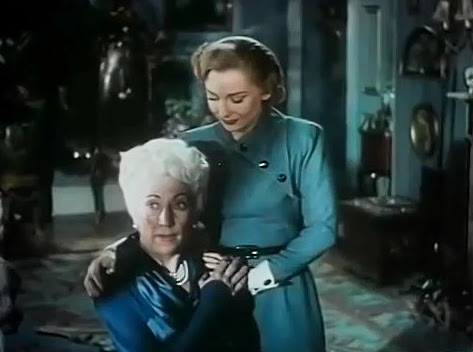
Martita Hunt and Jane Hylton
IT STARTED IN PARADISE (1952). Director: Compton Bennett. 

In the years leading up to WW2, Martha Watkins (Jane Hylton of The Manster) is frustrated that her employer, fashion designer Mme. Alice (Martita Hunt), thinks her designs are far too modern. Martha takes advantage of the situation after she importunes Alice to go off for a rest cure, and makes major changes to the line and even the studio itself. With the backing of her boyfriend, Arthur (Ian Hunter), Martha rises in the world of fashion, but makes the mistake of falling for a supposedly French bounder named Edouard (Terence Morgan). Meanwhile a younger designer, Alison (Muriel Pavlow of Murder She Said) and her boyfriend, Michael (Brian Worth), may prove formidable competition to Martha. Will ruthless Martha come undone?

Paging RuPaul!
If this film had been made in the United States ten years later it might have starred Susan Hayward at her bitchiest and been a lot of fun, but this comparatively dull British flick never really catches fire. Jane Hylton is a more than competent actress but she lacks that intense and fiery presence that might have made her performance more compelling. The others in the cast are all good enough, and Kay Kendall sparkles a bit as a superficial creature who makes an arrangement with Martha to bring in customers in exchange for clothing. The movie has an absolutely hilarious climax in which Alison shows up Martha with her own showing, featuring designs based on Elizabethan clothing. While these outfits might work for a costume party -- or for some drag queens -- the ordinary 20th century female would hardly be caught dead in most of them! Compton Bennett directed much better pictures, such as Daybreak. Malcolm Arnold's score helps just a bit. 

Verdict: Dig those crazy gowns! **. 

Thursday, July 9, 2020

STRANGERS WHEN WE MEET

Kim Novak and Kirk Douglas
STRANGERS WHEN WE MEET (1960.) Director: Richard Quine. Screenplay by Evan Hunter, based on his novel of the same name.

"Outraged innocence is always a good gambit, but the amateur always overplays it." -- Felix.

Larry Coe (Kirk Douglas) is an award-winning architect who is always hoping he'll be given the opportunity to fulfill his potential as an artist. Although he is happily married to Eve (Barbara Rush), and has two little boys, he is galvanized by the sight of a beautiful neighbor, Maggie (Kim Novak), who also has a husband (John Bryant) and young son, and is instantly attracted. Initially resistant, Maggie is eventually won over by the persistent and narcissistic -- and presumptuous -- Larry and the two begin an affair even as Larry designs a house for author Roger Altar (Ernie Kovacs). Maggie seems to be content with the way things are, but Larry isn't so certain, especially when he's offered a job that will take him and his family to Hawaii for five years.

On the beach: Kim Novak and Kirk Douglas
Although the plot goes in a very different direction, you're immediately reminded of Fatal Attraction, because in this movie Douglas basically plays a self-serving pig just as his son does in the later film. Larry seems to give absolutely no thought to his wife and children and is only concerned with his own gratification. Maggie at least has some excuse -- her husband is under-sexed, possibly even asexual, and she is neglected in the bedroom. That this is a sexual affair is made very clear, but that this is supposedly a romantic relationship is not as certain -- sexual obsession maybe -- despite the film's attempt to turn this into some kind of Brief Encounter, which it certainly isn't.

Larry (Douglas) is confronted by Felix (Matthau)
The acting and direction helps a lot. Aside from some moments when she is overly affected, Kim Novak gives a solid performance, proving that she had become quite accomplished in the right role and with a sympathetic director. However, she is so beautiful, such an obvious sex object (which may not have been the case in the novel) that it unbalances the story -- Larry just seems like a horny jerk after a hot babe. Douglas is excellent, but one senses he doesn't plumb Larry's guilt or vulnerability because he doesn't see Larry as doing anything wrong! Barbara Rush puts the viewer on Eve's side, and it's a little sickening when Eve starts blaming herself for her husband's affair. Another actor who really scores is Walter Matthau, playing Felix, a jealous neighbor and alleged friend of Larry's who confronts him about the affair and then makes a repellent play for Eve in a very tense and disquieting sequence. In her last screen role Virginia Bruce makes an impression as Maggie's mother; an interesting character whose back story is only hinted at. Ernie Kovacs is okay as the author who wants Larry to design his dream house, but his part is pretty unnecessary to the story. John Bryant does the best he can do with a thankless role. Betsy Jones-Moreland [Last Woman on Earth] and Paul Picerni play party guests.

Kirk Douglas and Barbara Rush
Then there's the subject of rape. Maggie tells Larry about how she flirted with a man who insisted on coming over to the house when her husband was out, and forced himself upon her after she had taken a sleeping pill. Larry accuses Maggie of wanting to sleep with the man, which is why she supposedly didn't lock the door before retiring. Whatever the case, the whole business of sexual assault is glossed over as if she were talking about somebody making a mere pass.

Verdict: Rather depressing look at martial infidelity with a rather unlikable protagonist. **1/4. 

Thursday, January 23, 2020

BUS RILEY'S BACK IN TOWN

BUS RILEY'S BACK IN TOWN (1965). Director: Harvey Hart. Screenplay by William Inge, writing as "Walter Gage."

Bus Riley (Michael Parks of Kill Bill) has spent three years as a sailor and now has come back to his small town and his family, which consists of his mother (Jocelyn Brando) and two sisters, worshipful Gussie (Kim Darby) and disdainful Paula (Mimsy Farmer of Four Flies on Grey Velvet). Also in the household is a boarder named Carlotta (Brett Somers), who objects to Bus' noisy presence. Bus discovers that his old sweetheart Laurel (Ann-Margret) is married to a wealthy older man, but bored and childish, she won't leave him alone. Bus had planned for a career as an assistant mortician, but that doesn't work out when lonely and middle-aged Spencer (Crahan Denton) -- who runs the funeral parlor with his no-nonsense mother (Ethel Griffies) -- wants Bus to move in with him and all that implies. Bus gets a job selling a house disinfectant device to lonely housewives while dallying with Laurel, but a neighbor girl named Judy (Janet Margolin) also catches his attention, especially after a tragedy in her family. But will Bus have the strength to cut all ties with selfish Laurel?

Michael Parks
Bus Riley's Back in Town started out as a short play by William Inge, who turned it into a screenplay, then was dismayed when changes to the script were made to accommodate Ann-Margret (who later claimed that she didn't care for the changes either). So dissatisfied was Inge that he used the name "Walter Gage" instead of his own. I don't know what the screenplay was like before it was changed, but Bus Riley comes off mostly like warmed-over Inge, with snatches of Picnic and other plays,  For instance, in both movies we've got a widow with two daughters who takes in boarders, one of whom is a neurotic spinster, not to mention a handsome hero who ignites sexual interest in many.

Ann-Margret
As for the actors, most of them are so good that you wish they had been given better material. This includes Brett Somers, whose part seems to have been cut to the bone; Kim Darby, whose feelings for her brother seem to border on the incestuous; Griffies and Denton as mother and son; Alice Pearce as a potential customer; and Janet Margolin in a sensitive turn as Judy, among others. As for Ann-Margaret, her appearance does not really unbalance the movie as some have suggested, and I happen to think that she's excellent in the film. Her sex-kitten mode is completely appropriate for her part, and she runs with it, out-acting Parks, whose James Dean impressions do little to suggest that the chief reason for casting him wasn't his considerable sex appeal. Both he and Ann-Margret are, in a word, voluptuous.

Margolin, Parks and Denton
An interesting aspect to the film is its pre-Stonewall treatment of homosexuality. One could argue that mortician Spencer is almost guilty of a form of harassment when he makes his suggestion to Bus (although he places his hands nowhere besides Bus' knee), but the man comes off as more desperate and pathetic than anything else. Bus doesn't get angry, but he is clearly disillusioned and simply walks out of the room. Later, at a minor character's funeral, he is friendly to Spencer and vice versa but it is, of course, awkward, and he excuses himself quickly. Inge himself was a deeply closeted homosexual man.

Michael Parks
For a time the star build-up certainly worked for Ann-Margret, but Parks' period of movie stardom was very brief, with him returning to television where he started with Then Came Bronson. He managed to amass 145 credits, however, and had a successful career by any standard, although mega-stardom eluded him. As for Bus Riley it got a surprisingly good review from the New York Times at the time of the film's release, but other reviews were mixed. It is probably the weakest of the films inspired by Inge's work. Harvey Hart also directed Dark Intruder.

Verdict: Inge Lite. **1/2. 

Thursday, July 25, 2019

PICNIC

An iconic image from Picnic by James Wong Howe
PICNIC (1956). Director: Joshua Logan. NOTE: Logan also directed the stage play. This review gives away some important plot points.

Hal Carter (William Holden) is a drifter and failed, wannabee actor who winds up in Kansas where he looks up an old buddy named Alan (Cliff Robertson), hoping to find work. Alan's father gives Hal a job, but things are complicated at the Labor Day picnic when Hal and Alan's fiancee, Madge (Kim Novak), find themselves attracted to one another. Alan is furious, but Madge's mother (Betty Field) is horrified at the fate in store for her daughter if she runs off with Hal. Meanwhile Madge's younger sister, Millie (Susan Strasberg), is suffering growing pains, and their border, spinster schoolteacher Rosemary (Rosalind Russell), is having a crisis of her own.

William Holden and Kim Novak
Picnic is based on the Pulitzer prize-winning stage play by William Inge, and screenwriter Daniel Taradash has intelligently opened up the drama without apparently losing much of the original's meat. Both of the two leads, Holden and Novak, are too old for their roles -- Novak was twenty-three and Holden thirty-eight looking older -- and Holden is really not the right type for Hal at all, but he still manages to give quite a good performance, as does Novak, whom I've always believed could be quite accomplished with the right role and director. Betty Field and Susan Strasberg score as mother and younger daughter, and Rosalind Russell, while she tends to overplay in some sequences, has a terrific moment when she's begging her steady beau, Howard (Arthur O'Connell, carried over from the stage version), to marry her. Cliff Robertson gives one of his best performances as Alan, a nice guy who is treated badly even as he treats Hal badly out of jealousy. There are also nice turns by Verna Felton (the tough maid on I Love Lucy) as a very sympathetic neighbor who takes to Hal right off the bat, and Reta Shaw and Phyllis Newman in smaller roles.

William Holden
Just as straight writers composed stories that revolved around female objects of desire, some gay writers did the same thing with male figures as the centerpiece. Tennessee Williams comes to mind with his "Orpheus Descending," which debuted on the stage four years after Picnic (although Williams' first version, "Band of Angels," dates back to 1940. Meanwhile "Orpheus" was filmed as The Fugitive Kind with Marlon Brando three years after Picnic hit screens.) Both Picnic and Fugitive Kind deal with sexy bad boys and drifters who burst into town and inflame passions among women; the plays and movies were too soon before Stonewall to deal upfront with any gay influences. This is not to say that the characters were all meant to be male.

Rosalind Russell and William Holden
However, both plays have more on their minds than just virile rough trade. Picnic is basically a study of small-town desperation and loneliness; the film has persistent undercurrents of both. It is made clear that Hal is just as lonely in his own way as Rosemary is, culminating in a painful sequence when Rosemary humiliates Hal after he, in her mind, rejects her advances. The film also looks at the pain of growing older and the anguished jealousy it can engender when a middle-aged person is confronted by someone with youth and promise and more overt attractiveness and sensuality.


Cliff Robertson and William Holden
Picnic has many memorable sequences. There is the amusing montage of scenes at the picnic, with crying babies, cute dogs, and silly games, and -- in contrast -- the sort of sexy slow dance that Hal and Madge do together on the bandstand. James Wong Howe's cinematography is outstanding, and George Duning has contributed a sensitive score. Picnic has to be considered an anti-romantic film. Playwright Inge probably meant the ending to indicate that Madge is giving full range to her feelings and taking a chance on life and love and perhaps getting away from a stifling small-town environment, but in the bittersweet conclusion she's also going off with a man she has known for only one day. (Paging Dr. Phil!) And does anyone really think the relationship between Rosemary and Howard will work?

The play starred Ralph Meeker as Hal, Paul Newman as Alan, Janice Rule as Madge, Eileen Heckart as Rosemary, and Arthur O'Connell as Howard. Aron Copeland's beautiful opera The Tender Land, which debuted around the same time as the stage version of Picnic, also dealt with a young woman who falls in love overnight with a drifter and wants to run away with him.

Verdict: Despite some problems, this is an excellent picture. ***1/2. 

Thursday, July 14, 2016

WIFE VS. SECRETARY

A pensive Jean Harlow
WIFE VS. SECRETARY (1936). Director: Clarence Brown.

Linda (Myrna Loy) is happily married to publisher Van (Clark Gable), who has a highly efficient and attractive secretary named Whitey (Jean Harlow). Linda doesn't see the pretty Whitey as a threat until her well-meaning mother-in-law, Mimi (May Robson of Bringing Up Baby), puts the thought in her head. As for Whitey, she has an adoring boyfriend in Dave (James Stewart), but she also realizes that she's developed feelings for Van. When Van and Whitey take an unscheduled trip to Havana for business, Linda jumps to conclusions and walks out, making the conflicted Whitey wonder if she has a future with her boss and if she really wants one. Wife vs Secretary is not a bad movie, but its chief appeal lies in the wonderful performances by the entire cast, especially Harlow in a more serious role of a very likable, appealing and decent woman. Myra Marsh of I Love Lucy fame plays a woman who consults with Van, and Gloria Holden of Dracula's Daughter plays Joan, a friend of Van and Linda's.

Verdict: Watch this one for Harlow and other excellent performances. ***.


Thursday, June 16, 2016

24 HOURS (1931)

Kay Francis and Clive Brook
24 HOURS (1931). Director: Marion Gering.

At a party Jim Towner (Clive Brook) turns to his wife, Fanny (Kay Francis), and asks her where things went wrong. Turns out both of them are seeing other people, with Fanny dallying with David (Minor Watson), and Jim fooling around with singer, Rosie Duggan (Miriam Hopkins). Rosie has thrown out her hoodlum husband, Tony (Regis Toomey), and trouble starts when he demands to be let back into her life again. One of the main characters winds up murdering another, with suspicion falling on a third. 24 Hours doesn't work as drama, mystery, or even melodrama, as it seems too long even at a mere 66 minutes. Of the cast Regis Toomey [Shopworn] comes off best, with Wade Boteler [The Green Hornet] also scoring as the doorman Pat, who is Rosie's brother. Clive Brook isn't bad, but he makes a rather dull leading man, and Francis is competent but not given very much to do as his wife. Miriam Hopkins [Lady with Red Hair] get a little more screen time as Rosie, bur her delivery of a couple of torch songs is almost ruined by her voice. Francis and Hopkins, although involved with the same man, don't have a single scene together, stripping the film of its main point of interest. Its stage origins are apparent, although one can't imagine this was ever any world-beater.

Verdict: This positively creaks. Even if you like Francis and Hopkins this is one you can miss. *1/2.

Thursday, February 18, 2016

THE PASSIONATE FRIENDS

Claude Rains and Ann Todd
THE PASSIONATE FRIENDS (1949). Director: David Lean.

Professor Steven Stratton (Trevor Howard) has always been in love with Mary (Ann Todd), and vice versa, but she's afraid of losing her identity and freedom in a romantic match with him and marries the wealthy Howard Justine (Claude Rains) for practical reasons instead. Years later, Mary and Steven reignite their passion and Mary's marriage almost ends, but she decides to stay with Howard. In what could only be termed an improbable and utterly amazing coincidence, Mary and Steven inadvertently wind up in adjoining rooms in the same resort at the exact same time, leading a disbelieving (of their innocence) Howard to file for divorce, even though Steven has since married another. This leads to some powerful and emotional sequences as husband and wife face the worst crisis in their lives, and an older-but-wiser Mary must make a supreme sacrifice. With direction from David Lean [Doctor Zhivago], and a script by Eric Ambler (from one of H. G. Wells' non-science fiction stories) The Passionate Friends isn't as good as Lean's earlier romantic drama Brief Encounter, but comes close. The performances by Claude Rains and Ann Todd [The Paradine Case] are simply superb, and Trevor Howard, while a cut below the other two, is also excellent. (It is probably because of the strength of the cast that it was decided not to use different actors for the varying ages of each character.) The film also boasts outstanding cinematography by Guy Green, and a fine score by Richard Addinsell, as well as a quite moving conclusion. The film is so good and so well-acted, in fact, that one can forgive the incredible coincidence that leads into the dramatic events that follow.

Verdict: Superior romantic drama with top talents involved. ***1/2.