Lively, entertaining reviews of, and essays on, old and newer films and everything relating to them, written by professional author William Schoell.

Thursday, April 2, 2020

THE SECOND GREATEST SEX

Jeanne Crain
THE SECOND GREATEST SEX (1955). Director: George Marshall.

In the old west of 1880 there are range wars between three towns who are all trying to get the lawful county seat by getting their hands on the papers inside a big safe. The men have been gone for a long time but when they finally come home with the safe, Matt Davis (George Nader) and Liza McClure (Jeanne Crain) finally get hitched. Unfortunately, before the marriage can be consummated, the safe is stolen and the war is back on. Liza and the other ladies decide to take a page from Aristophanes "Lysistrata" and hole up in a fort, withholding favors and everything else from the men folk until they give up fighting. Considering that men are "the second greatest sex," it us up to the women to set things right.

'With All My Heart" George Nader
I had heard of this flick for years but had trepidation about it because I was afraid it might be terminally cute, but while it's not quite a laugh-riot, it's still an entertaining movie. It is also a musical, with several songs by teams I'd never heard of. Things get off to a lively start with "What Good is a Woman Without a Man?" Matt (dubbed) sings a nice romantic ballad to Liza ("With All My Heart") and Reverend Maxwell (Keith Andes) leads the men in a rousing chorus of "Send Us a Miracle." And then there's the dancing, with which the picture really distinguishes itself.

Dancer Tommy Rall as Alf
The chief dancer in this is Tommy Rall [World in My Corner], who plays Alf Connors. First he is featured in an outstanding post-wedding number when he competitively dances with two other men who drop from exhaustion while he goes on to triumph. Later he does a ballet as his wife Katy (Kitty Kallen) dreams about him. As for the acting in this, Jeanne Crain makes the perfect leading lady, and Bert Lahr [Mr. Universe] makes a good impression as her father, Job. Jimmy Boyd is fun as Job's teenage son, who is always asking about S E X although -- as usual -- Job hasn't a clue as to how to discuss it with him. George Nader is fine as the hero, and we've also got good work from Paul Gilbert [So This is Paris] as a traveling salesman, Edna Skinner as the old maid schoolteacher who falls for him, and even Mamie Van Doren as a pretty maiden who sets her cap for the town preacher! George Wallace is one of the men trying to get the safe away from Matt and the others. Not as good as the earlier Seven Brides for Seven Brothers but fun.

Verdict: Say what you will about it, it's different. ***. 

THE FEMALE ANIMAL

Heartbroken: Hedy Lamarr
THE FEMALE ANIMAL (1958). Director: Harry Keller.

Tippling unhappy aging actress Vanessa Windsor (Hedy Lamarr) almost has an accident on her film set, but she is saved by handsome extra Chris Farley (George Nader). Entering into a romance with Vanessa, Farley moves into her beach house as a "caretaker," but he bridles at the thought of being seen as a gigolo. He accidentally gets involved with a pretty blond named Penny (Jane Powell) -- also coming to her rescue -- and is unaware that she is actually Vanessa's daughter. The fur will fly when Vanessa finds out she's competing with her own daughter for the man she's falling in love with ...

Jane Powell as a "drunken slut?" 
The Female Animal was forty-four-year-old Lamarr's last picture. It's likely that she wasn't crazy about being cast as Jane Powell's mother,  as Powell was only fifteen years younger, although Lamarr was still quite beautiful. She also gives a good performance in this, vividly bringing to life the sad situation of a successful woman who fears aging and being alone in the twilight years but who is doomed to meeting mostly men who just want to use her. Her emoting makes her character more sympathetic than she might have been. Most of Powell's great pictures [Seven Brides for Seven Brothers] were also behind her at this point, but she was obviously trying to broaden her range -- as a drunken slut, no less! -- and succeeds admirably, giving a terrific performance as a young woman who feels abandoned by her self-centered mother -- Vanessa fears the public even knowing that she has a daughter that age.

George Nader and Hedy Lamarr
George Nader is also good in the film, and there are notable turns from Jan Sterling as a fading actress with a yen for younger men, James Gleason as a bar owner, Jerry Paris as Chris' buddy, Mabel Albertson as Chris' landlady, and Ann Doran as Vanessa's sympathetic nurse. The movie is, in essence, a soap opera, but it works quite well on that level, and features the occasional saucy line, although it does not boast what one might call a brilliant screenplay.  Harry Keller also directed The Unguarded Moment with Nader and Esther Williams (also trying to broaden her range).

Verdict: No Sunset Boulevard, perhaps, but entertaining and generally well-acted. ***. 

MA AND PA KETTLE AT WAIKIKI

Percy Kilbride and Marjorie Main
MA AND PA KETTLE AT WAIKIKI (1953). Director: Lee Sholem.

Pa Kettle's (Percy Kilbride) cousin, Rodney (Loring Smith of Shadow of the Thin Man), who once hoped to marry Ma (Marjorie Main) but instead stayed in Hawaii to run a pineapple business, has been told to take it easy by his doctor. Rodney and his associates decide to importune Pa -- whom they wrongly think is rich and successful -- to temporarily run the pineapple business in Honolulu until Rodney's health improves. They also think Pa's brilliance will put the company on the fast track again. Against all odds, the ever-lazy Pa seems to come up with schemes that enrich the firm's coffers. But then he's kidnapped and taken to an island where he thinks there's buried treasure.

Percy Kilbride as the lazy Pa Kettle
Ma and Pa Kettle at Waikiki starts out well with several amusing sequences revolving both around Pa's efforts at the pineapple plant and Ma's encounters with the snobby bank president's wife, Teresa Andrews (Mabel Albertson of The House That Would Not Die) and her condescending lady friends. Unfortunately, the flick falls apart in the second half with the introduction of the thoroughly uninteresting kidnappers (including Russell Johnson and Myron Healey) and the whole dull business with the treasure hunt. Even the insertion of a Hawaiian version of Ma and Pa and their huge brood doesn't help, but leads to even more tedious sequences when these characters attempt to rescue Pa with Ma's super-butch assistance and a lot of coconuts. Okay, there's a cute business with a crab but that's about it.

Lori Nelson returns as the Kettle's grown daughter, Rosie, and goes to Hawaii with them, and her new love interest is Bob Baxter (Byron Palmer), who works for Rodney Kettle. Birdie Hicks (Esther Dale) returns briefly and is back to hating Ma again, leading into a funny sequence involving an air-conditioner that doesn't work the way Pa intended. This script has Ma seeming much more stupid than usual.

Verdict: Some fun, but otherwise a disappointment. **1/4. 

Thursday, March 19, 2020

RALPH MEEKER

Ralph Meeker in Code Two
RALPH MEEKER (1920 - 1988).

Meeker came to the public's and critics' attention when he replaced Marlon Brando in the stage version of A Streetcar Named Desire and won very good reviews. Then he got the lead role in William Inge's Picnic. The story goes that he turned down the lead in the film version because he didn't want to be tied down to a studio contract, and this negatively affected his career thereafter. He never attained the super-stardom of, say, a William Holden (who took Meeker's part in the film version of Picnic) but he did have a solid career and won many raves for his work in the years to come, amassing 110 credits in movies and on television. His pictures include The Naked Spur, Ada, The Food of the Gods, Jeopardy, The Fuzzy Pink Nightgown, and others that Great Old Movies is looking into this week (see below) -- including the famous Kiss Me Deadly, Meeker had three wives, the best-known of which was the actress Salome Jens of Seconds. He was only 67 when he died. 

SOMEBODY LOVES ME

Ralph Meeker and Betty Hutton
SOMEBODY LOVES ME (1952). Director: Irving Brecher.

Blossom Seeley (Betty Hutton of Spring Reunion) becomes a top vaudeville entertainer and sees a trio performing in a club one night. Spying the handsome crooner Benny Fields (Ralph Meeker of Jeopardy) -- one of the trio --  she decides "that's for me!" and hires all of them for her act. This arrangement doesn't work for long, until Benny proposes and becomes her accompanist. But soon he's "Mr. Seeley" and feels like a kept man. But did he marry Blossom for love or other motives?

Billie Bird and Cheetah? 
Although pretty much forgotten today, the real-life Seeley and Fields were once as famous as Jack Benny and Burns and Allen. This biopic revived their careers in the fifties. Betty Hutton gives one of her best performances in this, bold and brassy when she needs to be, and more subdued and lovely at other moments. Although generally one would hardly think of Ralph Meeker for the leading role in a musical, he's fine in this flick, and while he's really not a dancer, he sexily shakes his booty in one number. Robert Keith and Billie Bird [The Cat Burglar] are both first-rate as Blossom's manager and her best friend, who was once an entertainer herself. Adele Jergens also scores in an early sequence when she's a condescending headliner who gets undone by Bird and an adorable chimpanzee (who reads Variety no less). Jack Benny has a famous cameo as himself as a master of ceremonies.

Ralph Meeker
The film has some lively dance numbers and a good score comprised of classic tunes (like Gershwin's title song) and a few new numbers by Livingstone and Evans. The highlights are "I Cried Over You;" "Jealous;" "When I Was a Kid in Dixie;" and "Dixie Dreams." Meeker's voice was probably dubbed by Fields himself, as it sounds like him. An interesting scene has Benny admitting to Blossom that their marriage was essentially a career move, although according to this film he did fall in love with her later on. Hutton did only one more film after this one and then had a few TV appearances.

Verdict: Nice music, excellent performances, put over this lively musical biopic. ***. 

CODE TWO

Ralph Meeker, Jeff Richards, Robert Horton
CODE TWO (1953). Director: Fred M. Wilcox.

Three young men -- Chuck (Ralph Meeker), Russ (Robert Horton) and Harry (Jeff Richards of Born Reckless) -- join the police academy in Los Angeles and eventually ask to be assigned to the motor(cycle) squad. Chuck is a cocky if likable lug who goes after Russ' sister-in-law, Jane (Elaine Stewart of The Tattered Dress) but her focus is more on the shy-but-sexy Harry. Russ at first keeps the news about his assignment from his wife (Sally Forrest) because she fears for his safety, but tragedy is in store for one of the other men, with his two friends doing their best to avenge him. It all leads to an exciting climax in a warehouse with a boiling lime pit and a host of bad guys trying to make mincemeat of our heroes.

The three leads all give solid performances with fine support from the ladies and from Keenan Wynn as Police Sergeant "Jumbo" Culdane. William Campbell [The Young Racers] is also notable as a nasty, murderous trucker. Also on hand in smaller roles are Chuck Connors as a cop and James Craig as a police lieutenant. As for Meeker, he struts through the film with great charisma and authority.

Verdict: Well-done if minor cop melodrama. **1/2. 

KISS ME DEADLY

KISS ME DEADLY (1955). Produced and directed by Robert Aldrich.

Private eye Mike Hammer (Ralph Meeker) picks up a desperate runaway, Christina (Cloris Leachman of Happy Mother's Day, Love George), on the highway, embroiling him in a convoluted and dangerous case after they are waylaid and she is tortured and murdered. Mike barely survives himself, but he is intrigued and angry enough to determine to find out what's actually going on. As Hammer proceeds in his investigation over the objections of Lt. Pat Murphy (Wesley Addy of The Garment Jungle) -- who takes his licence away -- the bodies begin to pile up. Meanwhile Mike decides to shelter Lily Carver (Gaby Rodgers), the late Christina's terrified roommate. She and everyone but Velda (Maxine Cooper), Mike's secretary, seem concerned over a certain package that contains what Velda refers to as a "whatzis." After a number of people are beaten and killed, and Mike himself is subjected to truth serum by an unseen foe, he learns that Velda has been kidnapped. The climax occurs at a beach house occupied by a certain sinister doctor, all leading to a literally explosive finale.

Wesley Addy and Ralph Meeker
Kiss Me Deadly is one of Aldrich's best films. Although one could easily argue that it becomes hard to follow at times and under close inspection may not even make much sense, it is so brisk, well-acted, and absorbing that it is actually quite fascinating. Frank De Vol's score adds to the atmosphere,
as does Ernst Laszlo's superb cinematography, making the most of its LA locations. Then there's the acting. Meeker follows in the footsteps of Biff Elliott of I the Jury made two years earlier, and he is also near-perfect as a more thuggish variation of Mike Hammer. (Mickey Spillane did not care for the changes made to the character from novel to film.)

Percy Helton comes afoul of Ralph Meeker
Gaby Rodgers is so good as Lily that it's a surprise that she didn't become better known, but in addition to a few TV credits, she only did two pictures, this and an independent film that was barely released. Paul Stewart scores as a sinister mafia bigwig, Wesley Addy makes a convincing cop, and Marian Carr, Albert Dekker, and Maxine Cooper give flavorful performances as well. Percy Helton is up to his usual weaselly no-good-ness and figures in a sequence when Hammer uses an especially sadistic method to get a morgue attendant to talk. For a film made in the fifites, Kiss Me Deadly can be rather raw. Although Christina's torture is never actually shown, her dangling naked legs and the horrendous screams she omits tell the story in a way that might have sickened the stomachs of some viewers back in the day. (Alas, she keeps screaming as if the pliers were still being applied to her even though it's clear that no one is standing beside her any longer.)

Kiss Me Deadly deserves its reputation, although there are some critics who wax quite pretentiously about it -- profound it is not; cinematic it is. NOTE: Ahead of his time, Mike Hammer keeps an early version of an answering machine in his home office. Although much of the film's basic plot is derived from the novel, it deals strictly with mafia hoods and nothing radioactive.

Verdict: Despite the silly title, this is hard-hitting and very well done. ***1/2. 

PATHS OF GLORY

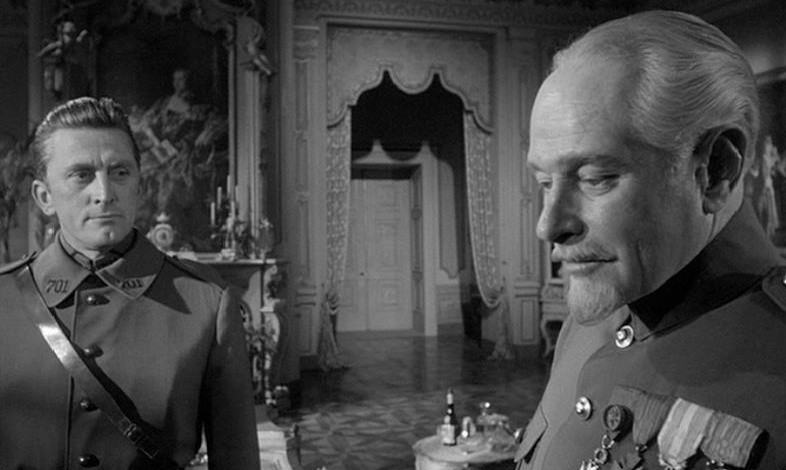
Kirk Douglas and George Macready
PATHS OF GLORY (1957). Director: Stanley Kubrick.

"There is no such thing as shell shock." -- General Mireau

French WW 1 General Paul Mireau (George Macready) initially makes it clear to General Brouard (Adolphe Menjou) that there is no way his battalion can possibly take a strategic position known as the "anthill." But Mireau changes his tune when Brousard talks about a promotion, even though they expect at least 60% casualties among their men.

Wayne Morris and Ralph Meeker
Now Mireau's second-in-command Colonel Dax (Kirk Douglas) is told in no uncertain terms that the men -- already exhausted and demoralized -- must take the hill the next day or else. Although the soldiers try their damnedest, it is an impossible and indeed suicidal task, and Mireau accuses them of cowardice. (Mireau even wants to fire on his own men because they aren't moving fast enough!) Mireau is talked out of shooting a hundred soldiers, but three are to be court-marshaled as an example. These three men are Private Arnaud (Joe Turkel of The Glass Wall); Private Ferol (Timothy Carey of The World's Greatest Sinner and Kubrick's The Killing); and Corporal Paris (Ralph Meeker), who is picked because he knows that his superior officer, Lt. Roget (Wayne Morris), essentially murdered one of his soldiers. Dax represents the men in what is basically a kangaroo court with an outcome that is clearly pre-ordained.

Old pros: Macready and Menjou
Paths of Glory is a powerful and maddening film, examining the outrageous miscarriages of justice and heartlessness that can take place during war time even among men fighting on the same side. The performances are excellent: a borderline slimy Menjou; an upright and morally-repulsed Douglas; Meeker, whose trademark cockiness eventually vanishes when he faces his own mortality; and Wayne Morris giving an unexpectedly strong performance as the morally-bankrupt Roget. Turkel and Carey are also notable -- as is Richard Anderson as the prosecutor --  but the one actor who positively walks away with the film is George Macready, who gives an absolutely ferocious and mesmerizing portrayal of the utterly loathsome and infuriating Mireau -- forget Gilda (in which I didn't think Macready was even all that great), this is the performance he should be remembered for.

Kubrick beautifully -- or rather horrifically -- recreates the WW 1 battlefield, and scenes of the men in the trenches as bombs explode unnervingly all around them are compelling, The film almost goes a bit off-course in the second half when it has aspects that remind one of the later Dr. Strangelove, but for the most part this is one of Kubrick's most successful and effective movies. Several years later the film King and Country had a similar theme but was not as good.

Verdict: George Macready's finest hour and a half and a highly memorable if imperfect picture for Kubrick. ***1/2. 

SOMETHING WILD (1961)

Carroll Baker and Ralph Meeker
SOMETHING WILD (1961). Director/co-screenplay: Jack Garfein.

Mary Ann Robinson (Carroll Baker of Bridge to the Sun) walks home from work one evening, and is pulled into the bushes and raped. This traumatic experience leads into a series of strange actions, such as her leaving home without telling her mother (Mildred Dunnock) or stepfather (Charles Watts), taking a job in a five and dime store in another neighborhood, and moving into a cramped "apartment" about the size of a closet. One afternoon on the Brooklyn Bridge she tries to throw herself into the river, but she is stopped by the intervention of a worker named Mike (Ralph Meeker). But this apparently kind stranger may have even more problems than Mary Ann does and she finds herself locked in his apartment ...

Carroll Baker
Something Wild was based on a novel named Mary Ann and directed (and co-written) by theater man Jack Garfein, who was married to Carroll Baker at the time. Baker is deglamourized in this and generally gives a good performance, as does Meeker, although both are given rather impossible characters to play. I believe the film is trying to say that two damaged individuals can find love with each other, but there's a big difference in being a (rape) victim and being (in essence) someone who commits criminal actions like holding someone against their will, so turning this into a "love" story -- and yes the film does try to make us believe this has a happy and romantic ending -- would be almost as ludicrous as having Mary Ann fall in love with her rapist (who never shows up after the opening sequence). Apologists for the film -- and there are many -- try to suggest that Mike only locked Mary Ann in because he didn't want her killing herself, but she could just have easily killed herself in the apartment and his motives for keeping her a prisoner aren't nearly so noble.

Cinematography by Eugene Shufftan
The shame of it is that this hopelessly muddled, even offensive film has a lot going for it. In addition to the leads we have notable work by Mildred Dunnock as the concerned if ineffectual mother; Jean Stapleton as a slatternly neighbor of Mary Ann's; Doris Roberts as a co-worker at the five and dime who is put off by what she perceives as Mary Ann's stuck-up attitude; Martin Kosleck [The Flesh Eaters] as the somewhat sleazy landlord; and others. The film has a highly interesting score by no less than Aaron Copland [The Heiress], and is strikingly photographed in black and white by Eugen Shufftan, who makes the most of some very familiar New York City locations. Shufftan gives the film a very grim and intense atmosphere throughout. Garfield's direction is good if imperfect. He only directed one other movie, The Strange One. 

Despite all the notable aspects, Something Wild is done in by its contrivances. One suspects the plot was concocted before the characters were conceived, and -- in the film, at least -- they are never developed all that well.

Verdict: Should these two sick individuals get married? Where is Dr. Phil when you need him? **. 

Thursday, March 5, 2020

OUR VERY OWN

Ann Blyth and Joan Evans
OUR VERY OWN (1950). Director: David Miller.

Gail McCaulay (Ann Blyth) is just about to turn 18. Gail, who has two younger sisters, is practically engaged to her handsome beau, Chuck (Farley Granger). The elder of Gail's two siblings, Joan (Joan Evans of On the Loose), is attracted to Chuck and very jealous of their relationship, and during an argument she lets slip that Gail was adopted, something Joan only recently discovered by accident. Gail's world is upended by this revelation, and she decides to seek out her birth mother (Ann Dvorak), but will she be able to ultimately handle her feelings and accept that she is very much loved by her true and supportive family? And what will her "real" mother be like?

Ann Dvorak and Jane Wyatt
Our Very Own is an absorbing and pleasant movie with good performances from Blyth, Evans and Granger as well as from Jame Wyatt and Donald Cook as the girls' parents. Ann Dvorak also scores as the birth mother who is so afraid her husband will find out about her child, and you wish she was given  more screen time. Natalie Wood is adorable as the youngest of the three sisters, and she has a cute scene when she's driving a TV installer (Gus Schilling) to distraction with all of her questions. Phyllis Kirk also appears to advantage as Zaza, a very sympathetic friend of Gail's -- her wealthy father would rather go to a party than attend her graduation.  Martin Milner is Bert, who has a crush on Joan and is rather unkind to Gwen (Kipp Hamilton of The Unforgiven), a slightly chubby girl who has a crush on him. Those who hope the film might be a trash wallow along the lines of Three Bad Sisters will be disappointed, as there are no cat fights and no talk of genetic issues that may derail marriage plans and the like.

Verdict: Compelling romantic drama with a heartwarming conclusion. ***. 

THE BONNIE PARKER STORY

Jack Hogan and Dorothy Provine
THE BONNIE PARKER STORY (1958). Director: William Witney.

In 1930's Oklahoma Bonnie Parker (Dorothy Provine of Kiss the Girls and Make Them Die) has a dead end job as a waitress after her husband, Duke (Richard Bakalyan), is sent up the river for 175 years. But then Bonnie meets the cocky "Guy Darrow" (Jack Hogan of The Cat Burglar), whose first passes are easily blocked by the feisty and easily-angered Bonnie. Eventually Guy convinces his new girlfriend that they could make a lot of money knocking off gas stations and the like, but Bonnie -- who proves much more strong-willed than Guy -- is sick of getting comparative chicken feed. Her new plan is to to break her husband out of jail and start robbing banks ...

Dorothy Provine as Bonnie Parker
Made almost ten years earlier than the more famous Bonnie and Clyde, this is arguably the better of the two pictures. Provine and Hogan give more convincing performances as these rather vicious individuals, and William Witney -- who helmed numerous cliffhanger serials -- knows how to keep things moving at a brisk pace and also creates lots of suspense in key moments. There are other good performances in the film as well: Joe Turkel [The Glass Wall] as Guy's brother; Patricia Huston as his girlfriend; William Stevens as a budding architect who sees a more romantic and tender side of Bonnie; Richard Bakalyan as Duke; Douglas Kennedy as a cop who is pursuing the couple; and others.

Jack Hogan as "Guy Darrow"
The picture has several good scenes, including the hold-up of a armored truck which is nearly interrupted by a boy scout troop and the terrified scoutmaster (Sydney Lassick), and a tense if amusing business when a cute little boy (Stanley Livingstone) seemingly identifies Bonnie and the others as "bank robbers." The climactic shoot-out is also extremely well-handled. One could argue that the film may not have a lot of period atmosphere and it's strange that Clyde Barrow's name was changed, albeit not very much.

Verdict: Very snappy AIP crime drama with vivid players. ***. 

A PAIR OF BRIEFS

Mary Peach and Michael Craig
A PAIR OF BRIEFS (1962). Director: Ralph Thomas.

Tony Stevens (Michael Craig) is a young lawyer hoping to get "briefs" -- cases -- that will pay more money than others. Tony is annoyed when newcomer Frances (Mary Peach) gets a high-paying case right off the bat due to connections, so he importunes a drunken friend of his in the prosecutor's office to let him stand up for the defendant in the same case (a highly unlikely scenario). Frances is representing Gladys Worthing (Brenda de Banzie), a shabby middle-aged woman who is suing her alleged husband, Sidney (Ron Moody of Murder Most Foul), for "restitution of conjugal rights." For his part, Sidney insists that he and Gladys were never married. As the case proceeds, Judge Haddon (James Robertson Justice) nearly has apoplexy dealing with the oddly reticent plaintiff as well as the conduct of the two opposing barristers.

Nicholas Phipps
A Pair of Briefs tries hard to be a hilarious near-farce of a comedy, but it is never as funny as it might have looked on paper. The performances are fine, with handsome Craig managing to actually come off like a nerd through much of the movie. What makes the film worthwhile and memorable are the developments and twists that come in the final third of the film, which are amusing. Also in the cast is Nicholas Phipps, who wrote the screenplay, as he did for the Craig vehicle Doctor in Love, in which he also appeared. A small part is played by Judy Carne, who later went on to fame on Laugh-In and through her combative marriage to Burt Reynolds.

Verdict: Interesting developments and a good cast help put this over. ***. 

MA AND PA KETTLE ON VACATION

Parisian dining: Marjorie Main and Percy Kilbride
MA AND PA KETTLE ON VACATION (1952). Director: Charles Lamont.

Ma (Marjorie Main) and Pa (Percy Kilbride) Kettle receive an invitation from Elizabeth and Jonathan Parker (a returning Barbara Brown and Ray Collins) -- their married daughter's in-laws -- to accompany them on a trip to Paris after their original traveling companions cancel. Once there, the foursome get embroiled in a silly story involving a nest of spies and secret Naval plans. Ma and Pa Kettle On Vacation is a step down from the previous movies in the series, although Ma and Pa remain utterly endearing creations and Main and Kilbride are superb in bringing them to life. There are still humorous lines and sequences in the film, such as when Ma belts an Apache dancer in a nightclub because she thinks he's actually hitting his lady partner, and Ma cluelessly refers to Parisians as "Parasites!"  The supporting cast includes Sig Ruman [Thank You Mr. Moto] as a spy, and the ever-versatile Jay Novello has a very small role -- as a Frenchman no less!

Verdict: The screenplay is weak but the players are spirited. **½.

PARIS MODEL

Eva Gabor and Tom Conway 
PARIS MODEL (1953). Director: Alfred E.  Green.

Four women who pick out a fancy dress -- a "Paris model" or a cheaper copy of it -- want to wow their men but wind up getting their comeuppance, except in the last instance. Gogo (Eva Gabor) hopes to hook the wealthy Maharajah of Kim-Kepore (Tom Conway) but her billing the dress to another man may cause a problem -- not to mention the appearance of a gorgeous brunette (Laurette Luez). Betty Barnes (Paulette Goddard) is in love with her boss (Leif Erickson), but his wife, Cora (Gloria Christian), may out-do the grasping secretary in the fancy dress sweepstakes. Marion Parmalee (Marilyn Maxwell) pulls out all of the stops with her husband's flirty boss Sullivan (Cecil Kellaway) in the hopes of getting hubby (Robert Bice of Invasion U.S.A.) the new presidency when the boss retires, but she doesn't reckon with Sullivan's formidable wife (Florence Bates). Marta (Barbara Lawrence) hopes that boyfriend Charlie (Robert Hutton) will propose to her for her 21st birthday dinner at Romanoff's and she may get a little help from "prince" Michael Romanoff [Arch of Triumph] himself.

Secretary vs wife: Paulette Goddard and Gloria Christian
I confess I nearly dumped Paris Model in my latest collection of "Films I Just Couldn't Finish" because the first episode with Gabor and Conway is so lame -- aside from a modestly amusing wind-up -- that I couldn't see spending much more time on it. (One can't imagine either of the Gabor sisters being crazy about having their thunder stolen by another woman.) But once I understood the point of the film, that it dealt with the dress and the stymied manipulations of its wearers -- not to mention that the later segments were more entertaining -- I found this quite enjoyable. The performances are generally good (although Eva Gabor is just plain weird, like a dopey showgirl from another dimension), with Kellaway and Bates taking the acting honors. The film comes full circle with a very funny ending when Tom Conway shows up again as the horny Maharajah. Alfred E. Green directed everything from science fiction (the aforementioned Invasion U.S.A.) to old Bette Davis movies [Dangerous] to Copacabana and everything in-between. Tom Conway's brother, George Sanders, was married to both Zsa Zsa and Magda Gabor, but somehow he never got around to Eva.

Verdict: More fun than you first imagine it will be. ***.

Thursday, February 20, 2020

ADA

Dean Martin and Susan Hayward
ADA (1961). Director: Daniel Mann.

Bo Gillis (Dean Martin of Sergeants 3) is a pleasant, uncomplicated good ol' boy running for governor under the direction of men like Steve Jackson (Martin Balsam) and savvy if crooked politico Sylvester Marin (Wilfrid Hyde-White). One night Bo is introduced to"B" girl Ada (Susan Hayward of And Now Tomorrow) and against everyone's advice eventually decides to marry her. Bo becomes governor and Ada, who doesn't trust Marin as far as she can throw him, makes a deal with him to become Lt. Governor, an idea that goes badly with Bo's male pride. When Bo announces that he's going to start reading bills before signing then and is out to clean up corruption, he is badly injured in a murder attempt. Now Ada is the acting governor, but she may find that Marin and his forces are not about to let this former whore boss them around.

Ada tells off biddies, including Kathryn Card, 2nd from left
With a plot like that -- hooker winds up becoming governor -- you would think that Ada would be a real trash wallow, but it's actually somewhere between a strong drama and a guilty pleasure and never quite makes up its mind which. The film does have a feminist perspective, even if it's only from a dated sixties point of view. Dean Martin is perfect casting for Bo -- he has to have enough charm and charisma to convince the voters but also be laid-back enough to be seen as comparatively "weak" next to strong-willed Ada. Hayward plays with her customary authority, and is especially good in a scene at a party at the governor's mansion, where she tells off a bunch of patronizing old biddies -- one of whom is Kathryn Card, Lucy's mother on I Love Lucy, here a tough old bitch and not the dithery Mrs. McGillicuddy.

Ralph Meeker and Susan Hayward
As for the supporting cast, Ralph Meeker [The Fuzzy Pink Nightgown] makes the best impression as Colonel Yancy, employing his trademark insolence to good effect as he makes flagrant passes at the governor's wife on a regular basis. (In the book this film is based on, Ada Dallas, Yancy and Ada were former lovers.) Martin Balsam is always solid but in this he isn't given much to do. The usually reliable Hyde-White is a major disappointment, giving a performance devoid of flavor and nuance -- there are at least a dozen character actors who could have given this role more bite.

Although Hayward and Martin performed surprisingly well together on camera, they did not like each other at all off-screen. For more on this and other Martin films see Martini Man: The Life of Dean Martin.

Verdict: Minor potboiler with some interesting elements. **3/4. 

THE IDOL

Michael Parks as The Idol
THE IDOL (1966). Director: Daniel Petrie.

"To be idolized, a man must offer the unusual." -- ad copy.

Marco (Michael Parks) is an American studying art in London. He has a sort of girlfriend in Sarah (Jennifer Hilary) and a kind of best buddy in Timothy (John Leyton), and the three pal around a lot together. Marco is less impressed when he meets Timothy's mother, Carol (Jennifer Jones), also an American, who is divorcing her husband and about to remarry. Carol also seems to be slightly overbearing with Timothy. Marco seems to have a problem with parents and authority in general. When Marco is embarrassed by Carol at a house-warming party, he is furious, but Carol warms up to Marco when he comes to her son's rescue after two slobs try to beat him up. One New Year's Eve Marco goes to Carol's home to find Timothy, but he has already gone to a party with Sarah. At midnight Marco gives Carol a kiss and one thing leads to another -- with highly unfortunate repercussions ...

Jennifer Jones
There were many great British films made in the 1960's, but The Idol isn't one of them. Its screenplay is half-baked and its characters poorly developed   -- especially Marco, who has little reason for doing anything he does except that he's an asshole -- and the overlong film is also tedious. Made by an American studio, The Idol would still have been a poor movie, but at least it might have been more entertaining with the right trashy cast. Parks is better in this film than he is in Bus Riley's Back in Town, but Laurence Olivier might have had trouble with this character. Jennifer Jones has the good sense to look embarrassed through most of the movie, and her performance is one of her weakest. John Leyton, although he's way too old to convincingly play someone who's just nineteen, probably comes off best. Jennifer Hilary is adequate but she lacks the raw sex appeal of, say, an Ann-Margret -- or a Michael Parks -- so her love scenes with Parks aren't very exciting.

Parks, Leyton and Hilary
Some viewers claim that Carol has incestuous feelings for her son and/or vice versa, but if this was intended, it is not handled very well. Timothy seems to have a crush on Sarah, whom he pursues when he thinks Marco has broken off his relationship with her, but it may be just as likely that Marco is the true object of his sensual attentions. In the long run, none of this makes a difference, because it's impossible to care about any of these characters. One member of the large supporting cast who deserves kudos, however, is Rita Webb as the landlady at Marco's nifty apartment who repeatedly remarks about her tenants that "they're all a bit mental." One wonders what she would think of this motley crew?

Verdict: Lame attempts at pseudo-profundity don't help and neither does an ad campaign that promises more than it delivers. **.

THE PRICE OF FEAR

Merle Oberon and Lex Barker
THE PRICE OF FEAR (1956). Director: Abner Biberman.

Jessica Warren (Merle Oberon) is driving carefree and a little drunk when she runs over an elderly man. Does she call for an ambulance? No, she keeps driving. Her temporary crisis of conscience fades when she sees dog track owner Dave Barrett (Lex Barker) "borrow" her car and figures if she reports the vehicle as stolen he will be accused of the hit and run, not she. Complicating matters for Dave -- who took Jessica's car because he was being followed by hoods who want a piece of his track -- is the fact that the same time the elderly man was run over, an enemy of Dave's was shot to death. Barrett is going to be convicted of one crime or the other, but he gets close to Jessica to find out what he can. But is she really falling in love with him or does she have her own agenda?

Warren Stevens and Merle Oberon
The Price of Fear has more than one interesting situation and the relationship between Jessica and Dave with their conflicting goals but obvious attraction to one another adds to the film's compelling quality. This was one of Oberon's last starring roles -- it's a bit surprising to see her in this kind of film noir -- and she gives an excellent performance that keeps the audience guessing as to exactly what's on Jessica's mind and what she is ultimately planning to do. Barker gives it the old college try, and his line readings are certainly not terrible, but next to Oberon he's a bit of a wooden Indian. Warren Stevens gives one of his all-time best performances as the shady character Frankie Edare, who's responsible for a lot of Dave's problems; he and Oberon play especially well together.

Lex Barker
There are also good performances from Gia Scala [The Garment Jungle] as the heartbroken daughter of the elderly man; Charles Drake [It Came from Outer Space] as the police sergeant assigned to the case; and Stafford Repp [Batman: The Black Widow Strikes Again] and Mary Field as a tippling cab driver and his unloving wife. With a little added depth and characterization, The Price of Fear would have made an even more memorable picture, but it's quite absorbing as it is. It has a tense climax and an uncompromising wind-up. Abner Biberman was primarily a television director.

Verdict: Another one of those movies that is so good you wish it were just a bit better. ***. 

FILMS I JUST COULDN'T FINISH ROUND 4

FILMS I JUST COULDN'T FINISH ROUND FOUR. 

As noted previously, these are not reviews, per se, but notes on films that I watched or suffered through until I just gave up on them for one reason or another. Sometimes I skipped to different sections just to get a sense of what was going on or to see if the film became more entertaining. Not all of these pictures are necessarily bad, they just didn't hold my attention. If you see one on the list that you think deserves another look, let me know.

Meet Mr. Callaghan (1954) is a British private eye movie about the murder of a wealthy man with four nephews and other suspects. The main character and lead actor are both rather irritating in their way, and the movie is full of cliches. I couldn't care less who the murderer was.

Sodom and Gomorrah (1962), which was directed by Robert Aldrich,  actually did not necessarily seem like a bad biblical spectacle of sorts, but I didn't care for the cast, which included Stewart Granger and a lot of actors whom I didn't find that interesting. This is an international co-production, not a Hollywood film, the reason why the cast is not exactly stellar. It all seemed a little tacky as well, just not something I wanted to spend another hour and a half on.

The Weekend Murders (1970) is actually a dubbed Italian film originally entitled Concerto per pistola solista. It is a take-off on an Agatha Christie-type British manor mystery with a reading of a will and (off-screen) murders occurring afterward. Comedy is provided by a Scotland Yard Inspector and a country sergeant who proves smarter than his superior. I actually watched most of this but it's rather slow and silly and eventually I just skipped to the end to find out who the killer was. The film's "composer," Franceso de Masi, has the temerity to rip off Tchaikovsky's Piano Concerto # 1 for the theme music, which one hopes was deliberate. The picture has no style and is not memorable.

Innocent Bystanders (1972) is a late-entry spy saga starring Stanley Baker as an aging operative who is sent on assignment by Donald Pleasence, but isn't apprised of all of the facts. I found the "mod"-like style of the film to be off-putting, and couldn't quite get through a quarter of it.

Screamers (1979) is a dubbed Italian film with Richard Johnson and Barbara Bach hoping to get treasure that is guarded by some mutated Atlanteans who have become half man and half fish. The prologue in a cave with Cameron Mitchell and Mel Ferrer has some gory moments and appears to be added afterward. In the main story Joseph Cotten plays a scientist who wants to study the fish-men. This is slow and unrewarding and isn't really a horror film at all.

Frances (1982) stars Jessica Lange in a very heavily fictionalized version of the life of actress Frances Farmer based on a biography that was later largely discredited. I didn't just turn this off after a time because I knew I wasn't going to get the real story -- Sam Shepard saunters through the movie and narrates even though his character never actually existed -- but the dramatic license at times becomes ludicrous, illogical and even outlandish. For the record Farmer was never lobotomized as this film depicts!

The Human Stain (2003) didn't hold my attention even though it actually has some interesting aspects in this study of an academic (Anthony Hopkins and Wentworth Miller in different time periods) who has hid the fact that he's African-American for virtually all of his adult life. (Ironically, he quits his job when he's accused of racism.) Based on a novel by Philip Roth (The Humbling) we have yet another old man in an improbable relationship with a much younger woman (Nicole Kidman). Both Hopkins and Kidman are miscast, and the film meanders a little too much, although Miller (bi-racial in real life) gives a very good performance.

Masks (2011) is a German-language version of an Italian giallo film, or at least that's what its proponents say it is. About a young lady who comes to study at a strange acting school, the movie is slow and dull despite the occasional bloody sword attack. Comparing it to the (best) work of Dario Argento is ridiculous. This had trouble holding my attention for more than a third.

Camp Dread (2014) is a pretty terrible film about a down-on-his-luck horror film maker (the down-on-his-luck Eric Roberts) who concocts a scheme to use troubled youths on a reality show that will ultimately turn into something like one of his horror movies. Then the youths begin getting killed. The film hasn't a dollop of atmosphere and some of the actors are amateurish to boot. Not compelling nor well-made enough to keep watching.

Suspiria (2018) is a remake of a much better film by Dario Argento centering on a coven of witches in a dance studio. The remake takes place in post WW2 Berlin, and in an attempt to add some depth and pathos to the story, drags in the events of the holocaust. The movie is long but the real problem is that it just didn't grip me or pull me into the story the way that Argento did. If they had stuck to making a simple and effective horror film this might have amounted to something. Tilda Swinton is quite good -- amazing, in fact -- in a dual role. I got about halfway through this and then peeked at subsequent sequences, some of which seemed so silly as to be laughable. Jessica Harper, the lead in the original Suspiria, has a cameo role.

Book Club (2018) has four friends -- Jane Fonda, Diane Keaton, Candice Bergen and Mary Steenburgen -- reading "Fifty Shades of Gray" for their book club and having assorted misadventures with men. Okay, for awhile this was cute, but it seemed too much like an extended ad for "Fifty Shades" (I wouldn't be surprised if the book's publisher is a division of the production company.) Too much like a sitcom, the humor is of the variety of friends getting together and making jokes about sex, the same stuff you can hear in any bar. This wasn't terrible, it just didn't hold my interest for more than half an hour. I was surprised that for a film supposedly against age discrimination, it portrays the very elderly in the same disdainful light as everything else.

Other films that failed to grip me: Hootenanny a-Go-Go; A Swingin; Summer; Gidget Goes to Rome; Every Day's a Holiday with Freddie and the Dreamers; Tough Kid; Racing Blood with Frankie Darro; Juvenile Court with Rita Hayworth; Wild Racers with Fabian; Promises, Promises with Jayne Mansfield, Maid for Murder; Hollywood Dreams; This Man is Dangerous; Adventures of a Private Eye; A Yank in Ermine; Badge of Honor with Buster Crabbe; Girl Loves Boy with Eric Linden; the eurospy flick 13 Days to Die; Doorway to Suspicion; Tale of Five Cities/Women starring Bonar Colleano; The Final Countdown with Kirk Douglas in bangs; and Master Stroke, a caper movie. 

Thursday, February 6, 2020

ANNIE GET YOUR GUN (1951)

Howard Keel and Betty Hutton in Technicolor!
ANNIE GET YOUR GUN (1950). Director: George Sidney.

Famed sharpshooter Frank Butler (Howard Keel of Jupiter's Darling) with Buffalo Bill Cody's (Louis Calhern) wild west show, takes on any challenger, but he meets his match in hillbilly Annie Oakley (Betty Hutton), who falls for him but discovers his male pride takes a beating each time she learns a new trick. During their first match she beats him, but she isn't so sure she wants to win the second one at the climax. On this she is advised by none other than Chief Sitting Bull (J. Carroll Naish) of Custer's Last Stand, who comes to see her as his honorary daughter. Will Annie get the man she loves or the prizes?

Naish, Hutton, Calhern
I had trepidation about watching this film because I had always loved the TV version with the wonderful Mary Martin, which was broadcast seven years after this film came out. I was also afraid Betty Hutton would be too overbearing. There are moments in her performance that are borderline, but I must say Hutton is excellent as Annie, capturing both the vulnerability and the pride of the character. Although Hutton does not sing badly (except on "They Say That Falling in Love is Wonderful" in which Howard Keel saves the day), her vocal skills are no match for Mary Martin's (who played Annie in a more feminine and lady-like fashion). In any case, Judy Garland was originally signed for the lead and did a few scenes that survive, and, frankly, she isn't nearly as good as Hutton.

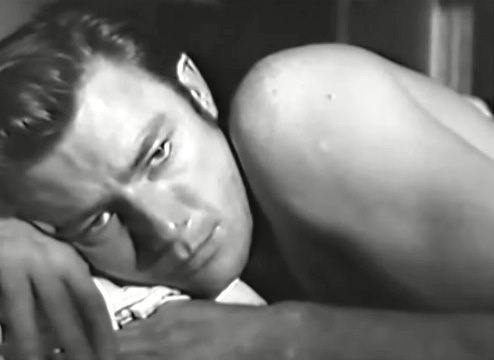
That "handsome devil" Keel
Now we come to Chief Sitting Bull. Although he was in part responsible for the massacre of American soldiers (who attacked first) at Little Big Horn, I guess that even in the 19th century celebrity trumps everything. The chief joined Buffalo Bill's show and stood around signing autographs -- yes! -- and participating in some re-enactments. Annie Oakley did indeed become like a daughter to Sitting Bull, but whether he encouraged her to throw a competition so she'd get her man is debatable. What is not debatable is that Irving Berlin's score is one of his finest, and one of the best of any Broadway musical, responsible for "There's No Business Like Show Business;""" "Doin' What Comes Naturally;" "The Girl That I Marry;" "My Defenses are Down;" "You Can't Get a Man with a Gun;" etc. although it's disappointing that the film excludes "Moonshine Lullaby;" "I Got Lost in His Arms;" "I'm a Bad, Bad Man" (which could have been quite a showcase for that handsome devil Keel); and "Old-Fashioned Wedding."
In addition to Hutton and Keel, there are fine performances from Naish and Calhern [The Asphalt Jungle] and Keenan Wynn, Clinton Sundberg, and little Brad Morrow as Annie's cute baby brother, Jake. Charles Rosher's widescreen, technicolor cinematography is often breathtaking.

Verdict: The cartoon Indians are questionable in this day and age, but the movie has an interesting (if heavily fictionalized) story and lots of great music and performances. ***. 

THE NAKED SPUR

Jimmy Stewart and Ralph Meeker
THE NAKED SPUR (1953). Director: Anthony Mann.

After the Civil War Howard Kemp (James Stewart) lost his farm to a faithless, greedy woman and is determined to buy it back with $5000 reward money for a murderer named Ben Vandergroat (Robert Ryan). Ben has been traveling with the daughter, Lina (Janet Leigh), of one of his deceased best friends, and he is equally determined to stay one step ahead of Kemp. Kemp enlists the aid of old prospector Jesse Tate (Millard Mitchell of Singin' in the Rain) and unsavory and dishonorable ex-soldier Roy Anderson (Ralph Meeker) to capture Ben, but now his two "partners" each want a third of the loot. The whole group begins a trek to Abilene where Ben is to be hung, but it's anybody's guess if they will all make it there in one piece, and if Ben will remain their captive ...

Robert Ryan and Janet Leigh. 
The Naked Spur sets up an interesting and harrowing situation -- the three captors are not just pitted against Ben and possibly Lina, but also each other -- and sustains suspense and tension all the way through. Admittedly, some scenes are not handled as dramatically as they might have been, and there's a disturbing sequence when a whole bunch of Indians are slaughtered when they are really just trying to get justice for a maiden who was apparently raped by Anderson. Stewart gives another impassioned and first-rate performance as Kemp, and Janet Leigh [Act of Violence] proves yet again that she was far more than just a pretty face. Ryan [Caught] plays in an unusual sardonic style considering what he's facing, but he pulls if off, and Meeker, as cocky as ever, makes the most of his turn as the rather sleazy Anderson. The ending seems tacked on to make Stewart's character more palatable, but it only makes him seem like an idiot. It's nice that character actor Millard Mitchell, who also gives a fine performance, is billed above the title with the four stars.

Verdict: Zesty if imperfect western with terrific cast. ***.