Lively, entertaining reviews of, and essays on, old and newer films and everything relating to them, written by professional author William Schoell.
Showing posts with label Stanley Kubrick. Show all posts

Thursday, March 19, 2020

PATHS OF GLORY

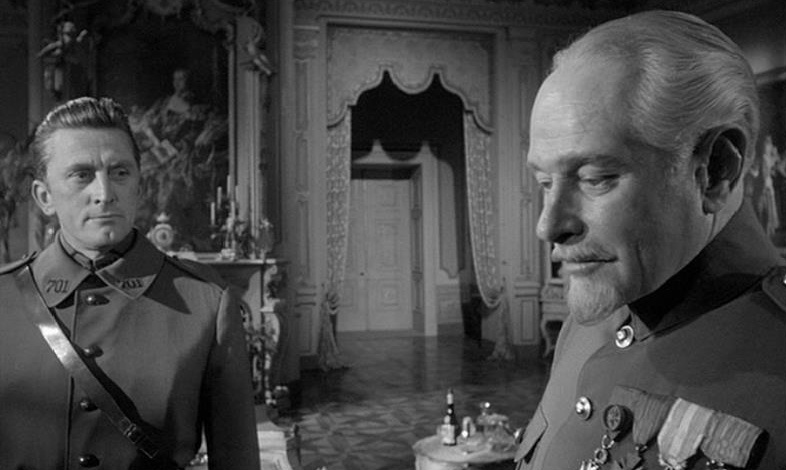
Kirk Douglas and George Macready
PATHS OF GLORY (1957). Director: Stanley Kubrick.

"There is no such thing as shell shock." -- General Mireau

French WW 1 General Paul Mireau (George Macready) initially makes it clear to General Brouard (Adolphe Menjou) that there is no way his battalion can possibly take a strategic position known as the "anthill." But Mireau changes his tune when Brousard talks about a promotion, even though they expect at least 60% casualties among their men.

Wayne Morris and Ralph Meeker
Now Mireau's second-in-command Colonel Dax (Kirk Douglas) is told in no uncertain terms that the men -- already exhausted and demoralized -- must take the hill the next day or else. Although the soldiers try their damnedest, it is an impossible and indeed suicidal task, and Mireau accuses them of cowardice. (Mireau even wants to fire on his own men because they aren't moving fast enough!) Mireau is talked out of shooting a hundred soldiers, but three are to be court-marshaled as an example. These three men are Private Arnaud (Joe Turkel of The Glass Wall); Private Ferol (Timothy Carey of The World's Greatest Sinner and Kubrick's The Killing); and Corporal Paris (Ralph Meeker), who is picked because he knows that his superior officer, Lt. Roget (Wayne Morris), essentially murdered one of his soldiers. Dax represents the men in what is basically a kangaroo court with an outcome that is clearly pre-ordained.

Old pros: Macready and Menjou
Paths of Glory is a powerful and maddening film, examining the outrageous miscarriages of justice and heartlessness that can take place during war time even among men fighting on the same side. The performances are excellent: a borderline slimy Menjou; an upright and morally-repulsed Douglas; Meeker, whose trademark cockiness eventually vanishes when he faces his own mortality; and Wayne Morris giving an unexpectedly strong performance as the morally-bankrupt Roget. Turkel and Carey are also notable -- as is Richard Anderson as the prosecutor --  but the one actor who positively walks away with the film is George Macready, who gives an absolutely ferocious and mesmerizing portrayal of the utterly loathsome and infuriating Mireau -- forget Gilda (in which I didn't think Macready was even all that great), this is the performance he should be remembered for.

Kubrick beautifully -- or rather horrifically -- recreates the WW 1 battlefield, and scenes of the men in the trenches as bombs explode unnervingly all around them are compelling, The film almost goes a bit off-course in the second half when it has aspects that remind one of the later Dr. Strangelove, but for the most part this is one of Kubrick's most successful and effective movies. Several years later the film King and Country had a similar theme but was not as good.

Verdict: George Macready's finest hour and a half and a highly memorable if imperfect picture for Kubrick. ***1/2. 

Thursday, May 30, 2019

THE KILLING

Marie Windsor and Vince Edwards
THE KILLING (1956). Director, co-screenplay: Stanley Kubrick.

Ex-con Johnny Clay (Sterling Hayden) has gathered together a motley group to rob a race track: bartender Mike (Joe Sawyer); cop Randy (Ted de Corsia of The Big Combo); sniper Nicky (Timothy Carey); front man Marvin (Jay C. Flippen), muscular Maurice (professional wrestler Kola Kwariani); and track employee George (Elisha Cook, Jr.). But George, who wants to participate so he can buy things for his unfaithful wife, Sherry (Marie Windsor), is unaware that she has taken a lover, Val (Vince Edwards), and when these two learn about the robbery they cook up their own plans ...

Elisha Cook Jr. and Marie Windsor
The Killing is Kubrick's third theatrical film (aside from some documentaries), and it is one of his best. He managed to get excellent performances from the cast, with Windsor being a stand-out along with Elisha Cook, Jr., [House on Haunted Hill] who here is given one of the best roles of his career and runs with it. The other cast members are all on the mark, including Dorothy Adams as Mike's bedridden wife, Ruthie. Colleen Gray gets only a few moments as Johnny's girlfriend, but she's fine, and Carey makes a weird and effective Nicky, who literally shoots horses. Lucien Ballard's cinematography is first-class, and Gerald Fried's musical score adds to the film's taut and suspenseful atmosphere.

Sterling Hayden with Jay C. Flippen 
Jim Thompson's dialogue is occasionally forgettable ("she has a dollar sign where her heart should be"), but there's also an interesting interchange between Marvin and Johnny in which the former tells the latter that he practically thinks of him as a son, but then virtually suggests that they run away together, although the implications of this go unexplored. The film has an ironic, knock-out ending that really delivers a wallop. The movie is generally filmed in long cuts and the tension would have been increased with sharper editing. As good as this is, I would have loved to see what this would have been like had Hitchcock directed it. Another interesting Kubrick film is Eyes Wide Shut.

Verdict: One of the best caper movies ever made. ***1/2. 

Thursday, June 7, 2018

EYES WIDE SHUT

Tom Cruise
EYES WIDE SHUT (1999). Produced and directed by Stanley Kubrick.

Alice (Nicole Kidman of Birth) and Dr. William Harford (Tom Cruise of Jack Reacher) are a moderately wealthy couple living in Manhattan (or what barely passes for same). After an argument, a high-on-grass Alice confesses to Bill that she saw a military man while they were on vacation and had such intense sexual fantasies about him  that she felt she could have walked away from Bill, their young daughter, and her whole life to be with this man. Bill can't get this out of his mind, and the next night he has a series of misadventures: Marion (Marie Richardson), the daughter of a dead elderly patient, tells him she's in love with him despite barely knowing him; some morons who think he's gay taunt him with homophobic slurs in Greenwich Village; he nearly sleeps with a hooker named Domino (Vinessa [sic] Shaw); and he re-encounters an old college friend who has become a musician. This friend, Nick (Todd Field), tells him of a mysterious series of parties he goes to where he plays the piano but isn't allowed to take off his mask. Intrigued, Bill rents a costume and goes off by taxi to an isolated estate where he discovers an elegant orgy where (generally) the women are naked, the men are clothed, and everyone wears a mask. Paranoia sets in when his deception is discovered and he is warned that powerful people will enact vengeance if he dares utter a word about what he's seen ...

Stanley Kubrick's final film, Eyes Wide Shut got a very mixed reception when it was released. I can't argue with all of the criticisms about it -- that it's slow at times, that it seems a bit stodgy for the nineties, that the orgy scenes are almost silly, and that it hardly develops into an intense thriller (which may not have been what Kubrick was after in the first place) -- and there has been pretentious overpraise for a picture that would hardly classify as a masterpiece. It also pretty much pushes aside any moral complexities for a one word quick-joke finale. However, I have seen Eves Wide Shut three or four times by now, and each time I find the nearly three-hour film completely absorbing and suspenseful. Admittedly, the sequence when Bill goes to buy a costume from a creepy man with a nubile daughter goes on too long, and there are others. One critic declared the picture an "old man's movie," probably because the orgies aren't that energetic and have no pounding rock soundtrack -- and Kubrick may have missed a lot of things he could have done with this film --  but this criticism misses the point that these parties are meant to be "classy" and ritualistic. Whether even the rich and famous would be bothered with secret sex societies is besides the point -- no married Senator, for instance, would want it getting out that he belonged to one.

The direction and the performances help a lot, with Cruise being more than adequate, and his then-wife Kidman out-acting him most of the time. Sydney Pollack, who directed Cruise in the mediocre The Firm,  perhaps proves a better actor [Husbands and Wives] than director in his role of Victor Ziegler, a wealthy man who gets help from Bill and provides counsel in return. The other roles are well cast, including Alan Cumming as a helpful hotel clerk who is obviously smitten with Bill. Although this scene got some criticism when the film first came out, Cumming at least makes the character likably goofy. The score consists of classical music along with some really cheap if sinister piano riffs. Filmed on sets, you never get a sense that this is taking place in New York City. The film is based on a novel that took place in Vienna.

Verdict: There are many, many things wrong with this movie, but I still find it visually and dramatically compelling. ***.

Thursday, August 31, 2017

LOLITA

Sue Lyon and James Mason
LOLITA (1962). Director: Stanley Kubrick.

"Shut your mouth, you horrible little psychopath!"


Professor Humbert Humbert (James Mason) takes a room with widowed landlady Charlotte Haze (Shelley Winters of The Chapman Report) because he's smitten with Charlotte's teenage daughter, the "nymphet" Lolita (Sue Lyon of The Night of the Iguana). Marrying Charlotte seems like the only way for Humbert to get to the true object of his affection, but he has more than one rival: television personality Clare Quilty (Peter Sellers); and young Dick (Gary Cockrell). Will Humbert's obsession with Lolita be his undoing? I haven't read Vladimir Nabokov's novel since college, but it seems to me that this is a very watered-down version of the book -- Lolita was much younger for one thing -- while basically staying more or less true to its intentions (Nabokov himself wrote the screenplay). Mason, as usual, offers another excellent performance, and in fact is superior to the rather cheesy material. 16-year-old Sue Lyon. who was introduced in this picture, is fine and never seems intimidated by the great Mason. Shelley Winters does a nice job as Charlotte, whom we're clearly not meant to feel much sympathy for. The novel was entertaining and very well-written, but not every book should be filmed. This just comes off as lurid and trashy and its entertainment value runs out early on. Peter Sellers plays a strange character but plays it well.  Sue Lyon was a talented actress but aside from her first two credits her career was relatively undistinguished [The Astral Factor], although she did have several interesting if short-lived marriages. Remade in 1997 with Jeremy Irons as Humbert Humbert.

Verdict: Mason saves the picture but probably should have turned it down, although it did get a lot of attention upon its release. **.

Thursday, July 27, 2017

DR. STRANGELOVE

Peter Sellers as Dr. Strangelove
DR. STRANGELOVE OR: HOW I LEARNED TO STOP WORRYING AND LOVE THE BOMB (1964). Director: Stanley Kubrick.

"Gentlemen, you can't fight in here! This is the war room!" 

Going off his nut, General Jack D, Ripper (Sterling Hayden) sends planes bearing megaton bombs into Russia without orders from the President (Peter Sellers). While Ripper's special British assistant, Mandrake (also Sellers), desperately tries to get the code from him that will stop the planes, President Muffley confers in the war room with General Turgidson (George C. Scott), the Russian ambassador Sadesky (Peter Bull), and the ex (?) Nazi scientist Dr. Strangelove (Sellers yet again). Meanwhile Major Kong (Slim Pickens) is determined to deliver his megaton payload come hell or highwater. Then the president learns from his opposite number, the unseen Dimitri, that if a bomb goes off on Russian soil it will automatically unleash a Doomsday weapon that will destroy all life on Earth! Dr. Strangelove has a plot that's strangely similar to Fail-Safe, released the same year, only Strangelove is not played straight but as a very, very dark black comedy (and is better known than the other picture), brutally -- if broadly -- satirizing the arms race, the cold war, and the paranoia and obsession people had at the time over atomic weapons and the possibility of WWIII. The deliberate pace of Strangelove may make the film seem longer than it actually is -- just a bit over 90 minutes -- but it is entertaining, grimly amusing, and very well-acted by all, with Sellers superb in a trio of very different roles. Hayden [Naked Alibi] , Scott, Bull (who can be seen trying hard to keep a straight face during Seller's antics as Dr. Strangelove in one scene), Keenan Wynn [Royal Wedding] as Colonel Guano, Tracy Reed as Turgidson's paramour, and Pickens in his most notable and iconic role are all on the money. Still, as well-made as it is, one can't quite say that this is a picture you will enjoySeven Days in May also came out in 1964 and dealt with the military-industrial complex, but there were no out of control missiles in it.

Verdict: Not for every taste, but certainly unique. ***.