Lively, entertaining reviews of, and essays on, old and newer films and everything relating to them, written by professional author William Schoell.
Showing posts with label Adolphe Menjou. Show all posts

Thursday, March 19, 2020

PATHS OF GLORY

Kirk Douglas and George Macready
PATHS OF GLORY (1957). Director: Stanley Kubrick.

"There is no such thing as shell shock." -- General Mireau

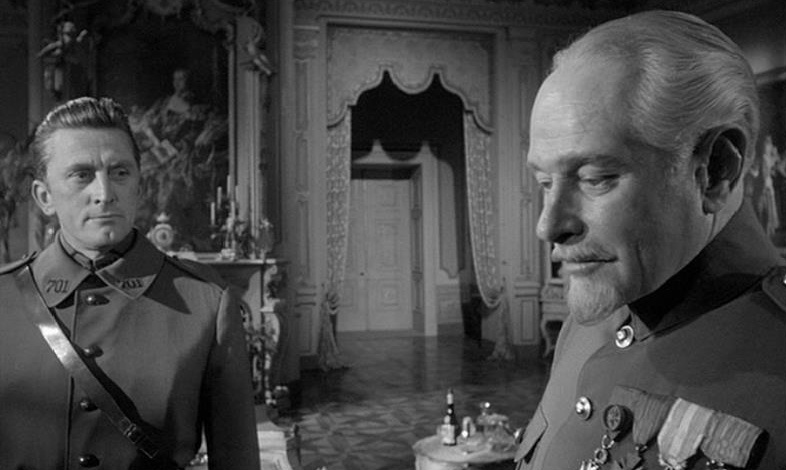
French WW 1 General Paul Mireau (George Macready) initially makes it clear to General Brouard (Adolphe Menjou) that there is no way his battalion can possibly take a strategic position known as the "anthill." But Mireau changes his tune when Brousard talks about a promotion, even though they expect at least 60% casualties among their men.

Wayne Morris and Ralph Meeker
Now Mireau's second-in-command Colonel Dax (Kirk Douglas) is told in no uncertain terms that the men -- already exhausted and demoralized -- must take the hill the next day or else. Although the soldiers try their damnedest, it is an impossible and indeed suicidal task, and Mireau accuses them of cowardice. (Mireau even wants to fire on his own men because they aren't moving fast enough!) Mireau is talked out of shooting a hundred soldiers, but three are to be court-marshaled as an example. These three men are Private Arnaud (Joe Turkel of The Glass Wall); Private Ferol (Timothy Carey of The World's Greatest Sinner and Kubrick's The Killing); and Corporal Paris (Ralph Meeker), who is picked because he knows that his superior officer, Lt. Roget (Wayne Morris), essentially murdered one of his soldiers. Dax represents the men in what is basically a kangaroo court with an outcome that is clearly pre-ordained.

Old pros: Macready and Menjou
Paths of Glory is a powerful and maddening film, examining the outrageous miscarriages of justice and heartlessness that can take place during war time even among men fighting on the same side. The performances are excellent: a borderline slimy Menjou; an upright and morally-repulsed Douglas; Meeker, whose trademark cockiness eventually vanishes when he faces his own mortality; and Wayne Morris giving an unexpectedly strong performance as the morally-bankrupt Roget. Turkel and Carey are also notable -- as is Richard Anderson as the prosecutor --  but the one actor who positively walks away with the film is George Macready, who gives an absolutely ferocious and mesmerizing portrayal of the utterly loathsome and infuriating Mireau -- forget Gilda (in which I didn't think Macready was even all that great), this is the performance he should be remembered for.

Kubrick beautifully -- or rather horrifically -- recreates the WW 1 battlefield, and scenes of the men in the trenches as bombs explode unnervingly all around them are compelling, The film almost goes a bit off-course in the second half when it has aspects that remind one of the later Dr. Strangelove, but for the most part this is one of Kubrick's most successful and effective movies. Several years later the film King and Country had a similar theme but was not as good.

Verdict: George Macready's finest hour and a half and a highly memorable if imperfect picture for Kubrick. ***1/2. 
Thursday, December 26, 2019

THE FUZZY PINK NIGHTGOWN

Jane Russell and Ralph Meeker
THE FUZZY PINK NIGHTGOWN (1957). Director: Norman Taurog.

Movie star Laurel Stevens (Jane Russell of Foxfire) is planning to attend the premiere of her new film The Kidnapped Bride, when she's actually kidnapped by two, fortunately, nice guys named Mike (Ralph Meeker) and Dandy (Keenan Wynn). Mike spent four years in prison for a crime he didn't commit, which makes Laurel feel sympathetic towards him. It also doesn't hurt that he's a rather sexy man. While Laurel's assistant Bertha (Una Merkel) and agent (Robert H. Harris) try frantically to find her, studio head Arthur Martin (Adolphe  Menjou) wants to keep it out of the papers, afraid it is -- or at least everyone will think it is -- nothing more than a publicity stunt. If Laurel admits she was kidnapped Mike could go to jail, but if she doesn't, her public could turn on her.

Adolphe Menjou, Una Merkel, Robert H. Harris
The Fuzzy Pink Nightgown has an interesting premise and holds the attention, but the movie could only have worked if it was a riotous farce, which it isn't; the picture has only a few chuckles. Yet a scene wherein Laurel and Mike drive off in a police car is so ridiculous that even Ralph Meeker looks irritated. The performances are good enough on one level -- although Meeker would never make a deft comedian -- but the leads take a back seat to Robert Harris, who is quite funny as the agent. Although Russell did appear in a few more movies, this was her last starring role, and her age was beginning to show -- it didn't help that Fuzzy was a flop. Ralph Meeker [Jeopardy] was seen to good advantage in Paths of Glory that same year.

Verdict: Ironically, Jane Russell's swan song as a major movie star. **1/2. 

Tuesday, October 14, 2008

THE CIRCUS QUEEN MURDER

THE CIRCUS QUEEN MURDER (1933). Director: Roy William Neill.

New York police commissioner Thatcher Colt (Adolphe Menjou) takes his efficient secretary off for a quiet, restful vacation in the bucolic town of Gilliad, but instead of balm he finds murder. There are sexy circus queens, angry husbands, illicit affairs, a troupe of cannibals, not to mention the usual lions, tigers and gorillas, but none of it saves the movie from being dull, dull, dull. Dwight Frye is his usual intense self as the jealous hubby of the high-wire circus queen (Greta Nissen). Ruthelma Stevens is Colt's lip-reading secretary, Miss Kelly. Colt has an admirably modern attitude toward women and even thinks that Miss Kelly would make a great police commissioner when he retires. Alas, the movie has no real snap to it and the plot isn't terribly interesting. The pic only runs 63 minutes but seems much longer. Menjou is fine, however. He played the same role in one other movie.

Verdict: Not as much fun as a barrel of monkeys.

THE SNIPER

THE SNIPER (1952). Director: Edward Dmytryk.

Eddie Miller (Arthur Franz) is a delivery man for a cleaning service and has a problem with women. When one of his customers, a singer named Jean (Marie Windsor) innocently excites him but sends him away when her boyfriend shows up, he begins a spree of shooting women, with Jean the first victim. Franz, who is excellent, is the perfect choice for the title role, with his clean cut features and appealing presence in stark contrast to the terrible crimes he's committing. The movie certainly has an interesting cast. Adolphe Menjou is the head cop on the case, Lt. Frank Kafka, and Richard Kiley, that Man of La Mancha himself, is a police psychologist. He gives disturbing statistics about sexual predators (the situation has obviously gotten much worse since 1952). Frank Faylen and Gerald Mohr are also cast as policemen. Miller's landlady is played by Mabel Paige, who sold Lucy and Ethel her dress shop in a classic I Love Lucy episode. Jay Novello, who also appeared on I Love Lucy, turns up in another amazing characterization as Pete, the owner of the bar where Jean sings for her supper. The movie is well made and completely absorbing, but it does give rather short shrift to the victims.

Verdict: Probably Franz' finest hour. ***.

Tuesday, March 4, 2008

JOURNAL OF A CRIME

JOURNAL OF A CRIME (1934). Director: William Keighley. From a play by Jacques Deval.

Ruth Chatterton learns that her producer husband (Adolphe Menjou) has fallen in love with a pretty and callow young actress. She takes his gun, goes to the theater, and shoots her, just as a bank robber who shot a teller tries to use the theater as a hide-out. Naturally, the robber is blamed for the mistress's murder, but Menjou finds his gun backstage and figures out the truth. [“Fiend! Fiend!” he keeps saying to his wife once they're home.] Menjou decides not to give his wife up to the police, hoping she'll crack and do the right thing as their relationship crumbles. This is very potent material, but the movie pretty much sticks to the surface and never explores with any depth the shattering emotions going on underneath. The dead girl is virtually forgotten and the teller we see shot early in the movie is hardly mentioned; there's little attempt to examine all the moral issues. One of the most interesting scenes has Chatterton going to see the bank robber convicted of her rival's murder on the eve of his execution, but otherwise the story goes in all the wrong directions, and the film's potential is wasted. Although Chatterton gets stronger as the picture proceeds, another problem with the movie is that both she and Menjou give comparatively perfunctory performances.

Verdict: Missed opportunities. **.