Lively, entertaining reviews of, and essays on, old and newer films and everything relating to them, written by professional author William Schoell.
Showing posts with label Ralph Meeker. Show all posts

Thursday, March 19, 2020

RALPH MEEKER

Ralph Meeker in Code Two
RALPH MEEKER (1920 - 1988).

Meeker came to the public's and critics' attention when he replaced Marlon Brando in the stage version of A Streetcar Named Desire and won very good reviews. Then he got the lead role in William Inge's Picnic. The story goes that he turned down the lead in the film version because he didn't want to be tied down to a studio contract, and this negatively affected his career thereafter. He never attained the super-stardom of, say, a William Holden (who took Meeker's part in the film version of Picnic) but he did have a solid career and won many raves for his work in the years to come, amassing 110 credits in movies and on television. His pictures include The Naked Spur, Ada, The Food of the Gods, JeopardyThe Fuzzy Pink Nightgown, and others that Great Old Movies is looking into this week (see below) -- including the famous Kiss Me Deadly, Meeker had three wives, the best-known of which was the actress Salome Jens of Seconds. He was only 67 when he died. 

SOMEBODY LOVES ME

Ralph Meeker and Betty Hutton
SOMEBODY LOVES ME (1952). Director: Irving Brecher.

Blossom Seeley (Betty Hutton of Spring Reunion) becomes a top vaudeville entertainer and sees a trio performing in a club one night. Spying the handsome crooner Benny Fields (Ralph Meeker of Jeopardy) -- one of the trio --  she decides "that's for me!" and hires all of them for her act. This arrangement doesn't work for long, until Benny proposes and becomes her accompanist. But soon he's "Mr. Seeley" and feels like a kept man. But did he marry Blossom for love or other motives?

Billie Bird and Cheetah? 
Although pretty much forgotten today, the real-life Seeley and Fields were once as famous as Jack Benny and Burns and Allen. This biopic revived their careers in the fifties. Betty Hutton gives one of her best performances in this, bold and brassy when she needs to be, and more subdued and lovely at other moments. Although generally one would hardly think of Ralph Meeker for the leading role in a musical, he's fine in this flick, and while he's really not a dancer, he sexily shakes his booty in one number. Robert Keith and Billie Bird [The Cat Burglar] are both first-rate as Blossom's manager and her best friend, who was once an entertainer herself. Adele Jergens also scores in an early sequence when she's a condescending headliner who gets undone by Bird and an adorable chimpanzee (who reads Variety no less). Jack Benny has a famous cameo as himself as a master of ceremonies.

Ralph Meeker
The film has some lively dance numbers and a good score comprised of classic tunes (like Gershwin's title song) and a few new numbers by Livingstone and Evans. The highlights are "I Cried Over You;" "Jealous;" "When I Was a Kid in Dixie;" and "Dixie Dreams." Meeker's voice was probably dubbed by Fields himself, as it sounds like him. An interesting scene has Benny admitting to Blossom that their marriage was essentially a career move, although according to this film he did fall in love with her later on. Hutton did only one more film after this one and then had a few TV appearances.

Verdict: Nice music, excellent performances, put over this lively musical biopic. ***. 

CODE TWO

Ralph Meeker, Jeff Richards, Robert Horton
CODE TWO (1953). Director: Fred M. Wilcox.

Three young men -- Chuck (Ralph Meeker), Russ (Robert Horton) and Harry (Jeff Richards of Born Reckless) -- join the police academy in Los Angeles and eventually ask to be assigned to the motor(cycle) squad. Chuck is a cocky if likable lug who goes after Russ' sister-in-law, Jane (Elaine Stewart of The Tattered Dress) but her focus is more on the shy-but-sexy Harry. Russ at first keeps the news about his assignment from his wife (Sally Forrest) because she fears for his safety, but tragedy is in store for one of the other men, with his two friends doing their best to avenge him. It all leads to an exciting climax in a warehouse with a boiling lime pit and a host of bad guys trying to make mincemeat of our heroes.

The three leads all give solid performances with fine support from the ladies and from Keenan Wynn as Police Sergeant "Jumbo" Culdane. William Campbell [The Young Racers] is also notable as a nasty, murderous trucker. Also on hand in smaller roles are Chuck Connors as a cop and James Craig as a police lieutenant. As for Meeker, he struts through the film with great charisma and authority.

Verdict: Well-done if minor cop melodrama. **1/2. 

KISS ME DEADLY

KISS ME DEADLY (1955). Produced and directed by Robert Aldrich.

Private eye Mike Hammer (Ralph Meeker) picks up a desperate runaway, Christina (Cloris Leachman of Happy Mother's Day, Love George), on the highway, embroiling him in a convoluted and dangerous case after they are waylaid and she is tortured and murdered. Mike barely survives himself, but he is intrigued and angry enough to determine to find out what's actually going on. As Hammer proceeds in his investigation over the objections of Lt. Pat Murphy (Wesley Addy of The Garment Jungle) -- who takes his licence away -- the bodies begin to pile up. Meanwhile Mike decides to shelter Lily Carver (Gaby Rodgers), the late Christina's terrified roommate. She and everyone but Velda (Maxine Cooper), Mike's secretary, seem concerned over a certain package that contains what Velda refers to as a "whatzis." After a number of people are beaten and killed, and Mike himself is subjected to truth serum by an unseen foe, he learns that Velda has been kidnapped. The climax occurs at a beach house occupied by a certain sinister doctor, all leading to a literally explosive finale.

Wesley Addy and Ralph Meeker
Kiss Me Deadly is one of Aldrich's best films. Although one could easily argue that it becomes hard to follow at times and under close inspection may not even make much sense, it is so brisk, well-acted, and absorbing that it is actually quite fascinating. Frank De Vol's score adds to the atmosphere,
as does Ernst Laszlo's superb cinematography, making the most of its LA locations. Then there's the acting. Meeker follows in the footsteps of Biff Elliott of I the Jury made two years earlier, and he is also near-perfect as a more thuggish variation of Mike Hammer. (Mickey Spillane did not care for the changes made to the character from novel to film.)

Percy Helton comes afoul of Ralph Meeker
Gaby Rodgers is so good as Lily that it's a surprise that she didn't become better known, but in addition to a few TV credits, she only did two pictures, this and an independent film that was barely released. Paul Stewart scores as a sinister mafia bigwig, Wesley Addy makes a convincing cop, and Marian Carr, Albert Dekker, and Maxine Cooper give flavorful performances as well. Percy Helton is up to his usual weaselly no-good-ness and figures in a sequence when Hammer uses an especially sadistic method to get a morgue attendant to talk. For a film made in the fifites, Kiss Me Deadly can be rather raw. Although Christina's torture is never actually shown, her dangling naked legs and the horrendous screams she omits tell the story in a way that might have sickened the stomachs of some viewers back in the day. (Alas, she keeps screaming as if the pliers were still being applied to her even though it's clear that no one is standing beside her any longer.)

Kiss Me Deadly deserves its reputation, although there are some critics who wax quite pretentiously about it -- profound it is not; cinematic it is. NOTE: Ahead of his time, Mike Hammer keeps an early version of an answering machine in his home office. Although much of the film's basic plot is derived from the novel, it deals strictly with mafia hoods and nothing radioactive.

Verdict: Despite the silly title, this is hard-hitting and very well done. ***1/2. 

PATHS OF GLORY

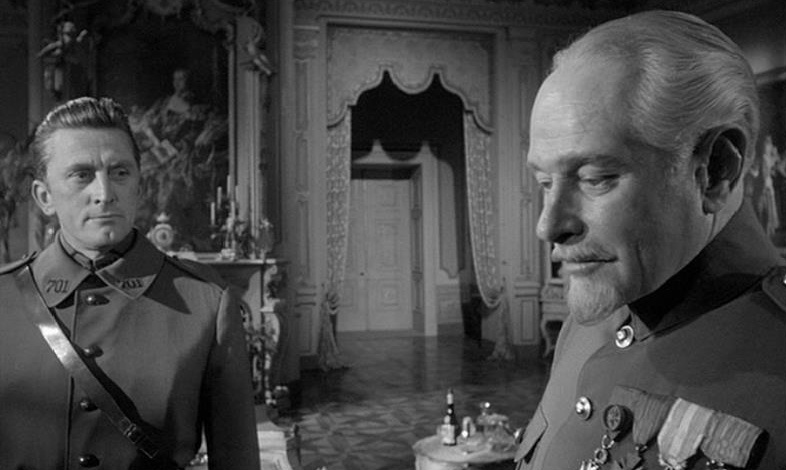
Kirk Douglas and George Macready
PATHS OF GLORY (1957). Director: Stanley Kubrick.

"There is no such thing as shell shock." -- General Mireau

French WW 1 General Paul Mireau (George Macready) initially makes it clear to General Brouard (Adolphe Menjou) that there is no way his battalion can possibly take a strategic position known as the "anthill." But Mireau changes his tune when Brousard talks about a promotion, even though they expect at least 60% casualties among their men.

Wayne Morris and Ralph Meeker
Now Mireau's second-in-command Colonel Dax (Kirk Douglas) is told in no uncertain terms that the men -- already exhausted and demoralized -- must take the hill the next day or else. Although the soldiers try their damnedest, it is an impossible and indeed suicidal task, and Mireau accuses them of cowardice. (Mireau even wants to fire on his own men because they aren't moving fast enough!) Mireau is talked out of shooting a hundred soldiers, but three are to be court-marshaled as an example. These three men are Private Arnaud (Joe Turkel of The Glass Wall); Private Ferol (Timothy Carey of The World's Greatest Sinner and Kubrick's The Killing); and Corporal Paris (Ralph Meeker), who is picked because he knows that his superior officer, Lt. Roget (Wayne Morris), essentially murdered one of his soldiers. Dax represents the men in what is basically a kangaroo court with an outcome that is clearly pre-ordained.

Old pros: Macready and Menjou
Paths of Glory is a powerful and maddening film, examining the outrageous miscarriages of justice and heartlessness that can take place during war time even among men fighting on the same side. The performances are excellent: a borderline slimy Menjou; an upright and morally-repulsed Douglas; Meeker, whose trademark cockiness eventually vanishes when he faces his own mortality; and Wayne Morris giving an unexpectedly strong performance as the morally-bankrupt Roget. Turkel and Carey are also notable -- as is Richard Anderson as the prosecutor --  but the one actor who positively walks away with the film is George Macready, who gives an absolutely ferocious and mesmerizing portrayal of the utterly loathsome and infuriating Mireau -- forget Gilda (in which I didn't think Macready was even all that great), this is the performance he should be remembered for.

Kubrick beautifully -- or rather horrifically -- recreates the WW 1 battlefield, and scenes of the men in the trenches as bombs explode unnervingly all around them are compelling, The film almost goes a bit off-course in the second half when it has aspects that remind one of the later Dr. Strangelove, but for the most part this is one of Kubrick's most successful and effective movies. Several years later the film King and Country had a similar theme but was not as good.

Verdict: George Macready's finest hour and a half and a highly memorable if imperfect picture for Kubrick. ***1/2. 

SOMETHING WILD (1961)

Carroll Baker and Ralph Meeker
SOMETHING WILD (1961). Director/co-screenplay: Jack Garfein.

Mary Ann Robinson (Carroll Baker of Bridge to the Sun) walks home from work one evening, and is pulled into the bushes and raped. This traumatic experience leads into a series of strange actions, such as her leaving home without telling her mother (Mildred Dunnock) or stepfather (Charles Watts), taking a job in a five and dime store in another neighborhood, and moving into a cramped "apartment" about the size of a closet. One afternoon on the Brooklyn Bridge she tries to throw herself into the river, but she is stopped by the intervention of a worker named Mike (Ralph Meeker). But this apparently kind stranger may have even more problems than Mary Ann does and she finds herself locked in his apartment ...

Carroll Baker
Something Wild was based on a novel named Mary Ann and directed (and co-written) by theater man Jack Garfein, who was married to Carroll Baker at the time. Baker is deglamourized in this and generally gives a good performance, as does Meeker, although both are given rather impossible characters to play. I believe the film is trying to say that two damaged individuals can find love with each other, but there's a big difference in being a (rape) victim and being (in essence) someone who commits criminal actions like holding someone against their will, so turning this into a "love" story -- and yes the film does try to make us believe this has a happy and romantic ending -- would be almost as ludicrous as having Mary Ann fall in love with her rapist (who never shows up after the opening sequence). Apologists for the film -- and there are many -- try to suggest that Mike only locked Mary Ann in because he didn't want her killing herself, but she could just have easily killed herself in the apartment and his motives for keeping her a prisoner aren't nearly so noble.

Cinematography by Eugene Shufftan
The shame of it is that this hopelessly muddled, even offensive film has a lot going for it. In addition to the leads we have notable work by Mildred Dunnock as the concerned if ineffectual mother; Jean Stapleton as a slatternly neighbor of Mary Ann's; Doris Roberts as a co-worker at the five and dime who is put off by what she perceives as Mary Ann's stuck-up attitude; Martin Kosleck [The Flesh Eaters] as the somewhat sleazy landlord; and others. The film has a highly interesting score by no less than Aaron Copland [The Heiress], and is strikingly photographed in black and white by Eugen Shufftan, who makes the most of some very familiar New York City locations. Shufftan gives the film a very grim and intense atmosphere throughout. Garfield's direction is good if imperfect. He only directed one other movie, The Strange One. 

Despite all the notable aspects, Something Wild is done in by its contrivances. One suspects the plot was concocted before the characters were conceived, and -- in the film, at least -- they are never developed all that well.

Verdict: Should these two sick individuals get married? Where is Dr. Phil when you need him? **. 

Thursday, February 20, 2020

ADA

Dean Martin and Susan Hayward
ADA (1961). Director: Daniel Mann.

Bo Gillis (Dean Martin of Sergeants 3) is a pleasant, uncomplicated good ol' boy running for governor under the direction of men like Steve Jackson (Martin Balsam) and savvy if crooked politico Sylvester Marin (Wilfrid Hyde-White). One night Bo is introduced to"B" girl Ada (Susan Hayward of And Now Tomorrow) and against everyone's advice eventually decides to marry her. Bo becomes governor and Ada, who doesn't trust Marin as far as she can throw him, makes a deal with him to become Lt. Governor, an idea that goes badly with Bo's male pride. When Bo announces that he's going to start reading bills before signing then and is out to clean up corruption, he is badly injured in a murder attempt. Now Ada is the acting governor, but she may find that Marin and his forces are not about to let this former whore boss them around.

Ada tells off biddies, including Kathryn Card, 2nd from left
With a plot like that -- hooker winds up becoming governor -- you would think that Ada would be a real trash wallow, but it's actually somewhere between a strong drama and a guilty pleasure and never quite makes up its mind which. The film does have a feminist perspective, even if it's only from a dated sixties point of view. Dean Martin is perfect casting for Bo -- he has to have enough charm and charisma to convince the voters but also be laid-back enough to be seen as comparatively "weak" next to strong-willed Ada. Hayward plays with her customary authority, and is especially good in a scene at a party at the governor's mansion, where she tells off a bunch of patronizing old biddies -- one of whom is Kathryn Card, Lucy's mother on I Love Lucy, here a tough old bitch and not the dithery Mrs. McGillicuddy.

Ralph Meeker and Susan Hayward
As for the supporting cast, Ralph Meeker [The Fuzzy Pink Nightgown] makes the best impression as Colonel Yancy, employing his trademark insolence to good effect as he makes flagrant passes at the governor's wife on a regular basis. (In the book this film is based on, Ada Dallas, Yancy and Ada were former lovers.) Martin Balsam is always solid but in this he isn't given much to do. The usually reliable Hyde-White is a major disappointment, giving a performance devoid of flavor and nuance -- there are at least a dozen character actors who could have given this role more bite.

Although Hayward and Martin performed surprisingly well together on camera, they did not like each other at all off-screen. For more on this and other Martin films see Martini Man: The Life of Dean Martin.

Verdict: Minor potboiler with some interesting elements. **3/4. 

Thursday, February 6, 2020

THE NAKED SPUR

Jimmy Stewart and Ralph Meeker
THE NAKED SPUR (1953). Director: Anthony Mann.

After the Civil War Howard Kemp (James Stewart) lost his farm to a faithless, greedy woman and is determined to buy it back with $5000 reward money for a murderer named Ben Vandergroat (Robert Ryan). Ben has been traveling with the daughter, Lina (Janet Leigh), of one of his deceased best friends, and he is equally determined to stay one step ahead of Kemp. Kemp enlists the aid of old prospector Jesse Tate (Millard Mitchell of Singin' in the Rain) and unsavory and dishonorable ex-soldier Roy Anderson (Ralph Meeker) to capture Ben, but now his two "partners" each want a third of the loot. The whole group begins a trek to Abilene where Ben is to be hung, but it's anybody's guess if they will all make it there in one piece, and if Ben will remain their captive ...

Robert Ryan and Janet Leigh. 
The Naked Spur sets up an interesting and harrowing situation -- the three captors are not just pitted against Ben and possibly Lina, but also each other -- and sustains suspense and tension all the way through. Admittedly, some scenes are not handled as dramatically as they might have been, and there's a disturbing sequence when a whole bunch of Indians are slaughtered when they are really just trying to get justice for a maiden who was apparently raped by Anderson. Stewart gives another impassioned and first-rate performance as Kemp, and Janet Leigh [Act of Violence] proves yet again that she was far more than just a pretty face. Ryan [Caught] plays in an unusual sardonic style considering what he's facing, but he pulls if off, and Meeker, as cocky as ever, makes the most of his turn as the rather sleazy Anderson. The ending seems tacked on to make Stewart's character more palatable, but it only makes him seem like an idiot. It's nice that character actor Millard Mitchell, who also gives a fine performance, is billed above the title with the four stars.

Verdict: Zesty if imperfect western with terrific cast. ***. 

Thursday, December 26, 2019

THE FUZZY PINK NIGHTGOWN

Jane Russell and Ralph Meeker
THE FUZZY PINK NIGHTGOWN (1957). Director: Norman Taurog.

Movie star Laurel Stevens (Jane Russell of Foxfire) is planning to attend the premiere of her new film The Kidnapped Bride, when she's actually kidnapped by two, fortunately, nice guys named Mike (Ralph Meeker) and Dandy (Keenan Wynn). Mike spent four years in prison for a crime he didn't commit, which makes Laurel feel sympathetic towards him. It also doesn't hurt that he's a rather sexy man. While Laurel's assistant Bertha (Una Merkel) and agent (Robert H. Harris) try frantically to find her, studio head Arthur Martin (Adolphe  Menjou) wants to keep it out of the papers, afraid it is -- or at least everyone will think it is -- nothing more than a publicity stunt. If Laurel admits she was kidnapped Mike could go to jail, but if she doesn't, her public could turn on her.

Adolphe Menjou, Una Merkel, Robert H. Harris
The Fuzzy Pink Nightgown has an interesting premise and holds the attention, but the movie could only have worked if it was a riotous farce, which it isn't; the picture has only a few chuckles. Yet a scene wherein Laurel and Mike drive off in a police car is so ridiculous that even Ralph Meeker looks irritated. The performances are good enough on one level -- although Meeker would never make a deft comedian -- but the leads take a back seat to Robert Harris, who is quite funny as the agent. Although Russell did appear in a few more movies, this was her last starring role, and her age was beginning to show -- it didn't help that Fuzzy was a flop. Ralph Meeker [Jeopardy] was seen to good advantage in Paths of Glory that same year.

Verdict: Ironically, Jane Russell's swan song as a major movie star. **1/2. 

Thursday, June 30, 2016

WALL OF NOISE

Ty Hardin and Suzanne Pleshette
WALL OF NOISE (1963). Director: Richard Wilson.

Horse trainer Joel Tarrant (Ty Hardin) goes to work for Matt Rubio (Ralph Meeker) who wants to get involved in racing. Angered when Joel's girlfriend, Ann (Dorothy Provine), whom he treated like crap, goes off with his friend and jockey, Bud (Jimmy Murphy), Joel takes up with Rubio's sophisticated and neglected wife, Laura (Suzanne Pleshette). Will their horse win the big race? Will Joel wind up with Ann or Laura? Is there any way that anyone could possibly care? Wall of Noise is an incredibly dull picture that is bolstered strictly by the talents of its supporting case, especially Meeker [Jeopardy], Murphy, Simon Oakland, Murray Matheson, and George Petrie. Hardin [Berserk] is only adequate, one of these lesser-talented hunks who plays everything in a key of anger because it's easier to do than real emoting -- he is always grimacing as if he's smelling something bad -- and Pleshette offers one of her rare lousy performances. The dialogue is often cliched and terrible, but it isn't helped by its delivery: Hardin and Pleshette [A Rage to Live] set off  as much passionate sparks as a wet firecracker. Even the racing scenes are dull, and after awhile you're just impatiently waiting until this bomb is over. Richard Wilson also directed the equally awful Raw Wind in Eden, which at least had a better title.

Verdict: Not enough noise to drown out this stinker, but the horses are nice. *1/2.

Thursday, September 5, 2013

JEOPARDY

Ralph Meeker sexily enjoys Stanwyck's discomfiture
JEOPARDY (1953). Director: John Sturges.

Doug Stilwin (Barry Sullivan), his wife, Helen (Barbara Stanwyck), and their young son, Bobby (Lee Aaker), are vacationing in Mexico at an isolated beach where Doug used to fish with Army buddies. A big piece of timber on a wobbly jetty falls and pins Doug's leg to the ground, and he can't pull it out or wiggle free no matter how hard he tries. There are about four hours before the tide comes in and completely covers his head, so Helen takes off in the car to get help. Unfortunately, she goes from the frying pan to the fire when she enlists the aid of Lawson (Ralph Meeker), a murderer who is wanted by the police... Jeopardy is a harrowing suspense film bolstered by good performances and some frightening situations. Although one could argue that Stanwyck may not always get across the variety of emotions Helen must be feeling as she deals with Lawson and worries about her husband, she adds an interesting sub-text of sexuality to her scenes with Meeker, as if Helen -- despite the inappropriateness of it -- can't help but find virile, sexy bad boy Lawson quite attractive [she doesn't resist all that much when he grabs her and hungrily kisses her]. Sullivan gives one of his best performances, a man understandably close to panic, completely dependent on his wife, and who has to remain strong for the sake of his plucky son. Little Lee Aaker is an especially talented child actor and the perfect complement to the actors playing his parents, and Meeker manages to make his character a little more dimensional than others might have. Jeopardy is a good, suspenseful movie, but it could have used another twenty minutes and even more character development.

Verdict: As unsettling at times as it is entertaining. ***.