Lively, entertaining reviews of, and essays on, old and newer films and everything relating to them, written by professional author William Schoell.
Showing posts with label William Inge. Show all posts

Thursday, March 19, 2020

RALPH MEEKER

Ralph Meeker in Code Two
RALPH MEEKER (1920 - 1988).

Meeker came to the public's and critics' attention when he replaced Marlon Brando in the stage version of A Streetcar Named Desire and won very good reviews. Then he got the lead role in William Inge's Picnic. The story goes that he turned down the lead in the film version because he didn't want to be tied down to a studio contract, and this negatively affected his career thereafter. He never attained the super-stardom of, say, a William Holden (who took Meeker's part in the film version of Picnic) but he did have a solid career and won many raves for his work in the years to come, amassing 110 credits in movies and on television. His pictures include The Naked Spur, Ada, The Food of the Gods, JeopardyThe Fuzzy Pink Nightgown, and others that Great Old Movies is looking into this week (see below) -- including the famous Kiss Me Deadly, Meeker had three wives, the best-known of which was the actress Salome Jens of Seconds. He was only 67 when he died. 

Thursday, January 23, 2020

COME BACK, LITTLE SHEBA

Oscar-winning Shirley Booth and Burt Lancaster
COME BACK, LITTLE SHEBA (1952). Director: Daniel Mann. Based on the play by William Inge.

"You didn't know I'd get old and fat and sloppy, but I didn't know it, either." -- Lola to Doc.

Lola Delaney (Shirley Booth) is a housewife who is always afraid that her husband, a chiropractor named Doc (Burt Lancaster), will fall off the wagon again. The couple got married years ago when Lola got pregnant, but she lost the baby, and fears that her husband feels trapped and disappointed with life and marriage. Doc does, of course, but he has a bond with Lola, although trouble appears when they take in a pretty young boarder named Marie (Terry Moore of Peyton Place). Marie becomes a symbol to Doc of lost youth and opportunity, just as Lola's old dog, Sheba (who probably ran away to die), is a symbol of her own faded dreams. When Doc comes to believe that Marie is not the sweet innocent he thought she was, he can't resist going to the bottle ...

Richard Jaeckel and Terry Moore
Shirley Booth played the role on the stage, and it would have been criminal for her not to repeat her part on the screen (she won a well-deserved Oscar for it). As she was not seen as being sufficiently box office, Lancaster was secured for the leading male role. Although Doc was always meant to be an older man, Lancaster is not as miscast as you might imagine. He's quite good, in fact, if not up to Booth. (One has to remember that Lola has become chubby and slovenly over the years, and there have been many cases of couples in which the husband is better-looking, or at least in better shape, than the wife.) Terry Moore also does some nice work, as do Richard Jaeckel [The Dark] as a football hero she dallies with and Richard Kelley as her fiance, Bruce. There are other good character performances in the film as well, including Lisa Golm's [Anna Lucasta] as a sympathetic German neighbor.

Terry Moore and Burt Lancaster
Come Back, Little Sheba is full of lovely and sad touches, such as Lola's phone conversation with her mother, when she desperately wants to come home for awhile, but her father, who has never forgiven her for past indiscretions, won't allow it. An amusing moment occurs when Lola tells Doc that she'll prepare him a hot meal if he comes home for lunch, but the "hot meal" turns out to be cottage cheese and buttermilk! The film is well-directed by Daniel Mann, and there's a nice score by Franz Waxman.

NOTE: I could only get a few minutes into a 1977 TV version of the play in which, incredibly, Laurence Olivier is even more miscast (and less effective) than Lancaster, and Joanne Woodward, also miscast, doesn't come even close to approximating Booth's genius. Booth had a pixilated, almost pathetic quality that made her just perfect for Lola.

Verdict: "Some things should never get old" -- A strong and touching drama. ***1/2. 

SPLENDOR IN THE GRASS

Natalie Wood and Warren Beatty
SPLENDOR IN THE GRASS (1961). Director: Elia Kazan. Original screenplay by William Inge.

In 1928 Kansas high school students Wilma Loomis (Natalie Wood) and Bud Stamper (Warren Beatty) are a couple, although they come from opposite sides of the tracks. Bud's father is a wealthy brewer while Wilma's family is of more modest means. Bud's hormones are really kicking in, but he knows Wilma is not the kind of girl who would want to go "all the way." Wilma's mother (Audrey Christie) assures her daughter that sex is just something that women "have to put up with." Bud's father (Pat Hingle) suggests that he get , in essence, a "bad girl" to satisfy him while continuing his relationship with Wilma, but instead Bud thinks it's best to break things off with Wilma -- this decision has unfortunate consequences.

Pat Hingle and Warren Beatty
I have to confess that when I was finished watching Splendor I had to wonder why it is so acclaimed. I think the main reason is that the film has a great, well-played and moving ending that sent moviegoers home happy. It's just that the rest of the film is well ... odd. I must say Natalie Wood gives a very good performance, although I'm not certain she quite gets across the emotional fragility of the character which might explain some of the things that happen to her. In his first film role, Beatty is acceptable, but he's too old for the part -- he was 24 at the time of filming -- and while good-looking enough, in some shots he just looks weird. I found Audrey Christie merely annoying as Wood's mother, although Hingle was better as Beatty's dad. One of the worst-played scenes in the movie is a scene in an alley when Beatty is shown his father's corpse.

William Inge
There are some good supporting performances in the film: Barbara Loden as Bud's free-wheelin' sister, Virginia; the ever-strange Zohra Lampert as a waitress Bud meets in college (going from Wood to Lampert is sort of like going from the sublime to the ridiculous!); the even-stranger Sandy Dennis as a classmate of Wilma's; Gary Lockwood [The Magic Sword] as a handsome boy who goes out on a date with Wilma with unfortunate results; Jan Norris as "bad girl" Juanita; Joanna Roos as Bud's somewhat overwhelmed and neglected mother; Charles Robinson [Brotherhood of Satan] as Wilma's more-than-friend, Johnny; and others. William Inge, whose screenplay was not based on one of his stage works, even appears briefly as a minister -- a former actor, he's fine. Of all people, Phyllis Diller [The Fat Spy] shows up in a New Year's Eve scene as Texas Guinan, making tasteless jokes about the stock market crash suicides.

From the sublime to the ridiculous? Zohra Lampert
Splendor is mostly about S-E-X, but it's also about romantic longing and the hatred that children often feel for their own parents. I'm not certain that, when all is said and done, Inge was able to lift the movie that much above the soap opera level, as some of the characters are stereotypes and not as well-developed as they could have been. A self-hating homosexual in real life -- one can't call him gay as he was not self-accepting -- Inge nevertheless understood the universality of romantic and sexual feelings just as his contemporary Tennessee Williams did. NOTE: The title comes from a Wordsworth poem.

Verdict: Some lovely things in this movie, yet ... **1/2. 

THE STRIPPER

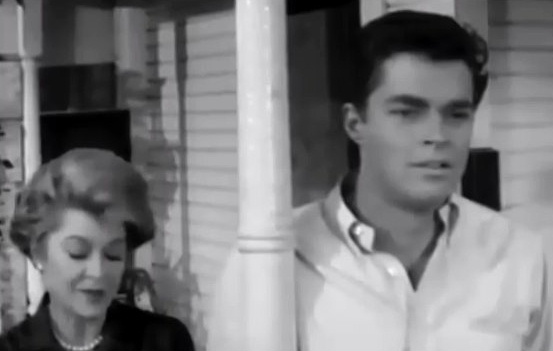
Richard Beymer and Joanne Woodward
THE STRIPPER (1963). Director: Franklin J. Schaffner. Based on the stage play "A Loss of Roses" by William Inge.

Along with her associates in a traveling magic act, Lila Green (Joanne Woodward) comes to the town where she lived as a child, but then is stranded when her boyfriend, Ricky (Robert Webber), runs off to greener pastures with all of their cash. Lila gets a room with a widow, Helen (Claire Trevor), who was her neighbor years ago, and who has a grown son named Kenny (Richard Beymer). Kenny and Lila develop an undeniable attraction to one another, but considering the age difference -- Woodward was eight years older than Beymer -- and everything else, Lila is afraid of being hurt and lonely once again. Then Ricky comes back into her life with a proposition ...

Claire Trevor and Richard Beymer
The Stripper is a lovely and absorbing film with three excellent lead performances. Although never considered a great beauty as such, Woodward [From the Terrace] has never looked better and she is excellent as Lila. (Marilyn Monroe, who was superb in the film adaptation of Inge's Bus Stop and was four years older than Woodward, might have been considered for this role had she not died tragically the previous year.) Beymer [Five Finger Exercise] gives a sensitive and intelligent performance as well, and Trevor [The Velvet Touch] is as adept as ever. Webber makes a very effective slime ball, and others in the cast include Gypsy Rose Lee and the odd Louis Nye as his associates (neither of them are especially memorable) and Carol Lynley, who makes a nice impression as a neighbor who has a crush on Beymer. Michael J. Pollard brings his own brand of quirkiness as a strange buddy of Kenny's who seems to have a thing for Lila but gets nowhere with her. The film could have used more scenes depicting the growing relationship between Kenny and Lila, but otherwise this is a very good movie.

Verdict: Strong cast and interesting situations add up to a memorable picture. ***1/2. 

BUS RILEY'S BACK IN TOWN

BUS RILEY'S BACK IN TOWN (1965). Director: Harvey Hart. Screenplay by William Inge, writing as "Walter Gage."

Bus Riley (Michael Parks of Kill Bill) has spent three years as a sailor and now has come back to his small town and his family, which consists of his mother (Jocelyn Brando) and two sisters, worshipful Gussie (Kim Darby) and disdainful Paula (Mimsy Farmer of Four Flies on Grey Velvet). Also in the household is a boarder named Carlotta (Brett Somers), who objects to Bus' noisy presence. Bus discovers that his old sweetheart Laurel (Ann-Margret) is married to a wealthy older man, but bored and childish, she won't leave him alone. Bus had planned for a career as an assistant mortician, but that doesn't work out when lonely and middle-aged Spencer (Crahan Denton) -- who runs the funeral parlor with his no-nonsense mother (Ethel Griffies) -- wants Bus to move in with him and all that implies. Bus gets a job selling a house disinfectant device to lonely housewives while dallying with Laurel, but a neighbor girl named Judy (Janet Margolin) also catches his attention, especially after a tragedy in her family. But will Bus have the strength to cut all ties with selfish Laurel?

Michael Parks
Bus Riley's Back in Town started out as a short play by William Inge, who turned it into a screenplay, then was dismayed when changes to the script were made to accommodate Ann-Margret (who later claimed that she didn't care for the changes either). So dissatisfied was Inge that he used the name "Walter Gage" instead of his own. I don't know what the screenplay was like before it was changed, but Bus Riley comes off mostly like warmed-over Inge, with snatches of Picnic and other plays,  For instance, in both movies we've got a widow with two daughters who takes in boarders, one of whom is a neurotic spinster, not to mention a handsome hero who ignites sexual interest in many.

Ann-Margret
As for the actors, most of them are so good that you wish they had been given better material. This includes Brett Somers, whose part seems to have been cut to the bone; Kim Darby, whose feelings for her brother seem to border on the incestuous; Griffies and Denton as mother and son; Alice Pearce as a potential customer; and Janet Margolin in a sensitive turn as Judy, among others. As for Ann-Margaret, her appearance does not really unbalance the movie as some have suggested, and I happen to think that she's excellent in the film. Her sex-kitten mode is completely appropriate for her part, and she runs with it, out-acting Parks, whose James Dean impressions do little to suggest that the chief reason for casting him wasn't his considerable sex appeal. Both he and Ann-Margret are, in a word, voluptuous.

Margolin, Parks and Denton
An interesting aspect to the film is its pre-Stonewall treatment of homosexuality. One could argue that mortician Spencer is almost guilty of a form of harassment when he makes his suggestion to Bus (although he places his hands nowhere besides Bus' knee), but the man comes off as more desperate and pathetic than anything else. Bus doesn't get angry, but he is clearly disillusioned and simply walks out of the room. Later, at a minor character's funeral, he is friendly to Spencer and vice versa but it is, of course, awkward, and he excuses himself quickly. Inge himself was a deeply closeted homosexual man.

Michael Parks
For a time the star build-up certainly worked for Ann-Margret, but Parks' period of movie stardom was very brief, with him returning to television where he started with Then Came Bronson. He managed to amass 145 credits, however, and had a successful career by any standard, although mega-stardom eluded him. As for Bus Riley it got a surprisingly good review from the New York Times at the time of the film's release, but other reviews were mixed. It is probably the weakest of the films inspired by Inge's work. Harvey Hart also directed Dark Intruder.

Verdict: Inge Lite. **1/2. 

A LIFE OF WILLIAM INGE: THE STRAINS OF TRIUMPH

A LIFE OF WILLIAM INGE: The Strains of Triumph. Ralph F. Voss. 1989; University Press of Kansas.

William Inge wrote several noteworthy plays -- Come Back, Little Sheba; Picnic; Bus Stop -- which were also made into excellent motion pictures. He also did an original screenplay for Splendor in the Grass, for which he won an Oscar, as well as the screenplay for All Fall Down. The Stripper was based on his unsuccessful play A Loss of Roses, and one of his one-acts was turned into Bus Riley's Back in Town, a film he later discredited. This in-depth biography looks at Inges' early years growing up in Kansas, his relationships with other family members, his struggles to find success as first an actor and then a playwright, his early Broadway successes, his friendship and rivalry with Tennessee Williams. his negative feelings about his homosexuality, and the post-success periods of the sixties and seventies in which nothing he wrote seemed to work and he tried much too hard to be hip and trendy. Inge's problem wasn't that he was gay, but that he couldn't accept it. He attended AA meanings with the writer Charles Jackson, a fellow self-hater and alcoholic, which was like the blind leading the blind. Inge's internalized homophobia probably reached its nadir in his 1965 play Where's Daddy? which was put out of its misery after only 21 performances. In this the main character, "Pinky Pinkerton," is a gay man who seduces teenage boys and tries to convince one of them to, in essence, go straight with a wife and kid! Inge lived to see Stonewall, but author Voss does not record Inge's reaction to it, if indeed he had one. Despite Inge's negative feelings about himself, he was a gifted playwright who managed to craft works that still resonate and that are still being produced today. This biography, while not without flaws and perhaps with too much (and conversely too little) preoccupation with his sexuality, gives Inge his due as both a man and an artist.

Verdict:  Insightful and absorbing biography of a great playwright. ***1/2. 

Thursday, August 8, 2019

BUS STOP

Monroe and Don Murray
BUS STOP (1956). Director: Joshua Logan. Based on the play by William Inge.

"Ain't it wonderful when somebody so terrible turns out to be so nice." -- Cherie.

Bo Decker is a young rancher who has a lot of energy but little experience with life or women. With his foreman and best friend, Virgil (Arthur O'Connell), he travels to Phoenix, Arizona to compete in a rodeo. He is certain that he will meet the right gal for him, and is convinced that that is just what's happened when he runs into nightclub entertainer Cherie (Marilyn Monroe). The trouble is that while Cherie may think Bo is handsome, she has no intention of marrying a complete stranger that she has just met. Bo, unfortunately, simply won't take no for an answer ...

Don Murray as Bo
Bus Stop was based on a stage play by William Inge, and it was opened up by screenwriter George Axelrod. Joshua Logan also directed the film version of Inge's Picnic the same year, although he had not directed the stage version of Bus Stop as he did Picnic. The movie benefits from inspired casting. Marilyn Monroe is simply outstanding as Cherie -- possibly the best performance of her career -- and is able to bring out the pathos and confusion in her character as well as her more comical aspects. Her interpretation of "That Old Black Magic" which she deliberately sings off-key in the saloon is very funny. Don Murray [Advise and Consent], whose first theatrical film this was, is also excellent, just perfect in fact, as Bo, managing to make a man who seems nearly psychotic at times a bit vulnerable and greatly appealing in some instances.

Arthur O'Connell and Monroe
As for the rest of the cast, Arthur O'Connell offers another of his spot-on performances as father surrogate Virgil. Betty Field [Seventeen] makes an impression, and seems to be channeling Mae West a bit, as the coffee shop owner, Grace. Robert Bray [Never Love a Stranger] has possibly his best role as the bus driver, Carl, who has a yen for Grace, and who has a fateful encounter with Bo. Eileen Heckart and Hope Lange are also effective in smaller roles as, respectively, Cherie's friend and co-worker and a young woman on the bus who befriends Cherie. Like Picnic, this romance has a bittersweet conclusion. Murray was nominated for an Oscar (supporting); Monroe should have been. The TV series Bus Stop was very loosely based on this movie.

Verdict: Very entertaining and well-acted comedy drama. ***. 

Thursday, July 25, 2019

PICNIC

An iconic image from Picnic by James Wong Howe
PICNIC (1956). Director: Joshua Logan. NOTE: Logan also directed the stage play. This review gives away some important plot points.

Hal Carter (William Holden) is a drifter and failed, wannabee actor who winds up in Kansas where he looks up an old buddy named Alan (Cliff Robertson), hoping to find work. Alan's father gives Hal a job, but things are complicated at the Labor Day picnic when Hal and Alan's fiancee, Madge (Kim Novak), find themselves attracted to one another. Alan is furious, but Madge's mother (Betty Field) is horrified at the fate in store for her daughter if she runs off with Hal. Meanwhile Madge's younger sister, Millie (Susan Strasberg), is suffering growing pains, and their border, spinster schoolteacher Rosemary (Rosalind Russell), is having a crisis of her own.

William Holden and Kim Novak
Picnic is based on the Pulitzer prize-winning stage play by William Inge, and screenwriter Daniel Taradash has intelligently opened up the drama without apparently losing much of the original's meat. Both of the two leads, Holden and Novak, are too old for their roles -- Novak was twenty-three and Holden thirty-eight looking older -- and Holden is really not the right type for Hal at all, but he still manages to give quite a good performance, as does Novak, whom I've always believed could be quite accomplished with the right role and director. Betty Field and Susan Strasberg score as mother and younger daughter, and Rosalind Russell, while she tends to overplay in some sequences, has a terrific moment when she's begging her steady beau, Howard (Arthur O'Connell, carried over from the stage version), to marry her. Cliff Robertson gives one of his best performances as Alan, a nice guy who is treated badly even as he treats Hal badly out of jealousy. There are also nice turns by Verna Felton (the tough maid on I Love Lucy) as a very sympathetic neighbor who takes to Hal right off the bat, and Reta Shaw and Phyllis Newman in smaller roles.

William Holden
Just as straight writers composed stories that revolved around female objects of desire, some gay writers did the same thing with male figures as the centerpiece. Tennessee Williams comes to mind with his "Orpheus Descending," which debuted on the stage four years after Picnic (although Williams' first version, "Band of Angels," dates back to 1940. Meanwhile "Orpheus" was filmed as The Fugitive Kind with Marlon Brando three years after Picnic hit screens.) Both Picnic and Fugitive Kind deal with sexy bad boys and drifters who burst into town and inflame passions among women; the plays and movies were too soon before Stonewall to deal upfront with any gay influences. This is not to say that the characters were all meant to be male.

Rosalind Russell and William Holden
However, both plays have more on their minds than just virile rough trade. Picnic is basically a study of small-town desperation and loneliness; the film has persistent undercurrents of both. It is made clear that Hal is just as lonely in his own way as Rosemary is, culminating in a painful sequence when Rosemary humiliates Hal after he, in her mind, rejects her advances. The film also looks at the pain of growing older and the anguished jealousy it can engender when a middle-aged person is confronted by someone with youth and promise and more overt attractiveness and sensuality.


Cliff Robertson and William Holden
Picnic has many memorable sequences. There is the amusing montage of scenes at the picnic, with crying babies, cute dogs, and silly games, and -- in contrast -- the sort of sexy slow dance that Hal and Madge do together on the bandstand. James Wong Howe's cinematography is outstanding, and George Duning has contributed a sensitive score. Picnic has to be considered an anti-romantic film. Playwright Inge probably meant the ending to indicate that Madge is giving full range to her feelings and taking a chance on life and love and perhaps getting away from a stifling small-town environment, but in the bittersweet conclusion she's also going off with a man she has known for only one day. (Paging Dr. Phil!) And does anyone really think the relationship between Rosemary and Howard will work?

The play starred Ralph Meeker as Hal, Paul Newman as Alan, Janice Rule as Madge, Eileen Heckart as Rosemary, and Arthur O'Connell as Howard. Aron Copeland's beautiful opera The Tender Land, which debuted around the same time as the stage version of Picnic, also dealt with a young woman who falls in love overnight with a drifter and wants to run away with him.

Verdict: Despite some problems, this is an excellent picture. ***1/2.