Lively, entertaining reviews of, and essays on, old and newer films and everything relating to them, written by professional author William Schoell.
Showing posts with label Joe Turkel. Show all posts

Thursday, March 19, 2020

PATHS OF GLORY

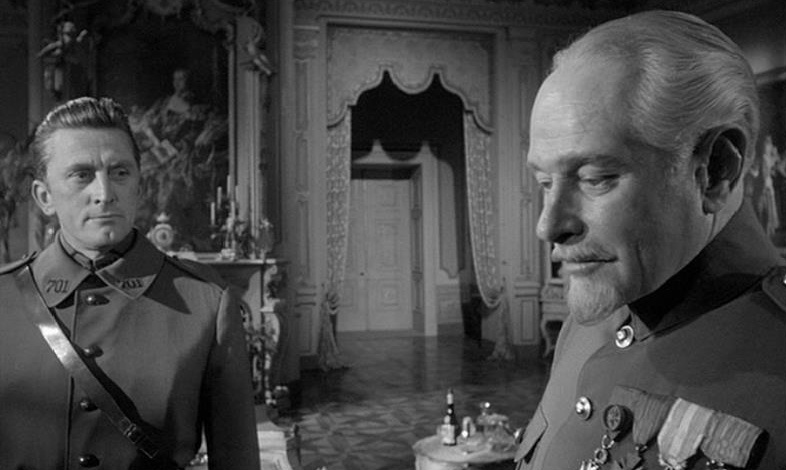
Kirk Douglas and George Macready
PATHS OF GLORY (1957). Director: Stanley Kubrick.

"There is no such thing as shell shock." -- General Mireau

French WW 1 General Paul Mireau (George Macready) initially makes it clear to General Brouard (Adolphe Menjou) that there is no way his battalion can possibly take a strategic position known as the "anthill." But Mireau changes his tune when Brousard talks about a promotion, even though they expect at least 60% casualties among their men.

Wayne Morris and Ralph Meeker
Now Mireau's second-in-command Colonel Dax (Kirk Douglas) is told in no uncertain terms that the men -- already exhausted and demoralized -- must take the hill the next day or else. Although the soldiers try their damnedest, it is an impossible and indeed suicidal task, and Mireau accuses them of cowardice. (Mireau even wants to fire on his own men because they aren't moving fast enough!) Mireau is talked out of shooting a hundred soldiers, but three are to be court-marshaled as an example. These three men are Private Arnaud (Joe Turkel of The Glass Wall); Private Ferol (Timothy Carey of The World's Greatest Sinner and Kubrick's The Killing); and Corporal Paris (Ralph Meeker), who is picked because he knows that his superior officer, Lt. Roget (Wayne Morris), essentially murdered one of his soldiers. Dax represents the men in what is basically a kangaroo court with an outcome that is clearly pre-ordained.

Old pros: Macready and Menjou
Paths of Glory is a powerful and maddening film, examining the outrageous miscarriages of justice and heartlessness that can take place during war time even among men fighting on the same side. The performances are excellent: a borderline slimy Menjou; an upright and morally-repulsed Douglas; Meeker, whose trademark cockiness eventually vanishes when he faces his own mortality; and Wayne Morris giving an unexpectedly strong performance as the morally-bankrupt Roget. Turkel and Carey are also notable -- as is Richard Anderson as the prosecutor --  but the one actor who positively walks away with the film is George Macready, who gives an absolutely ferocious and mesmerizing portrayal of the utterly loathsome and infuriating Mireau -- forget Gilda (in which I didn't think Macready was even all that great), this is the performance he should be remembered for.

Kubrick beautifully -- or rather horrifically -- recreates the WW 1 battlefield, and scenes of the men in the trenches as bombs explode unnervingly all around them are compelling, The film almost goes a bit off-course in the second half when it has aspects that remind one of the later Dr. Strangelove, but for the most part this is one of Kubrick's most successful and effective movies. Several years later the film King and Country had a similar theme but was not as good.

Verdict: George Macready's finest hour and a half and a highly memorable if imperfect picture for Kubrick. ***1/2. 

Thursday, March 5, 2020

THE BONNIE PARKER STORY

Jack Hogan and Dorothy Provine
THE BONNIE PARKER STORY (1958). Director: William Witney.

In 1930's Oklahoma Bonnie Parker (Dorothy Provine of Kiss the Girls and Make Them Die) has a dead end job as a waitress after her husband, Duke (Richard Bakalyan), is sent up the river for 175 years. But then Bonnie meets the cocky "Guy Darrow" (Jack Hogan of The Cat Burglar), whose first passes are easily blocked by the feisty and easily-angered Bonnie. Eventually Guy convinces his new girlfriend that they could make a lot of money knocking off gas stations and the like, but Bonnie -- who proves much more strong-willed than Guy -- is sick of getting comparative chicken feed. Her new plan is to to break her husband out of jail and start robbing banks ...

Dorothy Provine as Bonnie Parker
Made almost ten years earlier than the more famous Bonnie and Clyde, this is arguably the better of the two pictures. Provine and Hogan give more convincing performances as these rather vicious individuals, and William Witney -- who helmed numerous cliffhanger serials -- knows how to keep things moving at a brisk pace and also creates lots of suspense in key moments. There are other good performances in the film as well: Joe Turkel [The Glass Wall] as Guy's brother; Patricia Huston as his girlfriend; William Stevens as a budding architect who sees a more romantic and tender side of Bonnie; Richard Bakalyan as Duke; Douglas Kennedy as a cop who is pursuing the couple; and others.

Jack Hogan as "Guy Darrow"
The picture has several good scenes, including the hold-up of a armored truck which is nearly interrupted by a boy scout troop and the terrified scoutmaster (Sydney Lassick), and a tense if amusing business when a cute little boy (Stanley Livingstone) seemingly identifies Bonnie and the others as "bank robbers." The climactic shoot-out is also extremely well-handled. One could argue that the film may not have a lot of period atmosphere and it's strange that Clyde Barrow's name was changed, albeit not very much.

Verdict: Very snappy AIP crime drama with vivid players. ***. 

Thursday, March 7, 2013

THE GLASS WALL

THE GLASS WALL (1953). Director/co-writer: Maxwell Shane.

The explosion in the home video/DVD market has vomited a lot of should-be-forgotten crap onto the unsuspecting viewer, but now and then it has helped film buffs to re-discover a fine film that got lost in the shuffle, such as The Glass Wall. The film was the first American movie for Italian star Vittorio Gassman, and it was hoped that it would lead to a major starring career for the actor in American films. That didn't quite pan out, although Gassman appeared to advantage in other American movies, such as Rhapsody with Elizabeth Taylor and, years later, did an amusing turn in The Nude Bomb with Don Adams as Maxwell Smart. He continued to make many films in Italy and elsewhere.

In The Glass Wall, Gassman plays Peter Kaban, a "DP" [or "displaced person"] who stowaways on a ship heading toward New York after harrowing experiences in concentration camps and the like. Unfortunately, he's denied entry into the U.S. because he has no proof of who he is, and is to be sent back the next day by a tight-assed clerical type. Kaban knows that there is an American soldier, Tom (Jerry Paris), whom he aided overseas, who can identity him, and jumps ship so he can find him. Along the way Peter encounters hungry Maggie (Gloria Grahame), who tries to steal a coat [from Kathleen Freeman] and hides Peter out as they fall in love. [Grahame has a great, beautifully-delivered speech about how deadening her job was putting tips on shoe laces all day long.] Other complications include Tom's selfish fiancee (Ann Robinson of The War of the Worlds) who wishes Tom would stay out of the whole affair despite how much it means to a desperate Peter. It all leads to a dramatic climax on top of the U.N. building. The two leads are terrific, and there's excellent support from Robin Raymond [Girls in Chains] as a dancer who also befriends Peter, as well as Joe Turkel [Tormented] as her brother and Else Neft as her mother, among others. Joseph Biroc's photography is a definite plus. Shane also directed the mediocre Nightmare (1956).

Verdict: A lost film to remember, as they say. ***1/2.