Lively, entertaining reviews of, and essays on, old and newer films and everything relating to them, written by professional author William Schoell.
Showing posts with label Paul Stewart. Show all posts

Thursday, February 16, 2023

HELL ON FRISCO BAY

Alan Ladd
HELL ON FRISCO BAY (1955). Director: Frank Tuttle. 

Ex-cop Steve Rollins (Alan Ladd) was framed for a murder he didn't commit and sent to prison for five years. When he gets out he is determined to find out who really murdered the victim and clear his name. He pretty much ignores his wife, Marcia (Joanne Dru), because he wants to protect her and also because she dared to dally with a gentleman out of loneliness when Steve wouldn't even let her come to see him. The San Francisco docks are controlled by a nasty man named Victor Amato (Edward G. Robinson), who has a good right hand, Joe (Paul Stewart), and a good-for-nothing nephew, Mario (Perry Lopez), who loves the ladies. Joe spends his nights with a former movie star named Kay (Fay Wray) while Victor is stuck with his pious wife, Anna (Renata Vanni), who treats Mario like a son and thinks he should be a priest. Steve talks to assorted individuals in the hopes they can give him information that might help him, but when Amato offers him a job, and Steve turns him down, he vows to make him pay -- painfully. 

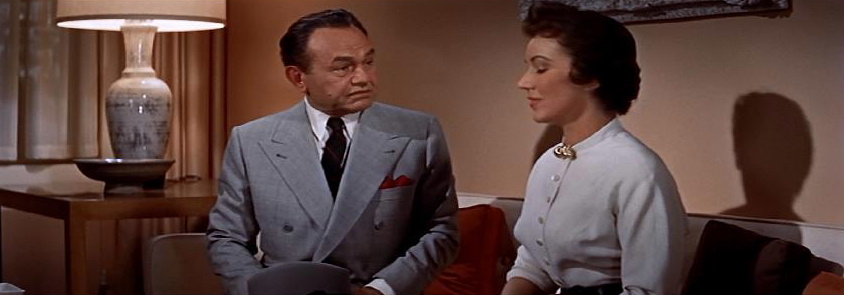
Robinson and Fay Wray
Hell on Frisco Bay
 is a fast-paced and entertaining film noir thriller with many intriguing elements and a highly interesting cast. Ladd could probably play this kind of role in his sleep by now, but he manages to stay awake and acquits himself nicely. A deceptively cheery Robinson slowly unveils the layers of corruption and evil until he reveals the slimy lizard at his core, going so far as to order Joe to murder his own nephew. Stewart is excellent as the hired gun who's trying to get out from under Robinson's thumb. Fay Wray scores as Kay, and one of the best scenes is between Wray and Robinson as Amato makes a pass at her and gets angry when she turns him down, hitting her. "Get out, you filthy peasant!" she screams. Joanne Dru is acceptable as Marcia, giving solid line readings that don't always hit the emotional mark. 

William Demarest and Rod Taylor
The film is also full of flavorful performances by a wide variety of supporting players. William Demarest is a cop and friend of Steve's while Willis Bouchey is the police lieutenant who has to be convinced of Steve's innocence. Rod Taylor plays a hood who may have committed the murder Steve was sent away for with Tina Carver as his girlfriend. Peter Hansen [When Worlds Collide] is the corrupt cop, Connors, and Anthony Caruso [The Asphalt Jungle] is especially notable as a fisherman who is scared that if he talks to Steve his young son, George (Peter J. Votrian, who is also good) may come to harm. Renata Vanni probably made a career out of playing long-suffering wives or mothers. Nestor Paiva plays another dock worker who tries to work things out with Amato and only winds up dead. Perry Lopez [The Steel Jungle] plays the sexy but weak nephew to perfection. Jayne Mansfield plays his date.

Paul Stewart with Robinson
Ladd is manhandled by the chubby gunsel Hammy (Stanley Adams) in one scene and turns the tables on him, beating him up and telling Joe to "get your pig outa here!" The film has a boat chase at the end that is exciting although not quite on the level of similar scenes in those old cliffhangers. Although this might not be listed among Max Steiner's greatest scores, it is effective and thrilling when it needs to be. The screenplay is good, but one wishes the picture crackled with tension -- although it comes close at times -- but director Frank Tuttle doesn't make the film quite as explosive as it could have been. Still, it's quite well-played and snappy.

Verdict: Memorable crime drama with some outstanding performances. ***. 

Thursday, September 17, 2020

EDGE OF DOOM

Farley Granger and Dana Andrews
EDGE OF DOOM (1950). Director: Mark Robson.

Father Thomas (Dana Andrews) tells a colleague (Robert Karnes)  -- who wants to leave this impoverished parish and go elsewhere -- the story of young Martin Lynn (Farley Granger), and how meeting him helped renew his faith. Martin's father was a criminal who committed suicide, and he hates the church because he was denied a Christian burial. Now Martin needs a raise to send his ill mother out of town, but his boss can't afford it. When the mother dies, Martin insists that old Father Kirkman (Harold Vermilyea of Manhandled) -- the one who denied the burial -- make up for all the money his mother gave to the church by paying for an elaborate funeral. Kirkman objects and things go downhill from there.

Granger with Mala Powers
Edge of Doom doesn't exactly take an intellectual approach to the material -- few "religious" movies ever do -- but it is nevertheless an interesting picture, and not as simple-minded as it might at first sound. An interesting aspect is the depiction of Father Kirkman. While he is not quite an ogre, he is also not the beneficent Bing Crosby-type of priest, being generally grumpy (and not in a cute way) and unpleasant, out of touch with his parishioners -- I wonder what the Catholic church thought of how he was portrayed. It would also be all too easy to dismiss Father Thomas as a bleeding heart who confuses reasons (for a person's behavior) with excuses, but it is easy to see why he has sympathy for Martin despite the young man's actions. Oddly, virtually no sympathy is expressed for the victim, despite his being an elderly priest! But this is typical of movies that focus more on troubled-young-men who become killers than they do on the ones they kill (especially if the killers are handsome).

In deep trouble: Farley Granger
The performances in the film are generally good. Granger at 25 may be a little old for the part but he certainly has affecting moments. Andrews is solid and convincing in an unusual role for him. Mala Powers is sensitive and effective as Martin's girlfriend. There is also good work from Paul Stewart as a neighbor, Robert Keith as a detective, Vermilyea as the older priest, Houseley Stevenson [Dark Passage] as Martin's boss at the flower shop, and Mabel Paige as an old woman who sees the priest killer outside the rectory and becomes a witness. Adele Jergens is a bit unsatisfactory as Stewart's girlfriend, however, especially in a scene she has with Andrews and Granger at the rectory. Douglas Fowley and Ellen Corby have smaller roles. Oddly Joan Evans, who was with Granger in Roseanna McCoy the previous year, receives top billing with him and Andrews but only has a small and relatively unimportant role as Father Kirkman's niece; she has one tiny scene with Granger. NOTE: Apparently the scenes with Andrews telling Martin's story were added after the film's initial release, as some feel the whole point of the movie and the novel it is based on is that the Church really can't do much to solve the problems of its parishioners.

Verdict: Imperfect but interesting crime drama. ***.

Thursday, March 19, 2020

KISS ME DEADLY

KISS ME DEADLY (1955). Produced and directed by Robert Aldrich.

Private eye Mike Hammer (Ralph Meeker) picks up a desperate runaway, Christina (Cloris Leachman of Happy Mother's Day, Love George), on the highway, embroiling him in a convoluted and dangerous case after they are waylaid and she is tortured and murdered. Mike barely survives himself, but he is intrigued and angry enough to determine to find out what's actually going on. As Hammer proceeds in his investigation over the objections of Lt. Pat Murphy (Wesley Addy of The Garment Jungle) -- who takes his licence away -- the bodies begin to pile up. Meanwhile Mike decides to shelter Lily Carver (Gaby Rodgers), the late Christina's terrified roommate. She and everyone but Velda (Maxine Cooper), Mike's secretary, seem concerned over a certain package that contains what Velda refers to as a "whatzis." After a number of people are beaten and killed, and Mike himself is subjected to truth serum by an unseen foe, he learns that Velda has been kidnapped. The climax occurs at a beach house occupied by a certain sinister doctor, all leading to a literally explosive finale.

Wesley Addy and Ralph Meeker
Kiss Me Deadly is one of Aldrich's best films. Although one could easily argue that it becomes hard to follow at times and under close inspection may not even make much sense, it is so brisk, well-acted, and absorbing that it is actually quite fascinating. Frank De Vol's score adds to the atmosphere,
as does Ernst Laszlo's superb cinematography, making the most of its LA locations. Then there's the acting. Meeker follows in the footsteps of Biff Elliott of I the Jury made two years earlier, and he is also near-perfect as a more thuggish variation of Mike Hammer. (Mickey Spillane did not care for the changes made to the character from novel to film.)

Percy Helton comes afoul of Ralph Meeker
Gaby Rodgers is so good as Lily that it's a surprise that she didn't become better known, but in addition to a few TV credits, she only did two pictures, this and an independent film that was barely released. Paul Stewart scores as a sinister mafia bigwig, Wesley Addy makes a convincing cop, and Marian Carr, Albert Dekker, and Maxine Cooper give flavorful performances as well. Percy Helton is up to his usual weaselly no-good-ness and figures in a sequence when Hammer uses an especially sadistic method to get a morgue attendant to talk. For a film made in the fifites, Kiss Me Deadly can be rather raw. Although Christina's torture is never actually shown, her dangling naked legs and the horrendous screams she omits tell the story in a way that might have sickened the stomachs of some viewers back in the day. (Alas, she keeps screaming as if the pliers were still being applied to her even though it's clear that no one is standing beside her any longer.)

Kiss Me Deadly deserves its reputation, although there are some critics who wax quite pretentiously about it -- profound it is not; cinematic it is. NOTE: Ahead of his time, Mike Hammer keeps an early version of an answering machine in his home office. Although much of the film's basic plot is derived from the novel, it deals strictly with mafia hoods and nothing radioactive.

Verdict: Despite the silly title, this is hard-hitting and very well done. ***1/2. 

Thursday, September 5, 2013

CHICAGO SYNDICATE

O'Keefe, Hayes, Lane and Stewart
CHICAGO SYNDICATE (1955). Director: Fred F. Sears.

"First you give me the cold shoulder and now you're romancing me like I'm Liberace."

A man named Kern is gunned down in the street and it develops that he was bookkeeper for a mobster named Arnold Valent (Paul Stewart). Kern's wife commits suicide and her daughter, Joyce (Allison Hayes), becomes a social pariah. Barry Amsterdam (Dennis O'Keefe) is hired to go undercover to get the goods on Valent, and he runs into an angry young woman with a gambling habit who turns out to be Joyce Kern; eventually the two join forces. Joyce's presence is irksome to Connie (Abbe Lane), Valent's girlfriend, who is also a singer and has a lap dog named Benny (Xavier Cugat). Hayes clearly has the leading female role, but she's billed under Lane, who gets co-star status with O'Keefe. Apparently Lane and Cugat (who were married at the time) were a package deal, as Cugat, who can't act [even when he's playing an orchestra leader!], just seems along for the ride. On the other hand, O'Keefe [Hold That Kiss] is fine, Stewart is excellent, while Hayes is a little more problematic. The infamous "fifty foot woman" [a Great Old Movies favorite] has no problem doing her usual shtick -- smouldering, bitter hostility -- but she's less successful in getting across any of her character's other nuances. Still, Hayes is always fun, especially when she's trading barbs with and spilling hot coffee on Lane, who doesn't give a bad performance; Lane could have used a little more seasoning but she managed to amass a few credits after this. Chicago Syndicate is entertaining even if it plays like little more than an expanded TV episode. Sears also directed such fun sci fi as The Giant Claw and Earth vs. the Flying Saucers.

Verdict: O'Keefe and Hayes make an interesting pair. **1/2.

Thursday, October 22, 2009

THE WILD PARTY (1956)


THE WILD PARTY (1956). Director: Harry Horner.

Anthony Quinn, Carol Ohmart (Vincent Price's bitchy wife in House on Haunted Hill), Arthur Franz of Atomic Submarine and The Sniper, Nestor Paiva of Tarantula, Kathryn Grant of The 7th Voyage of Sinbad, Paul Stewart and Nehemiah Persoff all in the same movie -- too bad it's a nearly unwatchable stinker. It's even more of a shame that virtually everyone in the cast gives a good performance, especially Carol Ohmart, who mostly did TV work. She plays Erica, who is seeing boyfriend Franz on his last night before going overseas, and is kidnapped by a crazy, desperate Quinn. Jay Robinson plays an even crazier pal of Quinn's, Gage. Persoff's hippie character, "Kicks," is incredibly annoying, although Persoff plays him well (too well). A lot of bad dialogue and under-developed characters.

Verdict: Fairly pitiful, with a cast that deserves better. *.

Tuesday, May 13, 2008

WALK SOFTLY STRANGER

WALK SOFTLY STRANGER (1950). Director: Robert Stevenson.

Chris Hale (Joseph Cotten) is a small time gambler and hood who enters into a relationship with crippled beauty Elaine Corelli (Alida Valli) in a small midwestern town. He becomes a surrogate son for his kindly landlady, Mrs. Brentman (Spring Byington), and holds up a casino with a buddy, Whitey Lake (Paul Stewart). This character study of redemption through love holds the attention and has interesting facets, but it doesn't quite work as either drama or thriller, and the romance between the two leads is never quite convincing. However the acting is, for the most part, quite good -- Byington and Stewart come off best, in fact -- and there's a suspenseful car ride sequence near the end. Adroitly directed by Stevenson, and with a pleasing score by Friedrich Hollaender. Although Valli is not Ingrid Bergman and isn't exactly passionate in her playing, her performance in this is decent and Cotton is as solid as ever. Future talk show host Jack Paar is pleasant as a co-worker of Cotten's. 

Verdict: At least it's different. **1/2.