Lively, entertaining reviews of, and essays on, old and newer films and everything relating to them, written by professional author William Schoell.
Showing posts with label Timothy Carey. Show all posts

Thursday, February 18, 2021

POOR WHITE TRASH (1957)

Timothy Carey, Peter Graves and Lita Milan
POOR WHITE TRASH (aka Bayou/1957). Director: Harold Daniels. 

New York architect Martin Davis (Peter Graves of Stalag 17) comes down to the bayou hoping to get assigned to a building project, but he's told by the man who called for him (Douglas Fowley) that he has to fight for the job. Martin is an intelligent man who refuses to sink down to other people's levels whether it comes to scrabbling with competitors or in actual fist fights. Martin, however, learns that he may have to fight for Marie Hebert (Lita Milan of I Mobster), a pretty Cajun woman who has innocently ignited the lust of shop owner Ulysses (Timothy Carey of Paths of Glory) and with whom Martin falls in love.  

Lita Milan and Peter Graves
Poor White Trash is actually the 1961 re-release title of a film originally called Bayou, which has some additional footage and a prologue where a man sings the catchy title tune. The most lurid -- and somewhat cinematic -- sequence has Ulysses chasing Marie through the mud of the swamp and finally cornering the exhausted woman. Marie is clearly raped (even if it isn't depicted graphically) but she has no reaction to this, offering Ulysses some money she owes him the next day as if nothing had happened instead of kicking him in the balls or telling her fellow Cajuns. This is clearly the fault of the script, although Milan herself registers nothing but a mild weariness after what would have had to have been a traumatic experience. 

"an orgiastic, self-flagellating dance"
Otherwise, Milan is attractive and appealing in the film. Graves was never a great actor, and this film offers more evidence of that, although he does register competence and likability. Douglas Fowley is fine as Martin's friend but he gets into a bit of trouble when he also essays Marie's dotty father, Emil. Timothy Carey, the Nicolas Cage of an earlier generation, displays his trademark intensity and is quite good as Ulysses, although one doesn't know quite what to make of the sequence when he does a kind of orgiastic, self-flagellating dance halfway through the movie. This uncomfortable sequence goes on for far too long, which is also the case in a love scene over which the storm outside is not-so-cleverly superimposed.  

Ed Nelson has a small role, but although Jonathan Haze of Little Shop of Horrors is also in the film I didn't spot him. There is some atmospheric photography and a vaguely evocative score by Gerald Fried. One of the film's most disturbing scenes is actually a party scene celebrating the marriage of an elderly man to a very young girl who looks like she'd like to run away from the oldster as fast as her feet could take her. 

Verdict: A trashy curiosity indeed. **. 

Thursday, March 19, 2020

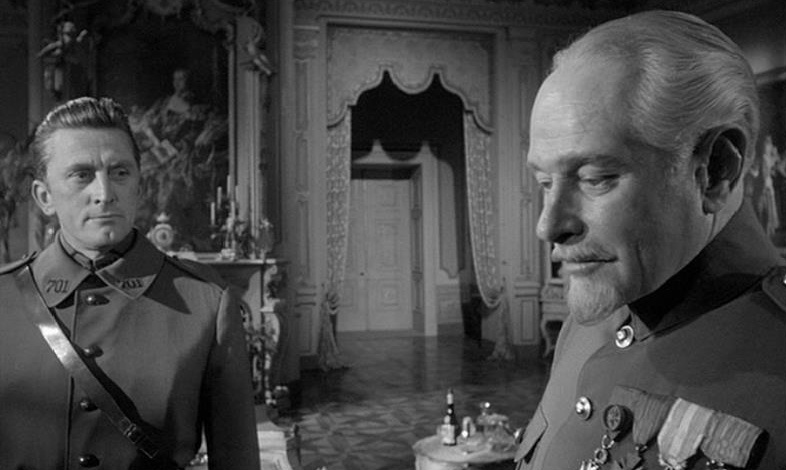
PATHS OF GLORY

Kirk Douglas and George Macready
PATHS OF GLORY (1957). Director: Stanley Kubrick.

"There is no such thing as shell shock." -- General Mireau

French WW 1 General Paul Mireau (George Macready) initially makes it clear to General Brouard (Adolphe Menjou) that there is no way his battalion can possibly take a strategic position known as the "anthill." But Mireau changes his tune when Brousard talks about a promotion, even though they expect at least 60% casualties among their men.

Wayne Morris and Ralph Meeker
Now Mireau's second-in-command Colonel Dax (Kirk Douglas) is told in no uncertain terms that the men -- already exhausted and demoralized -- must take the hill the next day or else. Although the soldiers try their damnedest, it is an impossible and indeed suicidal task, and Mireau accuses them of cowardice. (Mireau even wants to fire on his own men because they aren't moving fast enough!) Mireau is talked out of shooting a hundred soldiers, but three are to be court-marshaled as an example. These three men are Private Arnaud (Joe Turkel of The Glass Wall); Private Ferol (Timothy Carey of The World's Greatest Sinner and Kubrick's The Killing); and Corporal Paris (Ralph Meeker), who is picked because he knows that his superior officer, Lt. Roget (Wayne Morris), essentially murdered one of his soldiers. Dax represents the men in what is basically a kangaroo court with an outcome that is clearly pre-ordained.

Old pros: Macready and Menjou
Paths of Glory is a powerful and maddening film, examining the outrageous miscarriages of justice and heartlessness that can take place during war time even among men fighting on the same side. The performances are excellent: a borderline slimy Menjou; an upright and morally-repulsed Douglas; Meeker, whose trademark cockiness eventually vanishes when he faces his own mortality; and Wayne Morris giving an unexpectedly strong performance as the morally-bankrupt Roget. Turkel and Carey are also notable -- as is Richard Anderson as the prosecutor --  but the one actor who positively walks away with the film is George Macready, who gives an absolutely ferocious and mesmerizing portrayal of the utterly loathsome and infuriating Mireau -- forget Gilda (in which I didn't think Macready was even all that great), this is the performance he should be remembered for.

Kubrick beautifully -- or rather horrifically -- recreates the WW 1 battlefield, and scenes of the men in the trenches as bombs explode unnervingly all around them are compelling, The film almost goes a bit off-course in the second half when it has aspects that remind one of the later Dr. Strangelove, but for the most part this is one of Kubrick's most successful and effective movies. Several years later the film King and Country had a similar theme but was not as good.

Verdict: George Macready's finest hour and a half and a highly memorable if imperfect picture for Kubrick. ***1/2. 

Thursday, May 30, 2019

THE KILLING

Marie Windsor and Vince Edwards
THE KILLING (1956). Director, co-screenplay: Stanley Kubrick.

Ex-con Johnny Clay (Sterling Hayden) has gathered together a motley group to rob a race track: bartender Mike (Joe Sawyer); cop Randy (Ted de Corsia of The Big Combo); sniper Nicky (Timothy Carey); front man Marvin (Jay C. Flippen), muscular Maurice (professional wrestler Kola Kwariani); and track employee George (Elisha Cook, Jr.). But George, who wants to participate so he can buy things for his unfaithful wife, Sherry (Marie Windsor), is unaware that she has taken a lover, Val (Vince Edwards), and when these two learn about the robbery they cook up their own plans ...

Elisha Cook Jr. and Marie Windsor
The Killing is Kubrick's third theatrical film (aside from some documentaries), and it is one of his best. He managed to get excellent performances from the cast, with Windsor being a stand-out along with Elisha Cook, Jr., [House on Haunted Hill] who here is given one of the best roles of his career and runs with it. The other cast members are all on the mark, including Dorothy Adams as Mike's bedridden wife, Ruthie. Colleen Gray gets only a few moments as Johnny's girlfriend, but she's fine, and Carey makes a weird and effective Nicky, who literally shoots horses. Lucien Ballard's cinematography is first-class, and Gerald Fried's musical score adds to the film's taut and suspenseful atmosphere.

Sterling Hayden with Jay C. Flippen 
Jim Thompson's dialogue is occasionally forgettable ("she has a dollar sign where her heart should be"), but there's also an interesting interchange between Marvin and Johnny in which the former tells the latter that he practically thinks of him as a son, but then virtually suggests that they run away together, although the implications of this go unexplored. The film has an ironic, knock-out ending that really delivers a wallop. The movie is generally filmed in long cuts and the tension would have been increased with sharper editing. As good as this is, I would have loved to see what this would have been like had Hitchcock directed it. Another interesting Kubrick film is Eyes Wide Shut.

Verdict: One of the best caper movies ever made. ***1/2. 

Thursday, April 23, 2009

THE WORLD'S GREATEST SINNER


THE WORLD'S GREATEST SINNER (1962). Director: Timothy Carey.

A vanity production for Timothy Carey (pictured), who wrote, produced, directed and stars in this fairly terrible home movie. Carey plays Clarence Hilliard who quits his hated insurance job and sets out to make himself famous as "God." Before long he has masses of followers. There are many scenes of Carey making out with assorted women from the elderly to the under-aged. Carey was actually a good, charismatic actor -- he looks and sounds like John Turturro, who is not a relation -- who had some impressive screen roles in other movies, but this is too cheap and silly to amount to much. Whatever points the film is allegedly making are lost in a pretty bad screenplay.

Verdict: Schlock with a talented lead, but still schlock. *.