Lively, entertaining reviews of, and essays on, old and newer films and everything relating to them, written by professional author William Schoell.
Showing posts with label Fay Wray. Show all posts

Thursday, July 2, 2026

POINTED HEELS

William Powell and Fay Wray
POINTED HEELS (1929). Director: A. Edward Sutherland. Colorized.  

"I was so afraid you were going to be sensible -- and go away." -- Lora.

Broadway producer Robert Courtland (William Powell) is interested in the mildly talented Lora Nixon (Fay Wray of King Kong and Queen Bee) but she leaves the show to marry the wealthy Donald Ogden (Phillips Holmes of Beauty for Sale). Learning of his marriage, Donald's furious mother cuts him off without a penny and he and his new wife move into a dingy flat. Lora's brother, Dash (Richard "Skeets' Gallagher), has an act with his wife Dottie (Helen Kane), and they interest Courtland -- who is still attracted to Lora -- in their show, which they threaten to sink by suddenly deciding to act all "refined." Courtland can't help but notice a rift in the Ogden's marriage -- musician Donald can't quite deal with Lora being the breadwinner -- but will he take advantage of the situation? 

Phillips Holmes
Pointed Heels
 is a charming old musical, an early sound film, that features some good performances from the three leads although it frequently eschews logic. For instance, why would Donald feel out-classed by Lora when his score is being used for the new musical and she only has a supporting part? And one could certainly raise their eyebrows at Courtland's technique for loosening up the Nixons -- he gets them drunk before sending them out on stage on opening night! As well, Donald is working on a "symphony" but the passages we hear don't exactly sound like classical music. The songs in this include "Ain't Ya" and "I Have to Have You." Helen Kane only appeared in eight films but she became famous as the basis of Max Fleischer's cartoon character Betty Boop and even originated the phrase "Boop-boop-deboop." She sued Fleischer but lost, even though Betty Boop was clearly inspired by her. A. Edward Sutherland also directed Follow the Boys and many others. 

Verdict: Minor but fairly nice old musical with interesting players. ***. 

Thursday, August 28, 2025

QUEEN BEE

Joan as Eva Phillips
QUEEN BEE (1955). Written and directed by Ranald MacDougall. Colorized version.      

"Really that Dr. Pearson is absurd. He actually trembles when he talks to me. You'd think he'd never seen a beautiful woman before." -- Eva. 

Although dating Jud Prentiss (John Ireland of The Ceremony), the Yankee Eva (Joan Crawford) sets her cap for Jud's boss, Avery Phillips (Barry Sullivan of Pyro), a wealthy Southern gentleman, and follows him home. Eva lies and tells Avery that she's pregnant, and the "gentleman" literally leaves his fiancee, Sue (Fay Wray), at the church door to run off with Eva. Years later the two are trapped in a miserable, dysfunctional marriage with Avery spending most of his time in his bedroom getting drunk. Ironically, Avery is nicknamed "Beauty" but now has a large scar on his face due to a drunken driving accident. Meanwhile the aforementioned Jud has fallen for Avery's sister, Carol (Betsy Palmer), who positively loathes Eva. Into this miasma of Southern rage and scandal comes Eva's sweet cousin, Jennifer (Lucy Marlow of He Laughed Last), who is moving into the mansion completely unaware of the goings-on. When Eva, who never lets go of a man, finds out that Jud and Carol are engaged, things in the household will get even tenser, if such is possible ... 

Mrs. Vorhees meets Lucy Harbin
Queen Bee
 is certainly not a perfect movie, but it is a strangely compelling melodrama with a lot going on in the background. Joan Crawford dominates the picture, of course, as she should, and gives a highly effective performance as a rather nasty character who admits what she is but still can't help making excuses for her behavior. If you don't quite believe her when she's showing vulnerability, it's because you can't quite imagine Eva ever being vulnerable in any real sense, although she is not above playing on people's sympathies. 

Cocktails and savagery at the Phillips
As for the rest of the cast, Betsy Palmer stands out as Carol, standing up to Eva/Joan on occasion even as you realize she is just no match for her strong-willed, highly neurotic sister-in-law. Lucy Marlow, with her odd square face, has a couple of unconvincing moments but is basically solid as the ultimately disillusioned Jennifer. (You're not quite certain how or why she falls for the dissolute Avery, and any actress might have a hard time making that convincing.) Fay Wray has one scene as Sue, the jilted fiancee, who seems to have lost herself in never-got-over-it vagueness. Wray is good, but it's hard to imagine that she would ever want anything to do with this couple, let alone have cocktails with them in their drawing room. 

Barry Sullivan with Crawford
The men don't fare as well. John Ireland and Barry Sullivan give rather stilted, rushed line readings as compared to the ladies. William Leslie makes an impression, however, as the handsome and charming Ty, and Jennifer seems demented in preferring Avery, on the verge of cirrhosis of the liver, over this hunk. Katherine Anderson is suitably hard and unpleasant as the nurse who takes pleasure in being nasty to the little boy (Tim Hovey) who suffers nightmares, until the little guy knows "how [the nightmare] ends" at the violent climax. Hovey is as adorable and adept as ever. (A sobering postscript is that the fellow committed suicide at only 44.) Willa Pearl Curtis, as a maid, has a nice vignette when she expresses sympathy to Jennifer over being dumped and muses about her own romantic missteps. Years later Crawford and Palmer both played deranged murderesses, Crawford in Strait-Jacket (at the opening) and Palmer in Friday the 13th. Handsomely shot by Charles Lang. 

Verdict: Crawford in a compelling portrait of a woman who deservedly hates herself. ***. 

Thursday, February 16, 2023

HELL ON FRISCO BAY

Alan Ladd
HELL ON FRISCO BAY (1955). Director: Frank Tuttle. 

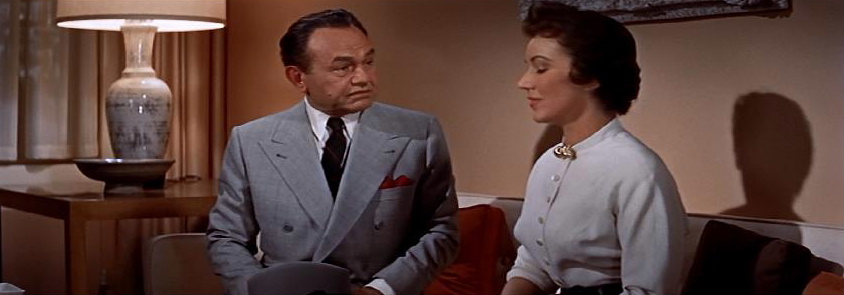
Ex-cop Steve Rollins (Alan Ladd) was framed for a murder he didn't commit and sent to prison for five years. When he gets out he is determined to find out who really murdered the victim and clear his name. He pretty much ignores his wife, Marcia (Joanne Dru), because he wants to protect her and also because she dared to dally with a gentleman out of loneliness when Steve wouldn't even let her come to see him. The San Francisco docks are controlled by a nasty man named Victor Amato (Edward G. Robinson), who has a good right hand, Joe (Paul Stewart), and a good-for-nothing nephew, Mario (Perry Lopez), who loves the ladies. Joe spends his nights with a former movie star named Kay (Fay Wray) while Victor is stuck with his pious wife, Anna (Renata Vanni), who treats Mario like a son and thinks he should be a priest. Steve talks to assorted individuals in the hopes they can give him information that might help him, but when Amato offers him a job, and Steve turns him down, he vows to make him pay -- painfully. 

Robinson and Fay Wray
Hell on Frisco Bay
 is a fast-paced and entertaining film noir thriller with many intriguing elements and a highly interesting cast. Ladd could probably play this kind of role in his sleep by now, but he manages to stay awake and acquits himself nicely. A deceptively cheery Robinson slowly unveils the layers of corruption and evil until he reveals the slimy lizard at his core, going so far as to order Joe to murder his own nephew. Stewart is excellent as the hired gun who's trying to get out from under Robinson's thumb. Fay Wray scores as Kay, and one of the best scenes is between Wray and Robinson as Amato makes a pass at her and gets angry when she turns him down, hitting her. "Get out, you filthy peasant!" she screams. Joanne Dru is acceptable as Marcia, giving solid line readings that don't always hit the emotional mark. 

William Demarest and Rod Taylor
The film is also full of flavorful performances by a wide variety of supporting players. William Demarest is a cop and friend of Steve's while Willis Bouchey is the police lieutenant who has to be convinced of Steve's innocence. Rod Taylor plays a hood who may have committed the murder Steve was sent away for with Tina Carver as his girlfriend. Peter Hansen [When Worlds Collide] is the corrupt cop, Connors, and Anthony Caruso [The Asphalt Jungle] is especially notable as a fisherman who is scared that if he talks to Steve his young son, George (Peter J. Votrian, who is also good) may come to harm. Renata Vanni probably made a career out of playing long-suffering wives or mothers. Nestor Paiva plays another dock worker who tries to work things out with Amato and only winds up dead. Perry Lopez [The Steel Jungle] plays the sexy but weak nephew to perfection. Jayne Mansfield plays his date.

Paul Stewart with Robinson
Ladd is manhandled by the chubby gunsel Hammy (Stanley Adams) in one scene and turns the tables on him, beating him up and telling Joe to "get your pig outa here!" The film has a boat chase at the end that is exciting although not quite on the level of similar scenes in those old cliffhangers. Although this might not be listed among Max Steiner's greatest scores, it is effective and thrilling when it needs to be. The screenplay is good, but one wishes the picture crackled with tension -- although it comes close at times -- but director Frank Tuttle doesn't make the film quite as explosive as it could have been. Still, it's quite well-played and snappy.

Verdict: Memorable crime drama with some outstanding performances. ***. 

Thursday, April 28, 2022

TREASURE OF THE GOLDEN CONDOR

Cornel Wilde and Anne Bancroft
TREASURE OF THE GOLDEN CONDOR (1953). Director: Delmer Daves. 

In 18th century France Jean Paul (Cornel Wilde) becomes the bonded servant of his hateful uncle the Marquis de St. Malo (George Macready). Jean also falls in love -- and vice versa -- with his cousin Marie (Anne Bancroft). Jean is the rightful heir to the estate and money but there is no proof that his parents, who died at sea, were ever married. Jean figures only money can get him out of his predicament, especially after he is arrested for assaulting his uncle and trying to flee, so he takes off on a treasure hunt in Guatemala with a man named MacDougal (Finlay Currie). 

Wilde with Finlay Currie
In Guatemala the two men set off with MacDougal's daughter Clara (Constance Smith) and look for a stone serpent to guide them to the treasure. Despite the fact that the movie made much of the fact that some of it was filmed in Guatemala, it doesn't especially add to the film's veracity, especially when the treasure seems to be found in a matter of minutes. There's a snake, a cave-in, and minimal excitement in the treasure scene. Then Jean returns to France, is put on trial, and has a rousing and satisfying final battle with his awful uncle, the best and most memorable sequence in the movie. Wilde gives a charismatic lead performance, with good support from a slimy Macready and a passionate if duplicitous Bancroft in one of her earliest roles. (When she eyes Wilde with his shirt off you can imagine she'd rather cozy up to him than Dustin Hoffman!) Irish actress Smith had about thirty credits but never hit the heights. Fay Wray has a supporting part as Macready's wife, and Leo G. Carroll is also in the cast, but I didn't recognize Robert Blake as a nasty stable boy.  The rich score by Sol Kaplan is beautifully orchestrated by Edward Powell. The main problem with this movie is that the viewer will expect it to be about a treasure hunt but that only takes up a small portion of the picture.

Verdict: Good cast can only do so much with comparatively weak and derivative material. **1/2.

Thursday, May 30, 2019

SMALL TOWN GIRL

Farley Granger and Jane Powell
SMALL TOWN GIRL (1953). Director: Leslie (Laszlo) Kardos.

Rich and patronizing playboy Richard Livingstone III (Farley Granger) speeds through the small town of Duck Creek, sasses Judge Kimbell (Robert Keith), and winds up thrown in jail for thirty days. Richard importunes the judge's daughter, Cindy (Jane Powell), to let him out one night for his "mother's" birthday. Richard has a jealous if unfaithful fiancee in Broadway star Lisa Bellmount (Ann Miller), but during a night in New York he and Cindy start to fall in love. How will the judge react when he is apprised of this situation?

Jane Powell
Small Town Girl is the perfect example of a well-turned out MGM musical. The players are fine and enthusiastic (Granger is much better than you might imagine); the TechniColor is vivid and beautiful; there are a couple of more than pleasant tunes ("Small Towns;" "The Fellow I Follow"); some excellent production numbers; and an essentially amiable if lightweight veneer that puts over the slight but entertaining storyline. Jane Powell [Seven Brides for Seven Brothers] again proves an adept leading lady with a lovely voice and good delivery. And besides Granger, Powell has a host of excellent supporting players and character actors to back her up.

Bobby Van 
First among these is Bobby Van [Lost Horizon], who plays Ludwig Schlemmer, the boy next door who has Broadway aspirations. Van is by no means handsome in Hollywood terms, but he is so irrepressible and talented that it doesn't matter; he has a kind of Al Jolson delight in performing. The most famous highlight of Small Town Girl is when Van literally hops his way across town in sheer spirited excitement, a well-choreographed (Busby Berkeley) sequence that was filmed with only a few cuts. When Ludwig meets Ann Miller and tells her his name, she says "Well, keep it quiet and no one will notice." Ludwig's father is played by "Cuddles" Sakall, whose character in this seems more grumpy and unpleasant than lovable.

Miller struts her stuff
Then there's Ann Miller [Carolina Blues]. There may well have been better female dancers in Hollywood musicals, but in this Miller stars in a zesty production number, "Feel That Beat," wherein the members of the band are hidden behind walls and under the floor, with only their arms and instruments protruding. As for the rest of the players, Robert Keith is fine as the judge, as is an uncredited Chill Wills as the friendly sheriff, Happy. Fay Wray is the judge's wife; Billie Burke is her dithery self as Richard's society mother; William Campbell is a reporter; Marie Blake is a shop customer; and Beverly Wills, the daughter of Joan Davis, plays Ludwig's sister, Deidre. Nat King Cole also sings a number, "Burn Low." Photographed by Joseph Ruttenberg.

Verdict: Delightful MGM musical. ***.   

Thursday, February 8, 2018

DRAGSTRIP RIOT

Gary Clarke and Fay Wray
DRAGSTRIP RIOT (1958). Director: David Bradley.

Rick Martin (Gary Clarke) was once in trouble with the law and his mother (Fay Wray!) and grandfather (Ted Wedderspoon) are forever afraid he'll do something stupid. Rick innocently ignites the ire of Bart Thorson (Bob Turnbull) because the latter covets the former's girlfriend, Janet (Yvonne Lime of I Was a Teenage Werewolf). To get even with Rick, Bart falls in with a motorcycle gang of toughs who also have a grudge against Rick, leading to a dangerous game of chicken involving two cars and an onrushing train; a death dive off a cliff; and a free-for-all rumble on the beach where the true bad guys are finally routed. None of this is as exciting as it sounds due to a slow pace -- even a race is kind of dull. Affecting a Jean Harlow  "platinum blond" hair color, Clarke makes a sensitive enough hero; Wray, light-years from King Kong, is fine as his mother; and there are more than acceptable performances from Turnbull, Lime, John Garwood as Silva, leader of the gang, and others. Connie Stevens [Hawaiian Eye] plays Marge, one of Janet's pals, who gets in a "cat fight" with Silva's brunette moll at one point; and Steve Inhat is cast as "Dutch," another biker, but is given little to do; he was also in Date Bait with Clarke. Connie also sings a song and there's another musical number as well. In one unintentionally hilarious scene, Rick looks around the beach for Janet as if she's nowhere in sight when a subsequent shot shows her not only just a few yards away but screaming her head off! It's equally humorous that the rumble, which supposedly takes place in an isolated spot, turns out to be happening right near the kids' hot spot, "Mom's."

Verdict: Slightly more entertaining than watching paint dry. *1/2.

Thursday, December 2, 2010

ALFRED HITCHCOCK PRESENTS: SEASON FOUR

ALFRED HITCHCOCK PRESENTS Season 4. 

A whole bunch of ironic, amusing, and suspenseful stories served up by the ever-droll Hitch. "Poison" features Wendell Corey in a tale of a snake in a bed. "Man with a Problem" finds Gary Merrill out on a ledge threatening suicide. "Tea Time" teams Margaret Leighton and Marsha Hunt in a tale of wife vs. mistress. "Mrs. Herman and Mrs. Fenimore" is a delightful tale of a miserly uncle and the two women in his life, Dora Merande and Mary Astor, both of whom are wonderful. Then there's the creepy "Waxwork," and Franchot Tone and Mary Astor again in "The Impossible Dream" about an aging actor. Bette Davis stars in "Out There, Darkness," about a woman who pays the price for her jealous actions, and there's nice work from Fay Wray in "The Morning After." Other notable episodes include "Murder Me Twice" with Phyllis Thaxter in a tale of reincarnation; "The Desert Shall Blossom," with two cowboys and a gangster; "Kind Waitress," with Olive Deering; "The Diamond Necklace" with the great Claude Rains; Dennis Day in "Cheap is Cheap;" and Robert Morse and Paul Douglas in "Touche." 

Verdict: More fun with Hitchcock. ***.

Thursday, August 26, 2010

KING KONG (1933)

KING KONG (1933). Directed by Cooper and Schoedsack. 

Nearly 90 years after its initial release, King Kong remains an outstanding film and one of the most exciting motion pictures ever made. While some may consider them "crude" today, the fact is that many of the stop-motion effects by Willis O'Brien and company are still eye-popping and extremely effective, with Kong himself being a wonderful creation -- both playful [flapping the cracked jaw of a defeated T Rex with amusing curiosity] and extremely dangerous, to say the least. The picture is fast-paced, intense, and at times quite disturbing. (You can feel sorry for Kong if you want to; the one who gets my sympathy is that poor terrified woman who's grabbed out of her bed in the hotel and dashed to the ground -- not to mention all of the big ape's other victims]. Max Steiner's excellent score imbues the film with atmosphere, as do the elaborate sets, beautiful matte paintings, and other FX work. All in all, King Kong is a kind of epic tragedy for all concerned. This is still the best version of the story bar none. NOTE: You can read more about this and other monster movies in Creature Features: Nature Turned Nasty in the Movies

Verdict: Cinematic and magical. ****.

Thursday, May 6, 2010

QUEEN BEE


QUEEN BEE (1955). Director [and screenplay]: Ranald MacDougall. From a novel by Edna L. Lee.

"Never come between me and my liquor. You might get knocked down." -- Avery.

"You can't imagine the things they've made me do trying to protect myself." -- Eva.

Well ... what to make of this picture? We have a bitter Eva Phillips (Joan Crawford), who is still smarting over the way her southern in-laws treated her when she came from Chicago; her heavy-drinking husband, Avery (Barry Sullivan) who has a big scar on his cheek from a car accident and is nicknamed "Beauty;" cousin Lucy (Jennifer Stewart), who comes for a lengthy stay and is caught between neurotic factions; sister Carol (Betsy Palmer), who only wants to marry Eva's cast-off lover Jud (John Ireland), but is tempting fate; and poor batty Sue (Fay Wray), who was literally left at the altar on her wedding day when Avery ran off with Eva. This is the kind of over-baked melodrama in which characters stand around and talk about the problems that define them at the drop of a hat. To say it lacks subtlety is a massive understatement. At the same time it's quite entertaining and oddly riveting, and works itself up to a dramatically horrifying climax. Everyone in the film seems to have studied at the School of Unnatural Acting, but most are effective, with Crawford being quite authoritative and giving her fans a good show. She is wise enough to show the vulnerability beneath her character's bitchiness. After her, Betsy Palmer comes off best, but both Ireland and Sullivan have their moments, and Katherine Anderson makes a mean nurse in Miss Breen. Years later Palmer played deranged maniac Mrs. Voorhees in the original Friday the 13th.

Verdict: Not exactly Tennessee Williams, but strangely compelling. ***.

Thursday, October 29, 2009

BLACK MOON

BLACK MOON (1934). Director: Roy William Neill. 

"The natives are restless." 

A wife and mother, Juanita Lane (Dorothy Burgess), becomes a little too involved with the voodoo culture on the island of San Christopher to the point where she's prepared to sacrifice her own child. People around her, such as a telegraph operator and the child's nurse, Anna (Eleanor Wesselhoeft) are murdered. There are interesting elements to the movie to be sure, but despite all the activity and running around, it generates more tedium than thrills or horror. Fay Wray is secretary Gail Hamilton, and Jack Holt is Juanita's husband. The movie is inherently racist, but at least Clarence Muse portrays "Lunch" McClaren, a sympathetic and likable black character. Ruva, the sinister voodoo lady, is portrayed by Madame Sul-Te-Wan. 

Verdict: A possible cure for insomnia. * 1/2.

Thursday, August 20, 2009

THE COBWEB


THE COBWEB (1955). Director: Vincente Minelli.

"Van Gogh didn't sell a painting in his lifetime, but now they're worth thirty million. They weren't that bad then and they're not that good now, so who's crazy?"

The patients and staff of a Clinic for Nervous Disorders become embroiled in -- believe it or not -- a fight over which drapes to hang in the library. Some want an attractive if standard pattern, while others, such as Dr. Stewart McIver (Richard Widmark) want to transfer drawings done by a young patient, Stevie (John Kerr), to silk screenings and hang them instead. The complications of the staff's private lives don't help much. Dr. Devanal (Charles Boyer), the former head of the clinic now in a sort of advisory capacity, is an unregenerate skirt-chaser whose secretary (Adele Jergens) is in love with him. Dr. McIver's wife Karen (Gloria Grahame) feels neglected by her husband, who is slowly being drawn to the widowed Activities Director Meg Rinehart (Lauren Bacall). Then there's Miss Inch (Lillian Gish), the prickly, strong-willed spinster with territorial instincts who objects to anyone she sees as threatening to her authority. This is an interesting if overlong melodrama/soap opera with outstanding performances by Gish [great in a mostly unsympathetic part] and Grahame, and very good performances by most of the rest of the cast. The love story between Stevie and fellow patient Sue (Susan Strasberg) is kind of boring, however. Oscar Levant is quite amateurish as a neurotic patient and his scenes should have been cut as they add nothing to the picture. Fay Wray, Myra Marsh [from the operetta episode of I Love Lucy] and Virginia Christine appear in smaller roles. Christine had much bigger roles in The Mummy's Curse, Three Brave Men, and Nightmare (1956). She later became "Mrs. Olsen" of coffee commercial fame.

Verdict: Over-baked but enjoyable for the most part. ***.

Wednesday, November 26, 2008

IT HAPPENED IN HOLLYWOOD


IT HAPPENED IN HOLLYWOOD (1937). Director: Harry Lachman.

Tim Bart (Richard Dix) is a western star in silent pictures who has a real appreciation and love for his young fans. When he does a test for a new sound film, he discovers that he just can't get the lines out right. He's offered a second chance in Hollywood, but he doesn't want to play any part that goes against his essentially good guy image. Frankly, this movie is a little too treacly for my taste, and it doesn't have that many amusing scenes. Dix isn't bad, Faye Wray (as an actress who has a yen for Bart) is as lovely as ever, but the picture is stolen by Bill Burrud as little Billy, a kid who travels miles to see his idol. The best scene is a party in which the guests are all lookalikes of famous movie stars. There's a damn good Garbo imitator, but the Mae West impersonator is none too impressive.

Verdict: Too sappy for some. **.

Wednesday, April 2, 2008

THE MOST DANGEROUS GAME

THE MOST DANGEROUS GAME (1932). Directors: Ernest B. Schoedsack and Irving Pichel.

Bob Rainsford (Joel McCrea) is the only survivor of a shipwreck near a small island owned by the sinister Count Zaroff (Leslie Banks). Safe on land in the count's gothic castle, he learns that Eve Trowbridge (Fay Wray) and her brother Martin (Robert Armstrong) are also ship-wrecked "guests" waiting patiently for the count's launch to be repaired -- only Eve tells Bob that she's heard the launch going out at night. It turns out that the sociopathic Zaroff deliberately causes shipwrecks and then hunts down "the most dangerous game" -- human beings -- from the survivors. The first half of the film is suspenseful enough, but the second half is non-stop excitement as Bob and Eve try desperately to outwit the count, his men, and his killer dogs and survive until dawn. Thrilling right up until the very last shot. Made concurrently with King Kong (as the FX of that film were being completed) this utilizes some of the same, very recognizable sets. Robert Armstrong gives a more flavorful, less wooden performance than usual and is very good as the ill-fated brother. The shipwreck sequence is very well-done, the effects work is excellent, and the castle settings are atmospheric and intriguing. Although he has been criticized as being "campy," Leslie Banks actually offers a very effective and comparatively low-key portrait of the psychopathic count and never gnoshes on the scenery. His versatility is shown with his much more benign character in The Tunnel. The Most Dangerous Game is highly entertaining although it could probably have used a few more minutes of character development. Suitably rousing score by Max Steiner.

Verdict: A classic! ***1/2.