Lively, entertaining reviews of, and essays on, old and newer films and everything relating to them, written by professional author William Schoell.
Showing posts with label Robert Wise. Show all posts

Thursday, July 2, 2026

EXECUTIVE SUITE

EXECUTIVE SUITE
(1954). Director: Robert Wise.

Avery Bullard, the head of Tredway Furniture Corporation, drops dead on a city street and a war begins over which of the executive directors will take charge of the company. The most interesting aspect of this picture is the opening, in which we see everything from Bullard's point of view (we never actually see Bullard). Then the picture just about talks itself to death, coming to life only sporadically whenever Barbara Stanwyck comes on as Julia Tredwell, wringing her hands, and yelling at one or two of the other characters. What this picture needs is a lot more of Stanwyck and a lot less of June Allyson, who is at her most perfectly cloying as William Holden's drippy wife. Fredric March, Nina Foch, Shelley Winters, Paul Douglas, and especially Louis Calhern all give good performances, however, with Stanwyck being the zippiest. Holden is adequate, and Walter Pidgeon is a bit better than usual in more of a character part. The funniest sections of the film -- which hasn't many laughs, just talk -- have to do with Calhern and his pretty, ever-hungry mistress. Allyson was a lot better in Woman's World, which came out the same year, had a similar premise, and was a much more entertaining movie.

Verdict: Given how little the women have to do in this film, it's a man's world after all. *1/2.

Thursday, August 17, 2023

THIS COULD BE THE NIGHT

Anthony Franciosa, Jean Simmons, Paul Douglas
THIS COULD BE THE NIGHT (1957). Director: Robert Wise. 

Anne Leeds (Jean Simmons of Angel Face) is a schoolteacher who inexplicably gets part-time work as a secretary for one of the partners, Rocco (Paul Douglas), in a Manhattan nightclub. Rocco's partner, playboy Tony Armotti (Anthony Franciosa), thinks Anne, due to her upper-crust education, is stuck up and doesn't belong in the club, but Rocco takes a shine to her. As Tony and Anne work out their differences, other denizens of the club interact with our trio: singer Ivy (Julie Wilson); dancer Patsy (Neile Adams) and her mother Crystal (Joan Blondell); Hussein (Rafael Campos), a busboy who slowly warms up to Anne; and slick lawyer, Devlin (Tom Helmore). Will Anne and Tony ever get together, and what will Rocco think of it when they do?

Jean Simmons and Anthony Franciosa
This Could Be the Night
 came out two years after the film version of Guys and Dolls, which also starred Jean Simmons, and while it's a quite different story and may take place in a different time period, I doubt if it's a coincidence that it presents a "greenhorn" (virgin) interacting with various gangster and nightclub types. There are musical numbers in this, too, although they are integrated into the nightclub setting and This Could is not a musical as such. The three leads all give very good performances. However, one has to say that while Franciosa is a very good and intense actor, he is not a charm boy. He plays a scene with some schoolchildren with absolutely no humor at all!

Simmons, Franciosa, and Rafael Campos
Although one can understand why no cult grew up around singer Julie Wilson as it did around Judy Garland, she is a snazzy entertainer and is okay as an actress; she was essentially a cabaret star. Filipino Neile Adams appeared on Broadway, in a couple of films and several TV shows, but her chief claim to fame was as the wife of eventual superstar Steve McQueen (from 1956 - 1972). Joan Blondell is fat, unpleasantly brassy, and unappealing in this. Along with the leads Adams and Blondell are shown in the end credits, but not Rafael Campos, which is distinctly unfair. Talented Campos [Lady in a Cage] is exuberant and quite good in the film and has at least as much to do as the other two. (Frankly, I didn't understand the whole business with Hussein being able to change his name if he passes an algebra test!?) 

Franciosa with William Joyce
Another interesting player is William (Ogden) Joyce, who plays Bruce, a fellow teacher of Anne's who, oddly, never gets to first base with her -- he isn't treated all that well. (Joyce is handsome and adept in this but his only leading role was in I Eat Your Skin.) Attractive bandleader and trumpeter Ray Anthony [Girls Town], one-time husband of Mamie Van Doren, is cast as himself and exudes charm, and J. Carrol Naish plays the club chef with his usual charisma.  While the three lead characters are fairly well-developed, and there's some attempt to flesh out the supporting characters, the portraits tend to be on the superficial side. This is a somewhat unusual directorial assignment for Robert Wise. The film is sharply photographed by Russell Harlan. 

Verdict: With good actors and several interesting sequences, this is smooth entertainment. ***. 

Thursday, June 25, 2020

THE SET-UP

Robert Ryan
THE SET-UP (1949). Director: Robert Wise.

Bill Stoker (Robert Ryan) is a 35-year-old boxer at the end of his game. He rarely if ever wins his matches, but he still has dreams even though he knows that 35 is old for a fighter. His wife, Julie (Audrey Totter), whose heart breaks for him, can't stand to see him being literally and figuratively beaten up in the ring and wishes he'd do anything else for a living. Although Bill wants her there, Julie resists going to the ring -- Paradise City in Atlantic City -- that night. Unbeknownst to Bill, his manager, Tiny (George Tobias), has made a deal with fight promoter "Little Boy" (Alan Baxter) for Bill to take a dive during his fight with newcomer Tiger Nelson (Hal Baylor of This Is My Love). Tiny is sure that Stoker hasn't got a chance against Tiger, but the determined Stoker may give everyone a surprise. But this may come with a terrible cost.

Audrey Totter and Ryan
The Set-Up, beautifully directed by Robert Wise, is one of the best boxing films ever made. With sharply observed vignettes of other boxers and hangers-on, fight fans, promoters and others, it pulls us into this insane bloody world of triumph and defeat and never lets go. The film is supposed to take place in real time -- 73 minutes for both him and the audience -- although this may not be entirely accurate. Whatever the case, Robert Ryan, who was actually forty at the time of filming, gives perhaps his most outstanding performance. Whether he's mirroring the disappointment he feels when he sees his wife's empty chair or dredging up untapped reserves in order to fight his much younger opponent, he is on top of every scene. Tall and handsome, with the look of a winner, Ryan is still able to get across his character's desperation and fear of being a loser. Totter is also excellent, especially in a silent sequence over a railroad track when you can nonetheless tell everything that she must be feeling as she ponders her future with the man she loves and seems unable to help. Her smile when she sees something amusing in an arcade, a smile that fades when things remind her of her life and marriage, is touching.

Baylor vs. Ryan
There are also good turns from George Tobias, Baxter, and Baylor, as well as Wallace Ford [The Breaking Point] as Gus, who oversees things backstage; David Clarke as the sadly defeated Gunboat; Percy Helton cast in another sympathetic part as Tiny's associate, Red; Darryl Hickman as young boxer Shanley; and James Edwards as black boxer, Luthor Hawkins; among others. The film also benefits from Milton R. Krasner's expert cinematography. Absorbing and well-detailed, The Set-Up also boasts a satisfying and moving conclusion, and the match itself is quite exciting and even suspenseful -- both Ryan and Baylor had done some boxing in real life. The script was inspired by a poem about an African-American boxer.

Verdict: More powerful than Raging Bull and half as long. ***1/2. 

Thursday, June 11, 2020

ODDS AGAINST TOMORROW

Harry Belafonte and Ed Begley
ODDS AGAINST TOMORROW (1959). Director: Robert Wise.

With some difficulty ex-cop Dave Burke (Ed Begley of Sweet Bird of Youth) puts together a small team to pull a bank job in the town of Melton. There is initial resistance from musician Johnny Ingram (Harry Belafonte), and especially Earle Slater (Robert Ryan), a racist who at first refuses to work with a black man. But Ingram's family has been threatened by Bacco (Will Kuluva of To Trap a Spy), to whom he owes money, and Slater is tired of his wife, Lorry (Shelley Winters) paying all the bills, so they ultimately decide to go along with the plan. Everything seems to go like clockwork, until the actual robbery.

Robert Ryan and Shelley Winters
Odds Against Tomorrow, like all good caper films, spends a lot of time concentrating on its characters, so their fates have a little more meaning. There are still things we don't learn about these three men, however. The performances help make them three-dimensional: Begley is superb; Ryan again proves what an excellent and under-rated actor he was; and Belafonte also proves that there's more to him than just good looks and musical ability. Shelley Winters, in the early phases of her slovenly phase, is also excellent, and there is a very, very well-played scene between Ryan and Gloria Grahame [Blood and Lace], playing a lusty neighbor, in the former's apartment. Will Kuluva scores big in a fine turn as the menacing Bacco.  Richard Bright is cast as Coco, an associate of Bacco's who is clearly meant to be an old-fashioned pre-Stonewall "faggot" -- nasty and queeny -- not the only element that at times makes Odds seem a bit dated. Coco makes flirtatious comments to Johnny, who only looks upon him with homophobic disdain. (Not the first or last time a movie looks at one minority group with sympathy while being unsympathetic towards another.)

Robert Ryan
Kim Hamilton, a lovely actress, makes an impression as Ingram's ex-wife, who couldn't put up with his gambling and the type of people it put him into conflict with. There are also smaller roles played by people who would go on to bigger parts: Wayne Rogers as a tippling soldier, and Zohra Lampert as a young lady he's trying to impress in a bar. Hefty black songstress Mae Barnes also has a good scene when Belafonte cuts into her act. I also spotted Cicely Tyson as a bartender. Joseph C. Brun's cinematography of New York City and environs, including the Hudson river and Melton, is of a high order, and there is an interesting and quirky score by John Lewis, full of dissonance, which occasionally veers into uncomfortable shrillness. Odds is fast-paced but conversely takes its time telling its story. It has a literally explosive finish, although at the end some viewers, along with the characters, might think it was all a little pointless. A slightly jarring note is the too comic delivery of an actor who plays a man whose car is somewhat demolished during a gun battle. Watching the scenes in "Melton," I was pretty sure they were filmed in Hudson, NY, and it turns out I was right.

Verdict: Highly interesting, absorbing and extremely well-acted caper film with a difference. ***. 

ROBERT WISE: THE MOTION PICTURES

ROBERT WISE: THE MOTION PICTURES. J. R. Jordan. Newly Revised and Updated. BearManor; 2020.

Although Hitchcock, John Ford, Billy Wilder and William Wyler, among others, may get the lion's share of the attention and critical kudos, the fact remains that Robert Wise was not only a solid and highly-skilled director who worked in many genres, but the architect of many successful and famous motion pictures. Beginning as an editor -- Wise worked on Welles' Citizen Kane and Magnificent Ambersons, among others -- his first professional directorial credit was for producer Val Lewton's Curse of the Cat People. (He returned to the horror genre with The Body Snatchers and the marvelous Haunting). Although today Wise is probably best remembered for directing the box office blockbusters The Sound of Music and West Side Story, in his younger days he helmed such gritty film noir-type pictures as Born to Kill, Odds Against Tomorrow and The Set-Up. Wise also did two major science fiction films, The Day the Earth Stood Still and The Andromeda Strain. He also helmed Star Trek: The Motion Picture and the unfortunate Star!, among others. Some of his other notable films include Three Secrets and Tribute to a Bad Man, and there was the very occasional stinker, such as Executive Suite.

J. R. Jordan's well-written tome finally gives Wise his due with an illustrated book that covers all of his motion pictures. Each essay gives a background to the film, why Wise chose the project, his working methods on the set, synopses, important highlights of each picture, and lengthy quotes from people, including crew and cast members, who worked with Wise. Aside from one man who claims Wise was unsympathetic when he was injured on the set, everyone's recollections are positive. Wise was no martinet, a la Otto Preminger, but a reasonable and well-adjusted craftsman and artist who didn't need to scream at or belittle people to get what he wanted from them. Like Hitchcock, he was always fully prepared for each scene, choose his actors with great care, and only gave them direction when it was required. Wise left behind an impressive body of work and this well-researched tome will remind readers of the director's long and distinguished career. This is by no means a gossipy book, but Janette Scott's comments on Rossana Podesta when they were working together on Helen of Troy are amusing.

 Verdict: For Wise fans and film enthusiasts in general. ***1/2.


Addendum
The book is dedicated to the author's father. Joseph C. Jordan Jr. suddenly passed a short time following the publication of this article. In Robert Wise: The Motion Pictures the author wrote, "Those I interviewed for this book generally described Robert Wise as noble, patient, validating, and a class act. Such words, in short, apply to Dad."

Mr. Jordan's wife, Rosetta, preceded him in death by 37 years (see photo). He missed her terribly and never remarried. The author was fortunately afforded the opportunity to be at his father's bedside on the day of the passing. Prior to the moment of death, the author faced his father and said, "This is a special day. You're going to be with Mom again." Mr. Jordan's face lit up, as his excitement was clearly apparent. He passed a short time later.

BORN TO KILL

Lawrence Tierney and Claire Trevor
BORN TO KILL (1947). Director: Robert Wise.

In Reno for a divorce, Helen Brent (Claire Trevor) encounters Sam Wilde (Lawrence Tierney), an aptly-named sociopath who murders a rival for his girlfriend, Laurie's (Isabel Jewell), affections, and then kills her, too. Helen discovers the bodies but keeps mum about it so as not to upset high-toned fiance Fred Grover (Phillip Terry). Helen's foster sister Georgia (Audrey Long) is rolling in dough but Helen, the poor relation, sees Fred as her ticket into prosperity. But the animal magnetism of Mr. Wilde -- "most men are turnips, but you're not a turnip," she tells him -- upsets her equilibrium to such an extent that she covers for him no matter how disturbed she becomes over what she finds out about his true nature.

Esther Howard and Walter Slezak
Born to Kill is what might be called ferocious film noir. Once it starts it never lets up under Robert Wise's adroit and classy direction. Lawrence Tierney probably delivers the best performance of his career, and Claire Trevor nearly walks off with the movie with her sterling portrait of the psychologically damaged Helen Brent, who is terribly afraid that her association with Wilde will allow her to give full vent to her very worst instincts. Walter Slezak [Lifeboat] scores as the casually amoral private detective hired by landlady Mrs. Kraft (Esther Howard), a friend of the late Laurie, to find her killer, while Howard herself offers a fascinating portrayal of the beer-tippling, likable, but rather off-putting old woman. Phillip Terry [The Lost Weekend] again proves that he was more than just one of Joan Crawford's exes, and Isabel Jewell and Tony Barrett (as her ill-fated date, Danny) are also notable. Although he seems artificial at first Elisha Cook Jr. makes a decidedly positive impression as Wilde's best friend, although a lot about him remains unexplored. Audrey Long is fine as the fairly superficial heiress who comes to marry Wilde.

Claire Trevor and Phillip Terry
The film is full of memorable sequences, such as the chilling and well-handled double murder of Laurie and Danny, and especially a great sequence when the feisty and tenacious Mrs. Kraft nearly meets her maker in an isolated sand dune. In general the film is taut and fast-paced and holds the attention throughout. I do have a couple of quibbles, however. The police do not make their presence known until the closing moments of the film, but surely there would have been an investigation into the aforementioned double murder, and surely Mr. Wilde would have been the chief suspect. The private eye is clued in to this but not the police? Another problem is that the ending to the film seems rushed and overly melodramatic. It also should be noted that Sam Wilde is also one of your dumber sociopaths; just the fact that he's so unconcerned over his actions and their repercussions makes this abundantly clear. Still, Born to Kill is an exciting and suspenseful picture with some unpredictable moments. The contributions of composer Paul Sawtell and cinematographer Robert de Grasse should also be noted. Both gentlemen also worked on Bodyguard, which also starred Lawrence Tierney.

Verdict: Memorable crime drama with some sensational performances. ***1/2. 

Friday, December 28, 2018

STAR!

Daniel Massey, Julie Andrews, Richard Crenna
STAR! (1968). Director: Robert Wise.

It must have seemed like a good idea back in the sixties. Let's take the director of the mega hit The Sound of Music, Robert Wise, and team him up with Julie Andrews, the star of not only that film but of Mary Poppins. This was the period of big, long "road show" movie musicals, and everyone must have figured Star! would be one of the biggest and most successful of them all. Boy, were they wrong! Let's get one thing straight at the start. Star! didn't fail because tastes had changed (even if they had); it failed because it was bad.

"Poor Jenny" from Lady in the Dark
Even if The Sound of Music hadn't been based on a hit musical, it had a compelling story line. Star! is not based on anything but the life of Gertrude Lawrence, best known to those of us today as the star, with Yul Brynner, of the wonderful Rodgers and Hammerstein Broadway musical The King and I. She had only a few film appearances, and while she was well-known in theatrical circles, she was perhaps not quite a household name. So Star! was already lacking built-in pre-appeal. Then there was the fact that the only thing Lawrence and Andrews had in common is that they were British; Andrews simply wasn't able to successfully approximate the real Gertrude Lawrence. The sketches and songs early in the picture that are meant to be funny fall completely flat because Andrews, despite her talent, is no Lucille Ball  -- nor Lawrence. Andrews makes a good try at coming off like a tempestuous and difficult diva (which is how the film tries to portray Lawrence ) but she just can't get that far away from Maria Von Trapp.

Spending spree at Cartier's 
Star! provides some basic facts of Lawrence's life, although it fictionalizes and exaggerates a lot and combines two suitors, a banker and a small-time producer, into one character (Richard Crenna). Her other suitors include a military captain (Michael Craig), another actor named Charles (Robert Reed), a show biz type briefly essayed by Anthony Eisley, and a husband named Jack (John Collin), who is nothing much like Lawrence's actual first husband. Her closest relationship is probably with Noel Coward, played herein by a de-sexualized Daniel Massey. (The production saved money no doubt by casting male actors who couldn't command large fees.) The film also details her troubles with debts and taxes that nearly landed her in jail, and one of the best scenes has her dramatically declaiming before a a judge (Murray Matheson of Wall of Noise) in bankruptcy court. Lawrence spent much more than she earned, thinking nothing of, say, dropping into Cartier's to buy whatever she fancied.

"He Never Said He Loved Me"
There are several production numbers in the film, staged by actor-choreographer Michael Kidd [It's Always Fair Weather], but most of them are unmemorable, campy, too-weird, or all three. The "Poor Jenny" number from Lady in the Dark is at least lively, but also staged in a way that is more stupid than inventive. There is a silly number set in a Limehouse brothel that could have used more dancing. The one production number I enjoyed, very well performed by Andrews, was one in which she appears to be a harem girl singing about how her doctor loves all of her separate parts but "He Never Said he Loved Me." It has the whimsy that the rest of the film is lacking. At another point Andrews sings a simple love song on a bare stage and nails it beautifully.

The movie makes the mistake of proceeding as a documentary of Lawrence's life which the lady herself is watching and commenting on. Although this is a widescreen picture, about half the movie uses about only a third of the screen to reproduce black and white newsreels. It's a dumb and pointless approach. But then the whole project was ultimately pointless, laying an egg at the box office, almost killing off Andrews' career, incurring the wrath of bored critics, and doing little to revive interest in the real Gertrude Lawrence, considered one of the greatest theatrical talents of the 20th century -- more's the pity. The movie never even mentions her appearance in the film version of The Glass Menagerienor --shockingly -- her triumph in The King and I. 

Verdict: Ten good minutes out of three hours (!) is not enough to save this movie. **. 

Thursday, July 13, 2017

TRIBUTE TO A BAD MAN

 Don Dubbins with his mentor, Cagney
TRIBUTE TO A BAD MAN (1956). Director: Robert Wise.

"You act like a man with a lot of ideas, all of them second-rate and none of them honorable." 

"A man doesn't die of a broken heart from his first love, only from his last."

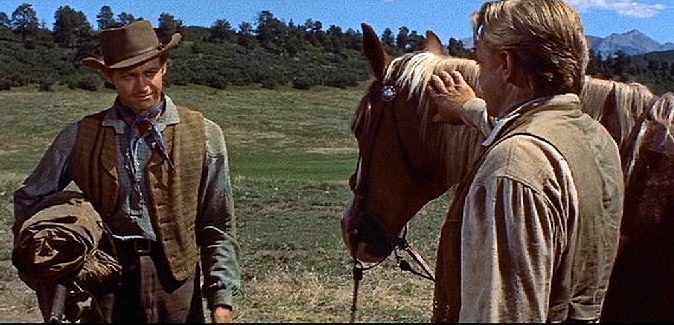
Young Steve Miller (Don Dubbins), who wants to be a cowboy or wrangler, winds up in the territory owned and run by Jeremy Rodock (James Cagney). Rodock has had to put up with people encroaching on his land and stealing horses and livestock for years, and he enacts his own rough justice, including hanging the perpetrators. The latest to earn his enmity is his old partner, L.A. Peterson (James Bell), and his son, Lars (Vic Morrow), but he may be wrong in his belief that either murdered one of his ranch hands. Rodock lives with Jocasta (Irene Papas, in her American debut), a woman with a past who is coveted by McNulty (Stephen McNally) and for whom Steve develops a growing infatuation. Finally tensions begin to boil over and Jocasta fears that Steve may develop the same hardness she sees in Jeremy, but is it possible that Rodock can mend his ways? Tribute to a Bad Man is an interesting western with some intriguing characters, and interactions among them, and the acting is uniformly good. Cagney is marvelous as the crusty autocrat with romantic leanings, and Papas gives a lovely performance as the woman he is devoted to. ("Introduced" in this film, Papas had already made several films overseas.) Don Dubbins was Cagney's protege, and the boyishly handsome actor always gives sensitive portrayals as he does here. McNally [The Lady Pays Off] and Morrow [Great White] make multi-dimensional villains, and James Bell and Jeannette Nolan [My Blood Runs Cold] score as Morrow's parents. Lee Van Cleef, Royal Dano, Peter Chong, and Onslow Stevens also make notable, if briefer, contributions. Cagney's patronage led to Dubbins appearing in this and These Wilder Years with Cagney, but the long career that followed consisted mostly of television work. This has nice widescreen Robert Surtees cinematography, adroit Robert Wise direction, a good Miklos Rozsa score, and a touching ending, although one could argue that the film certainly glosses over certain aspects of Rodock's character and actions.

Verdict: Romance and hangings in the wide open spaces. ***.

Thursday, April 20, 2017

THREE SECRETS

Eleanor Parker and Patricia Neal
THREE SECRETS (1950). Director: Robert Wise.

"Is he going to be surprised! You know what his grounds [for divorce] were? He said I wasn't a woman!" -- Phyllis, on learning that she's pregnant.

A plane crashes on a mountain and the only survivor is a little boy. As rescue workers prepare for the dangerous two mile ascent, three women arrive on the scene, all of them wondering if the child is the one they gave up for adoption. The little boy was born on the same day as their child, and came from the same orphanage. Susan (Eleanor Parker) is afraid her marriage may not survive if her husband (Leif Ericson) learns she had a child out of wedlock. Phyllis (Patricia Neal) was a war correspondent whose husband (Frank Lovejoy) left her because she was never home and wouldn't conform to being a traditional wife; she learns she is pregnant after he remarries. Ann (Ruth Roman) gave birth to a boy fathered by a conscienceless wealthy man who paid the ultimate price for his callousness. Three Secrets concentrates on the emotional turmoil of the women's lives and not on the harrowing details of the rescue of the boy, which would have been a completely different picture. The three leading ladies all give fine performances, with Parker and Neal being especially notable. Katherine Warren is also good as Susan's mother, and Kenneth Tobey appears briefly as an army officer who catches Susan with her soldier boyfriend (Arthur Franz). The film's premise is contrived but irresistible, but some of it has to be taken with a grain of salt. An orphanage might acquire three baby boys on the same day in a big city, but all three women basically arrive there at the same time, and how likely is it that Phyllis will remember Susan, who she barely speaks to, five years later, reporter or no. But these are minor concerns: the picture plays beautifully, is very well-acted and well-directed, and has a very moving conclusion. David Buttolph's score disconcertingly reworks the melody of "I Get a Kick Out of You." Although it's been unfairly compared to it, this is completely different from A Letter to Three Wives. This was remade for television in 1999.

Verdict: Oh a higher plateau than the usual soap opera. ***1/2.

Thursday, March 2, 2017

THE DAY THE EARTH STOOD STILL (1951)

"Gort" and Patricia Neal
THE DAY THE EARTH STOOD STILL (1951). Director: Robert Wise.

Klaatu (Michael Rennie), an emissary from a group of united planets, arrives on earth in a large saucer, accompanied by a potentially destructive law enforcement robot named Gort. Klaatu has come to earth to warn the world that the other planets will not tolerate earthlings, who have recently discovered atomic power, bringing their violent aggressiveness into outer space. His solution if earth doesn't mend its ways: destroy the entire planet! [Talk about aggressiveness!]

Held prisoner by the military, Klaatu, who wants to learn earth ways, escapes and moves into a boarding house, where he meets the lovely widow, Helen (Patricia Neal) and her likable little boy, Bobby (Billy Gray). Once Helen discovers the truth about the mysterious visitor and his plan, you keep waiting for her to argue about all the good in the world, the notable doctors, scientists, artists, and to tell Klaatu that most of the world's wars are caused  by a mere handful of residents. You expect her to say "innocent children like my son will be killed along with the warmongers," but she never does. This is the major reason why I've never particularly cared for this "classic." While Helen and Bobby represent good earthlings, too much of this portrayal is distinctly negative and unfair.

One can imagine, of course, that none of the aliens really wish or intend to wipe out the billions of earth's inhabitants, but foolishly hope this warning might suffice. But surely these powerful aliens can simply deal with the spaceships of more aggressive nations instead of dooming every person on the earth? No one even suggests this much more sensible solution.

That being said, The Day the Earth Stood Still is modestly entertaining and thought-provoking, although probably not in the way the filmmakers intended. Michael Rennie offers perhaps his best performance as the enigmatic Klaatu, his face registering amusement or bafflement and suggesting a certain superiority without becoming obnoxious about it. Neal is warm and sympathetic, but probably wasted in this movie. Billy Gray [The Navy vs the Night Monsters], Hugh Marlowe (as Helen's fiance) and others all give good performances and Robert Wise's direction is fine. The film also boasts Leo Tover's [The Snake Pit] excellent cinematography, and a superb score by Bernard Herrmann, whose spooky, jangling music influenced dozens of later scores. [Tover and Herrmann also worked on Journey to the Center of the Earth] The film itself was also very influential, with Hugh Marlowe headlining Earth vs the Flying Saucers a few years later and many other aliens-visit-earth films to come.

One last troubling aspect to the movie: After an over-zealous soldier shoots Klaatu at the beginning of the film, Gort responds by disintegrating tanks and rifles, but doesn't injure any men. Later, however, he completely disintegrates two soldiers who weren't even firing at him! Klaatu explains at one point that Gort is like a policeman, apparently one who is as quick-to-shoot as that first soldier was. The two dead men, whose deaths were completely unnecessary, are never mentioned again. Most likely they were killed so that the audience could feel Helen was in danger when she goes to give Gort a command that will stop him from further action. Still ...

The Day the Earth Stood Still (the title refers to Klaatu suppressing all energy world wide as a demonstration of his power) was remade in 2008 with Keaua Reeves playing a variation of Klaatu. Kathy Bates played an aggressive secretary of defense. Despite some good performances and effects and a much higher body count, the movie was not really an improvement over the original, itself no masterpiece.

Verdict: A bit too simplistic and even childish at times, but Herrmann's score is great. **1/2.

Thursday, July 21, 2016

I WANT TO LIVE!

Sailor Brett Halsey with good-time gal Susan Hayward
I WANT TO LIVE! (1958). Director: Robert Wise.

Barbara Graham (Susan Hayward), a prostitute and petty criminal, falls into bad company and finds herself arrested for the murder of a 61- year-old woman who supposedly kept cash in her house. One of Barbara's alleged confederates (James Philbrook) turns state's evidence and his testimony helps to convict her. Then it's on to death row ...  I Want to Live! was conceived as a heavily fictionalized anti-death penalty film, so it greatly stacks the deck in favor of Graham's innocence (not that the film suggests she should be executed if she were guilty), suppressing certain details and intimating it's only her reputation and background and her once being very nasty to a witness that have sealed her fate. Graham also makes the mistake of trying to bribe a fake witness who turns out to be a cop. Graham supposedly had a sexual affair with a fellow inmate, Rita (Marion Marshall), and while this is played down, it is pretty clear that Rita has a hankering for Barbara, whom she later betrays. As for Hayward, she comes off as much too well-bred to be a completely convincing "B" girl, so she substitutes toughness and crudity and on that level is quite effective, winning an Oscar (as did Robert Wise, whose direction is on the money). Of the supporting cast, there is notable work from Virginia Vincent as Barbara's lovely friend, Peg; Wesley Lau [Perry Mason] as Barbara's husband, Henry, who can't remember if she was home with him that certain night or not; Gage Clarke as the defense attorney, Tibrow; and Peter Breck as Peter Miranda, who claims he will set up an alibi for Barbara if she pays him but turns out to be a cop. Others in the cast include Brett Halsey [Return of the Fly], Lou Krugman, Theodore Bikel, Simon Oakland, and Joe De Santis [A Cold Wind in August].

The murder of Mabel Monahan is never depicted (in the fifties it would have been considered in poor taste anyway) and the woman herself is given short shrift. We never see any relatives she may have had, and the prosecutors are never developed as characters. In the long run it doesn't matter if Graham pistol whipped and suffocated her victim -- just the fact she was there and participated (if we are to believe this is true) makes her guilty in the eyes of the law. Apparently the prosecutors had very good reasons to think Graham was guilty that had nothing to do with her "morals."  The execution scene is very well-handled but it tries to extract pity for Graham without ever doing the same for her alleged victim, who died horribly in a terror that was probably worse than Graham's.

Verdict: Take with a grain of salt, but well-done for what it is. **1/2 out of 4.

Thursday, April 24, 2014

THE ANDROMEDA STRAIN

"It's growing!" Kate Reid and Arthur Hill
THE ANDROMEDA STRAIN (1971). Director: Robert Wise.

Project Scoop, which collects organisms in space, crashes to earth  in a small town in New Mexico. Everyone is killed by a plague from an organism inside the scoop aside from an old man and a baby, both of whom are taken to a secret Nevada base known as "Wildfire," which was created to contain deadly biological alien entities. Inside the base several scientists try to figure out why these two particular humans survived, and to determine the exact nature of the organism that killed everyone else, and how it was transmitted. It is decided to wipe out the town with a bomb, but will that be such a good idea ...? The Andromeda Strain, based on a novel by Michael Crichton ["Micro"], was one of the first of the technological sci fi/medical thrillers, and it's a pip, well-directed by Wise and very suspenseful. [The movie Alien owes a lot to Andromeda's climax with its destruct mechanism that only allows a short time to cancel it]. Arthur Hill as the head of the team offers his usual competent if bland performance; James Olson, David Wayne and Paula Kelly are a bit more flavorful; and Kate Reid [A Delicate Balance] is simply outstanding as the grouchy, dyspeptic Dr. Ruth Leavitt -- she's a a real asset to the movie. Glenn Langan [The Amazing Colossal Man] has a small role as a politician and is fine. Remade as an A&E mini-series in 2008.

Verdict: Taut, creepy, and fascinating. ***1/2.