Lively, entertaining reviews of, and essays on, old and newer films and everything relating to them, written by professional author William Schoell.
Showing posts with label William Demarest. Show all posts

Thursday, February 16, 2023

HELL ON FRISCO BAY

Alan Ladd
HELL ON FRISCO BAY (1955). Director: Frank Tuttle. 

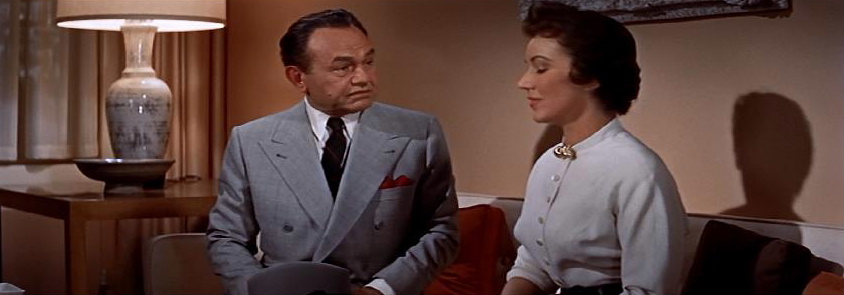
Ex-cop Steve Rollins (Alan Ladd) was framed for a murder he didn't commit and sent to prison for five years. When he gets out he is determined to find out who really murdered the victim and clear his name. He pretty much ignores his wife, Marcia (Joanne Dru), because he wants to protect her and also because she dared to dally with a gentleman out of loneliness when Steve wouldn't even let her come to see him. The San Francisco docks are controlled by a nasty man named Victor Amato (Edward G. Robinson), who has a good right hand, Joe (Paul Stewart), and a good-for-nothing nephew, Mario (Perry Lopez), who loves the ladies. Joe spends his nights with a former movie star named Kay (Fay Wray) while Victor is stuck with his pious wife, Anna (Renata Vanni), who treats Mario like a son and thinks he should be a priest. Steve talks to assorted individuals in the hopes they can give him information that might help him, but when Amato offers him a job, and Steve turns him down, he vows to make him pay -- painfully. 

Robinson and Fay Wray
Hell on Frisco Bay
 is a fast-paced and entertaining film noir thriller with many intriguing elements and a highly interesting cast. Ladd could probably play this kind of role in his sleep by now, but he manages to stay awake and acquits himself nicely. A deceptively cheery Robinson slowly unveils the layers of corruption and evil until he reveals the slimy lizard at his core, going so far as to order Joe to murder his own nephew. Stewart is excellent as the hired gun who's trying to get out from under Robinson's thumb. Fay Wray scores as Kay, and one of the best scenes is between Wray and Robinson as Amato makes a pass at her and gets angry when she turns him down, hitting her. "Get out, you filthy peasant!" she screams. Joanne Dru is acceptable as Marcia, giving solid line readings that don't always hit the emotional mark. 

William Demarest and Rod Taylor
The film is also full of flavorful performances by a wide variety of supporting players. William Demarest is a cop and friend of Steve's while Willis Bouchey is the police lieutenant who has to be convinced of Steve's innocence. Rod Taylor plays a hood who may have committed the murder Steve was sent away for with Tina Carver as his girlfriend. Peter Hansen [When Worlds Collide] is the corrupt cop, Connors, and Anthony Caruso [The Asphalt Jungle] is especially notable as a fisherman who is scared that if he talks to Steve his young son, George (Peter J. Votrian, who is also good) may come to harm. Renata Vanni probably made a career out of playing long-suffering wives or mothers. Nestor Paiva plays another dock worker who tries to work things out with Amato and only winds up dead. Perry Lopez [The Steel Jungle] plays the sexy but weak nephew to perfection. Jayne Mansfield plays his date.

Paul Stewart with Robinson
Ladd is manhandled by the chubby gunsel Hammy (Stanley Adams) in one scene and turns the tables on him, beating him up and telling Joe to "get your pig outa here!" The film has a boat chase at the end that is exciting although not quite on the level of similar scenes in those old cliffhangers. Although this might not be listed among Max Steiner's greatest scores, it is effective and thrilling when it needs to be. The screenplay is good, but one wishes the picture crackled with tension -- although it comes close at times -- but director Frank Tuttle doesn't make the film quite as explosive as it could have been. Still, it's quite well-played and snappy.

Verdict: Memorable crime drama with some outstanding performances. ***. 

Thursday, November 8, 2018

JOHNNY DOUGHBOY

Jane Withers
JOHNNY DOUGHBOY (1942). Director: John H. Auer.

16-year-old Ann Winters (Jane Withers) is sick and tired of playing 12-year-olds in her movies, and runs off to be a woman. She winds up staying at the home of playwright Oliver Lawrence (Henry Wilcoxon of Cleopatra), and gets the wrong idea about his feelings for her. Meanwhile Penelope Ryan (also Jane Withers), the winner of an Ann Winters lookalike contest, comes to visit Ann and is importuned to temporarily replace her by Ann's manager, Harry (Willam Demarest). A group of has-been child actors, played mostly by, well, has-been child actors, want the real Ann to take part in a show they want to do for soldiers; they've been told that they can only go on if a "real" star also participates. Penelope tries to appeal to the spoiled Ann's better nature to get her to do the show, but it may be a losing battle.

Alfalfa, Jack Boyle Jr, and Spanky McFarland
Johnny Doughboy was one of several pictures Jane Withers did for Republic studios as a teen lead when her long run as a child star was over. Nowadays most baby boomers remember Withers, who is still alive, as Josephine the Plumber in many commercials for Comet cleanser (which is also still around), while she may be completely unknown to younger people (aside from film buffs), especially Millennials. Johnny Doughboy is a pleasant minor musical with some snappy tunes in it, including "Baby's a Big Girl Now;" "You Better Not (With Somebody Else);" and "A Guy Like I." An amusing but also strangely sobering number, "All Through," has several former child stars, including Bobby Breen, Baby Sandy, Spanky and Alfalfa, essentially singing about how they're washed up in Hollywood, a song with built-in pathos when you consider the fate of some of these young actors. (Actually Carl "Alfalfa" Switzer was not washed up, appearing in a few Gas House Kids comedies as well as other movies and shows for several years afterward.)

Carl "Alfalfa" Switzer does his singing routine
Three other cast members of Johnny Doughboy are of note. Jack Boyle Jr. (billed as "Patrick Brook") makes an impression as the handsome singing actor Johnny Kelley and does a great dance routine with Withers, but he had very few credits. Ruth Donnelly [The Family Next Door] is as adroitly acerbic as ever as Miss Biggsworth, who looks after Ann; and Etta McDaniel, sister of the more famous Hattie, is amiable as Oliver Lawrence's housekeeper, Mammy.  "Alfalfa" reprises his funny tone-deaf singing routines from Little Rascals.

Verdict: Another amiable Republic musical. **1/2. 

Thursday, April 30, 2015

TWENTY PLUS TWO

TWENTY PLUS TWO (1961). Joseph M. Newman.

When Richard Diamond, Private Detective wound up its four season run, star David Janssen played a man who looks for missing people in Twenty Plus Two. Tom Alder (Janssen) has always been interested in the case of a girl who completely vanished 12 years ago when she was 16. At the same time, movie star Leroy Dane (Brad Dexter) discovers that the woman who answered his fan mail has been murdered. Jacques Pleshette (Jacques Aubuchon) then hires Alder to look into the disappearance of his brother, Auguste. Are these cases all connected in some way? Meandering through the story are three women: former love Linda (Jeanne Crain), who sent him a "Dear John" letter; hostess turned socialite, Nicki (Dina Merrill), whom Tom met in a post-war Tokyo; and Eleanor Delaney (Agnes Moorehead), the mother of the missing girl. Twenty Plus Two is fairly unpredictable and reasonably absorbing, but it ultimately adds up to nothing. It's one of those movies in which characters spend years covering up a "murder" that was clearly self-defense and yet never bother getting a good lawyer. Janssen is fine and the other actors are okay, but the picture is stolen by Moorehead, especially in a scene with Janssen when the two look at photos of the missing 16-year-old and realize that she's already turned into a woman. An unintentionally funny scene has teenage girls screaming over Brad Dexter [99 River Street] as if he were Troy Donahue! William Demarest [The Perils of Pauline] gives a superb performance as a bitter and drunken ex-reporter, walking off with the movie in one brief sequence.

Verdict: Like an extended Richard Diamond episode in CinemaScope. **1/2.

Thursday, January 1, 2015

THE PERILS OF PAULINE (1947)

Betty Hutton and John Lund
THE PERILS OF PAULINE (1947). Director: George Marshall.

Pearl White (Betty Hutton) leaps from a factory job into "show business" when she joins a traveling theater company with the help of a dowager named Julia (Constance Collier). Tired of her mistreatment by the dreamy head of the troupe, Michael Farrington (John Lund of No Man of Her Own), she walks off and finds herself in silent pictures, becoming the great and wealthy serial heroine of The Perils of Pauline and others. But when she offers Michael a job as her leading man will it lead to lasting love for the couple or just disaster? The Perils of Pauline is very loosely based on the life of Pearl White, which actually had enough drama in it without the screenwriter's inventions. Hutton, never one of my favorites, is excellent, however, and she gets good support from Lund (playing a truly obnoxious character whose good looks only make slightly more palatable), Collier [Rope], Billy De Wolfe, and William Demarest as a film director. Songs by Frank Loesser [The Most Happy Fella] include "Rumble," "I Wish I Didn't Love You So," and "Papa Don't Preach." In real life serials were made very quickly, but in this the filming of The Perils of Pauline stretches out for years and years!

Verdict: Hutton in fine form and an entertaining biopic, if mostly balderdash. ***.

Thursday, May 1, 2014

DANGEROUS BLONDES

Jane gives Miss Ralston a wolf whistle
DANGEROUS BLONDES (1943). Director: Leigh Jason.

Former actress Jane Craig (Evelyn Keyes) is married to popular mystery writer Barry Craig (Allyn Joslyn). Jane's friend Julie (Anita Louise) comes to her with a tale of someone trying to chloroform her in a dark room at the studio where she works, and news of a murder plot during the filming of a commercial later in the evening. Before long Jane and Barry are embroiled in two mysterious killings, which Inspector Clinton (Frank Craven) thinks he has the solution for. Of course it remains for Barry to really explain who the killer is ... Dangerous Blondes is snappy and amusing, if minor, and didn't result in a series about the Craigs, although Keyes and Joslyn are fine in the parts. Others in the cast include Edmund Lowe [Hot Pepper] as an advertising man, William Demarest as a cop, and Ann Savage as Erika McCormick. John Abbott [Deception] makes an impression as the nervous secretary Roland X. Smith, as does Hobart Cavanaugh as Philpot, the elevator attendant. Minerva Urecal appears as a housekeeper and is, as they say, swell. Craven is typically excellent. An interesting scene has Jane giving pretty model Miss Ralston (Lynn Merrick) a wolf whistle.  Leigh Jason also directed Lost Honeymoon.

Verdict: Nothing special but easy to take with quite a few funny moments. **1/2.

Thursday, April 10, 2014

WHEN WILLIE COMES MARCHING HOME

Willie (Dan Dailey) is questioned by French resistance


WHEN WILLIE COMES MARCHING HOME (1950). Director: John Ford.

After Pearl Harbor, small-town boy and bandleader Bill Kluggs (Dan Dailey) is anxious to enlist. Although his early training doesn't go so well, he eventually develops "the highest rating of any instructor," which means the Army has more use for him in camp than overseas. Unfortunately, said camp is located right in Bill's home town, where he stays -- and stays -- while other men ship out and his neighbors get more and more resentful. Eventually he goes on a mission and winds up behind enemy lines and working with the French resistance, and is sent back to England with important information -- unfortunately he can't talk about the mission. One annoying thing about this otherwise good and funny movie is that no one -- not even Bill's parents -- acknowledge that he's performing an important service as an instructor (an assignment that is not without its dangers). Dailey is excellent, and he has fine support from William Demarest [Pardon My Past] and Evelyn Varden [The Bad Seed] as his parents; Colleen Townsend as his girl, Marge; Jimmy Lydon [Henry Aldrich Haunts a House] as her brother; and Corinne Calvet as a beautiful lady with the French resistance.

Verdict: Well-done and keeps you chuckling, with a fine lead performance. ***.

Thursday, July 11, 2013

ROMANCE ON THE RUN

Edward Brophy and Donald Woods
ROMANCE ON THE RUN (1938). Director: Gus Meins.

When the famous "Czarina's Tears" necklace is stolen, insurance man Ridgeway (Andrew Tombes) is horrified to discover that his secretary, Dale (Patricia Ellis), renewed the policy while he was in Boston. Ridgeway hastily calls in private eye Barry Drake (Donald Woods) to get back the necklace for $10,000. Drake gets the necklace and takes the money, but it turns out that the necklace is a phony. So Dale rushes after him and his valet Whitey (Edward Brophy) even as they rush after the thieves, Lily (Grace Bradley) and Charlie (Craig Reynolds). The "romance" of the title is that Barry and Dale are supposedly falling in love after initial mutual hostility, but we see precious little evidence of this. Woods can handle this kind of light material with aplomb, but this material isn't just light, it's paper-thin, and an interesting enough premise is completely wasted. William Demarest plays a cop who's also looking for the necklace. Director Gus Meins' best-known film is Laurel and Hardy's wonderful Babes in Toyland. Ellis isn't bad; she made only three more pictures after this, including Block-Heads, also with Laurel and Hardy. Woods did several "Mexican Spitfire" films with Lupe Velez, and starred on television as Craig Kennedy, Criminologist.

Verdict: A couple of minor titters and little more, but the cast is game enough. **.

Thursday, May 9, 2013

HE'S A COCKEYED WONDER

HE'S A COCKEYED WONDER (1950). Director: Peter Godfrey.

Freddie Frisby works as a tomato sorter in a plant owned by Caldwell (Charles Arnt) and supervised by the grumpy Bob Sears (William Demarest). Freddie has to date Sears' daughter Judy (Terry Moore) on the sly, because Sears hates him, and would much prefer Caldwell's son Ralph (Ross Ford) as a son-in-law. Frisby figures he has little chance with Judy after he gets fired, but then learns that his uncle, a magician, has left him his entire estate ... He's a Cockeyed Wonder certainly has possibilities, and the movie is fun whenever Rooney, who's fine, is in charge, but it, unfortunately, goes way off in the wrong direction. While a lot of laughs could have been milked out of Freddie's hapless magic act, instead the picture brings in a gang of robbers, has the two main characters kidnapped and threatened with death [!]  -- all of it quite tedious and not especially funny. The performances are good, however, including Douglas Fowley as the nasty head of the gang of thieves, and there are a few genuine laughs along the way. Godfrey also directed Please Murder Me and others and seemed to divide his time between comedies and thrillers. Fowley had a long list of credits and made a strong impression in Desire in the Dust.

Verdict: A little too cockeyed but Rooney fans may enjoy. **.

Tuesday, May 20, 2008

PARDON MY SARONG


PARDON MY SARONG (1942). Director: Erle C. Kenton.

Bud Abbott and Lou Costello are city bus drivers who wind up driving their bus out of town for a wealthy yachtsman (Robert Paige) in a hurry, then -- wanted by the police -- become his crew, only to become lost in a gale. Along for the ride is a pretty gal played by a snappy Virginia Bruce. On a small uncharted island the group runs into natives and comes afoul of Lionel Atwill, who is trying to get his hands on a sacred ruby and brooks no interference from anyone. Pardon My Sarong starts out promisingly, with some funny routines by the boys, but once they go to sea the story becomes uninvolving and the gags are silly even by A&C standards. Bruce tries to liven things up but hasn't enough to do, and Lionel Atwill is completely wasted in a nothing part. Leif Ericson does a fine job as a native who's in love with a gal who falls for Lou, and Irving Bacon (Ethel's father on the classic "Ethel's Hometown" episode of I Love Lucy) is great as an exasperated gas station attendant. William Demarest is also good as a detective who tries to nab Bud and Lou. A nightclub scene features some talented Black entertainers: The Four Inkspots and Tip, Tap and Toe. Nan Wynn is the native girl who inexplicably falls for Costello. The film ends with Costello acting heroically in a way that is somewhat out of character for him.

Verdict: Some amusing bits but painfully stupid at times. **.