Lively, entertaining reviews of, and essays on, old and newer films and everything relating to them, written by professional author William Schoell.
Showing posts with label Joseph Calleia. Show all posts

Thursday, February 2, 2023

THE GLASS KEY

Alan Ladd
THE GLASS KEY (1942). Director: Stuart Heisler. 

Politician Paul Madvig (Brian Donlevy), essentially a crook, is trying to clean up his reputation for re-election by going after hood Nick Varna (Joseph Calleia). Paul has formed an alliance with wealthy Ralph Henry (Moroni Olsen), and also fallen in love with Henry's daughter, Janet (Veronica Lake). Meanwhile Paul's sister, Opal (Bonita Granville), is head over heels for Janet's brother, Taylor (Richard Denning), a gambling addict with serious debts. Paul's associate and best friend, Ed Beaumont (Alan Ladd), stumbles across Taylor's dead body, and wonders if Paul, who hated Taylor and his influence over his sister, could possibly be responsible. Apparently both Opal and Janet think that he is. The truth may be a little more complicated.

Ladd and Lake
Based on the novel by Dashiell Hammett, The Glass Key is a reasonably absorbing but rather unpleasant bit of film noir. For one thing, there isn't a single really likable major character; even the hero played by Ladd is a creep. Ladd is as swell at the hardboiled routine as anyone, but he never quite comes off as a real person. He's handsome, but almost as bland and artificial as a Ken doll. Brian Donlevy is as good and forceful as ever, but it's a typically brusque and bristling Donlevy performance like he gives in virtually every movie, including The Creeping Unknown. Similarly Joseph Calleia is excellent in his very familiar gangster role. Veronica Lake has been seen to better advantage in other movies (such as I Married a Witch). 

"Let's have a drink." William Bendix with Ladd
Part of the problem is that the characters in this are mostly one-dimensional and the actors can't do enough to flesh them out. One exception is William Bendix, who honestly steals the movie as the sadistic gunsel who nearly beats Ed to death. Bendix also has a splendid scene, again with Ladd, when they sort of share a drink together as a semi-drunken Bendix tells Ladd what horrible things he's going to do to him. It's not in the script, but Bendix makes this miserable character come alive and almost makes your flesh crawl. (Why Ed would want to be anywhere near the psychopath who put him in the hospital is another question.) Before he became the lovable hero of TV's Life of Riley, Bendix frequently played distinctly malevolent characters and played them superbly.

Tramp and Dickhead: Margaret Hayes and Ladd
A tip of the hat also must go to Margaret Hayes, who briefly plays Eloise Matthews, the trampy wife of a newspaper publisher who makes a play for Ladd right in front of the man after she learns her hubby is flat broke. A true gentleman -- not -- Ladd fervently responds to her sexual entreaties. Again, even with this character being played by the pleasant and inoffensive- looking Ladd it can't disguise what an utter dickhead Ed is! Others in the cast include Frances Gifford as a friendly nurse; Donald MacBride as the easily-influenced district attorney; and Billy Benedict as an office boy. Bonita Granville does a nice job as the grieving girlfriend of the dead Denning.

Verdict: If ever a "hero" didn't deserve a happy ending! **1/4. 

Thursday, August 3, 2017

ALGIERS

Charles Boyer and Hedy Lamarr
ALGIERS (1938). Director: John Cromwell.

Hiding out in the Casbah, jewel thief Pepe le Moko (Charles Boyer) falls for Gaby (Hedy Lamarr), the fiancee of a wealthy tourist. But will the woman who adores him, Ines (Sigrid Gurie), be indirectly responsible for his destruction? Algiers is the first American remake of the French film Pepe le Moko, which had only come out one year earlier. Algiers is virtually a scene for scene remake of Pepe -- sometimes even a shot for shot remake -- but it still has the edge on the French original. For one thing, we have Charles Boyer [Gaslight] in the title role, and he is not only much more "romantic"-looking than the rather potato-faced Jean Gabin, but offers a much more nuanced and emotional performance. Although most of her dialogue is virtually the same as in Pepe, Hedy Lamarr  [Crossroads] gives a much warmer and more human delivery, making her character much more likable. Gurie is fine as Ines, although this version is less compassionate toward her than the original, which cuts her out of the ending and has Slimane, the inspector, telling her off for betraying Pepe. Slimane is portrayed by Joseph Calleia [Five Came Back], and it is one of the actor's most memorable performances. Others in the cast include Johnny Downs as Pierrot, Joan Woodbury as his girlfriend, and Leonid Kinskey as L'Arbi. Boyer sings a song (C'est la vie) as Gabin did in the original, but the sequence where Tania sings has been omitted. Another plus for this version is an effective musical score by Mohamed Ygerbuchen and Vincent Scotto. James Wong Howe was cinematographer. Of course in neither version of the story does the romanticized criminal Moko seem that much like a real person. Incidentally, Boyer never says the line "Come with me to the Casbah; we will make beautiful music together"--  more's the pity! Samuel Goldwyn discovery Sigrid Guris, a "Norwegian" actress born in Flatbush, only made a few movies. Remade as Casbah with Tony Martin.

Verdict: More fun in the Casbah! ***.

Thursday, June 1, 2017

GILDA

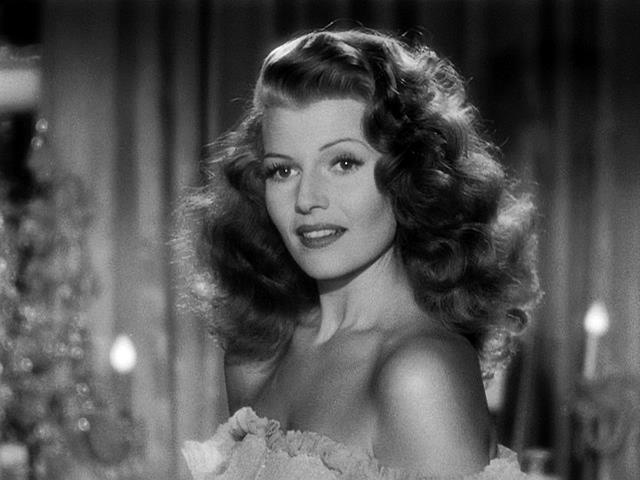
Rita Hayworth
GILDA (1946). Director: Charles Vidor.

"Hate can be an exciting emotion. Very exciting. Hate is the only thing that can ever warm me." -- Ballin Mundson.

"If I'd been a ranch, they'd have named me the bar nothing." -- Gilda.

Down Argentine way just at the end of WW2, a hustler and crooked gambler named Johnny Farrell (Glenn Ford) is nearly robbed when a stranger on the docks with a spear in his cane comes to his rescue. The stranger is casino owner Ballin Mundson (George Macready), who hires Johnny to look after his interests. Some time later Ballin introduces Johnny to his beautiful wife, Gilda (Rita Hayworth), and both feign ignorance of the fact that they were once involved. Johnny and Gilda have a real love-hate relationship to add to the stew, and Ballin has a consortium with a bunch of Germans to add to the confusion. After a man is murdered in the casino, Ballin seems to commit suicide in his plane ... What to make of the modestly entertaining and often silly Gilda? Artificial and Hollywoodish as all get-out, with one-dimensional characters and one of the shortest climaxes in the history of the movies, Gilda has a few interesting twists and turns and is distinguished by the sex appeal and fine, constantly insinuating performance of Rita Hayworth, who makes the most of a standard role of the good-bad girl who is kept by wealthy men while loving the poor fellow she truly adores. Ford is not bad, if miscast, as the grubby borderline lowlife who winds up a kind of bodyguard/ersatz gunsel to Ballin (the narration he's given is unnecessary). Macready gives a good performance -- probably the longest and most famous of his career -- although some of his line readings are a little too matter-of-fact; one can think of other actors who might have played it in a somewhat more colorful and poetically sinister fashion. Steven Geray, Gerald Mohr, and Joseph Calleia all score as, respectively, a lowly casino employee who knows where the bodies are buried; a slimy guy with a hankering for Rita; and the police inspector who is concerned with the doings of the German consortium (even if no one in the audience is).

Some people* have had a different reading on Gilda, claiming that Johnny Farrell is a literal hustler on the bisexual side, Ballin's boyfriend, in fact, and that Johnny's self-hatred forced him to walk away from Hayworth before the story begins. This theory has it that Ballin needs to have power over attractive people of both sexes (one is reminded of Clifton Webb's character in Laura). Unfortunately, this take on the film makes it seem like a bad, regressive gay novel of the forties -- the tormented "queer" pulls away from the guy he's with and walks off into the sunset with a woman -- and while some advocates of this theory can point out certain lines and situations in scene after scene (and they may even have a point), they forget that many, many movies featured bad (and good) guys with live-in bodyguards and buddies, and this was never necessarily considered homoerotic. The proponents of this theory would have a lot to make of the Gilda imitation, Forbidden and many others as well.

Rudolph Mate has contributed some fine cinematography, but you would never know that the story takes place in Buenos Aires, as it has little Argentinian atmosphere. Gilda might be considered film noir except for the fact that its crime aspects are comparatively minimal. The pseudo-clever dialogue is often amusing.

* such as film noir specialist Eddie Muller on the Gilda DVD.

Verdict: Anyway, it's fun watching Hayworth do her "Put the Blame On Mame" number. **1/2.

Thursday, August 11, 2016

AFTER THE THIN MAN

Myrna Loy and William Powell
AFTER THE THIN MAN (1936). Director: W. S. Van Dyke.

Nick Charles (William Powell) and wife, Nora (Myrna Loy) have returned from New York to California in this first sequel to The Thin Man, but discover that wherever they go murder follows. Nick learns that when it comes to intrigue and craziness, Nora's relatives are not much different from the thugs and ex-cons Nick hangs out with. This time Nora's cousin, Selma (Elissa Landi of The Sign of the Cross), is accused of murdering her philandering husband, Robert (Alan Marshal). The suspects include a nightclub owner named Dancer (Joseph Calleia); a dancer named Polly (Penny Singleton); her "brother," Phil (Paul Fix of The Bad Seed); Dr. Kammer (George Zucco), who thinks everyone is nutty: and David Graham (James Stewart), who has long carried a torch for Selma. Somewhat better than The Thin Man, this is arguably not a whole lot better than a typical mystery from a minor studio, but it is served up with relish, some very good acting, and has an effectively comic-dramatic ending. Singleton, who was billed as "Dorothy McNulty" back then, is vivid as Polly, and Jessie Ralph [David Copperfield] simply walks off with the movie as Nora's formidable Aunt Katherine, a harridan force of nature if ever there were one. Sam Levene is fine as Lt. Abrahms, the detective on the case. Asta has a bit more to do then he did in the first film.

Verdict: Nick Charles is no Perry Mason, but this is fun enough. ***.

Thursday, May 7, 2015

FIVE CAME BACK

Patric Knowles and Joseph Calleia
FIVE CAME BACK (1939). Director: John Farrow.

A plane flying over South America crash lands in the jungle, but only five people can fly back when the plane is fixed, and there are headhunters in the area. Will it be the convict who faces execution (Joseph Calleia), or the blowsy brunette (Lucille Ball) who feels she hasn't got much of a future? Professor Spengler (C. Aubrey Smith) and his peppery wife (Elisabeth Risdon)? Crimp (John Carradine), who is delivering his prisoner but uses no handcuffs or takes any precautions? Or Pete (Allen Jenkins) who is traveling with his murdered boss's little boy, Tommy? Then there's the eloping couple, Judson (Patric Knowles) and Alice (Wendy Barrie), and the two pilots, played by Chester Morris [The She-Creature] and Kent Taylor [Gangbusters]. Five Came Back certainly features an interesting situation, but it's contrived, and the acting, while professional, is generally of the second-rate Hollywood variety. However, "Lucy" isn't bad as Peggy, and Knowles makes an impression as Jud, while Barrie does her best with the part she's given. At least in this earlier version the horrible death of a steward is remarked upon at some point. Farrow directed the remake Back from Eternity some years later, but it wasn't much of an improvement. This is not one of the great movies of 1939.

Verdict: Maybe more headhunters would have livened this up. **.

Wednesday, June 11, 2008

DEADLINE AT DAWN

DEADLINE AT DAWN (1946). Director: Harold Clurman.

"Golly, the misery that walks around in this pretty, quiet night."

Alex (Bill Williams), a sailor who has to catch a bus at six am to report back to duty, is on leave in Manhattan when he discovers that a woman (Lola Lane) with whom he dallied earlier in the evening has been murdered. A hard-boiled, disillusioned taxi dancer named June (Susan Hayward) feels sorry for him and helps him find out who the real killer is before he has to catch his bus -- or is arrested. They are aided by Gus Hoffman (Paul Lukas), a sympathetic cab driver. Along they way they encounter cops, blackmail victims, shady ladies (one played by Osa Massen), the dead woman's nasty brother (Joseph Calleia), her blind ex-husband, and a sad man (Steven Geray) with white gloved hands who is smitten with Hayward. This isn't much of a mystery -- the identity of the killer is pretty obvious -- but it has an undercurrent of loneliness and lost souls that gives the film a poignant and disturbing edge. Considering that New York is essentially a major character in the film, it's criminal that the movie was clearly shot on Hollywood sound stages and not on location. Clifford Odet's screenplay, awash in great dialogue and interesting characters, was based on the novel by Cornell Woolrich (William Irish). Jerome Cowan demonstrates his versatility as a nervous if exuberant blackmail victim. Hayward offers an interesting portrait of a tough, unpleasant woman who slowly allows her humanity to shine through. Joe Sawyer, who's only seen in the distance, makes an impression as a drunk friend of the dead woman's. The entire cast is excellent.

Verdict: More here than meets the eye. ***.

Thursday, February 14, 2008

WILD IS THE WIND


WILD IS THE WIND (1957). Director: George Cukor.


Widower Gino (Anthony Quinn) decides to marry his sister-in-law Gioia (Anna Magnani, pictured) and flies to Italy to bring her home to his family in America. The movie spends the first hour doing its best to inject drama into the situation -- Gino keeps comparing Gioia to her dead sister; the two argue over killing wild horses -- but the movie doesn't really live up to its "wild" title until Gioia begins an affair with Gino's handsome young ward, Bene (Tony Franciosa). The script by Arnold Schulman may never really rise above a soap opera level, but somehow it doesn't matter much because the direction, cinematography (Charles Lang), and acting are of such a high order that they smooth over all the imperfections of the story. Magnani is as wonderful as ever, but Cukor wrests fine performances from Quinn (one of his best ever), Franciosa, and the entire supporting cast as well. Joseph Calleia and Lila Valenty score as Quinn's brother and sister-in-law, and Delores Hart is lovely in the small role of Quinn's daughter. Once it gets going this is quite absorbing and has a very nice ending.

Verdict: Definitely worth a look. ***1/2.