Lively, entertaining reviews of, and essays on, old and newer films and everything relating to them, written by professional author William Schoell.
Showing posts with label Franklin J. Schaffner. Show all posts

Thursday, January 23, 2020

THE STRIPPER

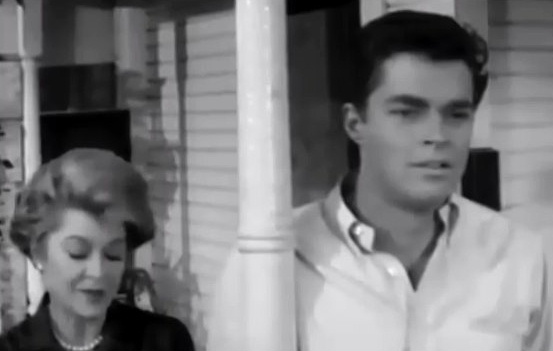
Richard Beymer and Joanne Woodward
THE STRIPPER (1963). Director: Franklin J. Schaffner. Based on the stage play "A Loss of Roses" by William Inge.

Along with her associates in a traveling magic act, Lila Green (Joanne Woodward) comes to the town where she lived as a child, but then is stranded when her boyfriend, Ricky (Robert Webber), runs off to greener pastures with all of their cash. Lila gets a room with a widow, Helen (Claire Trevor), who was her neighbor years ago, and who has a grown son named Kenny (Richard Beymer). Kenny and Lila develop an undeniable attraction to one another, but considering the age difference -- Woodward was eight years older than Beymer -- and everything else, Lila is afraid of being hurt and lonely once again. Then Ricky comes back into her life with a proposition ...

Claire Trevor and Richard Beymer
The Stripper is a lovely and absorbing film with three excellent lead performances. Although never considered a great beauty as such, Woodward [From the Terrace] has never looked better and she is excellent as Lila. (Marilyn Monroe, who was superb in the film adaptation of Inge's Bus Stop and was four years older than Woodward, might have been considered for this role had she not died tragically the previous year.) Beymer [Five Finger Exercise] gives a sensitive and intelligent performance as well, and Trevor [The Velvet Touch] is as adept as ever. Webber makes a very effective slime ball, and others in the cast include Gypsy Rose Lee and the odd Louis Nye as his associates (neither of them are especially memorable) and Carol Lynley, who makes a nice impression as a neighbor who has a crush on Beymer. Michael J. Pollard brings his own brand of quirkiness as a strange buddy of Kenny's who seems to have a thing for Lila but gets nowhere with her. The film could have used more scenes depicting the growing relationship between Kenny and Lila, but otherwise this is a very good movie.

Verdict: Strong cast and interesting situations add up to a memorable picture. ***1/2. 

Thursday, July 7, 2016

PAPILLON

Dustin Hoffman and Steve McQueen
PAPILLON (1973). Director: Franklin J. Schaffner.

Henri Charriere (Steve McQueen), a safecracker known as Papillon (Butterfly) due to a tattoo on his chest, is convicted of murdering a pimp (a crime he insists he did not commit) and sent to a French penal colony. He becomes friends with counterfeiter Louis Dega (Dustin Hoffman) and the two start planning an escape. After several false starts and others joining the team, they manage to get out -- but their trials and tribulations are by no means over. Papillon, if I recall correctly, was a very big hit and a feel-good movie about the indominability of the human spirit. It is also very much a Hollywood movie that often tries to stay on a "light" level despite the grimness of the proceedings. At first McQueen just seems to be walking through his role -- and Hoffman hardly ever seems anything other than Dustin Hoffman in a prison skit -- but with the aid of effective make up he is more impressive in the later scenes. Papillon has to be taken with a grain of salt, as Charriere's memoirs, upon which the film is based, were later determined to be largely fictional; he was never on Devil's Island for instance. McQueen was forty-three when he did this picture, four years older than Charriere was when he made his final escape, although the actor is made up to look like a senior citizen and emotes that way as well; this is not only highly-fictionalized but on occasion plays like a parody. Victor Jory [Cat-Women of the Moon] plays an old Indian chief who wants his own tattoo; Anthony Zerbe is the leader of a colony of lepers; Bill Mumy ["It's A Good Life"] is a young convict who essentially commits suicide; Don Gordon [The Final Conflict], Woodrow Parfrey and Robert Deman are all other convicts who get involved in the big escape one way or another; they are all good. But Papillon, which holds the attention and has a few harrowing moments without ever being really riveting, gets its power not from the performances but from Fred J. Koenekamp's cinematography and Jerry Goldsmith's typically effective musical score.

 Verdict: Not any kind of masterpiece but Papillon's exhaustive efforts to gain his freedom eventually pull you along. ***.