Lively, entertaining reviews of, and essays on, old and newer films and everything relating to them, written by professional author William Schoell.
Showing posts with label Minor Watson. Show all posts

Thursday, August 14, 2025

BEYOND THE FOREST

"What a dump!" Joseph Cotten and Bette Davis
BEYOND THE FOREST (1949). Director: King Vidor. Colorized version.

"You wear that yourself. No dead cat for me -- mink!" -- Rosa to Jenny. 

Rosa Moline (Bette Davis) lives with her doctor husband, Lewis (Joseph Cotten), in the town of Loyalton, Wisconsin. Growing older, Rosa is desperate to find a more exciting life in Chicago with businessman Neil Latimer (David Brian), with whom she is having an affair. However, Rosa's plans are stymied when she runs off to Chicago and discovers that Neil has a new fiancee. But when Neil comes back to Loyalton for a birthday party for his employee Moose (Minor Watson), Rosa realizes that she still has a chance with Neil. But Moose may throw a monkey wrench into her plans ... 

"If I don't get out of this town I'll die!"
Excoriated for years -- even Davis expressed her hatred for the picture -- Beyond the Forest has come in for reassessment and garnered new fans over the years. What the movie has going for it is Davis' vivid performance, solid supporting performances from most of the cast, fast-paced and dramatic direction from King Vidor, an evocative score by Max Steiner that makes adroit use of the song "Chicago" but also has its own compelling themes, and fine cinematography from Robert Burks. While Rosa is not exactly an admirable woman -- she is rather a pathetic figure, in fact -- Davis gets across her utter desperation, especially in a sequence when she stands by her bedroom window with the fiery smelters in the background. "If I don't get out of this town I'll die. If I don't get out of this town I hope I die."

I'm not just any woman -- I'm Rosa Moline!
Ann Doran as a woman with many children has an interesting exchange with Rosa in the post office. Doran expresses sympathy for Rosa, possibly because she herself feels a bit trapped by the small-town life she lives with half a dozen offspring to look after. "This town has been tough on Rosa," she says, to which a neighbor replies, "Rosa's been tough on the town." Vidor peppers the film with other interesting vignettes as the movie unfolds, a murder occurs, along with a decidedly unwanted pregnancy. Rosa's husband is a perfectly nice man, but he can't give Rosa what she needs and is terrible unexciting. You sense if he slapped her around she would respect him more (or kill him). 

Davis with David Brian
Dona Drake (of Kansas City Confidential)   certainly makes an impression as Jenny, the slovenly, funny maid who works for the Molines and exchanges comical barbs with Rosa, reminding her that if she fires her she, Rosa, will have to do the work. Drake also figures in the bravura climax to the picture, when a fever-wracked Rosa makes up her mind to get to the train to Chicago come Hell or high water. There's an operatic intensity to this sequence as Rosa determinedly if on unsteady legs makes her way to the train station where she meets her ultimate fate. 

Verdict: Think what you will of this, Davis saunters through this saucy film noir, a variation of Madame Bovary, with aplomb. ***. 

Thursday, November 10, 2022

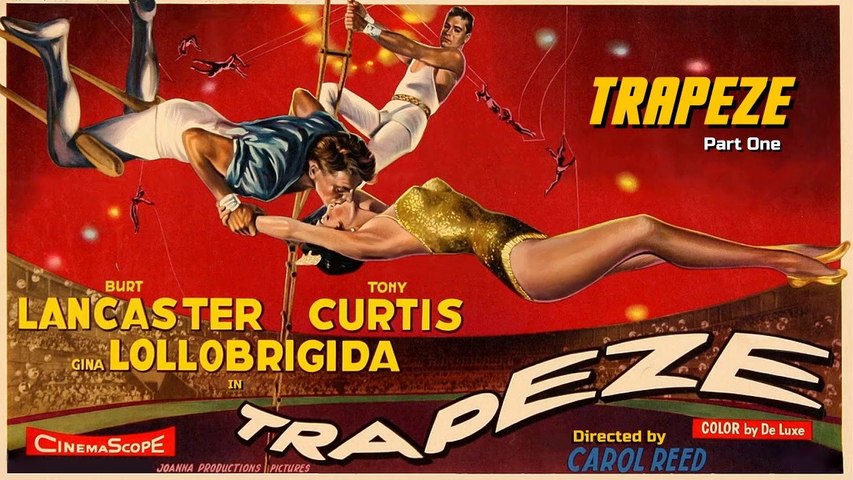
TRAPEZE

TRAPEZE (1956). Director: Carol Reed.

Bitter former acrobat Mike Ribble (Burt Lancaster) is working as a rigger for a Paris circus after falling and injuring himself while attempting a "triple" flip while performing high in the air. Tino Orsini (Tony Curtis) is an aspiring performer who talks Mike into teaming up with him for an act, hoping he can teach him to do the triple. Then there's the highly ambitious and beautiful Lola (Gina Lollobrigida of Woman of Straw) who manages to secure a position in their act while bouncing back and forth between both men. 

Lancaster, Lollobrigida and Curtis
While it's certainly understandable that both men would get the hots for Lola -- in my opinion Lollobrigida was always the sexiest and most beautiful of the Italian sex bombs -- falling in love with such a fickle and manipulative person is something else again. And one can't really see Lola falling for anyone but herself. But Trapeze is essentially a melodrama, and as such feelings are created in and discarded by the characters simply to serve the needs of the plot -- that's all there is to it. As a circus picture, Trapeze is only fair to middling. However, it comes alive during the aerial sequences, which are thrilling, skillfully intercutting the three main actors into the actions of real circus performers. Clearly they were each willing to be photographed doing some aerial work, although not high above the ground one supposes.

The performances are good. Curtis and Lancaster would reteam for Sweet Smell of Success the following year when Curtis would really come into his own. This is not Lollobrigida's first American film, but probably the biggest English role she'd had to that date. Her character is kind of impossible, and her transformation from opportunist to someone sincerely in love with one of the men isn't believable, but for that I'd blame the script. Others in the cast include Minor Watson (of Beyond the Forest) as a man from Ringling Brothers; Thomas Gomez as the fat and rather obnoxious boss of the Paris circus; Katy Jurado as Rosa, who is carrying a torch for Mike; and Gerard Landry as her husband. There are interesting and flavorful moments in the movie, but it's nothing very deep, although one senses everyone working on the film thought it would be. Malcolm Arnold's score is so overwrought at times that it approaches the comical.

All of the homoeroticism of the novel, The Killing Frost, upon which the film is based, was eliminated, although if you watch it carefully ... In the novel Tino is executed for murdering Lola, although she was actually killed by Mike, who was in love with -- you guessed it -- Tino! 

NOTE: It has been said that Lancaster, because of his background, did all of the trapeze stunts in the film except for the Triple. I think this has been very exaggerated. For one thing, Lancaster is clearly in front of a blue screen in some shots and if one freezes the film the aerialist playing Lancaster is clearly a different person in the long shots. 

Verdict: Stick with The Big Circus. **1/2. 

Thursday, October 6, 2016

MR. DISTRICT ATTORNEY

Peter Lorre
MR. DISTRICT ATTORNEY (1941). Director: William Morgan.

Socialite P. Cadwallader Jones (Dennis O'
Keefe) is assigned to the district attorney's office primarily on the strength of his father's name. At first he's a first-class screw-up, but then he gets involved with some missing money, and a suspect, Hyde (Peter Lorre), who seems to be missing himself. This picture is the first of two that were based on the radio series of the same title -- there were two TV series as well -- all of which have the exact same title, which meant that I looked up Mr. District Attorney and couldn't understand why there was a completely different cast aside from O'Keefe (not even playing the same character) and Lorre was nowhere to be found. Well, of course that was the 1947 version. In any case, this picture is utterly undistinguished but for the brief appearance of Peter Lorre. O'Keefe is okay, and the supporting players include Minor Watson, Grady Sutton, Stanley Ridges, and Florence Rice. After Lorre, Helen Brown makes the best impression as Hyde's wife. Let's hope the second movie with this title was a bit better.

Verdict: Fast-paced but stupid and uninteresting. *1/2.

Thursday, June 16, 2016

24 HOURS (1931)

Kay Francis and Clive Brook
24 HOURS (1931). Director: Marion Gering.

At a party Jim Towner (Clive Brook) turns to his wife, Fanny (Kay Francis), and asks her where things went wrong. Turns out both of them are seeing other people, with Fanny dallying with David (Minor Watson), and Jim fooling around with singer, Rosie Duggan (Miriam Hopkins). Rosie has thrown out her hoodlum husband, Tony (Regis Toomey), and trouble starts when he demands to be let back into her life again. One of the main characters winds up murdering another, with suspicion falling on a third. 24 Hours doesn't work as drama, mystery, or even melodrama, as it seems too long even at a mere 66 minutes. Of the cast Regis Toomey [Shopworn] comes off best, with Wade Boteler [The Green Hornet] also scoring as the doorman Pat, who is Rosie's brother. Clive Brook isn't bad, but he makes a rather dull leading man, and Francis is competent but not given very much to do as his wife. Miriam Hopkins [Lady with Red Hair] get a little more screen time as Rosie, bur her delivery of a couple of torch songs is almost ruined by her voice. Francis and Hopkins, although involved with the same man, don't have a single scene together, stripping the film of its main point of interest. Its stage origins are apparent, although one can't imagine this was ever any world-beater.

Verdict: This positively creaks. Even if you like Francis and Hopkins this is one you can miss. *1/2.

Thursday, January 15, 2015

CHARLIE CHAN IN PARIS

CHARLIE CHAN IN PARIS (1935). Director: Lewis Seller.

Charlie Chan (Warner Oland) comes to Paris to investigate some counterfeit bank bonds when his associate, the Apache dancer Nardi (Dorothy Appleby), is murdered at the end of her act. Then Yvette (Mary Brian of Manhattan Tower), the fiancee of Chan's handsome young friend Victor (Thomas Beck of Every Saturday Night) gets in trouble when she goes to get some compromising letters from a former boyfriend, Henri Latouche (Murray Kinnell), who is also murdered. Chan now has at least two murders to solve, with the help of Inspector Renard (Minor Watson) and his irrepressible son Lee (Keye Luke). A weird old beggar goes around causing mayhem, and there's a scene in the Paris sewers. The cast is good, and Erik Rhodes is especially memorable as the ever-amusing artist Max Corday. The best scene has Corday assuming Chan can't speak English well and asking him if he wants a "little dlinky," after which Chan makes clear that he speaks English quite well, thank you. Kinnell often appeared in Charlie Chan movies in a variety of roles. This was the first appearance of Keye Luke as Lee Chan.

Verdict: Acceptable if minor Charlie Chan mystery. **1/2.

Thursday, August 8, 2013

BEYOND THE FOREST

Rosa and the saw mill: "If I don't get out of here I'll die."
BEYOND THE FOREST (1949). Director: King Vidor.

"There's only one person in this town who does anyone a real favor. That's the undertaker -- carries them out." -- Rosa Moline.

"No more dead cat for me! Mink!" -- ditto.

NOTE: Some plot points are given away in this review. Based on a novel by Stuart Engstrand, this vivid melodrama, a kind of poor man's Madame Bovary, has always polarized Davis fans and general movie-goers alike. Davis plays Rosa Moline, a self-absorbed, aging woman in the small town of Loyalton, Wisconsin, which has one industry -- a sawmill constantly issuing smoke and stench -- and one doctor, Rosa's gentle husband, Louis (Joseph Cotten). Bored Rosa, who wants much more out of life than Louis can give her, is having an affair with wealthy businessman Neil Latimer (David Brian of The Damned Don't Cry). Things run hot and cold with Rosa and Latimer for some time, but just when things look perfect Rosa is confronted by Latimer's caretaker, Moose (Minor Watson), who threatens to divulge information to his boss that will utterly ruin things for Rosa. Before she knows it, Rosa is put on trial for murder ...

Hardly anybody, including me, likes Beyond the Forest the first time they see it, perhaps because Davis and the movie seem overblown and slightly grotesque, but the damn thing grows on you and actually has quite a bit going for it. First there's Vidor's direction, which makes the most of Rosa's claustrophobia and frustration, and pulls the viewer along from the very first moment until the highly dramatic climax. Davis has been criticized for supposedly playing a teenager when she was in her forties, but nowhere is it said in the film that Rosa is that young, and one can't assume she is just because the character was younger in the novel. [The characters in the novel "The Postman Always Rings Twice" may have been teenagers or at least very young, but no one has suggested that Turner and Garfield were playing teens in the movie.] Davis comes off like the middle-aged woman whose opportunities are running out just as time is, and who does her best to look and act much younger, and her performance, despite some odd moments perhaps, is vital and effective. Robert Burks' photography makes the most of the bucolic locations and grim situations. Max Steiner's snappy and attractive score was nominated for an Oscar.

Rosa's dilemma is that she fancies herself a non-conformist, different from and superior to the other townspeople, but she hasn't the gifts that would enable her to get away without latching on to some man. The odd thing about Beyond the Forest is that while it's hard to like Rosa, you can't help but find yourself sympathizing with this somewhat sociopathic female who just has to get to Chicago or die [and this has much to do with Davis' performance]. The ending, in which a feverish, dying Rosa literally drags herself inch by inch and step by step to the train station, is not only operatic, but extremely well-handled by Vidor, superbly acted by Davis, and whatever else you think of the film, is just plain good movie-making. The stylized scene when Rosa gets lost in the big city and encounters weird characters is a bit problematic, but sort of works anyway.

Joseph Cotten (Shadow of a Doubt) perhaps makes Louis even more placid than he needs to be. [Some people writing about this movie don't seem to get that it doesn't matter if Louis is "nice" and "pleasant" and forgiving and so on. To Rosa his placidity is deadly.] Dona Drake (Valentino) is excellent as the Native American maid who is so mistreated by Rosa but gives as good as she gets. Minor Watson, a fine actor, played a very different role from Moose, a studio executive, in his next film with Davis, The Star, and is equally convincing in both pictures. Ruth Roman (Invitation) is lovely as Moose's daughter; Davis has a fine moment putting on Roman's mink and looking at herself in the mirror. David Brian is probably the weakest of the cast members, but he's perfectly competent as the rugged Latimer, who's used to getting what he wants, including Rosa. The ubiquitous Ann Doran is one of Loyalton's disapproving [of Rosa] housewives.

Verdict: Love it or hate it, it plays. ***.

Thursday, September 8, 2011

HENRY ALDRICH, BOY SCOUT

HENRY ALDRICH, BOY SCOUT (1944). Director: Hugh Bennett.

Henry Aldrich (Jimmy Lydon) has become a troop leader in the boy scouts and is hoping to get a promotion by leading his team to victory in some games. Endangering this scheme is young Peter Kent (Darryl Hickman), the obnoxious son of an old classmate (Minor Watson) of Henry's father, Sam (John Litel) -- Henry has been put in charge of the boy. Meanwhile Henry is also hoping to impress his girl, Elise (Joan Mortimer), who is playing hard to get. This is an okay enough entry in the long-running movie series, although the sentimental aspects do become a bit cloying at times. Peter only gets in line after he gets beaten up, a suspect development to be sure. However, the cast --- including Charles Smith as Dizzy and Olive Blakeney as Mrs. Aldrich --  are as proficient as ever, the picture is often amusing, and there's a suspenseful and funny bit when Henry and Peter are caught on a crumbling cliff as Dizzy tries to haul them up on a shredding rope. Yikes! Darryl Hickman's brother Dwayne played Dobie Gillis on TV.

Verdict: Another pleasant saga in the life of the irrepressible Henry Aldrich. **1/2.

Thursday, February 18, 2010

THE STAR


THE STAR (1952). Director: Stuart Heisler.

"Take a good look ladies! I am Margaret Elliot! And it is a shame that Margaret Elliot is waiting on a couple of old bags like you! I am Margaret Elliot and I intend to stay Margaret Elliot!" -- Margaret Elliot [Bette Davis]

Margaret Elliot (Bette Davis) was once one of the biggest stars in Hollywood, but now her belongings are being auctioned off, she's locked out of her apartment by the landlady, and she drives around so drunk one night that she -- and her Oscar -- wind up in the hoosegow! Davis actually gives one of her best performances in this absorbing movie, and her character is self-absorbed and a bit monstrous at times, but also sympathetic. Davis has several particularly effective scenes in this: telling off her greedy relatives, who don't seem to understand that she's broke; yelling at two nosy and nasty customers when she temporarily [very temporarily] takes a job as a sales clerk (see dialogue quote above); and when she reacts to a screen test as she realizes to her horror that trying to play a drab middle-aged woman as if she were a much younger sexpot was a disastrous mistake. The amusing opening has Davis walking into her own agent Harry (an effective Warner Anderson) carrying off the chandelier from her mansion at the aforementioned auction. [Apparently, nothing sold for very much because it does nothing to relieve her financial problems; she never mentions getting any money from the auction house in any case.] Sterling Hayden gives a nice performance as a former leading man and ex-actor who comes to Margaret's rescue and bails her out of jail; and young Natalie Wood is lovely and adept as her worshipful daughter. Kay Riehl and Fay Baker are also notable as, respectively, Margaret's compassionate landlady and her not-so-understanding sister. Minor Watson from Beyond the Forest plays a studio chief; Katherine Warren is his wife and both are swell. Blossom Rock/Marie Blake, sister of Jeanette Macdonald, plays a maid. Very nice score by Victor Young. Starlet Barbara Lawrence, one of the sweet young things supplanting aging actresses like Elliot, plays herself. She had appeared in A Letter to Three Wives and years later was in Kronos, making her last film in 1962. Paul Frees also appears as a producer who tries to interest Margaret in a script.

Verdict: Very entertaining and vivid. ***1/2.

Monday, October 6, 2008

OUR BETTERS


OUR BETTERS (1933). Director: George Cukor.

"Think of the people who have married for love. After five years do they care for each other any more than those who married for money?"

An American gal named Pearl (Constance Bennett) marries an impoverished British Lord and becomes Lady Grayston, only to learn on her wedding day that all her husband is interested in is her money and that he already has a lover on the side. Thereafter cynical, sophisticated Pearl becomes the giver of some of England's most notorious parties. Her friends include gossipy Thornton (Grant Mitchell, the father in The Man Who Came to Dinner); Duchess Minnie (Violet Kemble Cooper) and the gigolo, Pepi (Gilbert Roland), that she's keeping; and Arthur (Minor Watson), a pleasant middle-aged man who's in love with her. Then there's the dance instructor, Ernest (Tyrell Davis), who shows up at the end and is as ludicrous a gay stereotype as anything in The Producers. Taken from a play by Somerset Maugham, the movie is full of good dialogue and has some funny scenes, especially a rib-tickler involving Pepi. Bennett is arch and hard and very good, Roland is amusing, and Cooper nearly steals the picture as the somewhat unrealistic, addle-pated, but hopelessly romantic Minnie. As Pearl's more upright younger sister, Bessie, Anita Louise gives one of the worst and most affected performances ever seen in a movie.
Verdict: An amusing, occasionally trenchant, trifle. **1/2.