Lively, entertaining reviews of, and essays on, old and newer films and everything relating to them, written by professional author William Schoell.
Showing posts with label Steven Geray. Show all posts

Thursday, April 23, 2026

NIGHT WITHOUT SLEEP

June Vincent and Gary Merrill
NIGHT WITHOUT SLEEP (1952). Director: Roy Ward Baker.

Broadway composer Richard Morton (Gary Merrill of Another Man's Poison) wakes up from a bender with a vague idea that he might have killed a woman. His shrink has already suggested that he's capable of violence, especially when he's drinking. There are three women in his life: his wife, Emily (June Vincent of Shed No Tears), who backed his last show on the condition that he marry her if the show was successful; his girlfriend, Lisa (Hildegarde Knef), who is in despair that she can't maintain a hold on him; and movie star Julie Bannon (Linda Darnell of Star Dust), who was in his last show before she became a star, and whom he basically forgot until re-encountering her at a party. Since the film consists of many flashbacks, the audience has to wonder if one of these ladies will wind up dead or not. 

Merrill with Linda Darnell
Night Without Sleep
 is full of over-familiar noir elements, but manages to entertain in spite of it. The acting is good all around, although it's not easy to be sympathetic to the somewhat unlikable Morton, who can be a self-righteous jerk. Cast in a role all too typical for her, Vincent is adept as the always-in-control wife, Knef is appealing in her vulnerability as Lisa (even if it's hard to root for her), and Darnell displays her usual star power as the surprisingly naive and even somewhat gullible Julie. Others in the cast include Hugh Beaumont as Merrill's friend, Donald Randolph as the psychiatrist, and Steven Geray as a restaurant owner. 

Verdict: Noir flick holds the attention and is well-acted. ***. 

Thursday, April 25, 2024

HOLIDAY IN HAVANA

Mary Hatcher, Desi Arnaz
HOLIDAY IN HAVANA (1949). Director: Jean Yarbrough.

Bus boy turned bandleader Carlos Estrada (Desi Arnaz of Cuban Pete) wants to sign up singer Lolita Valdez (Mary Hatcher) to be a vocalist with his group. Talking to what he thinks is Lolita through a hotel room door, Carlos is highly insulted by the gal's termagant mother, Mama Valdez (Minerva Urecal of That Other Woman). Hating Lolita for "her" remarks, Carlos attempts to find a new singer with which to enter a competition at a carnival in Havana. Through a sequence of events, Lolita winds up accompanying Carlos and his band to Havana, but he thinks she is a woman named "Delores." Meanwhile two opposing agents, Marge (Ann Doran of Violent Road) and Sam (Ray Walker), are both anxious to sign Lolita to a contract that will bring her to New York. 

Ray Walker, Minerva Urecal, Ann Doran
I asked myself while watching "why is Holiday in Havana so dull?" Desi Arnaz is charming and talented -- I was never crazy about his voice but he does know how to put over a song -- as is his leading lady, Mary Hatcher, and there is fine back up from Urecal, Doran, and Steven Geray and Sig Arno as members of the band. There are also some snappy song numbers -- Hatcher scores with the lovely "I'll Take Romance" while Desi does "The Straw Hat Song" (which he reprised on Lucy) and that exciting bongo-rhumba finale. But then there's everything in-between, silly situations with no real laughs even though the cast is more than game. The movie runs a little over an hour but it seems three times as long. Mercifully, Arnaz found gainful employment, and showcased his considerable talent, on I Love Lucy two years later. Despite her ability, Mary Hatcher's film career -- after only a handful of credits -- was over that same year. Hatcher had a beautiful near-operatic voice and did some Broadway musical productions in addition to film assignments. 

Verdict: Desi has energy to spare but he needs a better script. **1/2. 

Thursday, September 14, 2017

JESSE JAMES MEETS FRANKENSTEIN'S DAUGHTER

Narda Onyx, John Lupton and Cal Bolder
JESSE JAMES MEETS FRANKENSTEIN'S DAUGHTER (1966). Director: William Beaudine.

"My, you're a humanitarian. You should have stayed in Europe and given pink pills to sweet old ladies." -- Maria to Rudolph.

Dr, Maria Frankenstein (Narda Onyx), daughter of Victor, and her befuddled brother, Rudolph (Steven Geray of Gilda), transplanted from Vienna, are experimenting on men in the old west, inexplicably trying to create a strong monster to do their bidding. Her latest victim is Hank Tracy (Cal Bolder), who is a friend of the infamous Jesse James (John Lupton). Juanita (Estrelita Rodriguez), a villager, believes that Maria murdered her brother, and in the process of helping Jesse and Hank, falls in love with the former. Meanwhile Marshall MacPhee (Jim Davis of Monster from Green Hell) is on the look-out for Jesse with the help of James' former associate, Lonny (Rayford Barnes). The surprising thing about this absurd but entertaining movie is how creditable the acting is, with Onyx doing her best to make her ridiculous character come alive, the talented Geray making an impression despite the fact that at times he appears to have wandered into the wrong movie, and baby-faced Lupton [The Man in the Net], outfitted with a mustache, coming off more like the title outlaw that one would have imagined. Rayford Barnes makes his mark as Lonny as well, but it's Estrelita who really makes an impression as Juanita, playing the whole bizarre scenario with conviction. William Fawcett and Nestor Paiva also have good supporting roles. Onyx mostly did television work; this was her last credit. This was also the last credit for "Estralita," who had appeared in Rio Bravo. Bolder frequently appeared as a heavy on The Man from U.N.C.L.E., and Barnes had nearly 300 credits. As "The Wild Bunch" is mentioned in this movie it's interesting that Barnes was later cast in Sam Peckinpah's movie The Wild Bunch. Veteran director Beaudine keeps things moving.

Verdict: Strangely absorbing if not terribly wonderful. **1/2.

Thursday, June 1, 2017

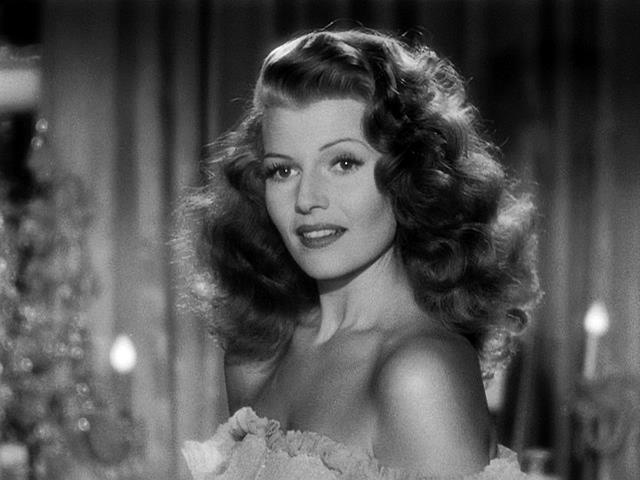
GILDA

Rita Hayworth
GILDA (1946). Director: Charles Vidor.

"Hate can be an exciting emotion. Very exciting. Hate is the only thing that can ever warm me." -- Ballin Mundson.

"If I'd been a ranch, they'd have named me the bar nothing." -- Gilda.

Down Argentine way just at the end of WW2, a hustler and crooked gambler named Johnny Farrell (Glenn Ford) is nearly robbed when a stranger on the docks with a spear in his cane comes to his rescue. The stranger is casino owner Ballin Mundson (George Macready), who hires Johnny to look after his interests. Some time later Ballin introduces Johnny to his beautiful wife, Gilda (Rita Hayworth), and both feign ignorance of the fact that they were once involved. Johnny and Gilda have a real love-hate relationship to add to the stew, and Ballin has a consortium with a bunch of Germans to add to the confusion. After a man is murdered in the casino, Ballin seems to commit suicide in his plane ... What to make of the modestly entertaining and often silly Gilda? Artificial and Hollywoodish as all get-out, with one-dimensional characters and one of the shortest climaxes in the history of the movies, Gilda has a few interesting twists and turns and is distinguished by the sex appeal and fine, constantly insinuating performance of Rita Hayworth, who makes the most of a standard role of the good-bad girl who is kept by wealthy men while loving the poor fellow she truly adores. Ford is not bad, if miscast, as the grubby borderline lowlife who winds up a kind of bodyguard/ersatz gunsel to Ballin (the narration he's given is unnecessary). Macready gives a good performance -- probably the longest and most famous of his career -- although some of his line readings are a little too matter-of-fact; one can think of other actors who might have played it in a somewhat more colorful and poetically sinister fashion. Steven Geray, Gerald Mohr, and Joseph Calleia all score as, respectively, a lowly casino employee who knows where the bodies are buried; a slimy guy with a hankering for Rita; and the police inspector who is concerned with the doings of the German consortium (even if no one in the audience is).

Some people* have had a different reading on Gilda, claiming that Johnny Farrell is a literal hustler on the bisexual side, Ballin's boyfriend, in fact, and that Johnny's self-hatred forced him to walk away from Hayworth before the story begins. This theory has it that Ballin needs to have power over attractive people of both sexes (one is reminded of Clifton Webb's character in Laura). Unfortunately, this take on the film makes it seem like a bad, regressive gay novel of the forties -- the tormented "queer" pulls away from the guy he's with and walks off into the sunset with a woman -- and while some advocates of this theory can point out certain lines and situations in scene after scene (and they may even have a point), they forget that many, many movies featured bad (and good) guys with live-in bodyguards and buddies, and this was never necessarily considered homoerotic. The proponents of this theory would have a lot to make of the Gilda imitation, Forbidden and many others as well.

Rudolph Mate has contributed some fine cinematography, but you would never know that the story takes place in Buenos Aires, as it has little Argentinian atmosphere. Gilda might be considered film noir except for the fact that its crime aspects are comparatively minimal. The pseudo-clever dialogue is often amusing.

* such as film noir specialist Eddie Muller on the Gilda DVD.

Verdict: Anyway, it's fun watching Hayworth do her "Put the Blame On Mame" number. **1/2.

Thursday, May 18, 2017

THE LONE WOLF AND HIS LADY

Ron Randell as the Lone Wolf
THE LONE WOLF AND HIS LADY (1949). Director: John Hoffman.

"Stealing a diamond is the farthest thing from my mind." -- Lanyard.

"Yes, about as far as I can throw St. Paul's Cathedral. -- Jamison.

John Murdock (Douglas Dumbrille), the new publisher of the Daily Tribune, is so stupid that he doesn't know what a newspaper morgue is, but he wants the paper to sensationalize the news in order to increase circulation. Fisher (Arthur Space) is made the new editor and Grace (June Vincent), who worked on obituaries, is promoted to reporter. She importunes Michael Lanyard, the infamous "Lone Wolf" (Ron Randell) to sell his memoirs to the papers and also go to work for the Tribune, covering the exhibition of a fabulous diamond called the "Tahara." Naturally, Lanyard is the chief suspect when the diamond disappears. Randell makes an acceptable Lone Wolf, but he isn't as good as other actors who've played the part. As the leading lady, June Vincent gets a larger role than usual and is excellent. For added support we've got William Frawley [East Side, West Side] as the cop investigating the case; Alan Mowbray [Dante] as Lanyard's valet, Jamison; and Steven Geray as diamond expert Van Groot. Still, this is not an especially memorable Lone Wolf move. Randell and Vincent also appeared together in Counterspy Meets Scotland Yard. Not to be confused with The Lone Wolf Meets a Lady. From Columbia studios.

Verdict: The Lone Wolf's "lady" helps this quite a bit but not quite enough. **.

Thursday, August 25, 2016

PYGMY ISLAND

Billy Barty and Johnny Weissmuller
PYGMY ISLAND (1950). Director: William Berke.

Army Captain Kingsley (Ann Savage of Dangerous Blondes) disappears when she leads an expedition into territory where she hopes to find a certain plant. This plant has unusual properties and will provide "strategic war materials." Major Bolton (David Bruce of Lady on a Train) arrives in Africa to search for Kingsley and confers with the famous Jungle Jim (Johnny Weismuller), who tells him that this plant grows primarily in pygmy territory. Some nasty foreigners led by Leon Marko (Steven Geray)  and his confederate Novak (Tristram Coffin) try to exploit the pygmies, who are led by Makuba (Billy Curtis). Billy Barty [The Day of the Locust] plays the likable pygmy, Kimba; in fact all of the pygmies seem to be played by Caucasian little people. Elephants go on a mini-stampede at one point, crushing a jeep and a truck, and Jungle Jim has an exciting battle with a crazed gorilla that tries to throw him off of a rope bridge into a watery chasm; the picture's best scene. Tamba the chimp gets in on the action as well. While this looks like an ultra-cheap Monogram production, the early Jungle Jim features were released by Columbia.

Verdict: Kind of dull for the most part. **.

Thursday, August 18, 2016

SKY LINER

Would you want this shifty guy (Greg McClure) on an airliner?
SKY LINER (1949). Director: William Berke.

A diverse group of people are flying to San Francisco on TWA. Few of them realize that George Eakins (John McGuire of Sea Raiders) of the State Department has been murdered and been replaced by a man known only as Smith (Steve Pendleton). Smith, who is hoping to sell important papers on the flight, is accompanied by Eakin's secretary, Amy (Rochelle Hudson of Meet Boston Blackie). Steven Geray [The Unfaithful] plays Bokejian, a representative of a foreign power who is anxious to buy those government secrets. An added complication is the presence on the flight of one J. S. Konigsby (Greg McClure), who is a dangerous jewel thief. But when one of those characters is murdered, Federal agent Steve Blair (Richard Travis) teams up with intrepid stewardess Carol (Pamela Blake) to ferret out the murderer and keep the passengers under control. Sky Liner is not quite as interesting as it sounds, but it's a mildly entertaining programmer with a generally competent cast. William F. Leicester is the pilot, Captain Fairchild; George Meeker is a financier; and Jack Mulhall is Colonel Hanson.

Verdict: There have been worse ... **1/2.

Thursday, May 29, 2014

THE UNFAITHFUL

Zachary Scott and Ann Sheridan
THE UNFAITHFUL (1947). Director: Vincent Sherman.

While her husband is out of town, Chris Hunter (Ann Sheridan) returns from a party and is attacked in her home, ultimately killing her assailant. Chris tells her husband, Bob (Zachary Scott), as well as the police, that she never met the man, a sculptor named Tanner. But if that's the case, why did Tanner do a bust of a woman who looks exactly like Chris Hunter, and why are some people offering it to her husband for sale ..? This is an excellent Americanized variation on, and post-WW2 updating of, The Letter, but it takes awhile for the viewer to realize it as it has so many interesting elements of its own. Sheridan [Nora Prentiss] gives one of her best performances, and has an especially good moment when she has a heart to heart talk with her husband about things she did when he was overseas and why she did them. Zachary Scott [Ruthless] is also excellent, as is Lew Ayres [Damian: Omen 2] as the friend and lawyer who comes to the couple's assistance. Eve Arden certainly scores in the somewhat edgier-than-usual role of Bob's cousin, Paula, and the dialogue [by David Goodis and James Gunn] as she tries to explain Chris' wartime actions to Bob is trenchant and memorable. Marta Mitrovich is quietly effective as the angry widow, Mrs. Tanner; Steven Geray suitably oily as a kind of blackmailer and art dealer; Jerome Cowan appropriately wily as a prosecutor; and John Hoyt ever-grim as a suspicious police detective. This is probably director Vincent Sherman's [The Damned Don't Cry] finest hour and a half. A first-rate score by Max Steiner and fine Ernest Haller photography complete the ensemble.

Verdict: A snappy, sophisticated picture that on its own terms is nearly as good as the original ***1/2.

Thursday, June 20, 2013

I LOVE TROUBLE

I LOVE TROUBLE (1948). Director: S. Sylvan Simon.

Private eye Stuart Bailey (Franchot Tone) is hired by a man named Johnston (Tom Powers, the victim in Double Indemnity) to investigate his wife, who has been getting a series of letters threatening to expose her "past," and eventually disappears. Bailey discovers that Mrs. Johnston (Lynn Merrick) was once an entertainer known as Janie Joy, so he pursues that angle via some of her old associates, then gets warned off by a thug, Martin (Donald Curtis) in the employ of John Caprillo (Eduardo Ciannelli). Bailey encounters a young lady, Norma (Janet Blair), who claims that the woman he's after is her sister, even though she doesn't recognize a photograph of her. Then there's sexy "Boots" (Adele Jergens) who sometimes drinks too much; Reno (John Ireland), who runs a nightclub; and his boss, Keller (Steven Geray), all of whom may know more about the missing woman than they're saying. There are a couple of twists, a couple of murders, and a final confrontation in Bailey's apartment. I Love Trouble may not get high marks as a mystery nor film noir, but it's smooth and entertaining, and Tone is excellent, and has a highly adept supporting cast. Raymond Burr and Arthur Space have small roles (as muscle and cop, respectively), and an unrecognizable (perhaps slightly more subdued and older) Glenda Farrell is snappy as Bailey's very efficient secretary. Janis Carter [Night Editor] also is vivid in a pivotal role whose exact nature I won't reveal here. Simon also directed The Fuller Brush Man (which also had Blair and Jergens) and many others.

Verdict: Pleasant time-passer with some good scenes and a modicum of suspense. ***.

Thursday, April 5, 2012

PHANTOM OF THE OPERA

Claude Rains
PHANTOM OF THE OPERA (1943), Director: Arthur Lubin.

Handsome Technicolor version of the silent classic stars the great Claude Rains as Erique Claudin, who loves the pretty singer Christine (Susanna Foster), paying for her lessons in secret, but has a tragic and fateful misunderstanding with a music publisher that results in the latter's death and Claudin getting a face full of corrosive acid. Thereafter he haunts the Paris Opera in a cloak and mask committing murders to advance the career of Christine. Nelson Eddy, in fine voice, plays lead baritone and love interest, Anatole. Edgar Barrier has what is probably his best and biggest part in movies as Inspector Doubert, who not only investigates the murders but is Anatole's rival for Christine. Fritz Feld, Fritz Lieber, and Steven Geray all have supporting roles and all are good. The horror aspects of the story are fairly muted with the exception of a well-executed scene with the chandelier crashing into the audience; Lubin was hardly the best choice for director. Still the film is good to look at, Rains is as excellent as ever [Barrier and the others are also more than acceptable], and there's some wonderful music and singing. The French opera [actually a German opera sung in French] is the third act of Flowtow's Martha. The Russian opera was cobbled together from Tchiakovsky's 4th symphony even though there were plenty of Russian operas, including Tchiakovsky's, to choose from.Very attractive settings.

Verdict: Not all it could have been but quite entertaining. ***.

Thursday, July 15, 2010

CORNERED

CORNERED (1945). Director: Edward Dmytryk. 

Laurence Gerard (Dick Powell), a Canadian shot down over France and helped by the underground, learns that the resistance fighter he married and hardly knew was murdered along with many others under the orders of a collaborationist named Jarnac -- who is supposedly dead. Gerard travels to Buenos Aires to find Jarnac, even though he doesn't know what he looks like or what name he might be using. Helping and hindering along the way are Jarnac's widow (Micheline Cheirel), the hostess Mrs. Camargo (Nina Vale), her mousy husband (Steven Geray), a shady tourist guide (Walter Slezak of Lifeboat), and the sinister Dr. Satana (Morris Carnovsky). Even Edgar Barrier and Nestor Paiva get into the act as, respectively, an insurance agent and a police official. Powell and Slezak give terrific performances, with a sharp assist from Luthor Adler and the rest of the supporting cast. The movie is unpredictable and basically absorbing, though it has no great Hitchcock-like set-pieces and is rather talky at times. Still, it is undeniably intriguing and has an exciting climax. NOTE: Cornered is one of the eight films on Warner brothers' Film Noir Classic Collection Volume 5. 

Verdict: Powell proves again that he's not just a song and dance man. ***.

Thursday, February 25, 2010

IN A LONELY PLACE

IN A LONELY PLACE (1950). Director: Nicholas Ray. 

"I said I liked it. I didn't say I wanted to kiss it." -- Laurel referring to Steel's face when he tries to kiss her. 

Screenwriter Dixon Steele (Humphrey Bogart) is the primary suspect when a pretty hat check girl, Mildred (Martha Stewart) ,who tells him the plot of a novel at his home, is brutally murdered. Laurel Gray (Gloria Grahame) is a neighbor who becomes involved with Steele and is troubled by his temper and all the rumors. Did he do it or didn't he? Frank Lovejoy is the detective on the case. There's a nice score by George Antheil, and the film is well photographed by Burnett Guffey. The acting is good -- Martha Stewart is especially effective -- but the problem with the movie is that the lead character is so repellent. Very good, uncompromising ending, however. An uncredited Alix Talton of Deadly Mantis plays Fran, a friend of Dixon's, and Morris Ankrum of The Giant Claw and Steven Geray are also in the cast. Martha Stewart was attractive and talented but her career petered out by 1964 with only a short list of credits. 

Verdict: Holds the attention, has interesting aspects, but one suspects there's less here than meets the eye. **1/2.

Wednesday, January 14, 2009

THE CRIME DOCTOR'S GAMBLE

THE CRIME DOCTOR'S GAMBLE (1947). Director: William Castle. 

The Crime Doctor, Dr. Ordway (Warner Baxter), is visiting Paris and touching base with an old friend, the Prefecture of Police (Marcel Journet), when he becomes embroiled in another murder case in which a rich man is supposedly murdered by his estranged, disinherited son, Henri (Roger Dann). Steven Geray plays the family lawyer, and Micheline Cheirel is Henri's wife, Mignon. Eduardo Ciannelli is a welcome presence as Mignon's knife-throwing father, Maurice. There's also a series of paintings, more deaths, and a climax at an auction before the killer is exposed -- it won't be that much of a surprise to anyone. Still, this holds the attention and is generally well acted. 

Verdict: Okay time passer. **1/2.

Wednesday, June 11, 2008

DEADLINE AT DAWN

DEADLINE AT DAWN (1946). Director: Harold Clurman.

"Golly, the misery that walks around in this pretty, quiet night."

Alex (Bill Williams), a sailor who has to catch a bus at six am to report back to duty, is on leave in Manhattan when he discovers that a woman (Lola Lane) with whom he dallied earlier in the evening has been murdered. A hard-boiled, disillusioned taxi dancer named June (Susan Hayward) feels sorry for him and helps him find out who the real killer is before he has to catch his bus -- or is arrested. They are aided by Gus Hoffman (Paul Lukas), a sympathetic cab driver. Along they way they encounter cops, blackmail victims, shady ladies (one played by Osa Massen), the dead woman's nasty brother (Joseph Calleia), her blind ex-husband, and a sad man (Steven Geray) with white gloved hands who is smitten with Hayward. This isn't much of a mystery -- the identity of the killer is pretty obvious -- but it has an undercurrent of loneliness and lost souls that gives the film a poignant and disturbing edge. Considering that New York is essentially a major character in the film, it's criminal that the movie was clearly shot on Hollywood sound stages and not on location. Clifford Odet's screenplay, awash in great dialogue and interesting characters, was based on the novel by Cornell Woolrich (William Irish). Jerome Cowan demonstrates his versatility as a nervous if exuberant blackmail victim. Hayward offers an interesting portrait of a tough, unpleasant woman who slowly allows her humanity to shine through. Joe Sawyer, who's only seen in the distance, makes an impression as a drunk friend of the dead woman's. The entire cast is excellent.

Verdict: More here than meets the eye. ***.

Sunday, May 11, 2008

THE ADVENTURES OF DR. FU MANCHU -- TV

THE ADVENTURES OF DR. FU MANCHU (1956). Television series.

Only 13 episodes of this series. produced by the TV division of Republic Pictures, aired in 1956, which is too bad because the show is a lot of fun. William Witney, who also directed Republic's serial Drums of Fu Manchu, directed about half of the episodes, which probably have more action in them than usual. Glen Gordon is quite good as the evil doctor, a rather handsome Fu Manchu, even if he doesn't look especially Oriental. Lester Matthews is an effective Sir Denis Nayland Smith, Fu's greatest adversary, but Clark Howat, who plays John Petrie (of the Surgeon General's office) is bland and forgettable. Carla Balenda is better as his assistant, Betty Leonard, and Laurette Luez adds a little spice as Fu's sexy mistress and helpmate Karamaneh. John George rounds out the weekly cast as Kolb, an evil midget who works for Fu.

As with the serial and films, Fu Manchu is not presented as the more dimensional and fascinating character of Sax Rohmer's novels, but simply as a comic book villain. Four of the series' episodes are available on DVD. In "The Prisoner of Dr. Fu Manchu" (the first episode) a peace delegate (Leonard Strong) from the Far East in town for a conference is replaced by a double, and Betty is mesmerized into trying to kill the original. Morris Ankrum plays an inventor who is to demonstrate his new device at the conference. In episode 2, "The Golden God of Dr. Fu Manchu," Fu steals gold bullion from a wrecked train, and orders a court-martialed soldier who's working with him (Rick Vallin) to murder a woman who turns out to be the wife he abandoned. Vallin and Jean Willes as the wife give solid performances. At one point Fu tortures another man with a red hot bar of gold. Keye Luke appears in this episode.
In episode 9, "The Death Ships of Dr. Fu Manchu," the doctor injects deadly germ cultures into melons in the hopes of having the U.S. accused of bacteriological warfare. In episode 11, "The Master Plan of Dr. Fu Manchu," Fu kidnaps a plastic surgeon and forces him to change the features of a man who turns out to be Adolph Hitler. Much of the action takes place on Der Fuhrer's island hideout and has to do with a cyclotron that will made America's atomic weapons ineffective. Steven Geray, who appeared in episode 1 as another character, is excellent as Hitler-with-a-New-Face. Fu kills one guy with a nasty "Tarantula Magda" spider. It's hard to believe, however, that Fu Manchu would be especially interested in an alliance with Hitler.

The show is decidedly atmospheric, basically well-written and well-acted, and has an excellent (uncredited) musical score as well. Hopefully the remaining episodes will be available on DVD one day. In the meantime, Rohmer's novels, generally creepier and more chilling than the series, are worth looking for on ebay and elsewhere.

Verdict: Lots of fun. ***.

Friday, April 18, 2008

THE MASK OF DIMITRIOS

THE MASK OF DIMITRIOS (1944). Director: Jean Negulesco.

A mystery writer named Leyden (Peter Lorre) is fascinated by the tales of a master criminal, Dimitrios Makropolous (Zachary Scott), who was found dead on a beach, and travels to interview people who knew -- and hated -- him. On his journeys he encounters Mr. Peters (Sydney Greenstreet), who wants to know what Leyden is up to without giving away any of his own secrets. Flashbacks illustrate the increasingly violent and cunning career of Dimitrios -- one of the best vignettes details how he helps maneuver a harmless little clerk (Steven Geray) into betraying his country via greed and gambling. But Dimitrios may even have one last trick up his sleeve. Although quite talky, the picture moves fast and features excellent performances from the entire cast; Lorre and especially Greenstreet are a marvel to watch as they emote with great skill and conviction. Kurt Katch as Colonel Haki, Victor Francen as Grudek, Marjorie Hoshelle as the clerk Bulic's wife, are all stand-outs, with Florence Bates and Edward (Eduardo) Ciannelli also offering noteworthy bits. Faye Emerson isn't bad as a discarded woman in Dimitrios' life. Negulesco may not be a Hitchcock (it would be interesting to ponder how the great Hitch would have handled this material) but his direction is quite good nonetheless. Based on A Coffin for Dimitrios by Eric Ambler.

Verdict: Fascinating! ***1/2.