Lively, entertaining reviews of, and essays on, old and newer films and everything relating to them, written by professional author William Schoell.
Showing posts with label Burl Ives. Show all posts

Thursday, March 27, 2025

THE BRASS BOTTLE

The genie goes flying!
THE BRASS BOTTLE (1964). Director: Harry Keller.

Harold Ventimore (Tony Randall of No Down Payment) is an architect hoping to get some choice assignments from his boss, Mr. Beever (Philip Ober). He is engaged to Sylvia (Barbara Eden of The Yellow Canary), whose father Anthony (Edward Andrews) heartily disapproves of him, thinking he's a complete kook. This opinion is not revised when Harold acquires a large bottle that turns out to hold an ancient genie, Fakrash (Burl Ives), who in gratitude for being freed after thousands of years wants to do anything and everything he can for Harold. Unfortunately, Fakrash' notions are quite a bit dated and even dangerous ... Eventually Harold tries to convince everyone that Frakrash is exactly who he says it is, but it may be more difficult than he imagines. 

Burl Ives with Kamala Devi
The Brass Bottle
 is an absolutely delightful comedy fantasy with a wonderful performance from Burl Ives as the genie. Perhaps hoping to ground the story a bit more Randell underplays and probably isn't as amusing as he could have been, but this approach works fine. Eden is lovely, as is Kamala Devi, who plays a rather independent female genie named Tezra. Andrews, Ober, and Ann Doran as Eden's mother are all swell, as are Parley Baer as a potential client for Harold, and Richard Erdman and Kathie Browne as a couple who are Harold's unconventional buddies. At one point Fakrash reduces some authorities to tiny stature and has them desperately clinging to a pencil in a pitcher of water! Not much later Eden played a genie herself in I Dream of Jeannie. Harry Keller also directed several melodramas starring George Nader such as The Female Animal. 

Verdict: Charming, with a very satisfying conclusion! ***1/2. 

Thursday, July 21, 2022

SUMMER MAGIC

Mills, Mathers, McGuire, Hodges, Pollard

SUMMER MAGIC (1963). Director: James Neilson.

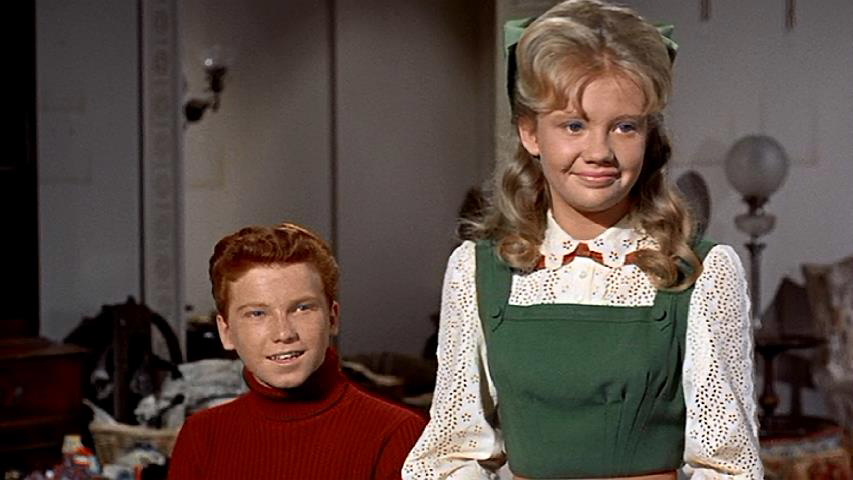
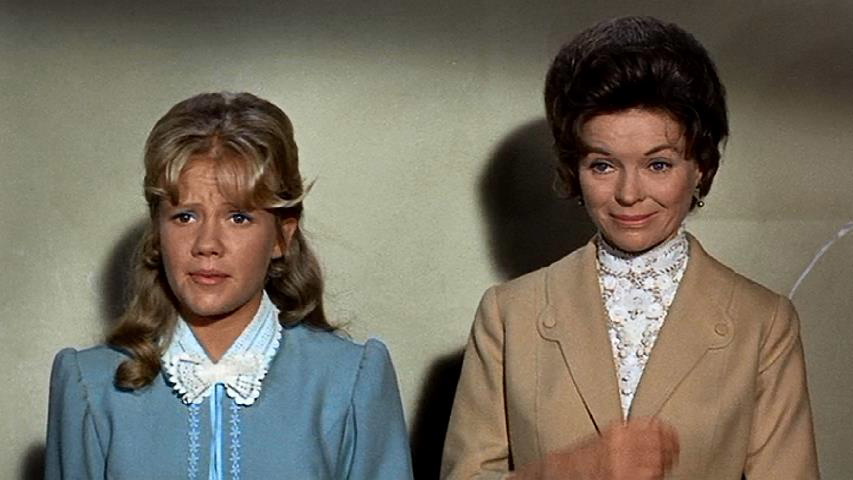
Widow Margaret Carey (Dorothy McGuire of Susan Slade) has to move her brood from Boston to a rented house in the country for financial reasons. The agent for the house, Osh Popham (Burl Ives of The Big Country), assures her that the owner is anxious for her to move in, but is he keeping secrets as his wife, Mariah (Una Merkel), suggests? Neither daughter Nancy (Hayley Mills) or older son Gilly (Eddie Hodges) are thrilled when they learn that stuck-up, pretentious cousin Julia (Deborah Walley), is moving in, but both young ladies are thrilled to meet the handsome young schoolmaster, Charles (James Stacy). Nancy is deflated when Charles seems to prefer Julia, but she may get the consolation prize when the house's real owner (Peter Brown of Violent Road) finally shows up. 

Eddie Hodges and Hayley Mills
Although there are a couple of moments when Summer Magic threatens to become dangerously sitcom-like and overly cutesy, I have to admit the darn thing has a lot of charm, not to mention several excellent performances. The gifted Hayley Mills always seems to be wonderful, and the same can be said of Dorothy McGuire. Ives and Merkel make an interesting couple, with the ever-quirky Michael J. Pollard (was there ever an actor anything like him?) playing their son with his customary shit-eatin' benevolence. Eddie Hodges is fine as Gilly, who would have preferred to stay in Boston, and little James Mathers (younger brother of Leave It to Beaver's Jerry Mathers) nearly steals the pic as the youngest member of the family. (It's somewhat annoying that when he's bullied because he has long hair and is wearing a Buster Brown outfit said bullies don't get any comeuppance.) 

Hayley with Dorothy McGuire
Summer Magic is a musical, and while the songwriting team of the Sherman Brothers is not exactly Rodgers and Hammerstein, they have contributed some more-than-pleasant tunes, including "On the Front Porch with You," "The Ugly Bug Ball," "Beulah" and others. Hayley, Eddie and Burl do their own singing while I believe the others are dubbed. The rather abrupt character reversal of Julia is unconvincing, although Deborah Walley manages to handle it all with aplomb. A song in which the girls sing about "Femininity" and hiding your true self to snare a beau is the most dated thing about the picture, even if it takes place in the twenties. Although Dorothy McGuire was not that old and still attractive, the film doesn't give her a romantic partner, another dated aspect.

Verdict: Take it with a grain of salt and this is amusing and entertaining in equal measure. ***. 

Thursday, June 12, 2014

THE BIG COUNTRY

That's a mighty bigggg country, all right!
THE BIG COUNTRY (1958). Director: William Wyler. Produced by Wyler and Gregory Peck.

Easterner James McKay (Gregory Peck) goes west to meet the family of his fiancee, Patricia (Carroll Baker). There he discovers that her father, Henry Terrill (Charles Bickford), has been embroiled for years in a feud with the Hannassey family, which is led by grizzled but proud Rufus (Burl Ives). James also finds he has a rival in foreman Steve (Charlton Heston), who doesn't believe he makes a fit mate for Patricia. While Steve needs to impress Pat and flaunt his machismo on a regular basis, the more secure James wants to be loved for other reasons than his ability to fight (at which he happens to be quite good). As the feud that James wants no part of heats up, he is drawn to a lovely friend of Pat's named Julie (Jean Simmons), who owns the land where both families send their cattle for water, and who has the unwanted eye of Rufus' crude son, Buck (Chuck Connors). Eventually all the intense rivalries boil over ... Franz Planer's widescreen photography gets across the vastness and beauty of the countryside in panoramic style, and even the comparatively "petty" quarrels are set against the hugeness of the "big" country. A major fight scene between James and Steve is photographed mostly in long and medium shot, where their struggle is contrasted with the epic majesty of their impressive surroundings. Other memorable scenes include James trying to tame a spirited horse that pulls the blanket off its back with its teeth [although you sort of wish he would just let the horse retain its independent spirit]; James and Julie trying to outdo one another with gross and grisly stories of sharks and red ants; a pistol duel between two characters late in the movie; and a  moving climactic scene between Rufus and his son, Buck. Gregory Peck, although a little too cool at times, gives an excellent performance in a role that was made for him. Heston also gives one of his best performances and Baker [The Carpetbaggers] and Simmons [Angel Face] are similarly perfect. As the blustering patriarchs who hate each other Bickford and Ives nearly walk off with the movie; the latter is especially effective in his entrance scene when he comes to a party at the Terrill estate to tell off Henry in no uncertain terms. Although he's saddled with a stereotypical role, Mexican actor Alfonso Bedoya scores as the Terrill servant, Ramon. And Chuck Connors offers an outstanding turn as the nasty but somehow likable Buck, who seems as lonely as he is horny. The Big Country has a fairly predictable plot but somehow it doesn't matter, as you are anxious to see the confrontations and developments that you know are coming, and Wyler's expert direction not only adds an artistic sheen to the production but insures that you're never bored for the nearly three hour running time. [It might have been more interesting if James weren't quite so adept at fighting and everything else.] Jerome Moross' theme music is wonderful and I believe was later re-used for a western TV show. It's very strange that this movie -- considering its major stars and director -- seems to have been almost completely forgotten. It's arguably more successful than Peck's other big western, Duel in the Sun.

Verdict: Rousing, absorbing, Grand Old Western with superior direction and some fine performances. ***1/2.

Thursday, August 2, 2012

EAST OF EDEN

EAST OF EDEN (1955). Director: Elia Kazan.

"You kept on forgiving us, but you never really loved us."

"It's awful not to be loved. It's the worst thing in the world."

In  1917 Monterey, Adam Trask (Raymond Massey), with his sons Caleb (James Dean) and Aron (Richard Davalos), try to make a killing with lettuce kept fresh with ice, but they have bigger problems than hoping this new business will succeed. Aron has always planned to marry Abra (Julie Harris), but there is a growing attraction between her and Cal, who never feels he had his father's love. In the meantime Cal discovers that his supposedly dead mother, Kate (Jo Van Fleet) is actually running a brothel not too far away, something his brother is unaware of. Then there are tensions created by the advent of WW1, and Aron's initial decision to stay out of the fighting. First of all, anyone expecting a literal transcription of John Steinbeck's novelistic take on Cain and Abel must look elsewhere, because this movie only concerns a portion of a very long book, and it makes changes to the plot and characterizations. Taken on it's own terms, however, East of Eden is still a masterpiece, with a wonderful, committed cast, fine direction from Kazan, high-grade cinematography from Ted McCord, and an interesting score by Leonard Rosenman. Whatever impression Dean may have made off-screen, the camera certainly loves him, and this movie probably showcases his mystique the best of his three movies; he is excellent. Although Dean got the lion's share of the attention, Davalos is also compelling as his brother, and there is also some fine work from Van Fleet, Harris and Massey. Burl Ives and Albert Dekker have significant roles and are also good, as is Barbara Baxley as an unpleasant nurse who shows up late in the picture. Yes, there are scenes that are too stagy, dialogue that is too obvious [Dekker unnecessarily bringing up Cain and Abel, as if the audience is too stupid to get it], but the picture is totally absorbing and has a deeply moving wind-up.

Verdict: Hollywood at its best. ****.