Lively, entertaining reviews of, and essays on, old and newer films and everything relating to them, written by professional author William Schoell.

Thursday, July 14, 2016

WIFE VS. SECRETARY

A pensive Jean Harlow
WIFE VS. SECRETARY (1936). Director: Clarence Brown.

Linda (Myrna Loy) is happily married to publisher Van (Clark Gable), who has a highly efficient and attractive secretary named Whitey (Jean Harlow). Linda doesn't see the pretty Whitey as a threat until her well-meaning mother-in-law, Mimi (May Robson of Bringing Up Baby), puts the thought in her head. As for Whitey, she has an adoring boyfriend in Dave (James Stewart), but she also realizes that she's developed feelings for Van. When Van and Whitey take an unscheduled trip to Havana for business, Linda jumps to conclusions and walks out, making the conflicted Whitey wonder if she has a future with her boss and if she really wants one. Wife vs Secretary is not a bad movie, but its chief appeal lies in the wonderful performances by the entire cast, especially Harlow in a more serious role of a very likable, appealing and decent woman. Myra Marsh of I Love Lucy fame plays a woman who consults with Van, and Gloria Holden of Dracula's Daughter plays Joan, a friend of Van and Linda's.

Verdict: Watch this one for Harlow and other excellent performances. ***.


SUZY

Jean Harlow and Cary Grant's hand
SUZY (1936). Director: George Fitzmaurice.

"I don't dance much and I don't sing so well, but I can be awful cute when I want to be." -- Suzy

Suzy (Jean Harlow), an American entertainer in London on the eve of WW1, eventually finds herself married to two men at the same time: Factory foreman Terry (Franchot Tone), who at one point gets shot by a spy; and wealthy French playboy and war hero, Andre (Cary Grant) who distinguishes himself as a flier -- and a heel. How this bizarre situation came about and how it is resolved is the stuff of Suzy, a wartime soap opera that mixes dogfights, Mata Hari-types, inadvertent bigamy, adultery, German spies, and music halls -- and it's still a meandering bore. Jean Harlow is delightful in the first half of the film but director Fitzmaurice is unable to get her to properly handle some of the tougher scenes in the second half, although she certainly had the ability to do so. Tone and Grant are both fine -- although Tone is as unconvincing as an Irishman as Grant is as a Frenchman! --  but Lewis Stone walks off with the movie as Grant's stern but loving father, who eventually comes to care very much for the showgirl he at first disapproves of. [The picture eliminates Stone from the finale and shouldn't have.] Inez Courtney [The Reckless Way], Una O'Connor [Stingaree], and Benita Hume are also notable as, respectively, Suzy's pal, landlady, and love rival. Fitzmaurice also directed Mata Hari with Greta Garbo. The most unforgivable thing about Suzy is that it tries to rip off the "I was reading a book" scene from Dinner at Eight!

Verdict: Melodramatic claptrap that seems cobbled together from scenes from better movies. **.

DEADLY ILLUSIONS: JEAN HARLOW AND THE MURDER OF PAUL BERN

DEADLY ILLUSIONS: JEAN HARLOW AND THE MURDER OF PAUL BERN. Samuel Marx and Joyce Vanderveen. Random House; 1990.

Samuel Marx was a friend of Paul Bern's and worked at MGM as a story editor at the time of Bern's death. For years he accepted the story that Bern committed suicide because it turned out there was already another woman in his life and a scandal might have derailed both his career and his wife, Jean Harlow's. Paul Bern was horrendously slandered as a monster, abuser, and so on in a phony biography of Harlow as well as two films inspired by it. This book dispels the notions that Bern was impotent (he is described by one doctor  as being "underdeveloped," but not in an abnormal way)  and beat Harlow out of frustration, or that he had no interest in women to begin with. Marx makes clear that the often negative (for the time) rumors about Bern stubbornly persisted for decades with reporters taking the old bio and films as gospel. Dorothy Millette had been involved with Bern years earlier, when she had to be committed to an institution and Bern provided her continual support (and indeed performed many acts of kindness for others). Then Dorothy was released, however delusional, and made her way to Hollywood, expecting she and Bern would continue their relationship and he would groom her for stardom. Unfortunately  ... Marx and Vanderveen make a convincing case that Louis B. Mayer and underlings covered up the murder of Paul Bern in this interesting bio-crime story.

Verdict: Fast read with interesting information. ***.


SARATOGA

Jean Harlow and Clark Gable
SARATOGA (1937). Director: Jack Conway.

Margaret Hamilton to Frank Morgan: "You have no idea what my face looked like before I used your cream."

Frank Morgan to Margaret Hamilton: "I can imagine."

Race track gambler Duke Bradley (Clark Gable) thinks that Carol Clayton (Jean Harlow), the daughter of his friend, Frank Jonathan Hale), is a bit snooty. Carol is engaged to the rich "sucker" Hartley Madison (Walter Pidgeon), but she finds herself drawn to the cruder Duke even as she engages in verbal fisticuffs with him. Will Carol and Duke admit their feelings for one another? This is the slight premise of Saratoga, which also has some bits of business about bidding on horses, switching jockeys at the last minute, and betting on the climactic race, most of which is a little confusing and even a bit on the dull side. This is a shame, because each and every cast member is working at the top of his or her game, and that not only includes the already-named, but Una Merkel as Duke's racing pal; Frank Morgan as her befuddled and jealous husband, who markets cold cream as "Harriet Hale;" Hattie McDaniel as Carol's saucy and lovable maid/companion; Frankie Darro as an obnoxious jockey; and George Zucco (doing a rare turn at comedy) as a slightly strange doctor. Margaret Hamilton also scores in a small role as one of Morgan's unsatisfied customers, and Lionel Barrymore is fine, as usual, working in his befuddled, cranky, old-timer mode.The acting in this is just wonderful and there are some memorable scenes, such as a near-silent one in which Duke communicates to Carol that her father has died. There's a very enjoyable train scene with the various principals taking turns at singing a chorus, their acting skills and personality making up for untrained voices. Despite several genuinely amusing moments, the film has an air of sadness because Harlow died tragically young while making this picture, and her scenes had to be finished with a dubbed double seen only from the back or behind binoculars. The film has an amiable nature, even though the Walter Pidgeon character is treated especially shabby, and Carol doesn't come off like the most likable of creatures.

Verdict: So many fine actors and so many good things in it that it's too bad this really isn't all that memorable. **1/2.

Thursday, July 7, 2016

SHOOT THE MOON

Peter Weller and Diane Keaton
SHOOT THE MOON (1982). Director: Alan Parker.

Faith Dunlap (Diane Keaton), a housewife with four young daughters, is married to an acclaimed author named George (Albert Finney), who is having an affair with Sandy (Karen Allen). Faith learns of the affair and divorce papers are filed, and the children try to cope with the painful disintegration of their parents' marriage and their own worries for the future. The oldest daughter, Sherry (Dana Hill) is particularly anguished, and at first wants no relationship with the father whose love she craves. Then a contractor named Frank (Peter Weller) enters the picture and begins his own relationship with Faith, and George's jealousy and paranoia threaten to demolish everything ... Shoot the Moon was a talked-about movie in its day, although it's pretty much forgotten now, and one can see why. While the film is quite good at delineating the emotional upheaval affecting the oldest daughter, and there are some good, near-powerful sequences, the characters are a little too unsympathetic to make us fully root for them. Spouses do tend to have conflicted feelings during divorces, and the film spells that out but never fully engages us. The constant presence of the four daughters, however adorable, sometimes makes this resemble a dark Disney film. The deck is sort of stacked against George because he is a self-absorbed asshole, which the film never quite addresses until the ending; while George had a girlfriend on the side, it is not clear if he actually wanted a divorce. Keaton [Interiors] gives an excellent performance, nearly matched by Finney [Tom Jones], and there is superlative work from the young Dana Hill as their daughter, Sherry  -- one of the best scenes is between Finney and Hill as they have a long talk on a dock. Weller [Star Trek Into Darkness] doesn't get much of a chance to be more than the likable, swaggering hunk with a penchant for his own violence. A scene when Faith and George have a fight in a restaurant is pure sitcom and out of sync with the rest of the movie. George Murdock scores in a brief scene as Faith's dying father. Michael Seresin's cinematography is superb.

Verdict: Something's missing ... **1/2.

PAPILLON

Dustin Hoffman and Steve McQueen
PAPILLON (1973). Director: Franklin J. Schaffner.

Henri Charriere (Steve McQueen), a safecracker known as Papillon (Butterfly) due to a tattoo on his chest, is convicted of murdering a pimp (a crime he insists he did not commit) and sent to a French penal colony. He becomes friends with counterfeiter Louis Dega (Dustin Hoffman) and the two start planning an escape. After several false starts and others joining the team, they manage to get out -- but their trials and tribulations are by no means over. Papillon, if I recall correctly, was a very big hit and a feel-good movie about the indominability of the human spirit. It is also very much a Hollywood movie that often tries to stay on a "light" level despite the grimness of the proceedings. At first McQueen just seems to be walking through his role -- and Hoffman hardly ever seems anything other than Dustin Hoffman in a prison skit -- but with the aid of effective make up he is more impressive in the later scenes. Papillon has to be taken with a grain of salt, as Charriere's memoirs, upon which the film is based, were later determined to be largely fictional; he was never on Devil's Island for instance. McQueen was forty-three when he did this picture, four years older than Charriere was when he made his final escape, although the actor is made up to look like a senior citizen and emotes that way as well; this is not only highly-fictionalized but on occasion plays like a parody. Victor Jory [Cat-Women of the Moon] plays an old Indian chief who wants his own tattoo; Anthony Zerbe is the leader of a colony of lepers; Bill Mumy ["It's A Good Life"] is a young convict who essentially commits suicide; Don Gordon [The Final Conflict], Woodrow Parfrey and Robert Deman are all other convicts who get involved in the big escape one way or another; they are all good. But Papillon, which holds the attention and has a few harrowing moments without ever being really riveting, gets its power not from the performances but from Fred J. Koenekamp's cinematography and Jerry Goldsmith's typically effective musical score.

 Verdict: Not any kind of masterpiece but Papillon's exhaustive efforts to gain his freedom eventually pull you along. ***.

THE MAN IN THE NET

Alan Ladd confronts Carolyn Jones
THE MAN IN THE NET (1959). Director: Michael Curtiz.

John Hamilton (Alan Ladd) is an aspiring painter who's brought his wife, Linda, to the country to work on his art -- and keep dipsomaniac Linda (Carolyn Jones) away from the liquor. Unfortunately, the bored and resentful Linda can't stay away from men, either. When John returns from a business trip to New York, he discovers that Linda is missing. Everything goes awry in the second half of this very poor mystery due to suspect developments and a bad screenplay. Half the town converges on Hamilton's home, denouncing him as a wife-murderer, when the townspeople barely know him and there's no reason for them to act like villagers out to get that evil Baron Frankenstein. Worse, John is befriended by a little girl, Emily (Barbara Beaird), who enlists a whole bunch of her little friends into helping John investigate the mystery. The entire second half of the film is taken up with these children, who are cute and not bad actors, but they make the picture resemble a distinctly forgettable Disney movie. Ladd [The Carpetbaggers], his face puffy and years older due to heavy drinking, barely gives a performance, while Jones [Eaten Alive] pretty much steals the show in her vivid portrayal of the screwed-up Linda. Charles McGraw [Roadblock] is typically vital as the town sheriff, and Diane Brewster and John Lupton are effective as family friend Vicki and her handsome husband, Brad (you might call Lupton a "prettier" version of Marshall Thompson). As Brad's father, John Alexander is so terrible you'd have to assume he was given the part as a favor to someone were it not for the fact that he amassed many theater and movie credits; this is not a highlight of his, or anyone else's, resume. Curtiz is defeated by the material.

Verdict: Even one of the lesser episodes of Perry Mason (not that there were many) is better-scripted and more entertaining than this. *1/2 out of 4.

ZEIGFELD GIRL

HIGH CAMP: Judy Garland on top of poles
ZIEGFELD GIRL (1941). Director: Robert Z. Leonard.

Three young ladies are chosen to join Ziegfeld's Follies (Ziegfeld himself is never seen): Sandra (Hedy Lamarr), who is married to a jealous, out-of-work violinist, Franz (Philip Dorn) but is courted by the handsome singer, Frank (Tony Martin); Sheila (Lana Turner), who has a truck-driving boyfriend, Gil (James Stewart) but who is drawn to the wealthy Geoffrey (Ian Hunter); and Susan (Judy Garland), who has been working for years with her has-been father, "Pop" Gallagher (Charles Winninger), who is afraid he'll be nothing without her. Pop tries to get Susan to sing in a hokey, super-fast, old-fashioned style -- as the director, John (Paul Kelly) puts it "they quit beating a song to death ten years ago" -- but when she delivers "I'm Always Chasing Rainbows" as a ballad the whole audience is moved. (Of course, it makes little sense that the diminutive Garland would ever have been hired as a showgirl, and in one scene in fact she is told that she is not a showgirl, so I'm not certain what she was supposed to be doing before her singing talent was discovered.) This is one of probably dozens of films that look at the trials and tribulations of three women hoping for success in show business -- you can even include Valley of the Dolls in the bunch, for that matter -- and while the melodramatics are cliched and not that interesting, the picture is still quite entertaining. Busby Berkeley put together the production numbers, the best of which is Garland's "Minnie from Trinidad," which definitely turns into high-camp when Garland is lifted high above the stage atop poles at the finale! Garland is swell, Lamarr is beautiful and effective, and Turner isn't quite up to her more dramatic scenes, in which she tends to over-act, to put it mildly. Turner is chosen to be the gal who nearly winds up in the gutter, but even when she becomes a drunk she still looks glamorous! Jimmy Stewart is miscast and somewhat perfunctory in this, although he gets plenty of scenes. Eve Arden shows up once or twice doing her usual schtick; Fay Holden appears briefly as Lana's mother ("I didn't raise my boy to be a Ziegfeld girl," she says to Jackie Cooper when he imitates his sister); Paul Kelly orders the show girls around but isn't really given a character to play; and Tony Martin has a handsome face, a beautiful voice, and is charmingly smarmy as Frank. There are notable if quite small, supporting performances from Rose Hobart as Martin's neglected wife, and Renie Riano [Nancy Drew -- Detective]  as Annie, Lana's wise-cracking maid. I've no doubt Ziegfeld gals, especially the more popular ones, were paid comparatively well, but Lana's apartment looks like something a major film star like Joan Crawford might have lived in! But that's the movies! NOTE: Not to be confused with The Great Ziegfeld in which the great Ziegfeld actually appeared.

Verdict: Likable musical with attractive players. *** out of 4.

THE OTHER LOVE

Richard Conte and Barbara Stanwyck
THE OTHER LOVE (1947). Director: Andre De Toth.

"I'm not fooled, doctor. I know death is a guest here. Though he sent me his compliments."

Karen Duncan (Barbara Stanwyck) is a successful concert pianist who comes to a sanitarium for treatment of an unspecified illness. She and her doctor, Anthony Stanton (David Niven), find themselves falling for one another, and he suggests that Karen spend many months just resting. But Karen is restless for life, and goes off with race car driver Paul Clermont (Richard Conte) for a romantic and wearying time in Monte Carlo. Trying to evade her fate, Karen only gets sicker ... The Other Love is based on the story "Beyond" by Erich Maria Remarque. Fourteen years after The Other Love was released, Remarque wrote the novel "Heaven Plays No Favorites," which was filmed as the Al Pacino starrer Bobby Deerfield, which also deals with a dying woman and a race car driver. The Other Love proves no more convincing than Deerfield and Stanwyck's fine performance is wasted in a trite, superficial soap opera. Although Stanwyck is never that good at portraying vulnerability, she easily out-acts her two male co-stars. Gilbert Roland has a nice turn as a croupier who tries to take advantage of Karen, and Joan Lorring [The Corn is Green] is notable as another doomed patient in the sanitarium. Natalie Schafer briefly appears to sparkle in that certain sleazy way of hers as a guest at Monte Carlo. Miklos Rozsa' score doesn't help at all. Roland had a much more memorable appearance with Stanwyck in The Furies. NOTE: For more on Bobby Deerfield see Al Pacino In Films and On Stage.

Verdict: Dark Victory this isn't. **.

STAGE STRUCK (1948)

Kane Richmond and Audrey Long
STAGE STRUCK (1948). Director: William  Nigh.

Benny Nordick (John Gallaudet of Docks of New Orleans) who runs a night club and a acting school racket, murders hopeful Helen Howard (Wanda McKay) because she knows too much about his sleazy operation. Nick Mantee (Kane Richmond) helps Nordick cover up the crime and becomes his partner. Ignoring the advice of Lt. Williams (Conrad Nagel of All That Heaven Allows) and his assistant Sgt. Ramey (Ralph Byrd), Helen's sister Nancy (Audrey Long)  takes it upon herself to go undercover at Nordick's school. Dodging persistent passes from Mantee and suspicious glances from Nordick, she tries to find out what she can. Stage Struck is a passable Monogram entry with an interesting cast, most of whom were down on their luck. Lt. Williams' reason for being tough with Helen after she learns of her sister's murder makes no sense, and his piousness gets a little tiresome as well. The leads are fine in this cheap production, and Anthony Warde, Pamela Drake and Evelyn Brent [Holt of the Secret Service] have smaller roles and are equally effective. I've no doubt that acting and modeling schools that are more interested in taking gullible people's money than helping their careers still exist in every major city. Richmond and Byrd, of course, were major serial heroes. Richmond amassed over 100 credits, but this was his last film; he retired from movies to work in the fashion industry. Byrd did a few more films and died rather young in 1952.

Verdict: Distinctive Nagel, Byrd and Richmond help put this over. **.

LOONEY TUNES: BACK IN ACTION

MEGA-STAR: The Adorable Daffy Duck
LOONEY TUNES: BACK IN ACTION (2003). Director: Joe Dante.

To his dismay, disbelief, and horror, Daffy Duck, who has always played second fiddle to Bugs Bunny, finds himself fired by the Brothers Warner. Also fired is a security guard named DJ (Brendan Fraser), the son of famous Bond-like actor, Damien Drake (Timothy Dalton). It develops that Drake really is a super-spy, and has been kidnapped by the sinister forces of one Mr. Chairman (Steve Martin). DJ becomes unlikely teammates with Daffy and the woman who fired both of them, Kate (Jenna Elfman), to find and rescue Drake even as Bugs Bunny and other weird characters, both live and animated, provide a zany backdrop. On paper it might have seemed like a good idea to combine live action with cartoon animation as in Who Framed Roger Rabbit?, but despite the lovable characters -- underdog Daffy has always been my long-time favorite "funny animal" -- the spy plot is ill-advised and the movie is much, much more silly than any of the classic Warner Brothers cartoons. Kids will enjoy this the most, while their parents and older viewers may get a kick out of all the in-jokes (surely the children won't get the reference to the Psycho shower murder, although it is funny). Fraser and Elfman do the best they can, while Steve Martin offers a bizarrely notable turn as the definitely weird Mr. Chairman. Others in the cast include an amusing Joan Cusack; a sinister Granny with Tweetie Bird in tow; the Tasmanian Devil; Marc Lawrence; a slithering brain from Fiend Without a Face; Robby the Robot from Forbidden Planet; the hulking insectoid creature from This Island Earth;  Jeff Gordon; Peter Graves; a plant from Day of the Triffids; the ape-man in a helmet from Robot Monster; Yosemite Sam; Elmer Fudd; Roger Corman (as a director); Dick Miller (as a studio guard); and Heather Locklear as a showgirl/secret agent. Did I miss anyone? The film's highlights include an amazing battle on top of the Eiffel Tower and a clever scene in the Louvre when Bugs and Daffy jump into different paintings and immediately convert to the style of the specific artist. Considering everything, you really want to love this movie, but at times it gets too frenetic and stupid without being especially funny. Still, there's always the delightful Daffy!

Verdict: Daffy rules -- but this great star needs a better vehicle. **1/2 out of 4.

Thursday, June 30, 2016

CALL NORTHSIDE 777

CALL NORTHSIDE 777 (1948). Director: Henry Hathaway.

"Did it ever occur to you that everyone might be selling that dead cop short? He might have had a mother who scrubbed floors, too."

Chicago Times reporter P. J. McNeal (James Stewart) is assigned to look into an ad offering a $5000 reward for information about an old murder case. Frank Wiecek (Richard Conte), a small-timer, was convicted of shooting a cop and has spent eleven years in jail. His mother, Tillie (Kasia Orzazewski), who scrubs floors for a living, has saved up her money in the hopes someone will come forward with info that may exonerate her son. Initially skeptical, and told by his editor, Kelly (Lee J. Cobb) to keep the human interest story going to sell papers, McNeal eventually comes to believe in Wiecek's innocence and does all he can to overturn his conviction. Call Northside 777, which was based on real-life events, features solid performances from the principals (with especially good work from Orzazewski), as well as Betty Garde [Mr. Lucky] as Wanda Skutnick, the primary witness against Wiecek, and Otto Waldis [Unknown World] as her husband, Boris. Joanne De Bergh has a nice turn as Wiecek's ex-wife, but Helen Walker [Impact] has hardly any screen time as Mrs. McNeal. The picture is briefly stolen by an uncredited actress who certainly delivers in her role as a drunken barfly who gives McNeal much-needed information. The film builds up much suspense as it goes along, has interesting details (even if some are suspect), and a nice score by Alfred Newman. However, you're left with the nagging feeling that this new evidence might well mean Wiecek should get a new trial, but it doesn't absolutely prove his innocence!

Verdict: Real-life suspense story holds the attention. ***1/2.

ROYAL WEDDING

Fred Astaire and Jane Powell
ROYAL WEDDING (1951). Director: Stanley Donen.

"She's quiet, but deep. At least I hope she's deep or she's wasting a lot of her time being quiet." -- James Ashmond on his daughter, Anne.

Tom and Ellen Bowen (Fred Astaire and Jane Powell) are a brother and sister team of entertainers who take their latest show, "Every Night at Seven," to London just in time for the Royal Wedding. Although Ellen has been a bit of a playgirl, and Tom isn't marriage-minded, they both find themselves falling in love: Ellen with Lord Brindale (Peter Lawford); and Tom with pub owner's daughter and dancer, Anne (Sarah Churchill). But will respective marriages break up the act? Royal Wedding is a bit of MGM fluff but well turned out, with very good performances, some nice singing and dancing, and several highlights. For me it's Jane singing the beautiful romantic ballad "Too Late Now," although Astaire's dancing on his room's walls and ceiling is a close second. Then there's Astaire and Powell's rendition of the comical "How Could You Believe Me (When I Said I Love You)?" The songs are by Alan Jay Lerner and Burton Lane, and another memorable tune is "My Love," warbled beautifully by Powell. Sarah Churchill [He Found a Star] received a lot of bashing for her acting in this, but I think she's charmingly effective, and despite the somewhat mannish features that I've noted, quite lovely -- she was the daughter of Winston Churchill. Albert Sharpe scores in the role of Anne's father, James Ashmond, and Keenan Wynn is fine in dual roles of twin brothers, one for each side of the Atlantic. "I Left My Hat in Haiti" is a snappy production number.

NOTE: Beware which DVD firm you buy, rent or borrow this movie from. Westlake Entertainment offers one of the worst video transfers I've ever seen, with washed-out colors, whole scenes that seem cast in shadows, and so on. You expect this for cheap old B movies and TV shows, but a glossy MGM musical? Fortunately, there are other DVDs of this movie.

Verdict: Dancing on the ceiling indeed! *** out of 4.

THE FINAL CONFLICT

Son of Satan: Sam Neill
THE FINAL CONFLICT aka Omen III: The Final Conflict/1981. Director: Graham Baker.

"Most people confuse 'evil' with their own trivial lusts and perversions." -- Damien Thorn

Damien Thorn (Sam Neill), the anti-Christ, is now grown and still causing bloody mischief after the events of The Omen and Damien: Omen 2. Thorn becomes the new ambassador to Britain, then discovers that the Christ child has been born in London. Even as Thorn has his minions murdering male infants in case one of them is his adversary, Father DeCarlo (Rossano Brazzi) and his monks attempt to kill Thorn with special daggers -- only the little devil outwits them every time. Thorn develops a relationship with reporter Kate Reynolds (Lisa Harrow), but seems more interested in indoctrinating her teenage son, Peter (Barnaby Holm), into the ways of evil and lord only knows what else. But Damian's plans may come to nothing despite his best efforts ... The Final Conflict is a highly-enjoyable, slick and well-made horror film if you don't take it seriously, which is impossible to do for all but the sub-literate. On that mindless level the film boasts an excellent performance from Neill [Daybreakers], and a very notable turn from Don Gordon, who is Damien's executive assistant, and unbeknownst to Thorn, the father of a boy born on the wrong day. Brazzi [Summertime] doesn't seem to take anything that seriously, and probably didn't; Harrow and Holm are fine. The set-pieces in the film -- an assassin gets caught in a fiery trap while trying to kill Damien in a TV studio; the assorted suspenseful murders of the infants -- are well-done although a scene with dogs allegedly tearing a monk apart doesn't quite work because the rather cute doggies don't actually seem to be doing anything. The film is tremendously bolstered by a near-operatic score by Jerry Goldsmith, who has delivered an epic and beautiful theme with demonic undertones, and embellishes every scene with a sweeping and majestic backdrop. When Kate is, to all intents and purposes, raped late in the movie, she has virtually no reaction! But then the filmmakers have no more compassion for the assorted victims than Damien does.

NOTE: This was followed by the TV movie Omen IV, and just this year A and E had a series entitled Damien detailing the further adventures of Damien Thorn; it lasted one season.

Verdict: Comparatively empty but engaging and rather clever horror flick. *** out of 4.

WALL OF NOISE

Ty Hardin and Suzanne Pleshette
WALL OF NOISE (1963). Director: Richard Wilson.

Horse trainer Joel Tarrant (Ty Hardin) goes to work for Matt Rubio (Ralph Meeker) who wants to get involved in racing. Angered when Joel's girlfriend, Ann (Dorothy Provine), whom he treated like crap, goes off with his friend and jockey, Bud (Jimmy Murphy), Joel takes up with Rubio's sophisticated and neglected wife, Laura (Suzanne Pleshette). Will their horse win the big race? Will Joel wind up with Ann or Laura? Is there any way that anyone could possibly care? Wall of Noise is an incredibly dull picture that is bolstered strictly by the talents of its supporting case, especially Meeker [Jeopardy], Murphy, Simon Oakland, Murray Matheson, and George Petrie. Hardin [Berserk] is only adequate, one of these lesser-talented hunks who plays everything in a key of anger because it's easier to do than real emoting -- he is always grimacing as if he's smelling something bad -- and Pleshette offers one of her rare lousy performances. The dialogue is often cliched and terrible, but it isn't helped by its delivery: Hardin and Pleshette [A Rage to Live] set off  as much passionate sparks as a wet firecracker. Even the racing scenes are dull, and after awhile you're just impatiently waiting until this bomb is over. Richard Wilson also directed the equally awful Raw Wind in Eden, which at least had a better title.

Verdict: Not enough noise to drown out this stinker, but the horses are nice. *1/2.

FROM MOTHER AND DAUGHTER TO FRIENDS

FROM MOTHER AND DAUGHTER TO FRIENDS. Nancy Aniston. Prometheus; 1999.

As I have little interest in the TV show Friends and its star, Jennifer Aniston, it may seem odd that I chose this tome to read. I think I have always been curious about how it really feels for someone in show biz to essentially have a non-career while their child goes on to great success and fame. From Mother to Daughter does not really explore that, as Nancy Aniston -- if we're to believe her -- seemed more interested in her actor husband's success than her own, and encouraged her daughter in her acting pursuits. She doesn't come off like a stereotypical "stage mom," either. Nancy did her best to get husband John Aniston on his feet and make a living when his acting career stalled for years. He later became a successful soap opera actor and, typically, discarded the wife who'd been there for him, although Nancy is charitable and suggests that what she saw as encouragement he only interpreted as nagging. All Nancy could get her husband to say was "I am not committed to this marriage" -- she subsequently learned he had a girlfriend (one of his co-stars). After daughter Jennifer's success on Friends, Nancy made the innocent mistake of talking to a tabloid show (ostensibly about a special school she felt was doing good work) and an over-reacting Jennifer stopped speaking to her mother. (This book did little to close the gap but after a few years -- when Jennifer broke up with Brad Pitt -- she reached out to her mother once again.) But forget about Jennifer, Friends, and Brat Pitt, From Mother and Daughter works because it is a very well-written memoir that frankly explores painful moments such as the death of Nancy's baby sister; her mother walking out on the family (and the mother's subsequent death); the rejection from her husband and their divorce, and watching as her children grew up to lead their own lives in which she may not necessarily have played as large a part. Some of this must be taken with a grain of salt, as the book presents only one side of the story, and there are hints that Nancy could be a mite priggish, but her writing about how women -- especially cast-off wives -- need to empower themselves is admirable. If her account is accurate, however, Jennifer should probably have stopped talking to her father, not her mother. In any case, Nancy Aniston passed away a few weeks ago, and one hopes that she and her daughter reconciled long before then.

Verdict: Affecting and often moving memoir. ***1/2.

SWAMP WOMAN

Jack La Rue as Pete Oliver
SWAMP WOMAN (1941). Director: Elmer Clifton.

An innocent jailbird named Jeff Carter (Richard Deane) escapes into swampland where an isolated community has thrived, if that's the word, for decades. Chased by determined Det. Lt. Rance (Ian MacDonald), Jeff runs into Lizbet Tollington (Mary Hull), who thinks Jeff is mighty "purty" and wants to keep him. This does not sit well with local moonshiner Pete Oliver (Jack La Rue), who had hoped to marry Lizbet himself. Back into town sashays the "Swamp Woman" herself, Annabelle (Ann Corio), Lizbet's older sister, who in turn is being sought by old vaudeville colleague "Flash" Brand (Jay Novello). Will the assorted love and legal troubles of these characters be happily resolved? A cheap PRC release, Swamp Woman features a minor but interesting story and has several flavorful performances from such good character actors as Novello [The Lost World] and La Rue [The Story of Temple Drake], who makes an impression as the tough if heartbroken Pete. Deane had handsome, sensitive features and was a good actor, but he only had five credits. Corio had few movie credits as well and Hull only appeared in this one picture. Elmer Clifton also directed the wonderful Universal serial The Secret of Treasure Island. Not to be confused with Roger Corman's far superior Swamp Women. 

Verdict: There are worse things in the swamp. **.

DARK WAS THE NIGHT

DARK WAS THE NIGHT (2014). Director: Jack Heller.

A logging operation not too far away from the town of Maiden Woods drives out a carnivorous creature that seeks sustenance. Sheriff Paul Shields (Kevin Durand), still grieving over the death of one of his two little boys, now has to contend with citizens panicking over old legends, and a barely seen creature that snatches people and leaves parts of their bodies draped over tree branches. Paul gathers everyone in a church, but it seems nothing can stop this hulking, determined monster ... Dark was the Night is not a schlocky syfy channel-type movie, but a well-made theatrical feature with good performances, stabs at characterization, several creepy and suspenseful scenes, and a downbeat, downright depressing conclusion. Even accounting for his character's emotional state, Durand gives an odd and low-key performance, but that adds to the movie's general weirdness. There are nice turns from Bianca Kajlich as the sheriff's wife, Susan; Ethan Kusidman as his son, Adam (where do they find all of these very talented child actors?); and Lukas Haas -- once a child actor himself -- as Deputy Donny Saunders, among others. Ryan Samul's cinematography is a plus, and Darren Morze has contributed a sinister rock theme for the closing credits.

Verdict: A wendigo on the loose. ***.

Thursday, June 23, 2016

ANNUAL GAY/LGBT FILM ROUND UP

Gerald Grant and Calvin Culver in Score
As this is Gay Pride Month in New York and elsewhere, it's time for my annual round-up of gay-themed films. Gay-oriented movies have proliferated incredibly in recent years, although many of them seem to be sit-com style independent comedies. However, there are literally dozens if not hundreds of films to choose from,  everything from camp-fests with cavorting drag queens to serious romantic stories to sobering or uplifting documentaries. This week I look at the groundbreaking seventies film A Very Natural Thing, the spicy, ambisexual romp Score, documentaries on gay life both before and after Stonewall, a recent theatrical film about that very event -- which was both controversial and little-seen -- and others.

A word about Score. It is not my policy to review "adult" films here, not because of any squeamishness or priggishness on my part, but because of a general lack of interest. However, Score, in spite of its hardcore sequences, is an example of the kind of erotic movie that began to proliferate in this period, ones in which there were more complex plots, longer running times, more interesting characters, and naked people who could actually act even when their clothing was on. Eventually these movies became out-dated as the increasingly graphic sexual nature of both films and TV shows pretty much made a lot of porn obsolete. I imagine that "adult" films today are back to focusing on the sex act and little else.

A VERY NATURAL THING

An iconic image from Very Natural Thing
A VERY NATURAL THING (1974). Director: Christopher Larkin.

David (Robert McLane aka Robert Joel) is a fairly conservative gay teacher who used to be in the seminary. He falls hard for a guy named Mark (Curt Gareth), who tells him right off the bat that he isn't much for romance. In spite of this David moves in with Mark, and tries to follow his lead by having a more open relationship. It's not a surprise when things don't work out, but it is a surprise as to which man moves out first ... When David meets a nice new fellow, he's somewhat gun-shy. A Very Natural Thing was, to my knowledge, the very first theatrical gay-themed movie (after The Boys in the Band) that was not a porn film. There are erotic scenes in the movie, and some quick glimpses of full frontal nudity, but nothing out and out pornographic. Christopher Larkin's goal in making the film was to present homosexuality unapologetically, and to show how gay couples could be very similar to straight couples, what with issues of monogamy and such, and yet also different in some ways. Of course, it is a little off-base in suggesting that a gay man must be conservative and/or religious in wanting to be monogamous. The film is very low-budget, and the appealing cast consists of talented amateurs who lack spontaneity and are overly earnest at times. Jay Pierce makes a nice professional impression as David's sophisticated friend, Alan. David is apolitical, but scenes from the actual Gay Pride March are incorporated into the film when he meets up with Jason (Bo White), who gently argues with David on gay politics and turns out to be separated from his wife (Deborah Trowbridge). In one interesting scene Jason's cast-off spouse wants him to visit her family but he tells her he's spending the weekend with David, and the pain and disappointment is etched tellingly in her face as she bravely wishes him well. It could be argued that there ultimately isn't that much to A Very Natural Thing  -- one critic stated that it proved that homosexuals could be just as boring as heterosexuals -- but there's something compelling about the movie in spite of it. I found the ending extremely moving, but whether it was because of the music, memories of my youth, the fact that so many in this period would die of AIDS (just when so many, as in this film, were feeling good about being gay), or everything put together, I don't know.

Verdict: Imperfect but groundbreaking and in its attitudes towards gay men a quantum leap forward from The Boys in the Band. ***.

SCORE

Casey Donovan (Cal Culver) and Gerald Grant 
SCORE (1974). Director: Radley Metzger.

Elvira (Claire Wilbur) and Jack (Gerald Grant) are a pair of married swingers who like to invite other couples over for some sexual fun and games. As both spouses are "bisexual," Elvira tries to score with the wife while Jack goes after the husband. The two have turned this into a competition to see who can get the highest "score." Elvira and Jack's latest party-goers are Eddie (Calvin Culver) and his wife, Betsy (Lynn Lowry), who are much less sophisticated than their hosts. As the evening progresses towards a midnight deadline, Elvira and Jack both make strong attempts to get it on with their opposite number and win some points. Score actually works up some suspense as to whether or not the couple will "score," and the major set piece of the film -- not that this will surprise anyone -- is that they do, in a protracted hardcore sequence that jumps back and forth from the two women to the two men.

Based on an off-Broadway show by Jerry Douglas, who also wrote the screenplay, Score is typical of seventies "porn" in that there is at least an attempt to develop real characters and storylines -- there are some witty lines and the acting is good -- although this could not exactly be called a bisexual Who's Afraid of Virginia Woolf? (Like the infamous The Devil in Miss Jones, this picture also played in "legitimate" moviehouses.) Due to the rise of the modern gay rights movement, bisexuality (both real and imagined) also came out of the closet, albeit of the self-conscious, somewhat phony variety demonstrated in Score -- it might be called a gay movie with bisexual pretensions. (There is one straight sex scene in the movie, but most of it is homosexual in nature.) Jack tells his wife regarding Eddie, "you wouldn't appreciate him half as much as I do, and worse than that, he won't appreciate you half as much as me." The film more than suggests that the two gentlemen, at least, are far, far more interested in men than they are in their wives or women in general. While Score is meant to be a fun-loving, open-minded, free love free-for-all in which one's full sexuality is encouraged, one can't escape the suggestion that Jack is basically a gay man living with and off a wealthy lesbian, which actually makes the movie seem dated in these days of gay marriage.

Aside from a few genuine bisexuals or the bi-curious, the movie seems to defeat itself because the gay male viewers will be bored by the lesbian scenes and vice versa -- it's a question of the filmmakers wanting to have their cake and eat it, too. Hetero men may enjoy the "girl-on-girl" action but as for the rest ... ? Jerry Douglas (who is not to be confused with The Young and the Restless actor of the same name), also wrote and directed a film entitled Both Ways, in which Gerald Grant again plays a bisexual husband who has an affair with a gay man (Dean Tait) and, in a regressive twist, murders him. Neither film successfully ushered in a new genre of bisexual porn. Calvin Culver was better known as erotic film star Casey Donovan and was the boyfriend of actor-writer Thomas Tryon for several years. Grant and Wilbur had only a few film credits, but Lynn Lowry had a long list of credits, frequently in horror films. Radley Metzger also directed the non-exploitation The Cat and the Canary and did a slick editing job on The Flesh Eaters.

Verdict: If the description gets you excited, than by all means watch it! **1/2 out of 4.

BEFORE STONEWALL

BEFORE STONEWALL (1984). Directors: Greta Schiller; Robert Rosenberg.

This highly interesting documentary looks at aspects of the gay community before the start of the modern-day Gay Rights Movement. It looks at the large number of gay men and lesbians who fought in WW2, chronicles the harassment of homosexuals during the McCarthy era, and examines the change in attitudes towards gay people both within and without the diverse community. Back in those days, gay couples would often mimic straight couples, with, say, the "butcher" of the two women trying to come off like a man so they wouldn't be hassled as "queer" if they went out on a date. Some gay men deliberately overdid the "camping" as a way of declaring themselves and expressing their independence, although there is little outrageous camping in gay bars today. The Civil Rights Movement for black people influenced the Gay Rights movement with its increasing (non-violent) militancy, leading to the Stonewall rebellion. People interviewed for this film include activist Frank Kameny; Allen Ginsberg (who recounts how his famous poem "Howl" was considered obscene); historian Martin Duberman; Harry Hay of the Mattachine Society, an earlier Gay Rights group; Barbara Gittings; Craig Rodwell of the Oscar Wilde bookstore, and many others. There are perhaps too many clips of alleged drag queens from old movies, but many people will find this an eye-opener.

NOTE: It's become obligatory today to say that Stonewall and the whole modern-gay rights movement was started by drag queens of color. If this was true, no problem, but the Stonewall was not exclusively a drag bar. Yes, drag queens would patronize the place, and there were certainly some drag queens there and fighting against the police the night of the riot, but the crowd was an ethnically diverse group -- Black, White, Hispanic etc. -- and the majority were not in drag; everyone played a part.

Verdict: How things have changed! ***.

AFTER STONEWALL

AFTER STONEWALL (1999). Director: John Scagliotti.

This documentary looks at all the developments, both positive and negative, that overtook the gay community and gay rights advocacy after the Stonewall riots of 1969. After Stonewall traces the formation of the Gay Liberation Front, which fell apart from too much divisiveness; the Gay Activists Alliance, which brought a new (non-violent) militancy to the fight for acceptance and gay rights; the scourge of AIDS, unfairly deemed a "gay" disease and which almost took the gay male community back into a figurative stone age; the rise of groups such as the National Gay Task Force, Queer Nation and Act Up (an AIDS Rights group); and the emergence of Anita Bryant and her anti-gay hate group, Save the Children, which served to galvanize many members of both the gay and straight community to organize and fight back. Along the way we meet Out politician Barney Frank; lesbian congresswoman Sheila James Kuehl (who played Zelda on Dobie Gillis); writers Armistad Maupin, Larry Kramer and Craig Lucas; black historian Barbara Smith; and many others. You'll also learn that Betty Friedan wanted lesbians out of the National organization of Women because she saw them as the "lavender menace" that would topple women's rights; watch Out Army officer Sgt. Malkovich get on the cover of Time; revisit the tragic death of young Matthew Shephard; and listen to some activists deplore the media exploitation of gay rights and its increasing commercialization.

Verdict: Excellent documentary which explores the very wide diversity of the gay and lesbian community. ***1/2.

STONEWALL (2015)

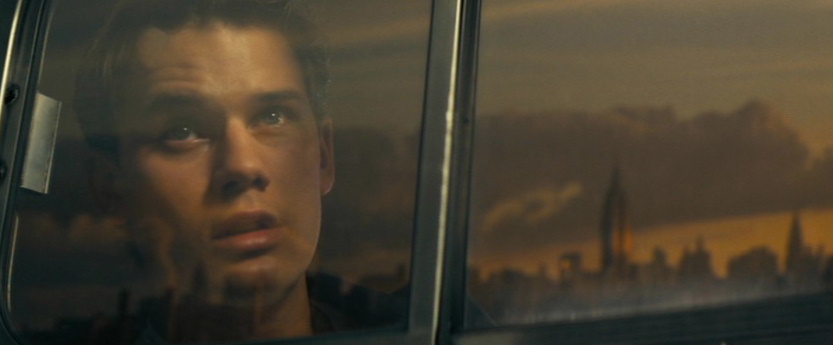
Danny gets his first view of Manhattan
STONEWALL (2015). Director: Roland Emmerich.

After he is discovered having sex with another man, Danny Winters (Jeremy Irvine) leaves his small town and his coach-father's rejection and comes to Manhattan. There he meets an excitable drag queen named Ray (Jonny Beauchamp), who befriends him and falls for him unrequitedly. Ray is part of a group of gay hustlers, street people and "queens" who congregate on and around the Stonewall bar in Sheridan Square, a mafia-run dive that caters to different elements of the gay community. Danny, who is masculine and very handsome, has no sexual feelings for the effeminate Ray, but winds up in a brief relationship with Trevor (Jonathan Rhys Meyers), who works for the early gay rights group, the Mattachine Society. After a series of misadventures, Danny winds up in the Stonewall during a police raid, but this time the angry patrons fight back and a riot ensues ... One would hope that a movie based on this seminal event in Gay Liberation would be better than this, but Stonewall seems overrun with cliches and caricatures. Many people objected to the fictional character of Danny -- white, masculine and good-looking (as if there are no white, masculine, good-looking gay guys!) -- because he doesn't typify the more outre customer of the Stonewall, but considering the fact that a great many white gay guys traveled from their small towns to make their way to Greenwich Village (including the Stonewall), this seems unfair. (And there have certainly been plenty of movies about queens and transvestites so why not equal time?) A bigger problem is that this fictional character takes center stage, throwing the first brick and shouting "gay power!" Worse is that Danny's misadventures in New York with pathetic old johns and sometimes obnoxious drag queens with attitude -- Ray's hopeless crush on Danny, for instance, although, oddly, I almost found myself hoping this unlikely couple would make it -- have been done so often that you think you're seeing something made twenty years ago. (Sheesh, we've even got the bit about the gay guy coming home to discover the man he loved has gotten married!)  Films have been made in which gay characters wind up at the Stonewall riots, and that's what this should have been -- but it shouldn't have been called Stonewall. Jon Robin Baitz' screenplay tries to touch all bases, but with so much time given over to Danny's less interesting and over-familiar life story, there's not much room left for the event itself. If Ed Murphy (Ron Perlman) -- who was involved in the bar, was said to be a criminal, and later became a gay activist -- were alive today he would undoubtedly file a lawsuit. Of the actors Beauchamp does a pretty fine job with Ray, and the British Irvine is credible as Danny, although at times he over-acts when his character over-reacts. He's another English actor who sounds perfectly American (a gift that doesn't always work the other way around.) Meyers is good as Trevor and successfully disguises his Irish origins. Perlman is certainly vivid as Murphy, and there are other effective performances among the large supporting cast. While this is not a terribly good picture -- a shame, considering its honorable intentions -- there are some good scenes, such as when white leather guys come to the defense of a black drag queen that Murphy is about to beat (although Keller's, where the scene takes place, was not a leather bar, and this is more of a "feel-good" moment than a real one). This is not the first fictionalized movie about the Stonewall Rebellion.

Verdict: For a movie based on a real event and certain real characters, this seems rather unreal at times. But some viewers may well find it inspiring and powerful although it, unfortunately, seems to catalog a variety of stereotypes. **1/2.

JUDAS KISS

2 sides of the same coin: Richard Harmon; Charlie David
JUDAS KISS (2011). Director: J. P. Tepnapa.

"My Hollywood career has consisted of parties and rehab."

"I even masturbate cinematically!"

Failed screenwriter Zachary Wells (Charlie David) goes back to his old film school, the scene of his first and last triumph, to help judge a competition. He has a one-night stand with a student who turns out to be in this same competition. But a bigger surprise comes when this student reveals his name as Danny Reyes (Richard Harmon) and his film as "Judas Kiss." The trouble is that Danny Reyes is Zachary's real name, and "Judas Kiss" is the film he made that won the competition fifteen years earlier. This is already an intriguing situation but it turns into the Twilight Zone when it develops that Danny Reyes is Zachary's younger self, and he is told by an old man, who is still another version of Danny Reyes, that his life will turn out much better if he actually loses the competition. Naturally younger Danny objects to this idea ... This could have been a gay variation on a whimsical, fantasy film, but the tone is too heavy (without being profound) and the characters don't seem the slightest bit surprised or perplexed by this odd situation. Zach makes love to his younger self -- a bizarre situation in of itself -- but doesn't recognize him or even think he looks familiar. Judas Kiss isn't the first film in which characters are given second chances by going back in time (although it's never made quite clear that this has happened, even when Zach tells a teacher that she "doesn't look a day older"), but its main problem, perhaps, is that it tries to tackle a little too much in one movie. In spite of its overly complicated plot and surplus of characters, the film is well-produced for an independent and is often strangely arresting, although it drags in the final quarter. Many of the actors could be described as talented amateurs, but the leads in this have had a significant body of work, especially Harmon, who has definite presence and is effectively intense, and David (who looks even better without his beard), although he doesn't quite bother to get across his character's desperation, although that may be due to the generally superficial tone of the movie (despite some serious elements). Former (?) porn star Sean Paul Lockhart* certainly makes an impression as a young man, Chris, who wants a relationship with Danny; there's no reason he can't have a solid legitimate acting career. Julia Morizawa, among others, is also notable as Abbey. The entire cast sings the catchy closing credit number, "If I Fall." Some of the male actors overdo the "girlishness" at times.

* Lockhart (also known as Brent Corrigan for his adult films) is the subject of a 2016 James Franco movie entitled King Cobra, which the former disavows.

Verdict: Well, at least it's certainly different .,. **1/2.

TAB HUNTER CONFIDENTIAL

TAB HUNTER CONFIDENTIAL. Tab Hunter and Eddie Muller. Algonquin Books.
TAB HUNTER CONFIDENTIAL (2015). Director: Jeffrey Schwarz.

As this documentary is based on a book, I'll start with a review of Hunter's autobiography:

Once a movie star, always a movie star – and is there anything on earth more self-absorbed than a movie star? Tab Hunter tells how a great-looking guy with absolutely no acting experience managed to become fading star Linda Darnell's leading man in one of her last pictures, and then moved onward and upward to become a movie star in his own right, appearing in such films as Damn Yankees and The Pleasure of His Company. He doesn't gloss over how he quickly descended to the depths as a Hollywood has-been, then made a comeback of sorts by co-starring with Divine in two funny movies. Hunter's story is reasonably absorbing and somewhat enlightening about Hollywood, but what it mostly does is remind us of the shallowness of movie stars – all movie stars. Not being normal people, they just don't get it. For instance, on one page Hunter (or rather his co-author) writes how disappointed he was that his then-agent Henry Willson wasn't behind him more when he tested for an important role. He complains that Willson didn't care if he got the role as long as it was one of his many clients. So much for loyalty Hunter complains, or words to that effect. What did Hunter expect Willson to do – focus only on him and to hell with all of his other clients!!! It just doesn't occur to Hunter how hypocritical he sounds. Considering that he's out of the closet – a decision that may have had more to do with the fact that his sexual orientation was pretty much an open secret as opposed to true self-acceptance on his part -- Hunter refers to certain people he dislikes as “fags” a lot more often than he should. But then, Hunter comes across as moderately likable but not especially bright. This is by no means an essential read but many people will find it absorbing.

Now on to the film version:

Tab Hunter Confidential was produced by Hunter's long-time companion, so this can hardly be taken as an unbiased examination of the subject and his career. First it seems obvious that Hunter -- who left the Catholic Church years ago due to its attitudes, which made him feel like an outcast, and who has rejoined the virulently homophobic institution in his elder years (there are organized religions that welcome gays, for Pete's sake) -- is not exactly a poster boy for Gay Liberation. One senses that Hunter became openly gay for career reasons more than out of a true acceptance of his sexuality, which still seems to embarrass him. Nevertheless he makes an appealing subject for a biography -- Hollywood heartthrob is secretly gay -- and while he talks briefly about considering marriage to a woman, he doesn't cop out and claim to be bisexual. As in his memoir, Hunter comes off as relatively likable if not exactly an intellectual. The documentary consists primarily of a long, frank interview with Hunter interspersed with comments from everyone from John Waters to Clint Eastwood, Darryl Hickman and Mother Delores Hart, a former co-star of Elvis Presley's who became a nun. Hunter talks about his affair with Tony Perkins, as well as relationships with a prominent figure skater and others, but completely glosses over how and why these relationships came to an end (but one can guess: career reasons). Hunter finally settled down with a young producer, Allan Glaser, who was thirty years younger than Hunter, making him definitely come off like a typical movie star, gay or not. The documentary also offers clips of Hunter's recording career -- he had a nice enough voice but tended to go flat a little too often -- and film highlights, such as a genuinely strong performance in Gunman's Walk as a psychopath. Hunter was better in his second film, Island of Desire, than he gives himself credit for, and his performance of "Reproduction" was a highlight of Grease 2. Hunter also talks about his arrest at a gay party and the report of it in Confidential magazine. NOTE: Director Jeffrey Schwarz also directed the superb documentary Vito, on author and gay activist Vito Russo.

Verdict: Book ***. Film: ***.

CAROL

Lovers: Cate Blanchett and Rooney Mara
CAROL (2015). Director: Todd Haynes.

"What use am I to her, to us, if I'm going against my own grain?"

In the 1950s Carol Aird (Cate Blanchett) is in the process of divorcing her husband, Harge (Kyle Chandler), when she spots Therese Belivet (Rooney Mara) behind the counter of a department store -- and vice versa. Despite differences in age and class, the two embark upon a friendship and then into a full-fledged sexual and romantic affair. Trouble arrives when Harge decides to sue for sole custody of their adorable daughter, Rindy (Sadie Helm), on charges of aberrant morality. In desperation Carol sends Therese out of her life, but will they ever be able to renew their relationship? Carol is based on "The Price of Salt" by Patricia Highsmith (better known for her thrillers such as Strangers on a Train), perhaps the only lesbian novel that has a positive ending for the two ladies. The climax milks the suspense as we wonder if Rooney can get over the hurt and abandonment she felt and embrace a new life with Carol. The acting in this is good, although Blanchett at first seems too affected and even predatory, but Mara is perfect at delineating her character's hesitation, desire, and acceptance of her sexuality. Kyle Chandler scores as the discarded husband, as does Sarah Paulson as Carol's friend and ex-lover, Abby. and there are notable turns from Trent Rowland as Therese's boyfriend, Jack, Cory Michael Smith as a deceptively nerdy private eye, and John Magaro and Jake Lacey as Therese's friends and co-workers. Carol is handsomely produced, and has a sensitive, if occasionally overly sombre, musical score by Carter Burwell [Mildred Pierce], as well as superior production design (Judy Becker) and photography (Edward Lachman). [The screenplay is  by Phyllis Nagy who sports an almost comically out-dated butch haircut as if she were living in the fifties.] Rooney played a rather negative lesbian/bi character in Side Effects.

Verdict: While this has been riotously over-praised in some quarters, it is a well-acted and worthwhile movie that scrupulously avoids dumb stereotyping. ***.

Thursday, June 16, 2016

THERE'S NO BUSINESS LIKE SHOW BUSINESS

The technicolor finale of There's No Business ...
THERE'S NO BUSINESS LIKE SHOW BUSINESS (1954). Director: Walter Lang.

Molly Donahue (Ethel Merman) and her husband Terence (Dan Dailey) are long-time vaudevillians who have three children who join their act: girl-happy Tim (Donald O'Connor); pretty Katy (Mitzi Gaynor); and jazz baby Steve (Johnnie Ray), who actually prefers to enter the priesthood. Tim falls hard for a sexy lady named Vicky (Marilyn Monroe), but a misadventure with her sends him running off from a role in a Broadway show on the eve of WW 2. Is this the end of the Five Donahues? Aside from the title tune (which actually comes from Annie Get Your Gun), you'd be surprised that the music is by Irving Berlin, as the new numbers are pretty terrible and the older ones are ruined by inappropriately jazzy arrangements. As Steve, Johnnie Ray over-sings everything and makes faces, and his rendition of "Alexander's Ragtime Band," which he butchers, has to be seen to be believed. Ray also delivers the pious "If You Believe" (while mimicking Elvis' movements!) while the Adorable One -- La Monroe -- sexes up "Tropical Heatwave" in her inimitable style, although she's dubbed by Delores Gray and the number is otherwise not especially memorable. Although Monroe isn't quite up to her more "serious" scenes, she's positively luminescent in this and delivers her comedy sequences with her usual panache. As for the rest of the cast, Merman is terrific, with fine support from Dailey, Gaynor [The Joker is Wild] and O'Connor; Ray is fairly pleasing when he isn't singing. Hugh O'Brian [Rocketship X-M] shows up briefly as a theater man who falls for Katy; Robin Raymond [The Glass Wall] is the crude Lillian, who dates Tim; and Chick Chandler and Lee Patrick hardly get any lines as a couple of old vaudevillians at the Donahues party. The ending is nicely sentimental, and the last production number is a positive riot of brilliant technicolor.

Verdict: It would be all too easy to quibble about this picture's general mindlessness and often hokey numbers, but it all plays in spite of it. ***.