Lively, entertaining reviews of, and essays on, old and newer films and everything relating to them, written by professional author William Schoell.
Showing posts with label historical. Show all posts

Thursday, June 4, 2026

DOCTOR ZHIVAGO

DOCTOR ZHIVAGO
(1965). Director: David Lean.

"What happens to a girl like that when a man like you has finished with her?"

It is the 61st anniversary of the release of this epic film by David Lean, based on the novel by Boris Pasternak.
At the beginning we learn that the two main protagonists, Yuri Zhivago (Omar Sharif), a doctor and poet, and Lara (Julie Christie), whose boyfriend is a revolutionary, have had a child. As the film progresses the two are married to other people, so you wonder for quite a while how the couple are ultimately going to get together. Their love story is set upon the background of WW 1 and the Russian revolution and all the chaos that ensued during and afterward.

As an epic, the film is quite effective with some memorable scenes: the dragoons charging on horseback and attacking the marching band of revolutionaries; an officer lecturing to tired, disgusted soldiers who falls into a barrel of water and then is shot dead in an instant; most of all the long, detailed journey that Yuri takes with his family to the country by railroad, dozens crowded into each car that buckle and sway as if any moment they'll fall to pieces.

Omar Sharif and Julie Christie
As a romantic drama, be forewarned that David Lean is no William Wyler, but perhaps the main problem is Maurice Jarre's muscial score. Jarre layers the soundtrack with attractive music (although Lara's theme wears out its welcome pretty quickly) but it doesn't embellish and compliment the emotions of the characters or what's going on on-screen like a score by, say, Max Steiner. Hence, despite all the grim and indeed heart-breaking stuff going on, you may never be especially moved by the proceedings.

The movie is over 3 hours long -- the DVD released on the 45th anniversary has the complete film, which is shown in letterbox format, thank goodness -- but it is never boring because Lean, whatever his deficiencies, keeps things moving, and the plot and characters are always interesting. Of course, like other long films, undoubtedly a lot of important stuff got left on the cutting room floor -- for instance, the scene wherein Yuri's wife and mistress finally meet is only referred to in dialogue [!] -- so the film at times seems a trifle disjointed. It helps to know Russian history to understand fully what's happening, and you may find yourself checking the novel out of the library to fill in some missing details.

Sharif in a contemplative moment
Omar Sharif may never have been considered a great actor, but he's effective enough in the title role, and has a particularly good scene when he looks in the mirror after a harrowing journey and realizes to his horror how much he's aged. Julie Christie is also good -- although neither performer compares to the greats of the golden age. The best acting comes from Ralph Richardson as Alexander, Yuri's father surrogate (and father-in-law); Rod Steiger as the ferocious Victor Komarovsky; and Tom Courtenay as Lara's husband. There is also fine work from Geraldine Chaplin as Yuri's wife; Rita Tushingham as his probable daughter; Alex Guinness as his half-brother; and Klaus Kinski as a mad man on the train. Omar Sharif's young son Tarek plays Yuri as a boy and does it well-- what a great face! Petya, Alexander's servant, is played by Jack MacGowran, who appeared in everything from The Giant Behemoth to The Exorcist. All in all, whatever its flaws, Doctor Zhivago is a very interesting picture. The hard work that went into the film is obvious.

Verdict: Worthwhile historical drama with frustrated romance at its heart. ***

Thursday, April 9, 2026

THE VIRGIN QUEEN

THE VIRGIN QUEEN (1955). Director: Henry Koster.

Ambitious Walter Raleigh (Richard Todd) makes his clever way to the court of Queen Elizabeth (Bette Davis) and becomes one of her favorites. All the while he's hoping she'll give him some ships to sail -- seeking treasure from the New World-- and dallying with a pretty lady-in-waiting and ward of the queen, Beth Throgmorton (Joan Collins). Although he is not billed above the title with the others, Herbert Marshall, who co-starred with Davis in The Letter, plays Lord Leicester. This is an interesting and entertaining movie, but the central performance is a bit problematic. Davis has her moments, certainly, but sometimes you get the impression that the queen is not being played by Bette Davis, but by Baby Jane Hudson! A definite problem is that Davis, despite the quasi-British accent she always affected, is not English, and she seems to be giving an impression of a queen rather than simply becoming the part. In a word, she's almost awful at times, but not enough to sink the picture. Todd, Marshall, Collins (who actually out-acts Davis) and the other cast members are all terrific.

Verdict: Hardly Bette's finest hour, but not without interest. ***.

Thursday, June 23, 2016

STONEWALL (2015)

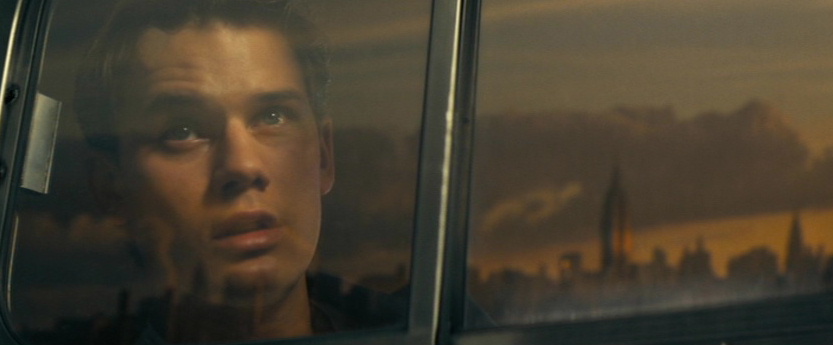
Danny gets his first view of Manhattan
STONEWALL (2015). Director: Roland Emmerich.

After he is discovered having sex with another man, Danny Winters (Jeremy Irvine) leaves his small town and his coach-father's rejection and comes to Manhattan. There he meets an excitable drag queen named Ray (Jonny Beauchamp), who befriends him and falls for him unrequitedly. Ray is part of a group of gay hustlers, street people and "queens" who congregate on and around the Stonewall bar in Sheridan Square, a mafia-run dive that caters to different elements of the gay community. Danny, who is masculine and very handsome, has no sexual feelings for the effeminate Ray, but winds up in a brief relationship with Trevor (Jonathan Rhys Meyers), who works for the early gay rights group, the Mattachine Society. After a series of misadventures, Danny winds up in the Stonewall during a police raid, but this time the angry patrons fight back and a riot ensues ... One would hope that a movie based on this seminal event in Gay Liberation would be better than this, but Stonewall seems overrun with cliches and caricatures. Many people objected to the fictional character of Danny -- white, masculine and good-looking (as if there are no white, masculine, good-looking gay guys!) -- because he doesn't typify the more outre customer of the Stonewall, but considering the fact that a great many white gay guys traveled from their small towns to make their way to Greenwich Village (including the Stonewall), this seems unfair. (And there have certainly been plenty of movies about queens and transvestites so why not equal time?) A bigger problem is that this fictional character takes center stage, throwing the first brick and shouting "gay power!" Worse is that Danny's misadventures in New York with pathetic old johns and sometimes obnoxious drag queens with attitude -- Ray's hopeless crush on Danny, for instance, although, oddly, I almost found myself hoping this unlikely couple would make it -- have been done so often that you think you're seeing something made twenty years ago. (Sheesh, we've even got the bit about the gay guy coming home to discover the man he loved has gotten married!)  Films have been made in which gay characters wind up at the Stonewall riots, and that's what this should have been -- but it shouldn't have been called Stonewall. Jon Robin Baitz' screenplay tries to touch all bases, but with so much time given over to Danny's less interesting and over-familiar life story, there's not much room left for the event itself. If Ed Murphy (Ron Perlman) -- who was involved in the bar, was said to be a criminal, and later became a gay activist -- were alive today he would undoubtedly file a lawsuit. Of the actors Beauchamp does a pretty fine job with Ray, and the British Irvine is credible as Danny, although at times he over-acts when his character over-reacts. He's another English actor who sounds perfectly American (a gift that doesn't always work the other way around.) Meyers is good as Trevor and successfully disguises his Irish origins. Perlman is certainly vivid as Murphy, and there are other effective performances among the large supporting cast. While this is not a terribly good picture -- a shame, considering its honorable intentions -- there are some good scenes, such as when white leather guys come to the defense of a black drag queen that Murphy is about to beat (although Keller's, where the scene takes place, was not a leather bar, and this is more of a "feel-good" moment than a real one). This is not the first fictionalized movie about the Stonewall Rebellion.

Verdict: For a movie based on a real event and certain real characters, this seems rather unreal at times. But some viewers may well find it inspiring and powerful although it, unfortunately, seems to catalog a variety of stereotypes. **1/2.

Thursday, June 20, 2013

SISSI: THE FATEFUL YEARS OF AN EMPRESS

Franz (Boehm) and Sissi (Schneider) at La scala 
SISSI: THE FATEFUL YEARS OF AN EMPRESS (aka Sissi - Schicksalsjahre einer Kaiserin/1957). Director: Ernest Marischka. 

The third and final installment in the Sissi trilogy continues the story of the beautiful young Austrian empress (Romy Schneider) and her husband, the Emperor Franz Josef (Karl Boehm). Sissi develops a serious lung infection  which has her doctor predicting that she will die unless she goes to a warmer climate, and that even then the outcome is not certain. The film turns into a type of travelogue as Sissi travels to other lands such as Portugal and Greece with her mother (Magda Schneider) and Major Bockl (Joseph Meinrad), whose romantic adventures with different women are briefly explored. The travelogue continues as the empress accompanies the emperor on a goodwill tour to Naples and Venice, where the Italian citizenry, still smarting over past unpleasantries and Austria's occupation, do their best to snub and ignore them. An interesting scene has everyone at the La scala opera house singing one of Verdi's patriotic choruses from Nabucco as the royal Austrians take their seat in their box. There are some attempts at drama when Sissi tries to make friends with one Hungarian, Count Batthyani (Peter Neusser)  who is not thrilled with Austria, and is told by handsome Hungarian Count Andrassy (Walter Meyer), whom she charmed in the last picture, that he is in love with her. Anton Profes' musical score is richly romantic and memorable, as is Bruno Mondi's photography, especially his exquisite shots of Venice. The opening credits feature a flock of birds actually spelling out the name "Sissi" before taking to flight -- marvelous. The leads and supporting players are fine and Vilma Degischer continues her wonderful portrait of the stern, if loving, mother-in-law Sophie. 

Verdict: Entertaining and nice to look at if you take it with a grain of salt. ***.  

Thursday, May 30, 2013

SISSI: THE YOUNG EMPRESS

A ball at the palace
SISSI: THE YOUNG EMPRESS (aka Sissi - Die junge Kaiserin/1956). Director: Ernst Marischka. 

This is the second film in the trilogy that began with Sissi. Sissi (Romy Schneider) and Franz Josef (Karl Boehm) are married and living in the beautiful Schonbrunn palace. As Empress of Austria, Sissi is instrumental in creating new understanding between the Austrians and Hungarians when she importunes Franz to offer amnesty to former enemies. Naturally, her termagant mother-in-law, Sophie (Vilma Degischer), a conservative with old, rigid ways, disagrees with Sissi, then goes too far when she decides to simply take over the raising of Sissi's baby daughter without even talking it over with the mother. This causes a brief separation between the emperor and his wife. This is an entertaining movie, even if it gets to be a little cloying at times, and there seem to be more kids [in the scenes when Sissi goes home to her family] than in The Sound of Music, adorable as they may be. Although this has the same cinematographer as Sissi, Bruno Mondi, the film and its glamorous, magnificent settings are photographed and displayed with much more care than in the first film, making this a treat to look at. Anton Profes has contributed a beautiful opening theme as well. The silly bodyguard, Major Bockl (Joseph Meinrad) is back and now in love with Sissi. Schneider, Boehm, Degischer and the other actors all give fine performances. 

Verdict: Not exactly heavy drama, but lovely in many ways, and well-acted. ***. 

Thursday, May 16, 2013

SISSI

Karl[heinz] Boehm and Romy Schneider
SISSI (1955). Director: Ernst Marischka.

The Austrian Archduchess Sophie (Vilma Degischer) has decided that her son, Emperor Franz Josef (Karlheinz Boehm) should take a wife, and she has decided upon her Bavarian niece Helene, known as "Nene" (Uta Franz). Unfortunately, while Nene is in town with her mother (Magda Schneider) and sister Elizabeth, nicknamed "Sissi" (Romy Schneider), Sissi accidentally encounters Franz, who doesn't know who she is (not having seen the sisters since childhood) and is almost instantly smitten and vice versa. This causes a serious complication, as the last thing Sissi wants to do is hurt and humiliate her sister, who already thinks of herself as engaged to Franz. That's about all the real drama you get in this nonetheless entertaining and very well-acted Austrian film that makes full use of beautiful Austrian palaces and settings. (Unfortunately, these settings are not photographed with any particular elan; in fact recreations in a Hollywood film might have been more impressive because of it). A bone-headed alleged bodyguard who mistakes Sissi for an assassin is thrown in for some unfunny comedy relief. The Archduchess describes Sissi as "16, impudent, and ill-mannered," but she doesn't come off that way until after the old lady gets sharp with her. Schneider was 17 when she made this film and is lovely. Her real-life mother plays her mother in the film. Boehm was later known simply as Karl Boehm, wherein he appeared in such films as Wonderful World of the Brothers Grimm. His most famous movie is probably Peeping Tom, wherein he was billed as "Carl" Boehm. This is the first part of a trilogy about the beautiful young empress which was later dubbed in English, spliced together, and released in the US (especially television) as Forever, My Love. The basic facts about Karl Franz preferring Sissi to Helene are true although much of the rest is fanciful fabrication.

Verdict: Nothing spectacular, easy to take, but lacks that certain Hollywood panache. ***.

Thursday, February 21, 2013

VOYAGE OF THE DAMNED

VOYAGE OF THE DAMNED (1976). Director: Stuart Rosenberg.

In 1939 Nazi Germany allowed about one thousand Jews to depart the country on a ship bound for Cuba, the SS St. Louis. This alleged "humanitarian" gesture was strictly a propaganda act, a smokescreen, as one character puts it, as it was never intended for the passengers to disembark in Cuba or anywhere else. Turned away by several nations, including, shamefully, the U.S., some of the passengers wold prefer death or mutiny to returning to Hamburg and certain execution in concentration camps. You would imagine that a movie on this subject would be very powerful -- and you can't help but be moved by the passengers' plight and the horrendous persecution and emotional devastation they were undergoing -- but Voyage of the Damned, unfortunately, plays like a lesser Movie of the Week with an almost-all-star, international, Movie of the Week-type cast [with some exceptions], "acting" up a storm at times but nonetheless seeming once-removed throughout it all -- in other words, the acting and direction are fairly perfunctory. Sequences that should have had great impact are pretty much frittered away by Rosenberg, and the movie is about 45 minutes too long, slack and lacking in needed tension. I mean, when you consider the situation these people were in! Some of the lesser known actors, such as Victor Spinetti as Dr. Strauss, who works in Cuba and desperately wants to get his small children off the ship, are more effective than the bigger names, although James Mason and Nehemiah Persoff are solid as usual. Sadly, Voyage of the Damned is blah when it should have been a masterpiece.The very large cast includes everyone from Lee Grant, Faye Dunaway and Ben Gazzara to Max von Sydow [as the captain], Wendy Hiller, Malcolm McDowell and even Orson Welles. Although they all have their moments, these could not be considered one of the better performances of any of them.

Verdict: Watch Judgment at Nuremberg instead. **1/2.

Thursday, November 15, 2012

MARK OF THE DEVIL

MARK OF THE DEVIL (aka Hexen bis aufs Blut gequäl/
1970). Director: Michael Armstrong.

"The most attractive things in the movie were my close-ups." -- actor Udo Kier.

Promoted as "the most horrifying movie ever made" -- patrons were given a "stomach distress" (vomit) bag along with their ticket -- Mark of the Devil certainly has its disgusting moments, but the fact is that once you get past the unpleasantness it's not a bad movie. Lord Cumberland (Herbert Lom), a famous witch hunter, arrives at a village with his young assistant, Christian (Udo Kier), and upsets the local witch hunter Albino (Reggie Nalder), who brands women who rebuff his slimy advances as witches. The latest victim is the busty tavern wench Vanessa (Olivera Vuco), who has caught the eye of Christian and vice versa. Cumberland proves little better than Albino, as he threatens a baron (Michael Maien) with torture unless he turns over his inheritance to the "Church," has thumbscrews and the rack applied to a young woman who insists she was raped by a bishop (in the movie's most notorious scene, this poor gal's tongue is extracted), and rapes the beautiful wife (Ingeborg Schoner) of a puppeteer. (The puppeteer is played by Adrian Hoven, who took over the direction of the film from Armstrong according to Kier.) Another hard-to-take scene has the bare-assed baron sat forcibly down on a bed of needles. Sadly, the torture sequences are probably accurate, and the movie makes it clear that there were often political, financial or sexual motives behind the witch hunters' accusations. The villains in this are utterly loathsome, and the ironic ending has the elements, oddly enough, of operatic or Greek tragedy. While the story holds the attention,  the actors are all good, and the pace is fast, Mark of the Devil hasn't got much style. It's too bad the film makers were more determined to make a horror film than a drama with horrifying sequences. Armstrong only directed one more movie 16 years later. This was a West German production, not very well dubbed, but at least we hear Herbert Lom's actual voice.

Verdict: Intense, gruesome, and absorbing. ***.

Thursday, August 23, 2012

DAMON AND PYTHIAS


DAMON AND PYTHIAS (aka Il tiranno di Siracusa/1962). Director: Curtis Bernhardt.

Pythias (Don Burnett) leaves his angry pregnant wife in Athens and travels to Syracuse on a political mission. There he encounters the thief Damon (Guy Williams of Captain Sindbad), but after some unpleasant moments the two become allies against the tyrannical King Dionysius (Arnoldo Foa), leading to Pythias being condemned to death. Impressed with Pythias' noble nature, Damon makes an amazing offer and sacrifice. This is an entertaining if unspectacular and pretty faithful rendition of the legendary platonic friendship with good performances from the two leads. Ilaria Occhini is zesty as Pythias' fiery and passionate wife, and Liana Orfei is fine as Damon's girlfriend. It's a surprise that veteran director Bernhardt (Possessed; My Reputation) helmed this foreign entry; this was his next to last film. Burnett is an appealing, attractive actor but he only made a few movies. NOTE: Available from Warner Archives Collection in a new remastered and widescreen edition.

Verdict: The ending almost brings a lump to your throat. ***. 

RASPUTIN, THE MAD MONK

RASPUTIN, THE MAD MONK (1966). Director: Don Sharp.

"This is only a house -- and she has all of Russia!"

Rasputin (Christopher Lee) -- whom everyone calls RasPOOtin -- may be a monk but he refuses to live like one, being given to love of drink and women -- and power. With his almost mesmeric command over women, he gets a a smitten Sonia (Barbara Shelley), lady-in-waiting to the Tsarina (Renee Asherson), to arrange for him to curry the latter's favor by ministering to her injured little boy. The Tsarina rewards him with a house, and entry into her charmed royal circle. But some of Rasputin's actions alarm Boris (Richard Pasco) even after Rasputin has arranged for him to take over as the royal family's doctor. Others are jealous of Rasputin's influence, and Sonia's brother (Dinsdale Landen) is furious at the monk's treatment of his sister. This all culminates in a lively final battle where Rasputin proves quite difficult to kill. While it's debatable how historically accurate this is, it's entertaining and fast-paced, with Lee giving a vivid performance, albeit one with a few hammy moments. The other cast members are good; few of them attempt a Russian accent. This has a few lurid Hammer studio touches: a hand lopped off; acid thrown in a man's face, but is not really a horror film.

Verdict: Rasputin through the Hammer lens. ***.

Thursday, August 2, 2012

THE GREAT MAN'S LADY

THE GREAT MAN'S LADY (1942). Director: William A. Wellman.

On the day of the dedication of a statue of the late and great man and pioneer-turned-millionaire Ethan Hoyt (Joel McCrea), reporters try to get a story about him from a woman, Hannah Sempler (Barbara Stanwyck), who claims she was once married to him, even though there's no proof of a union and it might even make Hoyt a bigamist. The movie is a flashback to 1848 that explains this contradiction, and shows how Hannah did indeed marry Ethan, and why he remarried even though they were never divorced, and it's a sad and fascinating story.  Brian Donlevy is a third character, Steely Edwards, who falls unrequitedly in love with Hannah and has much to do with her life and marriage. There are interesting twists and turns to the plot, and the movie is bolstered by another excellent performance from the indomitable Stanwyck; McCrea and Donlevy are also very good. As the film proceeds we can see how much of his success Hoyt owes to the smarter Hannah. Stanwyck's old age make up as she plays a centenarian at the beginning and end is very well done.

Verdict: Flavorful film with fine performances and an unusual storyline. ***.

Thursday, April 12, 2012

THE SIGN OF THE CROSS

Claudette Colbert
THE SIGN OF THE CROSS (1932). Director: Cecil B. DeMille.

"I'm the emperor's most urgent business."

In 64 A.D. Marcus, (Fredric March), the prefect of Rome, falls in love virtually at first sight with Mercia (Elissa Landi). The problem is that Mercia is a Christian,as is her entire household, and Marcus causes all of Rome to gossip and watch in dismay as he defends her, although he doesn't share her beliefs. Another problem is that Emperor Nero's wife, Poppea (Claudette Colbert), has a thing for Marcus and is perfectly willing to commit adultery with him, which he refuses to do; she is not thrilled by his interest in Mercia. In the meantime hunky Tigellinus (Ian Keith), who should certainly pique the empress's interest but apparently doesn't, is already plotting against Marcus before the latter gives him plenty of ammunition due to his passionate interest in Mercia. If you can get past the pious nature of some of the scenes -- and some of the Christians do seem nuts -- this can and should be taken as a study of cruel oppression. The scenes of Christians being herded into an arena only to be mauled and eaten by lions are still quite raw and disturbing (if not as graphic as they would be today) and one can't help but think of the later Holocaust and its atrocities. [Ironically, Hollywood parties were probably more like Roman orgies than Christian prayer meetings.] Charles Laughton is excellent, as usual, in his brief appearances as Nero. Charles Middleton has a small role as the panicking Christian Tyros, who feels that God has forgotten his people. Tommy Conlon is excellent as the boy Stephen, who is tortured until he gives away the Christians' location. Colbert is as good as she was in Cleopatra, but March, frankly, never quite seems to get a handle on his character, perhaps because as written Marcus is a little unreal. There's a supposedly "lesbian" dance in which a woman seductively drapes herself around Mercia to music. The coliseum scenes are intense and harrowing and even if you're neither Christian or even religious it's hard not to be affected by the awful deaths of so many innocent people. [Ironically, many Christians today are similarly intolerant towards others.]

Verdict: DeMille has his cake and eats it, too! ***1/2.

Thursday, March 29, 2012

CLEOPATRA

Wilcoxon and Colbert
CLEOPATRA (1934). Director: Cecil B. DeMille.

"I am dying, Egypt, dying."

In 48 B.C. Egyptian princess Cleopatra (Claudette Colbert) first falls in love with Julius Caesar (Warren William) and then feels even more passion for the magnetic Marc Antony (Henry Wilcoxon). In the meantime, there is a lot of  jockeying for power and all sorts of heinous betrayal from many quarters. This is an opulent, totally absorbing bit of "Hollywood" history that is remarkably entertaining from start to finish. Colbert gives one of her finest performances, matched by florid William and studly Wilcoxon as her paramours. Other stand-outs in a fine supporting cast include Ian Keith as Octavian and Joseph Schildkraut as King Herod. This film also has the bit with Cleo wrapped up in a rug that was featured in the inferior remake with Elizabeth Taylor. One of the film's highlights is the detailed, briskly-edited montage of the war between Rome and Egypt, with a smitten Antony desperately fighting against his own countrymen out of love for Cleo. Fascinating, handsomely produced, and well-directed -- and ultimately moving.

Verdict: DeMille and Colbert at the height of their power. ****.

Friday, March 23, 2012

THE LAST OF MRS. LINCOLN

Robby Benson, Julie Harris, Michael Cristofer
THE LAST OF MRS. LINCOLN (1976). Producer/director: George Schaefer. Based on the play by James Prideaux. Broadway Theater Archive DVD.

"We may have been the first family, but we were far from rich."

"After your father was taken from us, people said it would get easier. But it doesn't. It gets harder."

"It is not the years that age us, but loneliness."

Recreating the Broadway show, The Last of Mrs. Lincoln was presented as a telefilm on PBS in 1976. It is wonderful that there will always be a permanent record of Julie Harris' superb performance as Mary Todd Lincoln in the days after the assassination of her husband. Then she has to deal with the death [after already losing two other children and a husband] of her 18-year-old son, Tad (Robby Benson), and what she wrongly sees as the betrayal of her oldest son Robert (Michael Cristofer) when he is forced to have her institutionalized when she has a nervous breakdown. She comes to the home of her sister (Priscilla Morrill), who after all these years still doesn't think Abraham Lincoln was worthy of her. [A great scene in a play full of many has Mary telling off an old biddy (Kate Wilkinson) who has supposedly come calling out of friendship but really just wants to crow.] Mary bonds with a young nephew (Patrick Duffy) who has more respect for her and her memories than almost everyone else around her. Benson and Cristofer are excellent in a stellar cast without a bad performance. The play takes incidents in history and makes them come alive, fleshing out these people in a way no history book could. Although it's excellent at delineating a certain time and place [from 1865 Chicago to Springfield many years later], it also reveals some universal truths. Cristofer later wrote the play The Shadow Box (which was also made into a telefilm) and now appears on the TV show Smash.

Verdict: A masterpiece. ****.


Thursday, August 25, 2011

THE KING'S SPEECH

THE KING'S SPEECH (2010). Director: Tom Hooper.

"Bertie," the Duke of York (Colin Firth), who eventually becomes King George the 6th of England, has a stammering problem that is especially noticeable whenever the poor man has to give a speech. In desperation his wife (Helena Bonham Carter) takes him to an Australian speech therapist named Lionel Logue (Geoffrey Rush), who has unusual methods of dealing with the problem. As strong-willed in his own way as the King, he and Bertie seem to become both friends and adversaries as the years progress. This is a superb film, completely absorbing from start to finish, that gives us an insider's view into a neglected aspect of history and does so brilliantly. Firth and Rush are magnificent, and there are also notable performances from Bonham Carter, Guy Pearce as Bertie's brother, Edward, who abdicates, Claire Bloom as Queen Mary, Derek Jacobi as the Archbishop, and others. In addition to the great acting, the film's direction, photography and editing are also all first-class. Deservedly won Best Movie Oscar for 2010.

Verdict: Yes, they can still make great movies. ****.

Thursday, May 13, 2010

DOCTOR ZHIVAGO 45TH ANNIVERSARY DVD


DOCTOR ZHIVAGO 45TH ANNIVERSARY DVD. (1965). Director: David Lean.

"The 1965 film captures the essence of Boris Pasternak’s Russian novel of remarkable passion and sweeping grandeur, presenting an intimate and deeply emotional story against the enormous backdrop of the Russian Bolshevik Revolution.

Omar Sharif stars in the title role of Doctor Zhivago, portraying the surgeon-poet over a half-century period. Zhivago, who is married to Tonya (Geraldine Chaplin), an aristocratic girl with whom he raises a family, is also in love with Lara (Julie Christie), a nurse whose life has been destroyed by tragedy. Repeatedly brought together and separated from each woman by war and revolution, Zhivago is torn apart by conflict. He loves Tonya deeply but his poetic soul belongs to Lara. Much like his beloved country, Zhivago’s spirit becomes battered by the devastation of war as he struggles to maintain his individualism in the face of overwhelming odds."

New Special Features:
Doctor Zhivago: A Celebration Part 1 & 2 (all-new production)

Additional Special Features:
Commentary by Omar Sharif, Rod Steiger and Lady Sandra Lean
(wife of David Lean) Part 1 & 2
Introduction by Omar Sharif
Doctor Zhivago: The Making of a Russian Epic
11 Vintage Featurettes
Zhivago: Behind the Camera with David Lean
David Lean's Film of Doctor Zhivago
Moscow in Madrid
Pasternak
New York Press Interviews Omar Sharif
New York Press Interviews Julie Christie
Geraldine Chaplin Screen Test
This is Omar Sharif
This is Julie Christie
This is Geraldine Chaplin
Chaplin in New York
Trailer
Blu-ray Exclusive: 8-Song CD Soundtrack Sampler of the Oscar®-winning score

Available on DVD: May 4, 2010

Official Site click here.
The DVD set contains two discs and the film is shown in wide screen.
For a review of the film click here.

Thursday, April 8, 2010

THE LION IN WINTER


THE LION IN WINTER (1968). Director: Anthony Harvey.

"To be a prisoner -- to be bricked in -- when you've known the world!"

Film version of the play by James Goldman, who also did the screenplay. At Christmas in 1183 A.D. King Henry II (Peter O'Toole) bemoans the fact that his three sons would prefer him dead and to rule in his stead, and lets his estranged wife, Eleanor of Aquitaine (Katharine Hepburn), out of imprisonment for the holidays. There follows a lot of plotting to force the King to choose one son over another as his successor. Although there are interesting moments in the movie, it basically reduces history to soap opera, with these famous characters acting in a very contemporary fashion and just being bitchy to one another. Some of the dialogue is quite bad. Hepburn won an Oscar, but she's miscast -- this stuff is just not her cup of java. Of the other cast members, Timothy Dalton comes off best as King Philip of France, who had an early dalliance with Henry's son Richard (Anthony Hopkins). One suspects that this consists more of moments of "dramatic license" than anything else.

Verdict: A supposedly historical Dynasty minus Joan Collins. **.

Wednesday, January 14, 2009

CAESAR AND CLEOPATRA


CAESAR AND CLEOPATRA (1945). Director: Gabriel Pascal.

Caesar (Claude Rains) and Cleopatra (Vivien Leigh) meet cute in Egypt in what seems like a black comedy based on the play by George Bernard Shaw, who also did the screenplay and therefore has to take most of the blame. Pseudo-Shakespearean, this minimally holds the attention but never quite becomes totally convincing. Rains is miscast as Caesar -- there's nothing wrong with showing a more vulnerable Caesar but it's hard to see this foppish fellow leading conquering Armies. The carpet scene where Caesar discovers Cleo in a rug was done better in the Elizabeth Taylor version. Leigh is excellent, and so are Flora Robson as her lady-in-waiting, Ernest Thesiger of Bride of Frankenstein fame as Theodotus, and the boy who plays Cleo's younger brother. Georges Auric's musical score has its moments, and the production values are generally excellent. But this is a poor excuse for drama. It has absolutely no climax!

Verdict: Lots of effort to little effect. **.

Wednesday, June 11, 2008

STORY OF WOMEN


STORY OF WOMEN (Une affaire des femmes/1988). Director: Claude Chabrol.

Marie (Isabelle Huppert) is a young housewife with two beautiful children living in occupied France during WW2. She helps a neighbor whose husband doesn't want another child by giving her an abortion, then does the same thing for a number of women. She also rents out one of her rooms to an engaging prostitute who befriends her. She has an affair with a cocky young man, thereby enraging her husband. You know from the beginning that she comes to a bad end. This is based on the true story of the last woman to go to the guillotine in France. The film is absorbing and well-acted, but the nominal heroine, although mostly guilty of poor judgment more than anything else, is not that likable or sympathetic. Francois Cluzet, Nils Tavernier, and Marie Trintignant are the co-stars. The children are marvelous. While not badly done, Story of Women somehow misses the mark.

Verdict: Intriguing but unsatisfying. **1/2.

Sunday, June 8, 2008

TOWER OF LONDON (1939)


TOWER OF LONDON (1939). Director: Rowland V. Lee.

The story of Richard III, the little princes in the tower, and all the skulduggery that went on in those long-ago days is good movie fodder, although both film versions (including the 1962 remake) take a great deal of dramatic license, especially the latter. The one thing both movies have in common is Vincent Price, who gives good performances in both versions. In this, the 1939 version, he is cast in a supporting, but pivotal, part as the Duke of Clarence, the half-brother of King Edward and Richard. In the 1962 remake he is no less than Richard III himself and the star. Although the first version has many macabre touches and was released by Universal, with Boris Karloff in a supporting role, it is not really a horror flick.

This first Tower of London, is entertaining, fast-paced, and well-produced. Basil Rathbone is as superb as ever as Richard III. Although not in the same league, Ian Hunter is fine as King Edward, whose philosophy is "marry your enemies and behead your friends." As the spoiled, petulant, whiny Duke of Clarence, Price offers a simpering and superior portrait. One of the best – and best-acted – scenes in the movie is when Price and Rathbone engage in a drinking contest with malmsy wine, a contest Price seems to win, although he winds up being killed by Rathbone and his body dumped in a wine vat. "He asked for Malmsy," Rathbone shrugs. An early scene detailing an execution (the beheading is off-screen, although we see reactions to it) is very well done. Although he has little dialogue, Karloff is excellent as the skulking, club-footed headsman, Mort, who measures the little princes for coffins as they sleep. The murder of the princes (young Edward is actually king at this point) is another good scene, both horrifying and heartbreaking. Young Edward’s brother, a mere child, cries out, "Kill me! Kill me! Let Edward live!" [This is one of the most notorious and loathsome crimes in the history of humanity.] As the boys die they squeal in much the same manner as one of them does very early in the film when he is just a squawling baby, a horrifying touch of pathos.

Verdict: A near-classic. ***1/2.