Lively, entertaining reviews of, and essays on, old and newer films and everything relating to them, written by professional author William Schoell.
Showing posts with label Tab Hunter. Show all posts

Thursday, April 9, 2026

OPERATION BIKINI

OPERATION BIKINI (1963). Director: Anthony Carras.

During the days of WW2 a submarine commanded by Captain Carey (Scott Brady) takes on a host of Marine underwater demolition experts, which in turn is led by Lt. Morgan Hayes (Tab Hunter). The sub is to take this gang to the Bikini atoll, where they are to destroy a submarine sunk by the Japanese. It seems this sub has special radar equipment on it that the allies don't want the Japs to get their hands on. Others on the demolition team include Joseph (Frankie Avalon), Floyd (Gary Crosby), Ed (Jim Backus), and William (Jody McCrea). Michael Dante plays Carey's second-in-command. On Bikini, Hayes and his band team up with certain friendly islanders, including Reiko (Eva Six), who has a brief dalliance with Hayes. 

Eva Six and Tab Hunter
American-International Pictures brought together some Beach Party players such as Avalon and McCrea, dropped in Tab Hunter, and "introduced" Hungarian actress Eva Six, who only made two more movies besides this one. Operation Bikini is pretty cheap and largely dull, although there are occasional spurts of action. Avalon, Hunter and the others turn in decent enough performances. Avalon even sings a song during a dream sequence, and proves not to be a bad singer at all. 

Tab Hunter
In the dream sequence Frankie is torn between his "girl back home," played by Nancy Dusina, and a sexy temptress, played by Judy Lewis. Lewis was the daughter of Loretta Young and Clark Gable. She had 28 credits, including Perry Mason, 77 Sunset Strip and The Secret Storm. The best thing about Operation Bikini is that unlike such films as Voyage to the Bottom of the Sea it features a realistic sub and gets across just what it's like to be in a cramped, uncomfortable submarine. 

Verdict: Ultimately, this is pretty much a waste of time. *1/2. 

Thursday, April 6, 2017

DAMN YANKEES

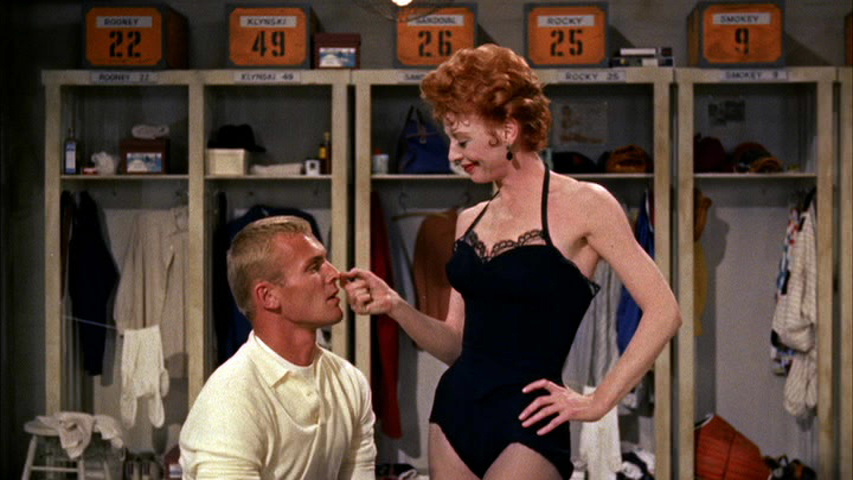
Whatever Lola Wants: Tab Hunter and Gwen Verdon
DAMN YANKEES (1958). Produced and directed by George Abbott and Stanley Donen.

"I was the ugliest woman in Providence, Rhode Island." -- Lola, remarking upon her origins

Joe Boyd (Robert Shafer) is a manic fan of the Washington Senators baseball team. The Devil -- in the form of a man named Applegate (Ray Walston) offers him a chance to become young and play for his favorite team against the "damned Yankees," even offering him an out. As "Joe Hardy" (Tab Hunter), Boyd becomes a star player with many fans, but he can't quite forget the wife, Meg (Shannon Bolin), he left behind. But will 172-year-old vamp Lola (Gwen Verdon) be able to keep Hardy in line? With its highly theatrical premise, this Broadway hit should not have worked as a movie but it does, mostly due to its performances and its recreation of some excellent production numbers. With the exception of Tab Hunter, most of the Broadway cast was transplanted to the big screen, a wise decision, especially in the case of Verdon. Although Verdon may not have been seen as a truly formidable sexpot, she is a highly talented performer with great dancing and acting skills and a really killer figure. Walston is as delightful as ever, and Hunter [Island of Desire] -- while not in the same class as the others -- does an okay job as the rather shy Hardy who wants to stay faithful to his wife. He briefly attempts some dancing as well and manages to pull it off. Rae Allen and Jean Stapleton [Dead Man's Folly], both of whom also appeared in the Broadway show, are snappy as, respectively, the inquiring reporter, Gloria Thorpe, and the likable neighbor, Sister Miller. Shafer and Bolin were primarily stage performers, and the former appeared in just this one picture. The score by Adler and Ross boasts some tunes that have become standards: "Whatever Lola Wants:" and the spirited "You Gotta Have Heart," but there's also Joe's nice farewell to his sleeping wife ("Goodbye Old Girl"); a snappy Mambo number; and the knock-out production number for Verdon and Hunter's "Two Lost Souls." Bob Fosse [Cabaret] did the choreography for both show and film; he and Verdon were married two years later. There's lots of dark humor and a poignant conclusion.

Verdict: One of the very best of the hit Broadway show film adaptations. ***1/2.

Thursday, September 22, 2016

THE SEA CHASE

THE SEA CHASE (1955). Producer/director: John Farrow.

How's this for perfect casting? In The Sea Chase John Wayne plays Karl Erlich, the Captain of a German freighter (the Ergenstrasse), who supports his country but is no fan of Hitler. Lana Turner is cast as Elsa Keller, a kind of Mata Hari German spy who winds up as the only female passenger among a bunch of horny sailors. While it can't be said that Wayne and Turner have great chemistry, the odd thing is that the movie actually works and both stars are more than adequate in their roles. Erlich sets sail from Sidney just as war is declared, and an old friend, the British officer, Jeff Napier (David Farrar of The Echo Murders) -- he was one of Elsa's many conquests -- doggedly pursues him. Complications ensue when Chief Officer Kirchner (Lyle Bettger) takes it upon himself to murder some innocent fishermen who are shipwrecked on a supply island, making Erlich and his crew not only murderers but wanted war criminals. Erlich also has a conflict with Schlieter (James Arness) who has a chip on his shoulder and hates taking orders from his captain. Not only is The Sea Chase suspenseful, but you get caught up in the unusual storyline and begin to care about what happens to the characters and their ultimate fate. Bettger [No Man of Her Own] is especially good as Kirchner, and there's also excellent work from Farrar and from John Qualen [Dark Waters] as Chief Engineer Schmidt. Richard Davalos, Tab Hunter, Paul Fix, Arness, and Claude Akins (whose name is misspelled as "Akin" in the credits) also have some fine moments. Clearly this picture would not have been made just a few years earlier. In WarnerColor.

Verdict: Memorable "forgotten" Wayne film with an intriguing and different plot. ***.

Thursday, June 23, 2016

TAB HUNTER CONFIDENTIAL

TAB HUNTER CONFIDENTIAL. Tab Hunter and Eddie Muller. Algonquin Books.
TAB HUNTER CONFIDENTIAL (2015). Director: Jeffrey Schwarz.

As this documentary is based on a book, I'll start with a review of Hunter's autobiography:

Once a movie star, always a movie star – and is there anything on earth more self-absorbed than a movie star? Tab Hunter tells how a great-looking guy with absolutely no acting experience managed to become fading star Linda Darnell's leading man in one of her last pictures, and then moved onward and upward to become a movie star in his own right, appearing in such films as Damn Yankees and The Pleasure of His Company. He doesn't gloss over how he quickly descended to the depths as a Hollywood has-been, then made a comeback of sorts by co-starring with Divine in two funny movies. Hunter's story is reasonably absorbing and somewhat enlightening about Hollywood, but what it mostly does is remind us of the shallowness of movie stars – all movie stars. Not being normal people, they just don't get it. For instance, on one page Hunter (or rather his co-author) writes how disappointed he was that his then-agent Henry Willson wasn't behind him more when he tested for an important role. He complains that Willson didn't care if he got the role as long as it was one of his many clients. So much for loyalty Hunter complains, or words to that effect. What did Hunter expect Willson to do – focus only on him and to hell with all of his other clients!!! It just doesn't occur to Hunter how hypocritical he sounds. Considering that he's out of the closet – a decision that may have had more to do with the fact that his sexual orientation was pretty much an open secret as opposed to true self-acceptance on his part -- Hunter refers to certain people he dislikes as “fags” a lot more often than he should. But then, Hunter comes across as moderately likable but not especially bright. This is by no means an essential read but many people will find it absorbing.

Now on to the film version:

Tab Hunter Confidential was produced by Hunter's long-time companion, so this can hardly be taken as an unbiased examination of the subject and his career. First it seems obvious that Hunter -- who left the Catholic Church years ago due to its attitudes, which made him feel like an outcast, and who has rejoined the virulently homophobic institution in his elder years (there are organized religions that welcome gays, for Pete's sake) -- is not exactly a poster boy for Gay Liberation. One senses that Hunter became openly gay for career reasons more than out of a true acceptance of his sexuality, which still seems to embarrass him. Nevertheless he makes an appealing subject for a biography -- Hollywood heartthrob is secretly gay -- and while he talks briefly about considering marriage to a woman, he doesn't cop out and claim to be bisexual. As in his memoir, Hunter comes off as relatively likable if not exactly an intellectual. The documentary consists primarily of a long, frank interview with Hunter interspersed with comments from everyone from John Waters to Clint Eastwood, Darryl Hickman and Mother Delores Hart, a former co-star of Elvis Presley's who became a nun. Hunter talks about his affair with Tony Perkins, as well as relationships with a prominent figure skater and others, but completely glosses over how and why these relationships came to an end (but one can guess: career reasons). Hunter finally settled down with a young producer, Allan Glaser, who was thirty years younger than Hunter, making him definitely come off like a typical movie star, gay or not. The documentary also offers clips of Hunter's recording career -- he had a nice enough voice but tended to go flat a little too often -- and film highlights, such as a genuinely strong performance in Gunman's Walk as a psychopath. Hunter was better in his second film, Island of Desire, than he gives himself credit for, and his performance of "Reproduction" was a highlight of Grease 2. Hunter also talks about his arrest at a gay party and the report of it in Confidential magazine. NOTE: Director Jeffrey Schwarz also directed the superb documentary Vito, on author and gay activist Vito Russo.

Verdict: Book ***. Film: ***.

Thursday, April 10, 2014

ISLAND OF DESIRE

The brat: Mike (Tab Hunter) peers at the object of his affection
ISLAND OF DESIRE (1952). Director: Stuart Heisler.

"Unpleasant -- brat!"

When a ship is bombed during WW2, the only survivors are a young marine named Mike (Tab Hunter of War-Gods of the Deep) and a middle-aged lady doctor named Elizabeth (Linda Darnell of Hangover Square). After they make their way to a deserted island that resembles paradise, their antagonistic relationship softens into a mutual attraction. Despite their situation, all seems quite blissful until an English pilot crash lands on the island and a triangle soon develops ... One problem with Island of Desire is that the two main characters never mention their lost comrades, nor wonder what's happening with the war; instead they engage in silly banter not long after everyone else is killed. However the fact that both of them don't quite seem to fit in and have no one else in their lives helps make their relationship more plausible. Darnell is quite good, and Hunter is also believable as the callow marine who bristles at being called a boy. This was Hunter's second film and he shows some acting ability to go with the considerable sex appeal. It would be easy to dismiss this as an "old maid's" fantasy film --virginal woman winds up on an island with handsome Royal Air Force pilot and Tab Hunter -- or sheer romantic folderol, but it holds the attention, is well-acted, well-photographed by Oswald Morris, and has a nice score by William Alwyn. John Laurie appears in flashbacks as another man who was shipwrecked on the island.

Verdict: For romantic souls and Tab Hunter/Linda Darnell fans. ***.

Thursday, March 18, 2010

WAR-GODS OF THE DEEP

WAR-GODS OF THE DEEP (aka The City Under the Sea/1965). 

Director: Jacques Torneur. Very, very loosely inspired by a poem by Edgar Allan Poe, this is a weird, half-successful fantasy/sci fi flick with many interesting elements. Jill Tregillis (Susan Hart) is snatched out of her ancestral manor on the coast by gill men who somewhat resemble the Creature from the Black Lagoon. A hidden door behind a bookcase leads into a cavern that leads down into the depths below the house. Hoping to find and rescue Jill, Ben Harris (Tab Hunter) and Harold Tufnell-Jones (David Tomlinson) descend into the caverns and find a kind of water-gate that drops them into the sea. Somehow [as in The Incredible Petrified World the logistics for this are never made clear] they wind up in an underwater city, abandoned by its original occupants, which has been taken over by a band of smugglers who came down there to flee the law a hundred years ago in 1803. Their leader, Captain Hugh, is played by Vincent Price, giving one of his better latter-day performances. Hunter and Tomlinson also get into the light-hearted spirit of the piece. There's even a chicken named Herbert who was probably modeled on the duck Gertrude in Journey to the Center of the Earth [which definitely influenced parts of this movie]; Gertrude was a better actor although Herbert has his moments. An undersea volcano is now threatening the ancient city with destruction, and Hugh and his men don't dare return to the surface or they'll age and die in an instant. Frank White's art direction, such as a drowning chamber with huge statues, is often striking, and Stanley Black's theme music is effective, although the rest of his score is a very mixed bag. The movie is quite entertaining for half its length, but then gets water-logged with a confusing and dull underwater battle. The continuity of the film is absolutely wacky, with the characters escaping from the city only to inexplicably wind up back where they started from. 

Verdict: Despite many flaws, it has its moments. **1/2.

Thursday, February 12, 2009

THE MAN WHO INVENTED ROCK HUDSON


THE MAN WHO INVENTED ROCK HUDSON: The Pretty Boys and Dirty Deals of Henry Willson. Robert Hofler. Carroll and Graf; 2005.

Henry Willson was the top Hollywood agent who represented many stars, including a plethora of “pretty boys,” and came up with names like Rock Hudson [his major client], Tab Hunter, Troy Donahue, and others who weren't quite as successful. When the studios collapsed and ethnic stars took over, Willson and his blond hunks were seen as passé and Willson, who spent his money on his clients instead of saving it, discovered who his real friends were. Although there is some attempt at balance, this emerges as an arch and mostly negative [if fascinating] look at Willson, although the point is made that Willson wasn't alone in hitting on attractive young actors – Hollywood has always had its share of male producers and agents who bed pretty aspiring actresses in exchange for services -- and the actors themselves could be pretty aggressive. Hofler seems to accept one Willson client's story -- that Willson told mob connections to “take care” of two gay men blackmailing Hudson while on the phone in front of this client – at face value. Even if we were to believe that Willson would have hit men “rub out” these two men, would he implicate himself in front of a witness? [It's possible that Willson was only giving a warning to this particular client in case he decided to do the same thing.]

Verdict: Despite its flaws, this is a good read and a highly entertaining look inside a certain aspect of Hollywood. ***.

Thursday, February 14, 2008

GREASE 2


GREASE 2 (1982). Director: Patricia Birch.

Okay. I came back from an extended trip out of town and a friend says to me, “Come up to the Ziegfeld theater, there's a picture playing there that I really enjoyed and I want you to see.” I was shocked to find out that the film was Grease 2. “You liked that!” I said. “I didn't even like Grease. It doesn't sound like your cup of tea at all.” Nevertheless we got in a cab and went up to the Ziegfeld, and to my great surprise I liked the damn thing, too! In fact, a few days later when we couldn't find a movie we both wanted to see one of us said to the other, “Hell – let's get in a cab and go up and see Grease 2 again.” And we did.
The way this sequel to Grease was mercilessly excoriated by the critics, you would think that the original movie was Citizen Kane. In truth, Grease 2 is a very entertaining and absolutely charming musical that features an attractive cast, some snappy numbers, and a lot of zesty pop-style choreography. Yes, it's as mindless as your average Archie comic book, and it's “message” [if you can even call it that] – become “cool,” disguise your true intelligence, and everyone will like you – is obnoxious, but no one ever said this stuff was supposed to be taken seriously. Perhaps the problem for some critics was that it was directed by a woman, and a choreographer at that.
The plot is simple. London exchange student Michael Carrington (Maxwell Caulfield) comes to Rydell High and falls for “pink lady” Stephanie (Michelle Pfeiffer) who is in the midst of breaking up with the leader of the T-Birds, Johnny (Adrian Zmed). Leaning she likes dark and dangerous guys, Michael practices on a motorcycle and develops the secret identity of the “cool rider” she's been looking for. After assorted misadventures, Stephanie learns the truth, she and Michael come together, and Johnny winds up with the plump but pretty Paulette (Lorna Luft). Pfeiffer, in one of her earliest roles, gives a convincing “light” portrait of a pretty if doomed girl of the lower class, and interprets her song numbers well. Caulfield is also good as her handsome leading man – intelligent-looking enough to be convincing as an excellent student and sexy enough to work in the guise of the cool rider. He can't really sing, but he manages to get through his numbers anyway. Lorna Luft almost steals the picture as Paulette, and there are many other flavorful performances, especially Eve Arden as the principal with her priceless facial expressions. [“I'm a little worried. I missed my last two periods,” says one pretty student. To which Arden replies: “That's okay. You can make them up after school.”
The songs were contributed by a number of people, but all of them capture the feel of the period in style, although their lyrics tend to be much more clever than those of actual sixties pop songs. Tab Hunter delivers a number about “Reproduction” to his class, who join in with joyful and vulgar abandon. The dancing, such as in the excellent opening production number “Back to School Again,” sung by the Four Tops, is also sexier than the fancy footwork of the period, but who cares? The sinewy Adrian Zmed shimmies his way through “Score” and “Prowlin'” and Peter Frechette tries to bed a cute colleen even as she thinks he's only going off to war in “Do It for Your Country.” Maureen Teefy, Leif Greene, Alison Price and Christopher McDonald [the quizmaster in Quiz Show] make the most of their smaller roles. Underneath the light touch there are some recognizable character types and the script is full of funny lines and situations. The final number, "We'll Be Together," celebrates enduring friendship and love and is a genuinely nice tune as well.
Verdict: This is really not bad at all. ***.