Thursday, October 13, 2022
BEYOND TOMORROW
Thursday, March 17, 2022
JUST A GIGOLO
| William Haines and Irene Purcell |
Lord Robert Brummel (William Haines) finds lots of female companionship with married women who have no problem cheating on their husbands. His Uncle George (C. Aubrey Smith) thinks his nephew is an overspending mountebank who doesn't know the value of a dollar. For some reason George thinks a match between Bob and equally upper-crust Roxana Hartley (Irene Purcell) would make the perfect union. But before he consents, Robert wants to make sure that Roxana isn't like (to his eye) most other women, and tests her by pretending to be a paid dancer and gigolo.
Just a Gigolo is a mildly amusing comedy that boasts a winning performance by the likable Haines, and an especially notable turn from the equally charming C. Aubrey Smith. Although a trifle off-putting at first, Irene Purcell proves an attractive and capable leading lady. This was her first full-length film and she only appeared in five more. (Ironically, Haines only had five more films to go before his movie career was over.) An interesting aspect of the film is the fury felt by Roxana when she learns of Bob's deception, his gall at testing her morals when he himself is hardly above reproach. The movie gets across the unjustness of the double standard without hitting you over the head with it. Although released in 1931, Just a Gigolo isn't creaky and moves at a fairly fast pace. Charlotte Granville is fun as Roxana's mother, and although Ray Milland is listed in the cast, if you blink you will certainly miss him. C. Aubrey Smith and Haines
Verdict: A good chance to see Haines, once a top box office attraction, in a sound film. **1/2.
Thursday, August 10, 2017
THE PRISONER OF ZENDA (1937)
| Ronald Colman meets Ronald Colman |
Major Rudolph Rassendyll (Ronald Colman) is vacationing when people keep remarking upon his strong resemblance to Prince Rudolph (also played by Colman). The two men meet and turn out to be cousins. When the prince is given a knock-out potion on the night before his coronation, his aides importune the major to impersonate him or all will be lost. But there are two complications. Will Princess Flavia (Madeleine Carroll), the prince's beloved, be able to see past the deception? And what happens when the real king gets kidnapped? Colman is terrific in both roles, and there is also expert work from the lovely Carroll [My Son, My Son] ; Raymond Massey [Possessed] as his evil brother, who wants the crown for himself; C. Aubrey Smith and David Niven as the king's friends and comrades; Mary Astor as the woman who loves Massey not wisely but too well; and especially Douglas Fairbanks Jr. [Little Caesar] as the haughty, deceptively sinister Rupert. The film is capped by an exciting sword fight between Colman and Fairbanks, but it never quite becomes a classic. Remade at least once.
Verdict: Colman and Massey are always interesting to watch. **1/2.
Thursday, January 19, 2017
LOVE ME TONIGHT
| Maurice Chevalier and Jeanette MacDonald |
"I don't know what will come tomorrow, but love me tonight."
Tailor Maurice (Maurice Chevalier) is hoping to be paid a large bill for several suits by the deadbeat Viscount Gilbert (Charles Ruggles). To that end Maurice travels to the home of the man's uncle, the Duke d'Artelines (C. Aubrey Smith), whom he is visiting. There Maurice becomes smitten with the Princess Jeanette (Jeanette MacDonald), who finds him rude and brash. Not wanting his uncle to realize he has yet another creditor nipping at his heels, Gilbert tells everyone that Maurice is actually a baron, and then an even greater dignitary traveling incognito. Slowly, Maurice begins to wear the princess down, but what happens when she learns he's just a tailor ..? Love Me Tonight would have to go on the list as one of the best movie musicals ever made. The story is slight, and often zany, but this is cinematic, very well directed by Mamoulian, with superior cinematography (Victor Milner of So Red the Rose) and editing (Mamoulian and William Shea). Chevalier gives an excellent and charming performance, MacDonald is swell, and Smith as effective and fun as ever. Ruggles is fine, but Myrna Loy as a countess and Charles Butterworth as a hopeless suitor for the princess's affections are less memorable. Elizabeth Patterson, Ethel Griffies, and Blanche Friderici stand out as a trio of "old biddies" who almost serve as a Greek chorus and are very funny.
And then there's the music. Although this was based on a straight stage play and not a musical, Rodgers and Hart provided several songs that were written just for the movie. The best-known is Isn't It Romantic, a standard. and a classic Rodgers melody. It is first sung (not that well, frankly) by Chevalier, then picked up by a customer in his shop, a cab driver, moving on to several other people throughout the French countryside, until the tune is taken up by marching soldiers and finally McDonald, whose voice is very imperfect but who at least sings the tune better than Chevalier. (He could get across a song without having a great voice). We also have "Lover;" "Apache:" "The Son of a Gun;" the title tune; and "Mimi." Some of Hart's racy lyrics survive intact in this pre-code movie (the production code was formed two years earlier, but not really enforced until 1934 when pictures had to obtain a certificate of approval.) Chevalier sings of how his father and mother "weren't very well acquainted."
Now here's where things get odd. Chevalier sings "Mimi" to MacDonald but the song is never repeated. I could swear that the first time I saw this movie, "Mimi" was intoned by virtually everyone in the movie. Am I confusing it with what happened with "Isn"t it Romantic?" But in the wikipedia entry regarding the song, it says that the song is "later reprised by the entire company." Could this have happened in a later movie? I swear I remember dozens of people singing the tune in Love Me Tonight, and the DVD doesn't say anything about the film being cut. Anyone know what's up?
The movie has other notable scenes, such as a Foxhunt in which Chevalier winds up befriending a frightened stag, and MacDonald's racing on a horse to get ahead of a train. The film begins with all of the sounds of Paris combining to form a kind of music.
Verdict: A lovely and entertaining gem, if a little odd at times. ***1/2.
Thursday, September 22, 2016
THOROUGHBREDS DON'T CRY
![]() |
| Ronald Sinclair, Mickey Rooney and Judy Garland |
Young Roger Calverton (Ronald Sinclair) travels to America in the company of his beloved grandfather (C. Aubrey Smith); the old man's employee, Wilkins (Forrester Harvey); and their horse, which they hope to enter in a race. They induce a brash jockey, Timmie Donovan (Mickey Rooney) to ride the horse, but fate intervenes in the form of Timmie's miserable father (Charles D. Brown), who claims he desperately needs an iron lung or else he'll die. Timmie is importuned to throw the race, leading to tragedy ... Thoroughbreds Don't Cry was an early hit for Rooney, but he's also got Judy Garland (their very first teaming) -- who for once isn't in love with Rooney's character -- and the inestimable Ronald Sinclair, who proves more than a match for Rooney's thespian skill. Sophie Tucker makes her mark as the woman who runs the boarding house where many jockeys, and Garland, live. Garland does a great rendition of "Goin' to Town." Frankie Darro appears briefly as another nasty jockey. Darro and especially Sinclair were extremely talented child actors, but the former was often relegated to bit parts as he got older, and Sinclair retired from acting only five years later, becoming an editor and producer of several Roger Corman flicks and working on everything from The Amazing Colossal Man to Dr. Goldfoot and the Bikimi Machine to Island Claws. Despite some charming moments and the uniformly excellent acting from the cast, Thoroughbreds can't quite seem to overcome its dated quality, and the whole movie at times seems a little unreal.
Verdict: Not Mickey's best. **1/2.
Thursday, August 18, 2016
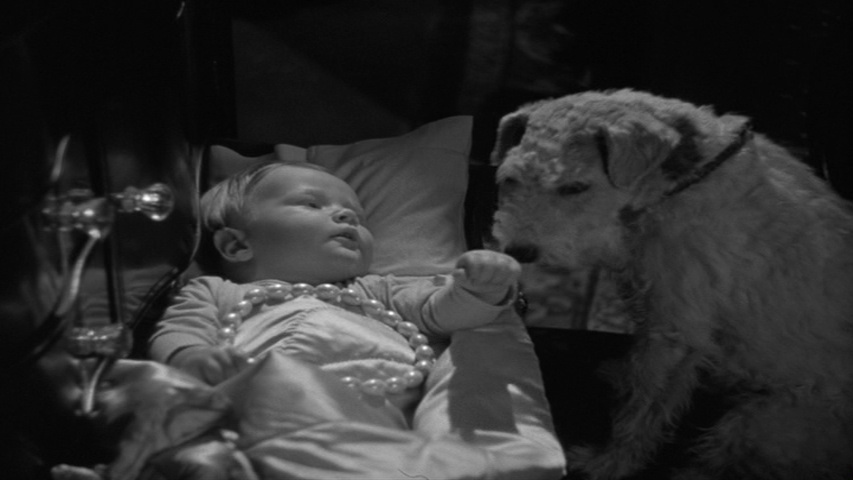
ANOTHER THIN MAN
| Baby Nicky and li'l Asta |
Back in New York with their new son, Nicky, and little Asta in tow, Nick and Nora (William Powell and Myrna Loy) are summoned to the Long Island estate of Colonel MacFay (C. Aubrey Smith). MacFay has been receiving weird death threats from an old employee named Church (Sheldon Leonard) and hopes to have Nick's protection. Naturally, as in most of these detective movies, the threatened man is murdered under the disinterested hero's nose, and the rest of the movie is concerned with finding out who done it. Another Thin Man is quite talky, but entertaining, with an intricate script and a denouement that is truly a surprise. Members of the supporting cast (as well as suspects in certain cases) include Virginia Grey [Jeanne Eagels] as MacFay's adopted daughter; Patric Knowles as her secret fiance; Tom Neal [Bruce Gentry] as a man carrying a torch for Grey; Otto Kruger as the detective on the case; Ruth Hussey as a kind of nanny; Muriel Hutchison as Church's paramour, among others, all giving adroit performances. The business with ex-cons being delighted to see Nick even though he sent them up the river gets tiresome, and leads into a party for little Nicky with the hoods each bringing their own baby! (Don't blink or you'll miss Shemp Howard.) Some of the subsequent victims certainly don't deserve to be murdered, but there's never any sympathy for them. However, there's a swell scene with Powell interacting with Marjorie Main [The Law and the Lady] as a landlady, and the ending is a pip! The killer in this is especially conniving and heartless.
Verdict: Things look up for the series with this entry. ***.
Thursday, August 4, 2016
AND THEN THERE WERE NONE (1945)
| Walter Huston and Barry Fitzgerald |
Several people receive invitations to the very isolated Indian island, and find themselves accused of murder and of escaping justice. One by one, in accordance with a nursery rhyme on "Ten Little Indians," the members of the party are killed as the diminishing survivors become increasingly paranoid. This somewhat light-hearted version of Agatha Christie's classic novel has perhaps too much humor, and changes the grim and uncompromising ending of the book, but it manages to work up considerable suspense along with atmosphere and a certain tension. The actors are generally good, with Barry Fitzgerald as a judge, Walter Huston as a doctor, Louis Hayward as an adventurer, June Duprez [The Brighton Strangler] as a secretary, and Judith Anderson [Rebecca] as a prim and proper if rather heartless middle-aged woman. Richard Haydn [Dear Wife], C. Aubrey Smith, and Roland Young also have important roles. Most of the actors have been directed to play it rather "cute," but for the large part Clair's direction is quite adroit. Christie created her own little sub-genre with this very influential book, which was filmed several times both as "And Then There Were None" and "Ten Little Indians." Most of these were pretty bad. There was a creditable British mini-series in 2015.
Verdict: The fascinating and macabre situation carries this along. ***.
Thursday, December 10, 2015
TARZAN THE APE MAN (1932)
| Maureen O'Sullivan and Johnny Weissmuller |
James Parker (C. Aubrey Smith), his daughter Jane (Maureen O'Sullivan), and Parker's associate Harry Holt (Neil Hamilton) are in Africa trying to find the mystical elephants' graveyard where valuable ivory can be appropriated. They find a treacherous way past a certain escarpment, encountering a horde of hippos and hungry gators, then eventually come afoul of a group of mean dwarfs. Tarzan (Johnny Weissmuller) doesn't put in an appearance until 23 minutes into the running time, and naturally helps save the day when Jane and the others are lowered by rope into a pit with a huge and violent ape. While he could never be considered a great actor, Weissmuller's pantomiming in this is highly effective, getting across both his primitive aspects as well as a charming shyness towards Jane. The movie reveals absolutely nothing of Tarzan's background, and doesn't follow the plot of Burroughs' first novel except for the business with Tarzan swinging away with a frightened but mesmerized Jane in his arms. The film reveals its incredible racism in at least one scene, when a native porter falls to his death from a horrifying cliff and Holt wonders first what was in the man's packs, and then says "poor devil." Tarzan never actually says "Me Tarzan, You Jane" but keeps repeating "Tarzan, Jane" as he taps her on the shoulder over and over again, revealing his sense of humor. O'Sullivan [Payment Deferred] gives a good performance, although she does get so whiny at times you wish Tarzan would throw her out of a tree. Smith [Little Lord Fauntleroy] and Hamilton are okay -- the only time I ever really liked Hamilton was when he played Commissioner Gordon on Batman -- and Cheetah, of course, is absolutely wonderful. At one point Tarzan murders a poor native guide as retaliation for Hamilton shooting one of the ape man's pets! A bit slow-paced at times. This was not the first movie to feature Tarzan, but it led into a long series with Weissmuller [Jungle Jim] and then other actors. Tarzan of the Apes must have been pretty strong stuff in 1932, although it was probably eclipsed the following year by King Kong.
Verdict: Compelling if uneven fantasy. ***.
Thursday, May 7, 2015
FIVE CAME BACK
| Patric Knowles and Joseph Calleia |
A plane flying over South America crash lands in the jungle, but only five people can fly back when the plane is fixed, and there are headhunters in the area. Will it be the convict who faces execution (Joseph Calleia), or the blowsy brunette (Lucille Ball) who feels she hasn't got much of a future? Professor Spengler (C. Aubrey Smith) and his peppery wife (Elisabeth Risdon)? Crimp (John Carradine), who is delivering his prisoner but uses no handcuffs or takes any precautions? Or Pete (Allen Jenkins) who is traveling with his murdered boss's little boy, Tommy? Then there's the eloping couple, Judson (Patric Knowles) and Alice (Wendy Barrie), and the two pilots, played by Chester Morris [The She-Creature] and Kent Taylor [Gangbusters]. Five Came Back certainly features an interesting situation, but it's contrived, and the acting, while professional, is generally of the second-rate Hollywood variety. However, "Lucy" isn't bad as Peggy, and Knowles makes an impression as Jud, while Barrie does her best with the part she's given. At least in this earlier version the horrible death of a steward is remarked upon at some point. Farrow directed the remake Back from Eternity some years later, but it wasn't much of an improvement. This is not one of the great movies of 1939.
Verdict: Maybe more headhunters would have livened this up. **.
Thursday, October 17, 2013
REBECCA
| The unnamed heroine (Fontaine) and Mrs. Danvers (Anderson) |
"[Rebecca's underwear] was made especially for her by the nuns at the Convent of St. Clair." -- a rhapsodic Mrs. Danvers
An unnamed young lady (Joan Fontaine) is in Monte Carlo as the companion to the horrible dowager Mrs. Van Hopper (Florence Bates) when she meets the handsome Maxim de Winter (Laurence Olivier), and the two are instantly attracted. The young lady agrees to become the second Mrs. de Winter -- Maxim's first wife, Rebecca, was drowned -- and they set off for his beautiful estate, Manderlay. There the nervous new wife sees evidence of the much more sophisticated Rebecca everywhere, and has to deal with a housekeeper, Mrs. Danvers (Judith Anderson), who loved Rebecca and sees the new Mrs. de Winter as a usurper. Eventually a number of secrets about Rebecca and her death are uncovered ... If there's any problem with this smoothly made and entertaining romance it's that the heroine is a bit too mousy -- after one especially cruel trick played on the unsuspecting victim by Mrs. Danvers, most women would have insisted the termagant be fired, for instance, but Fontaine lets it slide [although she does confront the housekeeper]. However, Fontaine is perfect and lovely in the role, although Olivier's performance, while good, is probably not one of his most outstanding. It could be argued that Judith Anderson overplays a bit too much, bristling "evil" at the very first confrontation, and one suspects Cloris Leachman based her portrayal of Frau Blucher in Young Frankenstein on Anderson in this. It has been suggested that Danvers was in love with Rebecca, but it's just as likely that, like a lot of old-school servants, she loved her mistress platonically and came to strongly, obsessively identify with her. In any case, Danvers' performance is basically good, which is also true of Florence Bates; George Sanders (as Rebecca's "cousin"); Gladys Cooper as a relative of Max's; Nigel Bruce as her husband; Reginald Denny as Max's associate, Frank; C. Aubrey Smith as a colonel; and Leo G. Carroll as Dr. Baker. The finale leaves you feeling somewhat sympathetic towards the unseen title character, and wondering if she was quite so "evil" and what she might have had to put up with as far as Maxim was concerned.
Verdict: Smooth, memorable picture from Hitchcock and producer David Selznick. ***1/2.
Thursday, July 30, 2009
THE FIREBIRD

"It's modern youth trying to grope its way through the moral chaos that's all around us!"
In Vienna Carola Pointer (the always vivid Verree Teasdale) is happily married to John (that fine actor Lionel Atwill) but she's a bit stuffy, and troubled by their daughter Mariette's (Anita Louise) fascination with modern, erotic music such as Stravinksy's Firebird (which plays over the credits and sporadically thereafter), which Carola thinks is "for savages." Carola is shocked when a neighbor, the licentious Herman Brandt (Ricardo Cortez), confesses that, in modern parlance, he has always had a thing for her. Later on, Brandt is found murdered, and there's gossip about a woman being seen sneaking into his apartment at night on a regular basis. Suspicion falls upon household staff, John's sister, Carola -- there's suspense over exactly which woman was presumably succumbing to Brandt's charms and may have dispatched him. As a mystery this may not be great shakes, but it's the excellent acting from the entire cast that puts it over. This includes C. Aubrey Smith, who plays the wise, understanding policeman assigned to the case.
Verdict: More quaint than "savage" by today's standards, but an interesting curio. **1/2.
Friday, September 5, 2008
KIDNAPPED (1938)
![]() |
| Freddie Bartholomew |
Verdict: Good show! ***1/2.
Monday, May 5, 2008
LITTLE LORD FAUNTLEROY