Lively, entertaining reviews of, and essays on, old and newer films and everything relating to them, written by professional author William Schoell.
Showing posts with label Nigel Bruce. Show all posts

Thursday, June 18, 2026

THE TWO MRS. CARROLLS

Bogart and Stanwyck in their only film together
THE TWO MRS. CARROLLS (1947). Director: Peter Godfrey.

"Would you like something, officers? A glass of milk perhaps?

Sally (Barbara Stanwyck) meets and falls in love with troubled artist Geoffrey Carroll (Humphrey Bogart), then learns he has a wife. Said wife conveniently dies, and Sally and Geoff are married, the two of them residing in Sally's palatial estate along with Geoff's very self-assured little girl, Beatrice (Ann Carter). Then along comes super-sexy Cecily Latham (Alexis Smith), who wants Geoff to paint her portrait and won't take no for an answer. Before long Sally is getting suspicious, especially when she learns that Geoff's first wife wasn't an invalid as he claimed, and that she's developing similar symptoms to what the first Mrs. Carroll had before she died ... 

Based on a stage play, The Two Mrs. Carrolls is a poor man's Suspicion, which was released six years earlier. There's even some business with a glass of milk. At least this is somewhat superior to the next thriller Stanwyck did with director Peter Godfrey, Cry Wolf with Errol Flynn, and the acting is quite good. Stanwyck is better at getting across the vulnerability and terror of the heroine than you might expect (although she does seem to summon up her bravery at the climax rather suddenly), Bogart is fine in all but his most challenging scenes, little Ann Carter proves a superlative child actress in her portrayal of the highly interesting and mature Beatrice, and gorgeous Smith has wicked fun as the slinky and self-absorbed Cecily, with Isobel Elsom scoring as her mother and Nigel Bruce as -- what else? -- a doctor. Anita Bolster is a riot as the saturnine housekeeper, Christine. Crackling good dialogue from Thomas Job (from Martin Vale's play) and a fine Franz Waxman score help a great deal. The last line provides a little wink at the audience. Bogart and Stanwyck play quite well together.

Verdict: No Suspicion, but fun nevertheless. **1/2.

Thursday, October 13, 2022

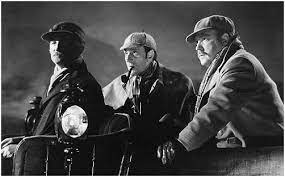
THE HOUND OF THE BASKERVILLES (1939)

On the moors with Holmes and Watson
THE HOUND OF THE BASKERVILLES
(1939). Director: Sidney Lanfield. 

"Oh, Watson, the needle." 

This is the first of two Sherlock Holmes films made by Twentieth Century-Fox and the first in which the wonderful Basil Rathbone created perhaps the definitive movie portrayal of the famous detective -- he is simply outstanding. The plot has to do with Holmes and Watson (Nigel Bruce) trying to save the life of an heir (Richard Greene) while dealing with rumors of the huge title beast roaming the foggy moors where the story takes place. John Carradine has a small role as a servant, and Wendy Barrie is the love interest. Lionel Atwill, who played Holmes' nemesis Professor Moriarty in a later film, Sherlock Holmes and the Secret Weapon, is excellent in the more sympathetic role of Dr. Mortimer. Mary Gordon played Mrs. Hudson for the first time in this picture. Barlowe Borland scores as the cranky, litigious old Frankland. Morton Lowry is fine as John Stapleton. The 1959 color remake is also quite creditable, and some may feel it has the slight edge. Followed by The Adventures of Sherlock Holmes. 

Verdict: Fine introduction to the Rathbone portrayal. ***.

Thursday, October 3, 2019

BECKY SHARP

Miriam Hopkins and Frances Dee
BECKY SHARP (1935). Director: Rouben Mamoulian.

Becky Sharp (Mariam Hopkins), a charity case in a finishing school, goes off with her wealthy friend Amelia (Frances Dee of I Walked with a Zombie) where she hopes to become affianced to Amelia's portly brother, Joseph (Nigel Bruce). Things don't go quite the way Becky expected, but she advances in society due to her looks, her aggressiveness, and many compliant men, including the Marquis of Sheyne (Cedric Hardwicke) and her husband, Rawdon Crawley (Alan Mowbray), whom she seems to love sincerely. But Becky's scheming may eventually undo her ...

Miriam Hopkins and Alan Mowbray
This version of Thackeray's Vanity Fair, filmed in early Technicolor, is amusing and engaging. Hopkins demonstrates true star quality, although her performance is at times overwrought and overly theatrical, yet she always plays with undeniable passion. It's hard to see Alan Mowbray [Dante], better known as a comic foil than anything else, as a romantic figure, but he is as good as ever, as is Hardwicke. Frances Dee is fine as Amelia, even though her character is allowed no real fireworks even when she thinks her husband is carrying on with Becky. Nigel Bruce offers one of his best portrayals as Joseph, and Alison Skipworth is a riot as Rawdon Crawley's peppery Aunt Julia. Billie Burke has a small role, and Mrs. Leslie Carter is lost in a crowd with no lines. (Five years later Hopkius would play Carter in Lady with Red Hair.) An exciting sequence takes place at a ball when Napoleon arrives at the nearby village of Waterloo.

Verdict: An arresting if uneven performance by Hopkins in an absorbing, fast-paced adaptation of a classic novel. ***. 

Thursday, March 21, 2019

THE CHOCOLATE SOLDIER

Rise Stevens and Nelson Eddy
THE CHOCOLATE SOLDIER (1941). Director: Roy Del Ruth.

Karl Lang (Nelson Eddy) and Maria Lanyl (Rise Stevens) are a married couple in Vienna who appear nightly in a production of The Chocolate Soldier. Karl is generally surrounded by adoring young ladies, but he is still jealous of the attentions his wife receives from other men, and thinks that she has quite a romantic history. He fears it is time for her to take yet another lover and his marriage may be doomed. To test Maria's affections, he disguises himself as an intensely romantic Russian singer ...

Eddy disguised as the Russian
Like Sweethearts, which Eddy did with Jeanette MacDonald three years earlier, The Chocolate Soldier completely throws out the plot of that operetta -- while retaining some of Oscar Straus' music -- and substitutes the storyline of that creaky old standby The Guardsman (which Lunt and Fontanne actually filmed ten years earlier). This plot was recycled for more than one I Love Lucy episode which at least had Lucy and Desi yukking it up. However, to be fair to the leads in this picture, they are both excellent and amusing in their own way. Often damned as a lousy actor, Eddy is actually quite effective in this, including when he is impersonating the love-mad Russian. Stevens, a mezzo-soprano to reckon with and a genuine operatic star (and with a voice far superior to Jeanette MacDonald's ), also proves a delightfully talented and sophisticated actress. Stevens may not have been a stunning beauty, but with her personality, manner and charm -- not to mention her cute appeal -- I have no doubt she had plenty of male admirers (she was happily married for 61 years, however).

Nelson Eddy as Karl
But then we come to the music. The best song, of course, is the gorgeous "My Hero," which is reprised more than once in the movie and deserves to be. Vivian Vance sang this song in the classic "Ethel's Home Town" episode of I Love Lucy, but while Vance had a nice voice, she can't compare to Stevens, who gives a superb rendition, joined in by Eddy, who is also in fine voice, at one point. Stevens is also given a beautiful aria from Samson and Delilah, while Eddy does Tannhauser.  There are other musical interludes, including a weird, unmemorable piece sung by Eddy as the Russian, and a frenetically-edited dance at a drinking establishment.

Rise Stevens
Frankly, the script for Chocolate Soldier is not the chief appeal of the movie, although it does manage to remain amusing and watchable due to the actors and the soundtrack. Florence Bates [The Brasher Doubloon], Nigel Bruce, and Nydia Westman [Forty Little Mothers] add to the fun as assorted associates of the lead couple, and all are very good. Rise Stevens did a version of The Chocolate Soldier for television with Eddie Albert in 1955, which I believe stuck to the original story of the operetta. Stevens had a long and wonderful career with the Metropolitan opera in New York and did very few films, one of which was Going My Way. She did a few operas, such as Carmen, on TV as well.

Verdict: Despite its obvious flaws, this is still quite entertaining. "My Hero," indeed! ***. 

Thursday, March 23, 2017

LILLIAN RUSSELL

Alice Faye as Lillian Russell
LILLIAN RUSSELL (1940). Director: Irving Cummings.

A young lady with singing talent reinvents herself as "Lillian Russell" to hide the fact that she's on the stage from her mother (Dorothy Peterson), but mama always knows. Like her mother, Lillian is an early feminist as well as a major theatrical performer with thousands of fans and a host of suitors, including Diamond Jim Brady (Edward Arnold) and "J. L." (Warren William of Dr. Monica), but she marries composer Edward Solomon (Don Ameche). Their marriage ends in tragedy, but waiting in the wings is reporter turned newspaper publisher Alexander Moore (Henry Fonda). Russell was actually married four times, and Solomon didn't die as in the movie, but turned out to be a (perhaps inadvertent) bigamist. As Faye herself noted, in this handsomely-produced (but oddly, black and white) movie, nobody ever ages no matter how many decades go by. Although Faye's singing voice could best be described as "pleasant" (and a little too deep at times), she gives a very good performance as Russell, wisely underplaying many of her more emotional scenes. Arnold is excellent in his portrait of the happy go lucky but broken-hearted Brady, and there are good turns from Ameche and William; Helen Westley [Million Dollar Baby] as Grandma Leonard; Joseph Cawthorn as vocal coach Leopold Damrosch; Ernest Truex as Lillian's father (who in real life was actually separated from his wife); and Nigel Bruce as William Gilbert (of Gilbert and Sullivan fame). Aside from the many musical highlights, there is grandma's recounting of a romantic story involving a mystery gift she once received, and a well-played scene between Arnold and William talking about their feelings toward Lillian. Henry Fonda [The Long Night], who usually leaves me cold, is quite good in this, although this was not an assignment he coveted. Old-time vaudevillians Joe Weber and Lew Fields, playing themselves, almost stop the movie dead with their long comedy routine, but as they happen to be very funny it doesn't matter. Eddie Foy Jr. plays his dad in a brief bit.

Verdict: Despite some inaccuracies, this is a highly entertaining and well-acted biopic. ***1/2.

Thursday, May 14, 2015

SHE (1935)

Helen Gahagan as "She"
SHE (1935). Directors: Lansing C. Holden; Irving Pichel. Colorized version. Based on the novel by H. Rider Haggard.

John Vincey (Samuel S. Hinds), who is dying of radiation poisoning, tells his nephew, Leo (Randolph Scott), that he can find the secret of immortality by finding the flame in a lost civilization which was first discovered by Leo's lookalike ancestor. Leo, Horace Holly (Nigel Bruce), and Tonya (Helen Mack of Son of Kong), whom they sort of pick up along the way, travel through a frigid wasteland and after an avalanche discover the cavern that leads to this lost land. There they find a bunch of unfriendly savages, but they also find -- "She" (Helen Gahagan), the absolute ruler of this weird little empire. She has lived for centuries, and thinks Leo is his ancestor, John, whom she actually murdered many years before. Now she wants to sacrifice Tonya ... She, superior to the sixties remake, has some striking settings, good special effects (for the period), and is well-acted by the two ladies. Bruce is less effective than he was as Dr. Watson, and Scott [Go West Young Man] is embarrassingly awful as the hero. The best scene depicts a thrilling fight on a high precipice that keeps tottering during the battle. Elaborately produced for its time, She was probably an influence, unconscious or otherwise, on such cruel-queen-in-strange-settings movies as Queen of Outer Space and many others. [At least this society has the Arts, evidenced by the dancing and statuary.] This is an entertaining adventure film, but Max Steiner's excellent score probably makes it seem even better than it is. The big gate from King Kong shows up early in the film. A singer and politician, Gahagan only appeared in this one movie.

Verdict: Interesting adaptation of classic adventure story. ***.

Thursday, October 17, 2013

REBECCA

The unnamed heroine (Fontaine) and Mrs. Danvers (Anderson)
REBECCA (1940). Director: Alfred Hitchcock.

"[Rebecca's underwear] was made especially for her by the nuns at the Convent of St. Clair." -- a rhapsodic Mrs. Danvers

An unnamed young lady (Joan Fontaine) is in Monte Carlo as the companion to the horrible dowager Mrs. Van Hopper (Florence Bates) when she meets the handsome Maxim de Winter (Laurence Olivier), and the two are instantly attracted. The young lady agrees to become the second Mrs. de Winter -- Maxim's first wife, Rebecca, was drowned -- and they set off for his beautiful estate, Manderlay. There the nervous new wife sees evidence of the much more sophisticated Rebecca everywhere, and has to deal with a housekeeper, Mrs. Danvers (Judith Anderson), who loved Rebecca and sees the new Mrs. de Winter as a usurper. Eventually a number of secrets about Rebecca and her death are uncovered ... If there's any problem with this smoothly made and entertaining romance it's that the heroine is a bit too mousy -- after one especially cruel trick played on the unsuspecting victim by Mrs. Danvers, most women would have insisted the termagant be fired, for instance, but Fontaine lets it slide [although she does confront the housekeeper]. However, Fontaine is perfect and lovely in the role, although Olivier's performance, while good, is probably not one of his most outstanding. It could be argued that Judith Anderson overplays a bit too much, bristling "evil" at the very first confrontation, and one suspects Cloris Leachman based her portrayal of Frau Blucher in Young Frankenstein on Anderson in this. It has been suggested that Danvers was in love with Rebecca, but it's just as likely that, like a lot of old-school servants, she loved her mistress platonically and came to strongly, obsessively identify with her. In any case, Danvers' performance is basically good, which is also true of Florence Bates; George Sanders (as Rebecca's "cousin"); Gladys Cooper as a relative of Max's; Nigel Bruce as her husband; Reginald Denny as Max's associate, Frank; C. Aubrey Smith as a colonel; and Leo G. Carroll as Dr. Baker. The finale leaves you feeling somewhat sympathetic towards the unseen title character, and wondering if she was quite so "evil" and what she might have had to put up with as far as Maxim was concerned.

Verdict: Smooth, memorable picture from Hitchcock and producer David Selznick. ***1/2.

Thursday, September 12, 2013

SUSPICION

Lina (Joan Fontaine) suspects her husband wants to kill her
SUSPICION (1941). Director: Alfred Hitchcock.

Lonely heiress Lina (Joan Fontaine) meets the charming mountebank Johnnie (Cary Grant) and finally falls in love. The two get married and move into a huge house that Johnnie can clearly not afford. Lina discovers that her husband has an aversion to work of any kind, and an addiction to gambling, even selling antique chairs given to her by her father as a wedding present, for money. A friend named Beaky (Nigel Bruce) shows up and lets slip further information that unsettles the discomfited wife. After Lina fears that her husband might be involved in a death that occurred in Paris, she then suspects that he is planning to do away with her. But is she right -- or this time does two and two add up to five? Suspicion is a smooth, beautifully photographed [Harry Stradling] and handsomely produced thriller that features an outstanding performance from Fontaine and also boasts Grant at his best, never quite giving away whether he's a total rotter or not. Other notable players include Dame May Whitty and Sir Cedric Hardwicke as Lina's parents, and Leo. G. Carroll as Johnnie's cousin, from whom he embezzles. It's been said that the ending is tacked on and a bit of a cop-out, but it still works. Unusual scoring by Franz Waxman.

Verdict: Another smooth suspenser from the Master. ***1/2.

Thursday, April 8, 2010

SHERLOCK HOLMES AND THE VOICE OF TERROR

SHERLOCK HOLMES AND THE VOICE OF TERROR (1942). Director: John Rawlins. 

Sherlock Holmes (Basil Rathbone) is called in when war-torn England is demoralized by a Nazi broadcaster -- the "voice of terror" -- who predicts and chortles over horrendous acts of sabotage. This was the first of Universal's "modern-dress" Holmes films, and while it can't compare with certain other entries in the series, on its own terms it's quite entertaining. Holmes works with the members of a council, one of whom may be a traitor. Evelyn Ankers plays an obvious prostitute, Kitty, who helps bring down the leader of the Nazi forces in England. Nigel Bruce (Watson), Thomas Gomez, Reginald Denny, and Henry Daniell all offer flavorful supporting performances. Hillary Brooke, who had a much bigger role in The Woman in Green -- in which Daniell played Moriarty -- has virtually a bit part as an Army driver in this. An unseen Edgar Barrier of The Giant Claw and many others does the "voice" for the broadcasts. This is supposedly based on an original Doyle story entitled "His Last Bow," but that was actually a collection of stories. It's safe to say Holmes never battled the Nazi's in Doyle's 19th century tales. 

Verdict: Despite the obvious problems, this is not bad at all. ***.

Thursday, April 1, 2010

DRESSED TO KILL (1946)

DRESSED TO KILL (1946). Director: Roy William Neill. 

This was the last of 12 "modern-day" Sherlock Holmes films done by Universal, and the 14th and final film in which Basil Rathbone starred as the great sleuth. It's an entertaining mystery in which Holmes matches wits with another female foe, Hilda Courtney (Patricia Morison). The plot has to do with a tune played on music boxes made by the inmates of a prison, and the secret held by the boxes and the tune. Morison isn't bad, although she can't compare to Gale Sondergaard in The Spider Woman. Edmond Breon is great as Dr. Watson's old friend Julian "Stinky" Emery -- what a likable performer! Ian Wolfe, who plays the Commissioner of Scotland Yard, later was the old blind man Burton White in the 1960 Lost World

Verdict: His Last Bow. Fast-paced and quite entertaining. ***.

Thursday, March 18, 2010

PURSUIT TO ALGIERS

PURSUIT TO ALGIERS (1945). Director: Roy William Neill. 

"My dear Watson, musical talent is no proof of innocence. The late Professor Moriarty was a virtuoso on the bassoon.

Sherlock Holmes (Basil Rathbone), along with Watson (Nigel Bruce), is importuned to help scurry Prince Nikolas (Leslie Vincent) out of England before he can be assassinated after his father the king dies in an "accident." With the prince in tow, Holmes and Watson travel by boat, wondering which of the seemingly innocent -- and not so innocent -- passengers may be assassins. Of course, the minute Martin Kosleck shows up you know he's not on the side of the angels, but the film still holds quite a few surprises. At a dinner party Watson makes reference to Holmes' adventure with "The Giant Rat of Sumatra," which Doyle referred to in his stories but which was never revealed in one of his original tales. Marjorie Riordan plays Sheila Woodbury, whom the prince admires and who has a very lovely voice; she sings a couple of charming numbers. The huge mute Gubek is played by an actor billed as "Wee Willie Davis" and Morton Lowry, who played Stapleton in The Hound of the Baskervilles (1939), is the helpful ship's steward. Very suspenseful, entertaining, and well-acted to boot. Rathbone is as marvelous as ever. Although Riordan was attractive and competent she had few credits, preferring other pursuits to acting. Despite his good looks, Leslie Vincent was uncredited in most of his film appearances. Twenty-four years after his last film credit he appeared on TV's Hawaii Five-O in 1972. 

Verdict: Great fun! ***.

Thursday, March 4, 2010

THE HOUSE OF FEAR


THE HOUSE OF FEAR (1945). Director: Roy William Neill.

"No man goes whole to his grave."

Sherlock Holmes (Basil Rathbone) is called in when members of a club in Scotland called the Good Comrades are being murdered off one by one. The bodies are always found in a deplorable condition as the victims are crushed or burned and so on. Loosely based on Doyle's story The Adventure of the Five Orange Pips -- which was about the revenge of the Ku Klux Klan -- this is basically an original screenplay which is bizarre and intriguing [even if today it might not hold up forensically]. Paul Cavanagh may not have appeared in every Sherlock Holmes movie, but it certainly seems as if he did -- in this he's Dr. Simon Merrivale, who may have gotten away with murdering his wife. Sally Shepherd is creepy as the cook and housekeeper Mrs. Monteith. Rathbone and Bruce are as wonderful as ever.

Verdict: Eerie and quite entertaining. ***.

Thursday, February 25, 2010

THE PEARL OF DEATH

THE PEARL OF DEATH (1944). Director: Roy William Neill. 

Very loosely based on Doyle's The Adventure of the Six Napoleons, this is the seventh of Universal's "modern-day" Sherlock Holmes films and the 9th in which Basil Rathbone plays Holmes. The great sleuth finds himself temporarily embarrassed when the famous Borgia Pearl is purloined after he disconnects the electric alarms for a demonstration of how ineffective the security for the pearl is. Holmes' main opponent in this is Giles Conover, played by Miles Mander. Scream Queen Evelyn Ankers is Conover's associate Naomi Drake. The plot has a hideous fellow named the Oxton Creeper (Rondo Hatton) running around stealing busts of Napoleon and breaking the backs of their owners. [This Creeper fellow was decidedly not in Doyle's original story. Rondo Hatton later starred in a film called House of Horrors where he again played a "Creeper."] Nigel Bruce as Watson had become dithery comedy relief by this point. Despite its "modern" setting, this still has that old-style flavor, and is quite entertaining, even if you may feel you're one step ahead of everyone in the movie throughout. 

Verdict: Creepy and well-done. ***.

Thursday, February 18, 2010

THE SCARLET CLAW

THE SCARLET CLAW (1944). Director: Roy William Neill. 

"For the first time we've been retained by a corpse." 

After learning of the murder of Lord Penrose's (Paul Cavanagh) wife, supposedly at supernatural hands, Sherlock Holmes (Basil Rathbone) receives a note from the very same woman telling him of her fears and apprehensions. Holmes and Watson then head to the small Canadian village of Le Morte Rouge [The Red Death] to investigate the series of mysterious deaths that have occurred there, including that of Lady Penrose. Creepy and suspenseful, with those great Universal sets and that certain atmosphere, The Scarlet Claw emerges as one of the best of the "modern-dress" Holmes films. This was not based on any of Doyle's original stories. Rathbone and Nigel Bruce are as wonderful as ever, as is the ever-reliable Cavanagh, and there's fine support from Gerald Hamer, Miles Mander, Kay Harding, Ian Wolfe and Arthur Hohl. Very well-directed by Neill. Watson makes an interesting reference to a famous "Father Brown" story by Chesterton. 

Verdict: Spellbinding. ***1/2.

Thursday, February 11, 2010

THE SPIDER WOMAN

THE SPIDER WOMAN (1944). Director: Roy William Neill. 

This is one of the best of Universal's "modern-dress" Sherlock Holmes movies. Holmes (the always wonderful Basil Rathbone) investigates when there is a series of "pajama suicides" of prominent men. A mysterious if somewhat familiar Indian Prince turns up at the gambling houses where some of the dead men interacted with Adrea [sic] Spedding (Gale Sondergaard), who sometimes goes about with a little mute boy named Larry. [There's a fascinating scene with this boy in Holmes' office. Although he has no dialogue, the kid is marvelous but, unfortunately, uncredited.] Sondergaard, who is outstanding, makes an excellent sparring partner for Rathbone. And watch out for one of the most hideous spiders you've ever seen! Supposedly based [very loosely I'm sure] on a story by Doyle. 

Verdict: Creepy and very entertaining, with a great cast. ***1/2.

Thursday, February 4, 2010

SHERLOCK HOLMES FACES DEATH

SHERLOCK HOLMES FACES DEATH (1943). Director: Roy William Neill. 

Dr. Watson: "Ghosts don't stab people in the neck, do they?" Sherlock Holmes: "Not well-bred ghosts." 

 In this very loose adaptation of Doyle's story "The Musgrave Ritual," Holmes (Basil Rathbone) and Dr. Watson (Nigel Bruce) investigate murders at Musgrave Manor, which has been opened for convalescent war patients and staff. There are hidden treasures, secret passages, and a floor that resembles a chessboard. Although this is another of Universal's "modern-dress" Holmes films, it retains the old-style atmosphere that is so crucial to the success of these mysteries. Hillary Brooke plays the sister of the murdered men and she isn't too terrible. Her boyfriend is played by Milburn Stone, who also appeared in The Great Alaskan Mystery, Roadblock, and Captive Wild Woman. Dennis Hoey is great as Inspector Lestrade, a role he repeated in most of these films, and which served chiefly as comedy relief. Halliwell Hobbes and Minna Phillips make an impression as the butler, Brunton, and his wife. 

Verdict: Crackling good fun! ***.

Thursday, January 28, 2010

SHERLOCK HOLMES IN WASHINGTON


SHERLOCK HOLMES IN WASHINGTON (1943). Director: Roy William Neill.
The third of Universal's "modern-dress" Holmes films presents the absurdity of United States intelligence officers calling in the British Holmes when certain documents on microfilm go missing. (Despite Holmes' genius, surely there are smart and swift U.S. agents to do the job?) Holmes and Watson take their first trip to the United States, where they cross swords with both Henry Daniell and George Zucco. Zucco had been a famous British spy and is now head of an international spy ring. Marjorie Lord is the doll, and Thurston Hall plays the lovable Senator Babcock. This is not without entertainment value -- and as usual Basil Rathbone and Nigel Bruce are marvelous -- but this just doesn't have that certain Holmesian atmosphere. While not exactly a fish out of water, Holmes really isn't in his element in this, either.
Verdict: Better the moors than Washington. **1/2

Thursday, January 21, 2010

SHERLOCK HOLMES AND THE SECRET WEAPON

SHERLOCK HOLMES AND THE SECRET WEAPON (1943). Director: Roy William Neill. 

"The needle to the last, eh, Holmes?" 

This is the second of the "modern-day" Universal Sherlock Holmes films [and the fourth film in which Basil Rathbone played Holmes], following Sherlock Holmes and the Voice of Terror. It is very, very loosely based on Doyle's story The Adventure of the Dancing Men, which refers to a code (which is used in the film). Frankly, Holmes really didn't fit into the WW2 milieu, and the only "modern" SH films which work are ones that more or less ignore the war and don't feature references to Nazis. The basic plot has to do with a scientist, Dr. Tobel (William Post Jr.) whose new weapon is coveted by the Germans. Frankly, the film doesn't really get interesting until we learn that the dreaded Professor Moriarty (Lionel Atwill) is involved in the plot. Rathbone is, as usual, excellent (although the odd comb-over he sports is a bit disconcerting) and his sparring with the equally great Atwill provides the film's highlights. The quoted line above comes about when Holmes suggests that an imaginative means of death would be to drain every drop of blood from a person's body. 

Verdict: If only there had been more of Moriarty and less of Dr. Tobel. **1/2.

Thursday, January 7, 2010

THE ADVENTURES OF SHERLOCK HOLMES

THE ADVENTURES OF SHERLOCK HOLMES (1939). Director: Alfred L. Werker. 

"There's death in every note of it.

Sherlock Holmes (Basil Rathbone) matches wits with Professor Moriarty (George Zucco) when the latter -- who has just managed to get off on a murder charge -- boasts that he will commit a spectacular crime right in front of the former's nose. Ida Lupino is a woman who fears for her brother's life -- does this tie in with the professor's plans? Despite the fact that the movie sort of clues us in early on as to what's going on, The Adventures of Sherlock Holmes is still suspenseful and exciting, with some eerie scenes relating to a club-footed killer. The haunting flute dirge that figures in the story is quite creepy. Little Terry Kilburn makes an impression as Billy, the page boy who appeared in some of the stories. Based on a play by William Gillette. Rathbone is excellent,as is Zucco as his nemesis. At one point Rathbone/Holmes masquerades as a music hall singer! This follows The Hound of the Baskervilles and was the second of two 20th Century-Fox films with Rathbone as Holmes. Followed by Sherlock Holmes and the Voice of Terror, the first of 12 Universal "modern-day" Holmes adventures with Rathbone. 

Verdict: There are some loose ends, but overall this is a pip! ***1/2.

Monday, September 22, 2008

PLAY GIRL


PLAY GIRL (1940). Director: Frank Woodruff.

"She's said good-bye to more men than most women have said hello to."

Grace Herbert (Kay Francis, pictured) has unapologetically made a living by romancing wealthy men and suing them for breach of promise. Unfortunately, the game is getting tougher as she gets older. Along comes orphaned, hungry Ellen Daley (Mildred Coles), whom Grace decides to make her protege. Their first target is Grace's old pal Bill Vincent (Nigel Bruce), but Ellen also has her eye on a handsome rancher named Thomas (James Ellison). It's hard to believe that Ellen would be so upset that Thomas is worth millions, but she's afraid Grace will get her hooks in him -- and maybe she will. Despite the unconvincing attitudes and actions of the protege, Play Girl is an amusing and appealing trifle with a nicely sentimental wind-up. Francis gives a top-notch performance as the world-weary Grace, and Coles and Ellison do a fine job as the young lovers. Margaret Hamilton has a few funny moments as Grace's friend and housekeeper, although you kind of wish Eve Arden was along for the ride. Bruce is a lot of fun as the lovable if slightly buffoonish Bill.

Verdict: A winner for Kay! ***