Lively, entertaining reviews of, and essays on, old and newer films and everything relating to them, written by professional author William Schoell.
Showing posts with label Basil Rathbone. Show all posts

Thursday, October 26, 2023

THE MAD DOCTOR

Basil Rathbone and Ellen Drew
THE MAD DOCTOR (1940). Director: Tim Whelan.

The wife of Dr. Sebastian (Basil Rathbone) dies of pneumonia but her death seems suspicious to her personal physician Dr. Downer (Ralph Morgan). Nevertheless Sebastian and his good right hand Maurice (Martin Kosleck of House of Horrors) settle the will and quickly leave for New York City. In Manhattan Sebastian sets up practice as a prominent psychiatrist and moves in on his latest victim, a wealthy neurotic named Linda (Ellen Drew of The Crooked Way) who has tried to throw herself off of a roof. As the not so good doctor and Maurice cheerily plan what they'll do with the loot once Sebastian marries -- and murders -- Linda, her former boyfriend, reporter Gil Sawyer (John Howard of The Invisible Woman), is checking the background of Sebastian, and crosses paths with the suspicious Dr. Downer. Meanwhile Maurice is not thrilled that Sebastian claims to be truly falling in love with Linda ... 

John Howard and Ellen Drew
The Mad Doctor
 is more of a suspense-thriller than an out and out horror film, although it is macabre and occasionally chilling. An interesting aspect of the film is the relationship between the two villains, as Maurice seems to be much more than a mere servant. Apparently Sebastian saved Maurice's life at one point and is beholden to him. Maurice sprays cologne on himself with an atomizer, which may have been the film's dated way of suggesting he is queer. In any case, Rathbone offers a superb performance -- no one can display withering contempt as well as Rathbone. The under-rated Kosleck is also excellent. Morgan is quite good as well, but Drew and Howard are simply not in the same league. 

Companions in crime: Rathbone; Kosleck
There are flavorful supporting performances from Barbara Jo Allen (appearing as "Vera Vague") as Linda's sister and Hugh O'Connell as her brother-in-law, although he tries too hard to be inappropriately comical. Billy Benedict and Kitty Kelly are fine in smaller roles and Douglas Kennedy has a bit as a hotel clerk. At one point Linda inexplicably asks to meet a certain person at the 79th Street subway, the only point of which is to apparently set up a chilling subway murder sequence. The picture could have used much more music during certain suspenseful sequences. The screenplay is rather dismissive of the benefits of psychiatry, going to far as to suggest that all shrinks are charlatans. 

Verdict: An outstanding Rathbone performance is the chief joy of this entertaining suspense film. ***. 

Thursday, August 31, 2023

DAVID COPPERFIELD (1935)

Freddie Bartholomew and W. C. Fields
DAVID COPPERFIELD
(aka The Personal History, Adventures, Experience, & Observation of David Copperfield the Younger/1935). Director: George Cukor.

"They seem rather obstinate oysters!" -- Aunt Betsey.

After his beloved mother's death, little David Copperfield (a wonderful Freddie Bartholomew) finds himself at the mercy of his hated stepfather, Murdstone (Basil Rathbone) and his equally loathsome sister (Violet Kemble Cooper), then sent off to work in a factory where he is befriended by the benevolent Micawber (W. C. Fields, pictured). Then the poor boy has to make his way on foot, penniless, to the home of his peppery Aunt Betsey (Edna May Oliver). The problem is that when David grows to manhood and is played by the relatively colorless Frank Lawton, he becomes a supporting character in his own story, which on the whole is full of too many characters that you just don't care about. For the most part, the acting is excellent, however, with Oliver and Rathbone as good as ever -- not to mention Jessie Ralph as nurse Peggotty -- and Roland Young making a striking Uriah Heep. Lewis Stone, Elsa Lanchester, Lionel Barrymore, Una O'Conner and others are lost in the episodic and sometimes dull picture, but Fields and Bartholomew make an engaging pair. Even at 130 minutes' running time there's simply too much plot crammed into the movie, and the second half is not nearly as good as the first. I generally like honest sentiment, but in David Copperfield the sentiment is often treacly, the characters' affection for one another bordering on the cloying. Everyone is just too "cutesy." However, the movie certainly has its admirers.

Verdict: Has its moments, but it's no Tale of Two Cities. **1/2.

Thursday, October 13, 2022

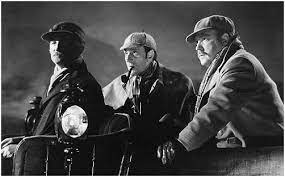
THE HOUND OF THE BASKERVILLES (1939)

On the moors with Holmes and Watson
THE HOUND OF THE BASKERVILLES
(1939). Director: Sidney Lanfield. 

"Oh, Watson, the needle." 

This is the first of two Sherlock Holmes films made by Twentieth Century-Fox and the first in which the wonderful Basil Rathbone created perhaps the definitive movie portrayal of the famous detective -- he is simply outstanding. The plot has to do with Holmes and Watson (Nigel Bruce) trying to save the life of an heir (Richard Greene) while dealing with rumors of the huge title beast roaming the foggy moors where the story takes place. John Carradine has a small role as a servant, and Wendy Barrie is the love interest. Lionel Atwill, who played Holmes' nemesis Professor Moriarty in a later film, Sherlock Holmes and the Secret Weapon, is excellent in the more sympathetic role of Dr. Mortimer. Mary Gordon played Mrs. Hudson for the first time in this picture. Barlowe Borland scores as the cranky, litigious old Frankland. Morton Lowry is fine as John Stapleton. The 1959 color remake is also quite creditable, and some may feel it has the slight edge. Followed by The Adventures of Sherlock Holmes. 

Verdict: Fine introduction to the Rathbone portrayal. ***.

Thursday, February 4, 2021

THE MARK OF ZORRO (1940)

THE MARK OF ZORRO
(1940). Director: Rouben Mamoulian. 

Diego Vega (Tyrone Power) returns to Los Angeles from Madrid and discovers that in his absence his elderly father (Montagu Love) has been unseated and a petty tyrant, Don Quintero (J. Edward Bromberg), is taxing the people to death and brutalizing the rebellious with the aid of nasty Captain Pasquale (Basil Rathbone). Diego's father is appalled by what his predecessor is doing but can't see himself fighting against the government, no matter how corrupt. Therefore Diego dons the mask of Zorro to fight his people's oppressor, and begins to act as a carefree, callous fop to avoid suspicion being focused upon him. This very good movie about one of the first masked "super-heroes" of sorts is fine entertainment, with smashing performances from all -- this is one of Power's best -- and an excellent sword fight between Power and Rathbone, who is also at his snarling best. Linda Darnell is lovely as the romantic interest and Gale Sondergaard splendid as Quintero's catty and unfaithful wife. Eugene Palette scores as the Padre, and there's a good scene when Power reveals his secret identity to the priest. Bromberg and Love are also in top form. Not as thrilling as the serial Zorro's Fighting Legion but much superior to Zorro Rides Again. 

 Verdict: Very entertaining classic. ***.

Thursday, November 2, 2017

FINGERS AT THE WINDOW

Laraine Day and Lew Ayres
FINGERS AT THE WINDOW (1942). Director: Charles Lederer.

In Chicago a series of seemingly unrelated individuals are slaughtered by an ax, and each time the killer is a different person. Actor Oliver Duffy (Lew Ayres) sees Edwina Brown (Laraine Day) being followed one night and comes to her rescue, determining that someone is definitely out to get her. Edwina, who doesn't seem very bright, scarcely seems to understand that someone wants to behead her. As the police focus in on Oliver himself as the killer, he tries to pin down the true architect behind the gruesome murders. If there is one major problem with Fingers at the Window, which has a splendid premise, it's the dopey character of Edwina, who seems half-demented throughout most of the movie. We are also clued in as to the identity of the mastermind very early on, although it must be said that for once he is given a motive that makes absolutely perfect sense. The conclusion is also suspenseful. Ayres [Johnny Belinda] and Day [And One Was Beautiful] are too "cutesy" by far, and the picture is stolen by an excellent Basil Rathbone [The Black Sleep] as Dr. Santelle.

Verdict: Creepy idea sort of frittered away but it has its good points and a great Rathbone. **1/2.

Thursday, May 25, 2017

THE LAST HURRAH

Spencer Tracy
THE LAST HURRAH (1958). Director: John Ford.

Mayor Frank Skeffington (Spencer Tracy) runs for one last term, and is up against a younger family man (Charles B. Fitzsimons) who seems the pawn of more experienced politicians. Frank's son, Junior (Arthur Walsh), is a fifties-type jazz baby who has little interest in politics or much else. Frank is closer to his nephew, Adam (Jeffrey Hunter), whose boss at a newspaper, Amos Force (John Carradine), and father-in-law Roger Sugure (Willis Bouchey), both detest Frank. Frank is an old-fashioned Irish-American politician who has survived decades due to his old cronies who love him, but it's a new world out there and Frank may get a surprise on election night ... The Last Hurrah could be picked apart on certain levels -- the characterization is quite superficial at times --  but it works because of its acting and Ford's smooth, professional direction. Tracy is excellent, and he gets fine support from Hunter, Walsh, Carradine, and especially Basil Rathbone in a scene-stealing turn as a banker who comes afoul of Frank and vice versa. (The whole sequence with Rathbone's lisping, clearly mentally-deficient son, who is cruelly used to blackmail Rathbone, is in questionable taste, to say the least.) Other cast stand-outs include Ricardo Cortez as Sam, the campaign manager; Donald Crisp as the cardinal; Basil Ruysdael as Bishop Gardner; and Jane Darwell as Delia Boylan, whose chief occupation seems to be to go to funerals and cackle. Edward Brophy [Romance on the Run] is also notable as "Ditto," Frank's old pal, a rather sad figure (whom we learn little about) who's given the last appearance in the picture. Anna Lee [Summer Storm] scores as Gert, a widow, in one of the film's most interesting sequences. Gert keeps repeating "he was a good man, Frank, a good man," when it's clear that her husband didn't even bother to see how she would get along after his death and left no insurance. Bob Sweeney is fine as a funeral director, as are Ken Curtis [Don Daredevil Rides Again] as Monsignor Killian, Dianne Foster as Adam's conflicted wife, and Frank Albertson as the opponent's manager, Jack Mangan. O. Z. Whitehead is quite good in the thankless role of Rathbone's son, Norman Jr. Harry Lauter, Edmund Lowe, Tom Neal; William Hudson all have smaller, generally non-speaking roles. Spencer Tracy was only 58 when  he did this picture, but looks years older, and his character was actually 72 in Edward O'Connor's source novel. Sure, make up could have been used to make Tracy look older, but I think years of heavy drinking had taken their toll.

Verdict: An excellent lead performance and a smooth production make this worthwhile. ***.

Thursday, January 12, 2017

HOLMES OF THE MOVIES

HOLMES OF THE MOVIES: The Screen Career of Sherlock Holmes. David Stuart Davis. Bramhall House; 1978. Foreword by Peter Cushing.

This entertaining book on movies featuring the famous character Sherlock Holmes has chapters on silent films such as The Murder On Baker Street;  the stage adaptation Sherlock Holmes starring William Gillette; early interpretations of Holmes played by Clive Brook, Reginald Owen, and even Raymond Massey; Arthur Wontner, considered one of the best of the early Holmesian thespians; and, of course, the most famous of actors to play Holmes, Basil Rathbone. Rathbone's many Holmes films are covered, and there are additional chapters on TV series starring Ronald Howard and Peter Cushing; the Hammer film The Hound of the Baskervilles, also starring Cushing; sixties films such as Sherlock Holmes and the Deadly Necklace and A Study in Terror; Billy Wilder's The Private Life of Sherlock Holmes; and more recent films that have had anything to do with the character, such as The Adventures of Sherlock Holmes' Smarter Brother. Knowledgeable and engaging, Holmes of the Movies is loaded with great photographs.

Verdict: All you could want to know about Sherlock Holmes on film, on stage, and on TV. ***.

Thursday, September 11, 2014

FRENCHMAN'S CREEK

FRENCHMAN'S CREEK (1944). Director: Mitchell Leisen.

Dona St. Columb (Joan Fontaine) is tired of the way her witless husband Harry (Ralph Forbes of Convicts at Large) keeps throwing her at the slimy Lord Rockingham (Basil Rathbone) -- who keeps making passes -- so she takes off with the children to a summer retreat where she finds the cuddly old servant, William (Cecil Kellaway), waiting for her. She also finds a notorious pirate named Jean Aubrey (Arturo de Cordova) who claims he's really not such a bad guy as pirate's go. It isn't long before Dona is smitten with Jean and vice versa and longing for a romantic and adventurous life at sea. But can she forsake her children to go off with the man who has so aroused her fiery passion ...? Fontaine, as good as ever, has probably never looked more gorgeous and indeed the whole movie is expertly filmed in especially ravishing technicolor by George Barnes. Rathbone sparkles in his scenes as Rockingham, and the film's highlight is a rousing battle he has on a staircase not with Jean but with a desperate Dona. Mexican actor Arturo de Cordova is not terrible, but this part needed a sexier fellow, like maybe Errol Flynn, to make it believable; de Cordova was a major star in Mexico and South America, however. Victor Young's score sounds like ersatz Debussy. Based on a novel by Daphne Du Maurier.

Verdict: Stick to Rebecca. **.

Thursday, October 25, 2012

QUEEN OF BLOOD

The very odd Florence Marley as a sinister queen
QUEEN OF BLOOD (aka Planet of Blood/1966 ) Writer/director: Curtis Harrington.

Using footage from a foreign space epic or two for FX shots, Curtis Harrington [What's the Matter with Helen?] fashioned this quaint horror-sci-fi tale using some American actors and Czech-born Florence Marley. Astronauts Alan Brenner (John Saxon), Laura James (Judi Meredith) and Paul  Grant (Dennis Hopper), among others, fly to pick up an alien visitor who has landed on the wrong moon. The visitor is a silent, spooky, weird alien queen (perfectly cast Marley) with green skin, an acorn hairdo, and a certain strict diet that Dracula could empathize with. Before long the crew find themselves fighting off her unwelcome advances. Queen of Blood is disjointed, but eventually it becomes modestly entertaining. Basil Rathbone plays a doctor who seems more fascinated by Marley's appetite than appalled. The actors do the best they can, considering what they have to work with. Meredith was the princess in Jack the Giant Killer. Now and then you'll hear some of Ronald Stein's music from Attack of the 50 Foot Woman.

Verdict: Okay, but no It, the Terror from Beyond Space. **1/2.

Thursday, April 5, 2012

THE BLACK CAT

Gale Sondergaard
THE BLACK CAT (1941). Director: Albert S. Rogell.

In this entertaining comedy-thriller, the relatives of elderly Henrietta Winslow (Cecelia Loftus) are gathered inside the obligatory spooky mansion waiting for her to die and wondering how much they'll each get. Naturally murders and weird goings-on ensue. The Black Cat certainly has an unusual collection of actors: everyone from Bela Lugosi (as a groundskeeper) to Broderick Crawford to Alan Ladd to Gale Sondergaard [who at least you expect to see in stuff like this] and even Gladys Cooper [whom you don't]. Sondergaard is very amusing as the sinister housekeeper, Abigail, and Gladys Cooper practically steals the picture in her turn as Myrna -- her husband is played by no less than Basil Rathbone, and he, too, is excellent. Anne Gwynne, Claire Dodd, and John Eldredge also have roles and Hugh Herbert is comic relief -- or something. Some may find this a little too humorous to sustain any kind of real atmosphere but it's fun and has an exciting climax.

Verdict: Any picture with this cast can't be all bad. ***.

Thursday, April 8, 2010

SHERLOCK HOLMES AND THE VOICE OF TERROR

SHERLOCK HOLMES AND THE VOICE OF TERROR (1942). Director: John Rawlins. 

Sherlock Holmes (Basil Rathbone) is called in when war-torn England is demoralized by a Nazi broadcaster -- the "voice of terror" -- who predicts and chortles over horrendous acts of sabotage. This was the first of Universal's "modern-dress" Holmes films, and while it can't compare with certain other entries in the series, on its own terms it's quite entertaining. Holmes works with the members of a council, one of whom may be a traitor. Evelyn Ankers plays an obvious prostitute, Kitty, who helps bring down the leader of the Nazi forces in England. Nigel Bruce (Watson), Thomas Gomez, Reginald Denny, and Henry Daniell all offer flavorful supporting performances. Hillary Brooke, who had a much bigger role in The Woman in Green -- in which Daniell played Moriarty -- has virtually a bit part as an Army driver in this. An unseen Edgar Barrier of The Giant Claw and many others does the "voice" for the broadcasts. This is supposedly based on an original Doyle story entitled "His Last Bow," but that was actually a collection of stories. It's safe to say Holmes never battled the Nazi's in Doyle's 19th century tales. 

Verdict: Despite the obvious problems, this is not bad at all. ***.

Thursday, April 1, 2010

DRESSED TO KILL (1946)

DRESSED TO KILL (1946). Director: Roy William Neill. 

This was the last of 12 "modern-day" Sherlock Holmes films done by Universal, and the 14th and final film in which Basil Rathbone starred as the great sleuth. It's an entertaining mystery in which Holmes matches wits with another female foe, Hilda Courtney (Patricia Morison). The plot has to do with a tune played on music boxes made by the inmates of a prison, and the secret held by the boxes and the tune. Morison isn't bad, although she can't compare to Gale Sondergaard in The Spider Woman. Edmond Breon is great as Dr. Watson's old friend Julian "Stinky" Emery -- what a likable performer! Ian Wolfe, who plays the Commissioner of Scotland Yard, later was the old blind man Burton White in the 1960 Lost World

Verdict: His Last Bow. Fast-paced and quite entertaining. ***.

Thursday, March 25, 2010

VOYAGE TO THE PREHISTORIC PLANET

VOYAGE TO THE PREHISTORIC PLANET (1965). Writer/director: John Sebastian. (Direction of added American scenes by Curtis Harrington). 

AIP took a Russian science fiction movie and made two new movies out of it by adding scenes with American actors: Voyage to the Prehistoric Planet was the first of the two. As astronauts in 2020 explore the planet Venus, Basil Rathbone [yes, Sherlock Holmes!] and Faith Domergue [of It Came from Beneath the Sea fame] communicate with them from HQ and another ship. [Rathbone and Domergue have no scenes together. Rathbone is filmed with two young actors, while Domergue -- with an unflattering beehive hairdo -- is all by her lonesome.] The astronauts encounter a tentacled killer plant, funny hopping rubber lizards [men in costumes], a mechanical brontosaurus, and a phony flying reptile. [There's also a quick shot of a squiggling underwater creature]. One of the astronauts hears a woman's voice as well as music, and they find a statue, shaped like a reptile, that proves Venus had once had a flourishing civilization -- and, the strangely poetic ending would indicate, still does. There's also a big robot -- and a hilarious scene with reel to reel tape [in 2020]! Composer Ronald Stein effectively reuses his music from Attack of the 50 Foot Woman. Rathbone and Domergue actually give good performances in their added sequences. However, they can't disguise the fact that the original movie, while not entirely terrible, was probably no world-beater. Followed by Voyage to the Planet of Prehistoric Women. 

Verdict: Rathbone and Domergue deserved better. **.

Thursday, March 18, 2010

PURSUIT TO ALGIERS

PURSUIT TO ALGIERS (1945). Director: Roy William Neill. 

"My dear Watson, musical talent is no proof of innocence. The late Professor Moriarty was a virtuoso on the bassoon.

Sherlock Holmes (Basil Rathbone), along with Watson (Nigel Bruce), is importuned to help scurry Prince Nikolas (Leslie Vincent) out of England before he can be assassinated after his father the king dies in an "accident." With the prince in tow, Holmes and Watson travel by boat, wondering which of the seemingly innocent -- and not so innocent -- passengers may be assassins. Of course, the minute Martin Kosleck shows up you know he's not on the side of the angels, but the film still holds quite a few surprises. At a dinner party Watson makes reference to Holmes' adventure with "The Giant Rat of Sumatra," which Doyle referred to in his stories but which was never revealed in one of his original tales. Marjorie Riordan plays Sheila Woodbury, whom the prince admires and who has a very lovely voice; she sings a couple of charming numbers. The huge mute Gubek is played by an actor billed as "Wee Willie Davis" and Morton Lowry, who played Stapleton in The Hound of the Baskervilles (1939), is the helpful ship's steward. Very suspenseful, entertaining, and well-acted to boot. Rathbone is as marvelous as ever. Although Riordan was attractive and competent she had few credits, preferring other pursuits to acting. Despite his good looks, Leslie Vincent was uncredited in most of his film appearances. Twenty-four years after his last film credit he appeared on TV's Hawaii Five-O in 1972. 

Verdict: Great fun! ***.

Thursday, March 11, 2010

THE WOMAN IN GREEN

THE WOMAN IN GREEN (1945). Director: Roy William Neill. 

"By the way, you may have noticed all through time that prominent men have prominent noses." 

Sherlock Holmes (Basil Rathbone) is called in when Scotland Yard is stymied by a series of "finger murders," in which young woman are killed and then have one of their fingers removed and taken away. Today we would think a serial killer is at work, carrying off "trophies," but there's a more fiendish motive to the murders which Holmes, of course, uncovers. This is an entertaining modern-dress Holmes outing, but it's less atmospheric than others in the series. Rathbone and Nigel Bruce as Watson are excellent, but Hillary Brooke makes a comparatively colorless villainess. Henry Daniell is a fine actor, but his portrayal of Moriarty doesn't compare to that of Lionel Atwill or George Zucco. Paul Cavanagh is as solid as ever as Sir George Fenwick, who comes afoul of the villains. Tense climax on a roof top and many amusing sequences. Brooke appeared on My Little Margie for several years. 

Verdict: Watson to the rescue! ***

Thursday, March 4, 2010

THE HOUSE OF FEAR


THE HOUSE OF FEAR (1945). Director: Roy William Neill.

"No man goes whole to his grave."

Sherlock Holmes (Basil Rathbone) is called in when members of a club in Scotland called the Good Comrades are being murdered off one by one. The bodies are always found in a deplorable condition as the victims are crushed or burned and so on. Loosely based on Doyle's story The Adventure of the Five Orange Pips -- which was about the revenge of the Ku Klux Klan -- this is basically an original screenplay which is bizarre and intriguing [even if today it might not hold up forensically]. Paul Cavanagh may not have appeared in every Sherlock Holmes movie, but it certainly seems as if he did -- in this he's Dr. Simon Merrivale, who may have gotten away with murdering his wife. Sally Shepherd is creepy as the cook and housekeeper Mrs. Monteith. Rathbone and Bruce are as wonderful as ever.

Verdict: Eerie and quite entertaining. ***.

Thursday, February 25, 2010

THE PEARL OF DEATH

THE PEARL OF DEATH (1944). Director: Roy William Neill. 

Very loosely based on Doyle's The Adventure of the Six Napoleons, this is the seventh of Universal's "modern-day" Sherlock Holmes films and the 9th in which Basil Rathbone plays Holmes. The great sleuth finds himself temporarily embarrassed when the famous Borgia Pearl is purloined after he disconnects the electric alarms for a demonstration of how ineffective the security for the pearl is. Holmes' main opponent in this is Giles Conover, played by Miles Mander. Scream Queen Evelyn Ankers is Conover's associate Naomi Drake. The plot has a hideous fellow named the Oxton Creeper (Rondo Hatton) running around stealing busts of Napoleon and breaking the backs of their owners. [This Creeper fellow was decidedly not in Doyle's original story. Rondo Hatton later starred in a film called House of Horrors where he again played a "Creeper."] Nigel Bruce as Watson had become dithery comedy relief by this point. Despite its "modern" setting, this still has that old-style flavor, and is quite entertaining, even if you may feel you're one step ahead of everyone in the movie throughout. 

Verdict: Creepy and well-done. ***.

Thursday, February 18, 2010

THE SCARLET CLAW

THE SCARLET CLAW (1944). Director: Roy William Neill. 

"For the first time we've been retained by a corpse." 

After learning of the murder of Lord Penrose's (Paul Cavanagh) wife, supposedly at supernatural hands, Sherlock Holmes (Basil Rathbone) receives a note from the very same woman telling him of her fears and apprehensions. Holmes and Watson then head to the small Canadian village of Le Morte Rouge [The Red Death] to investigate the series of mysterious deaths that have occurred there, including that of Lady Penrose. Creepy and suspenseful, with those great Universal sets and that certain atmosphere, The Scarlet Claw emerges as one of the best of the "modern-dress" Holmes films. This was not based on any of Doyle's original stories. Rathbone and Nigel Bruce are as wonderful as ever, as is the ever-reliable Cavanagh, and there's fine support from Gerald Hamer, Miles Mander, Kay Harding, Ian Wolfe and Arthur Hohl. Very well-directed by Neill. Watson makes an interesting reference to a famous "Father Brown" story by Chesterton. 

Verdict: Spellbinding. ***1/2.

Thursday, February 11, 2010

THE SPIDER WOMAN

THE SPIDER WOMAN (1944). Director: Roy William Neill. 

This is one of the best of Universal's "modern-dress" Sherlock Holmes movies. Holmes (the always wonderful Basil Rathbone) investigates when there is a series of "pajama suicides" of prominent men. A mysterious if somewhat familiar Indian Prince turns up at the gambling houses where some of the dead men interacted with Adrea [sic] Spedding (Gale Sondergaard), who sometimes goes about with a little mute boy named Larry. [There's a fascinating scene with this boy in Holmes' office. Although he has no dialogue, the kid is marvelous but, unfortunately, uncredited.] Sondergaard, who is outstanding, makes an excellent sparring partner for Rathbone. And watch out for one of the most hideous spiders you've ever seen! Supposedly based [very loosely I'm sure] on a story by Doyle. 

Verdict: Creepy and very entertaining, with a great cast. ***1/2.

Thursday, February 4, 2010

SHERLOCK HOLMES FACES DEATH

SHERLOCK HOLMES FACES DEATH (1943). Director: Roy William Neill. 

Dr. Watson: "Ghosts don't stab people in the neck, do they?" Sherlock Holmes: "Not well-bred ghosts." 

 In this very loose adaptation of Doyle's story "The Musgrave Ritual," Holmes (Basil Rathbone) and Dr. Watson (Nigel Bruce) investigate murders at Musgrave Manor, which has been opened for convalescent war patients and staff. There are hidden treasures, secret passages, and a floor that resembles a chessboard. Although this is another of Universal's "modern-dress" Holmes films, it retains the old-style atmosphere that is so crucial to the success of these mysteries. Hillary Brooke plays the sister of the murdered men and she isn't too terrible. Her boyfriend is played by Milburn Stone, who also appeared in The Great Alaskan Mystery, Roadblock, and Captive Wild Woman. Dennis Hoey is great as Inspector Lestrade, a role he repeated in most of these films, and which served chiefly as comedy relief. Halliwell Hobbes and Minna Phillips make an impression as the butler, Brunton, and his wife. 

Verdict: Crackling good fun! ***.