 |
| Dick Van Dyke and Kathleen Quinlan |
THE RUNNER STUMBLES (1979). Produced and directed by Stanley Kramer. Based on the play by Milan Stitt.
In a small town in the 1920's the brash, young, full-of-life Sister Rita (Kathleen Quinlan of Event Horizon) arrives and meets the somewhat dour Father Rivard (Dick Van Dyke of Bye Bye Birdie) -- who has been banished to the hinterlands because of some of his more controversial views -- the housekeeper Mrs. Shandig (Maureen Stapleton); two grumpy and dyspeptic older nuns; and the children Sister Rita will teach, including mischievous little James (Billy Jayne). Town tongues start to wag when an obvious friendship and closeness develops between the priest and the nun, and even the housekeeper seems a bit scandalized when Sister Rita moves into the rectory with the father after the other nuns develop consumption -- this is against the orders of the Monsignor (Ray Bolger). As romantic feelings between the pair begin to blossom, one knows things will not go well for these star-crossed lovers ... The Runner Stumbles begins with Rivard in jail, arrested for murdering Rita!
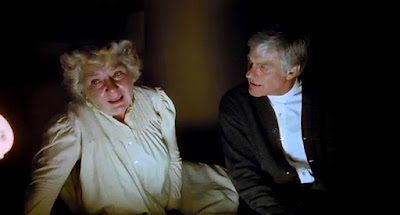 |
| Maureen Stapleton and Van Dyke |
I admit I had mixed emotions about watching this picture, as I thought it might be overly cute and Catholic in the worst sense of the word. I also questioned the casting of Dick Van Dyke, whose rubbery pickle-faced features hardly qualify him for a career in drama, as a romantic figure no less. But producer-director Kramer also was responsible for the great
Judgment at Nuremberg, so I felt it was definitely worth a look. To my surprise I loved the picture, and thought Van Dyke really delivered during his most difficult sequences. Quinlan and Stapleton are also excellent, and Tammy Grimes is quite effective as a friend and parishioner who is devastated by her father's death.
 |
| Kathleen Quinlan and Tammy Grimes |
The Runner Stumbles may not be a masterpiece like
Judgment at Nuremberg, but it is a lovely, poignant film with well-developed characters -- the incisive screenplay was written by playwright Milan Stitt, whose Broadway play this is based on -- and a sensitive score by Ernest Gold [
Unknown World;
Exodus), especially the theme that plays over the closing credits (itself derived from a tune, "My Rumble Seat Gal," also composed by Gold). Critics described the film as "old-fashioned" and didn't mean it as a compliment. I think it's old-fashioned in the best sense of the word. The courtroom denouement to the mystery, based on real-life events, packs a wallop, and the closing is remarkably touching. The film doesn't let the Catholic church and its often maddening, hypocritical edicts off the hook, and I imagine devout Catholics might have found this offensive. Too bad. This was the last film for Bolger, who is perfect as the monsignor, and for Kramer.
Verdict: This tragic love story is imperfect, perhaps, but it is also altogether admirable.***1/2.


