Lively, entertaining reviews of, and essays on, old and newer films and everything relating to them, written by professional author William Schoell.
Showing posts with label Stanley Kramer. Show all posts

Thursday, April 9, 2026

INHERIT THE WIND

INHERIT THE WIND
(1960). Director: Stanley Kramer.

"Fanaticism and ignorance is forever busy, and needs feeding!"

In 1925 John T. Scopes was arrested in Tennessee for teaching the theory of evolution to his students. Clarence Darrow defended him and William Jennings Bryan acted as prosecutor, while H. L. Mencken covered the "monkey" trial for a newspaper. In a play by Jerome Lawrence and Robert Edwin Lee, which fictionalizes the story, the characters were changed into Henry Drummond (Spencer Tracy) for Darrow; Matthew Harrison Brady (Fredric March) for Bryan; Bertram Cates (Dick York) for Scopes; and E. K. Hornbeck (Gene Kelly) of the Baltimore Herald for Mencken. The play and this film version thereof adds a further complication: Scopes/Cates is engaged to the daughter, Rachel (Donna Anderson), of the local preacher (Claude Akins), who is a borderline fanatic. The main strength of this film, besides the exchange of ideas and the notion of casting off narrow minds, is the acting by the two leads, both of whom are superb. March, in particular, possibly gives the best performance of his career, full of nuances, and giving his character enough charm to understand why people like and enjoy him even when they think he's dead wrong. (Florence Eldridge, who was married to March in real life, is also notable as Brady's wife, Sarah. And Gene Kelly is so good as Hornbeck that he proves to be far more than just a song and dance man and a fine dramatic actor. ) 

Fredric March and Spencer Tracy
There is, perhaps, a little too much dramatic license; for instance, it doesn't make sense that Drummond wouldn't ask for a recess after Brady's brutal examination of Rachel. The movie is serious and sickening under the amusement and banter, as timely today -- if not more so -- than it was in 1960. Its weakest moment is the sop to the religionists with Drummond carrying a bible out of the courtroom at the end. Still, it was brave of Kramer and the others to make the film way back in 1960. Leslie Uggams sings "That Old-Time Religion" over the credits.

Verdict: Powerful stuff with two massive lead performances. *** (half a star taken off for that compromised ending).

Thursday, January 20, 2022

THE RUNNER STUMBLES

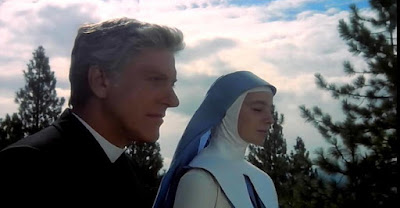
Dick Van Dyke and Kathleen Quinlan

THE RUNNER STUMBLES    (1979). Produced and directed by Stanley Kramer. Based on the play by Milan Stitt.  

In a small town in the 1920's the brash, young, full-of-life Sister Rita (Kathleen Quinlan of Event Horizon) arrives and meets the somewhat dour Father Rivard (Dick Van Dyke of Bye Bye Birdie) -- who has been banished to the hinterlands because of some of his more controversial views --  the housekeeper Mrs. Shandig (Maureen Stapleton); two grumpy and dyspeptic older nuns; and the children Sister Rita will teach, including mischievous little James (Billy Jayne). Town tongues start to wag when an obvious friendship and closeness develops between the priest and the nun, and even the housekeeper seems a bit scandalized when Sister Rita moves into the rectory with the father after the other nuns develop consumption -- this is against the orders of the Monsignor (Ray Bolger). As romantic feelings between the pair begin to blossom, one knows things will not go well for these star-crossed lovers ... The Runner Stumbles begins with Rivard in jail, arrested for murdering Rita!

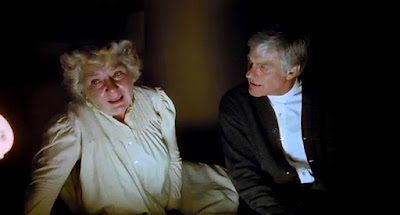
Maureen Stapleton and Van Dyke
I admit I had mixed emotions about watching this picture, as I thought it might be overly cute and Catholic in the worst sense of the word. I also questioned the casting of Dick Van Dyke, whose rubbery pickle-faced features hardly qualify him for a career in drama, as a romantic figure no less. But producer-director Kramer also was responsible for the great Judgment at Nuremberg, so I felt it was definitely worth a look. To my surprise I loved the picture, and thought Van Dyke really delivered during his most difficult sequences. Quinlan and Stapleton are also excellent, and Tammy Grimes is quite effective as a friend and parishioner who is devastated by her father's death. 

Kathleen Quinlan and Tammy Grimes
The Runner Stumbles may not be a masterpiece like Judgment at Nuremberg, but it is a lovely, poignant film with well-developed characters -- the incisive screenplay was written by playwright Milan Stitt, whose Broadway play this is based on -- and a sensitive score by Ernest Gold [Unknown World; Exodus), especially the theme that plays over the closing credits (itself derived from a tune, "My Rumble Seat Gal," also composed by Gold). Critics described the film as "old-fashioned" and didn't mean it as a compliment. I think it's old-fashioned in the best sense of the word. The courtroom denouement to the mystery, based on real-life events, packs a wallop, and the closing is remarkably touching. The film doesn't let the Catholic church and its often maddening, hypocritical edicts off the hook, and I imagine devout Catholics might have found this offensive. Too bad. This was the last film for Bolger, who is perfect as the monsignor, and for Kramer.

Verdict: This tragic love story is imperfect, perhaps, but it is also altogether admirable.***1/2.

Thursday, October 11, 2018

SHIP OF FOOLS

Oskar Werner and Simone Signoret
SHIP OF FOOLS (1965). Produced and directed by Stanley Kramer. Based on the novel by Katherine Anne Porter. 

"There are over a million Jews in Germany. What are they going to do -- kill all of us?" -- Lowenthal. 

"I've met women like you. You're 46-years-old and still think you're a coquette." 

"I didn't even see a Jew until I was fifteen." -- Tenny. "Maybe you were too busy lynching Negroes to take time for the Jews." -- Mary. 

In 1933 an ocean liner sets sail from Mexico to Germany with a motley group of crew and passengers. Dr. Wilhelm Schumann (Oskar Werner) is the ship's doctor, a married man with a heart condition who develops a romantic relationship with La Condesa (Simone Signoret), a woman who faces prison in Cuba because she spoke out against the oppressive government. David (George Segal) is an American "starving artist" who loves his girlfriend Jenny (Elizabeth Ashley), but fears she is too "modern" for him even as she fears he can only settle for the traditional wife who has no life or career of her own. Karl Glocken (Michael Dunn) is a dwarf who is not invited to the Captain's Table, any more than Lowenthal (Heinz Ruhmann), who is Jewish, but the two sit together and become friends. Bill Tenny (Lee Marvin) is a washed-up baseball player, and Mary Treadwell (Vivien Leigh) an aging and desperately lonely divorcee, who eventually have a distinctly unpleasant encounter. 

Vivien Leigh
Ship of Fools is not on the level of Stanley Kramer's masterpiece Judgment at Nuremberg, because even though it deals with matters German and (in part) with anti-Semitism, it doesn't have as good nor as powerful a story line. There are also some odd casting choices in this. Jose Ferrer as a Nazi? Simone Signoret as a Spanish noblewoman? Nonetheless Signoret did get a Best Actress Oscar nod, and Werner was also nominated as Best Actor. Both give good performances, although their love story isn't entirely convincing because one can't see any real on-screen chemistry between them, although they play well together. Poor Vivien Leigh is given the utterly thankless role of yet another desperate and aging woman to follow Blanche Dubois of Streetcar and Mrs. Stone of The Roman Spring of Mrs. Stone -- Still attractive, she must have gotten awfully sick of it. Leigh was fifty-two at the time, playing forty-six, although she holds up better than Signoret, who was forty-four playing forty-two. The irony is that Mary Treadwell acts as if she's all washed up when down the hall La Condesa is getting action with the handsome ship's doctor! Leigh's performance is fine but her portrayal is dated.  

Lee Marvin and Michael Dunn
Michael Dunn, infamous as the evil Dr. Loveless on The Wild, Wild West TV program gives a notable performance, but although Lee Marvin has his moments, he seems to have wandered in from a different movie. Liz Ashley, in her pre-sex pot phase, is more than credible as Jenny, as is George Segal as her painter boyfriend. Charles Korvin is appealing as Captain Thiele. Jose Ferrer is completely miscast and not very good in the film, but there is fine work from two lesser-known actors: Alf Kjellin [Madame Bovary] is wonderful as Freytag, who is forced to leave the Captain's table because he is married to a Jewish woman, but suffers from great guilt because he abandoned her for his career; and Charles De Vries makes an impression as young Johann, whose elderly father is a miser. Werner Klemperer has some nice moments as a crew member who hopes to initiate a relationship with Mrs. Treadwell and is rather cruel to her when he is rejected. 

Ernest Gold's score is effective and Ernest Laszlo's cinematography deservedly won an Oscar. (The film also won as Best Picture, and the art direction also received a statue.) Abby Mann's screenplay, however, just doesn't delve deep enough into the characters, of which there are too many (the character of the ball player doesn't even belong in the movie). The film can't be said to be boring, as such, but it is never riveting the way the far superior Judgment at Nuremberg is. Still, it has memorable scenes, such as the sad one when Dunn observes that Lowenthal is a "fool", because he just isn't able to believe the dire and hopeless future for the Jews in Germany. 

Verdict: Despite many good moments, this should have been a much more absorbing and powerful picture. **3/4. 

Thursday, July 20, 2017

NOT AS A STRANGER

Olivia de Havilland
NOT AS A STRANGER (1955). Producer/director: Stanley Kramer.

"Chris, help me, for God's sake, help me." --Lucas Marsh.

Lucas Marsh (Robert Mitchum) is determined to be a doctor but hasn't got the financial backing he needs to continue his internship. To get the money he romances the adoring Swedish nurse, Kristina (Olivia de Havilland), who has saved up quite a bit of money. The two get married, Lucas is able to complete his studies, and the couple relocate to a small town where Lucas becomes assistant to the aging family doctor, Dave Runkleman (Charles Bickford). Then there's the complication of the seductive Widow Lang (Gloria Grahame). Will Lucas ever be able to feel an honest and profound love for his wife? Not as a Stranger is a nice picture with winning performances, with Mitchum [Angel Face] doing some of the best work of his career. De Havilland [The Dark Mirror] is on the mark as Kris, as is Grahame, but she is given so little to do that it's a wonder her character was even included. It's also a mystery why Frank Sinatra [The Kissing Bandit] took the role of Al, Lucas' intern-buddy, as it's really a relatively minor supporting part. When Sinatra and Mitchum are on screen together, Frank looks unbelievably scrawny in contrast, which the crooner must have hated, but his performance is fine. Lon Chaney Jr. is not memorable as Lucas' drunken father, playing it in too obvious and phony a fashion, but Gertrude Hoffman has a nice bit as an old woman who tells the doctor that she has nowhere to go. The film introduces some weighty matters -- is the doctor's job just to keep people alive no matter what even when they're ready to let go? -- but never quite gets a grip on them. People in the doctor's office  include everyone from Nancy Kulp to Alfalfa! Lee Marvin and Mae Clarke have smaller roles as nurse and intern. Broderick Crawford offers a gruff but interesting performance as Lucas' and Al's teacher in the early hospital scenes. Franz Planer's photography is excellent, and it could be said that George Antheil's score is more than partly responsible for the whole success of the movie.

Verdict: Some moving moments and an interesting story, with a very well-cast and effective Mitchum. ***.

Thursday, May 24, 2012

JUDGMENT AT NUREMBERG

Note that "Judgment" is misspelled!
JUDGMENT AT NUREMBERG (1961). Producer/director: Stanley Kramer.

"There can never be any justification for these [acts] -- not in generations, not in centuries."

"It's not the killing that's the problem -- it's the disposal of the bodies."

"We beat the greatest war machine since Alexander the Great -- and now the boy scouts take over."

In 1948, after the "big guns" in the National Socialist Party have already been put on trail, some "smaller fry" -- judges who helped enact the illegal and immoral laws of Nazi Germany -- are also put on trial in Nuremberg. The presiding judge is Dan Heywood (Spencer Tracy), with Colonel Tad Lawson (Richard Widmark) as prosecutor and Hans Rolfe (Maximilian Schell) as the defense attorney. The most famous defendant is a well-respected jurist named Dr. Ernst Janning (Burt Lancaster). Rolfe claims that the U.S. can hardly act morally superior when they dropped bombs on Hiroshima and Nagasaki, while Heywood discovers that virtually no one in Nuremberg will admit they knew what was going on in the concentration camps. Meanwhile Lawson is told that the U.S. will need Germany as an ally in the cold war and convicting some of its leading citizens may not be such a good idea. But Lawson was one of the men who liberated the camps, he has horrifying memories, and shows films (actual documentary footage) of Nazi atrocities -- the ovens, children sentenced to death, piles of rotting corpses, starved and frightened human beings, drawings made on human skin, severed heads (all of which is quite hard to watch but highly necessary for the movie's ultimate impact) -- and isn't about to let these guys walk if he can help it. Only two years after the end of the war, he fears that the world is already losing interest. Schell won an Oscar, and deserved it. Widmark gives one of his best performances, and Tracy is superb. Marlene Dietrich also turns in an excellent performance as the widow of a Nazi who has already been executed, and Judy Garland has a fine turn as a woman who was put in jail at sixteen for alleged perjury when a Jewish father figure was accused of intimate relations with her, an Aryan. Montgomery Clift is also superb as a Jewish witness who was forcibly sterilized years before and argues that one could not expect him to be entirely rational after such an experience. Lancaster is a comparative lightweight in this cast, and isn't well-cast as a German, but he does his best and has a few good moments. Some of the best scenes are between Tracy and Dietrich as they try to understand each other's viewpoints, particularly a scene in a lively beer hall after Heywood has seen the disturbing movies taken in the camps and Dietrich protests that few Germans really knew what was going on -- but he just can't quite buy it. There are many other good supporting performances in the film, especially Virginia Christine as a German housekeeper who argues that Hitler did some good things along with the bad. Judgment at Nuremberg covers all viewpoints and all the bases in highly dramatic fashion, and while over three hours long, is never boring. It ends in a most satisfying fashion, and Tracy's final lines -- written by screenwriter Abby Mann -- pretty much sum it up.

Verdict: A masterpiece about a shameful event in history that must never be forgotten. ****.