Lively, entertaining reviews of, and essays on, old and newer films and everything relating to them, written by professional author William Schoell.
Showing posts with label Alex North. Show all posts

Thursday, June 4, 2026

I'LL CRY TOMORROW

I'LL CRY TOMORROW (1955). Director: Daniel Mann.

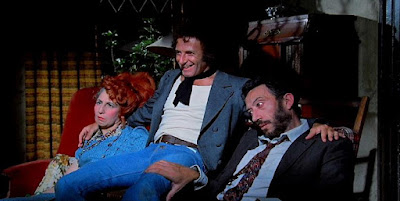
The more or less true story of singer Lillian Roth (Susan Hayward) and her battle with alcoholism. Although Hayward has a couple of self-conscious moments, basically she gives a very strong performance as this tormented woman who lost the first man (Ray Danton) she loved to illness and an early death, married a heavy-drinking gigolo and party boy (Don Taylor), then -- worst of all-- got hitched to a wife-beating thug played by Richard Conte (pictured). Virginia Gregg and Veda Ann Borg show up in much smaller roles. Carole Ann Campbell is excellent as Roth as a young girl, but the movie is basically stolen by Jo Van Fleet, who is simply superb as Lillian's mother. Hayward sings her own numbers, and isn't bad, although one can't imagine she would have been as successful a singer as she was an actress. Reviews of the film have noted that the atmosphere is more of the fifties when it was made than the period during which most of the story takes place. There is a nice score by Alex North. 

Verdict: Watch Susan Suffer! ***.

Thursday, February 17, 2022

SHANKS

Marvel Marceau and Marcel Marceau
SHANKS (1974). Directed by William Castle. Subtitle: William Castle Presents a Grimm Fairy Tale.

Deafmute Malcolm Shanks (Marcel Marceau) makes puppets and lives with his shrewish stepsister (Tsilla Chelton) and her husband Mr. Barton (Philippe Clay) in their home, where they berate and abuse him on a regular basis. One day Malcolm goes to work for the elderly Professor Walker (also Marceau) who shows him how he uses special technology, like magic, to reanimate the corpses of frogs and roosters. When the professor dies, Malcolm decides to reanimate him, but there is just a walking physical shell, no mind. Later on Malcolm turns his deceased sister and brother-in-law into "living" corpses to do his bidding, a situation that both fascinates and repels the young Celia (Cindy Eilbacher). Into the professor's mansion, where Malcolm has taken up residence, come a group of hard core and thuggish bikers who try to take the "living dead" technology away from Malcolm.

Chelton, Marceau and Clay
Shanks
 is William Castle's most original and possibly most interesting picture -- it was also the last film he directed (he also served as executive producer). Using occasional title cards like a silent film and a spirited, quirky score by Alex North [The 13th Letter], the movie proceeds, as it should, like a dream or nightmare. Because of this approach viewers might not look too closely at the rather ghoulish actions of the protagonist, well-acted by Marceau, who is sympathetic despite the fact that he turns corpses into large performing dolls. Marceau only speaks when he plays the professor. The other performances are excellent as well, although the casting of sixteen-year-old Eilbacher, who looks even younger, adds a bit of a creep factor as she sort of becomes the love interest for 51-year-old Marceau and comes to a highly unpleasant fate as well. This reminds me of the kind of films Tim Burton makes, with their weird subject matter and lapses in good taste, and I would not be surprised if that filmmaker was influenced by Castle's work in general and this film in particular. Photographed by Joseph F. Biroc [Forty Guns]. Castle appears as a grocer, and there is an interesting attack-by-rooster. 

Verdict: Although Castle's direction may not be not top-notch, and criticisms of the film are not without merit -- especially the deliberate pacing --  Shanks is still an unusual and worthwhile picture, a fitting end to his directorial career. ***. 

Thursday, February 21, 2019

WHO'S AFRAID OF VIRGINIA WOOLF?

Liz Taylor and Richard Burton
WHO'S AFRAID OF VIRGINIA WOOLF? (1966). Director: Mike Nichols.

"I'd divorce you if you existed." --Martha regarding George.

George (Richard Burton of Becket) is an Associate Professor of History at New Carthage University. His wife Martha (Elizabeth Taylor of Giant) is the daughter of the university president. Married for some years, they are enmeshed in bitter disappointment and alcohol. They were not able to have children, and George had hoped to be head of his department by now. The contempt they feel for themselves and for one another bursts out in lacerating games and accusations.

George Segal and Sandy Dennis
After a party one night they invite a younger couple, new to the university, to their home at two in the morning. Nick (George Segal) is a new biology teacher, and Honey (Sandy Dennis of That Cold Day in the Park) is his wife. The two were only married because of an hysterical pregnancy, and Honey's family is wealthy. Copious amounts of alcohol keep the "games" coming, with Martha pretending that she and George have a son. Before long all four people are lashing out at each other, and George decides it's time to put one rumor to rest.

George notices that Martha has plans for Nick
Who's Afraid of Virginia Woolf? intelligently opens up Edward Albee's play with scenes at a roadhouse and on the lawn, and the film is very well directed by Nichols, who gets excellent performances from the entire cast, and an especially strong one from Oscar-winning Elizabeth Taylor. Alex North's music is used very sparingly but it adds to the grim atmosphere of this black comedy, as does Haskell Wexler's top-notch black and white cinematography.

George fences with Nick
Since the play is much longer than the movie, cuts were obviously made, but I suspect that the movie is better than the play. It is debatable if Virginia Woolf is a great work of theater or more along the lines of kitsch, and in truth it probably lies somewhere in the middle. Although seen as a dissection of typical married life back when it premiered in the sixties,  it was obviously not the first play to deal with dysfunctional marriages. There was a typically sixties frankness and crudity to the language that was different, however, and Albee's dialogue is often very good and very funny.

George and Martha 
The whole business with the "son" doesn't really make much sense, but one's left with a vague air of tragedy because these people seem so pathetic, despite the fact that they are not that likable nor sympathetic. As played (beautifully) by Sandy Dennis, who also garnered an Oscar, even Honey is simply too freaky to engage our sympathies. Although we obliquely learn certain things about the characters -- the whole business with George's book, his parents' (?) deaths and so on is admittedly intriguing if obscure -- it might be said that we don't quite come to know them that well (nor do we want to).

Still, Who's Afraid of Virginia Woolf holds the attention and has its fascinating aspects. Underneath the laughs and bitchy interplay there is genuine pain and loneliness, but other plays have perhaps gone into the same themes with more brilliance and compassion. (Admittedly, there are undoubtedly big differences between the play, which I have not seen in some years, and the film.) Albee based George and Martha on a straight couple he knew -- they were never intended to be a gay couple, which is probably why he nixed an all-male version that Burton and Henry Fonda wanted to do with Jon Voight and Warren Beatty in 1970. True!

NOTE: The film Martha is referring to when she imitates Bette Davis saying "What a dump!" is Beyond the Forest.

Verdict: Who's Afraid of Alcohol Poisoning? ***. 

Thursday, September 13, 2018

THE OUTRAGE

Paul Newman
THE OUTRAGE (1964). Director: Martin Ritt.

In the late 19th century in the southwest, three men take refuge from a rain storm at a train depot: A priest (William Shatner), a prospector (Howard Da Silva) and a con man (Edward G. Robinson), with the first two telling the third the conflicting stories they heard at a murder trial. The trial centers on the notorious bandit Carrasco (Paul Newman), who is accused of raping a southern woman (Claire Bloom) and murdering her wealthy husband (Laurence Harvey). The bandit, the wife, the dead man (via an Indian medium) and then the prospector all tell their stories, but trying to figure out which is the correct one will drive you crazy. The Outrage is an interesting remake of the much more famous Japanese film Rashomon, and while it's generally a good picture (it helps if you're unfamiliar with the original), it's also a mixed bag. On the plus side is a charismatic and quite adept performance from Paul Newman, who's much better in what is essentially a character part than you might expect. Newman is on top of things in every scene. The next best performance is from Edward G. Robinson, whose expert acting skills are on marvelous display in his winning performance as the not very likable con artist. Although Claire Bloom [Three Into Two Won't Go] could be accused of being a little stagy and overly theatrical at times, she's playing many different interpretations of the same person and playing them well, with near-perfect line readings. Howard Da Silva scores as the prospector, and Laurence Harvey is fine in an underwritten part in which he is tied up and gagged for most of the running time. Shatner tends to overact a bit as he did as Captain Kirk -- he always seems to think he's doing Shakespeare -- but he's effective enough in the part.  James Wong Howe's cinematography is typically outstanding. While Alex North's score has some lovely things in it, it also seems inappropriate at times given the subject matter, but then again, The Outrage has several sequences that border on black comedy (which in of itself is inappropriate). Still, whatever its flaws, The Outrage is absorbing, good to look at, and features several excellent performances. Whether it has the kind of attitude towards rape that you might find today on, say, Law and Order:Special Victims Unit, is debatable. Martin Ritt directed Paul Newman in Hud the previous year.

NOTE: Apparently I had already reviewed this film on Great Old Movies eight years ago.  I liked it a little better this time around, and think it might even have more emotional impact than the original.

Verdict: Newman gives a striking performance in an unusual role for him. ***. 

Thursday, June 25, 2015

THE CHILDREN'S HOUR

Shirley MacLaine and Audrey Hepburn
THE CHILDREN'S HOUR (1961). Producer/director: William Wyler. Note: some plot points are revealed in this review.

William Wyler had already directed These Three, a sanitized film version of Lillian Hellman's play The Children's Hour, when he decided it was time to tackle the play and its sub-theme head on. Karen Wright (Audrey Hepburn) and Martha Dobie (Shirley MacLaine) co-own a young girls' boarding school in a small but wealthy community. Karen has held off her marriage to Joe Cardin (James Garner of They Only Kill Their Masters) because she wants to make sure the school is a success before she leaves. With the unwitting aid of Karen's miserable Aunt Lily (Miriam Hopkins), a hateful child named Mary (Karen Balkin) tells a malicious lie about the two women. Her grandmother, Amelia Tilford (Fay Bainter), believes the lie and spreads it around that Karen and Martha are lovers, with the result that all of the parents take their daughters out of school. Does Martha have deeper feelings for Karen than she wants to admit? Hellman's play was certainly ahead of its time, and some of the dialogue that may have seemed "politically correct" in the sixties was actually already in the play, produced about thirty years earlier. Martha goes on about people "who believe in it, who want it, who've chosen it for themselves," but this is something she just can't do. (Of course today it's more accurate to say gay people choose to accept themselves.) The dated, but not unrealistic for the period, line is Martha saying "I feel so sick and dirty I just can't stand it anymore," which is roughly equivalent to "Show me a happy homosexual and I'll show you a gay corpse" from The Boys in the Band. However, I've never felt Children's Hour was as offensive as Boys, because the latter is a mostly negative depiction of acknowledged gay characters while the former not only looks at the devastating results of gossip and innuendo but functions, whether intended or not, as a trenchant study of both external and internalized homophobia. These women's lives are ruined simply because people think they're lesbians, a revelation which Martha only acknowledges at the very end. The suicide in the film may strike modern-viewers as horribly dated but it's also quite moving, as is the conflicted character of Martha. John Michael Hayes' [Rear Window] script is excellent, William Wyler's direction is sensitive and splendid, and the acting from virtually the entire cast is simply incredible. Hepburn and MacLaine are perfection, Bainter and Hopkins come close to stealing the show, James Garner (whom I've never much cared for) gives probably the best performance of his career, and the little girls, including Veronica Cartwright as Rosalie, are so good it's almost scary. Add a lovely score by Alex North, fine cinematography by Franz Planer (who also shot Wyler's The Big Country), and expert editing from Robert Swink and you've got a near-masterpiece.

Verdict: Whatever its flaws, this picture plays. ***1/2.

Thursday, June 2, 2011

THE 13TH LETTER

THE 13TH LETTER  (1951). Director: Otto Preminger

In a small town in French Quebec, an unknown person is sending anonymous letters to various parties, spreading lies and gossip, causing emotional upheaval, and in at least one case, causing a suicide. Much of the gossip seems centered on the new doctor in town, Pearson (Michael Rennie) and the wife, Cora (Constance Smith), of another doctor, Laurent (Charles Boyer). The suspects include Denise Turner (Linda Darnell) and nurse Marie (Judith Evelyn of The Tingler). Rennie isn't bad, Darnell gives one of her lesser performances, and Boyer and Evelyn walk off with the acting honors. Dark, intriguing, and suspenseful movie. Alex North's unusual musical score is exceptional, especially during a grim funeral sequence. This is a remake of the French film Le corbeau, directed by Henri-Georges Clouzot.

Verdict: A lost Preminger film that is worth hunting down. ***.