Lively, entertaining reviews of, and essays on, old and newer films and everything relating to them, written by professional author William Schoell.
Showing posts with label Alma Kruger. Show all posts

Thursday, March 26, 2026

THESE THREE

THESE THREE
(1936). Director: William Wyler.

College friends Karen Wright (Merle Oberon) and Martha Dobie (Miriam Hopkins) decide to open a girl's school together. Into their lives comes a handsome doctor, Joe (Joel McCrea), with whom both fall in love. Joe, however, only has eyes for Karen. (A memorable scene has Martha watching him as he sleeps, with the passage of time indicating that she's done this for hours.) This not being a soap opera, Joe and Martha do not get involved and Martha never makes a play for him. Unfortunately, a nasty little girl named Mary (Bonita Granville) implies that the good doctor spent the night in Martha's room, and forces another child (Marcia May Jones) to confirm it. This leads to disastrous complications.

These Three was based on a play by Lillian Hellman called The Children's Hour. It, too, was about the destructiveness of gossip, but the lie was quite different -- that the two women were lovers (It turned out that Martha was a self-hating lesbian). Naturally Hollywood even in the 30's wouldn't tackle such a subject, so it was toned down and changed to alleged pre-marital sex and infidelity. Years later Wyler filmed the play again (as The Children's Hour) with the original story intact. In that version Miriam Hopkins played Martha's Aunt Lily (played by Catherine Doucet in These Three).

Miriam Hopkins and Merle Oberon
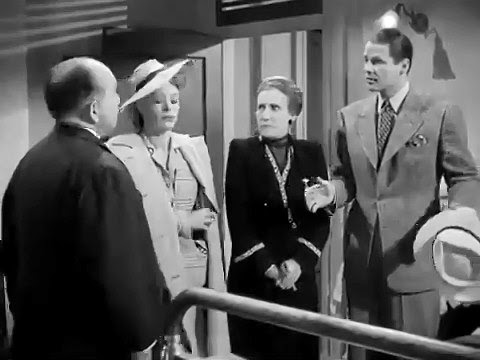
Even in its adulterated version These Three is a powerful story, and the film is well directed and very well played by the entire cast. In addition to those already mentioned, Alma Kruger makes an impression as Mary's grandmother, who starts the word-of-mouth campaign against the two women and their school. Margaret Hamilton plays the woman's stern maid, who can see through Mary, and in perhaps the movie's most satisfying scene, gives her a good slap.

Verdict: Superior, thoughtful drama. ***1/2.

Thursday, May 25, 2023

THAT OTHER WOMAN

Virginia Gilmore and James Ellison
THAT OTHER WOMAN (1942). Director: Ray McCarey. 

Emily Borden (Virginia Gilmore of The Brotherhood of the Bell) is secretary to handsome Henry Summers (James Ellison of The Ghost Goes Wild), who seems to spend more of his time chasing women than getting work done. Knowing how she feels about her boss, Emily's grandmother (Alma Kruger of Saboteur) suggests she create an air of mystery about herself by sending Henry some mysterious letters. This all leads to busy but not terribly funny complications wherein Henry thinks this lady's gangster boyfriend wants to kill him even as Emily's sort-of fiance, Ralph (Dan Duryea) goes after him as well. Henry masquerades as the caretaker of his cabin in the woods even as he finally begins noticing Emily. But what will happen when he learns she is the architect of all of his problems? 

Henry Roquemore, Gilmore, Urecal, Ellison
That Other Woman
 is yet another mediocre James Ellison comedy. Ellison is always reasonably adept in these vehicles but the greatest comedian in the world can't triumph over an insufficient screenplay. As for the ladies, neither Gilmore nor Kruger are especially adapt at comedy. The movie does have one moment of fun, and that is when Emily and Henry check into a hotel that seems to cater strictly to the elderly and encounter the termagant manager Mrs. MacReady, with Minerva Urecal looking throughout as if she wants to kill anyone who dares to even look at her! Typical of these kind of movies, Duryea's character is treated horribly.
Gilmore did a few movies but had more credits on TV. She was married to Yul Brynner for 16 years. 

Verdict: Much running around to little effect. **. 

Thursday, June 13, 2019

THE TOY WIFE

Luise Rainer
THE TOY WIFE (1938). Director: Richard Thorpe. Screenplay by Zoe Akins.

"A woman is like a postage stamp. Once there's a black mark on her, she's no good to nobody." -- Pick.

In pre-Civil war Louisiana, two sisters live on a plantation with their slaves and their father. Gilberte, or "Frou Frou" (Luise Rainer) is the pretty and somewhat muddle-headed younger daughter, and Louise (Barbara O'Neil) is the more practical and less attractive older daughter. The young mountebank, Andre Vallaire (Robert Young), wants to propose to Frou Frou, but he is too late, as she has already decided to accept a proposal from the lawyer, George Sartoris (Melvyn Douglas). The trouble is that Frou Frou doesn't love George, but Louise does ... and Andre will not forget Frou Frou. Things come to a boil when George asks Louise to come and run the household, as Frou Frou --  a "toy wife," in his estimation -- seems incapable of doing so.

Luise Rainer and Alan Perl 
Had The Toy Wife starred, say, Bette Davis, it would probably not be a nearly forgotten film today. Luise Rainer, who is outstanding in the film, had already won back to back Best Actress Oscars (for The Great Ziegfeld and The Good Earth) before appearing in this film, but for various reasons her career faded out soon after and long-lasting major stardom never materialized. Douglas, Young and especially O'Neil are also very good in the film, along with Theresa Harris [The Flame of New Orleans] as Frou Frou's maid and companion, "Pick," Libby Taylor as the housekeeper Suzanne, and Alma Kruger [Saboteur] as Andre's disapproving mother. Little Alan Perl is a charmer as George and Frou Frou's son, Georgie.

The Toy Wife's patronizing treatment of black characters is typical of the period, unfortunately, but the film is still absorbing and has a very touching conclusion. There is first-rate cinematography from Oliver T. Marsh and a nice score by Edward Ward.

Verdict: Memorable, well-acted, and unpredictable drama. ***.


Thursday, September 13, 2018

YOU'LL FIND OUT

Kay Kyser bolstered by Petter Lorre, Bela Lugosi, and Boris Karloff

YOU'LL FIND OUT (1940). Director: David Butler.

Playing himself, band leader Kay Kyser brings his College of Musical Knowledge, along with singers Ginny Simms and Harry Babbitt (also playing themselves) to a spooky mansion where resides Janis Bellacrest (Helen Parrish of First Love), who happens to be engaged to Kay's manager, Chuck Deems (Dennis O'Keefe). Before long the group finds itself cut off from everyone with a cut phone line and a bridge that falls apart due to an explosion. Janis' Aunt Margo (Alma Kruger of Craig's Wife) is friends with a spiritualist named Prince Sallano (Bela Lugosi), who seems to be held in little regard by Professor Fenninger (Peter Lorre) and Judge Mainwaring (Boris Karloff). As Kay, Chuck, and alleged comic Ish Kabibble explore secret passages in the old mansion, attempts are made on Janis' life more than once. RKO obviously hedged its bets by bringing in that triumvirate of terror in the persons of Lugosi, Lorre, and Karloff, who get right into the silly spirit of things with marked professionalism and without losing their dignity. Kyser remains a likable presence, although some of the comedy shtick he does in the film is not only unfunny but painful to watch; ditto for Kabibble, whose jokes wouldn't impress a three-year-old. However, O'Keefe [Abroad with Two Yanks] is just right for this kind of material and he and Kyser make an engaging comedy team at different points in the story. Ginny Simms, who was not only Kyser's singer but was involved with him at the time, zestfully sings two nice numbers, including "I'd Know You Anywhere" and "One Track Mind." Late in the picture Kyser has the band instruments imitating human voices with horrific results. There's an amusing business with the dog Prince, who gets phosphorescent paint on his tail at one point, and later on plays catch with a bomb! Experienced director David Butler helps keep this whole thing running more or less smoothly. A number called "The Bad Humor Man" may have made the "Good Humor" ice cream people nervous.

Verdict: Silly, but with some nice numbers and a few laughs, not to mention those horror stars! **1/2. 

Thursday, January 30, 2014

CRAIG'S WIFE

John Boles and Rosalind Russell
CRAIG'S WIFE (1936). Director: Dorothy Arzner.

"If a wife is the right kind of woman, her destiny should be in her own hands, not her husband's."

In the second film version of George Kelly's Pulitzer prize-winning play (after the silent), Rosalind Russell stars as Harriet Craig, whose home and its furnishings are the most important things in her life, much more important than people. Harriet likes things just so, and isn't above running other people's lives when she feels the need to. When a friend of Walter, her husband's (John Boles), murders his wife and commits suicide, Harriet fears their involvement may cause an unwanted wrinkle in their pristine universe. In the meantime, Walter's beloved Aunt Ellen (Alma Kruger of Saboteur) objects to the way her niece-by-marriage keeps everyone out of her home, and is slowly but surely distancing Walter from all of his friends, and has it out with her. "It isn't an opinion I have of you, Harriet," she tells the younger woman. "It's you I have." Harriet's sister is sick, so she has her own niece, Ethel (Dorothy Wilson), stay with her and tries to run her life as well. Craig's Wife is pretty faithful to the play [unlike the remake with Joan Crawford] but the problem is that Kelly's play is rather dated, and by no means can be seen as having a truly feminist perspective despite some of Harriet's cold if sensible attitudes. The performances are all very good, including Billie Burke as the widowed neighbor, Mrs. Frasier, and Jane Darwell as the housekeeper, Mrs. Harold. Arzner also directed Merrily We Go to Hell.

Verdict: Intriguing at times despite its age, and well-acted by all. ***.

Wednesday, December 17, 2008

THE CRIME DOCTOR'S WARNING

THE CRIME DOCTOR'S WARNING (1945). Director: William Castle. 

Clive Lake, an artist (Coulter Irwin), seeks Dr. Robert Ordway's (Warner Baxter, pictured) help for black outs that he's been having since youth. He has a dragon mother named Mrs. Wellington Lake (Alma Kruger), and naturally becomes a suspect when two of his models are murdered. Everything seems centered on a painting by a more famous artist in which the two women -- and a third -- were featured. Mindless yet intriguing -- and somewhat far-fetched -- The Crime Doctor's Warning holds the attention and is a perfectly flavorful "B"movie. John Litel plays the police inspector, but it's an uncredited Eduardo Ciannelli who perks up the film as Nick Petroni, an old sailor model who's angered that all anybody wants to paint is cheesecake. Director Castle keeps things moving swiftly. 

Verdict: Minor but reasonably engaging. **1/2.

Friday, January 4, 2008

SABOTEUR


SABOTEUR (1942). Director: Alfred Hitchcock.

It's just possible that this wonderful movie might have become a classic if Hitchcock had gotten the two leads he really wanted – Gary Cooper and Barbara Stanwyck – instead of Robert Cummings and Priscilla Lane. While some might feel the dynamic Stanwyck would have been wasted in this movie, she would have added far more bite and intensity than the competent but mediocre Lane. Bob Cummings was certainly a skilled comedic actor (some think Cummings could also turn in fine dramatic performances in such films as Kings Row), but he's all wrong for Saboteur. Michael Curtiz once said “some men squeeze a line to death” and Cummings not only does that but rushes mush-mouthed through his readings to such a degree that the effect is not stirring or powerful as he might have intended but ludicrous. Apparently Hitch just threw up his hands and bristled at having to use these two utter lightweights in a movie that deserved so much better. Cummings is falsely accused of sabotage at a defense plant and also of incinerating his best friend by putting gasoline inside a fire extinguisher. [Cummings carries little of the resonance of this throughout the rest of the movie.] The real culprit is Norman Lloyd (who is excellent), whom Cummings – with an initially unwilling Lane in tow – pursues across the country. There are scenes which give one pause – how can a man in handcuffs manage to swim, for instance – but also some fine moments and interesting settings, such as the dusty, deserted Soda City where they encounter some of the nest of spies in an eerie moment or two. Hitch works up a lot of suspense for the scene in which Cummings gets rid of said handcuffs with a car's fan belt, and the Statue of Liberty finale is superb. Giant close ups of Norman Lloyd's jacket sleeve – held by Cummings, who wants to save the man so that he can clear him -- beginning to tear are contrasted with stunning long shots of the two men clinging horrifically to the outside of the statue. Hitchcock always said that it should have been Cummings dangling (or falling?) from the statue, not the villain, but the sequence is breath-taking all the same. An inspired touch is having the saboteurs operating in the midst of a respectable charity ball, and they are presented as being for the most part quite ordinary and mundane, with the exception of the flamboyant Mrs. Sutton and the sinister fifth columnist leader, very well-played by, respectively, Alma Kruger and Otto Kruger (no relation). Frank Skinner's opening credits music is very effective and right on the money. The strangest moment: Priscilla Lane actually pays for a milkshake brought to her by one of her captors. Talk about adding insult to injury!
Verdict: Not what it could have been but still some knock-out sequences. ***.