Lively, entertaining reviews of, and essays on, old and newer films and everything relating to them, written by professional author William Schoell.
Showing posts with label Maureen Stapleton. Show all posts

Thursday, January 20, 2022

THE RUNNER STUMBLES

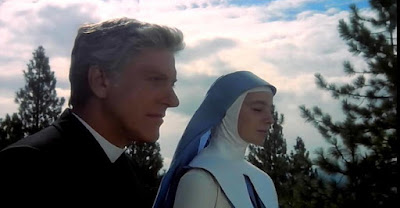
Dick Van Dyke and Kathleen Quinlan

THE RUNNER STUMBLES    (1979). Produced and directed by Stanley Kramer. Based on the play by Milan Stitt.  

In a small town in the 1920's the brash, young, full-of-life Sister Rita (Kathleen Quinlan of Event Horizon) arrives and meets the somewhat dour Father Rivard (Dick Van Dyke of Bye Bye Birdie) -- who has been banished to the hinterlands because of some of his more controversial views --  the housekeeper Mrs. Shandig (Maureen Stapleton); two grumpy and dyspeptic older nuns; and the children Sister Rita will teach, including mischievous little James (Billy Jayne). Town tongues start to wag when an obvious friendship and closeness develops between the priest and the nun, and even the housekeeper seems a bit scandalized when Sister Rita moves into the rectory with the father after the other nuns develop consumption -- this is against the orders of the Monsignor (Ray Bolger). As romantic feelings between the pair begin to blossom, one knows things will not go well for these star-crossed lovers ... The Runner Stumbles begins with Rivard in jail, arrested for murdering Rita!
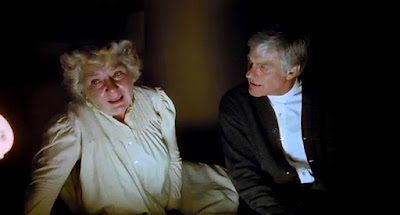
Maureen Stapleton and Van Dyke
I admit I had mixed emotions about watching this picture, as I thought it might be overly cute and Catholic in the worst sense of the word. I also questioned the casting of Dick Van Dyke, whose rubbery pickle-faced features hardly qualify him for a career in drama, as a romantic figure no less. But producer-director Kramer also was responsible for the great Judgment at Nuremberg, so I felt it was definitely worth a look. To my surprise I loved the picture, and thought Van Dyke really delivered during his most difficult sequences. Quinlan and Stapleton are also excellent, and Tammy Grimes is quite effective as a friend and parishioner who is devastated by her father's death. 

Kathleen Quinlan and Tammy Grimes
The Runner Stumbles may not be a masterpiece like Judgment at Nuremberg, but it is a lovely, poignant film with well-developed characters -- the incisive screenplay was written by playwright Milan Stitt, whose Broadway play this is based on -- and a sensitive score by Ernest Gold [Unknown World; Exodus), especially the theme that plays over the closing credits (itself derived from a tune, "My Rumble Seat Gal," also composed by Gold). Critics described the film as "old-fashioned" and didn't mean it as a compliment. I think it's old-fashioned in the best sense of the word. The courtroom denouement to the mystery, based on real-life events, packs a wallop, and the closing is remarkably touching. The film doesn't let the Catholic church and its often maddening, hypocritical edicts off the hook, and I imagine devout Catholics might have found this offensive. Too bad. This was the last film for Bolger, who is perfect as the monsignor, and for Kramer.

Verdict: This tragic love story is imperfect, perhaps, but it is also altogether admirable.***1/2.

Thursday, December 9, 2021

HEARTBURN

Jack Nicholson and Meryl Streep
HEARTBURN   (1986). Director: Mike Nichols. 

Food writer Rachel (Meryl Streep of Postcards from the Edge) and political columnist Mark (Jack Nicholson of Carnal Knowledge) get married, buy a house that needs a great deal of work, and eventually have a cute little daughter (played winningly by Streep's own daughter). Gossip at parties tends to revolve around which spouse is cheating, but Rachel -- who is pregnant again -- is shocked to discover that Mark is fooling around with a notorious Washington hostess. She is importuned to come back to Mark -- but do they really have a chance or should she face the fact that she may have married the wrong person?

Kevin Spacey 
Based on Nora Ephron's autobiographical novel, Heartburn has its amusing and poignant moments, and the acting is adequate -- Nicholson had already entered the familiar "Nicholson mode" by this time -- but director Mike Nichols favors overly long takes that throw off the pacing and actually make the film kind of tedious at times. Because this is based on Ephron's book -- she also wrote the screenplay -- we don't learn that much about husband Mark (the real-life Carl Bernstein) or whatever reasons he may have had for embarking upon affairs (not that some husbands necessarily need reasons). Steven Hill, Maureen Stapleton, and Stockard Channing have solid featured roles, but the supporting cast member who really stands out is a very young Kevin Spacey [Beyond the Sea] as a subway rider who later on robs Rachel's therapy group at gunpoint! 

Verdict: Carly Simon's music may be the best thing about the movie. **1/2. 

Thursday, October 15, 2015

LONELYHEARTS

LONELYHEARTS (1958). Director: Vincent J. Donehue.

Adam White (Montgomery Clift) importunes publisher William Shrike (Robert Ryan) to give him a job on the paper, but all he winds up with is doing the "Miss Lonelyhearts" column. Shrike verbally abuses his wife Florence (Myrna Loy) because of an indiscretion in her past, despite the fact that Shrike has had numerous infidelities of his own. Adam is engaged to Justy (Delores Hart) -- short for Justine, one supposes -- but he has an indiscretion of his own when unhappy wife Fay (Maureen Stapleton) discovers that he's "Miss Lonelyhearts" and asks if she can come see him at his apartment to talk about her troubles ... The best thing about Lonelyhearts is the acting, with Clift giving a superb performance, and Loy, Stapleton, Ryan and Hart providing excellent support. Ryan's character is in some ways incomprehensible, and while his performance may lack the spontaneity of Clift's, it is still quite effective. One can't quite understand why Florence stays with Shrike, however. The whole business with Stapleton seems contrived, and the story, despite some minor incidents, never seems to go anywhere. This is a shame because the characters are compelling and the acting memorable. There are interesting parallels in the picture, however: Adam's father (a very effective Onslow Stevens) is in jail because he murdered his adulterous wife and her lover; Florence cheated on her husband and Fay wants to do the same. Stapleton had done mostly television and stage work before being "introduced" in this film. Despite its flaws, this is better than The Day of the Locust, another movie taken from a Nathaniel West novel.

Verdict: A mesmerizing Clift easily outshines his material. **1/2.

Thursday, February 20, 2014

A VIEW FROM THE BRIDGE

Confused triangle: Vallone, Sorel and Lawrence
A VIEW FROM THE BRIDGE (aka Vu du pont/1962). Director: Sidney Lumet.

NOTE: This review discusses important plot points. Eddie Carbone (Raf Vallone of The Other Side of Midnight), his wife Beatrice (Maureen Stapleton of Interiors), and their niece Catherine (Carol Lawrence) live together near the shipyards in Brooklyn. They take into their home two illegal immigrants, Marco (Raymond Pellegrin), who is older and married, and handsome young Rodolpho (Jean Sorel), who is immediately attracted to Catherine and vice versa. This doesn't sit well with Eddie, who has not slept with his wife in months, and who seems to be obsessed with his pretty niece. Eddie never misses an opportunity to cast doubt on Rodolpho's sexuality because he sings, has blond hair, and other ludicrous reasons, but primarily because he sees him as his rival -- or perhaps is attracted to him and must belittle him in classic closet case fashion. It all culminates in a scene when Eddie first kisses Catherine full on the lips, and then does the same to Rodolpho in a supposed attempt to expose his homosexuality [talk about doing things backwards!] And things become even more melodramatic after that... The main strength of this adaptation of Arthur Miller's play is the acting, which is excellent across the board, especially the performances of a passionate Vallone, sympathetic Stapleton, and lovely, confused Lawrence. Unfortunately, it's all a trifle over-baked and coy at the same time, a combination that doesn't work. The double-kiss probably played on the stage, but it's much more of a dramatic device than anything you can take seriously, almost the stuff of soap opera. Since it's hard to believe that this "macho" guy would want to give a hard smack to Rodolpho's lips if he were really straight, critics ever since have speculated on the possibility that Eddie is a repressed homosexual [and indeed with his homophobia and other acts one can see how it could be interpreted that way]. Was Miller afraid to tackle the subject head on when he wrote the play in the fifties, leaving that sort of thing to Tennessee Williams (who probably would have made a better play out of View) and using Catherine as a "beard?" The ambiguity gives the whole movie a dated air, although it does have some powerful moments.

Verdict: Interesting, with a wonderful lead performance, but just misses being really special. ***.

Thursday, October 13, 2011

BYE BYE BIRDIE

Ann-Margret belts out title tune in Bye Bye Birdie
BYE BYE BIRDIE (1963). Director: George Sidney.

When Elvis-type rock singer Conrad Birdie (Jesse Pearson) is drafted, a plan is developed whereupon he will kiss a lucky girl, Kim (Ann-Margret), goodbye on the Ed Sullivan show. Songwriter Albert Peterson (Dick Van Dyke), whose song Birdie will sing, hopes this will lead to lasting success as a composer, while his secretary, Rosie (Janet Leigh), hopes it will lead to their marriage. Kim's father (Paul Lynde) hopes that his daughter's Sullivan appearance will lead to more business, while her boyfriend, (Bobby Rydell), just wants to belt Conrad in the nose. Albert's mother (Maureen Stapleton) seems only to want to take pot shots at Rosie ... and so on. But will a substitute ballet selection mean that Birdie and Kim will have to be bounced from the show, dashing everyone's hopes? Based on the Broadway stage musical, this adaptation is good-natured and pleasant but overall not that memorable. Ann-Margret at 22 seems way too sophisticated for a small town high school girl, and is in fact borderline grotesque at times. Maureen Stapleton, who doesn't seem to know how to kvetch, gives one of her rare bad performances. Van Dyke, Leigh, Sullivan (playing himself) and Rydell come off the best, with Lynde not far behind. Pearson isn't bad as the ersatz Elvis, but he's generally a bit too much, overdoing everything -- less would have been a lot more. Some of the songs make an impression: "Ed Sullivan;" "Put on a Happy Face" (which has become a standard); "Kids;" and the whole splashy production number "Got a Lot of Livin' to Do." The finale has the principles sabotaging a sequence from a Tchaikovsky ballet just so Conrad can sing Albert's forgettable number "One Last Kiss." Oy vey!

Verdict: Pleasant but not much more. **1/2.

Wednesday, July 16, 2008

INTERIORS

INTERIORS (1978). Director/writer: Woody Allen.

63-year-old Arthur (E. G. Marshall) tells his wife and three daughters that he wants to move out and be by himself for awhile. His wife Eve (Geraldine Page) foolishly imagines that he'll come back to her, and in this is humored by one of her daughters while another tries to make her see reality. Renata, a poetess (Diane Keaton), is married to a novelist (Richard Jordan) whose work fails to impress the critics. Her sister Flynn (Kristin Griffith) is an actress with an undistinguished career, and the third daughter, Joey (Marybeth Hurt), is still struggling to find herself. Renata says of Joey: "She has all the anguish and anxiety of the artistic personality without any of the talent." The situation leads inexorably to tragedy after Arthur gets a new woman, Pearl (Maureen Stapleton), in his life. Interiors is interesting and well-acted, but while Allen may not have wanted to just spell everything out, the film still needs more detail and character development. Dramatic things happen but the film doesn't always give us a chance to see the characters reacting to them. Interiors is Allen working in an Ingmar Bergman mode, although the film is not as deliberately-paced as anything by Bergman. Well-photographed by Gordon Willis. Sam Waterston has a small role as Joey's better half.

Verdict: Good enough to make you wish it were better. ***.