Lively, entertaining reviews of, and essays on, old and newer films and everything relating to them, written by professional author William Schoell.

Thursday, November 24, 2016

HAPPY THANKSGIVING!

Great Old Movies is taking the week off to enjoy some turkey.

Happy thanksgiving!

See you next week!

Bill

Thursday, November 17, 2016

SHOCK TREATMENT (1964)

 Lauren Bacall: Who's crazy?
SHOCK TREATMENT (1964). Director: Denis Sanders.

Harley Manning (Judson Laire) hires actor Dale Nelson (Stuart Whitman) to feign mental problems so that he can be admitted for observation in a mental hospital. It seems that crazy gardener Martin Ashley (Roddy McDowall), who lopped off his elderly employer's head with garden shears, may know where some of the old lady's fortune is hidden. Unfortunately, Dr. Beighley (Lauren Bacall), also has an interest in that money, and has developed a drug that can turn certain people into catatonics ... Made a year after Shock Corridor, in which the hero also feigned mental illness in order to be admitted to an institution, Shock Treatment may not necessarily be a better movie, but it is a lot more fun, a rather absurd melodrama that typically exploits mental illness without ever having anything of note to say about it. However, as a melodrama this works all the way through. While Whitman [Sands of the Kalahari] and Bacall [The Cobweb] are okay, the best performances come from Carol Lynley (as another patient) and McDowall [Fright Night], who gets across the character's anger and madness without chewing the scenery. Ossie Davis and Bert Freed have smaller roles. Everything seems resolved a little too neatly at the end, but the finale is very amusing, if not very believable.

Verdict: Watch out for Bacall and her needle! ***.

CONQUEST OF SPACE

effects of acceleration on astronaut Andre (Ross Martin)
CONQUEST OF SPACE (1955). Director: Byron Haskin. Produced by George Pal.

A giant space wheel has been erected above earth whose purpose is twofold -- as an observation post and as a platform to launch a ship to the moon. However, General Samuel Merritt (Walter Brooke) is informed by his superiors that there will be no test flight to the moon, but a direct trip to Mars where it is hoped they will find a way to replenish the earth's diminishing resources and find more land for a growing population. Merritt leads the expedition with his son, Barney (Eric Fleming), as second-in-command. The others on board include Andre (Ross Martin); the crude technical expert Sgt. Siegle (Phil Foster); the Japanese Sgt. Imoto (Benson Fong); and a stowaway, Sgt. Mahoney (Mickey Shaughnessy), who was told he was too old to go along. Trouble begins when the elder Merritt starts wondering if Man has any right to "invade" space, which, in his opinion, is the province of God. Conquest of Space is a more "serious" science fiction film with character-based melodrama substituting for sexy space-babes, giant spiders, and other far-out elements of fifties outer space epics. Although the human drama is not always convincing in this, it does make the picture more entertaining than it might have been. The special effects are quite good considering this was made in a pre-CGI time period, and the science itself, while far from perfect, is more reasonable than in the more outlandish sci fi flicks made around the same time. There are some good actors in this even if it has what might be called a C level cast. Walter Brooke is fine as the general; he was actually only ten years older than Eric Fleming [Queen of Outer Space], who plays his son. As the dead-common Siegle, Phil Foster isn't terrible, but his character and style of acting make him less comedy relief than extreme irritant. Fong and Shaughnessy are pretty much the same as always, and Ross Martin [The Twilight Zone: "Death Ship"], always a very good actor, isn't given enough to do. The best scenes have to do with a humongous asteroid that almost smashes into the spaceship, and the grim sequence when a dead astronaut's body, still attached to the end of its lifeline, floats outside the porthole. Filmed in technicolor,  the Martian landscape is striking. This ambitious picture led the way to the better -- and more macabre -- Forbidden Planet the following year.

Verdict: Highly interesting and well-done early science fiction film. ***.

ATHENA

Jane Powell, Steve Reeves and Edmund Purdom
ATHENA (1954). Director: Richard Thorpe.

Athena Mulvain (Jane Powell) and sister Minerva (Debbie Reynolds) -- two of several siblings -- belong to a family of health nuts, vegetarians, numerologists, and body builders run by Grandpa (Louis Calhern) and Grandma (Evelyn Varden). Grandpa is seventy-eight but can swing around the parallel bars with ease. Athena and Minerva find themselves falling for men who don't quite believe in the same things they do, with the former setting her cap for Adam Shaw (Edmund Purdom), a lawyer running for Congress; and Minerva becoming involved with boyish crooner Johnny Nyle (Vic Damone). Both women already have highly muscular boyfriends, Ed (Steve Reeves) and Bill (Richard Sabre), both of whom compete in the Mr. Universe contest at the end of the movie; and Adam has a sophisticated fiancee named Beth (Linda Christian). Will true love win out in the end, or will Adam and Johnny find themselves in some crushing body blocks? Athena is a very silly and kitschy musical with some pleasant songs by Martin and Blane, the best of which is "Love Can Change the Stars," well-warbled by Powell. Powell also does a creditable job with an aria from Donizetti's "Daughter of the Regiment." Obviously wealthy, the Mulvain family come off at first as free-spirited non-conformists who are at one with the earth and all that, but in one of the better scenes Adam tells Grandpa that they are actually intolerant of (indeed obnoxious toward) others who don't think as they do. Athena is typical of so many movies in which supposedly nice people simply decide they want someone for themselves and don't give a damn for the fact that they are already involved with someone else. The actors in this are all good, but Louis Calhern, as he often did, gives the best performance, and there are notable turns from Kathleen Freeman as Adam's secretary and Ray Collins as a political associate.  Calhern and Collins appeared together in Invitation. Steve Reeves is so handsome it's a wonder he ever bothered with the beard that he wore for most of his career. He was a real-life Mr. America and Mr. Universe, and his American career could have been developed, but he didn't want to slim  down the muscles for the role in Samson and Delilah that was eventually given to Victor Mature. Reeves became a name after the Italian Hercules became a surprise hit, and he was reportedly offered the role of James Bond in Dr. No but turned it down. In all but two films, Reeve's excellent voice was dubbed. NOTE: The body builders of the fifties and sixties were a different breed from what you see today, typified by Arnold Schwarzenegger, whose musculature is so overdone that he resembles something that was mutated in an H-bomb explosion. Steve Reeves had a great physique but he was in no way grotesque.

Verdict: The script is rather annoying, but there are some pleasant moments and performances. **1/2.

SHOCK (1977)

SHOCK (aka Beyond the Door 2/1977). Director: Mario Bava.

Dora Baldini (Daria Nicolodi of Opera), her second husband Bruno (John Steiner of The Devil Within Her) and her little boy Marco (David Colin Jr.) move into the home she previously occupied with her late first husband, a drug addict who presumably committed suicide. Being in the house -- a rather bad idea -- has an effect on Dora, as it seems to have on her son, an adorable seven-year-old child who begins doing upsetting things that he later tearfully denies. Bruno thinks it is all in Dora's head, reminding her of her stay in a mental institution after her husband's suicide. But do Dora and Bruno have other secrets as well ... Shock is Bava's last film, and it's not one of his best, although the story does lead up to some interesting twists and the performances are good. Little Colin is a wonderful scene-stealing child actor who easily walks off with the movie. There are some genuinely creepy moments in this, but the movie is still tedious and silly for much of its length. Steiner was a British actor who did much work in Italy, including Tenebrae, which starred Nicolodi. Shock was released in the U.S. as Beyond the Door 2 after the success of the original, which is related only in that Colin Jr. also had a role at the ripe old age of 3. Shock has been vastly over-rated by Bava fanatics.

Verdict: What this needs is a little more shock. **1/2.

YOUNG AND DANGEROUS

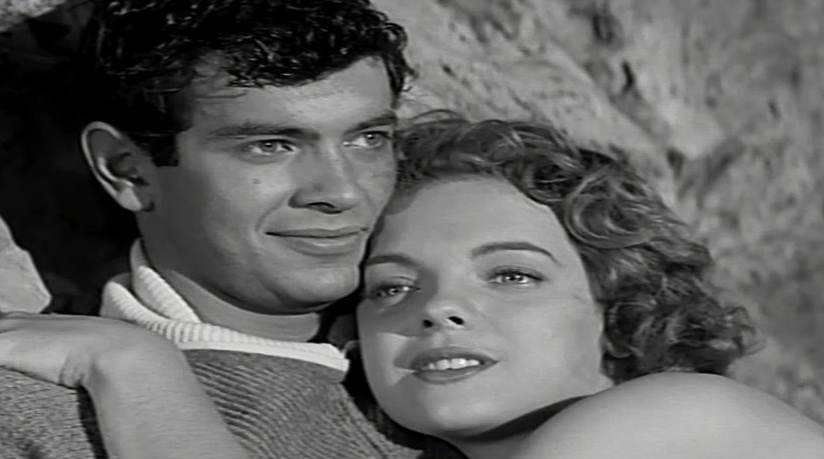
Good-looking couple: Mark Damon and Lili Gentle
YOUNG AND DANGEROUS (1957). Producer/director: William F. Claxton.

19-year-old Tommy Price (Mark Damon) is considered a "bad boy" who spends all of his time chasing bad girls for "all-night petting parties" and showing no signs of doing anything with his life, to the consternation of his father, Dr. Price (Edward Binns). But when Tommy goes on a date with 17-year-old Rosemary (Lili Gentle) -- which initially goes badly -- she brings out some of the inner sensitivity that was always inside of him. But can they convince his parents that he's changed? This mis-titled film sounds like a typical juvenile delinquent-jukebox melodrama, but while it's certainly no East of Eden, it is a well-done and quite well-acted romance. Damon and Gentle not only play together beautifully, but they are very good actors. Gentle married Richard D. Zanuck (son of Darryl) the following year -- their marriage lasted a decade -- and only made two more movies before retiring. Damon made some other teen movies, appeared with Vincent Price in House of Usher and with Boris Karloff in Black Sabbath -- he made several films in Italy -- and is now a successful producer. Handsome and with considerable acting ability, Damon was geared for a major stardom that never quite materialized. Dabbs Greer and Ann Doran offer strong support as Rosemary's parents, and Binns is fine as Tommy's father. One very long sequence, filmed in one shot without cutting, shows Tommy's friends "Weasel" (George Brenlin) and Roscoe (uncredited) in a phone booth trying to make a date with an "old reliable" girlfriend. Meant to be comedy relief, it just stops the picture dead. Produced in widescreen for Regal pictures, this was released by Twentieth Century-Fox.William F. Claxton later directed the lovably notorious creature feature Night of the Lepus.

Verdict: Not bad light drama with very appealing leads. ***.

Thursday, November 10, 2016

THE WOMAN IN QUESTION

Dirk Bogarde and Susan Shaw
THE WOMAN IN QUESTION (aka Five Angles on Murder/1950). Director: Anthony Asquith.

Agnes Huston (Jean Kent), a woman who has a fortune-telling act as "Madame Astra," is found strangled in her home. Supt. Lodge (Duncan Macrae) and Inspector Butler (Joe Linnane) interview assorted suspects and seem to get very different impressions of the woman. A neighbor, Mrs. Finch (Hermione Baddeley), sees her as a warm and classy lady, while her sister, Catherine (Susan Shaw of Pool of London) sees her as a crude and hateful antagonist. Then there's Bob Baker (Dirk Bogarde of I Could Go On Singing), who wants to do a mind-reading act with Agnes but winds up engaged to Catherine. The kindly Albert Pollard (Charles Victor) does lots of favors for Agnes and becomes smitten with her, and the sailor Michael Murray (John McCallum) has a hankering for her as well. The Woman in Question is an absorbing mystery-drama that features excellent performances from the entire cast, with a special nod to Jean Kent, who also appeared to good advantage in The Browning Version the following year. The film illustrates the fact that every person we know or meet forms a different impression of us depending on their own personality, circumstances, and a variety of other factors. The killer may not come as a big surprise, but the film is still quite watchable. With his good looks and acting skill, Bogarde was clearly destined for major stardom and was already on his way. McCallum was not well-known to American audiences.

Verdict: Noteworthy British mystery with top-notch performances. ***.

AFI FEST: IDA LUPINO, ANNA MAY WONG AND DOROTHY DANDRIDGE


AFI FEST (American Film Institute Festival).

The AFI Fest of November 10 to 17th, 2016, will highlight the talents of three very special women in film. Ida Lupino was not only a talented movie star, but one of Hollywood's early female film directors and producers. Anna May Wong was the first Chinese-American movie star, and Dorothy Dandridge was the first black woman to ever be nominated for the Best Actress Oscar (for Carmen Jones).  

These three women were all very unique and talented actresses.

I wrote my young adult bio of Dorothy Dandridge, Heartbreaker, some years ago, and it recounted the sad story of the actress trying to establish herself as a major player in major films despite her being African-American -- and this after nearly winning an Academy Award -- and her romantic heartbreak and other personal problems. One of her earliest film appearances was in the Republic musical Change of Heart.

As for the other ladies, Wong gave a memorable performance, among many, in Daughter of Shanghai and Lupino boith directed and starred in the notable drama The Bigamist, with Joan Fontaine and Edmund O'Brien. For other films and biographies of these actresses, simply type their names in the search bar above.

NO MAN'S WOMAN

Richard Crane and Marie Windsor
NO MAN'S WOMAN (1955). Director: Franklin Adreon.

Harlow Grant (John Archer) wants a divorce from his hateful wife, Carolyn (Marie Windsor), so that he can marry his sweetheart, Louise (Nancy Gates of World Without End). But everyone seems to hate Carolyn, including her father-in-law, Philip (Douglas Wood); her assistant, Betty (Jil Jarmyn), whose sexy boyfriend she tries to steal; said boyfriend, Dick Sawyer (Richard Crane), who owns his own fishing boat; and even Carolyn's own boyfriend, Wayne Vincent (Patric Knowles of Five Came Back), who is in the art business with her. Then the movie turns into a lesser Perry Mason episode without Perry Mason when one person is murdered, as expected. No Man's Woman is well acted and entertaining -- Windsor [Swamp Women] is as much fun to watch doing her slimy "bad girl" act as ever -- but the solution to this mystery holds absolutely no surprises. John Gallaudet, who later played a judge on the aforementioned Perry Mason, and Morris Ankrum are police officers, and Great Old Movies favorite Percy Helton is a caretaker. From Republic studios.

Verdict: A good role but not a great vehicle for Windsor. **1/2.

JUNGLE MANHUNT

Sheila Ryan and Bob Waterfield
JUNGLE MANHUNT (1951). Director: Lew Landers.

Photojournalist Anne Lawrence (Sheila Ryan) has come to Africa to search for Bob Miller (Bob Waterfield), a former war hero and football player who vanished into the jungle 9 years before. Miller seems to enjoy playing, as Ann puts it, "Great White God" to the natives, but he seems much more benign than certain "skeleton men" -- wearing black uniforms with skeletons painted on them -- who are decimating villages and enslaving many of the natives. Dr. Heller (Lyle Talbot) has cooked up a scheme to mine radioactive igneous rock that can be turned into valuable industrial diamonds. This is one of the better Jungle Jim adventures, with our hero (Johnny Weissmuller) leading Anne and Bob into isolated territory where they encounter a 100 foot lizard that battles a "sailback" crocodile in stock footage, not all of which seems to have come from One Million B.C. Bob Waterfield was a hunky former quarterback who was married to his high school sweetheart, the famous Jane Russell, for twenty-five years. Although he has an appealing personality in this, good looks and a fine physique seemed to be his chief assets and he only appeared in three films; Jungle Manhunt is the only one in which he actually played a character -- he later became head coach for the Los Angeles Rams. Sheila Ryan [Hideout] is a welcome and perky presence in the movie, and Lyle Talbot [The Vigilante], who gets a great death scene, gives a better performance than usual. Rick Vallin, cast again as a native, spends much of his time dealing with chimp Timba. At one point he seems a bit exasperated with his or her antics but on other occasions he certainly acts like he's charmed by the scene-stealing ape, who gets a lot of footage. The shark vs octopus stock footage that we see in so many movies also reappears in this one.

Verdict: 100 foot lizards, pretty gals and football players -- all in one movie! ***.

DEATH WALKS ON HIGH HEELS / DEATH WALKS AT MIDNIGHT

The eyes have it!
DEATH WALKS ON HIGH HEELS (aka La morte cammina con i tacchi alti/1971). Director: Luciano Ercoli.

DEATH WALKS AT MIDNIGHT (aka La morte accarezza a mezzanotte/1972. Director: Luciana Ercoli.

Nicole Rochard (Nieves Navarro), an exotic dancer in Paris, is the daughter of a murdered diamond thief. A masked man with startling blue eyes threatens her with death if she doesn't tell him where the diamonds are. Nicole fears that the masked man may be her own boyfriend, Michel (Simon Andreu), so she flees Paris with one of her fans, Dr. Robert Matthews (Frank Wolff). Matthews, an older man who is in an apparently loveless marriage, takes Nicole to a private retreat outside London, where the two begin falling in love. And then Death Walks on High Heels takes a 180 degree turn. It would be criminal to give away any of the plot twists in this highly interesting Italian suspense film which is enthusiastically and capably acted by all.

Beware that spiked metal glove!
Director Ercoli and star Navarro [Kiss Kiss Bang Bang] -- the two were married that year and were together until his death 43 years later -- reunited for Death Walks at Midnight, in which a model, Valentina (Navarro), agrees to participate in an experiment with a hallucinogen during which she has a vision of a woman being murdered by a man who wears a spiked metal glove. This murder supposedly occurred six months earlier, but there may have been a more recent victim. The killer stalks Valentina wherever she goes, and she also encounters Verushka (Claudie Lang), the rather agitated sister of one of the victims. And there are other weird people and events throughout. This one gets a little too tricky for its own good, but it is suspenseful and has a very exciting conclusion. Simon Andreu plays a reporter, Gio, and Pietro Martellanza is Valentina's sometime boyfriend, Stefano.

Although both of these films feature horror movie-type elements, such as masked killers on the loose, they are really convoluted mysteries.

Verdict: Death Walks on High Heels. ***
              Death Walks at Midnight. **1/2.

GREAT CHARACTER ACTORS: ROBERT H. HARRIS

Robert H. Harris
ROBERT H. HARRIS (1911 - 1981). Born: Robert H. Hurwitz.

Character actor Robert H. Harris amassed 116 credits during his lengthy career, and was one of those ever-reliable players that always gave a solid and interesting performance.

Although he appeared in quite a few movies, most of Harris' credits were for television work. He appeared on every television series of note in the fifties and sixties and afterward. and co-starred on The Court of Last Resort for its single season.
Particularly notable television appearances were as a fortune hunter in "Love Me to Death" on Peter Gunn  and "The Case of the Purple Woman" on Perry Mason.In one episode of that series, he was one of the most sympathetic murderers you ever saw. 

He had notable roles in such films as Valley of the Dolls, The George Raft Story, and The Big Caperand was especially good in Mirage. The only film he starred in was How to Make a Monster. and he lent a note of class to the proceedings.

Harris also appeared on the stage in everything from Richard III to Eugene O'Neill to the musical Foxy and indeed was in dozens of productions over the years. 

Like many a fine character actor, Harris was sometimes the best thing in a poor production, and his presence added luster to a superior one.

Thursday, November 3, 2016

SHOCK CORRIDOR

Attack of the Nymphos!
SHOCK CORRIDOR (1963). Produced, written and directed by Samuel Fuller.

"Their sickness is bound to rub off on you." -- Cathy

"Nymphos!"

Johnny Barrett (Peter Breck) hopes to win a Pulitzer prize by feigning a mental disorder that will get him committed to an asylum where he can find out who murdered one of the patients. He enlists his highly agitated girlfriend, Cathy (Constance Towers), to pretend to be his sister, so he can claim an incestuous attachment to her. Among the inmates that Barrett investigates are an ex G.I., Stuart (James Best), who turned traitor and now thinks he's a general in the confederacy; Boden (Gene Evans), a genius scientist who suffered a nervous breakdown and acts like a child; "Pagliacci" (Larry Tucker) a likable chubby guy who sings an aria from Barber of Seville off-key; and Trent (Hari Rhodes), a black man who has deluded himself that he is a white supremacist. Trying to be topical and controversial, Fuller has managed to come up with a movie that is undeniably arresting at times but, sadly, isn't very good, with some awful and pretentious dialogue, and scenes that border on parody. Barrett somehow manages to wind up in a ward for nymphomaniacs-- only because the script demands it -- where the women seem more interested in clawing him than kissing him -- it's an hilariously ludicrous sequence, badly overdone as so much of the movie is. Periodically Fuller inserts color stock footage (in a black and white movie) to illustrate certain points, and what can one say about Towers' dance number but that it is seriously weird? There are some good performances, with Breck [I Want to Live!] and Evans [The Giant Behemoth] coming off best. Fuller seems to have directed Constance Towers to be on the verge of a nervous breakdown herself. Mental illness is more exploited by the movie than examined. Samuel Fuller could make some good movies -- Forty Guns, for instance -- but this one is a notable failure.

Verdict: It's different, certainly, but still not very good. **.

DEAD EYES OF LONDON

DEAD EYES OF LONDON (aka Die toten Augen von London/1961). Director: Alfred Vohrer.

In London, there is a series of "accidental drownings" of vision-impaired men on foggy nights. These deaths are tied in with the Greenwich insurance company and may have something to do with a home for blind pensioners run by Reverend Dearborn (Dieter Borsche). Then there are the infamous, possibly mythical "blind killers of London" run by Jacob Farrell aka "Blind Jack" (Tor Johnson lookalike Ady Berber). Inspector Holt (Joachim Fuchsberger) and a braille teacher named Nora (Karin Beal) nearly pay a heavy price for getting involved in this mystery. Dead Eyes of London is a remake of an old Bela Lugosi film of the same title (aka The Human Monster), and it is an extremely suspenseful movie with some very good plot twists. Karl Lob has contributed some unusual camera work, such as a shot from inside a man's mouth as he sprays his throat! There's an exciting climax, and a well-handled murder inside an elevator shaft. The biggest "name" in the cast is Klaus Kinski [Doctor Zhivago] as Edgar Strauss. Based on a novel by the prolific Edgar Wallace.

Verdict: Well-done West German suspense thriller. ***

THE WHISTLER

Richard Dix
THE WHISTLER (1944). Director: William Castle.

This is the first of several Columbia films (and later a TV series) based on the radio show where a weird, whistling figure narrates mystery stories, as he does in this film. Earl Conrad (Richard Dix) is despondent after the death of his wife, Clair, and arranges to have a hit man murder him. Then Conrad discovers that Clair is still alive, and tries to call off the hit man. Unfortunately the go-between, Vigran (Don Costello),  has been killed by the police, and the hit man (J. Carrol Naish), who has been paid, thinks it is a point of honor to finish his assignment. The basic premise of the film was undoubtedly used in other movies both before and after The Whistler, but it has effective variations, Castle's direction is adroit, and the acting is generally good. Naish is a bit miscast as the hit man, a role that would have been better played by Peter Lorre. Joan Woodbury has a vivid turn as Vigran's angry wife, who blames Conrad for her husband's death, and Trevor Bardette scores as a sinister bum in a men's shelter where Conrad is hiding out. Billy Benedict, Byron Foulger, Cy Kendall, Alan Dinehart, and Gloria Stuart (as Conrad's secretary, who is secretly in love with him) also have roles of varying importance. One puzzling aspect of the film is it is never fully explained how a woman, Claire, who supposedly drowns on a vacation winds up in a Japanese POW camp. Later Whistler films include The Secret of the Whistler and The Return of the Whistler.

Verdict: Interesting low-budget suspense film. ***.

LA PAURA (FEAR)

Ingrid Bergman 
LA PAURA (aka Fear aka Non credo piu all'amore/1954). Director: Roberto Rossellini.

Irene Wagner (Ingrid Bergman), whose husband spent some time in jail, has drifted into an affair with Eric Baumann (Kurt Kreuger). Irene and her husband Alberto (Mathias Wieman) run a pharmaceutical company together and their children, who live in the country, are cared for by a nanny. Although Irene wants to break things off with Eric, she finds herself being blackmailed by an alleged old girlfriend of Eric's named Joanna (Renate Mannhardt). Then things get worse ... La Paura is an Italian "B" movie that has a lovely ending and is reasonably engaging without ever quite hitting a dramatic high note. The acting is good, with Bergman, as usual, giving a superior performance. Bergman left her husband and daughter four years earlier to be with the director of the film, Rossellini, but the scandal eventually died down after she divorced Rossellini [Voyage to Italy] three years after making this film and she came back to Hollywood. Based on a novel by Stefan Zweig.

Verdict: Has some suspense and intriguing situations, but decidedly minor. **1/2.

FILMS I JUST COULDN'T FINISH

Do you ever find yourself watching a film you don't remember and suddenly realize that you've seen it before? Even before Great Old Movies, I kept notes on virtually every movie I had ever seen for years, but at times I'll scratch my head and think to myself: "I saw this before. Why don't I remember it?" The answer is that I never took notes on films I never finished because they were either boring, really bad, or just-okay movies that were simply not my cup of tea. So I wind up watching a movie I never wanted to see all the way through in the first place all over again, sometimes giving up just where I did the last time.

To rectify that I will periodically run these posts listing movies I gave up on and why. These are not out and out reviews -- after all, I haven't watched every second of these films and I skipped or fast-forwarded through parts of them -- so these notes are to be taken with a grain of salt. And please, if somebody has seen a movie on this list that they enjoyed and think deserves a second and/or complete look, let me know!

To begin:

Larry Cohen has done some good movies and some very bad ones, but despite the presence of comic book writer/creator Stan Lee and Young and the Restless star Eric Braeden, The Ambulance (1990) just didn't hold my interest.

I'll look at British actor Paul Massie [The Two Faces of Dr. Jekyll] in just about anything -- and try to avoid looking at the rather overbearing James Robertson Justice -- but Raising the Wind (aka Roommates/1961), an English comedy about roommates who are all music students, just didn't work for me.

I wanted to watch 2013's I, Frankenstein as part of a special Frankenstein week on Great Old Movies, but when I realized that this picture had even less to do with Mary Shelley's novel than most Franky films -- the monster gets involved in a war between Lucifer's demons and some demon-hunting gargoyles -- I gave up after twenty minutes. It seemed like just another slick and empty modern-day horror film with CGI visuals. Another Frankenstein (2015), with an actor named Xavier Samuel as the monster, has modern-day scientists crafting a handsome specimen that degenerates and goes on a rampage. The film uses names and concepts from the original but is hardly on the same level; I finally gave up on it.

Bewitched (2005) was a new take on the old TV series with Nicole Kidman and Will Ferrell as Samantha and her befuddled fella, who is actually her co-star in a television remake of "Bewitched," in which she essentially plays herself. This actually wasn't totally horrible, and I watched much of it, but I just never had any desire to get back to it. Basically another unmemorable Nora Ephron movie. It may or may not make a difference that even as a kid I wasn't that big a Bewitched fan.

Despite their many differences, I just wasn't gripped by the Spanish-language film The Secret in Their Eyes (2009) nor by its American remake, Secret in Their Eyes (2015), both of which flashed back and forth in time way too much, and seemed both too cutesy and much too contrived.  Neither of them worked for me. I gave up on both after half the running time, flipped forward to the stupid endings, and was glad I hadn't wasted another two hours watching the rest of them.

In Coherence (2013) a group of moderately interesting dinner guests with a comet overhead discover that there's a duplicate of the house -- and everyone inside it -- just down the block. This begins well, but pretty soon just talks itself to death; I watched half of it, got increasingly bored, and gave up. Stretching out a weak, derivative Twilight Zone premise to an hour and a half just didn't work for me.

Grandma's Boy (2006) was an alleged comedy about a not-so-young man who must move in with his grandmother and her two female roommates. During the first half hour or so I admit I laughed once at a vulgar business involving a bathroom and somebody's mother, but mostly this was unfunny and dull, with uninteresting characters and actors aside from the "old" ladies. I gave up on this pretty quickly.

I gave up on Roger Corman's cheapjack imitation of Star Wars, Battle Beyond the Stars (1980) starring a miscast Richard Thomas, after about twenty minutes. It does feature a spaceship with what appear to be massive mammary glands underneath, for those who care.

I gave up on #Horror (2015) about a quarter of a way into the running time as I found the style of the movie to be completely off-putting, and who wants to spend ninety minutes with a pack of annoying "mean girls." A 48 Hours episode that dealt with the true story that influenced this movie was way more gripping.

Ghosts of Hanley House (1968) has the usual group of people trying to stay overnight in a haunted house with a hatchet murderer, but the production values for this are so abysmal I gave up on it pretty quickly. Speaking of horror, I also tried to watch Vampira: The Movie (2006), a documentary about actress and horror host Maila Nurmi, who appeared in the infamous Plan 9 from Outer Space. Although the film features a lengthy interview with the "star" herself, I didn't get past the first third because, frankly, I didn't find Nurmi and her tenuous connection to the likes of James Dean all that interesting.

More to come, I'm afraid.

TAILSPIN TOMMY

TAILSPIN TOMMY (12 chapter Universal serial/1934). Director: Lew Landers.

Air enthusiast Tommy Tompkins (Maurice Murphy) of Littleville is given the nickname "Tailspin" by an aviatrix named Betty Lou Barnes (Patricia Farr). Proving his ability as a pilot, Tommy gets a job delivering mail by air, and distinguishes himself with his acts of bravery. Wade Taggart (John Davidson) runs a rival company and tries to wipe out Tommy with acts of sabotage. Finally, the young man comes to the attention of Hollywood, who casts him as -- what else? -- a pilot in their aerial adventure film " Midnight Patrol." Based on Hal Forrest's comic strip, this is a kind of creaky old serial but the flying scenes are still fairly exciting, and there are some good cliffhangers involving crashing aircraft, a well-done earthquake, a train hurtling toward a chasm where the bridge has collapsed, and Tommy being dragged behind a plane as he dangles from a rope. The serial temporarily becomes a bit weird with a sequence in which Tommy and Betty Lou find themselves in an old mansion where a mad scientist traps them in a room with electrical dynamos. Noah Beery Jr. [The Three Musketeers] plays Tommy's intellectually challenged friend Skeeter, and others in the cast include William Desmond, Grant Withers, Dennis Moore, and the never-young Walter Brennan in a bit.  Maurice Murphy makes a pleasantly boyish and enthusiastic Tailspin. He had been acting since the age of ten, and amassed 57 credits. Followed by Tailspin Tommy in the Great Air Mystery in which Murphy was replaced by Clark Williams.

Verdict: Not an especially memorable serial but it has points of interest. **1/2.

Thursday, October 27, 2016

HALLOWEEN HORROR 2016

Scream for Your Life!
HALLOWEEN HORROR 2016

Well, we've got a huge crop of horror movies for this year's installment of Halloween Horror. There are movies from the forties, fifties, sixties, seventies, and eighties, as well as a couple of more recent vintage. Jason Voorhees is back in two installments of Friday the 13th, and we've even got the 2009 gay slasher flick, Hellbent. Plus two movies about Jack the Ripper, one British, one German, and two films about The Town that Dreaded Sundown. You'll also meet The Creeper and the people of Haunts and The House of Seven Corpses. And news about my latest horror epub!

Have fun!

THE CREEPER (1948)

Bug-eyed: Janis Wilson
THE CREEPER (1948). Director: Jean Yarbrough.

"Nora, get over yourself!" -- Dr. Reade

Nora Cavigny (Janis Wilson) is a highly neurotic young lady who has a phobia involving cats. This has to do with her father's experiments in Africa, something to do with -- get this -- making human tissue phosphorescent as an aid to surgery! Dr. Cavigny (Ralph Morgan) works with Dr. Bordon (Onslow Stevens) and Gwen Runstorm (June Vincent), and they all seem to have varying attitudes about what they're doing. Gwen is engaged to Dr. Reade (John Baragrey of Shockproof). who for utterly unaccountable reasons finds himself falling for the very nutty Nora. Then the claw murders begin ... The Creeper has some atmosphere and generally sufficient acting, although Janis Wilson is perhaps too odd even considering her character. Stevens [Lonelyhearts] makes an impression as Bordon, but the best work comes from June Vincent [Counterspy Meets Scotland Yard], as snappy and borderline bitchy as ever. Eduardo Ciannelli is also in the cast, along with David Hoffman as the rat-faced cat keeper, Andre. The Creeper is suspenseful but the experiments are inane, and the monster in this is particularly lame. Milton Rosen's theme music is a plus. Not to be confused with the Creeper played by Rondo Hatton in House of Horrors and The Brute Man, both of which came out earlier and were also directed by Yarbrough. Hatton also played a Creeper in the Sherlock Holmes feature The Pearl of Death. The 1942 Cat People may have had some influence on this picture.

Verdict: Some fun, but you can see why there was never a sequel nor a series of "Creeper" movies. **1/2.

JACK THE RIPPER (1959)

Out of his element: Lee Patterson 
JACK THE RIPPER (1959). Directors: Robert S. Baker and Monty Berman.

London. 1888. Jack the Ripper is stalking the west end, asking women if she is "Mary Clarke," and then bloodily dispatching them a moment later. Scotland Yard's Inspector O'Neill (Eddie Byrne) is on the case, but he welcomes the help of an old friend and American policeman named Sam Lowry (Lee Patterson). Lowry begins romancing Anne Ford (Betty McDowall), the ward of the surgeon Dr. Tranter (John Le Mesurier). Other characters include Dr. Urquhart (Garard Green); Sir David Rogers (Ewen Solon), the governor of the hospital; Louie (Endre Muller), a scarred mute who works at the hospital; Kitty (Barbara Burke), a former prostitute whose fiance killed himself when he learned of her past; and Hazel (Jane Taylor) a dance hall girl who doesn't realize that she's expected to fulfill certain other duties. Jack the Ripper has an excellent script by Jimmy Sangster, and while heavily fictionalized, it emerges as one of the better movies about the Ripper. Lee Patterson as the American cop acts as jauntily as if he just stepped out of an episode of Surfside 6, and is almost completely out of place in the film. The others are more on the mark, with especially nice work from Solon [The Hound of the Baskervilles] and Burke. The movie seems to have cheap TV production values for the most part, with much fog filling up the sound stage, but it nevertheless has atmosphere, as well as a suspenseful finale with an effectively gruesome coda (which briefly goes to color in some prints).

Verdict: Doesn't quite have the polish or production values of a Hammer film, but not bad at all. ***.

THE MONSTER OF LONDON CITY

Hansjorg Felmy
THE MONSTER OF LONDON CITY (aka Das Ungeheuer von London-City/1964). Director: Edwin Zbonek.

Richard Sand (Hansjorg Felmy) is playing the notorious Jack the Ripper in a London theater. Coincidentally, an unknown person is now slaughtering prostitutes in much the way the original Ripper did. Richard is the boyfriend of Ann Morlay (Marianne Koch of Frozen Alive), whose Uncle George (Fritz Tillmann) objects to the relationship. Ann's spiritual brother, Michael (Dietmar Schonherr), is a doctor. The Monster of London City, based on a book by Bryan Edgar Wallace, is one of the least interesting of the Ripper-themed movies, with a low excitement level, not much suspense, and murder sequences that are hardly arresting. The ending also seems rather obvious early on. Another distraction is the presence of a private eye, Teddy, (Peer Schmidt), whose bumbling antics are supposed to be comedy relief but are just irritating. Dubbed West German film.

Verdict: Not much to recommend in this fairly dull picture. **.

THE HOUSE OF SEVEN CORPSES

Faith Domergue and John Ireland
THE HOUSE OF SEVEN CORPSES (1974). Director/co-writer: Paul Harrison.

"Not exactly the Beverly Hilton, is it?" -- Gayle.

Seven murders or suicides took place in an old house where a filmmaker, Eric Hartman (John Ireland of Raw Deal), has come with his cast and crew to make a movie about these events. David (Jerry Strickler) finds a copy of the Tibetan Book of the Dead, and star Gayle Dorian (Faith Domergue) reads incantations from it in  the character of a witch. Unfortunately, these incantations get something stirring underneath the ground in the cemetery ... The House of Seven Corpses has a not-bad screenplay but its execution is mediocre. Domergue [Cult of the Cobra] offers the best performance as the likable diva whose career, like Domergue's, is on the downslide. John Carradine [Munster, Go Home!] plays the caretaker of the estate, and Charles Macaulay is vivid as the male lead, Christopher Millan. (He amassed 82 credits and later played both a judge and a district attorney on some of the Perry Mason telefilms.) Carole Wells plays the ingenue, Anne, who is David's girlfriend. Ron Foreman, the make up man and art designer, was drafted to basically play himself. The movie has atmosphere and a few lively moments, but at times it's disjointed and confusing, and the lighting schemes can cause eyestrain. Some amusing dialogue helps. This was filmed at the Utah State Historical Society in Salt Lake City, who probably hoped something a bit better might have come of it. This was the only film directed by Harrison.

Verdict: Watchable but inferior horror flick. **1/2.

HELLBENT

Dylan Fergus
HELLBENT (2004). Writer/director: Paul Etheredge.

"Why wouldn't you want to kill us -- we're fuckin ' fabulous!" -- Tobey

Eddie (Dylan Fergus) works for the LAPD, but only in an administrative capacity due to the loss of an eye in an accident. He wears his father's old cop uniform for a Halloween carnival, which he attends with some of his fellow gay male friends. His buddies include his apparently bisexual roomie, Chaz (Andrew Levitas); slightly geeky Joey (Hank Harris), who is wearing leather for the evening and isn't certain how it'll go over; and Tobey (Matt Phillips), who decides to go in drag, then wonders why no one is hitting on him. Two others attend the festivities: Jake (Bryan Kirkwood), a brooding bad boy type with attitude; and a masked killer who excites the others but prefers beheading people to making love. Just what the world needs: a gay slasher flick. Hellbent can at least be differentiated from Al Pacino's homoerotic serial killer movie Cruising, because both the hero and the major supporting characters are all  gay men, but their brutal slaughter might still make some viewers rather uncomfortable. Typical of slasher flicks, there's little pity for the victims, and just a slight attempt at pathos. The gruesome murder scenes are generally well-handled, with a standout being a slashing and decapitation that takes place amid the flashing lights of a crowded dance floor. The actors and characters are likable although not that well-developed, another slasher flick staple. One does have to ponder, considering the number of gay cops that there are nowadays (there's even a Gay Officers Action League or GOAL) why they couldn't have made the hero an actual cop on a night off. And must they have included the guy in drag and a few other stereotypes? On the plus side, the film does generate some suspense and eeriness, and it has a tense and exciting climax. The ending, however, may leave some viewers up in the air. Kirkwood is a standout as Jake, but the others are all pretty good. There is one especially nice touch dealing with a character who can't quite bring himself to actually kiss  another man until something helps him get over his hang-ups.

Verdict: If we must have gay slasher flicks ... ***.

THINGS THAT GO BUMP IN THE NIGHT

Cover: Kealan Patrick Burke
THINGS THAT GO BUMP IN THE NIGHT. William Schoell. Cemetery Dance.

This, my first published book, was given the generic title of Spawn of Hell by the publisher at the time. Things that Go Bump in the Night was the original title of the book, and we've gone back to that title for the brand new epub edition from Cemetery Dance.

Things was one of the first novels to deal with the subject of recombinant DNA technology, the making of hybrid creatures by splicing together DNA strands from different lifeforms. In this story a struggling artist and a fashion model encounter these strange and terrifying monsters when the couple go to find out what happened to the model's brother, who is found dead and half-eaten. The pair try desperately to stop an attack by these monstrosities -- some of whom have the faces of townspeople -- on the residents of a helpless community.  Imagine being eaten by someone with the face of a person you love, but whose body is incredibly grotesque ... A fun book!


Thursday, October 20, 2016

THE BROWNING VERSION (1951)

Brian Smith and Michael Redgrave
THE BROWNING VERSION (1951). Director: Anthony Asquith. Screenplay by Terence Rattigan, based on his stage play.

Andrew Crocker-Harris (Michael Redgrave), a teacher at a boy's school, is having a pretty lousy day. Ill health has necessitated his going to another school with less strenuous duties, but he may not be given a pension. His bitter wife, Millie (Jean Kent), is having an affair with another teacher, Frank (Nigel Patrick). And Andrew is beginning to realize that his attitude towards his students, brought about by his disappointment in life, marriage and career achievements, has turned him into a stuffy, rather unpleasant fellow whose students call "Himmler." Yet there is a young boy named Taplow (Brian Smith) whose compassion for the older man might be his saving grace ... The Browning Film is a rare gem, one of those beautiful movies that gives you hardly anything to quibble about. Although Michael Redgrave [Dead of Night] at first seems to be bordering on caricature, channeling Richard Haydn, he actually gives a wonderful and touching performance. The second best performance is from young Brian Smith, who essays a kindly, decent fellow who is wise beyond his years. Years ago Andrew began a new translation of Agamemnon and Taplow gives him a copy of "The Browning Version," translated by Robert Browning. Patrick and Kent [The Prince and the Showgirl] are also quite good as the dissatisfied lovers, with Frank ultimately ashamed of his actions, and neglected Millie unable to cope with the fact that her husband wanted companionship and she wanted much more. There's also nice work from Ronald Howard [Black Orchid] as Gilbert, who will take over Andrew's teaching duties, and Wilfrid Hyde-White as the headmaster. All aspects of the production are superior. Young Brian Smith, who was 19 but looked much younger, amassed sixty credits after completing this picture. Remade with Albert Finney in 1994.

Verdict: Beautiful and moving classic movie. ****.

A SHOCK TO THE SYSTEM

A SHOCK TO THE SYSTEM (1990). Director: Jan Egleson.

Graham Marshall (Michael Caine of Alfie) works in the marketing department at a large Manhattan firm. He is sure that he is next in promotion after his current boss, George Brewster (John McMartin), but to his horror and rage learns that has has been passed over in favor of a younger, slick asshole named Robert Benham (Peter Riegert). Adding to Graham's irritation is the presence of his wife, Leslie (Swoosie Kurtz), who is not sensitive enough to his needs, and whose response when he is passed over is not exactly supportive. When Graham is nearly frazzled in an electrical accident in his home, he comes up with an idea for solving his problems ... Based on a far superior novel by Simon Brett, A Shock to the System is well-acted by all, holds the attention, and is probably more entertaining to those who have never read the book. Andrew Klavan's screenplay makes many unnecessary changes -- including switching the story's locale from England to New York! --but has stupid moments, eliminates characters, jumbles sequences, and emerges as an acceptable "Lifetime" movie and not much else. (Klavan is typical of a minor screenwriter who thinks he can "out-clever" the original author, and fails.) Jan Egleson, basically a television director, covers the action adequately but there is no inspiration in the presentation of events, and even the suspense is comparatively minimal. Barbara Baxley [East of Eden] is Graham's mother-in-law (a highly interesting character in the novel who is virtually a non-entity in the film); Will Patton is a detective (also a much less interesting character than in the book); and Elizabeth McGovern of Downtown Abbey plays an office worker who dallies with Graham.

Verdict: Okay enough on its own terms, but you'd be better off reading the novel and skipping this adaptation. **1/2.

BEDTIME FOR BONZO

Diana Lynn, Ronald Reagan, and Bonzo in the back
BEDTIME FOR BONZO (1951). Director: Frederick De Cordova.

College professor Peter Boyd (Ronald Reagan) gets in hot water with Dean Tillinghast (Herbert Heyes), when the latter finds out Boyd's father was a criminal. Tillinghast wants Peter to resign at the end of the semester, and orders his daughter, Valerie (Lucille Barkley) to end their engagement. Peter sets out to prove that environment and upbringing have more to do with criminal behavior than heredity. How does he do this? By taking the science department's chimp, Bonzo, home with him, and hiring a woman, Jane (Diana Lynn) to act as the ape's "mother!" That is the incredible premise of this movie, which gets stupider by the second. Since I happen to be very fond of chimps and their antics, I thought this movie might be cute and entertaining, but another Bringing Up Baby (which had a leopard instead of a chimp) it is not. I need not say that Ronald Reagan [Kings Row] is hardly in the league of Cary Grant, but his performance in this isn't bad, and Diana Lynn [Ruthless] is charming. Walter Slezak is fine as another professor, while Jesse White is typically obnoxious and unamusing as a man named Babcock. Considering Peter is a professor it's odd how often he refers to Bonzo as a monkey instead of a chimp. Bonzo is a cute and capable performer, but the chimps are a lot more fun in the Tarzan movies.

Verdict: Why Reagan went into politics. **.