Lively, entertaining reviews of, and essays on, old and newer films and everything relating to them, written by professional author William Schoell.
Showing posts with label Ida Lupino. Show all posts

Thursday, January 29, 2026

THE BIGAMIST

Ida Lupino and Edmond O'Brien
THE BIGAMIST
(1953). Director: Ida Lupino.

"How could a man like you, successful, respected, get into a situation as vile as this?"

When Harry Graham (Edmond O'Brien) and his wife Eve (Joan Fontaine) apply to adopt a child, Mr. Jordan (Edmund Gwenn), who's in charge of investigating the couple's background, discovers that Graham has another wife, Phyllis (Ida Lupino) in another city where he frequently travels for business. The rest of the film is a flashback as Graham tries to explain to the horrified Jordan exactly how he got into this situation. The Bigamist is completely absorbing, realistically and logically explaining how Graham fell in love with two women, and is beautifully acted by the entire cast. 

Joan Fontaine with O'Brien
Lupino's direction is on the mark, as is her acting, and O'Brien is excellent. The picture is nearly stolen by Joan Fontaine, who has a splendid moment as she reacts to the terrible news delivered to her over the phone by her lawyer. Jane Darwell and Kenneth Tobey have small roles, and there's a nice musical score by Leith Stevens. Very touching movie with an interestingly open-ended wind-up. On youtube there is a beautifully colorized version of the picture. Screenwriter-producer Collier Young was married to Fontaine but had previously been married to Lupino! 

Verdict: Outstanding adult drama with fine performances. ****.

Thursday, January 16, 2025

LUST FOR GOLD

Jacob (Glenn Ford) stakes his claim
LUST FOR GOLD (1949). Director: S. Sylvan Simon.

Inspired by the true legends of the Lost Dutchman mine in the Superstitious Mountains of Arizona, the major portion of this film takes place in the last century with modern-day framing sequences that carry their own interest. Jacob "Dutch" Walz (Glenn Ford) commits murder to preserve the secret of the mine's location, then goes to town to stake his claim. There he encounters duplicitous Julia Thomas (Ida Lupino), who owns a bakery but dreams of a better life which she knows her husband (Gig Young) will never provide. So she begins a romance with an unsuspecting Walz. Lupino and Young are fine, and Ford is especially good as one of the more unpleasant characters he's played. If the main story's climactic gun battle near the mine weren't enough, the absorbing film also boasts a terrific cliffside fight as the modern-day story's thrilling finale. William Prince, Edgar Buchanan, Paul Ford and even Percy Helton [as a barber] are members of the supporting cast, and all are swell.

Verdict: Snappy and extremely entertaining. ***1/2.

Thursday, October 19, 2017

ROAD HOUSE

Wilde, Lupino and Widmark in a tense moment
ROAD HOUSE (1948). Director: Jean Negulesco.

"Jefty" Robbins (Richard Widmark of Garden of Evil) runs a road house complete with nightclub and bowling alley in a small town with his buddy Pete (Cornel Wilde) as a top employee. Jefty also hires Lily (Ida Lupino of Private Hell 36), upon whom he is struck, as a singer in the club. Jefty seems to think of Lily as his girlfriend even though they've apparently never even kissed, a problem she does not have with Pete, who succumbs to her charms, and vice versa, to the strains of Wagnerian opera on the radio. Clueless Jefty plans to marry Lily, and doesn't take it well when he discovers where her true feelings lie. Before long, he comes up with a plan for revenge ... Road House is one of those twisted melodramas that might have amounted to more than an entertaining time passer with a little more care and a much better script, but it never plumbs below the surface. One very amusing aspect of the film is Lily's "singing." Lupino's voice is not dubbed, and is absolutely awful, although she's a good enough actress to put over a number like "The Right Kind of Lovin'." In real life, the soused patrons of the club would have been tearing the gal to figurative shreds, but only in Hollywood can there be a rapt audience for someone with no talent. As waitress Suzie (Celeste Holm) says of Lily: "She does more without a voice than anybody I've ever heard." The real howler comes when Wagner plays on the radio and Lily tells Pete -- not without a trace of irony -- that her father told her that someday she'd sing at the Met! Lupino is swell, Wilde [The Naked Prey] is suitably manly and handsome and generally good, Holm has little to do (although she is billed above the title with her three more important co-stars) and adds little nuance to her role, and the picture is stolen by a splendid Widmark as the spoiled little boy in a man's body. Those viewers looking for possible homoeroticism in the relationship between Jefty and Pete should look elsewhere -- it's easy to imagine but it really isn't there, in my opinion.

Verdict: Once you get past Ida's singing, this is fun if distinctly minor. **1/2.

Thursday, November 10, 2016

AFI FEST: IDA LUPINO, ANNA MAY WONG AND DOROTHY DANDRIDGE


AFI FEST (American Film Institute Festival).

The AFI Fest of November 10 to 17th, 2016, will highlight the talents of three very special women in film. Ida Lupino was not only a talented movie star, but one of Hollywood's early female film directors and producers. Anna May Wong was the first Chinese-American movie star, and Dorothy Dandridge was the first black woman to ever be nominated for the Best Actress Oscar (for Carmen Jones).  

These three women were all very unique and talented actresses.

I wrote my young adult bio of Dorothy Dandridge, Heartbreaker, some years ago, and it recounted the sad story of the actress trying to establish herself as a major player in major films despite her being African-American -- and this after nearly winning an Academy Award -- and her romantic heartbreak and other personal problems. One of her earliest film appearances was in the Republic musical Change of Heart.

As for the other ladies, Wong gave a memorable performance, among many, in Daughter of Shanghai and Lupino boith directed and starred in the notable drama The Bigamist, with Joan Fontaine and Edmund O'Brien. For other films and biographies of these actresses, simply type their names in the search bar above.

Thursday, December 24, 2015

JENNIFER (1953)

Ida Lupino
JENNIFER (1953). Director: Joel Newton.

In this strange suspense film, Agnes Langsley (Ida Lupino) gets a job as caretaker at an abandoned estate because, for some reason, she wants to be alone. In spite of this she meets and keeps company with Jim Hollis (Howard Duff), who owns the general store in the town near the estate. When Agnes learns that the last caretaker, a young woman named Jennifer who was the cousin of the house's current owner, simply vanished one afternoon, she's intrigued enough to investigate, but seems more obsessed than merely curious. There are vague hints of the supernatural or something weird going on, especially in the ending, but nothing much is made of it. One supposes this is why Lupino plays the role like she's compelled for some reason to seek out the truth about Jennifer -- it's a strange performance, frankly, but not a bad one -- and the mystery of who Agnes is and why she's buried herself away is never quite resolved. (There's also the fact that Agnes never actually seems to do anything in her role as caretaker.) One could argue that the mystery over Jennifer isn't, either. Still, this is fairly absorbing, not badly acted, and has some creepy sequences, such as a search for Jennifer's body underground. The movie does get across the impression that there's something just out of sight, and the obtuse conclusion is borderline chilling. Robert Nichols plays Hollis' clerk, Orin, Mary Shipp is Agnes' employer, Lorna, and singer Matt Dennis plays himself in a lounge sequence. He sings and also composed the memorable tune, "Angel Eyes." James Wong Howe was the director of photography and also co-directed The Invisible Avenger. Lupino [The Bigamist] and Duff [Spaceways] got married two years before this film was made, and didn't divorce until 1984.

Verdict: Oddly compelling sort of mystery. **1/2 out of 4.

Thursday, August 6, 2015

THE LONE WOLF SPY HUNT

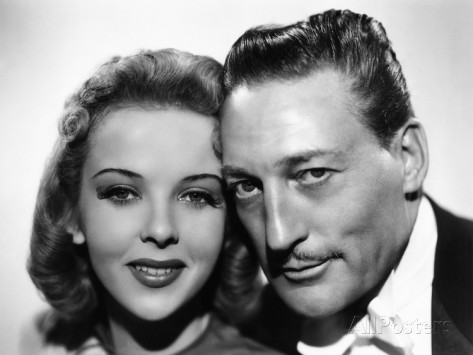
Ida Lupino and Warren William
THE LONE WOLF SPY HUNT (1939). Director: Peter Godfrey.

Michael Lanyard (Warren William), who is known as the "Lone Wolf," is a retired thief who is embroiled in a plot by an enemy to steal secret plans and frame him. This man, Spiro (Ralph Morgan), wants revenge, but just why is never explained. Spiro and his associates, including the beautiful Karen (Rita Hayworth), force Lanyard to crack a safe, but he manages to put one over on the gang, for a time at least. Meanwhile Inspector Thomas (Don Beddoe of Mandrake the Magician) and Sergeant Devan (Tom Dugan of The Galloping Ghost) are hoping they can finally arrest the infamous Lone Wolf. I believe this character had been around quite awhile before William starred in this film series, in which he is a retired widower with a young daughter, Patricia (Virginia Weilder), and a marriage-minded gal pal named Val (Ida Lupino of Private Hell 36). The movie is well-acted and pleasant enough, but it never rises above the level of a not-terribly-eventful programmer. The child Patricia is a somewhat irritating character and doesn't really fit in with the rest of the movie. There were several sequels and a TV series with Louis Hayward in the fifties.

Verdict: Has possibilities, but not one of the classics of 1939. **.

Thursday, August 21, 2014

NO BED OF ROSES: JOAN FONTAINE

NO BED OF ROSES: AN AUTOBIOGRAPHY. Joan Fontaine. William Morrow; 1978.

The very talented star of Rebecca, Suspicion, Letter from an Unknown Women, and many others proffered this very well-written and absorbing autobiography in the late seventies. The "feud" between her and her sister Olivia de Havilland seems to be attributed to a fairly childish sibling rivalry that existed since childhood, this despite the fact that both women won Oscars and became acclaimed, highly successful actresses. Fontaine was born in Japan, but she came to the US after her parents' marriage broke up, and had a comparatively privileged if often unhappy childhood. She intimates that both her father and stepfather had an unhealthy sexual interest in her. She married Brian Aherne even though Howard Hughes wanted her for a wife, this despite the fact that Olivia was practically engaged to the man at the same time, another blow to their relationship. Fontaine had other marriages and boyfriends, and along the way made quite a few movies: This Above All with Tyrone Power; Beyond a Reasonable Doubt with Dana Andrews; Kiss the Blood Off My Hands with Burt Lancaster; and The Constant Nymph with Charles Boyer. Fontaine has little to say about some of her films, such as Something to Live For and Voyage to the Bottom of the Sea, aside from the fact that she thought very little of them. She appeared in The Bigamist only because her husband at the time, Collier Young, produced it; Young had been married to co-star and director Ida Lupino previously. As Fontaine puts it: "After shooting all my scenes, director Ida saw the rushes, didn't like the photography, and changed cameramen before actress Ida began her own scenes!" The book concludes with a moving open letter from Fontaine to her late mother, with whom she had a relationship just as complicated as her relationship with her sister. Despite Fontaine's fame, what comes across to the reader is the damage that parents can inflict on their children, no matter who they might be or what becomes of them.

Verdict: Fascinating look at one lady's life in and out of Hollywood. ***1/2.

Thursday, July 3, 2014

THE STRANGE INTRUDER

Edmund Purdom and Ida Lupino
THE STRANGE INTRUDER (1956). Director: Irving Rapper.

During the Korean war, Paul Quentin (Edmund Purdom) promises his buddy Adrian (Donald Murphy of Frankenstein's Daughter) that he'll make contact with his family back home if he dies. After the war, during which Adrian is killed, Paul goes to his town to meet his family, who are unaware that he has mental and emotional problems -- they take to him as a surrogate of Adrian's. For some reason Paul takes too literally Adrian's telling him that he wants his children to be with him, and interprets this as meaning he must kill them...  The Strange Intruder works as neither drama nor suspense film, although Purdom gives a decent performance, as does Ida Lupino, playing Adrian's widow, Alice. The rest of the cast is interesting, too: a nearly unrecognizable Ann Harding [The Unknown Man] as Adrian's mother; Gloria Talbott as his sister; Douglas Kennedy as Alice's lawyer; and Jacques Bergerac [The Hypnotic Eye] as an ex-lover who is out to blackmail Alice. Carl Benton Reid of Amos Burke Secret Agent is on hand as Adrian's disabled father, who is able to walk again right after he meets Paul. [This also fails as an allegory, if that was what was intended.] Irving Rapper directed much better pictures, such as Now, Voyager.

Verdict: This should have been a half hour episode of some fifties dramatic series, and even then it might not have amounted to much. **.

Thursday, February 20, 2014

KRAFT SUSPENSE THEATER: SEASON ONE

Nina Foch and Katherine Crawford in "End of the World, Baby"
KRAFT SUSPENSE THEATRE aka Suspense Theatre. Season 1. 1963.

Kraft Suspense Theatre was the anthology series that began each week with stylized, Dali-esque drawings of running, furtive figures while intense, dramatic music blared in the background. The first two episodes, "The Case Against Paul Ryker," were quite good and were later spliced together and presented in movie houses as Sergeant Ryker. The third episode, "End of the World, Baby," had a mother and daughter (Nina Foch and Katherine Crawford) both involved with the same gigolo (Gig Young), and was mediocre if well-acted. I've seen most but not all of the first season episodes and generally the series was not in the league of, say, Alfred Hitchcock Presents, but there were some episodes that were quite memorable. In "One Step Down" Ida Lupino wants to find out who her dead husband's lover was, unaware that it's somebody she already knows (Gena Rowlands). Tourists Julie Harris, Julie Adams and Virginia Gregg get involved with a Latin hustler (Robert Loggia) in "The Robrioz Ring." "Are There Any More Out There Like You?" stars Robert Ryan and features Katherine Ross and Great Old Movies' favorite Jay Novello in a powerful story of a man whose disaffected daughter and friends are involved in a deadly hit and run. "The Threatening Eye," directed by Ida Lupino, is a truly excellent tale of a businessman (Jack Klugman) whose life is turned upside down by a sociopathic fellow employee (Annie Farge) whose motives at first seem hidden. "A Hero for Our Times" stars Lloyd Bridges as a philandering husband who witnesses a murder during an assignation and wonders how he can tell what he knows without compromising himself or his lover. While many other episodes were all but ruined by really stupid endings, they were almost always extremely well-acted.

Verdict: Some gems among the junk. **1/2.

Thursday, November 28, 2013

PRIVATE HELL 36

Steve Cochran and Ida Lupino have plans
PRIVATE HELL 36 (1954), Director: Don Siegel.

Detectives Cal Bruner (Steve Cochran) and Jack Farnham (Howard Duff) are trying to find some stolen loot and the guys who snatched it. When a marked $50 bill is given to chanteuse Lilli Marlowe (Ida Lupino) as a tip, they interview her to find out what she remembers about the generous club patron; Cal and Lilli are drawn to one another. Things take a dark turn when one of the two cops decides to pocket some of the aforementioned stolen loot ... Private Hell 36 is a minor crime drama with some good acting from all of the principals; Lupino is especially appealing as the slightly hard-bitten but likable saloon singer. Dean Jagger scores as the wise older boss of the two detectives, and Dorothy Malone is fine in the brief, thankless role of Farnham's wife [although Lupino and Duff were married at the time they are not paired with each other]. The script is credited to Lupino and her ex-husband, Collier Young. Borderline film noir. Director Siegel's best-known film is arguably Invasion of the Body Snatchers.

Verdict: Interesting idea that's not developed all that well. **.

Thursday, October 17, 2013

THE BIG KNIFE

Everett Sloane talks to Jack Palance
THE BIG KNIFE (1955). Producer/director: Robert Aldrich. Screenplay by James Poe from the play by Clifford Odets.

Movie star Charles Castle (Jack Palance) was involved in a hit and run that killed a child, but his p.r. man, Buddy (Paul Langton), took the rap for him. Charles' wife, Marion (Ida Lupino), who is separated from him, swears she'll divorce him if he re-signs with Stanley Hoff (Rod Steiger), who probably helped engineer the deception. Now there's a new complication: Castle had a woman with him in the car that night, Dixie Evans (Shelly Winters), and she's drunkenly shooting her mouth off everywhere she goes. Now Hoff and his associate Smiley (Wendell Corey), want to take care of Dixie -- permanently ... The Big Knife might have worked on the stage, and the Odets original was undoubtedly better than this half-baked adaptation, but the film sinks almost from the get-go. The chief problem is the epic miscasting of Jack Palance. Charlie might have evoked some sympathy in the viewer if he was played by a man who could get across his essential weakness and confusion, but Palance seems incapable of ever displaying the slightest trace of vulnerability. It gives the actor his presence and strength, but he's just all wrong for this picture. His scenes with Ida Lupino are stagey and over-rehearsed and just don't work at all -- both of them are busy "acting" instead of being. We're constantly being told of how wonderful Castle is and of his supposed integrity, but all we see is a corrupt, self-absorbed individual who allowed another man to take responsibility for his actions, slept with the man's wife, and acts like a dickhead throughout. When he protests at the idea of "silencing" Dixie, it's hard to believe that he would object -- he's the last one to take a high moral stance. It's up to the supporting cast to give the film whatever limited stature it has. Rod Steiger has some ferociously effective scenes as Stanley [some might think he's merely showing off]; Wendell Corey underplays beautifully as the slimy Smily; Everett Sloane is as solid as ever as Charles' agent; and Paul Langton has a beautifully and powerfully delivered speech to Castle at the end of the film that is one of the most memorable bits in the movie. As for the women, Ilka Chase offers a dead-on portrait of an oily, if stereotypical, gossip columnist, Shelley Winters is so-so as Dixie, and Jean Hagen fails to impress as Buddy's sluttish wife, Connie. Wesley Addy has a nice turn as the writer Hank Teagle. Oddly, a confrontation between Dixie and Hoff that might have been quite cinematic and dynamic is mentioned but not shown, but the film isn't "opened" up very much. It's hard to like or enjoy a movie in which virtually every character is either unpleasant or annoying. Robert Aldrich was the wrong director for this, as well. For a worthwhile Odets adaptation, see Clash By Night.

Verdict: A fairly embarrassing mess of Hollywood pseudo-profundity with horribly miscast leads. **.

Thursday, February 7, 2013

WOMEN'S PRISON

WOMEN'S PRISON (1955). Director: Lewis Seiler.

"They never get things right in prison pictures."

Convicted of vehicular manslaughter after accidentally killing a child, neurotic Helene (Phyllis Thaxter of The Sign of the Ram) is sent to a women's prison adjacent to a men's penitentiary. Her fellow inmates include Joan (Audrey Totter of The Saxon Charm), whose husband manages to cross over to see [and impregnate] her, returnee Brenda (Jan Sterling of Johnny Belinda), Mae (Cleo Moore of One Girl's Confession), and Dottie (Vivian Marshall) who does pretty bad impressions of Bette Davis and others but does a fairly good job of imitating Ida Lupino, who just happens to play the neurotic and slightly evil Amelia van Zandt, a prison official who lords it over the women's compound. All hell breaks loose when van Zandt is told she better find out how Joan's husband, Glen (Warren Stevens) managed to get in to see her [we never find out] and she begins slapping around the pregnant woman, raising the inmates' ire and leading to a fairly exciting climax. Women's Prison is the kind of junk movie that pretends to have some kind of social conscience while parading superficial platitudes and one-dimensional characters who have little basis in reality. Ida Lupino, with her mostly arch overplaying, does the best she can with terrible material; her real-life husband, Howard Duff (Dante), comes off much better and is quite good as the compassionate prison psychiatrist who thinks van Zandt is a psychopath. Thaxter is fine, but except for scenes when she's victimized gets little chance to etch a real character, and Ross Elliott is also good in his brief turn as her husband. Sterling and Totter aren't bad and Cleo Moore is Cleo Moore. The big trouble with this picture is that it isn't even very entertaining.

Verdict: A pretty bad "Bad Girls" picture. **.

Thursday, October 4, 2012

SEARCH FOR BEAUTY

Ida Lupino and "Buster" Crabbe
SEARCH FOR BEAUTY  (1934). Director: Erle C. Kenton.

"Baby, come to Mama!"

Larry Williams (Robert Armstrong) and Dan Healy (James Gleason), with the help of Jean Strange (Gertrude Michael), try a new con by putting out a "health" magazine and hiring above-board Olympic winners (Ida Lupino and "Buster" Crabbe) as editors to make it all look legitimate. Before long the editors are clashing with the publishers, who confuse a fitness mag with something a little bit racier. There's a search for perfect male and female physical specimens to work at a health farm, where Williams and company find they must adhere to the strict regimen along with all of the other guests even though they'd rather drink and watch pretty gals dancing on tables. The film is ful of risque dialogue and attractive performers -- and the lead actors are all swell -- but this pre-code movie ultimately doesn't amount to much.

Verdict: If only there were more solid laughs and a better story. **.


Thursday, August 30, 2012

IDA LUPINO: A BIOGRAPHY

IDA LUPINO: A BIOGRAPHY. William Donati. 1996; University Press of Kentucky.

Coming from a famous theatrical family, Ida Lupino had show biz in her blood, but according to this excellent biography, she got more fulfillment from directing than acting. This is not really a tell-all book -- Donati does look at Lupino's three marriages [to actor Louis Hayward, producer Collier Young, with whom she continued a working relationship even after their divorce, and finally the difficult Howard Duff], although there isn't that much on her estrangement from her only daughter. Donati doesn't go in for much in-depth analysis of Lupino's films [aside from the ones she directed] or acting technique, but he does deliver the basic facts in compelling fashion -- the book is a very good read. There is an examination of Lupino's often contradictory nature, her attitudes toward stardom, the Hollywood studio system and her pioneering efforts as director [she did not in any way she herself as a feminist], and her final days in which she wandered about in a disheveled house and grumbled at any one who came near her. Lupino had quite a life, and quite a career, and this book does justice to it, even if you wish at times there were a bit more about her major acting vehicles. Lupino was a star, but not quite of the front rank, never quite attaining the immortality of a Davis, Crawford or Stanwyck, although she was very talented. Of her directorial efforts they run the gamut from the poor [Outrage] to the decidedly memorable [The Bigamist]. Lupino also very ably directed one of the best ever episodes of the TV show Thriller, "Guillotine."

Verdict: Absorbing biography. ***1/2.

Thursday, March 29, 2012

THE WILD, WILD WEST SEASON 2

Ross Martin and Robert Conrad
THE WILD, WILD WEST Season two. 1966. CBS-television.

James West (Robert Conrad) and Artemis Gordon (Ross Martin) are back for a second [now in color] season of the post-Civil War spy series, The Wild, Wild West. Amidst a plethora of mediocre and plain silly episodes are some more notable stories, such as the exciting "Night of the Raven" with Dr. Loveless (Michael Dunn) and Phyllis Newman [better than you might imagine] as an  Indian princess. "Big Blast" guest-stars Ida Lupino as Dr. Faustino, who uses human bomb duplicates of Artie and Jim to try to blow up Congress! "Ready-Made Corpse" features Carroll O'Connor as a man who provides new faces for wanted criminals. "Man-Eating House" is a weird -- too weird -- but entertaining episode guest-starring Hurd Hatfield as an escaped jailbird in a creepy old haunted house. Dr. Loveless reappears in "Bogus Bandits" -- also guest-starring the inimitable Patsy Kelley -- staging bank robberies yet throwing away the money! The two most memorable episodes feature female antagonists: Delphi Lawrence makes an excellent Lucrece Posey, trying to form a criminal group of hit men in "Poisonous Posey"; and no less than Agnes Moorehead plays a murderous marriage broker in "Vicious Valentine," which probably has the most suspenseful climax of any season two episode. Another notable episode is "Tottering Tontine," in which members of a survivor-takes-all financial concern are wiped out one by one in a sinister old mansion by the sea. The Wild, Wild West was an imperfect series, but almost always entertaining in spite of it. The boys report to a portly colonel in many of the episodes, and President Grant himself appears in at least one story. Artie and Jim are always impeccably dressed in beautiful old-style suits with matching vests, and Conrad continues to wear the tightest pants on television -- for a 19th century secret service man no less! Other interesting guest-stars include Boris Karloff, Sammy Davis, Jr., Leslie Parrish, William Talman, Tom Drake, and Victor Buono. Click here to read about season one of the show.

Verdict: Still fun. ***.

Thursday, September 9, 2010

THRILLER SEASON 2

THRILLER Season 2. 1961. 

Boris Karloff was back as the dignified but figuratively winking host of the hour-long Thriller during its second season. Some of the "black comedy" introductions resembled the sort of thing Hitchcock did over on The Alfred Hitchcock Hour. Highlights of the second season include: "The Return of Andrew Bentley," based on a tale by August Derleth; "Waxworks," a Robert Bloch tale with Martin Kosleck and Oscar Homolka; "La Strega," a tale of a witch starring Ursula Andress which is notable primarily for Morton Stevens' scoring; "the grotesque "A Wig for Miss DeVore," also based on a tale by Derleth; and "An Attractive Family" featuring a group of charming sociopaths. "Cousin Tundifer" is a delicious black comedy with Edward Andrews going back in time to try to get rid of a wealthy uncle. "The Incredible Doktor Markeson," another Derleth story, stars Karloff as a doctor who successfully brings people back from the dead. 

"Flowers of Evil" presents Luciana Palazzi as a kind of black widow murderess whose husband worked in a morgue. "Kill My Love" features Richard Carlson giving possibly his most memorable performance as a man driven to murder until his actions even horrify himself. "Lethal Ladies" is a two-part tale [based on stories by Joseph Payne Brennan] in which Howard Morris and Rosemary Murphy -- who play different characters in each episode -- so lose themselves in their roles that the viewer is completely unaware that it's the same actors in each story [wife vs. philandering husband; mousy librarian vs. new boss]. "A Third for Pinochle" is another amusing tale with Edward Andrews' plans to murder his wife stymied by the two biddies who live across the street. Perhaps the best season 2 episode is "Guillotine," directed by Ida Lupino from a story by Cornell Woolrich, in which a woman poisons a headsman to prevent him from lopping off her lover's head -- but will he drop dead before he can do the deed? Clever -- and very, very suspenseful. 

Verdict: Really a great old series. ***1/2. NOTE: Click here to read about season 1.

Thursday, January 7, 2010

THE ADVENTURES OF SHERLOCK HOLMES

THE ADVENTURES OF SHERLOCK HOLMES (1939). Director: Alfred L. Werker. 

"There's death in every note of it.

Sherlock Holmes (Basil Rathbone) matches wits with Professor Moriarty (George Zucco) when the latter -- who has just managed to get off on a murder charge -- boasts that he will commit a spectacular crime right in front of the former's nose. Ida Lupino is a woman who fears for her brother's life -- does this tie in with the professor's plans? Despite the fact that the movie sort of clues us in early on as to what's going on, The Adventures of Sherlock Holmes is still suspenseful and exciting, with some eerie scenes relating to a club-footed killer. The haunting flute dirge that figures in the story is quite creepy. Little Terry Kilburn makes an impression as Billy, the page boy who appeared in some of the stories. Based on a play by William Gillette. Rathbone is excellent,as is Zucco as his nemesis. At one point Rathbone/Holmes masquerades as a music hall singer! This follows The Hound of the Baskervilles and was the second of two 20th Century-Fox films with Rathbone as Holmes. Followed by Sherlock Holmes and the Voice of Terror, the first of 12 Universal "modern-day" Holmes adventures with Rathbone. 

Verdict: There are some loose ends, but overall this is a pip! ***1/2.

Thursday, September 17, 2009

WHILE THE CITY SLEEPS

WHILE THE CITY SLEEPS (1956). Director: Fritz Lang. 

A young man called "the lipstick killer" is stalking women in the city during a shake-up at a newspaper where several men hope to be named the new editor. Dana Andrews is a hot-shot reporter; Ida Lupino is Mildred, a columnist; Vincent Price is the neophyte publisher; Rhonda Fleming is his unloving wife, Dorothy; James Craig is Dorothy's handsome lover; and George Sanders is an executive with his eye on the prize. The interesting cast, a generally fast pace, and a couple of exciting scenes -- such as a chase in the subway -- may keep viewers from initially noticing that this would-be sprawling movie is kind of mediocre. There's a dumb attempt, typical of the period, to blame juvenile delinquency on comic books! 

Verdict: Busy but basically insubstantial. **1/2.

Thursday, September 10, 2009

ON DANGEROUS GROUND

ON DANGEROUS GROUND (1952). Director: Nicholas Ray. 

"Sometimes people who are never alone are the loneliest.

Two lonely, tormented individuals -- Jim, a sadistic cop (Robert Ryan) and Mary, a blind woman (Ida Lupino) -- are brought together in an unusual, heart-breaking fashion in this unusual love story/crime thriller. Tough cop Jim Wilson is advised by his colleagues and his boss (Ed Begley) that he's losing control and is assigned to a murder in a small upstate town. There he meets the vulnerable if strong blind woman whose brother may be the chief suspect. While Lupino is perhaps a bit too restrained as Mary, Robert Ryan is terrific as Jim, and Ward Bond is also outstanding as the overwrought father of the murdered girl. Sumner Williams also makes an impression as the mentally-disturbed Danny. Nita Talbot has a brief but compelling bit as a sexy underaged gal in a bar who asks Ryan for a drink. This is a moody piece, full of poignant moments, held together by an excellent score by Bernard Herrmann. It's too bad some of the romantic strains are muted; Herrmann wrote a nocturne based on this score that is just beautiful. 

Verdict: Not for all tastes, but compelling and different. ***.

Thursday, September 3, 2009

LADIES IN RETIREMENT

LADIES IN RETIREMENT (1941). Director: Charles Vidor. 

Ellen Creed (Ida Lupino) is secretary-companion to wealthy Leonora Fiske (Isobel Elsom) on a large, isolated estate. Learning that her two somewhat "eccentric" sisters are about to be tossed out onto the street and possibly into an institution, Ellen importunes her employer to let the women come and stay with them for awhile. But even the kindly Mrs. Fiske can only take so much, and after a time the dithering, rather batty women drive her to distraction. When Ellen protests her treatment of them, she is fired -- so now all three sisters have nowhere to go. What to do? What to do? Ellen eventually comes up with a solution... Lupino is good in the movie, as are Elsa Lanchester and Edith Barrett as the sisters. Louis Hayward, who at the time was married to Lupino, is fine as Ellen's roguish nephew, and Evelyn Keyes sparkles as maid Lucy. Isobel Elsom practically steals the picture, however, as the charming if practical Mrs. Fiske. The macabre movie is pictorially interesting and absorbing, but when all is said and done the characters are almost all unsympathetic and after awhile you don't really care what happens to them. There isn't nearly enough suspense or tension, and Vidor never really brings it to a full bloody boil. 

Verdict: Portrait of a lady not so retiring. **1/2.