Lively, entertaining reviews of, and essays on, old and newer films and everything relating to them, written by professional author William Schoell.
Showing posts with label Ronald Neame. Show all posts

Thursday, June 18, 2026

I COULD GO ON SINGING

Garland sings with the school boys
I COULD GO ON SINGING (1963). Director: Ronald Neame.

"I've held on to every bit of rubbish in life, and thrown all the good bits away."

"Alone. It's an awful word. And I know what it means."

Jenny Bowman (Judy Garland) had a child with lover David Donne (Dirk Bogarde) years before, but wouldn't give up her singing career to marry him or care for their child. Now she's a big success doing a tour in London, Donne is also a successful doctor, and their son is a charming young lad, Matt (Gregory Phillips) in boarding school. Once she meets Matt, Jenny realizes she wants the boy to be part of her life on a permanent basis, but is that the best thing for the boy and is it possible for David to forget -- and forgive -- the past? 

Garland's final film is clearly fashioned for her talents -- at times you get the distinct impression she's only playing a variation of herself (although playing it well) --  and she comes through with flying colors, and Bogarde is also excellent; the two play marvelously together. They get fine support from Phillips as the boy and Jack Klugman as Jenny's manager. One could quibble that this is primarily a showcase for Garland's singing talents, and that the characters and storyline could use a lot more fleshing out, but the film boasts beautiful widescreen photography and handsome production values to go with the first-rate performances. As for Garland's singing, this film probably illustrates why her fans found her legendary even when she was near the end of her life. Her performances of the title tune, "All By Myself," and especially "It Never Was You" and "Hello, Bluebird, Hello" make it clear that the gal was one hell of a gifted singer with strong interpretive skills to say the least. A very charming scene has Garland at the piano singing along with the British schoolboys, including her son, who have just given a performance of "H.M.S. Pinafore." Some of Garland's dialogue sounds like snippets from her own life.  This film presents the Garland mystique far better than End of the Rainbow. This was Garland's last movie.

Verdict: A fitting filmic swan song for Judy Garland. ***.  

Thursday, November 9, 2023

THE PRIME OF MISS JEAN BRODIE

Maggie Smith as the airy Miss Brodie
THE PRIME OF MISS JEAN BRODIE (1969). Director: Ronald Neame. 

In 1930's Scotland Miss Jean Brodie (Maggie Smith) is a tenured teacher at the Marcia Blaine School for Girls. Jean is free-spirited, putting her at odds with the relatively new headmistress Miss Mackay (Celia Johnson of Brief Encounter), who keeps reminding her that this is a conservative school. Jean is one of those teachers who is convinced she can leave a lasting impression on her students and always supposedly knows what's best for them, even though she can be naive, dismissive, and rather stupid at times. She does her best to stay out of the clutches of the art teacher, Teddy Lloyd (Smith's real life husband at the time, Robert Stephens), her former lover, who is married and has six children. Jean encourages one of her charges, Mary (Jane Carr of Something for Everyone) to go off to Spain to fight alongside her brother, something which does not end at all well. Jean may have met her match in young Sandy (Pamela Franklin of The Food of the Gods), who replaces her in Teddy's bed and ultimately helps bring about her downfall.

Smith gets a dressing down from Pamela Franklin
The prime joy of Miss Jean Brodie is the performance of Maggie Smith, which netted her a well-deserved Best Actress Oscar. She fully brings to life all of the different, often maddening facets of Brodie's character and engages your full attention from start to finish. She is surrounded by other wonderful actors: Stephens as the utter pig of an art teacher; Gordon Jackson as the more gentlemanly music teacher with whom Jean dallies; Pamela Franklin, who is ferociously good as Sandy and especially excels in her climactic scene when she really tells off her irresponsible teacher, Jean; Celia Johnson as the long-suffering Miss MacKay, who tries various methods to send her nemesis packing; Jane Carr as the stammering, ill-fated Mary; and others. 

Smith with Robert Stephens
Miss Jean Brodie
 is by no means perfect. A comedy-drama, there are sequences in the girls' school that , unfortunately, remind one of antics in St. Trinian's! There is something a bit artificial and unreal about the film at times. However, what's amazing is that the particular school girls who form Jean's closest circle all look convincingly like children, despite their real ages, who age gracefully (or otherwise) into adulthood -- Franklin's transformation is especially astonishing. Rod McKuen composed a pretty song for the picture, but he should have been convinced not to sing it, as he has no voice. He had a certain run as a sappy poet and composer. 

Verdict: Smith's Academy Award-winning performance makes this film fully engaging whatever its flaws. ***. 

Thursday, July 21, 2022

THE CHALK GARDEN

Deborah Kerr and Hayley Mills
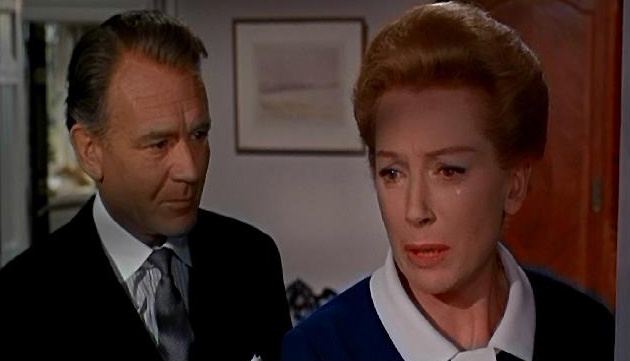
THE CHALK GARDEN (1964). Director: Ronald Neame. 

Miss Madrigal (Deborah Kerr) is the latest in a long line of governesses for young and incorrigible Laurel (Hayley Mills), whose mother went off with her new husband and left her in the care of her own mother, Mrs. St. Maugham (Edith Evans). Laurel, who hates her mother, Olivia (Elizabeth Sellars), for abandoning her, is determined to find out what if any secrets Miss Madrigal may have, and one of them is a doozy. Meanwhile the governess and Mrs. St. M disagree on who should raise Laurel, her mother or her grandmother. Madrigal believes she belongs with Olivia, while her employer vehemently denies this. Then Mrs. St. M's old friend, "Puppy," the retired Judge McWhirrey (Felix Aylmer) shows up, and eventually remembers where he has seen Miss Madrigal before ... 

John Mills with Kerr
The Chalk Garden is based on a play by Enid Bagnold, and in truth it is very stagey and often unconvincing. There were a great many changes made from theater to film. Deborah Kerr never quite seems to get a handle on her character (although in this she may not necessarily be blamed); Hayley Mills is fine but for one or two occurrences of over-acting; Edith Evans is on the money; and Sellars and Aylmer are perfectly solid. So too is John Mills, who plays the sympathetic butler. There is perhaps too much left unsaid in this version, and characters come to conclusions that seem without foundation.

Verdict: This Ross Hunter production has some merit but ultimately doesn't quite cut it. **3/4.