Lively, entertaining reviews of, and essays on, old and newer films and everything relating to them, written by professional author William Schoell.
Showing posts with label Virginia Grey. Show all posts

Thursday, June 18, 2026

JEANNE EAGELS

JEANNE EAGELS (1957). Director: George Sidney.

This lamentable biopic purports to be the life story of famous stage and screen actress Jeanne Eagels, but it comes off more like a travesty, almost a parody, of movie star biographies. Part of the problem is the casting and atrocious performance of Kim Novak, who has been seen to much better advantage in such movies as Vertigo and Middle of the Night. Apparently given no help at all in shaping her role by director George Sidney, Novak -- who does have a (very) few good moments -- portrays Eagels by lowering her voice an octave and developing an imperious manner and never seeming remotely human -- in fact at times she's more grotesque than anything else. She confuses over-acting with "Great Acting" and even has trouble with simple line readings. Although there was certainly enough drama in the real  Eagels's life, with two marriages, a drug problem, and death at 39, Jeanne Eagels needs to make up even more slanderous stuff (her family filed a law suit, but you can't libel the dead in the U.S.). In the movie an invented alcoholic actress named Elsie Desmond (a creditable Virginia Grey) brings Eagels the script for the play "Rain," hoping the latter will interest a producer in mounting the play as a comeback for her. Instead, Eagels steals the play away from Desmond, who then commits suicide. Eagels is seen as being similarly ruthless in other sequences as well. 

Agnes Moorehead with Novak
The two men in her life, one of whom she briefly marries, are portrayed by Jeff Chandler (who basically gives a good accounting of himself) and Charles Drake, who is okay as her husband. As Eagels' stern if loving acting coach, Agnes Moorehead gives a competent performance but at times seems affected by the movie's sheer badness. Murray Hamilton does his typical sleazy, oily, repulsive shtick as a vaudeville performer who tries to rape Jeanne. The movie mixes facts with fantasy, such as when Eagels is suspended from the stage for several months by Actors Equity (true) and has her running to vaudeville when she actually went to Hollywood to make (mostly silent) movies (one of which is inexplicably shown at the end of Jeanne Eagels, only it's a musical!). In actuality, Eagels had a triumph in the first sound version of The Letter, and was posthumously nominated for an Oscar, but this, incredibly, is never mentioned, even though it would have added up to an effective and bittersweet conclusion. Drake and Grey played a married couple in All That Heaven Allows and George Sidney also directed Bye Bye Birdie, for which he was more suited.

Verdict: Eagels certainly deserved better than this miserable schlock. *1/2.

Thursday, December 1, 2016

THE NAKED KISS

Bald and Beautiful: Constance Towers
THE NAKED KISS (1964). Produced, written and directed by Samuel Fuller.

A prostitute named Kelly (Constance Towers) comes to a small town, Grantville, after a violent incident with her pimp, and briefly hooks up with a hypocritical cop named Griff (Anthony Eisley of The Mighty Gorga). Griff wants Kelly to "get out of town" and go across the river to an establishment of ill repute run by Candy (Virginia Grey). Instead Kelly gets a job working at an institution that helps disabled children. Kelly then meets the hospital -- and the town's -- chief benefactor, the romantic and cultured Grant (Michael Dante). Despite at least one red flag, Kelly finds herself falling for Grant, but he has one highly disturbing secret. The Naked Kiss is superior to Fuller's earlier Shock Corridor, and full of equally controversial material. Of course it's not the first movie to have a hooker for a heroine, and not even the first to look into the subject of pedophilia (Never Take Candy from a Stranger came out four years earlier in Britain). The movie has a very interesting script, but, unfortunately, it descends into melodrama that only cheapens it. Towers is more effective and not as overwrought as she was in Corridor; Eisley is perfectly cast as the slimy Griff; Grey is terrific as ever; and Dante, while his character is essentially a charming if one-note villain, has his moments as well. Patsy Kelly appears as a nurse in the institution. The Naked Kiss, whatever its flaws, certainly has some interesting scenes. There's the opening with Kelly assaulting the pimp who shaved her hair off as her wig falls off of her head and she's revealed to be bald; Kelly's smack-in-the-face purse assault, this time on madame Candy; Kelly's landlady (Betty Bronson of The Locked Door) talking about the soldier she intended to marry but who never came home from the war; and especially the poignant scene when all of the children sing the plaintive melody 'Tell Me Why." Towers, who years later co-starred with Yul Brynner in "The King and I," reveals a lovely voice in this sequence. Edy Williams, who dated Dean Martin, appears briefly as a hooker. In Grantville, the movie theater's marquee reads "Shock Corridor."

Verdict: Good story, but too lurid and superficial. **1/2. 

Thursday, October 6, 2016

SWAMP FIRE

SWAMP FIRE (1946). Director: William H. Pine.

The teaming of Johnny Weissmuller and Buster Crabbe as adversaries who come to blows is the chief selling point of this pot-boiler. Although Weissmuller is top-billed, probably because of his Tarzan films, the main character is actually played by Crabbe. Mike Kalavich (Crabbe) returns from  the war and back to the Louisiana bayou, where a lack of confidence interferes with his ability as a pilot to safely guide ships through the Mississippi river. People think he's lost his nerve when he makes a decision that costs him his cargo, but not human lives. Meanwhile Johnny Duval (Weissmuller) returns from combat duty to his home on the Delta and eventually comes into conflict with Mike. Mike, who joins the Coast Guard, is involved with Toni (Carol Thurston) but a spoiled heiress named Janet (Virginia Grey) has set her cap for Mike; she and Toni have a lively bitch-slap session and a hair-pulling match that is probably the highlight of the picture. Crabbe isn't bad in this, but as expected, the best performance comes from the always-vital Virginia Grey [Another Thin Man] . Pierre Watkin is also in the cast as Grey's father, but then Watkin seems to have been in virtually every other movie ever made and is competent but little else in all of them. Weissmuller and Crabbe also appeared together in the "Jungle Jim" film, Captive Girl.

Verdict: Two Tarzans and Olympic swimming champs face off but the results are less than spectacular. **1/2.

Thursday, September 29, 2016

TARZAN'S NEW YORK ADVENTURE

The amazing Cheetah
TARZAN'S NEW YORK ADVENTURE (1942). Director: Richard Thorpe.

Hunter Buck Rand (Charles Bickford of Anna Christie) and his associates Jimmie (Paul Kelly of Zeigfeld Girl) and Manchester (Chill Wills) are in the Congo trying to capture lions for a circus. Naturally Tarzan (Johnny Weissmuller) objects to this, but Boy (Johnny Sheffield) is fascinated by their plane. Buck is fascinated himself when he observes how Boy can make a pack of elephants do whatever he wishes. After it appears that Tarzan and Jane (Maureen O'Sullivan) have been killed in a fire, Buck takes Boy back to New York with him. But when Tarzan finds out his son is gone ... Tarzan's New York Adventure is a very entertaining Tarzan film even though it goes far, far afield from Edgar Rice Burroughs' original conception. In this film Tarzan is so stupid that he takes a shower before taking off his one good suit (which dries off in miraculous time). In the novels, Tarzan had his savage side when it was called for, but he wasn't a monosyllabic and unsophisticated dummy. The stupidest moment in this movie occurs when Tarzan gives out with his famous yell and Jane says" Good heavens -- what's that?" even though she's heard it hundreds of times. Burroughs gave Tarzan and Jane a biological son who was named Jack, and later became known as "Korak" -- the boy in this movie is an orphan. Despite all this, the movie is a lot of fun. Cheetah has so much to do in the movie that it could almost be re-titled Cheetah's New York Adventure; you certainly hear her cackle that fabricated hyena laugh often enough. The chimp's special moments include her encounter with a water cooler, and her putting a trio of elephants through their paces as if she were an orchestra leader. The pachyderms are also amazing as Boy has them put on a show for the trio from New York. The actors in this are all good, with an uncredited Mantan Moreland having a couple of good moments reacting to Cheetah on the other end of the telephone. Virginia Grey is also fine as a nightclub singer who helps Tarzan and his mate find Boy. Cy Kendall, fatter than ever, plays the head of the circus. Sidney Wagner's photography, especially those striking shots of New York, is outstanding. This was O'Sullivan's last appearance as Jane, but Weissmuller and Sheffield had a few more pictures to go. Followed by Tarzan Triumphs.

Verdict: Highly improbable but also highly enjoyable Tarzan movie. ***.

Thursday, August 18, 2016

PORTRAIT IN BLACK

PORTRAIT IN BLACK (1960). Director: Michael Gordon. Produced by Ross Hunter.

Sheila Cabot (Lana Turner) is a beautiful woman married to a sick and seemingly hateful old man named Matthew (Lloyd Nolan). One day Sheila's lover, David (Anthony Quinn), who happens to be her husband's doctor, tells her how easy it would be to get rid of him. When Matthew conveniently kicks off, Sheila and David think they are above suspicion. But then a certain insinuating letter arrives ... Portrait in Black is an exhilarating suspense film whose chief strength is a superb performance from Quinn and an excellent score by Frank Skinner [Back Street] that helps keep viewers on the edge of their seats as all the various twists and turns of the plot -- and there are many -- skillfully unfold in a screenplay by Ivan Goff and Ben Roberts (based on their stage play). Michael Gordon's direction at least keeps things moving at a brisk pace, and there is some fine photography of San Francisco settings by Russell Metty [Miracle in the Rain]. While Turner and Quinn [Wild is the Wind] may not seem to have that much chemistry, Quinn's passion simply enfolds Turner and helps empower her more than competent performance. As for the rest of the cast: Lloyd Nolan; Sandra Dee as Turner's step-daughter; John Saxon as Dee's boyfriend; Richard Basehart as a scheming associate; Dennis Kohler as young Peter, Dee's step-brother; Virginia Grey as a secretary; and Ray Walston as a chauffeur who may know too much are all quite good, and for extra added measure we get Anna May Wong, of all people, playing the maid. Paul Birch shows up very briefly as a detective. This picture, now forgotten by most, was quite famous in its day, and is certainly worth a look. Producer Ross Hunter insures that the film has that certain Hunter gloss. The ad campaign for the pic seems to summon up images of Lana Turner, her daughter, and Johnny Stompanato which was turned into Where Love Has Gone with Susan Hayward in the Turner part.

Verdict: Very entertaining melodrama that isn't boring for an instant. ***.

ANOTHER THIN MAN

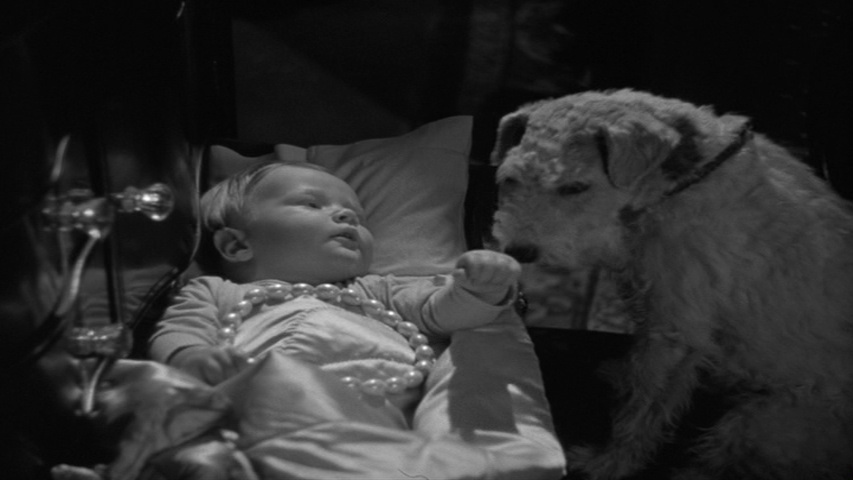
Baby Nicky and li'l Asta
ANOTHER THIN MAN (1939). Director: W. S. Van Dyke II.

Back in New York with their new son, Nicky, and little Asta in tow, Nick and Nora (William Powell and Myrna Loy) are summoned to the Long Island estate of Colonel MacFay (C. Aubrey Smith). MacFay has been receiving weird death threats from an old employee named Church (Sheldon Leonard) and hopes to have Nick's protection. Naturally, as in most of these detective movies, the threatened man is murdered under the disinterested hero's nose, and the rest of the movie is concerned with finding out who done it. Another Thin Man is quite talky, but entertaining, with an intricate script and a denouement that is truly a surprise. Members of the supporting cast (as well as suspects in certain cases) include Virginia Grey [Jeanne Eagels] as MacFay's adopted daughter; Patric Knowles as her secret fiance; Tom Neal [Bruce Gentry] as a man carrying a torch for Grey; Otto Kruger as the detective on the case; Ruth Hussey as a kind of nanny; Muriel Hutchison as Church's paramour, among others, all giving adroit performances. The business with ex-cons being delighted to see Nick even though he sent them up the river gets tiresome, and leads into a party for little Nicky with the hoods each bringing their own baby! (Don't blink or you'll miss Shemp Howard.) Some of the subsequent victims certainly don't deserve to be murdered, but there's never any sympathy for them. However, there's a swell scene with Powell interacting with Marjorie Main [The Law and the Lady] as a landlady, and the ending is a pip! The killer in this is especially conniving and heartless.

Verdict: Things look up for the series with this entry. ***.

Thursday, October 22, 2015

STRANGERS IN THE NIGHT

Helene Thimig
STRANGERS IN THE NIGHT (1944). Director: Anthony Mann.

Sgt. Johnny Meadows (William Terry) has exchanged letters with a young lady named Rosemary, and is on his way to Marteflores to finally meet her in the flesh. But he encounters another young woman, a doctor named Leslie (Virginia Grey), on a train and the two are immediately attracted to one another. Leslie turns out to be the new doctor in Marteflores, and pays a call on Rosemary's family, as does Johnny. There to greet them are Rosemary's mother. Hilda (Helene Thimig), and Hilda's companion, Ivy (Edith Barrett of I Walked with a Zombie). But where the hell is Rosemary? Most viewers will figure out what's going on, but there's still a twist or two. The leads are fine, but the picture is stolen by a wonderful Barrett, and Thimig is outstanding in her portrait of a seriously disturbed and lonely woman -- she is beautifully dramatic without chewing the scenery. Anne O'Neal is also notable as Leslie's nurse. This is a compelling little "B" movie, less than an hour long, that is bolstered by the acting. The appealing Terry also starred in Johnny Doesn't Live Here Anymore. Anthony Mann turned out lower-budgeted movies like this for Republic before going on to bigger and better items like The Furies and many others.

Verdict: Loneliness kills. ***.

Thursday, April 9, 2015

THE HARDYS RIDE HIGH

Mickey Rooney, Ann Rutherford and William Orr
THE HARDYS RIDE HIGH (1939). Director: George B. Seitz.

"Why do I want to get married and make one woman miserable when I can stay single and make lots of women happy!' -- Andy Hardy.

Judge Hardy (Lewis Stone) gets the astonishing news that he may have inherited two million dollars so he packs up the family to a Detroit mansion to check out the claim's validity. In the meantime son Andy (Mickey Rooney) goes "high-hattin'" to nightclubs where he refuses liquor and has trouble taking a smoke, but he is, after all, only sixteen years old [Rooney was actually three years older]. Daughter Marian (Cecelia Parker) proves to be as big an ass as usual. Aunt Milly (Sara Haden), who is the judge's sister-in-law [but always seems more like his sister] glamorizes herself but alas is still pretty homely, although gauche Andy thinks she's "all done up like a plush horse!" And Mrs. Hardy (Fay Holden) is just happy that she found a good frying pan in Detroit. A very young and unrecognizable Virginia Grey [Jeanne Eagels] plays a chorus girl who tries to vamp Andy -- the young stud is positively terrified by such a sophisticated city woman -- at the direction of her boyfriend, and rival heir, Phil Westcott (John King). Andy complains to girlfriend Polly (Ann Rutherford) that he's "all right until some la-di-da lizzie comes along," referring to the snooty Dick Bannersly (William Orr). The Hardys Ride High is a delightful entry in the series, with the usual top performances, especially the great Rooney, lots of humor, and the usual dose of honest sentiment. Judge Hardy comes mighty close to committing a crime in this, and frankly the whole business about the inheritance is never satisfactorily resolved, as if something were left on the cutting room floor. Marsha Hunt has a small role as a wife who appears before the court. William Orr later became the head of Warner Brothers television and was executive producer of many hit shows, including 77 Sunset Strip and Hawaiian Eye.

Verdict: Riding high indeed. ***.

Thursday, June 26, 2014

LOVE HAS MANY FACES

LOVE HAS MANY FACES (1965). Director: Alexander Singer.

Wealthy Kit Jordan (Lana Turner) is living in Acapulco and married to ex-beach bum, Pete (Cliff Robertson of Obsession). When an old flame of hers, another beach bum named Billy, washes up dead on the shore, it causes tension in her marriage, a situation that isn't helped by the arrival of Carol (Stefanie Powers of Die, Die My Darling), who once cared for Billy, and who attracts the attentions of Pete. Meanwhile half-naked hustler Hank (Hugh O'Brian) and his buddy, Chuck (Ron Husmann), zero in on two middle-aged tourists, Margot (Ruth Roman) and Irene (Virginia Grey). Although the movie is in general well-acted [by Hollywood standards] -- with an especially noteworthy and reptilian O'Brian -- the actors still aren't brilliant enough to make these stereotypes come to life. Marguerite Roberts' thrice-removed screenplay moves the characters around in allegedly interesting tableaux but nothing of consequence ever happens, and the dialogue is as empty as the people. The sub-plot with O'Brian and the ladies really goes nowhere.

Verdict: Go to the beach instead -- or Acapulco! *1/2.

Thursday, October 31, 2013

HOUSE OF HORRORS

Marcel (Martin Kosleck) admires his bust of the Creeper
HOUSE OF HORRORS (1946). Director: Jean Yarbrough.

Starving artist Marcel De Lange (Great Old Movies' favorite Martin Kosleck) is about to commit suicide in despair when he stumbles across an injured man known only as the Creeper (Rondo Hatton). The Creeper had already committed a series of murders, snapping people's spines, and is presumed dead. Marcel uses the Creeper to get revenge on his enemies, especially the acidic critic Holmes Harmon (Alan Napier), who has no tolerance for the abstract. The main suspect in Harmon's murder, however, is commercial illustrator Steven Morrow (Robert Lowery of the Batman and Robin serial), who was to be the target of his venom in the critic's latest column. Another critic, Joan Medford (Virginia Grey), happens to be Morrow's girlfriend and a champion of De Lange's macabre sculptures. But when she gets too close to figuring out De Lange's deadly secret ... This is a snappy and suspenseful horror thriller, well-directed by Yarbrough, and with an excellent performance from Kosleck, and good back up from Hatton [who thinks his bust is "pretty"], a highly vivacious (perhaps too vivacious considering the goings-on) Grey, and a more than competent Lowery and Napier. Howard Freeman also scores as another art critic, Hal Ormiston, who participates in a scheme to catch the murderer. The beautiful model Stella is played by Joan Shawlee and Lt. Brooks is Bill Goodwin. House of Horrors is an unofficial sequel to the modern-day Sherlock Holmes film The Pearl of Death, in which Hatton also played a Creeper who breaks spines. Oddly the opening credits of Horrors "introduce" Hatton as the Creeper. There were plans to make a series of Creeper films and turn Hatton into a horror star, but the poor fellow, who suffered from acromegaly due to exposure to poison gas in WW1, passed away before House of Horrors opened. Kosleck's most famous part was in The Flesh Eaters. Yarbrough directed She-Wolf of London and many, many others.

Verdict: Highly entertaining horror flick. ***.

Thursday, November 15, 2012

TARGET EARTH

TARGET EARTH (1954). Director: Sherman A. Rose.

A young lady. Nora (Kathleen Crowley), who was in deep sleep wakes up to discover that there is no one in her apartment building, and indeed the streets of the unnamed city she resides in are completely deserted -- until she encounters businessman Frank (Richard Denning) and they meet up with Vicki (Virginia Grey) and her boyfriend Jim (Richard Reeves) swilling champagne in a bar. Seems this motley group was left behind for one reason or another when the city was evacuated due to the invasion of steel electromagnetic robots from Venus. With a plot like that it sounds as if Target Earth would at least be entertaining, but while the opening scenes showing Nora exploring the city are quite striking and good at getting across her sense of isolation, the picture doesn't develop in a particularly interesting fashion. Even introducing a killer with a gun (Richard Roark), doesn't help much, nor does the fact that there is some decent attempts at characterization. The ladies in the cast are much, much better than the men, with the exception of Roark. Denning is as blandly amiable as ever, and Reeves is similarly lightweight. Arthur Space (Panther Girl of the Kongo) and Whit Bissell (Creature from the Black Lagoon) play Army men trying to deal with the outer space menace in separate sequences. The best thing you can say about the movie, aside from the opening sequences and some of the performances and a couple of interesting directorial touches, is that it's moderately better than the decade-later The Earth Dies Screaming, which had a very similar plot line. Rose only directed three movies and mostly did television work.

Verdict: Throughout the movie you only see one robot. **.

Thursday, July 5, 2012

ALL THAT HEAVEN ALLOWS

Rock Hudson and Jane Wyman
ALL THAT HEAVEN ALLOWS (1955). Director: Douglas Sirk.

"As Freud says, when we reach a certain age sex becomes incongruous."

""You were ready for a love affair, but not for love."

Cary Scott (Jane Wyman), a small-town widow approaching middle age, finds a second chance for happiness with a somewhat younger gardener named Ron Kirby (Rock Hudson). Even though Ron has his own successful business, he is seen as a poor choice for Cary, whose first husband was an affluent businessman. While the town busybodies gossip, even wrongly suggesting that something was going on between Cary and Ron even before Mr. Scott's death, Cary's son, Ned (William Reynolds), and daughter, Kay (Gloria Talbott), have strenuous objections to their mother's relationship with Ron. Concerned about her children's feelings, Cary makes a fateful decision, only to discover her children haven't time to give much thought to their mother's feelings. [A great scene has the children giving Cary a television set for Christmas, and the camera pulls in toward her sad reflection in the screen as she realizes this TV is meant to be her "companionship" for the future.] Jane Wyman gives an excellent and sensitive performance that holds up through all of the plot contrivances, and Hudson, if not on his co-star's level, is good and romantic and at the height of his male beauty. This is a typically handsome Ross Hunter production with picture postcard Technicolor cinematography. The screenplay tries [and fails] for added depth by making Kirby a Thoreau addict who tries, along with his friends Mick and Alida (Charles Drake and Virginia Grey), to turn aside from mindless ambition and enjoy life's simpler pleasures. [Only in a Hollywood movie can people who eschew the rat race and Keeping Up With The Jones' live in such utterly sumptuous surroundings. Anyone who lives in a reconverted, refurbished mill house has to have bucks.] That being said, there is some good dialogue and supporting performances from such as Gloria Talbott [as the constantly psychoanalyzing daughter], William Reynolds, Donald Curtis as a lecherous suitor, and Agnes Moorehead as Cary's good friend, Sarah. Jacqueline DeWit is the bitchy Mona, who dishes dirt on everyone, Nestor Paiva is one of Ron's circle of friends, and David Janssen is Kay's boyfriend. Although the film makes some attempt at dealing with ageism, it's also guilty of it in its treatment of Harvey (Conrad Nagel), who is Cary's steady date. Harvey may be twenty years older than Cary, but it's still a bit ludicrous to suggest that a man in his late fifties [as Nagel was] would settle for a sexless marriage with a younger woman, as Harvey more or less suggests. Setting aside these and other quibbles, All That Heaven Allows is not without appeal, although it is nowhere near as good as a similar vehicle with Barbara Stanwyck, My Reputation. Nice Frank Skinner score with classical themes.

Verdict:  Attractive soap opera with compelling leads [if for different reasons]. ***.

Sunday, October 9, 2011

BACK STREET (1961)

BACK STREET (1961). Director: David Miller.

"There isn't a marriage in the world where one doesn't love more than the other."

NOTE: This review contains spoilers. The third film version of Fannie Hurst's novel [earlier versions appeared in 1932 and 1941] makes just about every mistake conceivable in adapting the material. Rae Smith (Susan Hayward) falls in love with soldier Paul Saxon (John Gavin) without realizing that he's already married. She is going to fly to New York with him to start a new life, but misses the plane. They meet up years later and resume their affair while Paul's conveniently drunken and nasty wife (Vera Miles) insists she'll never give him a divorce. The first problem with the picture is that mistresses, while still capable of raising eyebrows, were not quite as scandalous in the sixties as they were in the thirties, forties and earlier. Another problem is that the life-long affair of the novel and other two film versions only occupies a few years in this version. The wife, mostly unseen in earlier versions, was never supposed to be a shrew but a perfectly nice person, one of the reasons the married man never divorces her. The earlier film versions concentrated on the loneliness endured by women in back street affairs, but Hayward has a successful career and lots of friends. Worst of all, in this version the married man's son is just a child, incapable of eventually reaching an understanding as regards to his father and the other woman he loved, (making the ending all the more inexplicable). In the first two film versions, Walter/Paul was only engaged and decided to marry Ray/Rae, but in this version he wants her to run off to New York with him without first telling her he's got a wife! At the end, after his and his wife's death in an accident, his very young children suddenly show up at his mistress' door and want to be friends with her -- which makes absolutely no sense at all [their being orphans notwithstanding]! At the time of filming Hayward was 44 and Gavin was 30 and the difference in their ages quite apparent, but the script unwisely ignores it. Hayward, who seems justifiably bored with the material, just goes through the motions for the most part. Gavin makes an effort and is acceptable. Miles comes off the best, with good support from Virginia Grey, Charles Drake, Natalie Schafer, Reginald Gardiner, and Robert Eyer as the son.The liveliest scene has Miles invading a charity auction to make snide remarks about Hayward and carry on in supremely bitchy fashion.

Verdict: A completely unnecessary remake that shows some promise at first but gets more tedious with every passing minute. **.

Thursday, June 4, 2009

JUNGLE JIM


JUNGLE JIM (1948). Director: William Berke.

A middle-aged Johnny Weissmuller (pictured) trades in the loincloth of Tarzan for the safari suit of Jungle Jim, which was based on an Alex Raymond comic strip. The snappy Virginia Grey plays Dr. Hilary Parker, who is hoping to get a cure for polio from a witch doctor -- while others are just hoping to find treasure. George Reeves gives a lively performance as a creepy photographer and Rick Vallin plays, of all things, a native chieftain. Lita Baron is the bitchy native girl who tells Parker that she's "like a man." There are elephant stampedes, falling boulders, an attack by alligators, an odd crocodile with a tail that's more like a tentacle, and a trained crow that pecks at typewriter keys. The best scene has Jim dangling from the side of a cliff; his wrestling with a lion isn't bad, either. This may be mostly stock footage, but it plays. Reeves is more interesting as a bad guy than as a hero. Grey also appeared in Black Zoo.

Verdict: Fast-paced jungle fun. **1/2.

Thursday, April 30, 2009

MR. AND MRS. NORTH (1942)


MR. AND MRS. NORTH (1942). Director: Robert B. Sinclair.

"Oh! Bristles from Brussels!"

There's trouble afoot when a body is found in the apartment of Mr. and Mrs. North (Gracie Allen and William Post Jr.) Paul Kelly [Secret Code] is the cop on the case; Virgina Grey, Jerome Cowan, Tom Conway, Rose Hobart, and others are among the suspects, which include the title couple. There's also a "Fowler Brush" salesman (Felix Bressart) who has important information to impart to the police, if they'll only take him seriously. Allen basically plays the usual daffy characterization that she was famous for; Post provides more sensible support. The film is light-hearted and easy to take, but also quite easy to forget.

Verdict: Gracie is always fun. **.

Friday, August 29, 2008

CRIME OF PASSION (1957)


CRIME OF PASSION (1957). Director: Gerd Oswald.

Kathy (Barbara Stanwyck), a lonelyhearts columnist turned reporter, meets and marries cop Bill (Sterling Hayden). Stifled by dull married life, she transfers all of her ambition to Bill, who is perfectly happy plodding along the way he is. First Kathy schemes to become friends with Bill's boss Tony (Raymond Burr) and his wife Alice (Fay Wray). Then she tries to Talk Tony into giving Bill his job upon retirement and then ... Let's just say that Stanwyck gives it the old college try, yelling all over the place, but her vivid performance is the only thing that will keep most viewers watching. This lacks the intensity and steaminess of true film noir; it's just a rather silly melodrama with a heroine who seems too smart to do the stupid things she does. Hayden and Burr are adequate; a middle-aged Wray is fine, and the second zestiest performance comes from Virginia Grey as a woman who's jealous of Kathy and Bill's friendship with the boss.

Verdict: Not exactly Madame Bovary. In fact it's not even Beyond the Forest.**.

Sunday, April 27, 2008

MEXICAN HAYRIDE


MEXICAN HAYRIDE (1948). Director: Charles Barton.


Bud and Lou are up to mischief down in Mexico, where Joe (Costello) has followed Harry (Abbott), who bilked him out of money and is now hoping to sell shares to a mine. At the arena, Bud realizes that the lady bullfighter Montana (Virginia Grey), is actually an old gal pal, Mary. Harry's sexy associate Dagmar (Luba Malina) tries to find out where Joe has hidden his money. And the law, as well as sinister old associates, are closing in. Fritz Feld is a scream as an elocution master who tries to help Costello with his speech, and a lot of humor is generated by the fact that Lou can't resist dancing every time he hears the Samba -- including in the bullring, where a very dramatic bull is after his hide. Costello also has a funny routine with the fast-talking Sidney Fields, and an amusing song and dance number with the zesty Malina. Lou's brother Pat Costello probably has a larger, speaking role in this than in any other A&C feature as a tough guy who's looking for Joe.

Verdict: Good-natured fun. ***

Friday, January 18, 2008

WHISTLING IN THE DARK


WHISTLING IN THE DARK (1941). Director: S. Sylvan Simon.

It's easy to see why this comedy-thriller starring the likable Red Skelton was so popular, engendering a couple of sequels. Skelton plays a radio detective called The Fox, who is kidnapped by the head of a cult (Conrad Veidt) who wants him to help him and his gang come up with a way to bump off a certain individual without the crime being traced back to them. The victim is the nephew of a wealthy woman who left money to the cult, only they can't collect it until the nephew is deceased. Skelton's colleague and fiancee Ann Rutherford (pictured), as well as his boss's daughter (Virginia Grey) – who has a yen for him -- are also kidnapped to put pressure on Skelton. Skelton comes up with a murder plot but tries to outwit his captors and save the life of the nephew, who is due to be poisoned while traveling on an airplane. While the movie is certainly never as nail-biting or cinematic as a Hitchcock picture, it does manage a good mixture of genuine suspense and laughs. The performances are all top-notch – Rutherford is particularly effective – and Mariska Aldridge is a riot as the hatchet-faced Hilda.
Verdict: Lots of fun. ***.