Lively, entertaining reviews of, and essays on, old and newer films and everything relating to them, written by professional author William Schoell.
Showing posts with label W. S. Van Dyke. Show all posts

Thursday, March 7, 2019

SWEETHEARTS

Nelson Eddy and Jeannette MacDonald
SWEETHEARTS (1938). Director: W. S. Van Dyke.

"She's in the hospital for over work. She can't even see the doctor for six months."

Gwen Marlowe (Jeanette MacDonald) and Ernest Lane (Nelson Eddy) have starred in the hit Broadway musical "Sweethearts" since the show opened -- and they were married -- six years ago. Producer Felix Lehman (Frank Morgan of Saratoga) is horrified at the notion that his stars may flee to Hollywood, but they are so fed up with demands upon their time that they agree to go west with movie man Norman Trumpett (Reginald Gardiner). But then the show's lyricist, Leo Kronk (Mischa Auer), comes up with a rather cruel way to keep the couple in New York -- by breaking them up! To do this he plants the notion in Gwen's head that Ernest is having an affair with their secretary, Kay (Florence Rice of Mr. District Attorney).

Eddy, Frank Morgan and MacDonald
Let's make it clear from the start that although Eddy, MacDonald, Morgan and others are swell, the true star of this picture is Victor Herbert. The plot of the great composer's operetta was thrown out for this mild backstage roundelay in which the lead characters only appear in "Sweethearts," which retains Herbert's music while attributing it to fictional composer Oscar Engel (an amusing Herman Bing). So we get the gloriously romantic title tune; McDonald warbling "Summer Serenade;" Nelson delivering "Marching On Parade" with real panache; and the couple dueting on "A Little Gray House in the West,"  memorable tunes all. MacDonald is delightful as she jazzes up "Pretty as a Picture."

Nelson and Jeanette
The shame of it is that the stars, especially MacDonald, seem more than up to the task of delivering what's required if there had only been a more sophisticated and/or meatier script. Both Gwen and Ernest have parents who are or were in show biz, and who talk about their past glories endlessly. but their children's near-contempt of them is a bit unsettling. Lucile Watson and George Barbier are two of the parents. Ray Bolger has no dialogue but does a snappy dance number, and Douglas McPhail [Babes in Arms] and Betty Jaynes show up briefly as young hopefuls. Fay Holden and Olin Howland have smaller roles. The two leads are in fine voice, even if they at times tend to over-sing, and Ms. MacDonald can occasionally be shrill.

Verdict: Beautiful MGM technicolor, some good performances and vocalizing, and lilting Victor Herbert music -- but oh that script! **1/2. 

Thursday, January 17, 2019

I TAKE THIS WOMAN

Hedy Lamarr
I TAKE THIS WOMAN (1940). Director: W. S. Van Dyke.

"Time wounds all heels." -- Marcesca.

Georgi Gregore (Hedy Lamarr) tries to throw herself off of an ocean liner due to an unhappy love affair, but she is saved by the compassionate Dr. Karl Decker (Spencer Tracy). Georgi is still dealing with her feelings for the married Phil Mayberry (Kent Taylor), when she gets involved with Karl -- who works at a clinic for low-income patients -- and marries him. But trouble begins when Karl joins a practice that caters to the wealthy, and Georgi runs into her ex-lover, Phil, once more. Can this marriage be saved?

Spencer Tracy and Hedy Lamarr
When I Take This Woman was first released, it came in for a mostly critical drubbing, and over the years has been considered a very bad picture starring a completely mis-matched Tracy and Lamarr. In actual truth, while the film is certainly not excellent, and at one point begins to rip off The Citadel, it is entertaining and very well-acted, with Tracy and Lamarr  playing very well together and making a very convincing romantic couple. In addition we've got some good work from Verree Teasdale as Georgi's effervescent friend, Marcesca, Kent Taylor as Phil, and Mona Barrie [Something to Sing About] as his bitter, heart-broken wife. Laraine Day, Louis Calhern, Frances Drake, and Paul Cavanagh also have notable supporting parts, along with Marjorie Main, Willie Best, Reed Hadley [Racket Squad], Don Castle [Roses are Red], and others.

I Take This Woman, alas, makes the mistake of trying to ape Frank Capra, throwing in a final scene that is sentimental in the wrong way and unconvincing. But the picture is still easy to take, Lamarr looks stunning, and the performances by both stars are quite memorable.

Verdict: Tracy and Lamarr make a better team than you might imagine. **3/4. 

Thursday, January 19, 2017

I MARRIED AN ANGEL

Sexless? Nelson Eddy and Jeanette MacDonald
I MARRIED AN ANGEL (1942). Director: W. S. Van Dyke.

In Budapest the irresponsible playboy and supposed banker, Willy (Nelson Eddy), is about to celebrate his 35th birthday with a masquerade ball. His disapproving associate, whom he calls "Whiskers" (Reginald Owen of The Good Fairy), thinks it's time Willy were married, and arranges for his shy secretary Anna (Jeannette MacDonald) to be invited to the party. His other, sexier secretary Marika (Mona Maris), suggests Anna go dressed as an angel, primarily to make fun of her. Willy doesn't know quite what to make of Anna, but later he dreams of an actual angel named Brigitta, who looks just like Anna, descending from heaven to marry him. But there are complications. I Married an Angel was based on a Rodgers and Hart musical, and it undoubtedly worked much better on the stage where its satirical aspects could be expressed with a degree of sophistication. Reworked as a vehicle for the essentially sexless duo Eddy and MacDonald, it simply comes off as weird and generally unmemorable. The picture picks up in the latter half, especially during a scene when Brigtta makes one tactless remark to her guests after another, assuming honesty is the best policy (but even this has a certain ugliness to it, as the targets are singled out for their age and appearance). MacDonald does become sexy in a nightclub scene, after Brigitta has fallen under the influence of a devilish baron (Douglass Dumbrille) and works her way scintillatingly through the crowd. I've no doubt most of the Rodgers and Hart songs were eliminated, but we still get the lovely title tune, the amusing "Willy Marry Me," and a snappy duet-dance between MacDonald and Binnie Barnes [Three Smart Girls] where the latter counsels the former to keep a "Twinkle in Your Eye." Wright and Forrest contributed one or two numbers as well. Unfortunately, both MacDonald [The Cat and the Fiddle] and Eddy [Phantom of the Opera] have a tendency to over-sing everything, clubbing the songs into submission. Their acting is fine, however, with MacDonald (although too old for the role of a virginal secretary) being as adept as the shy young woman warily approaching her boss at the party as she is as the semi-malicious character in the nightclub sequence. Owen, Maris and Barnes are fine, but Edward Everett Horton is wasted. Esther Dale and Gertrude Hoffman make their mark in smaller roles. At one point Eddy stands on a balcony and watches scenes of "Brigtta" inexplicably performing in such operas as Carmen -- making one wonder if the actress was hoping to be tapped by the Met. This was the last -- and probably least -- collaboration of the famous duo.

Verdict: Rodgers and Hart deserved better than this. **.

Thursday, September 15, 2016

SHADOW OF THE THIN MAN

William Powell and Stella Adler
SHADOW OF THE THIN MAN (1941). Director: W. S. Van Dyke.

Nick and Nora Charles (William Powell; Myrna Loy) are enjoying a relatively quiet life with Asta and little Nicky (Richard Hall) when murder comes a'calling again. This time the victim is a virtually anonymous jockey who's dead practically before the film begins, but soon other bodies begin to pile up. Suspects and victims alike include reporter Paul Clarke (Barry Nelson); his girlfriend, Molly (Donna Reed); her boss, "Link" Stephens (Loring Smith); his mistress, Claire Porter (Stella Adler); and assorted underworld or otherwise shady characters such as Fred Macy (Joseph Anthony); "Rainbow" Benny (Lou Lubin); and "Whitey" Barrow (Alan Baxter). Then there's Major Sculley (Henry O'Neill of Scandal Sheet) and the excitable Lt. Abrahms (Sam Levene of Dial 1119). Gathering the suspects at the climax where everyone has a serious hate on, Nora is afraid that Nick is going to name her as the murderer. This is a typically convoluted, but amusing "Thin Man" movie with very good performances from all. Stella Adler, who is very saucy in this picture, did a lot of theater work, but her film and TV credits were limited to five; she later became best-known as an acting coach. Joseph Anthony later became a director for the stage and of such films as Career.

Verdict: Smooth and entertaining. ***.

Thursday, August 18, 2016

ANOTHER THIN MAN

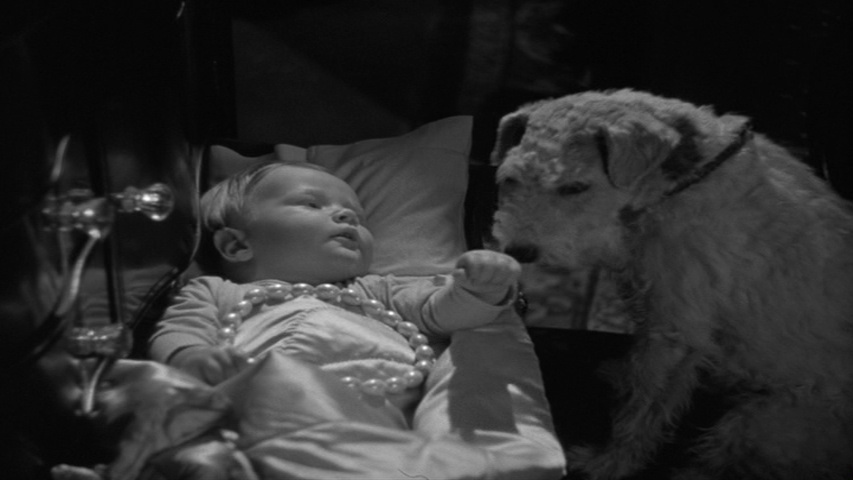
Baby Nicky and li'l Asta
ANOTHER THIN MAN (1939). Director: W. S. Van Dyke II.

Back in New York with their new son, Nicky, and little Asta in tow, Nick and Nora (William Powell and Myrna Loy) are summoned to the Long Island estate of Colonel MacFay (C. Aubrey Smith). MacFay has been receiving weird death threats from an old employee named Church (Sheldon Leonard) and hopes to have Nick's protection. Naturally, as in most of these detective movies, the threatened man is murdered under the disinterested hero's nose, and the rest of the movie is concerned with finding out who done it. Another Thin Man is quite talky, but entertaining, with an intricate script and a denouement that is truly a surprise. Members of the supporting cast (as well as suspects in certain cases) include Virginia Grey [Jeanne Eagels] as MacFay's adopted daughter; Patric Knowles as her secret fiance; Tom Neal [Bruce Gentry] as a man carrying a torch for Grey; Otto Kruger as the detective on the case; Ruth Hussey as a kind of nanny; Muriel Hutchison as Church's paramour, among others, all giving adroit performances. The business with ex-cons being delighted to see Nick even though he sent them up the river gets tiresome, and leads into a party for little Nicky with the hoods each bringing their own baby! (Don't blink or you'll miss Shemp Howard.) Some of the subsequent victims certainly don't deserve to be murdered, but there's never any sympathy for them. However, there's a swell scene with Powell interacting with Marjorie Main [The Law and the Lady] as a landlady, and the ending is a pip! The killer in this is especially conniving and heartless.

Verdict: Things look up for the series with this entry. ***.

Thursday, August 11, 2016

AFTER THE THIN MAN

Myrna Loy and William Powell
AFTER THE THIN MAN (1936). Director: W. S. Van Dyke.

Nick Charles (William Powell) and wife, Nora (Myrna Loy) have returned from New York to California in this first sequel to The Thin Man, but discover that wherever they go murder follows. Nick learns that when it comes to intrigue and craziness, Nora's relatives are not much different from the thugs and ex-cons Nick hangs out with. This time Nora's cousin, Selma (Elissa Landi of The Sign of the Cross), is accused of murdering her philandering husband, Robert (Alan Marshal). The suspects include a nightclub owner named Dancer (Joseph Calleia); a dancer named Polly (Penny Singleton); her "brother," Phil (Paul Fix of The Bad Seed); Dr. Kammer (George Zucco), who thinks everyone is nutty: and David Graham (James Stewart), who has long carried a torch for Selma. Somewhat better than The Thin Man, this is arguably not a whole lot better than a typical mystery from a minor studio, but it is served up with relish, some very good acting, and has an effectively comic-dramatic ending. Singleton, who was billed as "Dorothy McNulty" back then, is vivid as Polly, and Jessie Ralph [David Copperfield] simply walks off with the movie as Nora's formidable Aunt Katherine, a harridan force of nature if ever there were one. Sam Levene is fine as Lt. Abrahms, the detective on the case. Asta has a bit more to do then he did in the first film.

Verdict: Nick Charles is no Perry Mason, but this is fun enough. ***.

Thursday, August 4, 2016

THE THIN MAN

William Powell prepares to question the suspects
THE THIN MAN (1934). Director: W. S. Van Dyke.

Nick Charles (William Powell) retired as a detective when his wife, Nora (Myrna Loy), inherited a fortune from her father. On a trip back to New York, Nick discovers he can't stay away from sleuthing when several people he knows are embroiled in murder. Dorothy Wynant (Maureen O'Sullivan) is worried when her father, Clyde (Edward Ellis), disappears, and things get more complicated when Clyde's mistress, Julia (Natalie Moorhead of The Curtain Falls) is found murdered. More deaths follow as the suspects pile up: Wynant's ex-wife Mimi (Minna Gombell of Babbitt); his weird son, Gilbert (William Henry of Nearly Eighteen); his lawyer, MacCauley (Porter Hall); Mimi's gigolo and second husband, Chris (Cesar Romero); and several other nefarious types. Nick gathers all of the suspects (he pronounces the word with the accent on the second syllable, which is kind of charming in an old-fashioned way) at a dinner party he hosts with an utterly baffled Nora. The Thin Man has good performances from all -- Gertrude Short is snappy in a small role as the shrewish girlfriend of a dead hood -- but one could argue that there's more silliness than humor and it often gets in the way of the not-very-memorable story, although it does manage to build up minor interest and suspense as it goes along. Nobody who watches this will especially care who the killer is. Powell does his usual suave shtick with aplomb; Loy is fine if typically arch; and the little dog Asta almost runs off with the show. There were five sequels to this popular film, most of which, if memory serves me, were superior to this first entry. The title refers to the vanished Wynant, described by police and papers as a "thin man with white hair." Nick, rarely without a drink in his hand, seems half-inebriated throughout the movie. Nat Pendleton is the detective on the case, and Henry Wadsworth is Dorothy's fiance, Tommy.

Verdict: Too self-consciously "cute" by half but not without its moments. **1/2.

Thursday, December 10, 2015

TARZAN THE APE MAN (1932)

Maureen O'Sullivan and Johnny Weissmuller
TARZAN THE APE MAN (1932). Director: W. S. Van Dyke.

James Parker (C. Aubrey Smith), his daughter Jane (Maureen O'Sullivan), and Parker's associate Harry Holt (Neil Hamilton) are in Africa trying to find the mystical elephants' graveyard where valuable ivory can be appropriated. They find a treacherous way past a certain escarpment, encountering a horde of hippos and hungry gators, then eventually come afoul of a group of mean dwarfs. Tarzan (Johnny Weissmuller) doesn't put in an appearance until 23 minutes into the running time, and naturally helps save the day when Jane and the others are lowered by rope into a pit with a huge and violent ape. While he could never be considered a great actor, Weissmuller's pantomiming in this is highly effective, getting across both his primitive aspects as well as a charming shyness towards Jane. The movie reveals absolutely nothing of Tarzan's background, and doesn't follow the plot of Burroughs' first novel except for the business with Tarzan swinging away with a frightened but mesmerized Jane in his arms. The film reveals its incredible racism in at least one scene, when a native porter falls to his death from a horrifying cliff and Holt wonders first what was in the man's packs, and then says "poor devil." Tarzan never actually says "Me Tarzan, You Jane" but keeps repeating "Tarzan, Jane" as he taps her on the shoulder over and over again, revealing his sense of humor. O'Sullivan [Payment Deferred] gives a good performance, although she does get so whiny at times you wish Tarzan would throw her out of a tree. Smith [Little Lord Fauntleroy] and Hamilton are okay -- the only time I ever really liked Hamilton was when he played Commissioner Gordon on Batman -- and Cheetah, of course, is absolutely wonderful. At one point Tarzan murders a poor native guide as retaliation for Hamilton shooting one of the ape man's pets! A bit slow-paced at times. This was not the first movie to feature Tarzan, but it led into a long series with Weissmuller [Jungle Jim] and then other actors. Tarzan of the Apes must have been pretty strong stuff in 1932, although it was probably eclipsed the following year by King Kong.

Verdict: Compelling if uneven fantasy. ***.

Thursday, April 16, 2015

ANDY HARDY GETS SPRING FEVER

Mickey Rooney and Helen Gilbert
ANDY HARDY GETS SPRING FEVER (1939). Director: W. S. Van Dyke.

"I think my ending is better than Shakespeare's -- it's more spiritual." -- Andy Hardy

"You mean when the native girl throws herself into a volcano?" -- Miss Meredith

Andy Hardy (Mickey Rooney) is annoyed by Polly Benedict's attentions to a young Naval officer, but his spirits are revived when he meets the new dramatics teacher, Rose Meredith (Helen Gilbert). Andy writes a play, "Adrift in Tahiti," that is inspired by "Romeo and Juliet," with Andy and Polly (Ann Rutherford) cast as the star-crossed lovers. But will all go well on the play's opening night, and will "Tahula" -- Polly's heroine -- warm up her frigid attitude toward Andy? More importantly, will he get pretty teacher Miss Meredith to actually marry him? In a sub-plot Judge Hardy (Lewis Stone) discovers that he may have been swindled out of his life savings along with some of his friends, a development already used in the previous year's Jones Family film, Safety in Numbers. This is another charming and amusing Andy Hardy film [these were still called "Hardy Family" movies, but we all knew who the star was] with Andy discovering the pangs of unrequited infatuation. George Breakston ("Beezy") from Love Finds Andy Hardy makes another appearance. Sister Marion Hardy seems less flighty in this outing, Aunt Millie hardly appears, and Fay Holden has a little more to do as Mrs. Hardy and does it as well as ever. Helen Gilbert comes close to giving a very lovely performance but somehow there's something lacking in her.

Verdict: Randy Andy gets romantic. ***.