Lively, entertaining reviews of, and essays on, old and newer films and everything relating to them, written by professional author William Schoell.
Showing posts with label Murray Hamilton. Show all posts

Thursday, June 18, 2026

JEANNE EAGELS

JEANNE EAGELS (1957). Director: George Sidney.

This lamentable biopic purports to be the life story of famous stage and screen actress Jeanne Eagels, but it comes off more like a travesty, almost a parody, of movie star biographies. Part of the problem is the casting and atrocious performance of Kim Novak, who has been seen to much better advantage in such movies as Vertigo and Middle of the Night. Apparently given no help at all in shaping her role by director George Sidney, Novak -- who does have a (very) few good moments -- portrays Eagels by lowering her voice an octave and developing an imperious manner and never seeming remotely human -- in fact at times she's more grotesque than anything else. She confuses over-acting with "Great Acting" and even has trouble with simple line readings. Although there was certainly enough drama in the real  Eagels's life, with two marriages, a drug problem, and death at 39, Jeanne Eagels needs to make up even more slanderous stuff (her family filed a law suit, but you can't libel the dead in the U.S.). In the movie an invented alcoholic actress named Elsie Desmond (a creditable Virginia Grey) brings Eagels the script for the play "Rain," hoping the latter will interest a producer in mounting the play as a comeback for her. Instead, Eagels steals the play away from Desmond, who then commits suicide. Eagels is seen as being similarly ruthless in other sequences as well. 

Agnes Moorehead with Novak
The two men in her life, one of whom she briefly marries, are portrayed by Jeff Chandler (who basically gives a good accounting of himself) and Charles Drake, who is okay as her husband. As Eagels' stern if loving acting coach, Agnes Moorehead gives a competent performance but at times seems affected by the movie's sheer badness. Murray Hamilton does his typical sleazy, oily, repulsive shtick as a vaudeville performer who tries to rape Jeanne. The movie mixes facts with fantasy, such as when Eagels is suspended from the stage for several months by Actors Equity (true) and has her running to vaudeville when she actually went to Hollywood to make (mostly silent) movies (one of which is inexplicably shown at the end of Jeanne Eagels, only it's a musical!). In actuality, Eagels had a triumph in the first sound version of The Letter, and was posthumously nominated for an Oscar, but this, incredibly, is never mentioned, even though it would have added up to an effective and bittersweet conclusion. Drake and Grey played a married couple in All That Heaven Allows and George Sidney also directed Bye Bye Birdie, for which he was more suited.

Verdict: Eagels certainly deserved better than this miserable schlock. *1/2.

Thursday, May 16, 2019

ANATOMY OF A MURDER

James Stewart
ANATOMY OF A MURDER (1959). Produced and directed by Otto Preminger.

"Get off the panties! You've done enough damage." -- Judge Weaver.

Folksy former D. A. Paul Biegler (James Stewart) is importuned by his soused buddy, Parnell (Arthur O'Connell), to defend an Army lieutenant, Manion (Ben Gazzara), after the man shoots and kills a bar owner who allegedly raped his wife, Laura (Lee Remick). The trouble is that Laura seems rather sluttish, Manion has a hair-trigger temper, and the defense that Biegler comes up with -- an irresistible impulse that Manion couldn't control -- may not fly with the jury. And a hot shot prosecutor from out of town, Claude Dancer (George C. Scott), may put the lie to Laura's story in any case.

Eve Arden and Arthur O'Connell
Anatomy of a Murder is a frustrating picture. On one hand, it is very entertaining, frank, suspenseful and fast-paced, its nearly three hour length flying by in short order. There are also some excellent performances from Stewart (who in one interview did not seem to see his character as any kind of hero, which he isn't); Remick (who offers one of her best performances, in fact); Gazzara; a splendid Scott, who makes the most of his comparatively brief scenes; and especially O'Connell, who is superb as Parnell -- Stewart, O'Connell and Scott all received Oscar nominations, the last two in support. Eve Arden is also on hand as Biegler's seriously underpaid secretary, and she also makes the most of her scenes with her customary aplomb. Murray Hamilton also scores as a bartender, along with Kathryn Grant as the daughter of the victim, and Don Ross [Walk the Dark Street] makes his mark as a jailbird who testifies against Manion. Sam Leavitt's [Advise and Consent] cinematography was also rightly nominated for an Oscar, although I didn't especially care for Duke Ellington's jazz scoring.

Ben Gazzara
On the other hand, if you're expecting a neat and tidy story where all of the loose ends are tied up as in a Perry Mason episode, be forewarned that Anatomy of a Murder is not only ambiguous in its plot line but morally ambiguous as well. This last is no surprise, as the film is based on a novel written by the defense attorney who actually represented someone similar to Lt. Manion and fictionalized the true case. The result in real life was the same as in the movie. Frankly, some people may want to throw something at the TV screen when the film is over, while others will ruefully note that the justice system is imperfect and some people never quite get the justice they deserve.

George C. Scott and Lee Remick 
Another problem with the picture is that at times it is off-puttingly light-hearted, almost playing like a parody of a courtroom drama. You're gratified when the judge finally tells people that this is a serious matter, although it seems to take him forever to do so. Stewart's "aw shucks" manner becomes a little grating at times. And what on earth is up with that flamboyant cigarette holder than Manion uses in the court room? Judge Weaver is played by an actual judge, Joseph N. Welch, who later became an actor and had three credits. Although his performance is okay, for better or worse he does add to the almost comical tone of some sequences in the picture. Otto Preminger also directed the terrific Angel Face.

Verdict: Your call. Quite absorbing and well-acted, one of Preminger's better directorial jobs, thought-provoking, but it may have you gritting your teeth. ***. 

Thursday, February 26, 2015

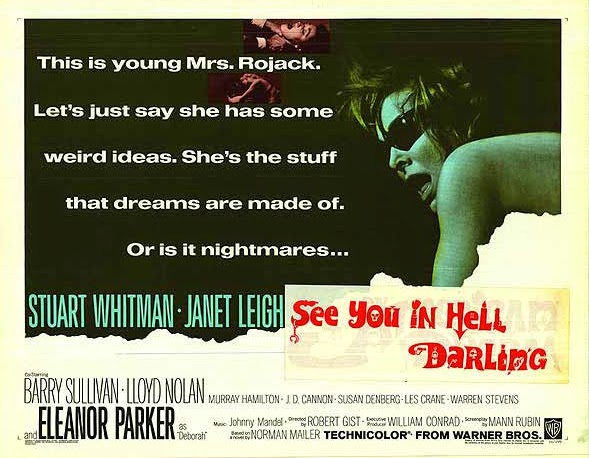
AN AMERICAN DREAM aka SEE YOU IN HELL DARLING

AN AMERICAN DREAM (aka See You In Hell Darling/1966). Director: Robert Gist.

When TV host Stephen Rojack (Stuart Whitman) pays a call on estranged wife, Deborah (Eleanor Parker), the vicious, drunken woman winds up falling off her balcony to her death. Rojack, grilled by police, does the sensible thing after his wife has just died and shacks up with old gal pal, Cherry (Janet Leigh). Rojack's father-in-law (Lloyd Nolan) contemplates pushing Stephen off of a balcony, and detectives Barry Sullivan and J. D. Cannon act like they'd like to tear his throat out. And we mustn't forget the whole host of mafia boys headed by Eddie Ganucci (Joe De Santis) and Johnny Dell (Warren Stevens) who have their own beef with Rojack. Whitman isn't bad, Parker [Lizzie] is vivid, Leigh plays it all in the key of bitter, Nolan is, frankly, terrible, Cannon over-acts in stock TV fashion, and Sullivan [Suspense] isn't much better. There are some interesting elements to An American Dream -- which is very loosely based on a novel by Norman Mailer -- but the movie is pretty much a melodramatic and at times even laughable mess. Acrophobes in the audience may have a few tense moments. Richard Derr has a bit as a producer while Murray Hamilton has a little more to do as an associate of Stephen's. Harold Gould and George Takei also have bits as lawyers. Whitman and Leigh appeared together in the monster bunny movie Night of the Lepus, which was actually a lot more entertaining than this.

Verdict: Everyone seems to be yelling -- or simmering -- to little effect. **.

Thursday, January 1, 2015

THE BROTHERHOOD

Misleading poster for "Brotherhood"
THE BROTHERHOOD (1968). Director: Martin Ritt. Produced by Kirk Douglas.

Frank Ginetta (Kirk Douglas of Seven Days in May) is overjoyed that his younger brother Vincent (Alex Cord of The Dead Are Alive) wants to join him in the "family" business, but Vince's new wife, Emma (Susan Strasberg) isn't so sure. Her own father, Dominick Bertolo (Luthor Adler of House of Strangers) is in the business and warns Vinnie that Frank is too old-fashioned and objecting to one good deal after another -- this could have serious repercussions not only for Frank but for Vincent. Then Frank discovers that Bertolo was the man who betrayed his father and many other mafioso years ago, and sets out to get revenge, setting in motion events that will have violent consequences ... The Brotherhood pre-dates The Godfather by several years, and while it is not as good, it is not a bad picture, with some effective performances. It's hard to figure out if Frank is supposed to have an accent or not because it comes and goes, but Douglas is good in the role. Cord is not an especially dynamic performer, but he has several effective moments. The film was a box office loser, probably because the studio used a poster showing Douglas and Cord kissing on the mouth. [Not even The Boys in the Band used such an image.] In the movie the kiss, which is shown from a different angle, is one of several affectionate good-bye kisses Frank gives his brother, and is not indicative of homoerotic incest. At least France retitled the film "The Sicilian Brothers" to make it more clear what was going on. Murray Hamilton and Eduardo Ciannelli make a good impression as fellow members of the brotherhood; Strasberg is given little to do. One of the best, most chilling scenes in the movie has Frank relating to Bertolo how he befriended a man he intended to kill and having absolutely no clue as to the complete immorality of what he's describing.

Verdict: Creditable mafia drama. ***.

Thursday, January 9, 2014

SERGEANT RYKER

Lee Marvin lashes out as Sergeant Ryker
SERGEANT RYKER (1968). Director: Buzz Kulik.

The theatrical release Sergeant Ryker was actually the first two episodes of [Kraft] Suspense Theatre from 1963 -- "The Case Against Paul Ryker" -- joined together and released as a movie five years later by Universal; it was not remade. Sergeant Ryker (Lee Marvin) has been convicted of treason because no one will believe his story of carrying out a secret mission for a military official who is now dead and can't back up what Ryker says. The prosecutor, Captain David Young (Bradford Dillman), wonders if Ryker had a fair trial, and also begins to question his guilt after he meets Ryker's wife, Ann (Vera Miles), who thoroughly supports him even if she's no longer in love with him. Young makes such a pest of himself trying to dig up evidence that will confirm Ryker's story that an outraged General Bailey (Lloyd Nolan) orders his court-martial, but not before Young, the man who convicted Stryker, defends him in his new trial. Complicating matters is the fact that Young and Ann Stryker are falling in love ... Sergeant Ryker is suspenseful, has some intriguing twists and turns, and is well-acted, with Miles and Nolan making the best impression. Dillman is vivid and striking, even if he does overact in some scenes, and Marvin, while not perfect casting, has some very strong moments as well. Murray Hamilton of Jaws gives a typically slimy and obvious performance as another captain and an associate of Young's.

Verdict: Fairly strong television drama turned into a pretty good movie. ***.

Thursday, August 9, 2012

SECONDS

SECONDS (1966). Director: John Frankenheimer.

"We lived our lives in a polite, celibate truce."

Middle-aged Arthur Hamilton (John Randolph) seems to be living the American dream: he has a good job and is in line to be the next president of the bank, lives in a beautiful home in the suburbs, has a kind and presentable wife. But Arthur suffers from a mid-life crisis, he and his wife feel no passion for one another and are going through the motions, and he is tired of the commute and rat race. So when an old friend who is supposedly deceased calls him from out of the blue and suggests he go to a certain address and can start his life afresh, get a second chance, he decides to go -- although not without trepidation. Hamilton is practically blackmailed into accepting the services of the people he connects with, and before he knows it he has said good-bye to his old life, made financial arrangements to look after his wife, and undergoes physical therapy and cosmetic surgery -- and wakes up looking just like Rock Hudson! With the new name of Tony Wilson, Hamilton (now played by Hudson), a "reborn," is ensconced in a seaside community in California as a minor artist. The problem is that Hamilton is a nice but essentially dull man and he finds that he can't get away from himself. It all leads up to a grim but inevitable finale. Randolph and Hudson are both excellent as the two sides of Hamilton -- Hudson probably gives his best performance, in fact -- and they get fine support from Frances Reid as Arthur's wife, Salome Jens as a woman who befriends "Tony," Jeff Corey as the head of the Reborn organization, Wesley Addy as Tony's valet, Murray Hamilton as Arthur's old friend, and others. [This is based on an excellent novel by David Ely that probably filled in some of the loose ends you might find in the movie if you examine it too closely.]

Verdict: Creepy and absorbing, with some excellent performances. ***1/2.

THE DROWNING POOL

Paul Newman as Lew Harper
THE DROWNING POOL (1975). Director: Stuart Rosenberg.

Private detective Lew Harper (Paul Newman) is contacted by a woman, Iris (Joanne Woodward), with whom he'd once had a fling, to come to her estate and help her with some problem. Iris' husband is interested elsewhere, her teenage daughter Schuyler (Melanie Griffith) is running around doing whatever she wants, and then her harridan mother-in-law (Coral Browne) is murdered. Has it something to do with Kilbourne (Murray Hamilton), who wanted the dead woman's property for its oil, or the recently discharged chauffeur (Andrew Robinson), who was diddling around with Schuyler? While investigating, fending off Schuyler's advances, and being kidnapped and beaten, Harper tries to get at the unsavory truth. The cast, including a laid-back Newman, is good, but you never really connect with any of the characters. Tony Franciosa and Richard Jaeckel are cops with secrets of their own. Hamilton and Gail Strickland as his wife are notable. The revelations of the story may have had more impact when Ross Macdonald's novel, upon which this was based, was first published. Newman essayed Lew Harper [originally Lew Archer] once before in Harper nine years earlier. The climax in a water-logged hydrotherapy room is fairly exciting.

Verdict: No more than acceptable private eye fare. **1/2.