Lively, entertaining reviews of, and essays on, old and newer films and everything relating to them, written by professional author William Schoell.
Showing posts with label Milton R. Krasner. Show all posts

Thursday, August 4, 2022

ARABIAN NIGHTS

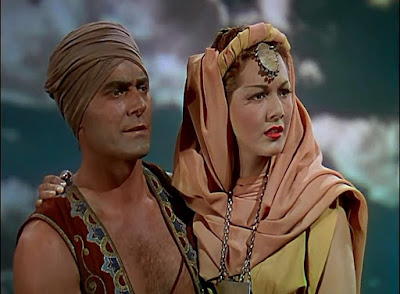
Jon Hall and Maria Montez
ARABIAN NIGHTS (1942). Director: John Rawlins. 
 

Sentenced to a slow death for trying to usurp the throne from his brother, Kamar (Leif Erickson) escapes and holds court in the palace while the true king, Haroun (Jon Hall of The Invisible Man's Revenge), goes on the run until he can regain his rightful position. Kamar is in love with the dancer Sherazade (Maria Montez) -- a different version of the Sheherazade of legend -- but before he can find her she is sold into slavery. As Sherazade and Haroun fall in love, they escape from slave traders and other nefarious characters until Kamar at last reclaims his chosen bride. But will true love win out in the end or is Haroun doomed to die? Young Ali (Sabu) will certainly do all he can to unite the lovers. 

Hall gets some wise counsel from Sabu
Universal may not have been in the same league as MGM when it came to gloss and pageantry, but they certainly gave it the old college try with Arabian Nights. The film is often beautifully photographed (Milton R. Krasner) in positively gorgeous -- and very expensive -- technicolor with striking desert vistas and impressive matte paintings. Frank Skinner's exciting score is flavored with the occasional "Arabian" touch. Jon Hall and Leif Erickson make a fine pair of literally dueling brothers, Sabu is as appealing as ever as the young Ali, and Edgar Barrier [Phantom of the Opera] is properly loathsome as Kamar's plotting associate, Nadan. 
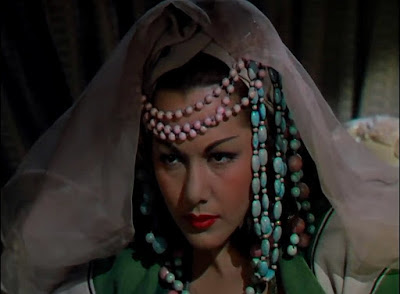
The Montez gives a smoldering look
As for Maria Montez? The movie is populated by starlets just as attractive if not more so than Montez, although she is certainly very decorative, as they say. One thing you must say about the woman is that she has a haughty, imperious authority -- possibly the way she was off-screen as well -- that works very well for her in parts like these. Her arrogance and self-confidence come through with her every line reading, which are generally on target. No, she's no Kate Hepburn, but one could hardly see Hepburn in this role (although she might have been better than one might imagine)! In other words, while no Oscar would have been in the offing for Ms. Montez, she is more than acceptable as Sherazade. 
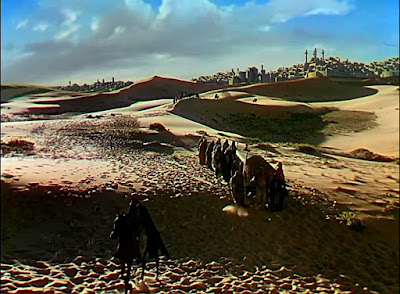
A striking sequence from Arabian Nights
There are other characters, some from the Arabian Nights, sprinkled throughout the movie. Sinbad, presented as a lazy lout instead of as a hero, is played by Shemp Howard, one of the Three Stooges! Aladdin (John Qualen) spends the movie trying to find his famous lamp and failing. Turhan Bey is cast as a captain in the King's army who comes to a bitter fate. As Ahmed, who runs a shop, Billy Gilbert overacts atrociously. Gilbert's scenes sometimes resemble something out of Abbott and Costello. Sherazade does a very expressive and sensual dance late in the movie, but apparently that was not Montez, who could neither sing nor dance. 

Verdict: A Maria Montez movie that is actually good! ***. 

Thursday, October 1, 2020

SCARLET STREET

Edward G. Robinson
SCARLET STREET (1945). Director: Fritz Lang. 

Christopher Cross (Edward G. Robinson of Barbary Coast) is a cashier for a large company, as well as a part-time painter, and is married to a harridan, Adele (Rosalind Ivan), who is still obsessed with her late husband. One evening he intercedes when he sees a young woman, Kitty (Joan Bennett of The Man Who Reclaimed His Head), being slapped around by a guy and she befriends him. He doesn't realize that the abusive fellow, Johnny (Dan Duryea), is Kitty's boyfriend, and he importunes her to take advantage of the situation when they both wrongly surmise that Cross is rich. Before long Cross is stealing from his company, and things get worse after that ...

Dan Duryea and Joan Bennett
If you haven't seen this film noir masterpiece I won't spoil it by saying anything more about the plot, other than to say that Scarlet Street is thoroughly unpredictable, full of surprising and completely unexpected and highly ironic developments. The acting is first-rate, with both Robinson and Bennett outstanding in their roles, and there is excellent support from Duryea, Ivan, and Margaret Lindsay [Emergency Hospital] as Kitty's initial roommate, Millie. The roles of Cross' friends and co-workers are also filled with fine character actors, and the film is well photographed by Milton R. Krasner. Hans J. Salter also contributed an interesting score. Then there's the great screenplay by Dudley Nichols, based on a French mystery novel.  For my money this is far superior to the earlier Lang-Bennett-Robinson-Duryea collaboration The Woman in the Window.Jean Renoir also filmed this story as La chienne. An added side note: Some paintings that figure in the story line and which are seen as great art by some of the characters are the very definition of kitsch!

Verdict: Absorbing and well-made, beautifully-acted melodrama. ***1/2. 

Thursday, June 25, 2020

THE SET-UP

Robert Ryan
THE SET-UP (1949). Director: Robert Wise.

Bill Stoker (Robert Ryan) is a 35-year-old boxer at the end of his game. He rarely if ever wins his matches, but he still has dreams even though he knows that 35 is old for a fighter. His wife, Julie (Audrey Totter), whose heart breaks for him, can't stand to see him being literally and figuratively beaten up in the ring and wishes he'd do anything else for a living. Although Bill wants her there, Julie resists going to the ring -- Paradise City in Atlantic City -- that night. Unbeknownst to Bill, his manager, Tiny (George Tobias), has made a deal with fight promoter "Little Boy" (Alan Baxter) for Bill to take a dive during his fight with newcomer Tiger Nelson (Hal Baylor of This Is My Love). Tiny is sure that Stoker hasn't got a chance against Tiger, but the determined Stoker may give everyone a surprise. But this may come with a terrible cost.

Audrey Totter and Ryan
The Set-Up, beautifully directed by Robert Wise, is one of the best boxing films ever made. With sharply observed vignettes of other boxers and hangers-on, fight fans, promoters and others, it pulls us into this insane bloody world of triumph and defeat and never lets go. The film is supposed to take place in real time -- 73 minutes for both him and the audience -- although this may not be entirely accurate. Whatever the case, Robert Ryan, who was actually forty at the time of filming, gives perhaps his most outstanding performance. Whether he's mirroring the disappointment he feels when he sees his wife's empty chair or dredging up untapped reserves in order to fight his much younger opponent, he is on top of every scene. Tall and handsome, with the look of a winner, Ryan is still able to get across his character's desperation and fear of being a loser. Totter is also excellent, especially in a silent sequence over a railroad track when you can nonetheless tell everything that she must be feeling as she ponders her future with the man she loves and seems unable to help. Her smile when she sees something amusing in an arcade, a smile that fades when things remind her of her life and marriage, is touching.

Baylor vs. Ryan
There are also good turns from George Tobias, Baxter, and Baylor, as well as Wallace Ford [The Breaking Point] as Gus, who oversees things backstage; David Clarke as the sadly defeated Gunboat; Percy Helton cast in another sympathetic part as Tiny's associate, Red; Darryl Hickman as young boxer Shanley; and James Edwards as black boxer, Luthor Hawkins; among others. The film also benefits from Milton R. Krasner's expert cinematography. Absorbing and well-detailed, The Set-Up also boasts a satisfying and moving conclusion, and the match itself is quite exciting and even suspenseful -- both Ryan and Baylor had done some boxing in real life. The script was inspired by a poem about an African-American boxer.

Verdict: More powerful than Raging Bull and half as long. ***1/2. 

Thursday, June 9, 2016

THE FOUR HORSEMEN OF THE APOCALYPSE (1962)

Glenn Ford and Ingrid Thulin with backdrop of Notre Dame
THE FOUR HORSEMEN OF THE APOCALYPSE (1962). Director: Vincente Minelli.

This remake of the silent film of the same title has been updated to WW Two. Argentinian Madriaga (Lee J. Cobb) is dispatched with rather quickly, and most of the story takes place in Paris, where an initially superficial Julio Desnoyers (Glenn Ford) has an affair with the married Marguerite Laurier (Ingrid Thulin of The Silence). Julio's father Marcelo (Charles Boyer) had deserted Army service years before and begs his son to fight the Nazis, unaware that Julio has already joined the resistance. This leads to the movie turning into a ersatz spy picture that has Julio going off on a suicide mission and a final confrontation with his cousin Heinrich (Karl Boehm of Sissi). Other characters include Julio's sister Chi Chi (Yvette Mimieux of Light in the Piazza) who joins the resistance much sooner; Marguerite's husband, Etinne (Paul Henreid); and Heinrich's father, Karl (Paul Lukas). It's amazing that adding all the excitement and peril of WW Two, plus technicolor and CinemaScope, has not resulted in a better movie than the original, but a far worse one. A middle-aged Glenn Ford is horribly miscast -- Minelli wanted a more appropriate Alain Delon but MGM nixed it -- and his love affair with Marguerite never for a minute seems passionate or believable. Scenes that should crackle with tension and drama are frittered away by Minelli's lacklustre direction. Not a single actor ever gets a close up, further distancing us from the characters, and Andre Previn's musical score can best be described as insipid. Milton R. Krasner's cinematography is a plus, but the sweeping vistas do little to pull us into the story. Other changes from the silent version include more wartime interaction between the two families -- one French, the other German -- and Etienne is not blinded. A bizarre sequence has Marguerite telling her husband she's leaving him for Julio the exact instant after he shows up, shattered by being tortured, after months away -- what perfect timing! Badly written and poorly made despite all the technological advances, this is a colossal bore. Of the cast, only Charles Boyer makes much of an impression. Like the silent version, this also has shots of phantom horsemen floating through the skies, and this time it seems even hokier.

Verdict: Stick with the original. ** out of 4.