Lively, entertaining reviews of, and essays on, old and newer films and everything relating to them, written by professional author William Schoell.

Thursday, July 20, 2023

DELIGHTFULLY DANGEROUS

DELIGHTFULLY DANGEROUS (1945). Director: Arthur Lubin. 

15-year-old Sherry Williams (16-year-old Jane Powell) lives in a girls' school that is paid for by her sister, Josephine (Constance Moore of Buck Rogers), a big Broadway musical comedy star -- or so Sherry thinks; Josephine is actually a burlesque queen known as "Bubbles" Barton. Things come to a head when Broadway producer Arthur Hale (Ralph Bellamy) comes to the school and is impressed with Sherry's talent, but not with her youth. As for her sister, he just can't see putting a burlesque star in one of his "classy" shows. But this being Hollywood, chances are good that one or both ladies will wind up starring in a Broadway show. 

Ralph Bellamy and Jane Powell
Delightfully Dangerous features some excellent performances, with a very young Powell on top of things even at that early stage of her career (this was only her second film). Constance Moore has such style and class that one can't imagine anyone objecting to putting her on Broadway. Ralph Bellamy is Ralph Bellamy, his lack of sex appeal stripping the film of any sexual tension. Arthur Treacher and Louise Beavers are fun as Bellamy's butler and Moore's maid, dresser, and confidante. Ruth Tobey is cute as Sherry's best friend, Molly, and Shirley Hunter makes her mark as a bitchy classmate named Nadine. Christian Drake is appealing as Jimmy Burns, a young sailor and friend of Hale's who is attracted to Sherry when she's all dolled up and looks older than her years. 

It's interesting that at one point Josephine does a parody of the high-pitched soprano style of singing when that's just the sort of thing Powell specialized in. The show that Hale finally puts on is a combo of the old and new, with Straussian melodies interspersed with jive. While some of the production numbers are just plain weird and even a bit dull, the finale is colorful and features some excellent dancing. By far the best number features "Bubbles" on the stage at the burlesque house, doing a sharp, fun and sexy rendition of "I'm Only Teasing." There are some plot similarities to Doll Face which also came out that year.   

Verdict: Another typically unreal but somewhat entertaining Hollywood musical. **1/2. 

BROOKLYN ORCHID

BROOKLYN ORCHID (1942). Director: Kurt Neumann.

Tim McGuerin (William Bendix) and Eddie Corbett (Joe Sawyer) are partners in a cab company. McGuerin is married to Sadie (Grace Bradley of The Invisible Killer), a former burlesque queen who now acts like she's To the Manor Born. Sadie can't stand Eddie's fiancee, Mabel (Florine McKinney of Beauty for Sale), who always needles her about her past. Ducking out from a party honoring the rather obnoxious pianist, Ignatz Rachkowsky (Leonid Kinskey), the two fellows try out Tim's anniversary gift of a fishing pole, and they net themselves a gal who has just tried to commit suicide. This gal, Lucy (Marjorie Woodworth), is angry that they saved her and insists that they take care of her, going so far as to try to move into the McGuerins' high-tone apartment. Tim and Eddie do their best to keep their respective ladies from finding out about Lucy, but she follows them on vacation, where she is pursued by an amorous wealthy man named Goodweek (Skeets Gallagher of The Meanest Gal in Town). Then Lucy runs into Sadie and Mabel and they all compare notes ... 

Brooklyn Orchid -- the title refers to a flower girl contest won by Lucy -- is the second of three comedies featuring Bendix and Sawyer as McGuerin and Corbett. (Brooklyn Orchid is wrongly listed as the first in some sources). The players are all game and adept at this kind of farce -- Kinskey is a riot and Jack Norton (of Fashion Model)  nearly steals the show as an inebriated music critic -- and there are a few laugh-out-loud moments, but the ultimate result is like a TV sitcom that treads overly familiar territory. As good as they are, Bendix and Sawyer are no Laurel and Hardy. 

Verdict: Some limited fun in this amiable comedy. **1/2. 
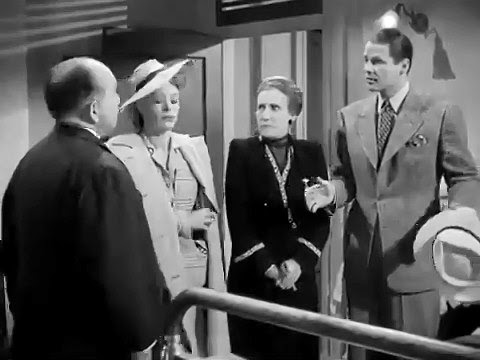
MURDER IN THE MUSIC HALL

William Marshall and Vera (Hruba) Ralston
MURDER IN THE MUSIC HALL (1946). Director: John English.

Lila Leighton (Vera Ralston) is a figure skater who appears in an ice show on the stage of a music hall. She is contacted by Carl Lang (Edward Norris), who spent five years in the penitentiary for killing a man named Douglas. Now Carl tells Lila that he was only covering for her, that he knows she killed Douglas out of jealousy. Lila is still digesting this absurd accusation when Carl himself is murdered, literally stabbed in the back in his penthouse. With the aid of her boyfriend, handsome conductor Don Jordan (William Marshall), Lila tries to ferret out who killed Carl before she herself is accused of the crime by Inspector Wilson (William Gargan). The suspects include Lila's fellow performers -- Millicent (Helen Walker of Nightmare Alley), Diane (Julie Bishop of Why Men Leave Home), and Gracie (Ann Rutherford) -- as well as Rita Morgan (Nancy Kelley of The Bad Seed), the wife of gossip columnist George Morgan (Jerome Cowan). 

Suspects: Helen Walker, Ann Rutherford, Julie Bishop
Murder in the Music Hall
 is a well-turned-out mystery from Republic studios starring the wife, Ralston, of the studio head. The plot has interesting aspects, especially concerning a certain blind stranger, although the true identity of this person is obvious from the first. The identity of the murderer, however, is by no means certain but won't come as that much of a surprise, either. Never a particularly great actress, Ralston generally manages to be appealing, as she is in this. Marshall, Norris, Gargan and the ladies are all adept. There are some skillful real-life figure skaters who put on brief acts as well. James Craven, Jack La Rue and Anne Nagle are also in the cast in small roles. Director John English also helmed a number of serials.

Verdict: Acceptable Republic murder mystery with an interesting cast. **1/2. 

Thursday, July 6, 2023

BRIEF ENCOUNTER -- Another Viewing

Celia Johnson and Trevor Howard
BRIEF ENCOUNTER (1945). Director: David Lean. Produced and written by Noel Coward from his play. 

"So easy to lie when you're trusted implicitly. So easy -- and so degrading."

"Thank you for coming back to me."

Laura Jesson (Celia Johnson) is happily married to husband Fred (Cyril Raymond), with whom she has two children. One afternoon at a train station a helpful doctor -- also married with children -- Alec Harvey (Trevor Howard) gets something out of her eye for her. They meet again quite accidentally, but sparks strike, and romantic feelings develop. Although the relationship remains emotional and never becomes sexual -- although it almost does -- both Laura and Alec are convinced they are in love. But the guilt they are feeling over their respective spouses almost ruins whatever happiness the relationship is giving them. Finally a choice has to be made. But will Laura be able to accept it?

Johnson and Howard
Brief Encounter is no cheap soap opera but a brilliant examination of a difficult situation that is all too common now as it was back then. Laura and Alec are decent people who do love their spouses, but who can't help but react to a sudden and intense romantic infatuation that seems to come out of nowhere and is nearly overpowering. (Is it really true love? Possibly not.) The movie neither accepts nor judges, but merely presents this situation and its joys and agonies primarily from Laura's point of view. This is not about the heartbreak of the spouses because they don't know what's happening. This is one movie in which the narration is not intrusive but only adds to our understanding. What makes Brief Encounter a masterpiece is not only the sensitive direction, the superb performances from Johnson and Howard and indeed the entire cast, but Robert Krasker's first-rate cinematography. It doesn't hurt that everything is soaked in the strains of Rachmaninoff's Piano Concerto No. 2. 

Stanley Holloway and Joyce Carey
The humor in the film comes from the antics of station master Stanley Holloway and the lady who runs the food and drink counter, Myrtle (Joyce Carey). Holloway does his best to charm the lady, who is rather common but tries her damnedest not to appear that way. There is also fine work from Everley Gregg as Dolly, the chatty and annoying woman who ruins Laura's last moments with her lover, and Valentine Dyall has a splendid scene with Alec as his friend Stephen, whose flat Alec is using temporarily. "I'm not angry," Stephen tells Alec when he realizes a woman ran out of the flat just before he entered, "just disappointed." One of the film's most trenchant observations is when Laura realizes that even if she were to only tell Fred about Alec decades later when they were both old and gray, it would still hurt him horribly. The movie has a lovely and moving conclusion. 

Verdict: Truly another great movie that just seems to get better and better each time you see it. ****. 

THE ADVENTURES OF FRANK MERRIWELL

Donald Briggs as Frank Merriwell
THE ADVENTURES OF FRANK MERRIWELL (12-chapter Universal serial/1936). Directors: Clifford Smith; Lew Landers. Colorized version.

Famed college athlete Frank Merriwell (Donald Briggs) is beloved by most of his classmates aside from the jealous and bitter House Peters (House Peters Jr.) Merriwell's father has been missing for two years, but Frank learns of a ring that may lead to a treasure. While Frank and his pals ponder this, an evil man named Daggett (Ben Hewlet), who always wears a weird mask, is out to get the treasure for himself. Frank and a whole host of classmates -- and his girlfriend, Elsie (Jean Rogers of Flash Gordon) -- travel by boat in pursuit of clues to the treasure. They eventually find the gold but it is alternately stolen by and taken back from Daggett and his desperadoes. Along the way Frank and his buddies find themselves in mortal danger ... 

Ben Hewlet as Daggett
Frank Merriwell, whose adventures originally took place around the 1890s, was once a very famous fictional character with dozens of stories detailing his exploits. These translate well to the serial medium, and make use of several good cliffhangers: a train smashes into an uncoupled runaway engine; Frank and Elsie are nearly crushed by a towering tree when it crashes downward; Frank is attacked by an escaped lion at the circus etc. The pace of the serial is generally swift, but there are duller detours showing us stage acts, assorted parties, and the unfunny antics of class cut-up, the dufus Harry (Sumner Getchell). 

John King and Jean Rogers
There is some strange casting in the serial. As mentioned the character of House Peters is played by House Peters, Jr., the son of silent film star House Peters. Other classmates of Merriwell's are also played by the sons of (at the time) well-known actors, including Wallace Reid Jr. and Edward Arnold Jr. However, Frank's best buddy, Bruce, is played by John "Dusty" King, who displays an excellent baritone singing voice and later went on to play the lead in the serial Ace Drummond. Adventures of Frank Merriwell, even when colorized, remains a bit creaky and forgettable, despite a couple of decent moments. The villain in this is utterly colorless. 

Verdict: You may be wishing this was over long before it's over! **1/4. 

TRAIL OF ROBIN HOOD

Roy sings to dog Bullet
TRAIL OF ROBIN HOOD (1950). Director: William Witney. Filmed in TruColor.

Retired actor Jack Holt, playing himself, hopes to sell a batch of Christmas trees at cost so all the little children can have one. Businessman Aldredge (Emory Parnell) sees this as a good way for him to lose money, so his daughter Toby (Penny Edwards of That Hagen Girl) goes out west to see what she can do. She can't convince Holt to change his methods, and comes into conflict with Roy Rogers (Roy Rogers), who heads the Soil Conservation Service. When Jack is injured in a bad fire, little Sis McGonigle (Carol Nugent of Vice Raid) rounds up a bevy of cowboy stars to bring the Xmas trees to market even though the bridge out of town has been set on fire!

Rex Allen yells at Sis to move her ass -- sort of
Republic studios would occasionally bring together many of its western stars in one movie but fans must have been greatly disappointed -- as I was -- to see how little screen time they get in this, which is, after all, a Roy Rogers and Trigger picture. Monte Hale doesn't even get a close up, although Rex Allen and Allan "Rocky" Lane have a little more to do (but not much). Lesser lights such as Tom Tyler, Crash Corrigan, Tom Keene, and Kermit Maynard at least get a little dialogue. Rex yells at Sis to go ahead and plough over the bridge even though it's on fire and collapses just a second later -- good idea, Rex! 

Jack Holt
Jack Holt appeared in only two more movies and died the year after Trail was released. He had started out in silent films in 1914 and amassed nearly 200 credits, including the serial Holt of the Secret Service. George Chesbro, who was a bad guy in many of Holt's movies, also appears in Trail. The title of this flick makes no sense as there's no Robin Hood, and it's stretching things a bit to suggest that Holt is like Robin Hood in his giving his Christmas trees to the poor. The dog Bullet also appears in the movie, and there's a talented turkey named Galahad who is spared the carving knife. Gordon Jones, who played The Green Hornet, is cast as Sis' big brother, and Clifton Young, who began as a child actor in "Our Gang" comedies, makes an impression as the bad guy Mitch McCall. Young was especially notable in Dark Passage with Bogart.

Verdict: Boo! Hiss! Let's see more of Monte Hale! **. 

THE MEANEST GAL IN TOWN

Zazu Pitts and El Brendel
THE MEANEST GAL IN TOWN (1934).  Director: Russell Mack. 

Tillie Prescott (Zazu Pitts) owns a small town clothing store and has been keeping company with barber Chris Peterson (El Brendel) for a decade. Chris tells her he won't marry her until he can afford a second barber chair. Tillie decides to splurge on $300 for the chair, but discovers that Chris has installed a sexy lady -- a stranded actress named Lulu (Pert Kelton) -- as his manicurist. Tillie stops speaking to Chris and winds up being taken advantage of by a slick salesman named Jack (Skeets Gallagher). Chris determines to get Tillie's store back for her while Jack and Duke Slater (James Gleason) compete for the favors of Lulu. Will true love win out in the end?


Pert Kelton as Lulu
 The Meanest Gal in Town is a cute picture with good performances and many funny moments. Pert Kelton was the original Alice on The Honeymooners -- first playing the character on Cavalcade of Stars -- and also played Marion the Librarian's mother in The Music Man. Mae West had appeared in two or three films by 1934 and Kelton at times seems to be channeling her (perhaps deliberately), although in general Kelton has her own style. 

Verdict: Amiable comedy with gifted players. ***. 

Thursday, June 22, 2023

GREAT OLD MOVIES

GREAT OLD MOVIES is taking it's summer-starts break. We will be back in two weeks. 

In the meantime check out B MOVIE NIGHTMARE if you haven't already. 

Thanks!

Thursday, June 8, 2023

FRANKIE AND JOHNNY

Harry Morgan, Elvis, Nancy Kovacks

FRANKIE AND JOHNNY (1966). Director: Frederick De Cordova. 

Frankie (Donna Douglas) and Johnny (Elvis Presley) are entertainers on the riverboat-casino S. S. Mississippi Queen. Frankie's jealousy is ignited when a gypsy fortune teller tells Johnny that a redhead will bring him good fortune, so he zeroes in on Nellie Bly (Nancy Kovak of Jason and the Argonauts). All he wants from Nellie is for her to accompany him when he gambles, but both Frankie, and Nellie's boyfriend -- also Johnny's boss -- Braden (Anthony Eisley), get the wrong idea. Things come to a head when Frankie, Nellie, and showgirl Mitzi (Sue Ane Langdon) all dress up as Madame Pompadour for a masquerade ball, and Braden's associate Blackie (Robert Strauss) comes up with a criminal way of eliminating Johnny as a rival during a rendition of the title tune. 

Sue Ane Langdon and Donna Douglas
Frankie and Johnny could have been a really interesting look at the riverboat scene of the 19th century as well as a trenchant observation of what unruly passions can lead to, but instead it's just an Elvis Presley Picture, although on that level it's fun and entertaining. Elvis doesn't so much act as exude personality, and Donna Douglas -- who just can't eliminate that Elly Mae Beverly Hillbillies accent entirely -- while adequate, pretty much shows why she made no further theatrical movies after this one. On the other hand Nancy Kovack is classy and sexy as Nellie, Langdon is a lot of fun as Mitzi, who also loves Braden, and Harry Morgan [All My Sons] and Audrey Christie [Splendor in the Grass] score as Cully and Peg, a married couple who are friends and co-workers of the title duo. Anthony Eisley of Hawaiian Eye is also very good as boss Braden, and Joyce Jameson has an excellent turn as a drunken redhead whom Johnny thinks might temporarily substitute for Nellie. 

Douglas with Nancy Kovack
Frankie and Johnny comes pretty close to being a bona fide musical -- as opposed to just an Elvis Presley Musical -- because its score has quite a variety of music. The classic title tune is reinterpreted and there's a fine version of When the Saints Go Marching In. Elvis does a superlative job delivering such memorable ballads as Please Don't Stop Loving Me and Angel at My Side. He also has a charming number with a harmonica-playing shoeshine boy, Hard Luck, and a bouncy piece called Look Out, Broadway. (Jerome Cowan appears uncredited as a Broadway producer who likes F and J's act.) Except for Elvis, everyone's singing voice seems to be dubbed. Forget the gorgeous gowns of the ladies, Elvis himself wears one striking and beautiful ensemble after another! 

Verdict: The plot gets a bit bogged down and slightly tiresome, but it's hard to dislike the flick and even harder to dislike Elvis. ***. 

BELLE OF THE YUKON

Randolph Scott and Gypsy Rose Lee
BELLE OF THE YUKON (1944).  Director: William A. Seiter. 

Former con man "Honest" John Calhoun (Randolph Scott of Captain Kidd) owns an Alaskan nightclub and saloon which is managed by Pop Candless (Charles Winninger). Pop's daughter, Lettie (Dinah Shore), is breathlessly in love with handsome piano player, Steve (William Marshall), but there is a rumor that Steve may have a wife and children. Then John's old girlfriend, an entertainer named Belle De Valle (Gypsy Rose Lee), turns up as the star attraction at the saloon  -- and with marriage in mind. When Honest John decides to open a bank and importunes everyone to put their money in it, the trouble really begins. 

Dinah Shore and William Marshall
Belle of the Yukon is one of those movies that is perfectly pleasant while it's unfolding, but when it's over you realize that there really wasn't much to it. There's no great plot to speak of aside from the misunderstandings between Lettie and Steve and John and Belle, and attempts to make off with the bank's gold engineered by George (Robert Armstrong) and Sheriff Maitland (Guinn "Big Boy" Williams). The songs by Burke and Van Heusen [Duffy's Tavern] are no great shakes although "A Slay Ride in July" is one that could grow on you. Scott is stalwart but not really a deft comedian; Gypsy Rose Lee (the subject of Gypsy) is okay but nothing that special; Dinah Shore sings quite well and is reasonably appealing; and William Marshall has little to do but look quite dreamy and now and then punch out the sheriff. Charles Winninger and Florence Bates as Lee's companion easily walk off with the movie, which so often was the case. 

Verdict: Amiable if minor-league piffle with some good performances. **1/2. 

YUL BRYNNER: THE INSCRUTABLE KING

YUL BRYNNER: THE INSCRUTABLE KING. Jhan Robbins. Dodd, Mead; 1987.

Yul Brynner was a man who liked to make up stories about his past life, resented reporters digging into his private affairs, and loved creating an air of mystery about himself. So it's no wonder that this biography fails to get that deep inside  the man, although it is also a problem that there seem to be no major interviews with the people who knew him best. In this book Brynner comes off as a talented if childish man who has many admirable qualities -- a distaste for prejudice and a love of children, for instance -- but was also insecure (giving him a superiority complex), boastful, and a bit selfish. He was married four times, apparently discarding each wife as he found a new lover, but the book never really goes behind the scenes in any of these marriages. Brynner's most famous role was as the king in Rodger's and Hammerstein's The King and I, which he played in Broadway, London and touring productions as well as in the motion picture adaptation. He himself felt that Hollywood did not make the best of his abilities, although he gave excellent performances in such films as Anastasia in which he was "dynamic and sexy." The book is entertaining and provides an overview of Brynner's career, but it is rather superficial all told.

Verdict: Hopefully not the last word on Brynner. **1/2. 

AMICA

Camoine and Amica
AMICA. Composed by Pietro Mascagni. Conductor: Manlio Benzi. Director: Alessio Pizzech. Singers: Anna Malavasi; David Sotgui; Pierluigi Dilengiti; Marcello Rosiello; Francesca De Giorgi. 2008. 

Performed at Mascagni's birthplace, Livorno Italy, this production, while hardly of Met quality, is admirable. Amica is a young woman who has been raised by her uncle, Camoine, who insists that she marry Giorgio, who adores her but whom she doesn't love. Instead she loves his brother, Rinaldo, whom her uncle banished some time before. Amica runs off into the mountains with Rinaldo after he returns, followed by Giorgio, who has no idea who her lover is, just as Rinaldo doesn't know that she was supposed to marry Giorgio. When the two men meet up in the high hills, they are each astonished to learn the truth. Rinaldo realizes that his running off with Amica will utterly destroy his brother, whom he has cared for since childhood, but Amica simply can't accept his decision for the two to part forever, leading to tragedy.

Mascagni responded to this story with music of great emotional power, melodiousness, and symphonic beauty. Some have noted that the music of the climax is so dramatic that it's as if the world had ended in a cataclysm, but this is exactly what has happened in the minds of the three lead characters and Mascagni expresses their torment in striking musical terms. With a clearly limited budget, the production is still effective, and the singers, while not necessarily world-class, deliver generally good vocal and dramatic performances. 

Verdict: Women just can't get a break! Another verismo masterpiece from Mascagni. ***1/2.   

GOLDEN GIRL

James Barton and Mitzi Gaynor
GOLDEN GIRL (1951). Director: Lloyd Bacon. Produced by George Jessel.

When tippling and irresponsible John (James Barton), loses the family boarding house in a casino, his wife, Mary Ann (Una Merkel of The Fuzzy Pink Nightgown) and daughter, Lotta (Mitzi Gaynor), along with singing boarder Mart (Dennis Day of I'll Get By), take off to tour the west as a stage troupe during the Civil War. Lotta, who becomes a celebrated entertainer, falls in love with a man named Tom Richmond (Dale Robertson of The Outcasts of Poker Flat) who may be keeping more than one secret. Meanwhile Mary Ann, Lotta and John are reunited in a surprising and unexpected fashion. 

Mitzi Gaynor and Dale Robertson
Golden Girl
 is the first of two films (both produced by George Jessel and directed by Lloyd Bacon) in which Mitzi Gaynor starred as an entertainer of the past, the second being The I Don't Care Girl. Lotta Crabtree actually existed, and her mother was her manager and looked out for her and her money. Her father was quite different from the way he is portrayed in the movie, and Tom Richmond is an entirely fictional creation as Lotta never married. She became a household name in the 19th century and acquired a fortune, much of which she gave to charitable causes. Aside from the character of Richmond, Golden Girl is a bit more faithful to the facts than was I Don't Care. In Golden Girl the real-life dancer Lola Montez arrives in town in a flurry of excitement, but Lotta was already a friend of the woman's at the time. Golden Girl pretty much ignores the realities of the war until Lotta is asked to transport Union gold in her wagon, and when she sings Dixie to the initially unreceptive audience, after the North has defeated the South, because she thinks Richmond, a rebel, is dead. 

Una Merkel and Dennis Day
As usual, Gaynor gives an excellent performance playing a somewhat self-centered character who is not entirely likable. Barton, who appeared on Broadway in Lerner and Loewe's Paint Your Wagon (and many other stage shows), is wonderful as Pop Crabtree, matched in perfection by the feisty Una Merkel. Dennis Day reveals a sterling operatic tenor voice when he gets to burst out in song by himself. His somewhat goofy looks doomed him to playing second fiddle and comedy relief -- mostly as foil to Jack Benny --  but there was much more to the man than that. As for Dale Robertson, well he's handsome and competent enough, but even he would have been the first to admit that he was more of a personality than an actor. He had his greatest success on television as the star of Tales of Wells Fargo. 

Verdict: Entertaining Hollywood look at the life of the once-famous Lotta Crabtree. ***.

Thursday, May 25, 2023

THE I DON'T CARE GIRL

Bob Graham and Mitzi Gaynor
THE I DON'T CARE GIRL (1953). Director: Lloyd Bacon.  Produced by George Jessel.

The real George Jessel is trying to produce a picture about old vaudeville star Eva Tanquay (Mitzi Gaynor of Anything Goes) and importunes his scriptwriters (Warren Stevens and Craig Hill) to locate people who knew the entertainer. These include Ed McCoy (David Wayne), supposedly the man who discovered her as well as her former partner; Charles Bennett (Oscar Levant of The Barkleys of Broadway), a composer; and Larry Woods (Bob Graham), another composer-performer who falls in love with Eva but is married. Larry is separated from his wife but a bigger problem is the seductive Stella Forest (Hazel Brooks of Sleep, My Love), who wants to star in Larry's operetta. Will true love win out over all?

David Wayne, Warren Stevens, Craig Hill
Hollywood is famous for coming out with biopics that have little to do with the real lives of their subjects, but The I Don't Care Girl takes the cake, as there's very little -- but the bare basics -- that have anything to do with Ms. Tanquay. The movie is really just an excuse to show off the admitted skills of Mitzi Gaynor, who gives a good performance, sings quite well, and is a sensational dancer with sensational gams. Ms. Gaynor is featured in some creative -- some might say overly creative -- big production numbers that have very little to do with anything ever seen on a vaudeville stage and everything to do with fifties fashion. 

Mitzi Gaynor and Oscar Levant
The title of the picture comes from Ms. Tanquay's most famous number, "I Don't Care." (Judy Garland, somewhat mimicking Tanquay,  arguably gives the best performance of this song in In the Good Old Summertime.) As for Tanquay, she was certainly a more interesting character than the sanitized version we see in this picture. Essentially forgotten today, she was once a tremendous international star, an early feminist, an absolutely relentless self-promoter, and had two or possibly three husbands as well as at least one affair. For a publicity stunt, she "married" a cross-dresser and wore a tuxedo while he wore the wedding dress. You can bet you won't see that in this movie! 

As for Bob Graham, the fellow is handsome, has a great baritone voice, and makes a smooth, likable leading man. But this was his last picture out of seven. What happened? Even the Internet Movie Data Base has very little information on him, including his date of birth and death. He is not to be confused with another actor named Robert Graham. 

Verdict: The story is just a mass of cliches but the cast is game and the dancing is great. ***.   

THAT OTHER WOMAN

Virginia Gilmore and James Ellison
THAT OTHER WOMAN (1942). Director: Ray McCarey. 

Emily Borden (Virginia Gilmore of The Brotherhood of the Bell) is secretary to handsome Henry Summers (James Ellison of The Ghost Goes Wild), who seems to spend more of his time chasing women than getting work done. Knowing how she feels about her boss, Emily's grandmother (Alma Kruger of Saboteur) suggests she create an air of mystery about herself by sending Henry some mysterious letters. This all leads to busy but not terribly funny complications wherein Henry thinks this lady's gangster boyfriend wants to kill him even as Emily's sort-of fiance, Ralph (Dan Duryea) goes after him as well. Henry masquerades as the caretaker of his cabin in the woods even as he finally begins noticing Emily. But what will happen when he learns she is the architect of all of his problems? 

Henry Roquemore, Gilmore, Urecal, Ellison
That Other Woman
 is yet another mediocre James Ellison comedy. Ellison is always reasonably adept in these vehicles but the greatest comedian in the world can't triumph over an insufficient screenplay. As for the ladies, neither Gilmore nor Kruger are especially adapt at comedy. The movie does have one moment of fun, and that is when Emily and Henry check into a hotel that seems to cater strictly to the elderly and encounter the termagant manager Mrs. MacReady, with Minerva Urecal looking throughout as if she wants to kill anyone who dares to even look at her! Typical of these kind of movies, Duryea's character is treated horribly.
Gilmore did a few movies but had more credits on TV. She was married to Yul Brynner for 16 years. 

Verdict: Much running around to little effect. **. 

LADIES MAN (1962)

LADIES MAN (aka Lemmy pour Les Dames/1962). Director: Bernard Borderie. 

Special FBI agent Lemmy Caution (Eddie Constantine) is on vacation in France, hanging out with his buddy Dombie  (Robert Berri), when a wealthy woman named Claudia (Yvonne Monlaur) asks for his help. Their first meeting in a restaurant is interrupted by the arrival of two men of whom Claudia is obviously frightened, Mirko (Guy Delorme) and Hugo (Lionel Roc). Before Lemmy can consult with Claudia a second time, he finds her corpse at the bottom of a cliff. Nearby is a house inside which Lemmy finds three friends of Claudia's: Sophie, (Eliane D'Almeida), Francoise (Claudine Coster), and Marie-Christine (Francoise Brion). More than one attempt is made on Eddie's life as he tries to figure out which of the women might have had a hand in Claudia's death, as well as might be a part of a blackmail scheme. 

Lemmy Caution first appeared as a character in several novels written by British author Peter Cheyney. Beginning in 1955, the books were adapted into French films starring the very American Eddie Constantine, who had studied voice under Edith Piaf and found some success as a singer! Several Caution/Constantine films were made, the most famous of which is the weird Alphaville, which was not based on a Cheyney novel. Constantine wouldn't be the first or last American actor to achieve more success in Europe than he did in the States. 

Eddie Constantine
Regardless of what country it comes from, Ladies Man is typical private eye stuff. (In the books Caution eventually became a P.I. and, out of his jurisdiction, he basically acts like one in this movie.) We've got all of the usual American private eye tropes -- attempts on the hero's life, bodies turning up, lascivious females trying to get info out of the hero, and so on.  Constantine is by no means conventionally attractive -- he's like a somewhat better-looking Ernest Borgnine -- but he has a certain appeal. It's hard to judge his acting as this is the dubbed version of the film, but the actor dubbing Caution, be it Constantine or someone else, is excellent. The comedic stuff in the film, mostly centering on Lemmy's buddy Dombie, reminds one of similar antics in American PI shows. Pretty standard stuff, Ladies Man is moderately entertaining. Its rough-edged and satisfying conclusion reminds one of Mickey Spillane. An odd aspect of the film is that Caution is treated like a celebrity everywhere he goes, with people hungering for his autograph -- an FBI agent?! 

Verdict: If you want to see a Lemmy Caution movie it might as well as this one. **3/4. 

SAN FERNANDO VALLEY

SAN FERNANDO VALLEY (1944). Director: John English. 

At his ranch in the San Fernando Valley, crusty old Cyclone (Andrew Tombes of Meet the Boyfriend) finds his cowboys goofing off again to hang out and sing with his grand-daughter, Betty Lou (Jean Porter of Cry Danger). Disgusted, Betty Lou's older sister, Dale (Dale Evans), fires them all and replaces them with women, figuring Betty Lou will no longer hang around and distract the ranch hands. Dale nearly runs Roy Rogers (Roy Rogers) over with her car -- this take place in "modern" times -- and he tries to get a date to no avail. However, when Betty Lou, a mere child, gets a crush on Roy, Dale decides to have Roy romance her so that she will get over it. Naturally, the two fall in love. 

Meanwhile poor Oliver (Charles Smith) hopes to have Betty Lou fall in love with him, and the equally crusty Hattie (Dot Farley), sort of a den mother to the cowgirls, just might develop a yen for Cyclone. Roy and Dale, along with Bob Nolan and the Sons of the Pioneers, sing a few numbers, including the catchy title tune and "You're Too Good to be True." Oh yes, there's a plot of sorts when fired cowboy Matt (LeRoy Mason) and a buddy "borrow" some of Cyclone's valuable horses supposedly to get their jobs back but actually to get a lot of cash. Speaking of cash Roy's friend Keno (Edward Gargan of Behind the Mask) also wants to recover some money that was stolen from him, also by Matt. 

San Fernando Valley is amiable enough. It's more of a musical comedy than a western, although it does have some horse chases and gunplay and a couple of fistfights. It's funny that Roy and his horse Trigger are billed above the title but Dale Evans isn't. That would change in the future. As for Roy, his natural charm always helped carry his movies be they fair or foul. 

Verdict: Modestly entertaining Roy Rogers Movie. **3/4. 

WEIRD NEW MOVIE: THE BANSHEES OF INISHERIN

Brendan Gleeson and Colin Farrell
THE BANSHEES OF INISHERIN (2022). Written and directed by Martin McDonagh. 

In 1923 on the dreary if beautiful island of Inisherin off the Irish coast, a crisis develops between two long-time friends and drinking buddies. Colm (Brendan Gleeson of Troy) starts shunning Padraic (Colin Farrell of Fright Night) and finally tells him, in essence, that life is too short and Padraic is too dull. Colm wants to concentrate on his music and also wants his former friend to just leave him alone. Padraic has few enough friends as it is, although he has a good relationship with his sister, Siobhan (Kerry Condon). Padriac is also friends, sort of, with young Dominic (Barry Keoghan), who is considered the village idiot but is smarter than he seems. He is not only beaten by his father, the village policeman (Gary Lydon), but possibly molested as well. Things take a dark turn when Colm makes it clear that if Padraic keeps bothering him he will literally cut off his fingers one by one, a vow he intends to keep. 

Barry Keoghan as the sad Dominic
Well first let's look at the good things about Banshees. It is stunningly photographed by Ben Davis, it is extremely well-acted by the entire cast (four of whom were nominated for Oscars), and one has to say that it is certainly different. It's also generally absorbing, can be quite funny, and has a degree of suspense and fascination, with some interesting characters (most of whom, however, are under-developed). On the debit side, the movie and its situations are kind of unreal, and as the story progresses it perhaps becomes too strange to take seriously. One of the main characters is clearly mentally-unbalanced, but this is barely addressed, even as certain situations are ignored in the medical sense. Banshees is typical of so many modern movies and TV shows that things happen less because they are realistic but more for shock value. There are good lines and sobering developments but no real resolution. A scene between Colm and a priest at confession is very amusing but again, not at all real. The potshots at the cop, who is admittedly an awful person, also seem more trendy and political than anything else. 

Verdict: A slice of life that has interesting elements but in the long run seems a bit phony and contrived. **3/4. 

Thursday, May 11, 2023

DUFFY'S TAVERN

Ed Gardner
DUFFY'S TAVERN (1945). Director: Hal Walker.

Archie (Ed Gardner), the manager of the old-fashioned saloon Duffy's tavern, has hired 14 soldiers as waiters in the owner's absence because the record factory where they worked has closed down. O'Malley (Victor Moore) tries to raise money to reopen the factory but the bank won't extend him credit. His daughter, Peggy (Marjorie Reynolds of Up in Mabel's Room), meets and falls for one of the out of work soldiers, Danny (Barry Sullivan), not knowing that Archie is in love with her. Archie finally gets the idea of getting celebrities from a nearby hotel to put on a show and raise the needed capital. Archie acts as master of ceremonies, introducing sketches and song numbers with such guest artists as Betty Hutton, Brian Donlevy, Alan Ladd, Veronica Lake, and other performers from Paramount studios. 

Billy DeWolfe, Bing, and Betty Hutton
I can imagine how the public must have felt back in 1945 when they went to see a film allegedly starring Bing Crosby, and Der Bingle doesn't even show up until after 80 minutes into the running time! Instead we are treated to dull alleged comedy from Ed Gardner and Victor Moore, one of the unfunniest pairings in film history. Gardner had starred in the radio show Duffy's Tavern, and this picture was a film adaptation; ten years later Gardner starred in a TV sitcom of the same title. Based on his performance in this movie, I can see why Gardner has been completely forgotten -- he also contributed to the largely unfunny screenplay. He might be better known as Shirley Booth's first husband. 

Buck-toothed and brassy: Cass Daley
The last third of the film is somewhat of an improvement although much of it is also nearly unwatchable. Betty Hutton hollers her way through one number, and her less attractive clone Cass Daley (of Red Garters) also screams through a similar number -- both women lamenting the lack of interest they inspire in men. (The question is did Hutton rip off Daley or vice versa?) A terrific dance team temporarily lifts the audience's spirits and there's a quick, mildly amusing sketch with Paulette Goddard, Sonny Tufts, and Brian Donlevy.  The finale features Bing Crosby, first in a cute bio of his life with special guest-stars, and then his rendition of "Swingin' on a Star" with Dorothy Lamour and others joining in. The other generally forgettable songs are by Burke and van Heusen. This is one of the worst of the all-star studio films. Star Spangled Rhythm was a far superior Paramount compendium. 

Verdict: Put on any show but this one! **. 

KANSAS CITY CONFIDENTIAL

John Payne
KANSAS CITY CONFIDENTIAL (1952). Director: Phil Karlson. 

Joe Rolfe (John Payne) is trying to rebuild his life after a brief stir in prison, but he has no idea that a certain individual has gathered together three desperate criminals to help him pull off a bank job. Rolfe, who drives a flower delivery truck, becomes the patsy in this scheme and winds up being questioned by police. Then the action switches to Mexico, where Rolfe tries to infiltrate the gang, which consists of Boyd Kane (Neville Brand), Peter Harris (Jack Elam), and Tony Romano (Lee Van Cleef of The Big Combo). Rolfe romances Helen (Coleen Gray of Kiss of Death), daughter of retired cop Tom Foster (Preston Foster of I, the Jury), while trying to uncover the identity of the mysterious leader and clear his name.

Lee Van Cleef with Payne
Kansas City Confidential
 is an excellent piece of film noir, with Payne in top form, and everyone else giving top-notch performances. Lee Van Cleef certainly makes his mark in this as the sinister Tony Romano, and it's easy to see why his formidable screen presence eventually had him hitting it big overseas; this is one of his best performances in an American flick. Jack Elam is effective in a different way, less menacing and more on a perpetual verge of panicking. Coleen Gray makes a feisty and credible leading lady, and Dona Drake of Beyond the Forest saunters sexily and brazenly through her scenes as resort employee Teresa. The film is well photographed by George E. Diskant, and Paul Sawtell, never quite considered in the league of the great film composers, contributes an evocative and exciting score.

Payne with Coleen Gray
Of course Kansas City Confidential mustn't be examined too closely. The leader of the gang wears a mask to hide his identity, but when he shows up later in the movie it's hard to believe that his associates wouldn't recognize his voice and physical shape, nor that they wouldn't recognize each other. I watched this on Amazon Prime where they were offering a colorized version, but the next day when I went to finish it, the color version had disappeared and I watched the rest in black and white. Strange. Vivi Janiss, who played one of the members of the "Ladies Fang and Claw Society" on I Love Lucy, has a small role as a resort guest. John Payne was involved romantically with Coleen Gray in-between his last two marriages.

Verdict: Suspenseful, with an intriguing plot and some impressive acting. ***. 

VISIT TO A SMALL PLANET

Jerry Lewis
VISIT TO A SMALL PLANET (1960). Director: Norman Taurog.  

Intergalactic visitor Kreton (Jerry Lewis of The Patsy) has a fascination with Earth and attaches himself to a family that consists of businessman Roger Spelding (Fred Clark), wife Rheba (Lee Patrick), and daughter Ellen (Joan Blackman), whose horny boyfriend is Conrad (Earl Holliman of Hot Spell). Apparently Kreton's race has given up sex eons ago so he is fascinated whenever Ellen and Conrad make out. Roger has a neighbor named Mayberry (Gale Gordon), who is convinced the earth is being visited by flying saucers and extraterrestrials, which Roger thinks is utter poppycock until Kreton shows off his abilities. For one thing, whenever Roger or anyone else tries to tell anyone the truth about their visitor, all that comes out of their mouths is "Mary Had a Little lamb." Despite the irritation that Kreton may cause him, Roger appreciates it when he helps him with his boss, Abercrombie (Jerome Cowan). But it isn't long before the authorities take an interest in Kreton ... 

Lee Patrick, Jerry Lewis, and Fred Clark
Visit to a Small Planet
 is suggested by a play by Gore Vidal, who satirized McCarthyism. All that has been jettisoned to make way for the comedic style of Lewis, which actually fits the basic plot pretty well. Lewis is fine as the lovably dopey Kreton, although he gets competition from Lee Patrick, who is also lovably dopey. Clark, Gordon, Cowan and Holliman are all as professional as ever. Joan Blackman was introduced in this movie although she had already had a few credits; she later did a couple of films with Elvis. Ever-dignified John Williams (of Midnight Lace) is bizarre and perfect casting as Delton, the head of the extraterrestrials, and Ellen Corby is fun as Gordon's wife. Barbara Bostock makes a positive impression as Desdemona, who sings a weird ditty and dances with Lewis in a beatnik coffee shop scene. 

Verdict: Highly imperfect and often silly, but cute and well-acted as well. **3/4. 

A FRONT ROW SEAT Nancy Olson Livingstone

A FRONT ROW SEAT: An Intimate Look at Broadway, Hollywood, and the Age of Glamour. Nancy Olson Livingstone. University Press of Kentucky; 2022. 

Books written by second and third tier celebrities have to rely on a lot of name-dropping to create reader interest, and Livingstone certainly does a lot of that. She can be forgiven because she did, after all, have a good part in the famous Sunset Boulevard (as Nancy Olson) and was married to lyricist Alan Jay Lerner of Lerner and Loewe fame (My Fair Lady, Brigadoon, etc.). So the lady has plenty of anecdotes to share, including her impressions of the Beatles, whom she met through her second husband, record executive Alan Livingstone. However, she really doesn't go into much detail about Sunset Boulevard or any of her other movies, which include such Disney films as Pollyanna and The Absent-Minded Professor. She seems to be more interested in telling how JFK made passes at her and taking pot shots at Joan Crawford. Her anecdotes about Arthur Laurents and closet queen Moss Hart are not so much homophobic as naive and dated. However, she admirably exposes the anti-Semitism of the period. This overlong tome could have been reduced by a quarter if all of Livingstone's detailed descriptions of the clothing she wore were excised. Initially interesting, I eventually found the book rather tedious. 

Verdict: Some interesting passages to be sure, but hardly essential reading. **1/2. 

WHEN MY BABY SMILES AT ME

Betty Grable
WHEN MY BABY SMILES AT ME (1948). Director: Walter Lang. 

Burlesque performers Bonny Kane (Betty Grable) and her husband Skid Johnson (Dan Dailey) have dreams of the big time when they learn that Skid has been offered a big part in a Broadway show. Bonny is happy with her husband's advancement but she isn't thrilled when she learns he'll be performing with her rival, a predatory blonde named Sylvia (Jean Wallace of The Big Combo). Skid has a more serious problem than Sylvia and that's his love of liquor. Will Bonny succumb to the charms of admirer and rich rancher Harvey Howell (Richard Arlen) or will she be able to overlook her husband's peccadilloes? And will Skid wind up in Bellevue's dipsomaniac ward or back on Broadway? 

Dan Dailey and Betty Grable
Although many might consider this another Betty Grable Musical and she is very good in the picture the fact remains that this is Dan Dailey's show from start to finish. Dailey earned a Best Actor Oscar nomination for his strong and demanding turn as the frustrated, sad, and alcoholic Skid, and he delivers in every scene, the charming ones as well as the more difficult moments. He gets good support from such cast members as June Havoc (of My Sister Eileen) and Jack Oakie (of Million Dollar Legs) as another burlesque team, James Gleason as theater owner Lefty Moore, and Arlen and Wallace. Betty isn't showcased all that well in a weird torch number in which her movements are more strange than sexy, but she does a nice job with a pretty new number entitled "By the Way." This is the third version of a play entitled "Burlesque," so there are plenty of cliches on hand, but the picture is smoothly directed, photographed in beautiful technicolor, and despite its dramatic moments, is colorful fun. I'll leave it to individual viewers to decide if the ending is a happy one or not. Dailey does an imitation of Ted Lewis at one point and Jack Oakie does Al Jolson.  

Verdict: Dailey's fine performance gives this show biz drama some heft. ***.