Lively, entertaining reviews of, and essays on, old and newer films and everything relating to them, written by professional author William Schoell.

Thursday, March 12, 2015

CHARLIE CHAN IN PANAMA

Kane Richmond and Jean Rogers
CHARLIE CHAN IN PANAMA (1940). Director: Norman Foster. 

Charlie (Sidey Toler) and number two son (Victor Sen Yung) are in Panama, which is a nest of secret agents. A man is about to tell Charlie (who is in disguise as hat seller Fu Yen) the true identity of the spy named "Reiner," when this contact suddenly dies from smoking a poisoned cigarette. Charlie learns that the mysterious Reiner is out to sabotage the fleet going through the Panama canal. Suspects include Dr. Grosser (Lionel Royce), who keeps plague-carrying rats; Richard Cabot (Kane Richmond), who works in the nearby plant; Kathi Lenesch (Jean Rogers of Secret Agent X-9),  a dancer who catches Cabot's eye; Manolo (Jack La Rue of The Story of Temple Drake), who owns the club where Kathi dances; the somehow- sinister Compton (Lionel Atwill of The Devil is a Woman); school teacher Jennie Finch (Mary Nash); and others. There's a creepy scene in a cemetery with a dank tomb and a hidden room, and the climax has all of the suspects held captive by a bomb about to go off. 

Verdict: Lots of fun. ***. 

TARZAN OF THE MOVIES

TARZAN OF THE MOVIES: A Pictorial History of More than Fifty Years of Edgar Rice Burroughs' Legendary Hero. Gabe Essoe. Cadillac Publishing; 1968.

In this heavily illustrated book packed with movie stills and behind-the-scenes shots, Essoe covers dozens of Tarzan features from the silent period up to the Tarzan TV show with Ron Ely. As well, Essoe relates the careers, private lives and subsequent fates of the various actors who played the "Ape Man:" Elmo Lincoln; Johnny Weissmuller; Herman Brix (Bruce Bennett); Buster Crabbe; Gordon Scott; Mike Henry; Lex Barker; Jock Mahoney; and others. There are details on the sound serial The New Adventures of Tarzan; the disastrous Tarzan of the Apes remake with Denny Miller; the color features that were actually filmed in Africa and other exotic locations; and the terrible truth about Cheetah and the various, rather nasty chimps who played him. You'll also learn how Tarzan Escapes was deemed too gruesome and re-shot, with a sequence involving big bat monsters being excised, not to mention the Tarzan/big-crocodile fight that was used over and over and over again in Tarzan and probably other jungle movies.

Verdict: Good, informative read with great pictures. ***.

RIGHTEOUS KILL

De Niro and Pacino
RIGHTEOUS KILL (2008). Director: Jon Avnet.

Homicide detectives Turk (Robert De Niro) and Rooster (Al Pacino) try to discover whoever it is who is murdering sociopaths and low lives. One of the detectives narrates the story in flashback, sort of stripping the film of suspense -- the twist at the end comes a little too late. It's a great idea to combine Al Pacino and Robert De Niro [Raging Bull] in the same movie, as they were in the excellent Heat, but someone should have come up with a workable script. Righteous Kill is far-fetched and may have the members of the audience scratching their heads at the ending. John Leguizamo and Donnie Wahlberg are wasted as younger smart-alec detectives, Brian Dennehy [The Challenger Disaster] has some good moments as the cop boss, and Carla Gugino has a thankless role as a fellow detective who is also sleeping with Turk. Avet also directed 88 Minutes, which is better than this.

Verdict: Poor suspense film. **.

Thursday, March 5, 2015

THE CROWDED SKY

THE CROWDED SKY (1960). Director: Joseph Pevney.

While Captain Dick Barnett (Dana Andrews) and his bitter co-pilot Mike Rule (John Kerr) fly an airliner, a small Navy jet piloted by Dale Heath (Efrem Zimbalist, Jr.) is heading in the same general direction. Heath notes to his passenger McVey (Troy Donahue) that there are "2000 near-misses each year." As the audience tenses itself for the disaster to come, the movie features flashbacks showing the back stories of several of the characters, including crew and passengers. Rhonda Fleming [While the City Sleeps] is Heath's bored and unfaithful wife; Anne Francis is a stewardess in love with Rule; Barnett has a poor relationship with his son, Dick Jr. (Ken Currie); and so on. The Crowded Sky manages to maintain suspense not just over the plane situation, but also over the various characters' inter-relationships. Some of this is soap opera, but it is generally interesting to watch. Keenan Wynn flirts with a passenger, Jean Willes [Desire Under the Elms], whom he jilted years before and whom he doesn't recognize, while Patsy Kelly is an agent for actor Tom Gilson, both of whom feature in scenes of -- on one occasion -- inappropriate comedy relief. Joe Mantell plays the likable navigator, Louis, whose grotesque death is pretty much forgotten (shockingly) by the other characters. There is evidence that much footage was left on the cutting room floor, as Troy Donahue's role practically amounts to a bit, and another major character's death is also not given any kind of moving post script, making it all seem a rather callous exercise. One suspects there's a much better movie left somewhere, but The Crowded Sky is still quite entertaining. Freida Inescort shows up briefly as a woman who may or may not be Kerr's mother. The acting in this is perfectly okay but nobody really stands out as anything special. Pevney also directed The Strange Door.

Verdict: Stay on the ground. ***.

TWO ON A GUILLOTINE

TWO ON A GUILLOTINE (1965). Producer/Director: William Conrad.

Cassie Duquesne (Connie Stevens of Susan Slade) has not seen her father in years when she attends his funeral and is given the strange (and unlikely) conditions of his will. She must stay overnight for seven days in Duke Duquesne's (Cesar Romero) house or she will forfeit a small fortune that will go to her associate Buzzy (Parley Baer) and Connie's former nanny, Polly (Virginia Gregg of Crime in the Streets). Val Henderson (Dean Jones) helps Connie explore the house and its weird goings-on but she is furious to learn that he is a reporter. Then Polly shows up screaming that Duke is alive ... Two on a Guillotine was one of three light thrillers directed by Conrad in the sixties along with Brainstorm and My Blood Runs Cold, and is the best of them. The performances of everyone, including a Jack Lemmon-like Dean Jones, are all good, and Gregg (always an outstanding actress), and Connie Gilchrist as an hysterical housekeeper, are particularly noteworthy. There's a genuinely suspenseful climax involving the title object. The plot, which is reminiscent of some of William Castle's chillers, will not hold up to inspection but it doesn't need to. Max Steiner provides a good backdrop for the action. One has to wonder if the rabbit that is seen running through the house (and for which Steiner composed its own theme) ever actually gets anything to eat?

Verdict: Entertaining and effective comedy-thriller. ***.

MY BLOOD RUNS COLD

Troy Donahue and Joey Heatherton
MY BLOOD RUNS COLD (1965). Producer/Director: William Conrad.

"Oh, father, you sound like something out of East Lynne." 

Julie Merriday (Joey Heatherton) meets a handsome and brooding young man named Ben (Troy Donahue) who tells her that they are the reincarnation of past lovers: Julie's lookalike great-great-grandmother and the sailor she was separated from. Naturally Julie's father, Julian (Barry Sullivan), thinks that Ben is a fortune hunter while her Aunt Sarah (Jeanette Nolan) at first can't seem to make up her mind between Ben and Julie's fella, Harry (Nicolas Coster). Julie, who thinks she might be "a trifle over-bred,"  finds herself drawn to the strange young man even as Julian protests, and then the corpse of the caretaker (of their retreat, Spindrift) is washed up on shore... My Blood Runs Cold hasn't got a bad plot, but its interesting elements never really jell. Although Heatherton is the better actress, both she and Donahue [Live Fast, Die Young] appear to have the IQs of doorstops. The dialogue is cliched and the ending drawn out and tedious. Heatherton has given better performances elsewhere, but Sullivan [Suspense] and Nolan [The Big Heat] are excellent as the arguing brother and sister, and Coster is also effective. A major problem with the film, and one that in this case really sinks the movie, is Donahue's lousy acting. Scenes that might have been touching or bristled with tension or passion, are just frittered away by an actor who can say his lines, look pretty and gloomy, but little else. In this, at least, Donahue is a model, not an actor.

Verdict: This had possibilities, but ... **.

TARZAN TRIUMPHS

TARZAN TRIUMPHS (1943). Director: William Thiele.

Jane is out of Africa looking after her sick mother when who should show up but the beauteous Zandra (Frances Gifford of Jungle Girl). She saves Boy's life but then finds herself in trouble when a pack of loathsome Nazis -- who first pretend to be friends -- descend on her tribe in the city of Pallandria and begin to enslave them. At first Tarzan (Johnny Weissmuller) stays out of the conflict, making him seem not very heroic, but he cries "Now Tarzan make war!" when Boy (Johnny Sheffield of Bomba the Jungle Boy) is kidnapped and he, Zandra, Boy -- and of course, the magnificent Cheeta -- roust the invasion of German soldiers. Tarzan seems pretty hot for Zandra in at least one sequence when they go swimming. The actors are all fine for this sort of thing, and Cheeta proves once again that he is the most wonderful and talented creature in all of Hollywood's animal kingdom. Cheeta dances to band music, steals grapes from monkeys (and then has to return them, chastened) and even talks on the radio to the Germans. The final shot of Cheeta about to talk to Hitler is priceless! Sig Ruman plays a Nazi sergeant.

A note of sheer disillusionment: Apparently Cheeta was actually played by a wide variety of chimpanzees. The Cheeta feted here died in 2011 and may not have appeared in any movies. Well, whichever Cheeta played what, these chimps were cute and talented and the highlight of every movie they were in.

Verdict: They should have given Cheeta -- whoever he was -- his own picture! **1/2.

LOVE ME OR LEAVE ME

LOVE ME OR LEAVE ME (1955)  Director: Charles Vidor.

"You'll never be sorry." -- Ruth

"What do you mean? I'm sorry already." -- Martin

The more or less true story of twenties singer Ruth Etting (Doris Day) and her difficult relationship to her manager and eventual husband, Martin Snyder (James Cagney). Love Me or Leave Me presents a story that was probably old even in its day and continues up until Sonny and Cher and beyond: the ambitious gal who falls in with a man who can help her and who thinks that she owes him her success and wants to control her. Cagney [Kiss Tomorrow Goodbye] is simply excellent in his highly unpleasant portrait of Snyder, although on more than one occasion he manages the significant feat of making the man sympathetic. Day [Pillow Talk] is right on top of things with Cagney  and is also excellent, never overdoing things as other actresses might have done. The biggest surprise comes from Cameron Mitchell [light years from The Toolbox Murders] who is also outstanding as Johnny, the pianist who falls in love with Ruth and vice versa. Day was a talented singer, but she isn't quite a torch singer, and while she has a couple of good numbers -- such as "I'll Never Stop Loving You" and "Look Around" -- you can hear the difference between Day in the movie and Etting's recording of "Ten Cents a Dance." Despite some sentimental hogwash at the end, this is a very good biography.

Verdict: Day and Cagney in top form. ***.

THE LION HUNTERS

THE LION HUNTERS (1951). Writer/director: Ford Beebe.

Yes, Bomba (Johnny Sheffield) is back in his fourth adventure, discovering that a lion has been injured and left to die in agony. At first Bomba blames the Masai tribe, but then learns that certain hunters are capturing the noble beasts presumably to put in zoos and circuses. Bomba doesn't feel that any animal should lose his freedom, and a young lady named Jean (Ann Todd) comes to agree with him. Jean is the daughter of the kind-hearted Tom Forbes (Morris Ankrum of Rocketship X-M), but his business partner and fellow trapper Marty (Douglas Kennedy of Flaxy Martin) isn't quite so benevolent. Meanwhile Bomba sneaks through Forbes' encampment and frees all of the lions. In another development the Masai chief's son goes out to kill a lion as a rite of passage but panics, with Bomba trying to prevent further bloodshed. An all-out lion attack caps the action. This is not a bad Bomba adventure, and the stock footage is very cleverly integrated into the new action. Ann Todd, aka Ann E. Todd, is not to be confused with the British actress of the same name. She was a nice actress and had many film credits but this was her last film. She then became a regular for many episodes of The Stu Erwin Show. Sheffield, now twenty-one, makes a very appealing hero exhibiting both a strong and sensitive nature.

Verdict: The lions are beautiful. **1/2.

PHIL SPECTOR

Helen Mirren and Al Pacino with Major Hair
PHIL SPECTOR (2013 telefilm). Writer/director: David Mamet.

Record producer Phil Spector (Al Pacino) invites young actress Lana Clarkson (Meghan Marx) to his home and she winds up being shot to death in his study. Arrested for murder, Spector first hires lawyer Bruce Cutler (Jeffrey Tambor) and then importunes an at-first disinterested Linda Kenney Baden (Helen Mirren) to represent him in court. Baden tries to prove his innocence by suggesting Clarkson somehow committed suicide. Playwright Mamet has put together a teleplay that is only suggested by real-life events -- or at least he "suggests" same -- but the basic facts are in the movie even if slanted. Tambor and Mirren [Hitchcock] are excellent and Pacino makes a weird if compelling Phil Spector, decked out in a hairdo that he considered an homage to Jimi Hendrix. Spector's wife Rochelle is not depicted, and the victim, Lana Clarkson, gets very short shrift. Ultimately the whole project is cynical and superficial, bolstered only by some good performances.

Verdict: Holds the attention but not much else. **1/2.

Thursday, February 26, 2015

LOVE FINDS ANDY HARDY

LOVE FINDS ANDY HARDY (1938). Director: George B. Seitz.

"Really, we're getting much too old for that sort of thing, hugging and kissing!" -- Polly

"Christmas -- with Andy Hardy next door!" -- Betsy

When Polly Benedict (Ann Rutherford) goes away for the holidays, Andy's (Mickey Rooney) pal Beezy (George P. Breakston) importunes him to date girlfriend Cynthia (Lana Turner) to keep the other guys away from her while he's on vacation. An added complication is Betsy Booth (Judy Garland), who is visiting her grandmother next door and develops a big crush on Andy despite him seeing her as "a child." Betsy, who despairs that she has "no glamour, no glamour at all" sings the cute number "In-Between" and proves that Garland was a great singer even at that tender age; Rooney and Garland both give especially outstanding performances in this and are a simply wonderful team. Meanwhile Polly comes back unexpectedly and is jealous of Cynthia, whom she calls "That awful red-headed creature!" In other developments the Hardy grandmother has a stroke and Mrs. Hardy (Fay Holden) has to go off to take care of her while cook Augusta (Marie Blake) complains about Marion's "mud" or coffee. Marion (Cecelia Parker), as flighty and immature as ever, finally breaks up with a still-unseen Wayne and Betty Ross Clarke again temporarily replaces Sara Haden as Aunt Millie as she did in Judge Hardy's Children. Communicating with Mrs. Hardy over ham radio, Judge Hardy acts as if he'd discovered the iphone. There is an excellent scene when the Judge (Lewis Stone) and Andy talk about the possibility of the much older man dying. Turner is a lot of fun as Cynthia, although she does seem to be out of Rooney's league. Don Castle [Roses are Red] plays a handsome bandleader who turns out to be Polly's cousin. Followed by Out West with the Hardys. 

Verdict: A nice combination of good humor and honest sentiment. ***.

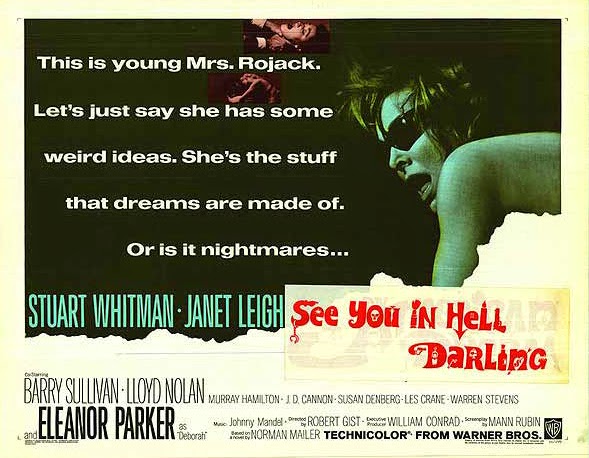
AN AMERICAN DREAM aka SEE YOU IN HELL DARLING

AN AMERICAN DREAM (aka See You In Hell Darling/1966). Director: Robert Gist.

When TV host Stephen Rojack (Stuart Whitman) pays a call on estranged wife, Deborah (Eleanor Parker), the vicious, drunken woman winds up falling off her balcony to her death. Rojack, grilled by police, does the sensible thing after his wife has just died and shacks up with old gal pal, Cherry (Janet Leigh). Rojack's father-in-law (Lloyd Nolan) contemplates pushing Stephen off of a balcony, and detectives Barry Sullivan and J. D. Cannon act like they'd like to tear his throat out. And we mustn't forget the whole host of mafia boys headed by Eddie Ganucci (Joe De Santis) and Johnny Dell (Warren Stevens) who have their own beef with Rojack. Whitman isn't bad, Parker [Lizzie] is vivid, Leigh plays it all in the key of bitter, Nolan is, frankly, terrible, Cannon over-acts in stock TV fashion, and Sullivan [Suspense] isn't much better. There are some interesting elements to An American Dream -- which is very loosely based on a novel by Norman Mailer -- but the movie is pretty much a melodramatic and at times even laughable mess. Acrophobes in the audience may have a few tense moments. Richard Derr has a bit as a producer while Murray Hamilton has a little more to do as an associate of Stephen's. Harold Gould and George Takei also have bits as lawyers. Whitman and Leigh appeared together in the monster bunny movie Night of the Lepus, which was actually a lot more entertaining than this.

Verdict: Everyone seems to be yelling -- or simmering -- to little effect. **.

THE GEORGE RAFT STORY

THE GEORGE RAFT STORY (1961). Director: Joseph M. Newman.

Dancer George Raft (Ray Danton) meets gals, entertainers and hoodlums in New York City nightclubs. Then it is suggested that he take off for Los Angeles and try his luck in the movies. He treats women like dirt, punches out people at the slightest provocation, gets a swell head, becomes a has-been, appears in Some Like It Hot as a kind of comeback, and in general acts like a major asshole. Oddly Raft -- who could have sued for defamation of character -- was still alive in 1961, so one supposes he actually liked that image as well as the fact that "Bugsy" or Benny Siegel (Brad Dexter of 99 River Street) was one of his best friends. Danton is an odd choice to play Raft, especially as he's much better looking and arguably much more talented than the real George Raft, who seemed to be a passable dancer and little else. Danton does an okay job of faking the fancy footwork with lots of coaching, but there's no genius there a la Fred Astaire. Jayne Mansfield, of all people, gives a more than credible performance as a fictional character who may or may not be Raft's bosomy wife. Neville Brand [Eaten Alive] is memorable as Al Capone, and Robert H. Harris makes a sympathetic if  exasperated producer, and there are other bits and supporting performances from Julie London as a singer; Margo Moore as a hat check girl; Barrie Chase as the actress, June; Barbara Nichols as a dubbed Texas Guinan; Frank Gorshin as a Raft associate; and Hershel Bernardi as Raft's much-maligned manager. The movie comes to a dead halt during a lengthy performance of a deadly song-and-comedy team. The cliches in the film -- and there are many -- include Raft earnestly complaining that he "can't say these lines!" (-- maybe because he can't act!) No matter what poor Danton played, he always came off as a low-life; he was equally sleazy in Too Much, Too Soon and other films.

Verdict: Poor biopic of someone hardly worth mentioning. **.

BRAINSTORM (1965)

Jeffrey Hunter
BRAINSTORM (1965). Director: William Conrad.

Jim Grayam (Jeffrey Hunter) discovers a passed out blond named Lorrie (Anne Francis) in a car on the railroad tracks. Saving the woman, he takes her home to her wealthy husband, Cort Benson (Dana Andrews), where it becomes obvious that this is a marriage from Hell. Jim and Lorrie begin an affair (incredibly, they seem to think they're being discreet), and Jim is subjected to a campaign of harassment. Then Jim decides that the only way for the couple to be free -- and be free to take care of Lorrie's small daughter -- is to plot a murder ... Brainstorm features a very good performance from the "impossibly" good-looking Hunter [Belles on Their Toes] and isn't badly directed by portly actor William Conrad [Cry Danger]. Francis is more than okay, but Andrews is atypically listless as Benson. Viveca Lindfors, with her Cheshire cat grin, is very effective as a psychiatrist who has to determine Jim's sanity. Mann Rubin's screenplay -- he also wrote An American Dream --  becomes increasingly implausible as it progresses, however. Strother Martin, Kathie Browne, and ham-handed Richard Kiel have smaller roles, and the last two are certainly vivid. Conrad is seen in the background of a hospital as an asylum inmate. Francis and Hunter appeared together as a romantic couple in Dreamboat 13 years earlier.

Verdict: Quite effective lead performance in half-baked melodrama. **1/2.

BOMBA ON PANTHER ISLAND

BOMBA ON PANTHER ISLAND (1949). Writer/director: Ford Beebe.

Rob Maitland (Harry Lewis) has traveled to Africa with his sister Judy (Allene Roberts) and is consulting with Commander Andy Barnes (Charles Irwin). While a dangerous panther is stalking and killing natives, Rob gets the idea of starting a fire to clear the brush on an island so he can have a base for agricultural research. Two attractive young women compete for the attentions of Bomba (Johnny Sheffield) as a fire rages out of control during a wild storm, and the panther makes its move. Bomba on Panther Island is an improvement on Bomba the Jungle Boy, with a more interesting story and some exciting developments. Bomba may have been called the Jungle Boy, but at 18 Sheffield (and his alter ago) was a man, something that is definitely noticed not just by Judy but by the sensual and beautiful native girl, Losana (Lita Baron), who is seen as a mysterious creature by the other natives. Baron [Jungle Jim] isn't bad, but Roberts isn't much of an actress. Irwin and Lewis are also professional. In this entry Sheffield is adept and quite charming as Bomba.

Verdict: Bomba better watch out for those "predatory females." **1/2.

OCEAN'S THIRTEEN

OCEAN'S THIRTEEN (2007). Director: Steven Soderbergh.

When Reuben Tishkoff (Elliott Gould) winds up in the hospital because he gets screwed over by hotel man Willy Bank (Al Pacino), his friends gather together to enact one more con. The idea is to deprive Bank of a coveted award by giving the reviewer (David Paymer) a miserable vacation -- and ruining Bank's opening night -- while rival hotelier Terry Benedict (Andy Garcia) agrees to help with their plan if they steal some of Bank's coveted diamonds for them. Ocean's Thirteen is leisurely but entertaining, with the best acting from Paymer, Garcia [Twisted], Gould, Pacino and Carl Reiner, not to mention Don Cheadle and especially Ellen Barkin [Adventures of Buckeroo Banzai Across the 8th Dimension] in an excellent turn as Bank's security gal, Abigail. George Clooney and Brad Pitt sort of saunter dully through this affair without raising a sweat, while Matt Damon is somewhat more interesting. Soderbergh also directed Behind the Candelabra and the inferior Ocean's Twelve.

Verdict: Amiable nonsense. ***.

Thursday, February 19, 2015

PAINTING THE CLOUDS WITH SUNSHINE

PAINTING THE CLOUDS WITH SUNSHINE (1951). Director: David Butler.

"Money has always been very mysterious, and on the first of the month, very elusive."

A sister act that is actually comprised of three unrelated ladies is the cornerstone of this kitschy musical comedy. Abby (Lucille Norman) is in love with Vince (Dennis Morgan), but can't put up with his gambling, while Ted (Gene Nelson of So This is Paris) is carrying a torch for Abby, while June (Virginia Gibson) in turn is pining away for Ted. Meanwhile the more practical Carol (Virginia Mayo of Smart Girls Don't Talk) decides the gals should move to Les Vegas and each find themselves a millionaire. By the time "Cuddles" Sakall shows up as the ever-lovable and often cloying honorary uncle, who runs a casino-hotel, you know the movie will be a positive mass of cliches. The cast is at least enthusiastic, there's brilliant Technicolor, and several nice song numbers, such as "Tiptoe Through the Tulips" (years before Tiny Tim made it popular again), "With a Song In My Heart," and "Jealousy." Unfortunately there are also some tunes which I believe were written just for the movie -- "A Necessary Evil" and "Mambo Man" -- which are truly wretched, although Gene Nelson does some excellent dancing for this and other numbers. Tom Conway [The Atomic Submarine] gives a fine comic performance as a banker who at first disapproves of his cousin, Ted's, upcoming nuptials. Wallace Ford is strictly irritating as a grubby business associate of Sakall's. Lucille Norman was a professional singer with a gorgeous semi-operatic voice; she made few appearances in films. Virginia Gibson had a longer list of film and TV credits. The big finish takes place at the "Helldorado" festival -- you can miss it.

Verdict: Amiable enough if rather treacly. **1/2.

THE LOCAL STIGMATIC

Al Pacino and Paul Guilfoyle
THE LOCAL STIGMATIC  (1990). Director: David F. Wheeler.

Cockney roommates Graham (Al Pacino) and Ray (Paul Guilfoyle) are two borderline sociopaths obsessed with dog races and celebrities. One afternoon the two men go to a pub and encounter actor David (Joseph Maher), whom they are jealous of and whom they brutalize. There isn't much else to The Local Stigmatic, which is based on a short play by Heathcote Williams in which Al Pacino appeared in the sixties. While the characters are unmemorable and one-dimensional, the acting can't be faulted, with both gentlemen giving very good performances; Pacino is especially good as a coolly sinister borderline sociopath, even if his accent was criticized. The Local Sigmatic, less than an hour long, was never officially released but was seen in private screenings before being issued on DVD. Guilfoyle (not to be confused with the unrelated older character actor and director of such films as A Life at Stake) has also been a very, very busy actor throughout his career.

Verdict: A mesmerizing Pacino if nothing else. **1/2.


CITY IN DARKNESS

Leo G. Carroll and Lynn Bari
CITY IN DARKNESS  (1939). Director: Herbert I. Leeds.

Charlie Chan (Sidney Toler) is in Paris where assorted characters are converging in a blacked-out city on the verge of war. Marie Dubon (Lynn Bari of Shock) is hoping to buy a forged passport from Louis Santelle (Leo G. Carroll) so that her husband, Tony (Richard Clarke), accused of embezzlement, can escape the city. Antoine (Pedro de Cordoba) sends his young son, Henri, off to war only to learn that his employer, Petroff (Douglass Dumbrille) may be up to treasonous activities. Lady spy Charlotte Ronnell (Dorothy Tree) is mighty handy with a gun, but she may not be the murderer Chan is looking for. This is an atypical Chan film in that there are no proverbs, few if any suspects, no sleuthing sons of Chan, and little suspense or excitement -- in other words it's a pretty dismal concoction. The performances are okay, with Dumbrille [A Life at Stake] taking top honors, but Harold Huber over-acts too much as a would-be French detective. Adrienne D'Ambricourt is more on the mark as a large and boisterous landlady. Lon Chaney Jr. has a bit part and just a couple of lines. Leeds also directed Bunco Squad.

Verdict: This one should have stayed dark. *1/2.

BOMBA THE JUNGLE BOY

BOMBA THE JUNGLE BOY (1949). Director: Ford Beebe.

"Filmed in glorious sepia tone," Bomba the Jungle Boy is the first in a series based on the children's books by Roy Rockwood. Photographer George Harland (Onslow Stevens of The Vanishing Shadow), his daughter, Pat (Peggy Ann Garner of Black Widow), and their friend, Andy (Charles Irwin) try to find more interesting wildlife and scenic views across a certain "Big Rift," but Pat gets lost. Bomba (Johnny Sheffield), who was raised by an old recluse who died, isn't too crazy about Pat at first, but then warms up to her, helping her build a refuge. When Pat asks Bomba for a leopard skin, he tries to take his off right in front of her; later she shows up in a remarkably professional leopard dress that seems fitted, patterned and sewn by experts. There is a plague of locusts, some hungry lions, a monkey named Otto, and more stock footage than you can shake a stick at. This is an ultra-cheap Monogram production that even serial thrill-king Ford Beebe can't do much with. The best performance is from Smoki Whitfield as the personable and bright native guide, Eli. Sheffield, of course, played "Boy" in the Tarzan films.

Verdict: Definitely room for improvement with this series. **.

YOU'RE ONLY YOUNG ONCE

Mickey Rooney and Lewis Stone
YOU'RE ONLY YOUNG ONCE (1937). Director: George B. Seitz.

This is the second film in the Andy Hardy series after A Family Affair and the first to star Lewis Stone and Fay Holden as Judge Hardy and his wife. The judge and family go on vacation to Catalina island, primarily because the judge wants to take in some fishing. Although Marion is apparently still in love with the unseen Wayne, she becomes smitten with a handsome lifeguard named Bill (Ted Pearson). Andy is also smitten with a sixteen-year-old named Geraldine (Eleanor Lynn), whom the judge thinks is much too fast for her. Judge Hardy acts as if her son is going to get married to the girl when it's only a summer romance, and Marion (Cecelia Parker) remains completely flighty in this and later pictures; fiance Wayne is simply forgotten. Meanwhile poor Aunt Millie (Sara Haden) is an old biddie if ever there were one, and the family nearly loses their house at one point. Mickey Rooney, terrific as always, was seventeen playing at fifteen, while Eleanor Lynn, playing sixteen, was an old lady of twenty-one looking five years older. You're Only Young Once has some sentiment and humor, but it's pretty much by the numbers, retreading the first picture with much less aplomb. Ann Rutherford is a lot of fun as Polly, however. Followed by Judge Hardy and Son, which was a decided improvement.

Verdict: This installment is a bit hokey and sanctimonious. **1/2.

THE AVENGERS Season 4

Emma Peel as queen of the Hellfire Club
THE AVENGERS (season four/1966).

The Avengers began life in 1961 as a man named John Steed (Patrick Macnee, who lasted through all seven seasons) helps "avenge" the murder of Dr. David Keel's (Ian Hendry) wife; the two men then went on to have several more adventures. Keel was replaced by Cathy Gale (Honor Blackman) for seasons 2 and 3, the episodes for which appeared to be on tape and rather low-tech in nature. With the 4th season, The Avengers was on film, became a very slick show, and best of all starred Diana Rigg [No Turn Unstoned] as the jumpsuit and leather-clad Mrs. Peel, who retained her femininity while apparently excelling in every form of combat known to man -- or, rather, woman. This was the first season in which the British series was shown in the U.S. on the high-rated ABC network. The show tried to maintain a balance between quirky, tongue-in-cheek humor and stories that had genuine suspense and excitement. Often the show would go over the line and descend into camp ["The Girl from Auntie" being a prime example, and as bad as the lowest camp episode of The Man from U.N.C.L.E.). On the other hand, many of the episodes were quite smart and entertaining: "Death at Bargain Prices" features a bomb inside a department store; athletes are hypnotized into committing crimes in "The Master Minds;" a murder-for-hire outfit masquerades as a dating service in "The Murder Market" (with Patrick Cargill of Inspector Clouseau and Suzanne Lloyd);"A Touch of Brimstone" features Emma caparisoned as a black queen in the Hellfire Club; and a bunch of pseudo-feminist slayers take orders from a marionette in "How to Succeed ... at Murder." We mustn't forget the "Man-eater of Surrey Green" with its monster plant. Other memorable episodes include "The Gravediggers"  with Paul Massie; "The Cybernauts" with Michael Gough; "The Hour that Never Was;" "Two's a Crowd;" "The House that Jack Built" with its weird, twisting domicile; "The Danger Makers;" and "A Sense of History." The show was generally very well directed and edited with many exciting fight scenes, and Mrs. Peel took on female opponents more than once, especially in "Murder Market" (two gals go after Emma at the same time) and "How to Succeed at ... Murder."

Verdict: Peel and Steed make a lively and sophisticated duo. ***.

GIGLI

Jennifer Lopez and Ben Affleck
GIGLI (2003). Writer/director: Martin Brest.

A "cute" (that is "nice") hit man named Larry Gigli (Ben Affleck of Hollywoodland), and a pretty -- and nice -- hit woman named Ricki (Jennifer Lopez of Monster-in-Law) team up to kidnap and possibly murder a mentally-disabled youth named Brian (Justin Bartha). And this is an (alleged) comedy? Perhaps in a very wild farce with extremely gifted farceurs this may have worked, but Gigli deserves its reputation as one of the worst movies ever made -- what on earth was Brest thinking (no wonder he hasn't worked since)? Let me make it clear that Gigli wasn't just excoriated because of over-exposure to "Bennifer" -- Lopez and Affleck were lovers at the time -- but because it was a tedious and dreadful picture. To make matters worse -- if that's possible -- there is even some homophobic nonsense with Ricki, a committed lesbian, having sex with Larry simply because the real-life couple had to sleep together in the movie! Al Pacino [88 Minutes] is the best thing in the picture as a maniacal mob boss, but there isn't enough of him to save the movie.

Verdict: If only this had been about Beniamino Gigli, the opera singer. This is beyond abysmal. 1/2 star for Pacino.

Thursday, February 12, 2015

THE GROOM WORE SPURS

Joan Davis and Ginger Rogers
THE GROOM WORE SPURS (1951). Director: Richard Whorf.

Cowboy star Ben Castle (Jack Carson) owes 60,000 dollars to a gambler named Harry (Stanley Ridges of Black Friday), so attorney Abigail (Ginger Rogers) tries his best to make a settlement. Ben winds up getting married to Abigail, but he fears it's all just part of the deal. Later there's a murder and an unfunny business with a plane going out of control on the runway. In the meantime, most of the minimal laughs have to do with Alice (Joan Davis), who wears a short chic hairstyle and thinks Abby is a little nuts. Carson and Rogers are adept, Davis is as lively as ever, but the script is pretty bad. James Brown is a pilot named Steve who would probably make a better match than lunkhead Carson, and Ross Hunter [All I Desire] is Austin Tindale, a banker who seems to have a hankering for Alice. Mira McKinney [Young Fugitives] is fun as a termagant cook, as is Victor Sen Young as Carson's butler, although he's unfortunately asked to speak fractured Chinese.

Verdict: Davis deserves much better, which is usually the case. **.

DIARY OF A MADMAN

Vincent Price
DIARY OF A MADMAN  (1963). Director: Reginald Le Borg.

"I don't know if I'm innocent of guilt or guilty of innocence." -- Odette

Magistrate Simon Cordier (Vincent Price) speaks to a condemned murderer, Louis Girot (Harvey Stephens), in his cell, wherein Girot says he only killed people because he was possessed by a spirit called a Horla. Cordier learns to his dismay that Girot was telling the truth, when said Horla reveals its presence and its terrible intentions. Cordier, who mourns his wife and child, falls for a very pretty model named Odette (Nancy Kovack), who already has a husband in poor painter Paul (Chris Warfield). A sculpted bust that Cordier makes of Odette is later used for a very grisly purpose. Loosely based on stories by Guy de Maupassant, Diary of a Madman has an excellent story and features a wonderful performance by Nancy Kovack -- its main problem is Vincent Price, who offers his customary charm but otherwise walks through the movie and its horrific events as if all he were thinking of was using his paycheck to acquire more artwork, which was probably the case. Cordier is a terrific role for any actor, but almost always Price just goes through the motions, maintaining that certain image that, unfortunately, often undermined his thesping. Most of the other actors, however, including Ian Wolfe [Games] as Simon's butler, are more on the mark. Price does not ruin the film's entertainment value, but he was more than capable of being so much better if director Le Borg had insisted upon it.

Verdict: Creditable horror flick. ***.

I, THE JURY

Peggie Castle and Biff Elliott
I, THE JURY (1953). Writer/director: Harry Essex.

"No one should belong to someone so completely that it blocks out the rest of the world, because if something should happen, you're lost." -- Dr. Charlotte Manning.

"From now on no one cuts me so deep I can't close the wounds." --Myrna Devlin

"You're not gettin' the heebie jeebies, are ya, baby?" -- Mike Hammer

Mike Hammer (Biff Elliot) is so outraged that someone murdered a friend, Jack, who saved his life during the war, that he vows to take care of the guilty party himself, being judge, jury and executioner. His friend, Captain Pat Chambers (Preston Foster) hopes to find the killer first. There are numerous suspects: art dealer George Kalecki (Alan Reed), who may be up to shady business; alleged college student Hal Kines (Bob Cunningham), who may be Kalecki's "playmate," among other things; the flirtatious Bellamy twins, Esther and Mary (Tani Guthire and Dran Hamilton); and a host of toughs and other nasty characters. Jack's girlfriend Myrna (Frances Osborne) has been seeing the sophisticated and wealthy shrink Dr. Charlotte Manning (Peggie Castle), with whom Mike becomes involved during the investigation. Then there are more murders, and Mike becomes more frustrated and violent. Who the hell is shooting all of these people, and why? I, the Jury, based on Mickey Spillane's first Mike Hammer novel, is an absorbing and well-acted thriller, with Biff Elliot, the first and arguably best Mike Hammer, playing the pants off of the role; he's just perfect as Hammer, with his good looks, sensitivity and sex appeal playing well off his brusque, rude and two-fisted manner. Castle [Beginning of the End] gives one of her more memorable performances, and there is fine work from the others mentioned, as well as from Mary Anderson [Chicago Calling] as Eileen Vickers. Margaret Sheridan [The Thing from Another World] makes a more than creditable Velma, Hammer's helpful secretary. Franz Waxman contributed an interesting jazz score. The story is the usual twisting Spillane concoction, watered down from the novel, and with the usual soupcon of misogyny underlining the whole story. When Kalecki breaks down into tears when he hears news of Hal's death, it seems clear the film is hinting that he was in love with him, but otherwise this is not explored. Some good dialogue sprinkled throughout. Elisha Cook Jr. and Nestor Paiva have smaller roles. This was remade with Armand Assante as Hammer about thirty years later.

Verdict: Highly interesting Mike Hammer picture. ***.

THE FLIGHT THAT DISAPPEARED

Paula Raymond and Craig Hill
THE FLIGHT THAT DISAPPEARED (1961). Director: Reginald Le Borg.

Flight 60 takes off from LA and is heading for Washington D.C. with several special passengers aboard. Carl Morris (Dayton Lummis of The Music Box Kid) is a physicist who has come up with an idea for a devastating Beta bomb. Marcia Paxton (Paula Raymond of The Beast from 20,000 Fathoms) is a mathematician and Morris' assistant. Tom Endicott (Crag Hill of Deadly Duo) is a rocket engineer who feels an attraction to Marcia. Inexplicably the flight keeps rising higher and higher into the air despite the best efforts of the crew. Then the engines stop running and the three aforementioned find themselves in a weird, fantastic nightmare -- or the Twilight Zone, if you prefer. The Flight that Disappeared is like a long, third-rate TZ episode complete with heavy-handed message. The first half is intriguing and well done and holds the attention, but then it collapses into illogical, incoherent stupidity below comic book level. The acting is generally professional, with Lummis taking top honors. Harvey Stephens [The Cheat] and Meg Wyllie are vivid as an hysterical, mentally-disturbed passenger and his blind wife. Another messterpiece from the fine folks at Bel-Air.

Verdict: A Rod Serling reject. **.

HARPER VALLEY P.T.A.

The "Harper Valley hypocrites" on the PTA board
HARPER VALLEY P.T.A. (1978). Director: Richard Bennett.

Based on Jeannie C. Riley's amusing hit record, this details the struggles of widowed mother Stella Johnson (Barbara Eden of A Private's Affair) against the hypocrites of the Harper Valley PTA. As in the song, Stella - who's been called an unfit mother -- attends a meeting, calls out all the board members, exposes their sins and hypocrisy -- and that should have been enough. Instead Stella, who doesn't seem to be playing with a full deck, spends time, money and energy getting further revenge on everyone on the council, even importuning her friend Alice (Nanette Fabray), who owns a beauty parlor, to put acid in the hair of council president Flora Simpson Reilly (Audrey Christie). Of course Ms. Reilly's hair falls off in clumps until she's practically bald, at one of her chi chi parties. Sure, the woman was a snob, but talk about overkill! Since we never see the repercussions of these revenge schemes, one imagines that Alice was arrested for assault and received the papers for a million dollar civil suit off-screen [not to mention that hardly anyone would go to her beauty parlor after they heard what happened to Reilly!] True, movies like this are not supposed to be looked at too closely, but via her actions Stella seems to prove that she really isn't a fit mother! There's an amusing bit of business with Stella locking one board member out of a hotel room stark naked -- he finds a clever way to drape his body --  and the scene involving horse manure doesn't, er, stink, but most of the movie is simply strained and unfunny. Not one of the many actors in this betrays any great comedic skill aside from John Fiedler, who is very amusing as an aging and unlikely Casanova. This was a hit, and led into a pretty bad TV series of the same name. Audrey Christie made a better impression years before as the reporter Jane in Keeper of the Flame, her first film.

Verdict: At least it's a great song. **.