Lively, entertaining reviews of, and essays on, old and newer films and everything relating to them, written by professional author William Schoell.

Thursday, August 31, 2023

MEDIOCRE NEW MOVIE: THE FABLEMANS

Father and son: Paul Dano and Gabriel LaBelle
THE FABLEMANS (2022). Director: Steven Spielberg. 

In 1952 young Sammy Fableman (Mateo Zoryan) lives in Arizona with his sisters, mother Mitzi (Michelle Williams of Shutter Island) and father Burt (Paul Dano of The Batman). Practically living with them is "Uncle" Bennie (Seth Rogan), who is Burt's best friend. As Sammy becomes a teen (Gabriel LaBelle), he makes amateur films with his boy scout troop that impress and excite his family and the townspeople. Footage of a camping trip that his father asks him to put together also reveals a disturbing secret. Apparently Mitzi and Bennie are in love. Sammy has to deal with this, his emerging hormones, anti-Semitism at school after he moves, and his first love affair with a girl named Monica (Chloe East). 

Mitzi sees the footage shot of her and "Uncle" Bennie
The Fablemans
is based on Spielberg's own childhood, and while his parents did divorce, I don't know how much of the triangle situation with "Uncle" Bennie is fact or faction. Frankly, it's the only halfway dramatic development in this film that I confess I found rather boring at times. I also confess that despite some good movies and box office successes (along with a few bombs), I was never that carried away with the semi-literate Spielberg or thought he was really in the front rank of filmmakers. (Two of his films that I think are especially good, however, are The War of the Worlds and Duel.)  

Little Sammy (Mateo Zoryan) and his train set
The Fablemans
 is perhaps supposed to be some kind of love valentine to the movies, but in that case I wish Spielberg had made a masterpiece, which this isn't. The acting is excellent -- Judd Hirsch enlivens the movie for the few minutes he's on-screen --  which is why you probably keep watching even when things get slow. Without a word of dialogue Michelle Williams is wonderful as she watches the footage of her and Bennie that Sammy excised from his video about the camping trip and explains why he has been so angry with her. It's a wonderful sequence, but there aren't enough of them in this movie. (All the high school business of bullying and young love has been seen a thousand times before and been done better besides.) As in most modern films, The Fablemans is so scared of being a soap opera that it minimizes the drama -- I mean this whole triangle situation, while it may be a trifle cliched, is rather explosive, but this only simmers without ever coming to a boil.

In the screenplay co-writers Spielberg and the equally over-rated Tony Kushner try to come up with powerful scenes, but they seem much too contrived, such as when a high school bully (a talented fellow named Sam Rechner) who appears in Sammy's movie breaks down and cries. Subtlety is all well and good -- if that is even what it is -- but the movie fails to really confront issues, it just meanders along until a silly conclusion when Sammy meets director John Ford. Then it's over. Ho hum. 

Verdict: We'll have to wait for an unlikely sequel -- this was not a box office hit -- to see the more interesting moments in Spielberg's career. **1/2. 

ROUND UP OF NEW AND RECENT FILMS PART TEN

Brendan Fraser
THE WHALE (2022). Director: Darren Aronofsky. Brendan Fraser stars as Charlie, a gay man who has been slowly killing himself through food since the suicide of his partner. He has a teenage daughter from his earlier marriage and tries to bond with her before it's too late. Along the way he interacts with his late partner's sister, his ex-wife, and a young religious man who wants to "save" him. Based on a stage play, this goes behind the scenes of a morbidly obese person and answers the question of how and why they got that way. This is a fairly interesting if imperfect film, with the daughter being nearly too obnoxious to take, and Fraser's Oscar-winning performance, while good, perhaps too dependent on a fat suit and prosthetics. Rob Simonsen's musical score seems to be doing most of the work. **1/2.  

Tai Gabrielle
UNCHARTED (2022). Director: Ruben Fleischer. Another movie inspired by a video game, this teams Tom Holland and Mark Wahlberg trying to find a treasure collected by Magellan even as Antonio Banderas tries to stop them. Tai Gabrielle makes an impression as a ruthless assassin working for Banderas. The players are game, there are some exciting scenes and stunt work, but the whole project is just so overfamiliar and ultimately forgettable. **1/2. 

Dennis Quaid and Bradley Cooper
THE WORDS (2012), Written and directed by Brian Klugman and Lee Sternthal. Bradley Cooper appropriates an old man's manuscript as his own and becomes rich and famous, but what happens when the truth comes out? Besides being very well-acted -- the cast also includes Dennis Quaid, Jeremy Irons, Ron Rifkin and others -- the film boasts cinematography by Antonio Calvache and a score by Marcelo Zarvos. Despite all this, The Words is not entirely satisfying and many viewers were not that happy with the ending. **3/4. 

Lady Gaga
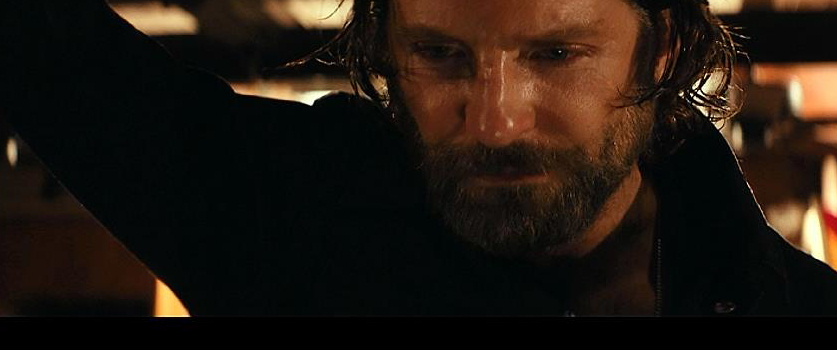
A STAR IS BORN (2018), Directed by Bradley Cooper. This is not so much a remake of the Janet Gaynor or Judy Garland versions of the venerable story, but of the Barbra Streisand version with the characters being singers instead of actors. Bradley Cooper as the older addict whose career is going to pieces, and Lady Gaga as the younger wannabee who accepts his help and achieves stardom, are both good but not spectacular. Rafi Gavron scores as a reptilian manager and there are good turns from Sam Elliott as Cooper's brother and Andrew Dice Clay as Gaga's father. 

Bradley Cooper
In addition to "Shallow" there are some good tunes in the movie, well-performed by the leads, especially Gaga. Just as Garland is transformed in her version of the story, Gaga is turned from a more original performer into a tiresome, sexed-up clone of Madonna, but not enough is done with this aspect of the story. A scene when Gaga wins a Grammy doesn't have a drunken Cooper accidentally hitting her but rather peeing in his pants! Ultimately, this version, although slickly done in some ways, lacks any emotional resonance, and you really don't care about any of the characters. Two former co-stars of Cooper's, all of whom appeared on the TV show Alias, are in the film: Greg Grunberg as a driver and Ron Rifkin as a counselor. Missing is Michael Vartan, another Alias alumnus, who I always thought was much more compelling and attractive than the somewhat over-rated and average-looking Cooper. **1/2. 

Thursday, August 17, 2023

ALFRED HITCHCOCK'S TOPAZ

Ill-fated lovers: Karin Dor and Frederick Stafford
ALFRED HITCHCOCK'S TOPAZ (aka Topaz/1969). Director: Alfred Hitchcock. Based on the novel by Leon Uris. UNCUT version. 

On the eve of the Cuban Missile Crisis, a haughty defecting Russian Intelligence officer, Colonel Boris Kusenov (Per-Axle Arosenius), escapes from Denmark with the help of the Americans, including Michael Nordstrom (John Forsythe) of the state department. Nordstorm is good friends with a French agent living in Washington named Andre Devereaux (Frederick Stafford), and asks him for his help. First he has to get certain papers from a Cuban officer, Rico Parra (John Vernon of Point Blank), who absolutely loathes Americans. Then Devereaux travels to Cuba, as he does frequently, to see if he can find out exactly what the Russians are up to there. Finally he learns of an organization, code named "Topaz," which consists of highly-placed treasonous French officials who are secretly working with Moscow. Devereaux can't tell his bosses what he has learned about activities in Cuba until he finds and excises this traitorous element. 

Frederick Stafford as Devereaux
If Topaz had been directed by anyone besides Alfred Hitchcock, it would be an acclaimed film. But because the direction is not "showy" as in some Hitchcock films, and there are no outstanding cinematic sequences one can point to -- although there are several good scenes -- Topaz has been unfairly dismissed as a Hitch stinker. Actually it has a very interesting plot and good characters, although you might wish some of them were better-developed. One which is better developed is Andre Devereaux, who seems to have a happy marriage with one-time resistance fighter Nicole (Dany Robin of Follow the Boys) but also has a mistress, Juanita de Cordoba (Karin Dor), in Cuba. Widow of a revolutionary hero, her appeal to Devereaux is obvious -- she is still a "resistance fighter," secretly working against communist influences in Cuba at great risk to herself and her associates. 

Roscoe Lee Browne and John Vernon
Topaz
 has several acts. The first suspenseful section deals with the defector and his family getting away in Denmark and nearly paying the final price when Russian agents with guns pursue them. The second act takes place in New York, especially in a Harlem hotel, where Devereaux's associate Philippe (Roscoe Lee Browne) makes a deal with Rico Parra's secretary, Luis Uribe (Donald Randolph of The Mad Magician), for some papers that detail Russian missile activities in Cuba -- a lot of suspense is worked up over getting those papers out of a certain briefcase and the street chase that follows (which ultimately leads to problems for Devereaux and far worse problems for Juanita). The third act occurs in Cuba. The final section takes place in France, when Devereaux must somehow explains things to his superiors without indirectly giving important information away to the communists. Although Hitchcock filmed three endings, all of which can be seen on the DVD, he went with a quiet if satisfying conclusion at an airport. Perhaps he should have chosen the ending in which Devereaux and his friend, a man known as "Columbine" who runs Topaz, have a duel. (Apparently this was the original ending but preview audiences hated it.) 

Carlos Rivas and John Vernon
Topaz
 features some interesting casting. John Forsythe is solid as Nordstorm, although we never get to learn that much about him. Czech actor Frederick Stafford played a secret agent in a couple of French films previously and seemed perfect for Devereaux, which he is. German actress Karin Dor -- whose best-known film was You Only Live Twice as a Bond villainess who goes to the piranhas -- is given one of her best roles as Juanita, and you wish there was more of her. Phillipe Noirot manages to make his unsympathetic character of Henri Jarre strangely appealing and Per-Axle Arosenius is terrific as the rather obnoxious Russian defector who may be figuratively bloodied but is definitely unbowed. John Vernon had a long career, mostly on TV, but his performance as Rico Parra is only adequate. As his bodyguard Hernandez, Carlos Rivas [The Black Scorpion] makes a striking figure with a thatch of red hair and a beard to match. Ann Doran [It, the Terror from Beyond Space] appears briefly as a woman who ministers to the defector and his family when they first arrive at the safe house. There are also good turns from Michel Subor as Devereaux' son-in-law Francois, and John Roper, Lewis Charles and Anna Navarro as ill-fated associates of Juanita's, among others. Roscoe Lee Browne and Donald Randolph make the most of their scenes in the hotel and elsewhere. 

John Forsythe
Topaz
 is well-shot by Jack Hildyard [Summertime] but Maurice Jarre's score is problematic. I love the exciting opening theme, but just wish the rest of the score had been as dynamic. There are some good moments, but the music mostly lacks the dramatic intensity that might have turned Topaz into a whole new picture; I truly believe it's one of the reasons the film wasn't a critical success. Hitchcock's longest  film, it also could have used some trimming and tightening, especially in the final section. (Apparently this was done for the original theatrical version.) The screenplay is by Samuel Taylor, who wrote Vertigo. 

Verdict: The Master of Suspense tells the story more simply, perhaps, but still manages to do a better job than most contemporary directors. Some terrific scenes in this! ***. 

THIS COULD BE THE NIGHT

Anthony Franciosa, Jean Simmons, Paul Douglas
THIS COULD BE THE NIGHT (1957). Director: Robert Wise. 

Anne Leeds (Jean Simmons of Angel Face) is a schoolteacher who inexplicably gets part-time work as a secretary for one of the partners, Rocco (Paul Douglas), in a Manhattan nightclub. Rocco's partner, playboy Tony Armotti (Anthony Franciosa), thinks Anne, due to her upper-crust education, is stuck up and doesn't belong in the club, but Rocco takes a shine to her. As Tony and Anne work out their differences, other denizens of the club interact with our trio: singer Ivy (Julie Wilson); dancer Patsy (Neile Adams) and her mother Crystal (Joan Blondell); Hussein (Rafael Campos), a busboy who slowly warms up to Anne; and slick lawyer, Devlin (Tom Helmore). Will Anne and Tony ever get together, and what will Rocco think of it when they do?

Jean Simmons and Anthony Franciosa
This Could Be the Night
 came out two years after the film version of Guys and Dolls, which also starred Jean Simmons, and while it's a quite different story and may take place in a different time period, I doubt if it's a coincidence that it presents a "greenhorn" (virgin) interacting with various gangster and nightclub types. There are musical numbers in this, too, although they are integrated into the nightclub setting and This Could is not a musical as such. The three leads all give very good performances. However, one has to say that while Franciosa is a very good and intense actor, he is not a charm boy. He plays a scene with some schoolchildren with absolutely no humor at all!

Simmons, Franciosa, and Rafael Campos
Although one can understand why no cult grew up around singer Julie Wilson as it did around Judy Garland, she is a snazzy entertainer and is okay as an actress; she was essentially a cabaret star. Filipino Neile Adams appeared on Broadway, in a couple of films and several TV shows, but her chief claim to fame was as the wife of eventual superstar Steve McQueen (from 1956 - 1972). Joan Blondell is fat, unpleasantly brassy, and unappealing in this. Along with the leads Adams and Blondell are shown in the end credits, but not Rafael Campos, which is distinctly unfair. Talented Campos [Lady in a Cage] is exuberant and quite good in the film and has at least as much to do as the other two. (Frankly, I didn't understand the whole business with Hussein being able to change his name if he passes an algebra test!?) 

Franciosa with William Joyce
Another interesting player is William (Ogden) Joyce, who plays Bruce, a fellow teacher of Anne's who, oddly, never gets to first base with her -- he isn't treated all that well. (Joyce is handsome and adept in this but his only leading role was in I Eat Your Skin.) Attractive bandleader and trumpeter Ray Anthony [Girls Town], one-time husband of Mamie Van Doren, is cast as himself and exudes charm, and J. Carrol Naish plays the club chef with his usual charisma.  While the three lead characters are fairly well-developed, and there's some attempt to flesh out the supporting characters, the portraits tend to be on the superficial side. This is a somewhat unusual directorial assignment for Robert Wise. The film is sharply photographed by Russell Harlan. 

Verdict: With good actors and several interesting sequences, this is smooth entertainment. ***. 

MOTHER DIDN'T TELL ME

Dorothy McGuire and William Lundigan
MOTHER DIDN'T TELL ME (1950). Written and directed by Claude Binyon. 

Jane Morgan (Dorothy McGuire), who writes commercial jingles, sets her cap for the very handsome Dr. William Wright (William Lundigan) when she goes to him for a weird cough. Fortunately Bill is equally attracted to Jane, and it isn't long before they start dating. Jane refuses to believe that she will become a typical lonely doctor's wife, even when Bill's mother  (Jessie Royce Landis) tries to warn her off. But even if Jane can deal with Bill's frequent absences due to the demands of his patients, she may find stiffer competition from Bill's attractive new associate, Helen (Joyce MacKenzie of Destination Murder). 

Leif Erickson and June Havoc
Two very charming and adept lead performances are what put over this engaging comedy-drama (with an emphasis on comedy). The sensitive and talented McGuire proves that she is no slouch when it comes to comic roles and her co-star Lundigan proves he is more than just a good-lookin' fella. These two performers help gloss over some odd moments in the script. On the train during their honeymoon, the conductor tells Bill that a woman passenger is unconscious and may have had a heart attack. Instead of showing the slightest concern, Jane is only annoyed. "I can't ignore an unconscious woman," Bill says. "But you can ignore a conscious one?" his wife responds. If it weren't for McGuire's sympathetic playing, Jane would be completely unlikable. In fact, after this exchange you begin to think that the mother-in-law has the right idea. 

Gary Merrill and June Havoc are another  doctor and his wife, friends of Bill's, and Leif Erickson [Arabian Nights] really makes an amusing impression as a headshrinker who really knows how to pitch the woo to the ladies. Then there are those adorable twins! Lundigan made Pinky the previous year. Claude Binyon also wrote and directed The Saxon Charm. 

Verdict: Two imperfect people in an imperfect but engaging romance. ***. 

THE DAY OF THE JACKAL

THE DAY OF THE JACKAL (1973). Director: Fred Zinnemann. Based on the novel by Frederick Forsythe.

In 1962 French President DeGaulle has been targeted for assassination by the terrorist group OAS because of the issue of Algerian independence, which he supports. Since DeGaulle is heavily guarded and many of the members of the OAS are well-known to the government, the group decides it would be safer to bring in an outsider and foreigner, and hire a contract killer who becomes known as the Jackal (Edward Fox of The Mirror Crack'd). The film details this sociopath's meticulous planning even as French officials convene under the direction of the Minister (Alan Badel of Salome) and assign Commissioner Lebel (Michael Lonsdale) to track him down. Using his quick wits and ruthless nature, the Jackal manages to stay one step ahead of the police, until they figure just when the man is going to strike. But will they be able to prevent disaster? Obviously, they do, but the interest in the film is in exactly how the Jackal will be stopped and when. 


Michael Lonsdale
The Day of the Jackal proceeds almost like a documentary. It has no real musical score (until the closing credits) and hasn't much style. There is one memorable sequence in which the Jackal murders a man whom he meets in a Turkish bath. This is handled in a low-key, matter-of-fact fashion that makes it all the more chilling. (The assassin is shown having sex with a woman he picks up, but whether or not he gets it on with the guy is left to the imagination, although he does apparently spend the night.) Edward Fox really isn't given a lot to sink his teeth into as his character is virtually unemotional and is given no real background or identity, but he manages to make a positive impression in spite of it. The other actors, mostly unknown, are all professional and adept. Jackal is one of those movies that keeps you perfectly absorbed even as you think afterward that it wasn't all that great. There's no real nail-biting suspense to the film. The only familiar faces in this, besides Lonsdale (who was later the villain in Moonraker), are Derek Jacobi [Breaking the Code] as his assistant, Caron, Jean Sorel [Sandra] as Bastien-Thiry, an OAS man who is executed at the opening of the film, and perhaps Delphine Seyrig, as Collette, a wealthy married woman who dallies with the Jackal and comes to regret it. 

Verdict: It entertains, but it sure could have used a musical score. **3/4. 

OSS 117 UNLEASHED

Kerwin Mathews
OSS 117 UNLEASHED 
(aka OSS 117 se dechaine/1963) 
Director: Andre Hunebelle.

An American agent with the Office of Strategic Services is searching for the prototype of a device that can detect atomic submarines and thinks he's found it in a grotto when he is killed. Hubert Bonisseur de la Bath, also known as OSS 117 (Kerwin Mathews of The Viscount), is sent to replace the dead man, and investigates a scuba instructor, Renotte (Henri-Jacques Huet), and his girlfriend, Brigitta (Nadia Sanders), who is keeping secrets. A nasty character named Mayan (Roger Dutoit) is out to keep 117 from finding the detector and employs various unsavory agents, male and female, to stop him. The climax takes place at a spooky estate located above the grotto where 117 will either destroy the device or die trying. 

Irina Demick holds a rifle on 117
OSS 117 was introduced in a series of French novels and made his first film appearance in 1957 where the character had a different name and was a French agent. When Dr. No became a sensation in 1962 filmmakers in France decided to revive the character and make him more like James Bond. Hence Mathews' adroit performance is clearly cut from the same cloth: a man with an eye for the ladies, callous and ruthless, and not at all bothered by the death of anyone, good guy or bad. The movie is fast-paced and suspenseful, with some colorful supporting characters. It cries out for a much better score, however, and the pop song that opens the film is especially bad. Followed by Panic in Bangkok. In French with subtitles. Director Hunebelle directed most of the succeeding 117 films in the sixties as well as Fantomas. 117 still appears in movies made in the 21st century. 

Verdict: Acceptable Eurospy film with handsome Mathews quite effective as the spy. **3/4. 

Thursday, August 3, 2023

GO NAKED IN THE WORLD

Anthony Franciosa and Gina Lollobrigida
GO NAKED IN THE WORLD (1961). Written and directed by Ranald  MacDougall. NOTE Some plot points are revealed in this review.

"I'd like to think someone in this family could be kind to women." -- Mary.

Nick Stratton (Anthony Franciosa) keeps re-enlisting in the Army because he is resistant to his father, Pete's (Ernest Borgnine), plans for him in the construction business. Pete feels a need to run his son's life, and in truth Nick does seem a little unfocused. But he develops a very clear focus when he falls in love with the beautiful Julie (Gina Lollobrigida), and vice versa, although she resists as long as she can. It seems Nick doesn't know that Julie is a highly-successful call girl, and Nick's father is one of her clients! 

Franciosa with Ernest Borgnine
Go Naked in the World 
 -- love that title! -- is an entertaining melodrama that boasts two terrific lead performances by Franciosa and Lollobrigida, who proves in this that she is more than just a very pretty face. (The only problem with Franciosa is that he seems much too sophisticated not to realize what profession Julie is in from the first.) As Pete, Borgnine gives a generally strong if imperfect performance, which is also true of Nancy R. Pollock as Pete's wife, Mary. There are nice turns from Luana Patten as Nick's sister, Yvonne, and Will Kuluva as a rather sleazy restaurant owner and friend (of sorts) of Pete's. Philip Ober, former husband of Vivian Vance, has some good moments as a former client of Julie's who takes her dancing. 

Gina as Julie
One of the best scenes in the movie has Nick going up high at a construction site -- twenty stories up -- to ask Pete for money. Pete, way out on a ledge, shows him the money, and tells him he has to come out to get it. There are a few tense moments as Nick makes his way out on the ledge. Pete's employees are not at all thrilled with his actions. 


Pollock, Borgnine, Patten, Franciosa
Although Pete can certainly be loud and overbearing -- his daughter hates him and his wife feels understandably unloved -- one can see why he would be irritated with Nick. (If Nick doesn't want his father controlling his life, he has the option of getting a job and his own place and telling him to go to hell.) Somehow Nick and Julie manage to get the money to go off to what appears to be Acapulco even though Julie has given up hooking. A hilarious moment has Pete telling Julie that she and Nick are "living in back alleys" when they're actually in an ultra-luxurious hotel room at the time! As for the tragic ending, the production code wouldn't allow redemption, as such, for Julie or a happy ending for the couple. The script is reasonably good, although the classic line from Mildred Pierce -- "leave something on me, I might catch cold" -- should never have been re-used. 

Verdict: Good performances help put over this absorbing if somewhat synthetic romance. ***. 

SATURN 3

Harvey Keitel, Kirk Douglas, Farrah Fawcett
SATURN 3 (1980). Director: Stanley Donen. 

Adam (Kirk Douglas) and his assistant and lover, Alex (Farrah Fawcett), work on Titan, a moon of Saturn, in an experimental food research station. One day along comes "Captain Benson "(Harvey Keitel), who has apparently murdered and taken the place of the real Captain Benson for unknown reasons. Benson also brings along with him a robot, Hector, that is linked to his own brain, follows his orders, and seems to lust for Alex just as he does. Obviously things are going to go wrong. Benson seems to think he has a right to sleep with Alex, suggests that Adam is over the hill, and sets about making trouble and being obnoxious. Then the robot begins to go berserk ... 

Hector goes after Alex
Saturn 3
 may or may not have been influenced by Alien, which came out the year before, but S3 suffers in comparison because the mechanical villain of the piece is nowhere nears as interesting as the monster in Alien. The film shows signs of much post-production tampering as well. The original director left and was replaced by Stanley Donen, of all people, hardly a Sci Fi specialist. Kirk Douglas is as charismatic as ever -- even showing off his naked butt (yet again!) -- while Fawcett Of All The Hair is acceptable but no more. It's impossible to judge Keitel's performance. He seems to be the best thing in the movie until you learn that producer Lew Grade didn't care for Keitel's Brooklyn accent and wanted the actor to redub his lines -- instead the lines were dubbed by Roy Dotrice, whose readings are excellent. 

Verdict: Some exciting scenes and interesting sets but relatively minor sci fi. **3/4. 

SAY ONE FOR ME

Debbie Reynolds and Robert Wagner
SAY ONE FOR ME (1959). Produced and directed by Frank Tashlin. 

Father Conroy (Bing Crosby) has a parish in the middle of the theater district and holds services at two in the morning. When one parishioner, Harry (Les Tremayne), falls ill and can't work, his daughter, Holly (Debbie Reynolds), takes up the slack. Harry and Father Conroy think she's working as a secretary, but Holly is actually appearing in a nightclub with her smooth and handsome partner and boss, Tony Vincent (Robert Wagner). Now the trick is to keep that wolf Tony at bay while both of them jockey for stardom. When Father Conroy gets a chance to put together a TV special, Tony thinks he's In Like Flynn -- but is he?

Ray Walston with Der Bingle
Say One for Me is artificial from the first frame to the last, and comes off more like something out of the 1930s than the 1950s. Bing doesn't strain too much to put over his familiar portrayal of Father Conroy, and Reynolds and Wagner are perfectly professional. Wagner sings and dances in this, but he's no threat to Fred Astaire. The supporting cast is perhaps of more interest: In addition to Tremayne, we've got Connie Gilchrist as the priest's cook and housekeeper; Joe Besser -- "Stinky" on The Abbott and Costello Show -- as Tony's manager; and especially Ray Walston in a terrific turn as an alcoholic associate of Tony's. Father Conroy cures the man of his addiction overnight! 

Judy Harriet as June January
There are a few songs by Cahn and Van Heusen, most of which are forgettable, with the exception of Bing's "I Couldn't Care Less" and "Christmas All Year Through." Judy Harriet plays a girl who is rejected for the nightclub by Tony and tells him in a year she'll be a star, which happens at the end of the movie as she warbles her hit record, "The Night Rock n Roll Died" -- also forgettable. The best music in the movie is actually the theme music by Lionel Newman. If the movie weren't treacly enough, it also throws in a baby and an unwed mother. Sebastian Cabot shows  up briefly as a fat Monsignor, and Herb Alpert is the sexy trumpet player in the background of one of the numbers.

Verdict: You can stand this for about an hour but unfortunately it's two hours long! **.   

CLAUDELLE INGLISH

Arthur Kennedy, Diane McBain, Constance Ford
CLAUDELLE INGLISH (1961). Director: Gordon Douglas.

Claudelle (Diane McBain) lives in a rented farmhouse with her father, Clyde (Arthur Kennedy), and her unhappy mother, Jessie (Constance Ford). Jessie is horrified at the thought of her daughter marrying a poor man, Linn (Chad Everett, who was 24 but looks about 12), and living the same kind of deprived life that she has. Claudelle has nothing to worry about on that score, however, as Linn falls in love with somebody else and she is devastated. Determined not to ever marry anyone, Claudelle embarks on a campaign to date very many boys and acquire gifts from all of them in exchange for you-know-what. In this amusingly lurid soaper, Claudelle's sensuality pits fathers against sons, inflames the lust of her father's boss (Claude Akins), and even starts her mother on the pathway to back seat action! 

Chad Everett, Diane McBain, Will Hutchins
Claudelle isn't really "evil," but the production code insures a "sin and suffer approach" to the proceedings. McBain [Parrish] was very appealing in some roles, and perhaps her casting prevents her from being too slatternly, but she doesn't quite throw herself into the difficult part as other actresses might have done; she's simply a bit too lightweight (although one could argue that she underplays). Arthur Kennedy was always a good actor but sometimes, as in this, he just seems to be going through the motions; Constance Ford is better as his rather desperate wife, and Claude Akins [Tentacles] is just terrific as horny, old Crawford. Claudelle's "suitors" include Will Hutchins, Robert Colbert, Frank Overton, Jan Stine, and an especially charming Robert Logan [77 Sunset Strip]. Claudelle Inglish is trashily entertaining, but it lacks the good dialogue and characterizations that might have lifted it above a soap opera level. Based on the novel by Erskine Caldwell, who also wrote "Tobacco Road." Gordon Douglas also directed the excellent creature feature Them.

Verdict: Lots of fun in spite of itself, but it might as well have been even trashier. ***.

ASH WEDNESDAY

Lovely Liz
ASH WEDNESDAY (1973). Produced by Dominick Dunne. Directed by Larry Peerce. 

Sixtyish Barbara Sawyer (Elizabeth Taylor) fearing that her husband, Mark (Henry Fonda), will leave her for a younger playmate, goes to Switzerland and has cosmetic surgery (graphically depicted) to make her look like -- gorgeous, 41-year-old Liz Taylor! After the bandages come off, Barbara goes to the resort of Cortina, Italy, staying in a fabulous hotel and wearing expensive fashions. She also turns the head of a playboy named Erich (Helmut Berger, again miscast as a heterosexual). Should Barbara succumb to her romantic feelings for Erich, and what will Mark think of her new look when he finally arrives in Cortina. She may learn that her marriage had more problems than her aged appearance ... 

Helmut Berger
With its superficial and one-dimensional characters, one really has to wonder why anyone thought making this movie was a good idea. Sure, lots of people might have loved looking at glamorous Liz (although probably not at distasteful surgery), but an actual  story might have helped. Half of the movie is taken up by scenes at the clinic, and the surgery sequence seems to last as long as the actual operation. When Barbara/Liz puts on her sweeping ultra-chic winter coat/robe that looks like it must have cost a thousand dollars, the film just suddenly seems to turn into a comical parody. Taylor's performance is generally on target, although it's not one of her best. Helmut Berger is Helmut Berger and doesn't really have to act just look enigmatic. Fonda is actually good in this -- his assorted reactions are perfect -- and Margaret Blye [The Entity] is fine as their daughter, Katie. Keith Baxter adds some zest as David, a (possibly gay?) fashion photographer who is also getting work done and befriends Barbara at the clinic and elsewhere. Monique van Vooren [What Makes Sammy Run?] plays a German celebrity who briefly chats with David at the clinic. 

Verdict: Another entry in the "Oh, how the rich suffer!" sweepstakes! **1/4. 

Thursday, July 20, 2023

THAT BRENNAN GIRL

Mona Freeman
THAT BRENNAN GIRL (1946). Produced and directed by Alfred Santell.

"Who you calling as cold as an igloo? You're not exactly a heatwave yourself!"

Ziggy (Mona Freeman of Angel Face) is an attractive if somewhat hard-boiled young woman  whose mother, Natalie (June Duprez), pretends to be her older sister. Ziggy gets in with a con artist named Denny (James Dunn of It's a Great Life) who has her working for him, but falls for a handsome sailor, Martin (William Marshall of Belle of the Yukon), whom she marries. Martin's wartime death leaves Ziggy with a baby girl and little life of her own, while Denny goes off to jail. Will these two highly imperfect individuals find their way back to each other, and will Ziggy get to keep her baby? 

Freeman with William Marshall
That Brennan Girl
 is an interesting study of two not entirely admirable or even likable people who turn out to have qualities that ultimately redeem them. Freeman gives a strong lead performance, and she gets excellent support from the pleasant and competent Dunn -- who makes his character more palatable than he could have been -- and a very charming and adept Marshall. June Duprez makes her mark as the mother who set her daughter on the wrong course right from the start, and Dorothy Vaughan is lovely as Denny's very loving Irish mother. Duprez, who reminds one a bit of Linda Darnell, was in everything from The Thief of Bagdad  to the serial Don Winslow of the Coast Guard and had many other credits as well. Watch for the cute sequence when a little baby boy slowly climbs backwards down the staircase!

Verdict: An oddball romance with very good performances. ***. 

THE NIGHT DIGGER

Patricia Neal and Nicholas Clay
THE NIGHT DIGGER (1971). Director: Alastair Reid. Screenplay by Roald Dahl, from the novel "Nest in a Falling Tree" by Joy Cowley.  

Maura Prince (Patricia Neal of The Hasty Heart) lives with her blind and difficult adoptive mother, Edith (Pamela Brown of Personal Affair), in a rambling mansion in England. Maura also works with stroke patients part-time at the hospital, and the doctor, Ronnie (Sebastian Breaks), wishes she would work full-time and hire a companion for her mother. Both mother and daughter do wind up with a companion when a young man named Billy (Nicholas Clay of Evil Under the Sun), shows up wanting room and board in exchange for gardening and fixing up the house. Maura is opposed to the idea but the contrary Edith agrees to take him in. As time proceeds Maura comes to care deeply for Billy, but she has no idea of what he's getting up to in the nighttime. It all comes to a head when Edith, after an accident, insists that Billy leave, and Maura comes to a fateful decision. 

Nicholas Clay
The Night Digger
 is the rare suspense-thriller -- if that's what you can call it -- that presents three-dimensional characters with back stories and idiosyncrasies (of course Billy's character takes it a step farther). The movie eventually turns into a dark and twisted romance between a lonely woman who looks years older than her age, and a young man whose psychological problems are far worse than she could ever imagine. The film is bolstered by three excellent lead performances -- as well as a sharp turn from Jean Anderson as friend and neighbor, Millicent, among others --  and moody cinematography from Alex Thomson. Bernard Herrmann's score is a bit problematic, as apparently the film was cut after completion and some of the score was inadvertently jettisoned. What we're left with sounds like snippets from previous Herrmann movies. A bit of politically-incorrect humor -- by today's standards -- has to do with one character suggesting that the minister's wife (Yootha Joyce), who has more on the ball than he does, should have been born a man, leading to Edith wrongly assuming that she and her husband are both going to have sex-change operations. Roald Dahl and Neal were still married when this film was made.

Verdict: Unusual dark if strangely poetic psychological study with great performances. ***.   

DELIGHTFULLY DANGEROUS

DELIGHTFULLY DANGEROUS (1945). Director: Arthur Lubin. 

15-year-old Sherry Williams (16-year-old Jane Powell) lives in a girls' school that is paid for by her sister, Josephine (Constance Moore of Buck Rogers), a big Broadway musical comedy star -- or so Sherry thinks; Josephine is actually a burlesque queen known as "Bubbles" Barton. Things come to a head when Broadway producer Arthur Hale (Ralph Bellamy) comes to the school and is impressed with Sherry's talent, but not with her youth. As for her sister, he just can't see putting a burlesque star in one of his "classy" shows. But this being Hollywood, chances are good that one or both ladies will wind up starring in a Broadway show. 

Ralph Bellamy and Jane Powell
Delightfully Dangerous features some excellent performances, with a very young Powell on top of things even at that early stage of her career (this was only her second film). Constance Moore has such style and class that one can't imagine anyone objecting to putting her on Broadway. Ralph Bellamy is Ralph Bellamy, his lack of sex appeal stripping the film of any sexual tension. Arthur Treacher and Louise Beavers are fun as Bellamy's butler and Moore's maid, dresser, and confidante. Ruth Tobey is cute as Sherry's best friend, Molly, and Shirley Hunter makes her mark as a bitchy classmate named Nadine. Christian Drake is appealing as Jimmy Burns, a young sailor and friend of Hale's who is attracted to Sherry when she's all dolled up and looks older than her years. 

It's interesting that at one point Josephine does a parody of the high-pitched soprano style of singing when that's just the sort of thing Powell specialized in. The show that Hale finally puts on is a combo of the old and new, with Straussian melodies interspersed with jive. While some of the production numbers are just plain weird and even a bit dull, the finale is colorful and features some excellent dancing. By far the best number features "Bubbles" on the stage at the burlesque house, doing a sharp, fun and sexy rendition of "I'm Only Teasing." There are some plot similarities to Doll Face which also came out that year.   

Verdict: Another typically unreal but somewhat entertaining Hollywood musical. **1/2. 

BROOKLYN ORCHID

BROOKLYN ORCHID (1942). Director: Kurt Neumann.

Tim McGuerin (William Bendix) and Eddie Corbett (Joe Sawyer) are partners in a cab company. McGuerin is married to Sadie (Grace Bradley of The Invisible Killer), a former burlesque queen who now acts like she's To the Manor Born. Sadie can't stand Eddie's fiancee, Mabel (Florine McKinney of Beauty for Sale), who always needles her about her past. Ducking out from a party honoring the rather obnoxious pianist, Ignatz Rachkowsky (Leonid Kinskey), the two fellows try out Tim's anniversary gift of a fishing pole, and they net themselves a gal who has just tried to commit suicide. This gal, Lucy (Marjorie Woodworth), is angry that they saved her and insists that they take care of her, going so far as to try to move into the McGuerins' high-tone apartment. Tim and Eddie do their best to keep their respective ladies from finding out about Lucy, but she follows them on vacation, where she is pursued by an amorous wealthy man named Goodweek (Skeets Gallagher of The Meanest Gal in Town). Then Lucy runs into Sadie and Mabel and they all compare notes ... 

Brooklyn Orchid -- the title refers to a flower girl contest won by Lucy -- is the second of three comedies featuring Bendix and Sawyer as McGuerin and Corbett. (Brooklyn Orchid is wrongly listed as the first in some sources). The players are all game and adept at this kind of farce -- Kinskey is a riot and Jack Norton (of Fashion Model)  nearly steals the show as an inebriated music critic -- and there are a few laugh-out-loud moments, but the ultimate result is like a TV sitcom that treads overly familiar territory. As good as they are, Bendix and Sawyer are no Laurel and Hardy. 

Verdict: Some limited fun in this amiable comedy. **1/2. 

MURDER IN THE MUSIC HALL

William Marshall and Vera (Hruba) Ralston
MURDER IN THE MUSIC HALL (1946). Director: John English.

Lila Leighton (Vera Ralston) is a figure skater who appears in an ice show on the stage of a music hall. She is contacted by Carl Lang (Edward Norris), who spent five years in the penitentiary for killing a man named Douglas. Now Carl tells Lila that he was only covering for her, that he knows she killed Douglas out of jealousy. Lila is still digesting this absurd accusation when Carl himself is murdered, literally stabbed in the back in his penthouse. With the aid of her boyfriend, handsome conductor Don Jordan (William Marshall), Lila tries to ferret out who killed Carl before she herself is accused of the crime by Inspector Wilson (William Gargan). The suspects include Lila's fellow performers -- Millicent (Helen Walker of Nightmare Alley), Diane (Julie Bishop of Why Men Leave Home), and Gracie (Ann Rutherford) -- as well as Rita Morgan (Nancy Kelley of The Bad Seed), the wife of gossip columnist George Morgan (Jerome Cowan). 

Suspects: Helen Walker, Ann Rutherford, Julie Bishop
Murder in the Music Hall
 is a well-turned-out mystery from Republic studios starring the wife, Ralston, of the studio head. The plot has interesting aspects, especially concerning a certain blind stranger, although the true identity of this person is obvious from the first. The identity of the murderer, however, is by no means certain but won't come as that much of a surprise, either. Never a particularly great actress, Ralston generally manages to be appealing, as she is in this. Marshall, Norris, Gargan and the ladies are all adept. There are some skillful real-life figure skaters who put on brief acts as well. James Craven, Jack La Rue and Anne Nagle are also in the cast in small roles. Director John English also helmed a number of serials.

Verdict: Acceptable Republic murder mystery with an interesting cast. **1/2. 

Thursday, July 6, 2023

BRIEF ENCOUNTER -- Another Viewing

Celia Johnson and Trevor Howard
BRIEF ENCOUNTER (1945). Director: David Lean. Produced and written by Noel Coward from his play. 

"So easy to lie when you're trusted implicitly. So easy -- and so degrading."

"Thank you for coming back to me."

Laura Jesson (Celia Johnson) is happily married to husband Fred (Cyril Raymond), with whom she has two children. One afternoon at a train station a helpful doctor -- also married with children -- Alec Harvey (Trevor Howard) gets something out of her eye for her. They meet again quite accidentally, but sparks strike, and romantic feelings develop. Although the relationship remains emotional and never becomes sexual -- although it almost does -- both Laura and Alec are convinced they are in love. But the guilt they are feeling over their respective spouses almost ruins whatever happiness the relationship is giving them. Finally a choice has to be made. But will Laura be able to accept it?

Johnson and Howard
Brief Encounter is no cheap soap opera but a brilliant examination of a difficult situation that is all too common now as it was back then. Laura and Alec are decent people who do love their spouses, but who can't help but react to a sudden and intense romantic infatuation that seems to come out of nowhere and is nearly overpowering. (Is it really true love? Possibly not.) The movie neither accepts nor judges, but merely presents this situation and its joys and agonies primarily from Laura's point of view. This is not about the heartbreak of the spouses because they don't know what's happening. This is one movie in which the narration is not intrusive but only adds to our understanding. What makes Brief Encounter a masterpiece is not only the sensitive direction, the superb performances from Johnson and Howard and indeed the entire cast, but Robert Krasker's first-rate cinematography. It doesn't hurt that everything is soaked in the strains of Rachmaninoff's Piano Concerto No. 2. 

Stanley Holloway and Joyce Carey
The humor in the film comes from the antics of station master Stanley Holloway and the lady who runs the food and drink counter, Myrtle (Joyce Carey). Holloway does his best to charm the lady, who is rather common but tries her damnedest not to appear that way. There is also fine work from Everley Gregg as Dolly, the chatty and annoying woman who ruins Laura's last moments with her lover, and Valentine Dyall has a splendid scene with Alec as his friend Stephen, whose flat Alec is using temporarily. "I'm not angry," Stephen tells Alec when he realizes a woman ran out of the flat just before he entered, "just disappointed." One of the film's most trenchant observations is when Laura realizes that even if she were to only tell Fred about Alec decades later when they were both old and gray, it would still hurt him horribly. The movie has a lovely and moving conclusion. 

Verdict: Truly another great movie that just seems to get better and better each time you see it. ****.