Lively, entertaining reviews of, and essays on, old and newer films and everything relating to them, written by professional author William Schoell.
Showing posts with label Gary Merrill. Show all posts

Thursday, April 23, 2026

NIGHT WITHOUT SLEEP

June Vincent and Gary Merrill
NIGHT WITHOUT SLEEP (1952). Director: Roy Ward Baker.

Broadway composer Richard Morton (Gary Merrill of Another Man's Poison) wakes up from a bender with a vague idea that he might have killed a woman. His shrink has already suggested that he's capable of violence, especially when he's drinking. There are three women in his life: his wife, Emily (June Vincent of Shed No Tears), who backed his last show on the condition that he marry her if the show was successful; his girlfriend, Lisa (Hildegarde Knef), who is in despair that she can't maintain a hold on him; and movie star Julie Bannon (Linda Darnell of Star Dust), who was in his last show before she became a star, and whom he basically forgot until re-encountering her at a party. Since the film consists of many flashbacks, the audience has to wonder if one of these ladies will wind up dead or not. 

Merrill with Linda Darnell
Night Without Sleep
 is full of over-familiar noir elements, but manages to entertain in spite of it. The acting is good all around, although it's not easy to be sympathetic to the somewhat unlikable Morton, who can be a self-righteous jerk. Cast in a role all too typical for her, Vincent is adept as the always-in-control wife, Knef is appealing in her vulnerability as Lisa (even if it's hard to root for her), and Darnell displays her usual star power as the surprisingly naive and even somewhat gullible Julie. Others in the cast include Hugh Beaumont as Merrill's friend, Donald Randolph as the psychiatrist, and Steven Geray as a restaurant owner. 

Verdict: Noir flick holds the attention and is well-acted. ***. 

Thursday, August 17, 2023

MOTHER DIDN'T TELL ME

Dorothy McGuire and William Lundigan
MOTHER DIDN'T TELL ME (1950). Written and directed by Claude Binyon. 

Jane Morgan (Dorothy McGuire), who writes commercial jingles, sets her cap for the very handsome Dr. William Wright (William Lundigan) when she goes to him for a weird cough. Fortunately Bill is equally attracted to Jane, and it isn't long before they start dating. Jane refuses to believe that she will become a typical lonely doctor's wife, even when Bill's mother  (Jessie Royce Landis) tries to warn her off. But even if Jane can deal with Bill's frequent absences due to the demands of his patients, she may find stiffer competition from Bill's attractive new associate, Helen (Joyce MacKenzie of Destination Murder). 

Leif Erickson and June Havoc
Two very charming and adept lead performances are what put over this engaging comedy-drama (with an emphasis on comedy). The sensitive and talented McGuire proves that she is no slouch when it comes to comic roles and her co-star Lundigan proves he is more than just a good-lookin' fella. These two performers help gloss over some odd moments in the script. On the train during their honeymoon, the conductor tells Bill that a woman passenger is unconscious and may have had a heart attack. Instead of showing the slightest concern, Jane is only annoyed. "I can't ignore an unconscious woman," Bill says. "But you can ignore a conscious one?" his wife responds. If it weren't for McGuire's sympathetic playing, Jane would be completely unlikable. In fact, after this exchange you begin to think that the mother-in-law has the right idea. 

Gary Merrill and June Havoc are another  doctor and his wife, friends of Bill's, and Leif Erickson [Arabian Nights] really makes an amusing impression as a headshrinker who really knows how to pitch the woo to the ladies. Then there are those adorable twins! Lundigan made Pinky the previous year. Claude Binyon also wrote and directed The Saxon Charm

Verdict: Two imperfect people in an imperfect but engaging romance. ***. 

Thursday, August 20, 2020

ANOTHER MAN'S POISON

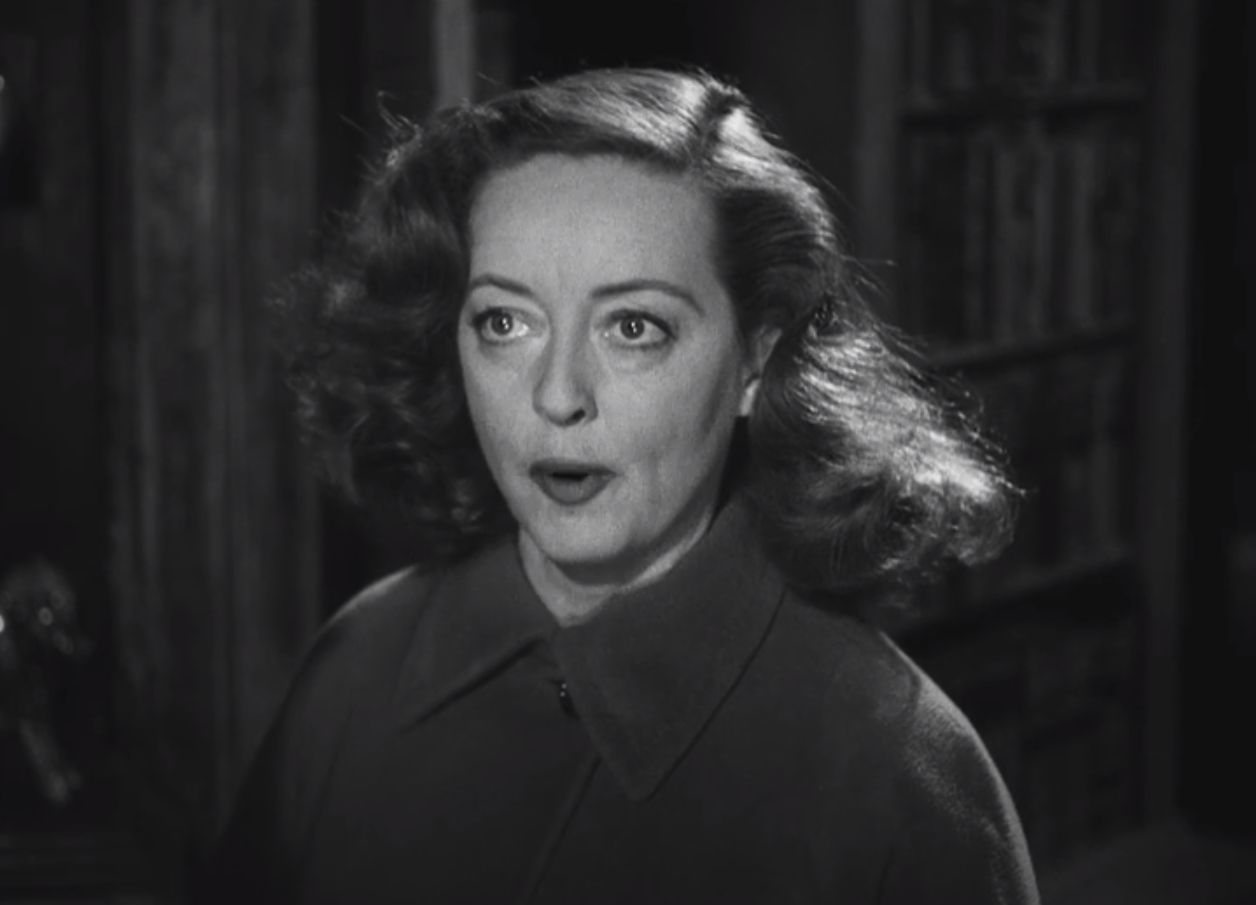
Bette Davis
ANOTHER MAN'S POISON (1951). Director: Irving Rapper.

Janet (Bette Davis) is a well-known English author of mysteries who finds herself with an unwelcome guest at her country estate. George Bates (Gary Merrill of Mysterious Island) tells her that he and her husband pulled off a bank robbery during which a guard was shot. George wants to see hubby immediately -- but there's a problem: he's lying dead, murdered, in the study. George helps Janet get rid of the body but he decides to impersonate her husband for both of their sakes, a decision that leaves Janet most uncomfortable. For one thing Janet is madly in love -- or lust -- with Larry (Anthony Steel), the very handsome fiance of her secretary, Chris (Barbara Murray of Operation Bullshine). And then there's the nosy next-door veterinarian, Dr. Henderson (Emlyn Williams), who is simply asking way too many questions ...

"You Killed Fury!?
Bette Davis -- although she finally has a chance to do a full-on British accent after doing a half-assed one for most of her life -- is not the best casting choice for Another Man's Poison. Fortunately, towards the end of the movie she is afforded some chances for her intense and formidable acting pyrotechnics when she learns that her beloved horse, Fury, is dead.  "You killed Fury!" she screeches at George before launching into a great speech in which she fervently expresses that the horse meant much more to her than any human being possibly could. I suppose she can't be faulted for being stagy when the movie is based on a stage play, even if there are attempts to open it up and get her away from the basic house set. But for much of the movie's length Davis seems to be doing an impression of a drag queen doing an impression of Bette Davis!

Gary Merrill
But Davis is magnificent compared to her then-husband Gary Merrill. Merrill had certainly given some fine performances in other movies, but in Another Man's Poison he seems like a college student merely reciting lines with little emotion or nuance and hoping that he's making a decent impression. True, his character is never well-delineated, which gives him a handicap right from the start, but even so he is utterly mediocre. The only problem with Emlyn Williams is that his character, the Nosy Parker who lives down the road, is so irritating. It's also hard to believe that George would even humor the man. He'd be more likely to tell him to screw off.

Anthony Steel
Barbara Murray gives a pleasant enough performance as the secretary who fears that she just can't compete with her boss, who has decided that she wants her Larry and that's that. As Larry, the very handsome Anthony Steel provides hunk appeal, but his acting is nothing to rave about. As with Merrill, his character is very under-written. In any case, his on-again/off-again dalliances with his fiancee's employer make Larry seem like a sleazeball. Reginald Beckwith and Edna Morris are notable in smaller roles as a villager who pursues George for an appearance with a local club, and the family housekeeper. Another Man's Poison is modestly entertaining, but despite a somewhat ironic and amusing (if not unexpected) wind-up, it's too contrived and even silly to be that memorable. Anthony Steel was one of the husbands of Anita Ekberg. Irving Rapper also directed Davis in two much more memorable movies, Now, Voyager and Deception.

Verdict: Latter-day Davis in a mediocre vehicle that is not without some points of interest. **3/4. 

Thursday, July 3, 2014

WHERE THE SIDEWALK ENDS

Dana Andrews confronts Gary Merrill
WHERE THE SIDEWALK ENDS (1950). Producer/director: Otto Preminger.

Detective Mark Dixon (Dana Andrews) is a tough cop who has been warned once too often to use less force when "interviewing" suspects, but he goes too far and inadvertently kills a war hero with a plate in his head (Craig Stevens of Peter Gunn), then covers it up. As part of his investigation he meets the dead man's estranged wife, Morgan (Gene Tierney), whose father (Tom Tully) is arrested for the crime. Mark's guilt increases as he and the lovely Morgan are drawn to one another, and she worries terribly about a man whom Mark knows is innocent. Will he do the right thing? Where the Sidewalk Ends reunites the director and leads of Laura and is good enough that you don't even miss Clifton Webb. Andrews, Tierney, Gary Merrill (as a crook Mark has been trying to ensnare), and even Craig Stevens all give adept performances, and there is good support from Tully, Karl Malden and Bert Freed as cops, Eda Reiss Merin as Freed's wife, and Ruth Donnelly as a restaurant owner and friend of Mark's. More proof that Dana Andrews was an under-rated actor.

Verdict: Smooth romance-suspenser with some fine performances. ***.

Thursday, May 30, 2013

MYSTERIOUS ISLAND (1961)

The shipwrecked soldiers vs bad-tempered giant crab
MYSTERIOUS ISLAND (1961). Director: Cy Endfield.

Jules Verne's Mysterious Island, which was inspired by Robinson Crusoe, was first filmed as a silent in 1929, turned into one of the worst movie serials ever in 1951, and finally became a worthwhile motion picture vehicle ten years later. During the siege of Richmond in 1865, several union soldiers, a war correspondent, a freed slave, Neb, (along with one rebel soldier) escape from prison in a balloon and wind up on an isolated island miles from anywhere. The film makes two major additions to Verne's story: two shipwrecked women appear on the island; and there are also giant monsters for FX stop-motion master Ray Harryhausen to play around with. [Harryhausen claimed the story would not be entertaining without them, but this is nonsense -- actually without the monsters Harryhausen would have had little to do.] Originally the monsters were supposed to be prehistoric creatures, but it was decided to make them products of growth experiments conducted by Captain Nemo (Herbert Lom), who has taken refuge in his submarine Nautilus in an underground grotto. British actor Michael Craig may seem an odd choice to play Union soldier Captain Harding, but he does a convincing American accent and is quite good and authoritative, although he seems completely different from the star of Doctor in Love, which he did the previous year. Gary Merrill gives one of his best performances as the reporter Spilitt, and Michael Callan is also notable in his turn as the boyish and frightened but ultimately courageous young Herbert. Joan Greenwood gives her usual affected performance as Lady Fairchild [she thickly stretches out her words to a comical degree], and Beth Rogan is at least decorative as her niece. Percy Herbert and Dan Jackson as the reb and Neb round out the cast and are fine.

But the two greatest contributions are made by composer Bernard Herrmann and Ray Harryhausen. Herrmann's score is excellent, beginning with the rousing opening theme and including the quirkier music for the attack by the giant. funny-looking bird. You might quibble with the quality of some of the process shots, but Harryhausen's animation is excellent. In addition to the big bird, we've got that wonderful giant crab, huge, buzzing bees, and -- perhaps best of all -- that baleful squid who attacks the men in the climax after fixing them with its giant, evil eye. Wilkie Cooper's cinematography employs highly attractive lighting schemes. Director Endfield [Sands of the Kalahari] keeps things moving at a good pace. The underwater sequences are very well-done and we're even treated to shots of the sunken city of Atlantis.

I've always wondered why this film isn't as well-known or well-received [although it was quite successful] as Disney's adaptation of 20,000 Leagues Under the Sea. For my money Mysterious Island is a much better picture, and the squid in the former can't compare to Harryhausen's impressive, slithering creation.

Verdict: Exciting and colorful with wonderful effects. ***1/2.

Monday, August 25, 2008

WITNESS TO MURDER

WITNESS TO MURDER (1954). Director: Roy Rowland.

Cheryl Draper (Barbara Stanwyck) sees Albert Richter (George Sanders) murder an unknown woman from a window in her apartment. Unfortunately Lt. Mathews (Gary Merrill) -- one of the dumbest police officers in Los Angeles -- is unable to find any evidence of a crime. He thinks Cheryl sent threatening notes to Richter simply because they were typed on her typewriter -- duh! Eventually Cheryl winds up in the psychiatric ward while it takes forever for Mathews to find out if Richter was in any way associated with a young woman whose dead body turned up in Griffin Park. Although this movie becomes increasingly silly and unconvincing as it proceeds, it does hold the attention and both Stanwyck and especially Sanders give top-notch performances. Although the finale on a high-rise construction site stretches credulity -- couldn't Cheryl have gone somewhere else to elude Richter? -- it does make for an effective and exciting climax.

Verdict: Leave it to Babs and George. **1/2.

Saturday, December 29, 2007

PHONE CALL FROM A STRANGER


PHONE CALL FROM A STRANGER (1952). Directed by Jean Negulesco. NOTE: This review includes important plot details so you may want to wait until after you've seen the movie to read it.

Now this is an odd one. The premise is workable: A lawyer (Gary Merrill) becomes friends with three other passengers on a plane that crashes. These three people are among the victims, and Merrill pays a call on their relatives and helps them resolve some conflicts. Nunnally Johnson's script -- which goes all over the lot -- may have looked good on paper, but the finished product is a mite ungainly and decidedly uneven. Some of the flashbacks to the earlier lives of the passengers occur after they've been killed, and some of these run on and on and on. There's something disjointed about the entire movie. The shame of it is that there are lovely and trenchant moments in the film, parts of which are quite moving. Merrill is workmanlike, stoic, but generally effective in a modest sense, low-key but much too inexpressive. Shelley Winters scores as a failed show biz hopeful who's winging her way back to hubby, who -- unbeknownst to her -- has filed for divorce. Michael Rennie offers one of his better performances as an alcoholic doctor who has decided to fess up about his role in a deadly drunk driving accident five years earlier. Keenan Wynn is as fine as ever as a gregarious jokester who is married to Bette Davis, who is much too artificial, perfunctory and grand lady-ish as the wife, but who has a solid moment recalling how much Wynn forgave and loved her. Evelyn Varden offers a dead-on portrait of a harridan mother-in-law to Winters, and Beatrice Straight turns in perhaps the best supporting performance as Rennie's grieving wife. Helen Westcott and Warren Stevens also do good work as, respectively, Merrill's once-unfaithful but still loving spouse, and Davis' lover, who leaves her flat after she becomes ill. Ted Donaldson is also good as Rennie's troubled son. Jean Negulesco's direction is smooth and both the drunk driving and plane crash scenes are powerful and expertly handled without being too grisly. Franz Waxman's opening theme music is also memorable. But the movie suffers from a surfeit of logic, such as Merrill getting hardly a scratch on him (comparatively) when most of his fellow passengers have been killed. The movie begins very well but wears out its welcome before too long.

Verdict: Not so great despite memorable moments. **1/2.