Lively, entertaining reviews of, and essays on, old and newer films and everything relating to them, written by professional author William Schoell.

Thursday, April 14, 2022

GREAT OLD MOVIES

Special projects have caught up with me temporarily.  GREAT OLD MOVIES will return in May 2022, if not before. 

For those who subscribe by email the posts come with the wrong, outdated email attached at the very bottom. I'm working to correct this. In the meantime you can contact me anytime at wmschoell@gmail.com. 

Thanks!

William Schoell

Thursday, March 31, 2022

A FUNNY THING HAPPENED ON THE WAY TO THE FORUM

Zero Mostel and Jack Gilford
A FUNNY THING HAPPENED ON THE WAY TO THE FORUM (1966). Director: Richard Lester. Music and lyrics by Stephen Sondheim. 

The slave Pseudolus (Zero Mostel) is hoping to acquire his freedom and comes up with a plan. His master's son, Hero (Michael Crawford), has fallen for a virginal courtesan, Philia (Annette Andre), just installed in Marcus Lycus' (Phil Silvers) brothel next door, and Hero will free Pseudolus if he arranges a relationship between the two. The problem is that Philia has already been bought by the egomaniacal Captain Milos Gloriosus (Leon Greene), who is on his way from Rome that very afternoon to claim his bride. Pseudolus schemes to get Philia away from Gloriosus even as his master Senex (Michael Hordern of Theater of Blood) schemes to get away from his termagant of a wife, Domina (Patricia Jessel).  


The first half hour or so of this adaptation of the Broadway musical A Funny Thing Happened on the Way to the Forum is delightful -- although it takes too long for someone to finally sing a song -- with Mostel fully in charge of his material along with Silvers, Jack Gilford as Hysterium, Hordern and Jessel, and especially Greene as the captain. But after awhile this farce just becomes a bit labored, and the film completely falls apart with a tasteless scene in the arena and especially a drawn-out slapstick sequence that falls completely flat. Others have noted that the film has a typically sixties attitude towards women: they are either young beauties lusted after by ugly old men or old hags unworthy of consideration. One could also argue that anything having to do with roman slavery is not exactly a great subject for the comedic treatment to begin with. I think the main problem is that this is the type of material that works much, much better on the stage. However, the producers wisely kept on Mostel and Gilford from the Broadway production. Unwisely, because they thought big movie musicals were on their way out, they cut most of Stephen Sondheim's tuneful score. What remains is the lovely "Lovely," sung by Philia; the captain's song as he comes into town and the dirge he sings later on; the spritely "Everybody Ought to Have a Maid;" and the infectious opening number "Comedy Tonight."

Leon Greene and Zero Mostel
As the young lovers Michael Crawford (who would find fame on Broadway as The Phantom of the Opera) and Annette Andre fail to make much of an impression. British actor Leon Greene, however, makes quite an impression and went on to have many more credits, mostly in the UK. Buster Keaton [Backstage], in his last role as a man looking for his kidnapped children, is, unfortunately, not good at all. 

Verdict: Some fun to be sure, but it just becomes too silly. **1/2. 

A WOMAN SCORNED: THE BETTY BRODERICK STORY

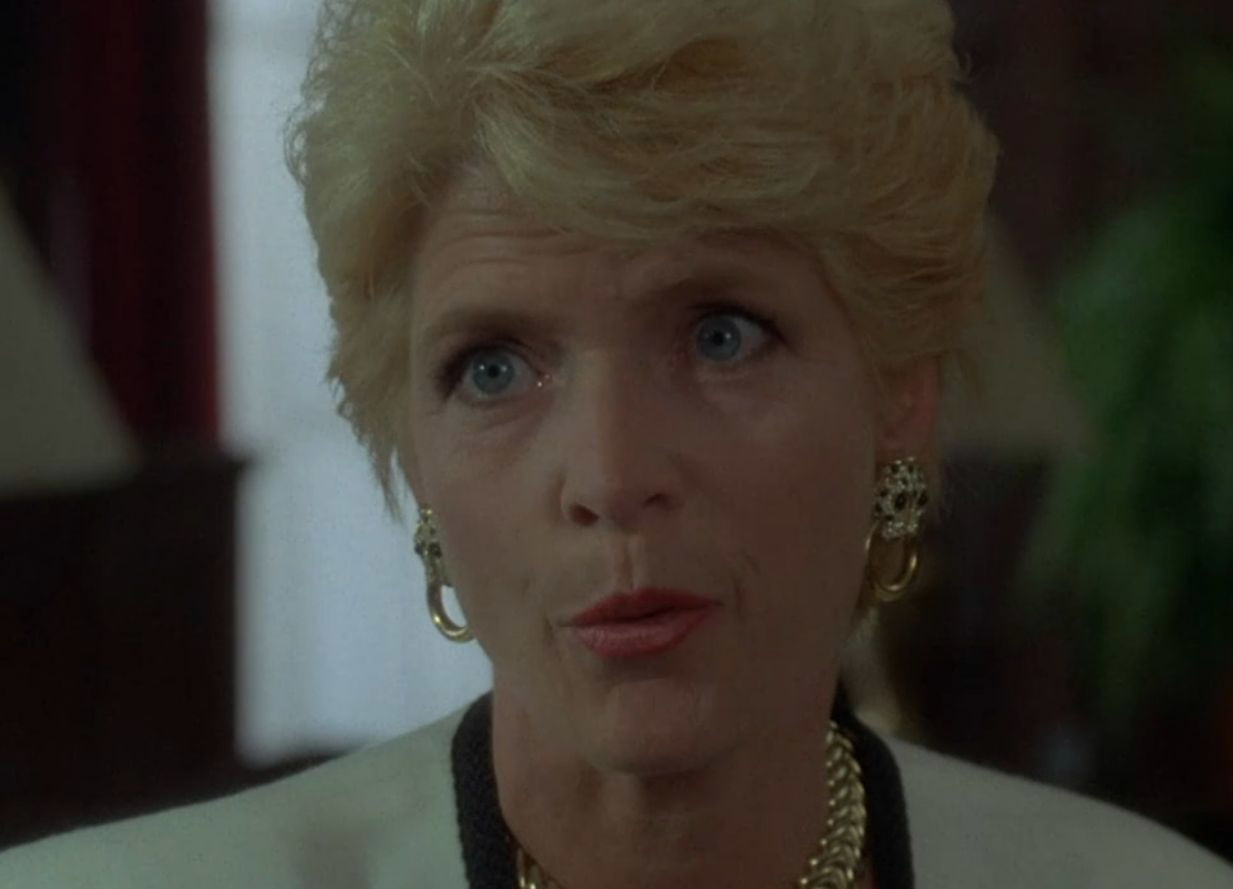
Meredith Baxter
A WOMAN SCORNED: THE BETTY BRODERICK STORY (1992 telefilm). Director: Dick Lowry. 

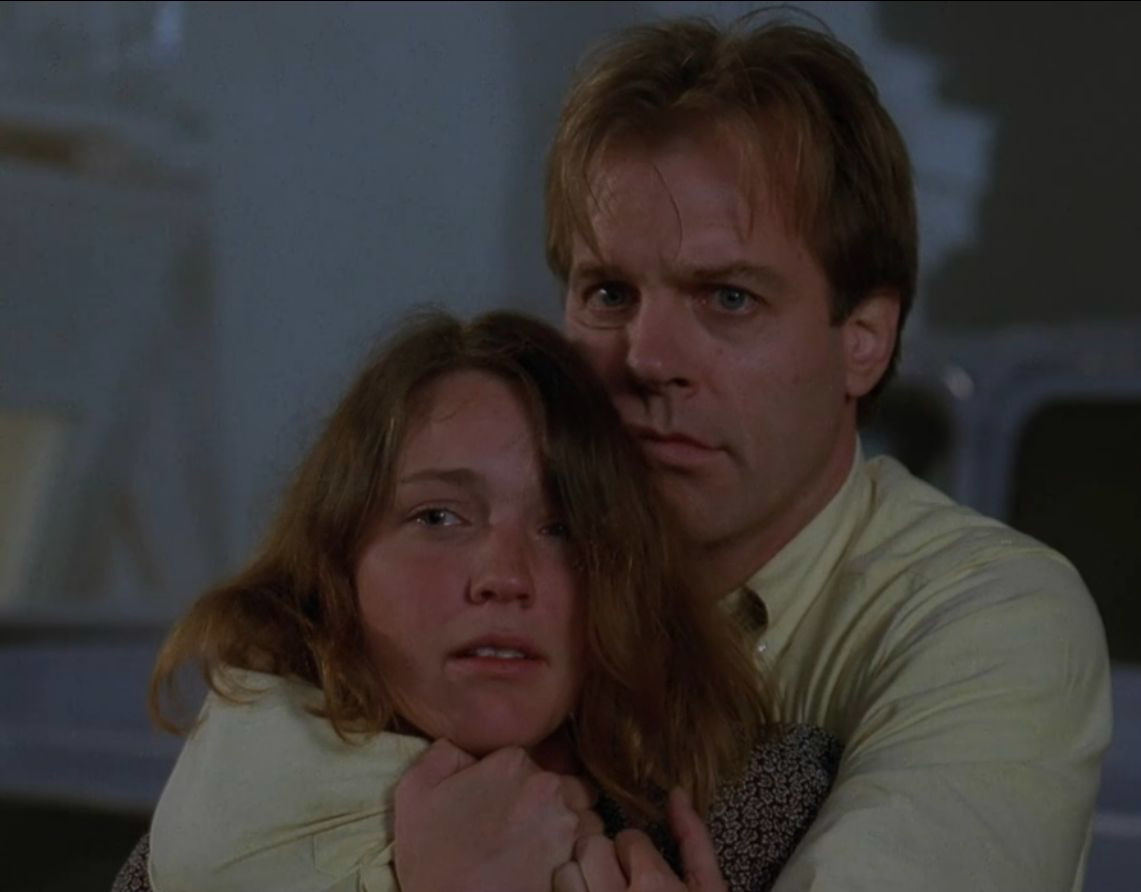
Betty Broderick (Meredith Baxter of The Cat Creature) has been nagging her successful husband, Dan (Stephen Collins) about a divorce for years, but when he finally gives up, moves out, and files papers, she is absolutely livid. Betty mounts a campaign of terror against the man that spares no one, including her own children. She goes so far as to call her little boy a "little traitor" because he wants her to stop carrying on the way she does, which includes driving her car into her now ex-husband's house when her children are inside! Later claiming that she was "driven to it," Betty goes to his home (supposedly wanting to "talk" late in the evening), climbs the stairs to the bedroom, and shoots both him and his new wife (Michelle Johnson) dead.

Kelli Williams and Stephen Collins
A Woman Scorned
 makes very clear that -- although some stupid people made Broderick a cause celdebre, seeing her as a symbol of middle-aged women dumped by husbands for younger models, an over-simplification to say the least -- Broderick was, as one psychologist calls her, an extreme "narcissist" who had no problem using her own children as pawns in a war with her ex. Ignoring restraining orders, acting like a loon, alienating friends and family -- even though she could have started over again with her new boyfriend -- she was her own worst enemy. In an Emmy-nominated performance, Meredith Baxter brings the woman vividly to life, never chewing the scenery, always making it clear what makes this woman tick. Baxter is excellent casting, showing the dark side of the sitcom mom she had previously played. Stephen Collins and Kelli Williams are also perfection as Dan Broderick and his oldest daughter, one of four children caught in the middle of this mess, and there are a host of solid supporting performances as well. Followed by Her Final Fury. Dick Lowry also directed The Jayne Mansfield Story and many others. 

NOTE: In 2014 Stephen Collins admitted to People magazine that he had "inappropriate sexual contact with three female minors." The statute of limitations prevented him from being arrested. 

Verdict: Well played and suspenseful, this is one high-class telefilm. ***. 

HER FINAL FURY: BETTY BRODERICK, THE LAST CHAPTER

Betty on trial: Meredith Baxter
HER FINAL FURY: BETTY BRODERICK, THE LAST CHAPTER (1992 telefilm). Director: Dick Lowry. 

After shooting her ex-husband and his new wife dead in their own bedroom, Betty Broderick (Meredith Baxter) goes on trial for double homicide. Betty has gotten a surprising amount of support, primarily because she paints herself as the stereotypical "discarded" wife, and her ex-husband as an abuser, even though the prosecution finds no evidence of this. DA Kerry Wells (Judith Ivey) is reluctant to put Betty's little boys on the stand, although they have important information to relate, because she fears further traumatizing them, but her eldest daughter, Kate (Kelli Williams of The Practice), willingly becomes a prosecution witness, incurring her mother's eternal enmity. 

Judith Ivey versus Meredith Baxter in court
Her Final Fury
 boasts another fine performance from Meredith Baxter as the narcissistic sociopath Betty Broderick. Judith Ivey also offers her customary excellent work, as does Kelli Williams as the conflicted daughter, who loved her father. Watching the proceedings, it is clear Broderick hated her husband less because of the divorce, than because he walked out on her, before she could do the same, and because she didn't get enough money despite his more than generous alimony payments. While we generally think it's men who shout "no one walks out on me!" and "If I can't have you, no one can!" women are perfectly capable of having the same mind set. The first trial ended in a hung jury (because of two dumb hold outs), but Betty was convicted in the second trial. 

Betty Broderick was denied parole in 2010 and on subsequent occasions because she showed no remorse and refused to admit she did anything wrong. (Let's make no mistake -- even if her husband had been the monster she portrayed him as, murder is never an option, and it only made things worse for everyone, especially her children.) Her next parole hearing isn't until 2032 when she will be 84. Interestingly enough, her two older children think she should stay in prison, while the two younger children want her to get out.

Verdict: Well-acted and absorbing follow up to A Woman Scorned. ***. 

POSTHUMOUS

POSTHUMOUS

My latest thriller, for people who love movies, celebrities, psychos, and suspense fiction, is entitled POSTHUMOUS. Below is a description. It's available in hardcover, trade paperback, and inexpensive kindle editions on amazon.

"Anna Corrigan, the daughter of the late movie star and entertainer Mavis Edwards, has spent years trying to deal with the emotional fall out from the decades she spent with her often difficult and neurotic mother. Anna attends her sister Estelle's singing showcase at a tiny supper club uptown, where she encounters some of her mother's "friends" from the past. These include a crooked business manager named Louie Mayhew; her old co-star Jerry Giddings, who has fallen on hard times; her bitchy rival Marjorie Easterbrook; choreographer “Busy” Borroway, an unrepentant child molester who numbered Mavis Edwards among his victims; and George Kelker, a director who refused to hire Mavis Edwards for an important production many years before. George is only the first of these individuals to be horribly murdered by a crazed female intruder who, Kelker's wife insists, looks just like Mavis Edwards! There had always been nutty stories in the tabloids about Mavis Edwards being alive and hidden in a sanitarium and with all these reports of a crazy lady who resembles her beginning to surface, Anna wonders if it could possibly be true. But as the murders continue and Anna finds her life unraveling, she learns that the truth is far more terrible than she could ever even imagine."

"POSTHUMOUS is a movie lover's thriller, dissecting one impossible star's neurotic behavior and the effect it has even years later on her children."

Is "Mavis Edwards" meant to be Bette Davis, Joan Crawford, Judy Garland, or someone else? Read the book to find out!  

CHINA MOON

Madeleine Stowe and Ed Harris 
CHINA MOON (1994). Director: John Bailey. 

Kyle Bodine (Ed Harris of National Treasure: Book of Secrets) is a detective working with a younger partner, Lamar (Benicio Del Toro of The Wolfman), and sort of showing him the ropes. Kyle meets an attractive woman named Rachel (Madeleine Stowe of Blink) and is at first unaware that she's married to an abusive and controlling husband, Rupert (Charles Dance of Alien 3). Kyle and Rachel begin a relationship, but there's a serious speedbump when Rupert winds up dead. Kyle risks his career by going to bat for Rachel without disclosing the affair to his superiors, but he doesn't realize that he is being seriously played by someone close to him.

Harris, Charles Dance, Del Toro
It's a wonder that China Moon ever got made. Its plot is over-familiar and whatever surprises it contains are not that jolting. The characters are one-dimensional, and the dialogue is flat. Although Charles Dance and Benicio Del Toro give effective and committed performances, I'm not certain what to make of the leads. I can be polite and say that Harris underplays, or was simply uninspired by the script -- no wonder -- but he's mediocre, as is Stowe. I'm not surprised that Stowe never had a major theatrical career as her presence is strictly small-scale, and works much better on television (in the TV series Revenge, for instance). If you're going to play a femme fatale, then play it for all it's worth, but Stowe never pulls out the stops. Her too-deep, unfeminine voice is no asset, either, although some people might have found it sexy. 

Verdict: Some films should never get beyond script stage. *1/2.  

Thursday, March 17, 2022

IN NAME ONLY

Grant, Lombard and Francis
IN NAME ONLY
(1939). Director: John Cromwell. 

Alec Walker (Cary Grant) is trapped in a loveless marriage with his wife Maida (Kay Francis), who freely admits she was in love with another man at the time of their wedding and only married Alec for his money. Alec meets a free-spirited widow, Julie Eden (Carole Lombard) with a small girl, and he and Julie, instantly smitten, fall in love. But will Maida graciously step aside -- or cause them all manner of trouble? What do you think? The stars are all in top form in this -- it's one of Francis' best performances -- and the picture is warm, humorous, dramatic, and absorbing, the only deficit a climactic bout with pneumonia that's a bit of a bore. Otherwise, this is very entertaining. Supporting players include Helen Vinson as the bitchy, man-hungry Suzanne, supposedly Maida's best friend; Katharine Alexander as Laura, Julie's bitter sister; and Charles Coburn as Grant's father, who doesn't have nearly enough to do. Grant and Lombard are really terrific in this. A lost film from that great year for movies, 1939. 
 
Verdict: Kay, Carole and Cary make this a winner! ***1/2.

JUST A GIGOLO

William Haines and Irene Purcell
JUST A GIGOLO (1931). Director: Jack Conway. 

Lord Robert Brummel (William Haines) finds lots of female companionship with married women who have no problem cheating on their husbands. His Uncle George (C. Aubrey Smith) thinks his nephew is an overspending mountebank who doesn't know the value of a dollar. For some reason George thinks a match between Bob and equally upper-crust Roxana Hartley (Irene Purcell) would make the perfect union. But before he consents, Robert wants to make sure that Roxana isn't like (to his eye) most other women, and tests her by pretending to be a paid dancer and gigolo. 

C. Aubrey Smith and Haines
Just a Gigolo is a mildly amusing comedy that boasts a winning performance by the likable Haines, and an especially notable turn from the equally charming C. Aubrey Smith. Although a trifle off-putting at first, Irene Purcell proves an attractive and capable leading lady. This was her first full-length film and she only appeared in five more. (Ironically, Haines only had five more films to go before his movie career was over.) An interesting aspect of the film is the fury felt by Roxana when she learns of Bob's deception, his gall at testing her morals when he himself is hardly above reproach. The movie gets across the unjustness of the double standard without hitting you over the head with it. Although released in 1931, Just a Gigolo isn't creaky and moves at a fairly fast pace. Charlotte Granville is fun as Roxana's mother, and although Ray Milland is listed in the cast, if you blink you will certainly miss him. 

Verdict: A good chance to see Haines, once a top box office attraction, in a sound film. **1/2.

WHAT EVER HAPPENED TO ORSON WELLES? Joseph McBride

WHAT EVER HAPPENED TO ORSON WELLES? A Portrait of an Independent Career. Joseph McBride. University Press of Kentucky. 

What Ever Happened to Orson Welles? is not a biography of the famous actor and director, but rather a study of his career and an attempt to correct misconceptions about the man that have proliferated both before and after his death. McBride is often successful at this, and sometimes not, and the book -- while well-written and well-researched -- occasionally has a petulant "fan-boy" tone to it. Film buff McBride became acquainted with Welles and was even cast in The Other Side of the Wind as a nerdy film geek (a talented writer, the less said about his acting the better), and spoke and dealt with him on and off over the years. McBride argues against some of the assertions made against Welles, but at other times makes clear that these assertions are often true. Welles clearly was a narcissist, and clearly expected those under his spell to do what he wanted, come hell or highwater. However, McBride argues that Welles was not some corpulent figure of fun but an artist who not only made some successful and brilliant films, but, like a true artist, kept on working right up to the very last minute of his life. McBride dissects many of Welles's lesser-known film projects, and does make it clear that Welles's career did not begin and end with Citizen Kane. One suspects he's just too close to The Other Side of the Wind to see how really bad it is. To his credit, McBride doesn't shy away from examining Welles's flaws, and even goes into the man's ambivalent feelings about his sexuality. 

Verdict: Whatever you think of Welles, this is an interesting and thought-provoking read. ***. 

THE BLACK ROOM

THE BLACK ROOM
(1935). Director: Roy William Neill.

A dire prophecy hangs over a feudal kingdom: the younger brother will murder the older in the infamous "black room" of the castle. To prevent this from occurring, the black room is sealed up, but the evil twin Gregor finds another way in. When the good twin Anton - both are played by Boris Karloff -- returns to the kingdom he learns that Gregor is suspected of doing away with several women who have completely disappeared. Although the movie doesn't make nearly enough of its horrific sequences, this is a very interesting macabre thriller with Karloff in top form -- both of him! Marian Marsh is lovely as the pretty Thea, who ignites romantic interest in the twins and others, but Robert Allen is pretty bad as her heroic lover, Lt. Lussan. Thor the dog gets high marks for his spirited performance as a hound who harasses Gregor.

Verdict: 2 Karloffs for the price of one! ***.

Thursday, March 3, 2022

THE OTHER SIDE OF THE WIND

John Huston as Jake Hannaford
THE OTHER SIDE OF THE WIND (Released 2018). Filmed from 1970 - 1976. Director: Orson Welles.

"He's so crooked he has rubber pockets so he can steal soup!"

"I'm bored with the whole story."

Director Jake Hannaford (John Huston) is celebrating his 70th birthday with a large assemblage of friends, enemies, and sycophants, while bemoaning the fact that he apparently can't complete his latest movie because his leading man, John Dale (Robert Random), has run off, not to mention the usual financial difficulties. Attending his party are such people as director-acolyte Brooks Otterlake (Peter Bogdanovich); critic Julie Rich (Susan Strasberg), who asks too many questions; associate Billy Boyle (Norman Foster); cynical actress Zarah Valeski (Lilli Palmer); and other characters played by Edmund O'Brien, Cameron Mitchell, Mercedes McCambridge, Paul Stewart, Gregory Sierra, Dan Tobin, John Carroll, and others. Interspersed with scenes from the party are sections of the uncompleted film-within-a film being made by Hannaford. 

Peter Bogdanovich
As revealed in the excellent book Orson Welles's Last Movie: The Making of 'The Other Side of the Wind' by Josh Karp, Welles took years to shoot this film outside the studio system and never did complete it. After years of legal entanglements it was eventually finished by others supposedly working from Welles' notes, and then released by Netflix. Some of the material seems to have been watered down from the original intentions for one reason or another, as you only know certain things are going on because you've read about the movie in Karp's book or elsewhere. 

Robert Random and Oja Kodar
The big problem with The Other Side of the Wind is that it has no plot, no decent script, only a premise that is never developed. The party scenes are shot with hand-held cameras that give the movie a very cheap cinema verite feel but also distance the viewer from what's going on on screen. The clips from Hannaford's movie are shot in color and widescreen and these sequences are a bit more striking -- a would-be sex scene in a car between the character played by Dale and the character played by Welles' real-life mistress (and co-screenwriter) Oja Kodar, for instance, and a sequence where Kodar walks about nude in the desert -- with a very hokey phallic symbol in evidence. (Kodar does have a nice body but that's about all you can say about her acting and writing abilities.) One doesn't know who contributed the film's rare moments of quality dialogue, but we can guess. 

Hannaford celebrates his birthday with a cake
We've been told by Welles' chroniclers that in this film Hannaford is a macho closet case who seduces his leading ladies (or the wives of his leading men) when he really wants to bed the leading men, and that he is obsessed with his current (or vanished) star John Dale. The evidence for this consists only of Hannaford keeping many life-size dummies of Dale around his residence, and some remarks made by Strasberg near the end of the film that don't cut quite close enough to make all of this a certainty. ("Have a go at the dummy, Jake," McCambridge says when someone starts shooting at them, "they bleed even more easily than people.") If Welles had finished his film, everything might have been made more explicit or at least more comprehensible, but I'm not sure that it would have made an especially good movie in any case, and the sexually-conflicted Welles, who had some old-fashioned ideas about homosexuality, probably wasn't the best person for this project in the first place. One of the longest scenes has to do with Jake going on about "faggots" to an English professor (Dan Tobin, who is excellent) who once had Dale in his class.

Lilli Palmer
John Huston might seem like perfect casting for Jake Hannaford but he only hits the mark in a couple of scenes, and is not that effective throughout most of the movie. Bogdanovich, although a trifle amateurish at times, suggests that he might have had a major career as an actor had he chosen that route instead of directing (of course he did amass 57 acting credits!!). Strasberg is a cast stand-out, and there are nice vignettes from Palmer, O'Brian, Sierra, Stewart, McCambridge, Mitchell, and others. The Other Side of the Wind truly shows desperation when Welles calls in a bunch of midgets to cause mischief, and although, as mentioned, there is some good dialogue lost in the mess, the movie is more often than not simply pretentious. The film is so briskly edited that you aren't bored, at least until it becomes painfully apparent that there isn't any real storyline. Michel Legrand's nice score does its best to smooth over the rough edges but it's a losing battle. 

Verdict: What a shame! An Orson Welles Home Movie. **. 

THE CABINET OF CALIGARI

Constance Ford, Daniel O'Herlihy, Glynis Johns
THE CABINET OF CALIGARI (1962). Director: Roger Kay. 

When her car breaks down, Jane Lindstrom (Glynis Johns of The Vault of Horror) seeks shelter at a sanitarium run by Dr. Caligari (Daniel O'Herlihy of Invasion U.S.A.). But her gratitude turns to fear and outrage when she discovers that there's no apparent way out of the establishment and she is being kept prisoner. The other "guests" don't seem to be much help: old Ruth (Estelle Winwood); romantic young Mark (Richard Davalos); friendly Vivian (Doreen Lang of The Wrong Man); firm and deceptively helpful Christine (Constance Ford); and others. When Jane sees Ruth being assaulted by one of the other patients as the others calmly watch, she determines to find her way out of this nuthouse no matter what she might have to do ... 
 

Johns is "helped" by Constance Ford
Robert Bloch wrote the screenplay for this mess, and it's proof that the man could turn out solid scripts as well as ones that should never see the light of day. This is one of three theatrical films for director Roger Kay, who mostly toiled in television, and he's unable to do much with this terrible story. Heroine Glynis Johns, with her squeaky voice and munchkin-like appearance, seems all wrong for this kind of movie, although one could argue that she is the ultimate masochist. Johns gives a good and committed performance, however, although there must have been times when she and the other actors wished they'd chosen a better project. Daniel O'Herlihy is effective in a supposedly dual role, and the others named are all better than the picture deserves. This is a remake of the silent classic The Cabinet of Dr. Caligari in name only, although some shots try to ape the expressionistic sets of the original. There is  an explanation for the strange goings-on, but the movie is so utterly tedious that you probably won't want to wait until the ending to find out. There are some interesting touches -- Caligari has a revolving door into his office, and there's a glass panel above Johns' bathtub into which people can peek as she bathes -- but they aren't enough to save this from the scrapheap.

Verdict: A waste of talent and celluloid. *1/2. 

ONE OF MY WIVES IS MISSING

James Franciscus and Jack Klugman
ONE OF MY WIVES IS MISSING  (1976 telefilm). Director: Glenn Jordan.

Daniel Corban (James Franciscus) is on his honeymoon in a small town when he tells Inspector Levine (Jack Klugman) that his wife walked out after a minor argument and hasn't been seen since. The laid-back Levine tries to be sympathetic but doesn't think there's much to worry about, especially when Mrs. Corban (Elizabeth Ashley) walks in and announces that she's back. The only problem is that Corban insists that he has never seen this woman before and that she is not Elizabeth Corban! Although Corban thinks of every way he can to convince the inspector that he's telling the truth, his "wife" counters his every move, and the situation truly begins to look desperate ... 

Elizabeth Ashley
Three good lead performances are at the heart of One of My Wives, a twisty tale that has been told before and afterwards. Anne Baxter was the harried honeymooner in Chase a Crooked Shadow (1958), then Janet Leigh in Honeymoon with a Stranger (1969). In 1986 came yet another telefilm, Vanishing Act, which starred Elliot Gould as the honeymooning husband. These were all official or uncredited versions of Robert Thomas' stage play "Trap for a Single Man." Like other versions, One of My Wives is suspenseful and intriguing, bolstered by Klugman's pleasant cop, Ashley's increasingly sinister and witchy portrayal, and Franciscus' credibly mounting fear, confusion and alarm. There is also good work from Joel Fabiani as a priest, Milton Selzer as a grocer, and the ever-lovable Ruth McDevitt as a neighbor. 

Verdict: Good version of this oft-told tale. ***. 

FOR THE DEFENSE

William Powell and Kay Francis
FOR THE DEFENSE (1930). Director: John Cronwell. 

Bill Foster (William Powell of The Thin Man) is a famous defense attorney known for his flamboyancy and for tricks that keep his clients from going to jail. His main squeeze is Irene Manners (Kay Francis of Give Me Your Heart), who is loyal to him but discovers that he has no intention of marrying her -- for him things are perfect as they are. Irene goes out for a drive with love-smitten Jack De Foe (Scott Kolk), who proposes to her just before she accidentally runs over and kills a man in the road (we never learn a damned thing about this unfortunate fellow). Jack doesn't want to get Irene involved so he lets her run off while he takes the rap, which is exacerbated by the fact that he was drinking. Irene importunes Bill to take Jack's case and keep him from going to jail for manslaughter, but the lawyer suspects that there's more to the story -- and more to Irene's relationship with Jack. 

Scott Kolk with Powell
At a mere 63 minutes, For the Defense moves at a brisk pace and wastes precious little time in true character development, although the actors, especially an excellent Powell, do much to bring these rather stock characters to life. There's a funny/scary bit in an early courtroom scene when Powell decides to test a piece of evidence, a bottle supposedly filled with nitroglycerine, by dashing it to the floor, giving everyone in the room conniption fits! With a far less dynamic role, Francis can do little to steal scenes from Powell, but she is quietly effective as a woman who loves not wisely but well; Kolk is also effective. The movie with its interesting situations is entertaining despite the contrived script. Poor Francis is decked out in a series of hats that remind one of a classic I Love Lucy episode when the boys give the gals some phony French fashions! John Cromwell would go on to direct much better pictures including Caged. Two years later Powell and Francis reteamed for Jewel Robbery

Verdict: Powell is always exciting to watch. **3/4. 

Thursday, February 17, 2022

SHANKS

Marvel Marceau and Marcel Marceau
SHANKS (1974). Directed by William Castle. Subtitle: William Castle Presents a Grimm Fairy Tale.

Deafmute Malcolm Shanks (Marcel Marceau) makes puppets and lives with his shrewish stepsister (Tsilla Chelton) and her husband Mr. Barton (Philippe Clay) in their home, where they berate and abuse him on a regular basis. One day Malcolm goes to work for the elderly Professor Walker (also Marceau) who shows him how he uses special technology, like magic, to reanimate the corpses of frogs and roosters. When the professor dies, Malcolm decides to reanimate him, but there is just a walking physical shell, no mind. Later on Malcolm turns his deceased sister and brother-in-law into "living" corpses to do his bidding, a situation that both fascinates and repels the young Celia (Cindy Eilbacher). Into the professor's mansion, where Malcolm has taken up residence, come a group of hard core and thuggish bikers who try to take the "living dead" technology away from Malcolm.

Chelton, Marceau and Clay
Shanks
 is William Castle's most original and possibly most interesting picture -- it was also the last film he directed (he also served as executive producer). Using occasional title cards like a silent film and a spirited, quirky score by Alex North [The 13th Letter], the movie proceeds, as it should, like a dream or nightmare. Because of this approach viewers might not look too closely at the rather ghoulish actions of the protagonist, well-acted by Marceau, who is sympathetic despite the fact that he turns corpses into large performing dolls. Marceau only speaks when he plays the professor. The other performances are excellent as well, although the casting of sixteen-year-old Eilbacher, who looks even younger, adds a bit of a creep factor as she sort of becomes the love interest for 51-year-old Marceau and comes to a highly unpleasant fate as well. This reminds me of the kind of films Tim Burton makes, with their weird subject matter and lapses in good taste, and I would not be surprised if that filmmaker was influenced by Castle's work in general and this film in particular. Photographed by Joseph F. Biroc [Forty Guns]. Castle appears as a grocer, and there is an interesting attack-by-rooster. 

Verdict: Although Castle's direction may not be not top-notch, and criticisms of the film are not without merit -- especially the deliberate pacing --  Shanks is still an unusual and worthwhile picture, a fitting end to his directorial career. ***. 

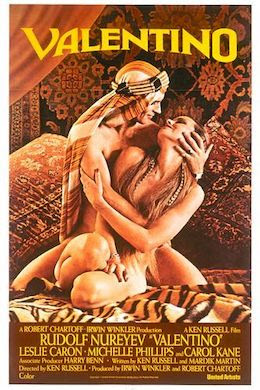
VALENTINO (1977)

VALENTINO
 (1978). Director: Ken Russell. 

Ken Russell takes the life of Rudolph Valentino (Rudolf Nureyev) and gives it the usual camp-grotesque treatment that he favors. Leslie Caron overacts (or was directed to overact) as Nazimova; Michelle Phillips (of The Mamas and the Papas) is barely adequate as Natasha Rambova. Other familiar faces in the cast are Anton Diffring as a cabaret owner; Linda Thorson ("Tara King" of TV's The Avengers) as a dance hall hostess; Huntz Hall of the Bowery Boys as Jesse Lasky; Carol Kane as an actress-friend of Fatty Arbuckle's; Seymour Cassel as an agent; John Ratzenberger of Cheers as a reporter. Russell himself plays Rex Ingram. Hall and Kane are simply mediocre. Some of the bad acting probably has to be attributed to Russell's lack of flair with actors. Nureyev, however, has charm and charisma and sometimes even hits the mark with his acting, but a different director might have brought out an even better performance. The picture really only comes alive when Rudy dances; especially good is Valentino's tango with Nijinski (Anthony Dowell) early in the picture. This is even worse than the 1951 Valentino; there is no attempt at characterization to speak of. Worse, the movie is actually quite boring. Russell wants so bad to be hip, but the dumb, homophobic humor works against it, as does just about everything else. By the way, the climactic boxing match never actually happened, which is true of most of the picture. 

Verdict: Turn it off after the tango. Another freak show from one of the worst film directors ever. *.

SOMEWHERE IN THE NIGHT

SOMEWHERE IN THE NIGHT
(1946). Director: Joseph L. Mankiewicz. Screenplay by Howard Dimsdale and Mankiewicz. 

 "Time doesn't change. it goes on and on but it doesn't change. I know because I've watched it. Nights. Days. Nights. Always the same. Nights are always gray. Days can have different colors, but the nights are dark and empty. Only people change. They grow old and ugly -- and pitiful. I've made believe so much for so long. That I was alive. That I had friends. That I wasn't dead. I wanted so much to make believe that somebody loved me." 

An amnesiac WW 2 veteran named George Taylor (John Hodiak) learns that someone named "Larry Cravat" has put $5000 for him in a bank account but can't remember why or even who the man is. So he begins a search for the elusive Cravat, encountering a pretty singer named Christy (Nancy Guild) who takes a shine to him and vice versa. During his search Taylor encounters assorted thugs, a villain named Anzelmo (Fritz Kortner) and a hard-boiled dame named Phyllis (Margo Woode). After she kisses an unresponsive Taylor, Phyllis says "I've had more fun drinking a bromo seltzer." (Sheldon Leonard has a notable turn as Phyllis' husband.) Lloyd Nolan is a police officer who's also looking for Cravat -- and George Taylor. 

John Hodiak
This interesting mystery has an intriguing plot and good dialogue, and is well-acted by Hodiak and everyone else. Woode is snappy as Phyllis, and Guild very appealing as Christy. (Guild gets to lip sync to a very nice torch song entitled "I'm in the Middle of Nowhere.") The cast stand-out, however, is Josephine Hutchinson as desperately lonely Elizabeth, who is very affecting in her brief scene wherein she speaks the dialogue quoted above. Somewhere in the Night is a snappy, absorbing picture, even if its wind-up is a little predictable and disappointing, but it has well-realized characters and memorable performances. Mankiewicz's direction is only routine for this type of material, however. This was Guild's first film; she also appeared in Abbott and Costello Meet the Invisible Man. She makes a much better impression in this film. 

Verdict: Suspenseful and different. ***.

THE WITNESS CHAIR

Walter Abel and Ann Harding
THE    WITNESS CHAIR     (1936). Director: George Nichols Jr. 

Stanley Whit-taker (Dou-glass Dumbrille) is found dead of a gunshot in his office. Although he left a suicide note admitting to embezzlement, the police determine that his death was really a homicide. Whittaker's associate, Jim Trent (Walter Abel of Fired Wife) is put on trial for the murder, but other suspects and interested parties include secretary Paula Young (Ann Harding of When Ladies Meet), bookkeeper Grace Franklin (Margaret Hamilton), office boy Benny Ryan (Billy Benedict), and even Trent's daughter, Constance (Frances Sage), who inexplicably wanted to run off with the much older and not especially attractive Whittaker. During the trial, the truth behind the murder eventually comes out. 

William "Billy" Benedict
The Witness Chair is an entertaining if very minor crime/court-room drama with generally good performances and a tidy if unspectacular screenplay. Ann Harding is as efficient as ever, even if her performance is of the long-suffering, hand-wringing variety. Back in the day, Harding was a major star -- this is a lesser vehicle for her -- but today she is known only to film buffs. Like Kay Francis and others, her films didn't show up on the late show until the days of TCM. Walter Able, a fine actor, was a leading man who later became a supporting player. The prolific Billy Benedict almost steals the film with his comic turn as the office boy, who hopes for a singing career and is annoyed that he gets such a short time in the witness chair. Margaret Hamilton is snappy as the outraged bookkeeper who insists that her boss, Whittaker, was innocent of theft. 

Verdict: Smooth easy watching if nothing to get excited about. **1/2. 

THE SHAGGY DOG (1959)

THE SHAGGY DOG (1959). Director: Charles Barton. 

Fred MacMurray's career was given a new lease on life when he signed to do this silly comedy for Disney Studios and it became a tremendous hit. Wilson Daniels (MacMurray) is a mailman who hates dogs. A magic spell turns his older son Wilby (Tommy Kirk) into a sheepdog -- or rather he takes over the body of a neighbor's sheepdog -- and he turns back at awkward moments. This charming and amusing comedy for children is a bit dragged out by a heavy-handed spy plot that develops late in the picture -- it also has a rather slow pace -- but it has enough laughs to keep you interested if you're game and MacMurray is splendid. There are also good performances from Kirk; Kevin Corcoran as his brother, Moochie; Tim Considine as his girl-crazy pal, Buzz; Jean Hagen as his mother; Cecil Kellaway as a professor; and especially that amazing dog who plays Chiffon. (Watching the animal go through its paces, you sometimes have to remind yourself that it hasn't a human brain but is just a dog.) Annette Funicello and Roberta Shore are the young ladies; Alexander Scourby is head of the spies. NOTE: To read about a fine biography of Fred MacMurray, click here

Verdict: Watch Chiffon go for a drive! ***.

Thursday, February 3, 2022

MAYERLING

Doomed lovers: Boyer and Darrieux

MAYERLING      (1936). Director: Anatole Litvak. French-language version with sub-titles.

Rudolph (Charles Boyer), the Crown Prince of Austria, is trapped in a loveless arranged marriage, disagrees with his father's politics and edicts, and spends most of his time carousing and womanizing. Until he espies the pretty young Marie Vetsera (Danielle Darrieux) and the two fall in love. Rudolph tries to have his marriage to the archduchess Stephanie (Yolande Laffon) annulled, but neither the Pope nor his father will allow this. The Emperor finally tells his son that this affair must end within 24 hours. The lovers spend one last fateful night together.

the real Prince Rudolph in younger days
Mayerling was a French film that turned Boyer into an international star. (I believe a dubbed version was also released). At 37 Boyer was a few years too old to play Rudolph (who was around 30), but it doesn't really matter. Boyer and Darrieux both give excellent performances in the less naturalistic style of the 1930's. The supporting cast consists of unfamiliar but well-chosen and effective French actors; I especially enjoyed Andre Dubosc as the prince's elderly and loving valet. 

Based on a novel, Mayerling -- named for the prince's retreat where the final rendezvous takes place -- is a fictionalized version of the story. There were at least three subsequent versions: The Secret of Mayerling, a French film that delves into the now-discredited theory that the lovers were murdered; a 1957 version with Audrey Hepburn and husband Mel Ferrer; and the 1968 version with Omar Sharif, which includes another lover of the prince's, an actress/possible prostitute that he apparently also tried to impress into a death pact. I have a feeling the real facts about our prince are much more interesting, and perhaps even less savory, than what happens in this movie. 

Boyer
In real life, Rudolph's marriage to Stephanie began happily enough, but frankly, Rudy was a bit of a dog; he even gave his wife a venereal disease! In the film Rudolph not only cheats on his wife but utterly humiliates her by asking Marie to dance with him instead of her at a royal ball. The couple's rather callous treatment of the wife is kind of glossed over, although the very young Marie does have the sensitivity to say of some gossiping old biddies, "It isn't easy getting old." Mayerling boasts a very arresting and interesting score by Arthur Honegger. Boyer and Darrieux reteamed 17 years later for The Earrings of Madame De.  

Verdict: If taken with a grain of salt, this is an impressive and well-made romantic picture. ***. 

DESTROYING LIVES AND CAREERS WITHOUT EVEN A HEARING

Chris Noth and Kevin Spacey
Gifted, Oscar-winning actor Kevin Spacey is accused of almost molesting someone at a drunken bash many years ago and all of a sudden he is fired off his show, House of Cards, his performance in a movie is digitally over-written by another actor, and he is persona non grata in Hollywood.

Chris Noth, star of Law and Order, Sex and the City, and others is accused of drunken, inappropriate behavior decades ago and is also dropped from his latest TV series, dropped by his agency, turned on by his wife and former co-stars (who throw him under the bus) and becomes persona non grata in Hollywood.

All of this happened without either gentleman even being given a chance to defend themselves. (Spacey has since been acquitted in one trial and I don't believe there are any criminal charges against him any more.)

Yes, we know guys can act like pigs, especially under the influence of alcohol and drugs, But I've no doubt the "victims" were also under the influence and their memories, after many, many years, are undoubtedly hazy. But in the long run it doesn't matter who's right or who's wrong.

Whatever happened to Innocent Until Proven Guilty? 

Neither of these gentlemen have been accused of out and out rape, which would certainly make them unsympathetic, to say the least, if they were guilty. Spacey was excoriated less for what he may have done at a party (or for allegedly groping other "victims") than for coming out years too late just after the charges went public, meaning he was attacked by both gays and homophobes. (And make no mistake -- a large part of what happened to him has to do with homophobia.)

Chris Noth helped some gal get an acting gig on Law and Order: Criminal Intent, but apparently she didn't turn into the next Lady Gaga so somebody has to pay. Noth has become a victim of the originally well-intentioned me-too movement, which has blown up to include virtually any man who even looks at a woman the wrong way. (Former governor Andrew Cuomo was certainly a victim of this.)

Should people be held accountable for alleged sloppy drunken behavior decades later, have their lives and careers utterly destroyed, simply on somebody's say-so, someone who may have an ax to grind, rent to pay, grievances to air, someone who needs both attention and cash, some redress to the "wrongs" they've suffered because their careers didn't amount to cat shit? The alleged victims may claim in lawsuits -- the whole reason for the accusations in the first place -- that their lives were destroyed, but somehow I don't think so. That's just legalese for let's-jack-up-the-bounty.

The horrible thing is this can happen to anyone. Yes, anyone can be accused of supposedly doing something many, many years in the past and before they even have a chance to answer the charges, suddenly their careers are over! There is no fair hearing, no trial, no nothing. To say this is unfair is an understatement. I'm not saying that people shouldn't be held accountable for their actions, but let's not just throw someone into the garbage bin a literal second later!

I hope there are producers out there who will hire both Spacey and Noth for their projects, because it all has to do with talent and not with private lives and unsubstantiated accusations. I've never met either gentleman -- perhaps they are both arrogant and unlikable (another reason for the accusations) --but that doesn't mean they should be wiped out by possibly false and exaggerated allegations. 

MURDER AHOY

Rutherford and real-life husband Stringer Davis
MURDER AHOY (1964). Director: George Pollock.

When one of the board members of a trust that helps to rehabilitate young offenders is blatantly poisoned, Miss Marple (Margaret Rutherford) decides to do her own investigation. With the help of her friend Mr. Stringer (Stringer Davis, married to Rutherford in real life), Miss Marple, wearing Naval uniform, goes into action, confining much of her investigation to the ship where these miscreants are trained. Captain Rhumstone (Lionel Jeffries of First Men in the Moon) isn't at all thrilled by this development, especially when he is forced to give his cabin to the snooping old lady. Other officers, staff -- and suspects -- include Dr. Crump (Nicholas Parsons); Bishop Faulkner (Miles Malleson of The Thief of Bagdad); Lt. Compton (Francis Matthews); matron Alice Fanbraid (Joan Benham); and others. When there are more deaths aboard ship, Marple knows her suspicions are correct, and she also uncovers the reasons behind the killings, but not before a fencing duel with the perpetrator. 

Charles Tingwell with Rutherford
Murder Ahoy was the last of the four Marple films which Rutherford did, and the only one that was not loosely based on a novel by Agatha Christie. Therefore this film is tailored for the attributes of Rutherford's version of the character, which wasn't that much like Christie's version. The film is suspenseful and amusing. As usual Charles Tingwell is on hand as Chief Inspector Craddock, who is exasperated not only to find that Miss Marple is on the job against his wishes, but is better at solving the crime than he is. 

Verdict: More fun with Miss Marple. ***.


HILDA CRANE

HILDA CRANE (1956). Director: Philip Dunne. 

After two disastrous marriages and what she considers "failure" in New York City, Hilda Crane (Jean Simmons) returns to her home town and her mother and ponders her future. Her unaffectionate mother, Stella (Judith Evelyn), thinks she should forget all about romantic notions of "love" and settle for appearances, a marriage that is settled and stabled (and, perhaps, without passion). Should Hilda marry small-town guy Russell Burns? (The fact that Burns is not only rich and nice, but is played by handsome Guy Madison, must have made Hilda's indecision over the matter seem a little comical to some ladies in the audience.) Or should she settle for a more passionate relationship with her former teacher Jacques (Jean-Pierre Aumont) whom she apparently finds more exciting? Evelyn Varden almost steals the picture as Russell's termagant of a mother, who thinks Hilda is nothing but a tramp and isn't afraid to say so. Peggy Knudsen adds some bite as Hilda's blunt friend, Nell, and Jeannette MacDonald's sister Blossom Rock (AKA Marie Blake) is cast as Mrs. Crane's housekeeper. (Years later she played Grandmama on The Addams Family TV show.) The usually reliable Judith Evelyn doesn't quite seem to get a handle on how she should play her character. Hilda Crane is watchable and generally well-acted, but despite the occasional crisp or intelligent line, it's just comes off as a forgettable soap opera. 

Verdict: Peyton Place Lite. **.

TUGBOAT ANNIE

TUGBOAT ANNIE (1933). Director: Mervyn LeRoy. 

Annie Brennan (Marie Dressler) lives and works on her tugboat, along with her often-drunk and lazy husband, Terry (Wallace Beery), whom she dearly loves. The only thing that comes between them is their son Alec (Robert Young), a successful captain of a luxury liner, who is disgraced by his father's behavior and wants his mother to leave him. This causes an estrangement between son and parents that is painful for all. Tugboat Annie features that swell team Dressler and Beery in top form. (Although Young is okay, he's rather one-note and out-classed in this company). Maureen O'Sullivan is excellent as Alec's girlfriend, and Frankie Darro is fine as Alec as a boy in the earlier scenes. Tugboat Annie and its leads never let you forget the pathos underneath the comedy. The only debit is that the climactic storm-at-sea sequence goes on a little too long, and is a bit confusing as well. 

Verdict: Dressler and Beery at their best. ***.

Thursday, January 20, 2022

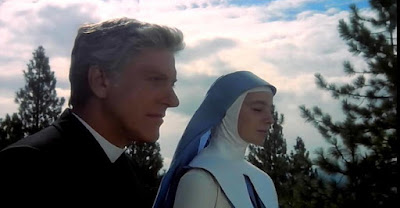
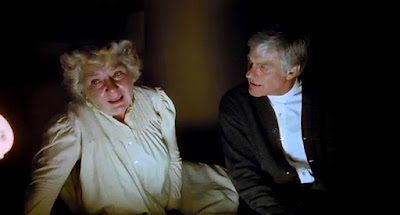
THE RUNNER STUMBLES

Dick Van Dyke and Kathleen Quinlan

THE RUNNER STUMBLES    (1979). Produced and directed by Stanley Kramer. Based on the play by Milan Stitt.  

In a small town in the 1920's the brash, young, full-of-life Sister Rita (Kathleen Quinlan of Event Horizon) arrives and meets the somewhat dour Father Rivard (Dick Van Dyke of Bye Bye Birdie) -- who has been banished to the hinterlands because of some of his more controversial views --  the housekeeper Mrs. Shandig (Maureen Stapleton); two grumpy and dyspeptic older nuns; and the children Sister Rita will teach, including mischievous little James (Billy Jayne). Town tongues start to wag when an obvious friendship and closeness develops between the priest and the nun, and even the housekeeper seems a bit scandalized when Sister Rita moves into the rectory with the father after the other nuns develop consumption -- this is against the orders of the Monsignor (Ray Bolger). As romantic feelings between the pair begin to blossom, one knows things will not go well for these star-crossed lovers ... The Runner Stumbles begins with Rivard in jail, arrested for murdering Rita!

Maureen Stapleton and Van Dyke
I admit I had mixed emotions about watching this picture, as I thought it might be overly cute and Catholic in the worst sense of the word. I also questioned the casting of Dick Van Dyke, whose rubbery pickle-faced features hardly qualify him for a career in drama, as a romantic figure no less. But producer-director Kramer also was responsible for the great Judgment at Nuremberg, so I felt it was definitely worth a look. To my surprise I loved the picture, and thought Van Dyke really delivered during his most difficult sequences. Quinlan and Stapleton are also excellent, and Tammy Grimes is quite effective as a friend and parishioner who is devastated by her father's death. 

Kathleen Quinlan and Tammy Grimes
The Runner Stumbles may not be a masterpiece like Judgment at Nuremberg, but it is a lovely, poignant film with well-developed characters -- the incisive screenplay was written by playwright Milan Stitt, whose Broadway play this is based on -- and a sensitive score by Ernest Gold [Unknown World; Exodus), especially the theme that plays over the closing credits (itself derived from a tune, "My Rumble Seat Gal," also composed by Gold). Critics described the film as "old-fashioned" and didn't mean it as a compliment. I think it's old-fashioned in the best sense of the word. The courtroom denouement to the mystery, based on real-life events, packs a wallop, and the closing is remarkably touching. The film doesn't let the Catholic church and its often maddening, hypocritical edicts off the hook, and I imagine devout Catholics might have found this offensive. Too bad. This was the last film for Bolger, who is perfect as the monsignor, and for Kramer.

Verdict: This tragic love story is imperfect, perhaps, but it is also altogether admirable.***1/2.