Lively, entertaining reviews of, and essays on, old and newer films and everything relating to them, written by professional author William Schoell.

Thursday, May 25, 2023

THE I DON'T CARE GIRL

Bob Graham and Mitzi Gaynor
THE I DON'T CARE GIRL (1953). Director: Lloyd Bacon.  Produced by George Jessel.

The real George Jessel is trying to produce a picture about old vaudeville star Eva Tanquay (Mitzi Gaynor of Anything Goes) and importunes his scriptwriters (Warren Stevens and Craig Hill) to locate people who knew the entertainer. These include Ed McCoy (David Wayne), supposedly the man who discovered her as well as her former partner; Charles Bennett (Oscar Levant of The Barkleys of Broadway), a composer; and Larry Woods (Bob Graham), another composer-performer who falls in love with Eva but is married. Larry is separated from his wife but a bigger problem is the seductive Stella Forest (Hazel Brooks of Sleep, My Love), who wants to star in Larry's operetta. Will true love win out over all?

David Wayne, Warren Stevens, Craig Hill
Hollywood is famous for coming out with biopics that have little to do with the real lives of their subjects, but The I Don't Care Girl takes the cake, as there's very little -- but the bare basics -- that have anything to do with Ms. Tanquay. The movie is really just an excuse to show off the admitted skills of Mitzi Gaynor, who gives a good performance, sings quite well, and is a sensational dancer with sensational gams. Ms. Gaynor is featured in some creative -- some might say overly creative -- big production numbers that have very little to do with anything ever seen on a vaudeville stage and everything to do with fifties fashion. 

Mitzi Gaynor and Oscar Levant
The title of the picture comes from Ms. Tanquay's most famous number, "I Don't Care." (Judy Garland, somewhat mimicking Tanquay,  arguably gives the best performance of this song in In the Good Old Summertime.) As for Tanquay, she was certainly a more interesting character than the sanitized version we see in this picture. Essentially forgotten today, she was once a tremendous international star, an early feminist, an absolutely relentless self-promoter, and had two or possibly three husbands as well as at least one affair. For a publicity stunt, she "married" a cross-dresser and wore a tuxedo while he wore the wedding dress. You can bet you won't see that in this movie! 

As for Bob Graham, the fellow is handsome, has a great baritone voice, and makes a smooth, likable leading man. But this was his last picture out of seven. What happened? Even the Internet Movie Data Base has very little information on him, including his date of birth and death. He is not to be confused with another actor named Robert Graham. 

Verdict: The story is just a mass of cliches but the cast is game and the dancing is great. ***.   

THAT OTHER WOMAN

Virginia Gilmore and James Ellison
THAT OTHER WOMAN (1942). Director: Ray McCarey. 

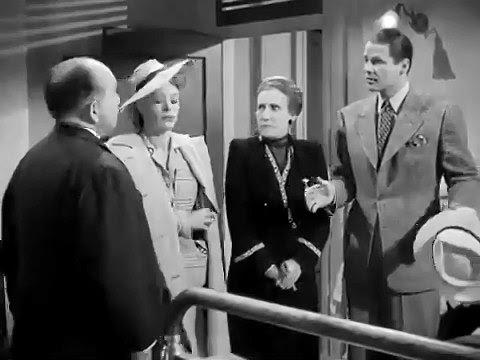
Emily Borden (Virginia Gilmore of The Brotherhood of the Bell) is secretary to handsome Henry Summers (James Ellison of The Ghost Goes Wild), who seems to spend more of his time chasing women than getting work done. Knowing how she feels about her boss, Emily's grandmother (Alma Kruger of Saboteur) suggests she create an air of mystery about herself by sending Henry some mysterious letters. This all leads to busy but not terribly funny complications wherein Henry thinks this lady's gangster boyfriend wants to kill him even as Emily's sort-of fiance, Ralph (Dan Duryea) goes after him as well. Henry masquerades as the caretaker of his cabin in the woods even as he finally begins noticing Emily. But what will happen when he learns she is the architect of all of his problems? 

Henry Roquemore, Gilmore, Urecal, Ellison
That Other Woman
 is yet another mediocre James Ellison comedy. Ellison is always reasonably adept in these vehicles but the greatest comedian in the world can't triumph over an insufficient screenplay. As for the ladies, neither Gilmore nor Kruger are especially adapt at comedy. The movie does have one moment of fun, and that is when Emily and Henry check into a hotel that seems to cater strictly to the elderly and encounter the termagant manager Mrs. MacReady, with Minerva Urecal looking throughout as if she wants to kill anyone who dares to even look at her! Typical of these kind of movies, Duryea's character is treated horribly.
Gilmore did a few movies but had more credits on TV. She was married to Yul Brynner for 16 years. 

Verdict: Much running around to little effect. **. 

LADIES MAN (1962)

LADIES MAN (aka Lemmy pour Les Dames/1962). Director: Bernard Borderie. 

Special FBI agent Lemmy Caution (Eddie Constantine) is on vacation in France, hanging out with his buddy Dombie  (Robert Berri), when a wealthy woman named Claudia (Yvonne Monlaur) asks for his help. Their first meeting in a restaurant is interrupted by the arrival of two men of whom Claudia is obviously frightened, Mirko (Guy Delorme) and Hugo (Lionel Roc). Before Lemmy can consult with Claudia a second time, he finds her corpse at the bottom of a cliff. Nearby is a house inside which Lemmy finds three friends of Claudia's: Sophie, (Eliane D'Almeida), Francoise (Claudine Coster), and Marie-Christine (Francoise Brion). More than one attempt is made on Eddie's life as he tries to figure out which of the women might have had a hand in Claudia's death, as well as might be a part of a blackmail scheme. 

Lemmy Caution first appeared as a character in several novels written by British author Peter Cheyney. Beginning in 1955, the books were adapted into French films starring the very American Eddie Constantine, who had studied voice under Edith Piaf and found some success as a singer! Several Caution/Constantine films were made, the most famous of which is the weird Alphaville, which was not based on a Cheyney novel. Constantine wouldn't be the first or last American actor to achieve more success in Europe than he did in the States. 

Eddie Constantine
Regardless of what country it comes from, Ladies Man is typical private eye stuff. (In the books Caution eventually became a P.I. and, out of his jurisdiction, he basically acts like one in this movie.) We've got all of the usual American private eye tropes -- attempts on the hero's life, bodies turning up, lascivious females trying to get info out of the hero, and so on.  Constantine is by no means conventionally attractive -- he's like a somewhat better-looking Ernest Borgnine -- but he has a certain appeal. It's hard to judge his acting as this is the dubbed version of the film, but the actor dubbing Caution, be it Constantine or someone else, is excellent. The comedic stuff in the film, mostly centering on Lemmy's buddy Dombie, reminds one of similar antics in American PI shows. Pretty standard stuff, Ladies Man is moderately entertaining. Its rough-edged and satisfying conclusion reminds one of Mickey Spillane. An odd aspect of the film is that Caution is treated like a celebrity everywhere he goes, with people hungering for his autograph -- an FBI agent?! 

Verdict: If you want to see a Lemmy Caution movie it might as well as this one. **3/4. 

SAN FERNANDO VALLEY

SAN FERNANDO VALLEY (1944). Director: John English. 

At his ranch in the San Fernando Valley, crusty old Cyclone (Andrew Tombes of Meet the Boyfriend) finds his cowboys goofing off again to hang out and sing with his grand-daughter, Betty Lou (Jean Porter of Cry Danger). Disgusted, Betty Lou's older sister, Dale (Dale Evans), fires them all and replaces them with women, figuring Betty Lou will no longer hang around and distract the ranch hands. Dale nearly runs Roy Rogers (Roy Rogers) over with her car -- this take place in "modern" times -- and he tries to get a date to no avail. However, when Betty Lou, a mere child, gets a crush on Roy, Dale decides to have Roy romance her so that she will get over it. Naturally, the two fall in love. 

Meanwhile poor Oliver (Charles Smith) hopes to have Betty Lou fall in love with him, and the equally crusty Hattie (Dot Farley), sort of a den mother to the cowgirls, just might develop a yen for Cyclone. Roy and Dale, along with Bob Nolan and the Sons of the Pioneers, sing a few numbers, including the catchy title tune and "You're Too Good to be True." Oh yes, there's a plot of sorts when fired cowboy Matt (LeRoy Mason) and a buddy "borrow" some of Cyclone's valuable horses supposedly to get their jobs back but actually to get a lot of cash. Speaking of cash Roy's friend Keno (Edward Gargan of Behind the Mask) also wants to recover some money that was stolen from him, also by Matt. 

San Fernando Valley is amiable enough. It's more of a musical comedy than a western, although it does have some horse chases and gunplay and a couple of fistfights. It's funny that Roy and his horse Trigger are billed above the title but Dale Evans isn't. That would change in the future. As for Roy, his natural charm always helped carry his movies be they fair or foul. 

Verdict: Modestly entertaining Roy Rogers Movie. **3/4. 

WEIRD NEW MOVIE: THE BANSHEES OF INISHERIN

Brendan Gleeson and Colin Farrell
THE BANSHEES OF INISHERIN (2022). Written and directed by Martin McDonagh. 

In 1923 on the dreary if beautiful island of Inisherin off the Irish coast, a crisis develops between two long-time friends and drinking buddies. Colm (Brendan Gleeson of Troy) starts shunning Padraic (Colin Farrell of Fright Night) and finally tells him, in essence, that life is too short and Padraic is too dull. Colm wants to concentrate on his music and also wants his former friend to just leave him alone. Padraic has few enough friends as it is, although he has a good relationship with his sister, Siobhan (Kerry Condon). Padriac is also friends, sort of, with young Dominic (Barry Keoghan), who is considered the village idiot but is smarter than he seems. He is not only beaten by his father, the village policeman (Gary Lydon), but possibly molested as well. Things take a dark turn when Colm makes it clear that if Padraic keeps bothering him he will literally cut off his fingers one by one, a vow he intends to keep. 

Barry Keoghan as the sad Dominic
Well first let's look at the good things about Banshees. It is stunningly photographed by Ben Davis, it is extremely well-acted by the entire cast (four of whom were nominated for Oscars), and one has to say that it is certainly different. It's also generally absorbing, can be quite funny, and has a degree of suspense and fascination, with some interesting characters (most of whom, however, are under-developed). On the debit side, the movie and its situations are kind of unreal, and as the story progresses it perhaps becomes too strange to take seriously. One of the main characters is clearly mentally-unbalanced, but this is barely addressed, even as certain situations are ignored in the medical sense. Banshees is typical of so many modern movies and TV shows that things happen less because they are realistic but more for shock value. There are good lines and sobering developments but no real resolution. A scene between Colm and a priest at confession is very amusing but again, not at all real. The potshots at the cop, who is admittedly an awful person, also seem more trendy and political than anything else. 

Verdict: A slice of life that has interesting elements but in the long run seems a bit phony and contrived. **3/4. 

Thursday, May 11, 2023

DUFFY'S TAVERN

Ed Gardner
DUFFY'S TAVERN (1945). Director: Hal Walker.

Archie (Ed Gardner), the manager of the old-fashioned saloon Duffy's tavern, has hired 14 soldiers as waiters in the owner's absence because the record factory where they worked has closed down. O'Malley (Victor Moore) tries to raise money to reopen the factory but the bank won't extend him credit. His daughter, Peggy (Marjorie Reynolds of Up in Mabel's Room), meets and falls for one of the out of work soldiers, Danny (Barry Sullivan), not knowing that Archie is in love with her. Archie finally gets the idea of getting celebrities from a nearby hotel to put on a show and raise the needed capital. Archie acts as master of ceremonies, introducing sketches and song numbers with such guest artists as Betty Hutton, Brian Donlevy, Alan Ladd, Veronica Lake, and other performers from Paramount studios. 

Billy DeWolfe, Bing, and Betty Hutton
I can imagine how the public must have felt back in 1945 when they went to see a film allegedly starring Bing Crosby, and Der Bingle doesn't even show up until after 80 minutes into the running time! Instead we are treated to dull alleged comedy from Ed Gardner and Victor Moore, one of the unfunniest pairings in film history. Gardner had starred in the radio show Duffy's Tavern, and this picture was a film adaptation; ten years later Gardner starred in a TV sitcom of the same title. Based on his performance in this movie, I can see why Gardner has been completely forgotten -- he also contributed to the largely unfunny screenplay. He might be better known as Shirley Booth's first husband. 

Buck-toothed and brassy: Cass Daley
The last third of the film is somewhat of an improvement although much of it is also nearly unwatchable. Betty Hutton hollers her way through one number, and her less attractive clone Cass Daley (of Red Garters) also screams through a similar number -- both women lamenting the lack of interest they inspire in men. (The question is did Hutton rip off Daley or vice versa?) A terrific dance team temporarily lifts the audience's spirits and there's a quick, mildly amusing sketch with Paulette Goddard, Sonny Tufts, and Brian Donlevy.  The finale features Bing Crosby, first in a cute bio of his life with special guest-stars, and then his rendition of "Swingin' on a Star" with Dorothy Lamour and others joining in. The other generally forgettable songs are by Burke and van Heusen. This is one of the worst of the all-star studio films. Star Spangled Rhythm was a far superior Paramount compendium. 

Verdict: Put on any show but this one! **. 

KANSAS CITY CONFIDENTIAL

John Payne
KANSAS CITY CONFIDENTIAL (1952). Director: Phil Karlson. 

Joe Rolfe (John Payne) is trying to rebuild his life after a brief stir in prison, but he has no idea that a certain individual has gathered together three desperate criminals to help him pull off a bank job. Rolfe, who drives a flower delivery truck, becomes the patsy in this scheme and winds up being questioned by police. Then the action switches to Mexico, where Rolfe tries to infiltrate the gang, which consists of Boyd Kane (Neville Brand), Peter Harris (Jack Elam), and Tony Romano (Lee Van Cleef of The Big Combo). Rolfe romances Helen (Coleen Gray of Kiss of Death), daughter of retired cop Tom Foster (Preston Foster of I, the Jury), while trying to uncover the identity of the mysterious leader and clear his name.

Lee Van Cleef with Payne
Kansas City Confidential
 is an excellent piece of film noir, with Payne in top form, and everyone else giving top-notch performances. Lee Van Cleef certainly makes his mark in this as the sinister Tony Romano, and it's easy to see why his formidable screen presence eventually had him hitting it big overseas; this is one of his best performances in an American flick. Jack Elam is effective in a different way, less menacing and more on a perpetual verge of panicking. Coleen Gray makes a feisty and credible leading lady, and Dona Drake of Beyond the Forest saunters sexily and brazenly through her scenes as resort employee Teresa. The film is well photographed by George E. Diskant, and Paul Sawtell, never quite considered in the league of the great film composers, contributes an evocative and exciting score.

Payne with Coleen Gray
Of course Kansas City Confidential mustn't be examined too closely. The leader of the gang wears a mask to hide his identity, but when he shows up later in the movie it's hard to believe that his associates wouldn't recognize his voice and physical shape, nor that they wouldn't recognize each other. I watched this on Amazon Prime where they were offering a colorized version, but the next day when I went to finish it, the color version had disappeared and I watched the rest in black and white. Strange. Vivi Janiss, who played one of the members of the "Ladies Fang and Claw Society" on I Love Lucy, has a small role as a resort guest. John Payne was involved romantically with Coleen Gray in-between his last two marriages.

Verdict: Suspenseful, with an intriguing plot and some impressive acting. ***. 

VISIT TO A SMALL PLANET

Jerry Lewis
VISIT TO A SMALL PLANET (1960). Director: Norman Taurog.  

Intergalactic visitor Kreton (Jerry Lewis of The Patsy) has a fascination with Earth and attaches himself to a family that consists of businessman Roger Spelding (Fred Clark), wife Rheba (Lee Patrick), and daughter Ellen (Joan Blackman), whose horny boyfriend is Conrad (Earl Holliman of Hot Spell). Apparently Kreton's race has given up sex eons ago so he is fascinated whenever Ellen and Conrad make out. Roger has a neighbor named Mayberry (Gale Gordon), who is convinced the earth is being visited by flying saucers and extraterrestrials, which Roger thinks is utter poppycock until Kreton shows off his abilities. For one thing, whenever Roger or anyone else tries to tell anyone the truth about their visitor, all that comes out of their mouths is "Mary Had a Little lamb." Despite the irritation that Kreton may cause him, Roger appreciates it when he helps him with his boss, Abercrombie (Jerome Cowan). But it isn't long before the authorities take an interest in Kreton ... 

Lee Patrick, Jerry Lewis, and Fred Clark
Visit to a Small Planet
 is suggested by a play by Gore Vidal, who satirized McCarthyism. All that has been jettisoned to make way for the comedic style of Lewis, which actually fits the basic plot pretty well. Lewis is fine as the lovably dopey Kreton, although he gets competition from Lee Patrick, who is also lovably dopey. Clark, Gordon, Cowan and Holliman are all as professional as ever. Joan Blackman was introduced in this movie although she had already had a few credits; she later did a couple of films with Elvis. Ever-dignified John Williams (of Midnight Lace) is bizarre and perfect casting as Delton, the head of the extraterrestrials, and Ellen Corby is fun as Gordon's wife. Barbara Bostock makes a positive impression as Desdemona, who sings a weird ditty and dances with Lewis in a beatnik coffee shop scene. 

Verdict: Highly imperfect and often silly, but cute and well-acted as well. **3/4. 

A FRONT ROW SEAT Nancy Olson Livingstone

A FRONT ROW SEAT: An Intimate Look at Broadway, Hollywood, and the Age of Glamour. Nancy Olson Livingstone. University Press of Kentucky; 2022. 

Books written by second and third tier celebrities have to rely on a lot of name-dropping to create reader interest, and Livingstone certainly does a lot of that. She can be forgiven because she did, after all, have a good part in the famous Sunset Boulevard (as Nancy Olson) and was married to lyricist Alan Jay Lerner of Lerner and Loewe fame (My Fair Lady, Brigadoon, etc.). So the lady has plenty of anecdotes to share, including her impressions of the Beatles, whom she met through her second husband, record executive Alan Livingstone. However, she really doesn't go into much detail about Sunset Boulevard or any of her other movies, which include such Disney films as Pollyanna and The Absent-Minded Professor. She seems to be more interested in telling how JFK made passes at her and taking pot shots at Joan Crawford. Her anecdotes about Arthur Laurents and closet queen Moss Hart are not so much homophobic as naive and dated. However, she admirably exposes the anti-Semitism of the period. This overlong tome could have been reduced by a quarter if all of Livingstone's detailed descriptions of the clothing she wore were excised. Initially interesting, I eventually found the book rather tedious. 

Verdict: Some interesting passages to be sure, but hardly essential reading. **1/2. 

WHEN MY BABY SMILES AT ME

Betty Grable
WHEN MY BABY SMILES AT ME (1948). Director: Walter Lang. 

Burlesque performers Bonny Kane (Betty Grable) and her husband Skid Johnson (Dan Dailey) have dreams of the big time when they learn that Skid has been offered a big part in a Broadway show. Bonny is happy with her husband's advancement but she isn't thrilled when she learns he'll be performing with her rival, a predatory blonde named Sylvia (Jean Wallace of The Big Combo). Skid has a more serious problem than Sylvia and that's his love of liquor. Will Bonny succumb to the charms of admirer and rich rancher Harvey Howell (Richard Arlen) or will she be able to overlook her husband's peccadilloes? And will Skid wind up in Bellevue's dipsomaniac ward or back on Broadway? 

Dan Dailey and Betty Grable
Although many might consider this another Betty Grable Musical and she is very good in the picture the fact remains that this is Dan Dailey's show from start to finish. Dailey earned a Best Actor Oscar nomination for his strong and demanding turn as the frustrated, sad, and alcoholic Skid, and he delivers in every scene, the charming ones as well as the more difficult moments. He gets good support from such cast members as June Havoc (of My Sister Eileen) and Jack Oakie (of Million Dollar Legs) as another burlesque team, James Gleason as theater owner Lefty Moore, and Arlen and Wallace. Betty isn't showcased all that well in a weird torch number in which her movements are more strange than sexy, but she does a nice job with a pretty new number entitled "By the Way." This is the third version of a play entitled "Burlesque," so there are plenty of cliches on hand, but the picture is smoothly directed, photographed in beautiful technicolor, and despite its dramatic moments, is colorful fun. I'll leave it to individual viewers to decide if the ending is a happy one or not. Dailey does an imitation of Ted Lewis at one point and Jack Oakie does Al Jolson.  

Verdict: Dailey's fine performance gives this show biz drama some heft. ***.  

Thursday, April 27, 2023

NASTY HABITS

Glenda Jackson and Sandy Dennis
NASTY HABITS (1977). Director: Michael Lindsay-Hogg. 

When the elderly abbess Hildegarde (Edith Evans) passes away, a battle ensues between two factions of nuns in Philadelphia. On one side is Sister Alexandra (Glenda Jackson), who wants to remain aloof as the Prioress Sister Walburga (Geraldine Page) and Mistress of Novices Sister Mildred (Anne Jackson) conspire with the somewhat addle-pated Sister Winifred (Sandy Dennis) to spy upon the other faction and trip them up at every turn. On the other side is the younger Sister Felicity (Susan Penhaligon) who sneaks out into the woods outside the convent for romantic rendezvous and hot sex on a regular basis. She wants all of her nuns to have a steady beau. Both groups are not above using hidden mikes and cameras to find out what the others are up to. When Felicity is excommunicated, she goes public, telling all on The Mike Douglas Show. Is this the end of this oddball Philly faction of possibly Catholic nuns? 

Jackson, Jackson and Page
Frankly, the notion of setting the whole Watergate story in a nunnery is brilliant, and while the execution may be flawed, Nasty Habits emerges as a memorable motion picture. The actors are all wonderful, but Glenda Jackson is simply superb as the quietly ferocious manipulator behind the scenes. One of her best sequences has her addressing the other nuns as to the difference between ladies and the bourgeoisie, but she is wonderful throughout. Nasty Habits may not be a laugh riot a la Night at the Opera, but it is consistently amusing. Keeping it in the family, a few of the cast members' husbands are also in the film: Rip Torn; Eli Wallach, and Jerry Stiller -- all play priests (Stiller's wife Anne Meara is a gum-chewing nun from Joisey.) Vatican scenes with Stiller and Wallach examine whether or not the Philly nuns are a true order or not, a sop to the Catholic Church, of course. Melina Mercouri is also fun as a nun who travels the world as a missionary and advises Sister Alexandra by telephone. 

Verdict: This very funny movie should have been a TV series! ***. 

PARADE On Broadway

All the Wasted Time

PARADE. Book by Alfred Uhry. Music and lyrics by Jason Robert Brown.

Parade, which first debuted on Broadway in 1999, is based on the true story of Leo Frank, a Jewish man married to a Southern Jewish woman and living in Georgia. He is accused of murdering a young girl who worked in the factory where he was superindendent. Due to anti-Semitism and politics, Frank winds up being railroaded for a crime he didn't commit. (Books which examine the case pretty much make it clear that Frank was not guilty.) Parade was revived by City Center's Encore series, where it was so well-received that it moved to Broadway, where I saw it last week.

Diamond and Platt
I consider Parade to be a modern masterpiece of musical theater, with a great and eclectic score that consists of jazz, ballads, love duets (such as the beautiful All the Wasted Time) and the rousing martial The Old Red Hills of Home. There is a large and very talented cast, led by Ben Platt as Leo and Micaela Diamond as his wife, Lucille. Both of them, especially Diamond, give excellent and sensitive performances. (It may have been a fluke during the performance I saw, but Platt seemed a little perfunctory at the climax, but otherwise was fine.) The show was very well-staged and directed, with the orchestra bringing Brown's score to life with vibrant effectiveness. 

The story has been filmed several times: They Won't Forget (1937) starring Claude Rains (although his character is not revealed to be Jewish); The People vs. Leo Frank (2009), and The Murder of Mary Phagan (1988 telefilm), with Peter Gallagher as Frank and Jack Lemmon as the governor, as well as several documentaries on the case. 

Verdict: An exciting, tuneful and moving evening on Broadway. ****. 

IT STARTED IN PARADISE

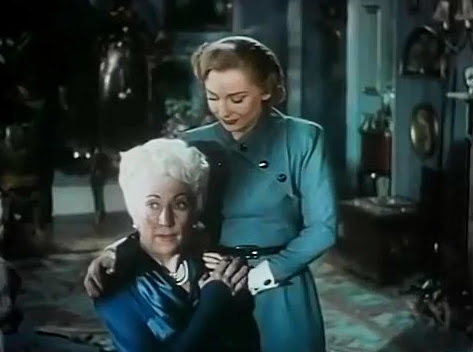
Martita Hunt and Jane Hylton
IT STARTED IN PARADISE (1952). Director: Compton Bennett. 

In the years leading up to WW2, Martha Watkins (Jane Hylton of The Manster) is frustrated that her employer, fashion designer Mme. Alice (Martita Hunt), thinks her designs are far too modern. Martha takes advantage of the situation after she importunes Alice to go off for a rest cure, and makes major changes to the line and even the studio itself. With the backing of her boyfriend, Arthur (Ian Hunter), Martha rises in the world of fashion, but makes the mistake of falling for a supposedly French bounder named Edouard (Terence Morgan). Meanwhile a younger designer, Alison (Muriel Pavlow of Murder She Said) and her boyfriend, Michael (Brian Worth), may prove formidable competition to Martha. Will ruthless Martha come undone?

Paging RuPaul!
If this film had been made in the United States ten years later it might have starred Susan Hayward at her bitchiest and been a lot of fun, but this comparatively dull British flick never really catches fire. Jane Hylton is a more than competent actress but she lacks that intense and fiery presence that might have made her performance more compelling. The others in the cast are all good enough, and Kay Kendall sparkles a bit as a superficial creature who makes an arrangement with Martha to bring in customers in exchange for clothing. The movie has an absolutely hilarious climax in which Alison shows up Martha with her own showing, featuring designs based on Elizabethan clothing. While these outfits might work for a costume party -- or for some drag queens -- the ordinary 20th century female would hardly be caught dead in most of them! Compton Bennett directed much better pictures, such as Daybreak. Malcolm Arnold's score helps just a bit. 

Verdict: Dig those crazy gowns! **. 

EYES OF TEXAS

EYES OF TEXAS (1948). Director: William Witney. 

Thad Cameron (Francis Ford of Charlie Chan at the Circus), who has started a home for boys who lost their fathers in WW2, is overjoyed to discover that his long-lost nephew, Frank, has survived. Before the two are reunited, however, Thad is killed by a pack of bloodthirsty dogs. Roy Rogers, playing himself -- this time he's a Marshall and not an actor -- investigates with the help of the Sons of the Pioneers as well as Doc Cookie Bullfincher (Andy Devine) and his amorous nurse, Penny (Lynne Roberts of Dick Tracy Returns). This time Roy is up against the ruthless lawyer Hattie Waters (Nana Bryant), a tough and clever middle-aged lady, her chief gunsel Vic (Roy Barcroft) and his evil pals, and the ex-con (Danny Morton of The Royal Mounted Rides Again) who pretends to be Thad's real nephew. Then there's those deadly dogs ...    

Pure evil: Barcroft, Morton, and Bryant
Eyes of Texas is a near-perfect "modern" Roy Rogers vehicle. The performances are all on target -- Bryant and Barcroft make especially nasty and effective villains in this -- the comedy relief isn't too pervasive -- Andy Devine is far more palatable than Gabby Hayes -- serial specialist William Witney keeps things moving at a thrilling pace, and Roy even sings a couple of pleasant tunes, "The Texas Trail" and "The Padre of Old San Antone." Then there's the amazing Trigger, who participates in fist fights by kicking out at the bad guys with his hooves and other amazing equine feats! 

Verdict: A prime example of why Roger Rogers movies were so damned popular! ***. 

THE GREAT RUPERT

THE GREAT RUPERT (1950). Director: Irving Pichel. 

Now here's a weird one. A down-on-his-luck entertainer, Joe Mahoney (Jimmy Conlin), with a trained squirrel act, reluctantly lets the squirrel, Rupert, go off on his own when he finds he can't get them bookings. Louie Amendola (Jimmy Durante), another entertainer who can't find work, moves into the apartment vacated by Mahoney with his family, but is unaware that the squirrel has moved back in. When Mrs. Amendola (Queenie Smith) prays for money, it drops from the ceiling into her hands! She is unaware that the landlord, who doesn't believe in banks, stashes his loot in a hole behind his bed, from whence the squirrel promptly throws it out. Despite the title, and the pivotal role that Rupert plays in the fortunes of the Amendola family, the squirrel -- animated through stop-motion -- hasn't much to do in the movie (although he isn't entirely forgotten either), which is decidedly bizarre, utterly original, and even strangely touching. The cast, including Durante, Sara Haden (as the landlord's wife), Chick Chandler (as an agent) and Terry Moore (Durante's daughter) are all fine, although love interest Tom Drake is strangely devoid of charm. 

Verdict: Really not as bad as you might expect, but certainly not for everyone. ***.

Thursday, April 13, 2023

THE LOVE MACHINE

John Phillip Law as Robin Stone, the "Love Machine"
THE LOVE MACHINE (1971). Director: Jack Haley Jr.  

Newscaster Robin Stone (John Phillip Law of The Sergeant) attracts the attention of both Network head Greg Austin (Robert Ryan) and his lustful wife, Judith (Dyan Cannon), leading to him getting more than one promotion both on-camera and in the executive suite. Meanwhile Robin beds numerous ladies, including a model named Amanda (Jodi Wexler) and Judith, both of whom become much too possessive. Recognizing that Robin has become too big for his britches and is a threat both to his job and his power, Austin wonders if a morals clause might be one way to get rid of the threat. It's well known that Stone has had many ladies in his bed, but is he also involved with his good friend, the flamboyantly gay photographer and producer Jerry Nelson (David Hemmings of Deep Red)? Judith causes a scene at a Hollywood party that may have them all out on the street. 

Dyan Cannon and Robert Ryan
Robin Stone was originally to be played by Brian Kelly, but just before filming began he was involved in an accident which ended his acting career (although he went on to become a successful producer). John Phillip Law then took over as Stone but was given a very underwritten role to play. Law is handsome and okay in the part, but he lacks that certain charisma, that all-important X Factor, at least in this picture, and Stone remains a bit of a cypher anyway. In the Jacqueline Susann potboiler that this was based on, Stone not only gets involved with Amanda and Judith, but with an actress named Maggie. This character has been reduced to a bit, well-played by Sharon Farrell. Robert Ryan gives the movie a touch of class as Austin, and manages to maintain his dignity. Hemmings is quite good and sharp as Jerry, although he was understandably criticized for perhaps overdoing the swishiness of his performance. (Jerry is neither gay nor a photographer in the book.)  Dyan Cannon, an actress who for some reason always looks as if she should have a mustache, is also good as Judith. 

Jodi Wexler and David Hemmings
Jodi Wexler was introduced in this film, both her first and last screen credit. I did not think her performance was bad, as she was playing a sweet and naive young lady, but Love Machine was a major bomb that didn't do much good for anyone's career. Jackie Cooper makes the most of his role as Danton Miller, the network head of programming. Shecky Greene is a second-rate comedian basically playing a version of himself, and there are good turns from Maureen Arthur as a promiscuous publicity agent and William Roerick as another executive who councils both Austin and his wife. 

Jackie Cooper and David Hemmings
Both the novel and the film adaptation were utterly excoriated by the critics. The odd thing is that the movie isn't truly awful, it's entertaining and has some vivid performances and sequences. There's Judith discovering Robin in the shower with two nubile and busty twins (the Collinsons of Twins of Evil) and setting fire to the bedroom by pouring vodka all over their clothing, and a four-way fight scene between Robin, Judith, Jerry and a boyfriend, Alfie (Clinton Greyn), over a supposedly incriminating inscribed bracelet that Judith thinks will utterly ruin Robin as they all desperately scrabble to get it and slap, pummel and kick anyone who gets in their way. These scenes are deliberately amusing if not hysterical. While the knocks at the TV industry may not rise to the level of Network, the gay material is a bit tiresome, Stone is never sufficiently developed even though he's the main character, and the film just sort of ends abruptly without any major resolution, much of the picture actually plays quite well.  Law, however, was seen to better advantage in Danger:Diabolik. 

Verdict: If you take this in the right spirit and don't expect Citizen Kane, but the book is much better ... ***. 

DOCTORS WIVES

DOCTORS' WIVES (1971). Director: George Schaefer.

"I don't appreciate your sleeping with your wife." 

Lorrie Dellman (Dyan Cannon) announces to a group of friends, all of whom are married to doctors as she is, that she intends to sleep with all of their husbands, and has already gotten to two of them. The next day Lorrie is caught in bed with a doctor and shot to death by her husband as everyone wonders which man (who survived the shooting and is fighting for his life in the hospital) was her lover. And this is just in the first ten minutes!

WIVES: McCargo, Williams, Cannon, Rule, Roberts
Unfortunately, anyone hoping for a serious film or just a trash wallow will be disappointed, as Doctors Wives is not a very good picture and sadly isn't quite bad enough to be much fun either. Judging from this movie, doctors, nurses and interns spend almost as much of their time having affairs as they do tending to patients. The wives in the picture consist of Amy (Janice Rule of The Swimmer) who is married to Peter (Richard Crenna), who is having an affair with his head nurse Helen (Diana Sands), whose little boy has an aneurysm. Then there's Della (Rachel Roberts of When a Stranger Calls) who is married to Dave (Gene Hackman) and confesses to him that she also had sex with lusty Lorrie. Maggie (Cara Williams) is separated from Joe (Carroll O'Connor) and drinks too much, while neglected Elaine (Marian McCargo aka Marian Moses) beds an intern-stud named Mike (Anthony Costello) even as her hubby Paul (George Gaynes of One Touch of Venus) is similarly occupied elsewhere. You need a scorecard. (If this makes you want to rush out and buy the DVD, be forewarned.) 

DOCTORS: Gaynes, Hackman, Colicos, O'Connor, Crenna
Others have noted that Doctors Wives comes off more as a racy and frank nighttime TV soap opera than a theatrical movie, and having the competent but bland, strictly small-screen Crenna in the lead doesn't help. Otherwise the cast is game with Roberts, Sands, Cannon and Williams making the best impression. And John Colicos is especially notable as the very cool, near-sociopathic wife killer who  schemes to get out of police custody when he's called to operate on Helen's son, and there are also good turns from Richard Anderson as the D.A. and Ralph Bellamy as Cannon's father. Anthony Costello also scores -- literally as well as figuratively -- as the horny and busy intern. The business with a gal named Sybil recording all of her sexual episodes is stupid, however, as is much of the movie. Several plot elements go unresolved but at least there wasn't a sequel! 

Verdict: For those anxious to see close-up shots of open heart surgery only! Some good performances but otherwise not worthwhile at all. **. 

BELLS OF ROSARITA

Roy Rogers and Dale Evans
BELLS OF ROSARITA (1945). Director: Frank McDonald. 

Sue Farnum (Dale Evans) appeals to her late father's good friend, Slim Phillips (Addison Richards), when she realizes that her father's slimy business partner, Ripley (Grant Withers) is trying to cheat her out of her circus. Slim and his daughter, Patty (Adele Mara) travel west to see what they can do. Almost immediately Slim is kidnapped! Filming nearby Sue's property, Roy Rogers, playing himself, gets involved and tries to find Slim with the help of Gabby Whittaker (Gabby Hayes) and Bob Nolan (also playing himself), head of the vocal group Sons of the Pioneers. 

Elliott, Livingstone, Sunset Carson, Allan Lane, Red Barry
Roy also comes through for Sue when he convinces her to put on a show in the nearby town and enlists the aid of the other Republic Studios western stars: Allan Lane [King of the Mounties], Sunset Carson, Wild Bill Elliot [Footsteps in the Night], Bob Livingstone and Don "Red" Barry. These fellows also help round up the ornery polecats who have kidnapped Slim. This must have been quite a thrill for Western movie fans back in the day. There's also a bunch of pleasant tunes, including Roy's "Build a Fence Around Texas" and the very talented Robert Mitchell Boy Choir. Gabby Hayes wears out his welcome rather quickly, however. 

Robert Mitchell Boy Choir
Bells of Rosarita is another "modern-day" Rogers western. The film-within-a-film that Roy is making is also entitled Bells of Rosarita and has something to do with a woman being forced to marry a man she does not love. Although there are some would-be exciting chases in the film, it can't quite escape being a little dull, although it is fun to see all of those handsome Western heroes in one movie. My mind wandered through the movie and I found myself wondering if the one black child in the choir was treated respectfully by the other white boys. It's good that he was included at all, of course. 

Verdict: A fairly typical Roy Rogers western musical with talented cast members. **1/4.    

BOULEVARD! A HOLLYWOOD STORY (2021)

BOULEVARD! A HOLLYWOOD STORY (2021). Director: Jeffrey Schwarz. 

Finding herself without too many opportunities despite her (Oscar-less) triumph in Sunset Boulevard, Gloria Swanson decided she would turn the movie into a Broadway musical. To that end she hired two young songwriters, pianist and composer Dickson Hughes and lyricist Richard Stapley, who were a romantic couple at the time, to work with her on the project. The fact that she apparently knew the two men were lovers didn't prevent Swanson from developing romantic and sexual feelings for the very handsome Stapley, but these feelings were not reciprocated. (Although Swanson was not unattractive, she had never been a great beauty, what with those teeth and chin, and probably even much younger hetero men might not have wanted to share the sheets with her!) Director Jeffrey Schwarz examines this triangle situation via archive footage (including Swanson doing a number from the show on Steve Allen), a video interview of Stapley taped by a friend, and Schwarz's audio interview with Hughes, as well as commentary from people who knew the two men (now deceased). Interspersed with these is some attractive animated footage illustrating some of the scenarios. 

Richard Stapley
Richard Stapley was an English actor who went to Hollywood in the hopes of becoming a major star. He had a good role in The Strange Door with Boris Karloff and Charles Laughton but wound up in stuff like Jungle Man-Eaters from the Jungle Jim B movie series. The documentary doesn't quite make it clear why he and Hughes broke up, but Stapley went back to England, changed his name to Richard Wyler, got married (his second wife, who seemed to have really been just a beard), became a macho motorcycle racer, and starred in several Eurospy movies as super-spy and super-stud Dick Smart. Swanson was never able to secure the rights to Sunset Boulevard -- in 1974 she starred in the amusing telefilm Killer Bees -- but Andrew Lloyd Webber had no such problem. Once Webber's show debuted in London, Hughes got to work. He couldn't do a show based on the movie, but he could do a show that depicted the attempts to make a show based on the movie. Using the songs that had already been written, and using himself, Stapley and the now-deceased Swanson as the main characters, he mounted "Swanson on Sunset" at a small venue in LA. What happened next is revealed in the documentary.

Hughes, Swanson, Stapley
The most interesting aspect of Boulevard may not be the whole business with Swanson and Sunset Boulevard, but the relationship between the two men, the cruelty of the vagaries of Hollywood, the terrible price often paid by people who relentlessly pursue stardom and deny their own true selves as they do so. Stapley did not age well, but he returned to Hollywood and kept plugging away practically until the day of his death. Hughes didn't get the major Broadway show -- and we don't learn if he had any long-term relationships after Stapley -- but he seems to have been happy enough in his life. One commentator seemed to feel that Stapley's letters to his boyfriend reveal a deep love, but we don't know how Hughes felt, possibly because he didn't want to talk about it. Was he heartbroken when Stapley walked out of his life, or did he feel "goodbye to bad rubbish." There is an implication that Stapley, like a lot of good-looking Hollywood types, could be an opportunist who thought of his career -- what there was of it -- above all else. What we hear of the songs written for the aborted show indicate that they were pleasant and adept show tunes if not quite on the level of, say, Richard Rodgers. Jeffrey Schwarz also directed the superb Vito, and many others. 

Verdict: With Swanson as a springboard, this is an interesting look at Hollywood dreams turned to dust. ***. 

3 FOR BEDROOM C

Gloria Swanson and James Warren
3 FOR BEDROOM C (aka Three for Bedroom C/1952. Director: Milton H. Bren. 

Movie star Ann Haven (Gloria Swanson), who has just won an Oscar, discovers there are no compartments available for her and her daughter, Barbara (Janine Perreau), and she must take a train to Hollywood in a hurry. She simply takes over a compartment and is lucky enough to discover that the true occupant, chemist Dr. Oliver Thrumm (James Warren), finds the two ladies charming. As other arrangements are made with the help of steward Fred (Ernest Anderson), Ann and Oliver find themselves falling for one another. But there are complications when Oliver finds out who Ann is, as well as interference from her manager, Johnny (Fred Clark of White Heat), the press agent Jack Bleck (Hans Conreid of The Twonky) and a declasse theater person, Conde Marlowe (Steve Brodie of Desperate), who is heading for Hollywood. Will the romance between Ann and Ollie run smoothly?                

Conreid, Clark, Brodie
Despite her performance in Sunset Boulevard, Gloria Swanson found herself with few movie offers (or turned them down) after her triumph in that picture. Unfortunately, her choice of this light -- very light -- comedy was not a good one. Her choice of leading man was also odd, as you have to wonder why she didn't go after someone with more box office clout. A former star of low-budget westerns, James Warren was handsome and competent enough, but he was no Cary Grant (who would certainly have turned this script down). Swanson herself is quite good, as are the supporting cast members already mentioned, and there are slightly amusing cameos from Margaret Dumont (who certainly doesn't get enough to do) and Percy Helton. 

As for Ernest Anderson, he plays the role of the intelligent, wise and educated steward with dignity. Anderson also had a good part in In This Our Life. Swanson had only two more theatrical films in her future -- a foreign comedy about Nero and Airport 1975 -- along with a host of TV show guest spots. She did her best to constantly reinvent herself and stay in the public eye. Janine Perreau, another member of the Perreau acting family, is more annoying than cute. 

Verdict: Labored comedy that is easy enough to take but never really gets off the ground. **. 

Thursday, March 30, 2023

THREE LITTLE GIRLS IN BLUE

Blaine, Vera-Ellen and Haver
THREE LITTLE GIRLS IN BLUE (1946). Director: H. Bruce Humberstone.

Three farm sisters in 1902 -- Pam (June Haver), Liz (Vivian Blaine) and Myra (Vera-Ellen) -- learn that they haven't inherited as much from their late aunt as they were expecting. So they go to Atlantic City and book a suite while Pam pretends to be an heiress. with Liz playing her secretary and Myra playing her maid. The plan is to attract a wealthy husband whom she will also, naturally, fall in love with. Pam quickly gets two suitors: Van (George Montgomery of The Brasher Doubloon) and Steve (Frank Latimore of In the Meantime, Darling). Meanwhile Myra finds herself very attracted to hotel employee Mike (Charles Smith of Henry and Dizzy) and vice versa. Of her two gentlemen callers Pam prefers Van, but will the fellow propose before their money runs out? 

Frank Latimore and George Montgomery
If Three Little Girls in Blue sounds familiar it's because it was already filmed at least twice as Three Blind Mice and Moon Over Miami. The plot is creaky but it's been dressed up with enthusiastic players and technicolor. There are several song numbers, with the suspicion being that the forgettable ditties are new while the best songs -- "On the Boardwalk in Atlantic City" and especially "You Make Me Feel So Young" -- are classics. All of the performances are good, with Charles Smith particularly notable as the likable Mike. As usual Vera-Ellen impresses with her dancing skills. Celeste Holm, who made her film debut in this picture, shows up late in the movie as Steve's sister. At times she channels "Oklahoma's" Ado Annie (she was in the Broadway show) and other times is the bitchily genteel Southern belle.

Verdict: Amiable, pleasant and well-played poop. ***.