| Marvel Marceau and Marcel Marceau |
| Chelton, Marceau and Clay |
| Marvel Marceau and Marcel Marceau |
| Chelton, Marceau and Clay |
| John Hodiak |
| Walter Abel and Ann Harding |
Stanley Whit-taker (Dou-glass Dumbrille) is found dead of a gunshot in his office. Although he left a suicide note admitting to embezzlement, the police determine that his death was really a homicide. Whittaker's associate, Jim Trent (Walter Abel of Fired Wife) is put on trial for the murder, but other suspects and interested parties include secretary Paula Young (Ann Harding of When Ladies Meet), bookkeeper Grace Franklin (Margaret Hamilton), office boy Benny Ryan (Billy Benedict), and even Trent's daughter, Constance (Frances Sage), who inexplicably wanted to run off with the much older and not especially attractive Whittaker. During the trial, the truth behind the murder eventually comes out.
The Witness Chair is an entertaining if very minor crime/court-room drama with generally good performances and a tidy if unspectacular screenplay. Ann Harding is as efficient as ever, even if her performance is of the long-suffering, hand-wringing variety. Back in the day, Harding was a major star -- this is a lesser vehicle for her -- but today she is known only to film buffs. Like Kay Francis and others, her films didn't show up on the late show until the days of TCM. Walter Able, a fine actor, was a leading man who later became a supporting player. The prolific Billy Benedict almost steals the film with his comic turn as the office boy, who hopes for a singing career and is annoyed that he gets such a short time in the witness chair. Margaret Hamilton is snappy as the outraged bookkeeper who insists that her boss, Whittaker, was innocent of theft. William "Billy" Benedict
Verdict: Smooth easy watching if nothing to get excited about. **1/2.
| Doomed lovers: Boyer and Darrieux |
MAYERLING (1936). Director: Anatole Litvak. French-language version with sub-titles.
Rudolph (Charles Boyer), the Crown Prince of Austria, is trapped in a loveless arranged marriage, disagrees with his father's politics and edicts, and spends most of his time carousing and womanizing. Until he espies the pretty young Marie Vetsera (Danielle Darrieux) and the two fall in love. Rudolph tries to have his marriage to the archduchess Stephanie (Yolande Laffon) annulled, but neither the Pope nor his father will allow this. The Emperor finally tells his son that this affair must end within 24 hours. The lovers spend one last fateful night together.
| the real Prince Rudolph in younger days |
Based on a novel, Mayerling -- named for the prince's retreat where the final rendezvous takes place -- is a fictionalized version of the story. There were at least three subsequent versions: The Secret of Mayerling, a French film that delves into the now-discredited theory that the lovers were murdered; a 1957 version with Audrey Hepburn and husband Mel Ferrer; and the 1968 version with Omar Sharif, which includes another lover of the prince's, an actress/possible prostitute that he apparently also tried to impress into a death pact. I have a feeling the real facts about our prince are much more interesting, and perhaps even less savory, than what happens in this movie.
| Boyer |
Verdict: If taken with a grain of salt, this is an impressive and well-made romantic picture. ***.
| Chris Noth and Kevin Spacey |
Chris Noth, star of Law and Order, Sex and the City, and others is accused of drunken, inappropriate behavior decades ago and is also dropped from his latest TV series, dropped by his agency, turned on by his wife and former co-stars (who throw him under the bus) and becomes persona non grata in Hollywood.
All of this happened without either gentleman even being given a chance to defend themselves. (Spacey has since been acquitted in one trial and I don't believe there are any criminal charges against him any more.)
Yes, we know guys can act like pigs, especially under the influence of alcohol and drugs, But I've no doubt the "victims" were also under the influence and their memories, after many, many years, are undoubtedly hazy. But in the long run it doesn't matter who's right or who's wrong.
Whatever happened to Innocent Until Proven Guilty?
Neither of these gentlemen have been accused of out and out rape, which would certainly make them unsympathetic, to say the least, if they were guilty. Spacey was excoriated less for what he may have done at a party (or for allegedly groping other "victims") than for coming out years too late just after the charges went public, meaning he was attacked by both gays and homophobes. (And make no mistake -- a large part of what happened to him has to do with homophobia.)
Chris Noth helped some gal get an acting gig on Law and Order: Criminal Intent, but apparently she didn't turn into the next Lady Gaga so somebody has to pay. Noth has become a victim of the originally well-intentioned me-too movement, which has blown up to include virtually any man who even looks at a woman the wrong way. (Former governor Andrew Cuomo was certainly a victim of this.)
Should people be held accountable for alleged sloppy drunken behavior decades later, have their lives and careers utterly destroyed, simply on somebody's say-so, someone who may have an ax to grind, rent to pay, grievances to air, someone who needs both attention and cash, some redress to the "wrongs" they've suffered because their careers didn't amount to cat shit? The alleged victims may claim in lawsuits -- the whole reason for the accusations in the first place -- that their lives were destroyed, but somehow I don't think so. That's just legalese for let's-jack-up-the-bounty.
The horrible thing is this can happen to anyone. Yes, anyone can be accused of supposedly doing something many, many years in the past and before they even have a chance to answer the charges, suddenly their careers are over! There is no fair hearing, no trial, no nothing. To say this is unfair is an understatement. I'm not saying that people shouldn't be held accountable for their actions, but let's not just throw someone into the garbage bin a literal second later!
I hope there are producers out there who will hire both Spacey and Noth for their projects, because it all has to do with talent and not with private lives and unsubstantiated accusations. I've never met either gentleman -- perhaps they are both arrogant and unlikable (another reason for the accusations) --but that doesn't mean they should be wiped out by possibly false and exaggerated allegations.
| Rutherford and real-life husband Stringer Davis |
When one of the board members of a trust that helps to rehabilitate young offenders is blatantly poisoned, Miss Marple (Margaret Rutherford) decides to do her own investigation. With the help of her friend Mr. Stringer (Stringer Davis, married to Rutherford in real life), Miss Marple, wearing Naval uniform, goes into action, confining much of her investigation to the ship where these miscreants are trained. Captain Rhumstone (Lionel Jeffries of First Men in the Moon) isn't at all thrilled by this development, especially when he is forced to give his cabin to the snooping old lady. Other officers, staff -- and suspects -- include Dr. Crump (Nicholas Parsons); Bishop Faulkner (Miles Malleson of The Thief of Bagdad); Lt. Compton (Francis Matthews); matron Alice Fanbraid (Joan Benham); and others. When there are more deaths aboard ship, Marple knows her suspicions are correct, and she also uncovers the reasons behind the killings, but not before a fencing duel with the perpetrator.
| Charles Tingwell with Rutherford |
Verdict: More fun with Miss Marple. ***.
| Dick Van Dyke and Kathleen Quinlan |
THE RUNNER STUMBLES (1979). Produced and directed by Stanley Kramer. Based on the play by Milan Stitt.
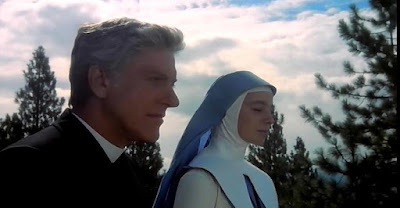
In a small town in the 1920's the brash, young, full-of-life Sister Rita (Kathleen Quinlan of Event Horizon) arrives and meets the somewhat dour Father Rivard (Dick Van Dyke of Bye Bye Birdie) -- who has been banished to the hinterlands because of some of his more controversial views -- the housekeeper Mrs. Shandig (Maureen Stapleton); two grumpy and dyspeptic older nuns; and the children Sister Rita will teach, including mischievous little James (Billy Jayne). Town tongues start to wag when an obvious friendship and closeness develops between the priest and the nun, and even the housekeeper seems a bit scandalized when Sister Rita moves into the rectory with the father after the other nuns develop consumption -- this is against the orders of the Monsignor (Ray Bolger). As romantic feelings between the pair begin to blossom, one knows things will not go well for these star-crossed lovers ... The Runner Stumbles begins with Rivard in jail, arrested for murdering Rita!
| Maureen Stapleton and Van Dyke |
| Kathleen Quinlan and Tammy Grimes |
Verdict: This tragic love story is imperfect, perhaps, but it is also altogether admirable.***1/2.
| The Martian Ambassador |
| Jack Nicholson as the president |
| In the Kennedy Room: Martin Short and Lisa Marie |
| Margaret Rutherford and Robert Morley |
| Rutherford with Flora Robson |
| Sam Waterston as Jack McCoy |
Jack McCoy: "I don't think he's going to confess."
Adam Schiff: "Why should he confess? You'll probably arrest somebody else tomorrow."
You had to take Law and Order with a grain of salt. To create suspense, far too many episodes had the police and prosecutors arresting more than one person -- sometimes as many as three members of the same family -- for the same murder, something that in real life would never happen (or the ADA wouldn't last very long). I think the writers even saw the silliness of this, prompting the exchange between McCoy and Schiff you can see above. When cops were dressed down by their higher-ups, the latter always came off like incredibly nasty and suspicious super-villains instead of real people.
| Jesse L. Martin and Leslie Hendrix as the M.E. |
Then there's the case of ADA Serena Southerlyn (Elizabeth Rohm, who appeared on the show for several seasons). In "Ain't No Love" in which a rap star is murdered, Serena is fired for being too passionate about a case and supposedly acting on emotion instead of evidence. She asks D.A. Arthur Branch (Fred Thompson) if he's firing her because she's a lesbian (which comes out of nowhere). He says "of course not," but when you consider that she had every good reason to think the man on trial was innocent she probably was fired for being gay. McCoy, who sometimes gets so overly passionate about things you think he's demented or will have a stroke, doesn't go to bat for her.
Over twenty years the show had a huge cast, most of whom gave notable performances. Jerry Orbach as Detective Lennie Briscoe; Jesse L. Martin as Ed Green; S. Epatha Merkerson as Lt. Van Buren; Linus Roache as ADA Mike Cutter (who told Jack off more than once); Chris Noth as Detective Mike Logan; Leslie Hendrix as the taciturn medical examiner; Angie Harmon as ADA Carmichael; Carey Lowell as ADA Ross. Paul Sorvino and George Dzunda also played detectives in the early seasons and were swell. Dianne Weist only lasted one season as the D.A.; she added nothing to the show.
"Misconception." There are terrific twists in this story of a pregnant woman who is attacked on the street. Season 2.
"Manhood." Cops let a gay colleague down by not responding to his calls for help. Season 3.
"American Dream" features Zeljko Ivanek as a killer who gets a new trial and goes up against Ben as his own lawyer. Season 4.
"Snatched." A wealthy man's son is kidnapped -- or was he? Season 4.
"Censure." A man terrorizing a woman and her child turns out to be a respected judge (David Groh). Season 4.
"Sanctuary." A superb episode with multiple points of view about racism and anti-Semitism as a Jew runs over a black boy and a a black man beats a white man to death. Season 4.
"Corruption." Lennie's old colleague (Kevin Conway) is accused of being on the take, then turns around and accuses Lennie. Season 7.
"Showtime." The trial of a director who murdered and dismembered his ex-wife. Season 7.
"Burden." A doctor murders a disabled boy, but he may be a serial killer and not a mercy killer." Season 8.
""DNR." A lady judge (Lindsay Crouse) is shot by a man who hired her husband; she wants to die but won't condemn him. Season 10.
"Marathon" A woman is shot in broad daylight, but Lennie Briscoe's allegedly hearing the confession of the killer is called into question. Good character development, especially concerning Briscoe. Season 10.
"Sundown." A man (George Martin) with Alzheimer's is accused of murdering his wife. Season 10.
"Identity." An elderly man's identity is stolen as well as his home; murder results. Season 14.
"Red Ball." Jack McCoy is forced to make a deal with a loathsome man in order to save a child's life. Season 16.
"Charity case." When a movie star adopts an African baby more than one murder results. Season 17.
"Captive." Sad (if somewhat contrived) episode in which McCoy actually prosecutes a boy for the murder of a child even though he had been kidnapped and molested. Season 17.
"Misbegotten." Interesting if imperfect, twisty episode about a bombing, the gay gene, and a brother-in-law accused of murder. Season 18.
"Quit Claim" Fascinating look at an illegal real estate scheme, who the real mastermind behind it is, and the manipulations of a mysterious female suspect. Season 18.
"Rumble." Jack charges a group of men who had a fight in a park -- with the resulting deaths of innocents -- as terrorists. Season 19.
"By Perjury." Mike (Linus Roache) matches wits with a lawyer (Dallas Roberts) who is representing relatives of victims of an airliner disaster.
"Anchors Away." A Bernie Madoff-inspired episode involving murders, a Ponzi scheme, and television reporters. Season 19.
"Shotgun." A storeowner (Elliot Gould) shoots men robbing his store but there are serious complications. Season 20.
"Innocence." Mike challenges the Innocence Project when they claim he wrongfully convicted a gay-basher. Season 20.
The last two episodes of the series beautifully illustrate the two main types of stories that appeared on the show. "Love Eternal" is an amusing, strange tale with a tacky woman arrested for murdering her masochistic, comics-collecting husband. The final episode, "Rubber Room," is a tense and suspenseful story of everyone trying to track down a boy planning to bomb a high school, while Lt. Anita Van Buren (S. Epatha Merkerson) waits for the results of her MRI regarding her cancer.
Verdict: Whatever its flaws, this was a compelling and intriguing series "ripped from the headlines." ***1/2.
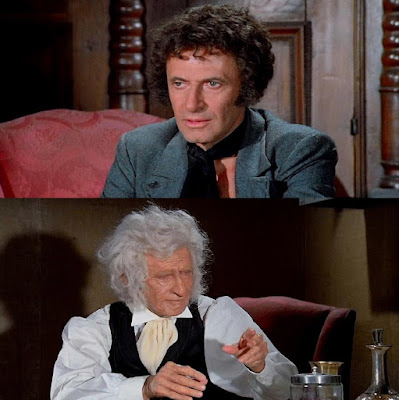
| Charles Boyer and Bobby Driscoll |
Three brothers -- (Jacques) Charles Boyer, (Desmond) Louis Jourdan, and (Louis) Kurt Kasznar -- interact in 1920's Ottawa, but the focus in this film is more on Jacques' son, Robert or "Bibi" (Bobby Driscoll). Bibi develops quite a crush on the maid, Mignonette (Linda Christian), although Desmond and Mignonette are attracted to each other. Louis is a wastrel and drunk who is married to a seeming shrew, Felice (Jeanette Nolan), who fears her daughter, Yvonne (Ann Faber), will become an old maid. The brothers' father, Grandpere (Marcel Dalio), just wants to have a good time in what time he has remaining. Then Bibi is accused of lying to the principal, Frye (Jack Raine), and the three brothers, united, decide to have a serious talk with the man.
The Happy Time settles most of the characters' problems in predictable fashion, but there is a pleasant time in getting there. The performances are uniformly excellent. Based on a Broadway show, the film's two biggest problems are its trivialism of alcoholism and its treatment of some of the female characters. Louis is clearly a hopeless drunk, but no one ever spares any compassion for his wife, whose shrill personality didn't come out of nowhere; her daughter is never developed at all. Marsha Hunt is fine in her brief screen time as Jacques' wife and Bibi's mother, but she also seems under-developed. Mignonette fares a little better, as does the next-door neighbor girl, Peggy (Marlene Cameron), who has an unrequited crush on Bibi and lies to the principal to get even with him. Louis Jourdan and Linda Christian
| Richard Erdman and Kurt Kasznar |
Verdict: Overly cute at times, but very well-acted, entertaining, and often charmingly sentimental. ***.
| On the set of I Love Lucy |
| Nicole Kidman as Lucille Ball |
| Warren Beatty and Jack Nicholson |
| Our "heroes" with Stockard Channing |
I admit I didn't expect much from this book, but it is so skillfully put together by co-author Lindsay Harrison, so well-paced and constructed, that it actually makes for a very compelling read. Of course the animosity between Natalie Wood's younger sister and her widower, Robert Wagner, is no secret, so one has to take some of this with a grain of salt. Lana Wood also doesn't seem to realize how people's behavior can be affected by copious amounts of alcohol. Still there's never been any proof that Natalie, say, surprised her husband and shipmate Christopher Walken having sex and took off in a dinghy in distress -- one of the theories -- and indeed the evidence seems to clearly point in another direction. If we are to believe reports and comments made by the two detectives (as filtered through Lana) who were assigned to Natalie Wood's death after the case was finally reopened, the original investigation was severely botched, either by incompetence or a star-struck attitude toward Robert Wagner, still a TV fixture at the time; and pathologist-to-the-stars Thomas Noguchi made serious errors as well. Clearly something bad happened on that ship and Wagner knows a lot more than he's telling. His account of that evening [Pieces of My Heart] simply doesn't match the facts, but so many years have gone by that he can only be considered a "person of interest" and not a "suspect." Well, judge for yourself.
| Lana and Natalie Wood |
Verdict: Worthwhile, well-written, and absorbing memoir. ***.