Lively, entertaining reviews of, and essays on, old and newer films and everything relating to them, written by professional author William Schoell.

Thursday, July 21, 2022

THE SCARFACE MOB

Eliot Ness and his Untouchables
THE SCARFACE MOB (1959). Director: Phil Karlson. 

With bootlegging gangsters like Al Capone (Neville Brand of Eaten Alive) -- nicknamed Scarface -- taking over Chicago, it is decided that Federal agent Eliot Ness (Robert Stack) will put together a special squad of incorruptible operatives soon to be known as the "Untouchables" because they cannot be bribed. One of the squad members is Joe Fuselli (Kennan Wynn of The Fuzzy Pink Nightgown), who served time for armed robbery but is anxious to make amends. Frank Nitti (Bruce Gordon) runs operations while Capote is temporarily in jail. George Ritchie (Joe Mantell), wants to impress his flirtatious wife, stripper Brandy (Barbara Nichols) -- whose uncle is a bookkeeper for Capone -- by volunteering to get info for Ness. Meanwhile the Feds set out smashing breweries, and more than one "untouchable" may come to a bad end. Ness also finds that his fiancee, Betty (Pat Crowley of There's Always Tomorrow), is in danger from the mob. 

Ness vs. Nitti: Stack with Bruce Gordon
Released in theaters, The Scarface Mob was actually the pilot for the TV show The Untouchables, originally shown in two parts on Westinghouse Desilu Playhouse and introduced by both Desi Arnaz and Walter Winchell, who provided snappy narration for the series. As a stand-alone movie, The Scarface Mob is a good if minor crime drama. Stack makes the perfect Ness, and the normally stoic actor even sheds tears when one of his operatives is killed. Pat Crowley is excellent as his fiancee turned wife, who marries Ness as much for protection as out of love (I don't believe Ness' wife was ever seen again on the TV series, although he called her on the phone frequently.) Brand, Gordon, Mantell, Wynn, and Nichols are all on target as well. Bill Williams also plays one of the Untouchables and is fine. 

Prohibition was undoubtedly one of the worst ideas in American politics. It only led to gangsters taking over the now-illegal alcohol industry and badly increased all manner of crime in Chicago and elsewhere. It was finally repealed due to public demand. 

Verdict: Credible and entertaining mob movie with very good performances. ***. 

SUMMER MAGIC

Mills, Mathers, McGuire, Hodges, Pollard

SUMMER MAGIC (1963). Director: James Neilson.

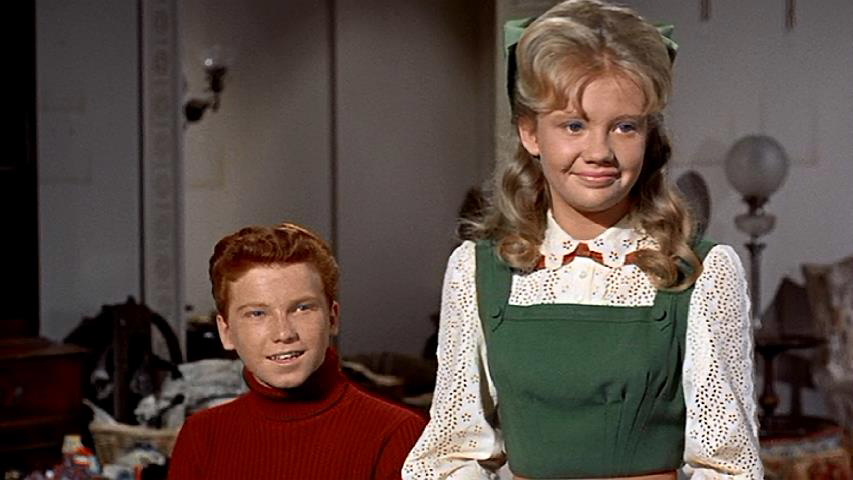
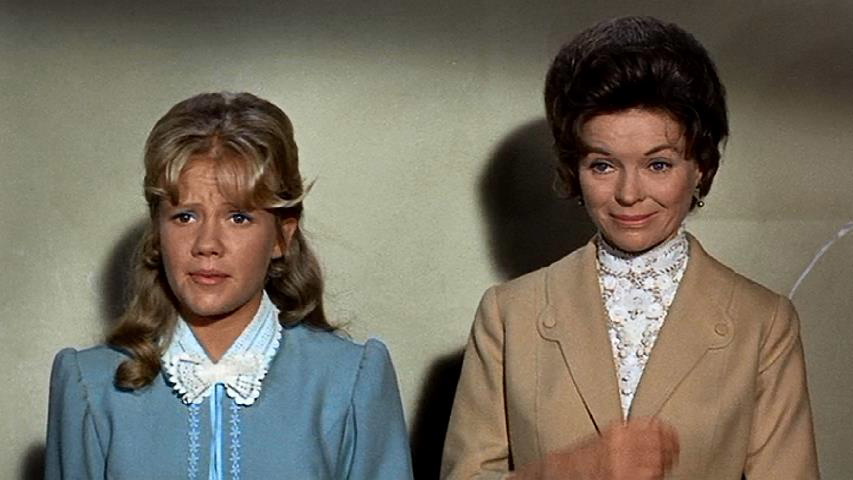
Widow Margaret Carey (Dorothy McGuire of Susan Slade) has to move her brood from Boston to a rented house in the country for financial reasons. The agent for the house, Osh Popham (Burl Ives of The Big Country), assures her that the owner is anxious for her to move in, but is he keeping secrets as his wife, Mariah (Una Merkel), suggests? Neither daughter Nancy (Hayley Mills) or older son Gilly (Eddie Hodges) are thrilled when they learn that stuck-up, pretentious cousin Julia (Deborah Walley), is moving in, but both young ladies are thrilled to meet the handsome young schoolmaster, Charles (James Stacy). Nancy is deflated when Charles seems to prefer Julia, but she may get the consolation prize when the house's real owner (Peter Brown of Violent Road) finally shows up. 

Eddie Hodges and Hayley Mills
Although there are a couple of moments when Summer Magic threatens to become dangerously sitcom-like and overly cutesy, I have to admit the darn thing has a lot of charm, not to mention several excellent performances. The gifted Hayley Mills always seems to be wonderful, and the same can be said of Dorothy McGuire. Ives and Merkel make an interesting couple, with the ever-quirky Michael J. Pollard (was there ever an actor anything like him?) playing their son with his customary shit-eatin' benevolence. Eddie Hodges is fine as Gilly, who would have preferred to stay in Boston, and little James Mathers (younger brother of Leave It to Beaver's Jerry Mathers) nearly steals the pic as the youngest member of the family. (It's somewhat annoying that when he's bullied because he has long hair and is wearing a Buster Brown outfit said bullies don't get any comeuppance.) 

Hayley with Dorothy McGuire
Summer Magic is a musical, and while the songwriting team of the Sherman Brothers is not exactly Rodgers and Hammerstein, they have contributed some more-than-pleasant tunes, including "On the Front Porch with You," "The Ugly Bug Ball," "Beulah" and others. Hayley, Eddie and Burl do their own singing while I believe the others are dubbed. The rather abrupt character reversal of Julia is unconvincing, although Deborah Walley manages to handle it all with aplomb. A song in which the girls sing about "Femininity" and hiding your true self to snare a beau is the most dated thing about the picture, even if it takes place in the twenties. Although Dorothy McGuire was not that old and still attractive, the film doesn't give her a romantic partner, another dated aspect.

Verdict: Take it with a grain of salt and this is amusing and entertaining in equal measure. ***. 

BUZZ

BUZZ: THE LIFE AND ART OF BUSBY BERKELEY. Jeffrey Spivak. University Press of Kentucky; 2010. 

In this well-written and interesting account of Busby Berkeley, we learn that the man responsible for so many knock-out and eye-popping production numbers in vintage musicals was not a choreographer in the classic sense, but came up with often startling ideas to incorporate into -- or overpower -- the song and dance routines. Berkeley also directed numerous films, including Forty Little Mothers and Babes on Broadway

Whatever the man's sexual orientation, Berkeley avoided MPs in the red light district by dressing in drag; his first wife considered him a mama's boy and most of his marriages did not last long; and early in his career he eagerly took the role of a campy queen in a Broadway show. Who knows? 

His personal life had other problems, including a propensity for drink. After three trials Busby was acquitted of vehicular manslaughter in the deaths of three people. His defense team argued that regardless of his inebriation at the wheel, a tire blow-out caused the accident. (But a sober driver might have been able to handle the car after the blow out.) While some of the people who worked with Busby had positive things to say about him, others considered him a rather vile and unpleasant individual. 

Frankly Buzz will not have you admiring the man but it does help you to admire his artistry, which is well-documented in this informative and engaging tome. 

Verdict:  Solid bio of a influential and creative Hollywood figure. ***1/2. 

THE CHALK GARDEN

Deborah Kerr and Hayley Mills
THE CHALK GARDEN (1964). Director: Ronald Neame. 

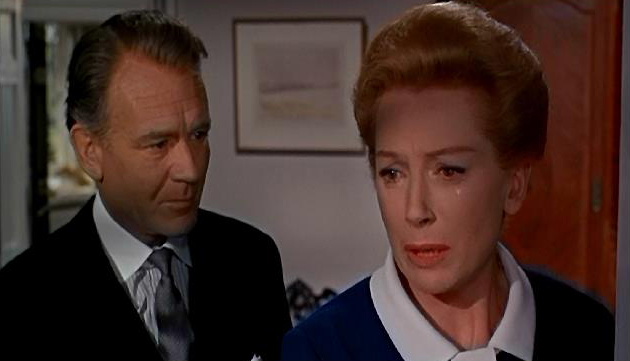
Miss Madrigal (Deborah Kerr) is the latest in a long line of governesses for young and incorrigible Laurel (Hayley Mills), whose mother went off with her new husband and left her in the care of her own mother, Mrs. St. Maugham (Edith Evans). Laurel, who hates her mother, Olivia (Elizabeth Sellars), for abandoning her, is determined to find out what if any secrets Miss Madrigal may have, and one of them is a doozy. Meanwhile the governess and Mrs. St. M disagree on who should raise Laurel, her mother or her grandmother. Madrigal believes she belongs with Olivia, while her employer vehemently denies this. Then Mrs. St. M's old friend, "Puppy," the retired Judge McWhirrey (Felix Aylmer) shows up, and eventually remembers where he has seen Miss Madrigal before ... 

John Mills with Kerr
The Chalk Garden is based on a play by Enid Bagnold, and in truth it is very stagey and often unconvincing. There were a great many changes made from theater to film. Deborah Kerr never quite seems to get a handle on her character (although in this she may not necessarily be blamed); Hayley Mills is fine but for one or two occurrences of over-acting; Edith Evans is on the money; and Sellars and Aylmer are perfectly solid. So too is John Mills, who plays the sympathetic butler. There is perhaps too much left unsaid in this version, and characters come to conclusions that seem without foundation.

Verdict: This Ross Hunter production has some merit but ultimately doesn't quite cut it. **3/4.

THEY ONLY KILL THEIR MASTERS

THEY ONLY KILL THEIR MASTERS
(1972). Director: James Goldstone. 

Chief of Police Marsh (James Garner) investigates when a woman is found dead and it is at first assumed that she was the victim of a Doberman Pinscher. But it turns out that she was murdered by a much more human adversary. Her husband (Peter Lawford) says she told him she was going to leave him for another woman. Interestingly enough, she was also pregnant at the time of her death. Suspects include a vet (Hal Holbrook), his assistant (Katherine Ross), who becomes involved with Marsh, and the vet's wife (June Allyson, who is quite good in a brief sequence). Edmond O'Brien plays the owner of a liquor store, and Tom Ewell and Ann Rutherford have supporting roles as well; Harry Guardino is another cop. This is typical of slick TV-like movies released theatrically in the seventies that try to be "hip" by adding homoerotic elements, but Lane Slate's script is pretty dated when it comes to the subject of homo and bisexuality and swinging. Garner is Garner; Ross is pretty. The best scene has the Doberman going a little nutty when Garner and Ross are in bed. 

Verdict: If you're a swinger you gotta die. **.

Thursday, July 7, 2022

POLLYANNA

Hayley Mills
POLLYANNA  (1960). Director: David Swift. 

Now that she has become an orphan, young Pollyana (Hayley Mills) is shipped off to a small midwestern city where she is to live in a mansion with her stern and uncompromising Aunt Polly (Jane Wyman). So as not to disturb her sleep, Polly gives her niece the smallest room up in the attic. Despite her travails, Pollyana has the most upbeat nature in the world, and refuses to see defeat in anything or anybody. Mayor Warren (Donald Crisp) wants the town to build a new orphanage while Polly -- the wealthiest citizen, who happens to own the building -- thinks all it needs is new plumbing. When everyone decides to hold a fair to raise money for the new orphanage, Polly forbids her to go, but she sneaks out anyway, nearly leading to tragedy. 

Mills with Richard Egan
A very popular movie in its day -- and the first film Mills did for Walt Disney -- Pollyana is undeniably entertaining and generally well-acted, especially by young Ms. Mills. A sub-plot has to do with the romance between Polly's assistant Nancy (Nancy Olson) and George Dodds (James Drury), not to mention Polly's interactions with old flame Dr. Chilton (Richard Egan). Pollyana also interacts with the hypochondriacal Mrs. Snow (Agnes Moorehead, badly over-acting); the weird recluse Pendergast (Adolphe Menjou); orphan boy Jimmy (Kevin Corcoran); grumpy maid Angelica (Mary Grace Canfield); the termagant Mrs. Tarvell (Anne Seymour); peppery cook Tillie (Reta Shaw); and the amazingly wishy washy and weak Reverend Ford (Karl Malden). Pollyana offers a surprisingly negative portrait of the minister, although he does eventually grow a spine. 

Egan with Jane Wyman
Pollyana is a little too long - surely the little ones in the audience grew impatient, not to mention needed bathroom breaks? -- and the whole business with Pendergast and his prisms that create rainbows gets tiresome very quickly. How faithful the film is to its turn of the century period I can't tell. Despite the open-endedness of the finale, the movie is extremely pat in virtually solving all of the problems of the characters with what seems like the snap of a finger -- this is almost funnier than anything else in the movie. Still, if you can take all that with a grain of salt, the movie may work for you. It is fun. 

Verdict: Classic Disney film with a fine lead performance. ***. 

ELMER GANTRY

  • Jean Simmons and Burt Lancaster
ELMER GANTRY
(1960). Director: Richard Brooks. 

 "He rammed the fist of God into me so fast that I never heard my father's footsteps." -- Lulu. 

Elmer Gantry (Burt Lancaster) is an operator who discovers there's money to be made and power achieved in the Evangelical movement, so he hooks up with one Sister Sharon (Jean Simmons) and her associate William Morgan (Dean Jagger), who doesn't quite trust Gantry. He and Sharon make a highly effective team but things are threatened when Lulu (Shirley Jones), an old girlfriend and preacher's daughter who's become a hooker, resurfaces in Gantry's life at an inopportune moment. The entire cast is fairly terrific, and that includes Hugh Marlowe [All About Eve; Earth vs. the Flying Saucers] in a supporting part as an anti-revivalism reverend; Arthur Kennedy as a reporter; and the always-flavorful Edward Anderson as Babbitt. Elmer Gantry is interesting and entertaining, but it doesn't always make its points very clearly, and one senses that its opportunities to say something have been blunted. The climactic fire is quite well-handled. The low point is Lancaster and Patti Page doing a duet, with Page in Full Female Vocalist mode. Nice score by Andre Previn. 

Verdict: Somehow less than the sum of its parts, but never boring. ***.

FOREVER YOUNG: A MEMOIR Hayley Mills

FOREVER YOUNG: A MEMOIR. Hayley Mills. Grand Central; 2021.

In this very well-written and completely absorbing memoir, Hayley Mills begins by telling us that not only wasn't she at the ceremony, but she wasn't even aware of it when she was given a special Oscar for her first Disney film, Pollyanna.  She then writes of her early years, her family -- including father John Mills and sister Juliet Mills and her possibly alcoholic mother, who was also an actress -- and her first film, the British independent Tiger Bay, in which she co-starred with Horst Buchholz and developed a major crush on him. She signed a contract with Walt Disney, a man she greatly admired (she says nothing whatsoever negative about him) and appeared in such films as The Parent Trap, In Search of the Castaways, Summer Magic, That Darn Cat and others. Her first adult role was in The Family Way, which was directed by the much older Roy Boulting, whom she married. Boulting put her in unmemorable and inappropriate vehicles such as Twisted Nerve and their marriage was ultimately unsuccessful. Mills doesn't neglect her films or acting career, but the strength of the book is how well she delineates the feelings she was going through as she became famous at a very early age and other life-and-career-changing events that occurred afterward. 

Verdict: One of the best show biz memoirs ever written. ****. 

SOUTH SEA WOMAN

Burt Lancaster and Virginia Mayo
SOUTH SEA WOMAN
(1953). Director: Arthur Lubin. 

Through a series of misadventures Sergeant James O'Hearn (Burt Lancaster), his buddy and rival Davey (Chuck Connors), and the woman, Ginger (Virginia Mayo), that Davey is in love with wind up on an isolated island that seems untouched by the war except that any soldiers there wind up in jail. O'Hearn only pretends that he's gone AWOL, but Davey wants no part of the war, with the result that O'Hearn, of all people, winds up court-martialed. The movie is a long flashback detailing how he wound up in such a situation with the story veering from Shanghai to the French island of Namou. Too much talk in the courtroom sequences slows the movie down but there's some good action near the end when a commandeered yacht helmed by O'Hearn takes on the Japanese fleet! The three leads all give very good performances, as does Viola Vonn as the Frenchwoman Lillie Duval, and Arthur Shields [Daughter of Dr. Jekyll] as another resident of the island. Paul Burke plays an ensign at the court martial. 

Verdict: Entertaining if unremarkable. **1/2.

GOLD DIGGERS OF 1933

Ruby Keeler and Dick Powell
GOLD DIGGERS OF 1933 (1933). Director: Mervyn LeRoy. 

Carol (Joan Blondell), Trixie (Aline MacMahon) and Polly (Ruby Keeler) are roommates and struggling chorus girls. They are excited to learn that Barney Hopkins (Ned Sparks) is putting on another show, but disappointed when they discover he has no financial backer. But neighbor Brad (Dick Powell), an aspiring songwriter, says he has dough and wants to invest. Polly, who has a crush on Brad, is convinced that he is a infamous bank robber, but he's actually the wealthy scion of a stuffy Boston family. When Brad's brother Larry (Warren William) mistakes Carol for Polly and tries to buy her off, she decides to string him along while ruthless Trixie -- the oldest and least attractive of the trio -- sets her cap for Larry's lawyer Peabody (Guy Kibbee). Will true love conquer all? On yes, there are songs and dance numbers as well. 

Ginger Rogers and chorus cuties
The production numbers were put together by Busby Berkeley, and they are inventive and engaging (I especially loved the roller-skating baby!). The songs, by Warren and Dubin, include "We're In the Money" (warbled by Ginger Rogers, who plays a friend of the aforementioned trio); "Torch Song," well-sung by the very likable Powell; "Pettin' in the Park;" "In the Shadows;" and "The Forgotten Man." This last number, which is a poignant salute to forgotten and homeless WW1 veterans, adds some depth to an otherwise frothy, mindless movie and wisely ends the film without the usual clinch or upbeat finale. Trixie is a kind of sleazy character but the movie glosses over that. The cast is good and enthusiastic, putting over the material with aplomb. 

Verdict: All this and Powell, too! ***. 

Wednesday, June 22, 2022

NEW PROJECTS

 Polishing up some exciting new projects. GREAT OLD MOVIES will return in July, if not sooner! 

Thursday, May 26, 2022

EDGE OF ETERNITY

Victoria Shaw and Cornel Wilde
EDGE OF ETERNITY      (1959). Director: Don Siegel. 

Near the Grand Canyon, Deputy Les Martin (Cornel Wilde of The Naked Prey) pursues a pretty if reckless driver, Janice (Victoria Shaw), distracting him from preventing the horrible murder of an unknown man marked for death. As Les and Janice begin a romance, there are other murders as well, and the County Attorney expects action. Sheriff Edwards (Edgar Buchanan of Lust for Gold) may be forced to ask Les to turn in his badge if he doesn't come up with something. Then Janice innocently gives Les a clue to the first dead man's identity, meaning that her family might even be involved ... 

Dashing Wilde
Edge of Eternity has Wilde adeptly playing a less dynamic, more laid-back kind of individual who nevertheless will eventually get his man -- and woman. His co-star, Victoria Shaw [The Eddy Duchin Story], is also quite adept and thoroughly winning. Also notable is Rian Garrick, who plays Janice's half-drunken brother, Bob; this handsome actor had only a few credits. Mickey Shaughnessy, Dabbs Greer, Jack Elam, and Edgar Buchanan, among others, are old reliables who give solid performances. 

Edge of Eternity also benefits from a score by (Mr.) Daniele Amfitheatrof and Burnett Guffey's CinemaScope photography of those sweeping grand canyon vistas. When a cable car that travels high over the canyon is first introduced, you know that it will figure in the thrilling climax, which it does, although the deputy's actions are a bit too foolhardy to be believed -- still it makes for a rousing sequence. The stunt work at the end -- the long shots reveal no nets and no FX work -- is not only amazing but almost horrifying! This is probably the only movie ever made in which the producers offer thanks to the U. S. Guano Corporation! Australian-born Victoria Shaw was married for a few years to Roger Smith before his marriage to Ann-Margret; Shaw and Smith had three children. 

Verdict: This movie is no guano! ***.

PEGGY SUE GOT MARRIED

Kathleen Turner and Nicolas Cage
PEGGY SUE GOT MARRIED  (1986). 
Director: Francis (Ford) Coppola. 

Peggy Sue (Kathleen Turner) is separated from her husband, high school sweetheart Charlie (Nicolas Cage of Ghost Rider), due to his adultery. She has mixed emotions about going to her 25-year high school reunion, but her daughter, Beth (Helen Hunt), importunes her to attend. After being crowned queen, Peggy Sue passes out and wakes up a quarter century in the past. She has an adult mind in a teenager's body! Trying to figure out if she's dead or simply going crazy, she has to determine if she wants to make the same mistakes -- such as marrying Charlie -- that she made before. 

Nicolas Cage
The basic premise of Peggy Sue, while not especially original, is compelling. Unfortunately, what the screenwriters have come up with doesn't do nearly enough with the material. Peggy Sue boasts some fine acting -- Turner and Cage are especially good if imperfect -- Jordan Cronenweth's photography is first-rate, and whenever the film seems emotionally moving it's undoubtedly due to John Barry's evocative scoring. The movie is a typical Hollywood "concept" picture which does as little with the concept as it possibly can. What could have been an especially affecting sequence when Peggy Sue goes to see her long-dead grandparents is turned into a weird bit of nonsense involving the old man's lodge brothers. (We never learn if her parents were still alive 25 years later.) It's as if the movie was merely a sequence of bits thrown together in the hopes it will turn into a cohesive whole. By the ending, nothing is really resolved. Peggy Sue is right back where she started. The whole time travel business is handled too prosaically anyway. 

Barbara Harris
A disturbing aspect of the picture is that more than once Peggy Sue mentions how much she loves and misses her two children (we only see one). This begs the question: how can she not marry Charlie when it means her beloved children (at least one of them) will no  longer exist -- but this never seems to occur to her. The superficial script doesn't wrestle with metaphysical issues in any case. So we're left with some interesting casting: Barbara Harris [Family Plot] as Peggy Sue's mother; Leon Ames and Maureen O'Sullivan as her grandparents; Barry Miller as the high school geek who makes good; John Carradine as a lodge member; and Kevin J. O'Connor [Deep Rising] as the romantic, mysterious school poet. While Barry's score adds a lot to the movie, it is not as good as his work on Somewhere in Time or Out of Africa

Verdict: Well-acted and reasonably entertaining, this is still a perfect example of how Hollywood can screw up fantasy-type movies. **1/4. 

AGE OF CAGE

AGE OF CAGE: Four Decades of Hollywood Through One Singular Career
. Keith Phipps. Henry Holt; 2022. 

Author Phipps makes it clear right from the beginning that this is not a biography of actor Nicolas Cage. Certainly there is plenty of material in both the man's career and occasionally chaotic private life to turn out a full bio, but instead Phipps has chosen to do a career study, describing the changes in Hollywood and the film industry over the years that impacted on Cage's career, and when he went with the flow or bucked the trends. Whatever you think of Cage -- nowadays many people see him as a name to avoid when it's listed in the cast -- he had some major successes, an Oscar for Leaving Las Vegas, made some odd but forthright choices (such as the voice he affected in Peggy Sue Got Married), and is generally considered an intense and talented thespian who has given some very interesting performances. Cage's marriages, divorces, and tax and financial troubles are briefly mentioned, but not covered in detail, as the book focuses exclusively on the work. Phipps examines all of Cage's output, from major films to direct-to-video releases, and discusses which ones are worth your attention. Cage is the nephew of Francis Ford Coppola, but he changed his name when charges of nepotism got too frenzied (the name change hardly worked). Cage is a big comic book fan who wanted to play Superman, but for multiple reasons it never happened. 

Verdict: Whether you're a fan of Cage or not, this is a breezy, entertaining and well-written look at the ups and downs of an interesting Hollywood career. ***. 

CARNIVAL IN COSTA RICA

Dick Haymes and Vera-Ellen
CARNIVAL IN COSTA RICA (1947). Director: Gregory Ratoff. 

Luisa Molina (Vera-Ellen), daughter of Costa Rican Rico (J. Carrol Naish) and American Elsa (Anne Revere), is told that she is to have an arranged marriage to Pepe Castro (Cesar Romero). For his part Pepe is already in love with the brash Celeste (Celeste Holm), and pretends to Luisa and her parents that he is too sickly to dance, sightsee or do much else that she might enjoy, hoping they will cancel the engagement. While Luisa is contemplating this possible union with a low-energy, half-dead spouse, she meets Jeff Stephens (Dick Haymes), who practically sweeps her off her feet during Carnival. Neither Luisa's or Pepe's parents have a clue to what is going on as everyone tries to do the right thing -- but what is it?

Celeste Holm and Cesar Romero
Carnival in Costa Rica is, as the title implies, very colorful and full of music, including a few fairly insipid if inoffensive songs by Levanna and Ruby. There isn't much plot beyond what is described in the paragraph above, so the movie sinks or swims on its musical numbers, which are at least energetic if not terribly inspired, and its performances. Everyone in the cast is more than adequate, but I especially enjoyed Anne Revere, sophisticated and stylish as the mother; Romero, who is as charming as ever; and of course the ever-delightful Fritz Feld as a hotel manager who has an amusing scene with the two fathers in question. Dick Haymes' is fine as an actor, and when he opens his mouth out comes one of the smoothest and most attractive voices in popular music. He knows how to put over a song, too (if only the songs had been a bit better). Little red-headed Tommy Ivo plays Luisa's sister even if he doesn't look much like a Costa Rican. Vera-Ellen's dancing is swell, but this could have used an Astaire or Kelly. 

Verdict: A pleasant and perfectly forgettable musical comedy without enough comedy. **1/4.

BLOODLINE

Audrey Hepburn
BLOODLINE
(1979). Director: Terence Young. 

"People who don't pay up end with their knees nailed to the floor." 

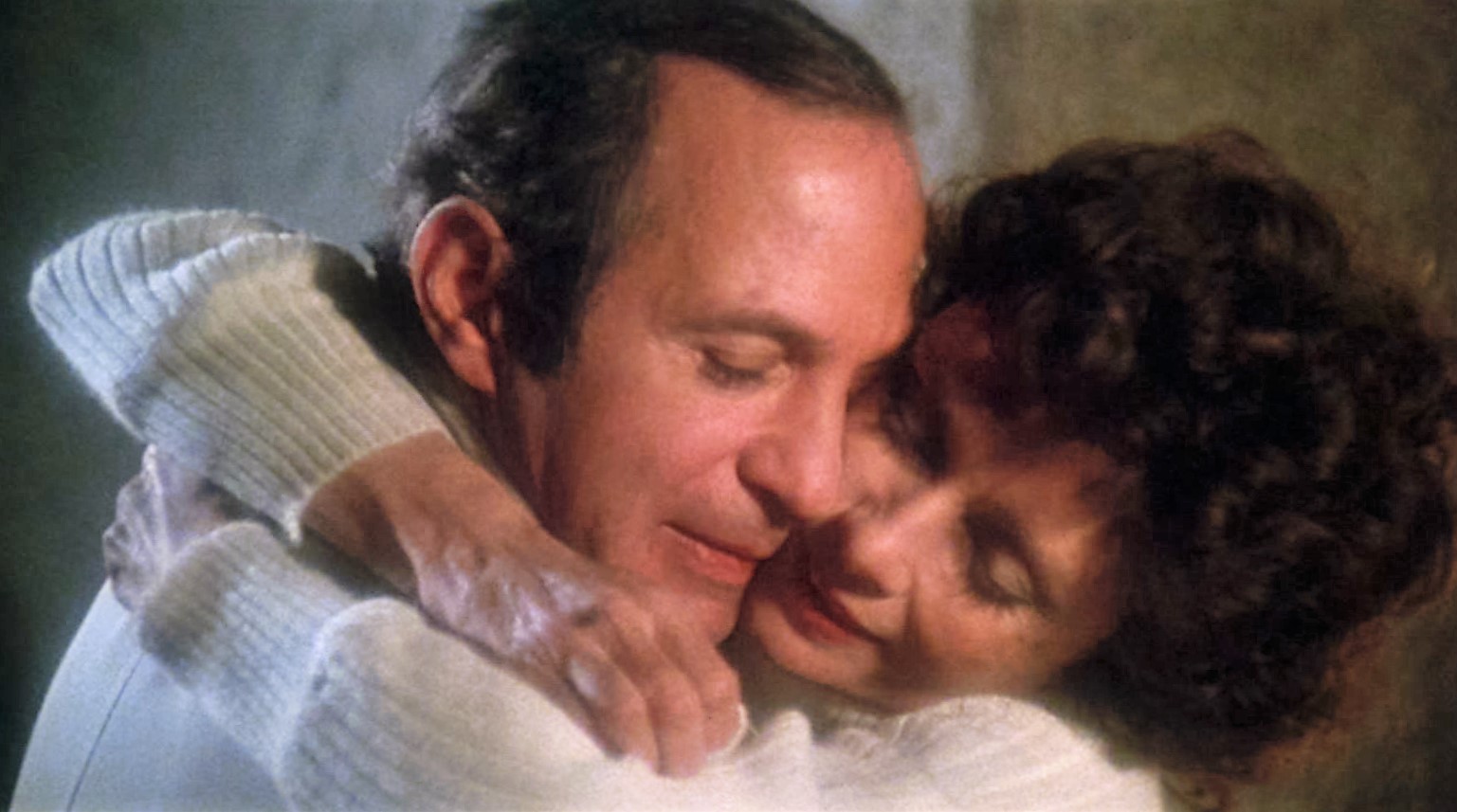
When her father, the head of an international pharmaceutical firm, is murdered, Elizabeth Roffe (Audrey Hepburn of The Unforgiven) takes over the company with the help of Rhys Williams (Ben Gazzara of The Young Doctors), whom she marries. But virtually all of the board members, all of whom are Elizabeth's relatives, are desperate for money, and appalled that she refuses to make the firm public, whereupon they could get ready cash. Before long, there are several attempts on Elizabeth's life, including an elevator crash that kills her secretary (Beatrice Straight). Who is the culprit: Ivo (Omar Sharif), whose mistress is demanding money; Helene (Romy Schneider), a ruthless race car driver; Sir Alec (James Mason), whose wife (Michelle Phillips) has run up huge gambling debts; or someone else? And who is responsible for the murders of several young women in snuff films? 

Ben Gazzara and Audrey Hepburn
Certainly an entertaining movie could have been made from Sidney Sheldon's absorbing page-turner, but this is a by-the-numbers effort with some unfortunate casting, slack direction, and an obnoxious musical score by Ennio Morricone, who simply layers the same treacly tune over every scene whether it is appropriate or not.  Director Young seems to have forgotten all he knew about directing, and despite an okay climax, Bloodline has virtually no suspense. The aforementioned elevator crash sequence is so brief and inept that it's positively comical. The best passages in the book, which concern Elizabeth's grandfather's ordeals in a Polish ghetto and the origins of Roffe Industries, get only a little screen time. This was sort of the second "comeback" picture for Hepburn, who gives a competent performance and looks good, if a little scary-skinny with, as one viewer put it, "ribs up to her neck." Gert Frobe from Goldfinger plays an inspector who tries to track down the culprit, but James Mason positively walks off with the picture, which is no surprise. 

Verdict: So much happening and still so dull. **.

Thursday, May 12, 2022

MY COUSIN RACHEL

Olivia De Havilland and Richard Burton
MY COUSIN RACHEL(1952). Directed by Henry Koster. 

Philip Ashley (Richard Burton of Becket) has been raised by a man whom he has always considered a brother, a father, and best friend, Ambrose Ashley (John Sutton of The Second Face). Now Ambrose has gone off on a vacation from which he never returns. While in Italy, Ambrose met and married an Italian woman with a possibly shady history. Now Ambrose -- who sent strange letters to his cousin, Philip -- is dead, and his widow is coming to visit the estate Philip will inherit. Rachel Ashley (Olivia De Havilland) seems charming, and Philip becomes smitten with her, but he can't shake the feeling that she may not be quite as sympathetic as she seems. That perhaps she was in some way responsible for his beloved cousin's death ... 

Richard Burton
My Cousin Rachel is based on a novel by Daphne Du Maurier, but it is no Rebecca or The Birds, because while Henry Koster is a workmanlike professional he is no Hitchcock. However, if taken more as a romantic drama and not necessarily a suspense film, Rachel is effective and absorbing and has excellent performances. The casting of de Havilland and Burton may seem strange, as they are both representatives of a very different kind of "Hollywood," with Olivia a product of the studio system and Burton an Angry Young Man of the theater. Still, they work together beautifully, and this is certainly a star-making performance for Burton. 

Audrey Dalton with Burton
Olivia de Havilland may not be perfect casting -- she doesn't even attempt an Italian accent -- but her strength is that she never lets the viewer know what she is thinking. No one watching the film can definitely make up their mind about Rachel's guilt or innocence. Audrey Dalton, whose performances can be variable, is lovely as Louise Kendall, someone who has known Philip since childhood and has always expected to marry him, but this is not a certainty once Philip meets Rachel. There's also nice work from Tudor Owen as major domo Seecombe; Ronald Squire as Nicholas Kendall; George Dolenz (father of Mickey Dolenz of the Monkees) as Guido, who may or may not be Rachel's lover. Hamilton Camp [Evilspeak], who plays Philip at age 15, later became a singer. 

Verdict: Not entirely satisfying, perhaps, but entertaining and well-acted. ***.

AGNES OF GOD

Meg Tilly and Jane Fonda
AGNES OF GOD (1985). Director: Norman Jewison. 

A young nun, Sister Agnes (Meg Tilly), is arrested for manslaughter when her strangled baby is found in a waste basket at the convent. Dr. Martha Livingstone (Jane Fonda), a psychiatrist, is brought in to assess the nun's mental condition. She has some problems in this due to the nun's reticence in talking about or even acknowledging her pregnancy, and the Mother Superior, Miriam (Anne Bancroft). has objections as well. Martha is a lapsed Catholic and Miriam accuses her of hating the Church. Martha decides to do some investigating and find out who the father of the baby is, and if somebody else strangled the infant. She discovers there's a secret exit from -- and entrance into -- the convent.

Anne Bancroft and Jane Fonda
The film version of Agnes of God, which was based on a stage play by John Pielmeier (who also wrote the screenplay) was packaged in movie houses as a murder mystery. If viewers, especially non-Catholic and non-religious viewers, knew it was actually a kind of dopey exploration of faith and the immaculate conception, there probably would have been even less of them in the theater. The film has a visual gloss to it due to Sven Nykvist's cinematography, some nice music by Georges Delarue, and the acting from the three leads can not be faulted, yet ... Most sensible viewers will feel that Sister Agnes definitely needs a psychiatrist! This is a study of severe mental illness masquerading as an examination of faith.

Verdict: Beatific looks can't help put this one over. **.  

OLIVIA DE HAVILLAND: LADY TRIUMPHANT

OLIVIA DE HAVILLAND: LADY TRIUMPHANT. Victoria Amador. University Press of Kentucky; 2020.

The author of this bio, a life-long De Havilland fan, tracked the actress down in Paris, begged to meet and interview her, and even showed up at de Havilland's doorstep without an invitation (eventually she was invited). Normally I'm very wary of bios written by obsessive fans, questioning their objectivity, but to be fair to Ms. Amador, her portrait of the reclusive Miss De. Havilland seems fair and balanced for the most part. The book looks at the actor's youth, her rather quick ascent in Hollywood, her most famous roles (such as Miss Melanie, of course) and movies, and insightfully examines her acting style and approach to different parts -- when De Havilland was less than special she's not afraid to say so. The book also recounts her ultimately successful legal battles with the studio. her famous "feud" with her sister, Joan Fontaine (which actually gets its own chapter), and her marriages and affairs (according to the diva herself, she did not sleep with Errol Flynn although she certainly wanted to). 

The portrait that emerges of De Havilland is not without warts, as the lady has often come off as quite affected and too oh-so-proper to be believed.  However this book will give the interested reader the basic facts and then some behind the career and life of the actress whose most interesting aspect was her appearances on film in such movies as Hush ... Hush, Sweet Charlotte, The Heiress, Lady in a Cage, The Dark Mirror, and many, many others. Inexplicably Amador supports De Havillamd's foolish, ill-advised and ultimately unsuccessful lawsuit against the producers of Feud: Bette and Joan. Admittedly she was portrayed, briefly, by an actress who was nothing like her and she would never have made comments about her sister in public, but that is hardly suit-worthy, and trying to change the laws about public figures would have been opening a can of worms that would have had terrible repercussions for journalists -- and biographers. Amador has added a new chapter after her subject's death that goes on and on and on perhaps a bit too much.

Verdict: Very good read for De Havilland fans and Hollywood observers in general. ***1/2. 

ENDLESS NIGHT

Hywel Bennett and Hayley Mills
ENDLESS NIGHT (1972). Director: Sidney Gilliat. 

Michael Rogers (Hywel Bennett) drives wealthy people across Europe but wants a better life for himself. He greatly admires a piece of property called Gypsy's Acre in a small English village, and dreams of having his dying architect friend, Santonix (Per Oscarsson), design a house for him there. Dreams do come true after Michael meets and falls for Ellie Thomson (Hayley Mills), a lovely young woman who turns out to be an American heiress. Michael is disturbed by the discrepancy in their incomes, but Ellie is determined to marry him, despite her family's and advisors' objections. She is helped in her goal by her friend, Greta (Britt Ekland), who becomes an unwelcome presence in the couple's lives after they tie the knot. Santonix does design a magnificent house for them on the desired property, but events occur which make them feel ill at ease. Then there's a death ... 

Bennett with George Sanders
Endless Night is based on the novel by Agatha Christie, one of the author's personal favorites, and it is a suspenseful and especially well-written book which is told, as in the film version, from the point of view of Michael. Endless Night is quite well-acted by all the participants -- George Sanders adds a touch of class as a deceptively friendly lawyer -- the house is something to see (particularly the inside of it), and the viewer may or may not catch on to the twist that occurs at the finale. 

Britt Ekland with Mills
The trouble is that Endless Night is just blah. There's only one possible twist, not a lot of serious suspects, and the whole production just comes off as second-rate. Even Bernard Herrmann's score seems to consist of snatches from other and better movies. Bennett and Mills first worked together in The Family Way, then reunited for Twisted Nerve and then this film. Hayley Mills married Roy Boulting, who was 33 years older than her, and it is said that his choices for her all but ruined her career. Mills is still acting although her profile is comparatively low today. Bennett passed away in 2017. Britt Ekland's [The Wicker Man] last credit was in 2006. 

Verdict: Read the novel instead. **1/2.

OH, YOU BEAUTIFUL DOLL

Mark Stevens and June Haver
OH, YOU BEAUTIFUL DOLL (1949). Director: John M. Stahl. 

Around the turn of the (last) century, song promoter Larry Kelly (Mark Stevens of Time Table) runs into classical composer Alfred Breitenbach ("Cuddles" Sakall) and uses the latter's arias from his unproduced opera to turn them into tin pan alley hits. This he does with the cooperation and encouragement of Breitenbach's daughter, Doris (June Haver), who has a big crush on Larry. While Alfred enjoys the money he makes as "Fred Fisher" -- the name he takes as composer of popular hits -- he is afraid he is bowdlerizing his art and will never be taken seriously as an operatic composer. So he just takes off to rework the opera while Larry, Doris, and his wife, Anna (Charlotte Greenwood) frantically search for him. But famous conductor Gottfried Steiner (Eduard Franz of The Four Skulls of Jonathan Drake) has an idea to get the man back ... 

Charlotte Greenwood and Cuddles Sakall
Mark Stevens had already teamed with June Haver two years earlier in I Wonder Who's Kissing Her Now in which he played composer Joe Howard, although in this his character is fictional. There really was a Fred Fisher, born Alfred Breitenbach, and he did have a daughter named Doris, but just about everything else is made up, including his being a classical composer. Cuddles Sakall gives his customary good and lively performance in this, and Mark Stevens gives a fine account of himself as well. Playing another good and proper gal as she generally did, the only thing June Haver lacks is a little frosting. Gale Robbins [Double Jeopardy] is a little spicier as actress Marie Carle, but she isn't given much to do. Charlotte Greenwood is swell as Cuddle's wife, but she not only doesn't deliver any of her famous high kicks, she doesn't sing and dance at all. 

The big finale
A strange thing about the picture is that both Haver and Stevens were singers, but both of them are dubbed in this movie. Bill Shirley, who has a splendid voice, did the singing for Stevens; he appeared as himself in a few movies as well. As for the songs, aside from the title tune (not composed by Fisher), and Fisher's best-known compositions "Peg O' My Heart" and "Chicago," and maybe one or two others, they are forgettable. The finale has Gottfried Steiner conducting a concert version of Fisher's hits, when it probably would have been more appropriate to play the original operatic versions (which never actually existed). In beautiful technicolor. 

Verdict: Pleasant, with a more interesting plot than usual, even if it's completely fabricated. ***.  

Thursday, April 28, 2022

BONNIE AND CLYDE

Warren Beatty and Faye Dunaway
BONNIE AND CLYDE (1967). Director: Arthur Penn. 

Bonnie and Clyde go on a crime spree robbing banks in the 1930's and become folk heroes to part of the population, but their days are numbered. This film was quite polarizing when it first came out, with some finding it slick and cinematic; others repellent and empty -- both viewpoints have validity. Warren Beatty [Splendor in the Grass] isn't bad as Clyde Barrow, the leader of a group of depression-era bank robbers, but he's never quite believable, either. The same could be said of Faye Dunaway [Mommie Dearest]  as Bonnie Parker, although she certainly demonstrates star-making vitality. The trouble with both of the leads is that they never seem quite as stupid as the people they're playing. Gene Hackman, Estelle Parsons and Michael J. Pollard as relatives and fellow gang members are perhaps more on the mark. 

Estelle Parsons and Gene Hackman
Today Bonnie and Clyde seems almost benign next to Goodfellas and similar movies. The picture doesn't really glorify these murdering robbers so much as it shows how pathetic and desperate they and their self-absorbed lives really are. But the movie can't really be considered a serious examination of these people because the characters lack dimension and the film can't seem to make up its mind whether or not to take them -- or itself, in fact -- seriously. In any case, the picture is generally entertaining and well-done, but it goes on about half an hour too long and is very Hollywood-ized to say the least. One could make a strong case that William Witney's The Bonnie Parker Story, made ten years earlier, is the better picture. 

Verdict: Okay, but maybe watch Little Caesar instead. **1/2.

ANNE BANCROFT: A LIFE

ANNE BANCROFT: A LIFE. Douglass K. Daniel. University Press of Kentucky; 2017. 

Anne Bancroft was typical of a lot of what we might call "second tier celebrities." Bancroft was accomplished and celebrated, an Oscar-winner, and had a highly successful career, yet for most of her life she was not really "bankable." Her husband, Mel Brooks, may have even become the bigger "name" at one time. In spite of this, Bancroft managed to amass many credits on TV, on the stage, and in films, with her most famous movies being The Miracle Worker (recreating her stage role) and The Graduate. This excellent biography covers her entire life and career from girlhood to death, and does so with intelligence and sensitivity. Author Daniel also analyzes Bancroft's technique in different roles, and doesn't shy away from recording times when she was off her game, at least according to certain critics. Bancroft toiled in B movies like Gorilla at Large and The Girl in Black Stockings, before entering a new phase and new admiration on Broadway and elsewhere. On the stage Bancroft tackled challenging roles in works such as The Devils and Mother Courage. The book is bolstered with many comments from people who knew and worked with the woman. Bancroft's first movie was Don't Bother to Knock, where she was upstaged by Marilyn Monroe but gave the better performance. She wisely turned down such projects as Myra Breckinridge and Mommie Dearest

Verdict: Excellent on every level and a good read as well. ****. 

TREASURE OF THE GOLDEN CONDOR

Cornel Wilde and Anne Bancroft
TREASURE OF THE GOLDEN CONDOR (1953). Director: Delmer Daves. 

In 18th century France Jean Paul (Cornel Wilde) becomes the bonded servant of his hateful uncle the Marquis de St. Malo (George Macready). Jean also falls in love -- and vice versa -- with his cousin Marie (Anne Bancroft). Jean is the rightful heir to the estate and money but there is no proof that his parents, who died at sea, were ever married. Jean figures only money can get him out of his predicament, especially after he is arrested for assaulting his uncle and trying to flee, so he takes off on a treasure hunt in Guatemala with a man named MacDougal (Finlay Currie). 

Wilde with Finlay Currie
In Guatemala the two men set off with MacDougal's daughter Clara (Constance Smith) and look for a stone serpent to guide them to the treasure. Despite the fact that the movie made much of the fact that some of it was filmed in Guatemala, it doesn't especially add to the film's veracity, especially when the treasure seems to be found in a matter of minutes. There's a snake, a cave-in, and minimal excitement in the treasure scene. Then Jean returns to France, is put on trial, and has a rousing and satisfying final battle with his awful uncle, the best and most memorable sequence in the movie. Wilde gives a charismatic lead performance, with good support from a slimy Macready and a passionate if duplicitous Bancroft in one of her earliest roles. (When she eyes Wilde with his shirt off you can imagine she'd rather cozy up to him than Dustin Hoffman!) Irish actress Smith had about thirty credits but never hit the heights. Fay Wray has a supporting part as Macready's wife, and Leo G. Carroll is also in the cast, but I didn't recognize Robert Blake as a nasty stable boy.  The rich score by Sol Kaplan is beautifully orchestrated by Edward Powell. The main problem with this movie is that the viewer will expect it to be about a treasure hunt but that only takes up a small portion of the picture.

Verdict: Good cast can only do so much with comparatively weak and derivative material. **1/2.

GOOD NEW MOVIE -- HOUSE OF GUCCI:

The cast of House of Gucci
HOUSE OF GUCCI (2021). Director: Ridley Scott.

Maurizio Gucci (Adam Driver) is smitten with the outgoing and ambitious Patrizia (Lady Gaga), and soon afterward they are married. Maurizio's father, Rodolfo (Jeremy Irons) isn't entirely taken with the union, but his brother, Aldo (Al Pacino) welcomes Patrizia and his nephew to New York. Then there's Aldo's son, Paolo (Jared Leto of Urban Legend), who is treated like a moron by his father, and who wants to design his own line. There are behind-the-scenes battles for control of the Gucci company, and then Maurizio has the temerity to have an affair and ask for a divorce. Patrizia is not going to take this lying down ... 

Lady Gaga was a determined Patrizia
House of Gucci
 is an entertaining and well-acted biopic and suspense story (even if you know the outcome) that holds the attention throughout its length. Lady Gaga is good, but I suspect there are other actresses who could have made more of the part. Driver and Leto (although he's initially over the top) are also quite good, but the pic is nearly stolen by a wonderful Pacino and especially Jeremy Irons as the father. If you're hoping to see some courtroom dynamics, be warned that the film ends rather abruptly with the arrest of certain parties -- you'll have to watch details of the murder trial on Dateline, which covered the story more than once.  

Verdict: Well, you may not rush out to buy a Gucci bag, but all the skullduggery in this is fascinating. ***1/4.  

TALES OF MANHATTAN

TALES OF MANHATTAN (1942). Director: Julien Duvuvier. 

This very entertaining film is a series of tales connected by a tailcoat that proves lucky or disastrous for whoever wears it, including an actor (Charles Boyer) who is in love with a married woman (Rita Hayworth); a man (Cesar Romero) who is about to get married and who has a jealous fiancee (Ginger Rogers) and a friend (Henry Fonda) who tries to help him; a musician (Charles Laughton) whose wife (Elsa Lanchester) gets him the tailcoat to wear on the night he conducts his symphony, to disastrous (and somewhat unlikely) results; and a down-on-his luck lawyer (Edward G. Robinson) who wears the coat to a reunion of his ivy league college buddies who have no idea of how far he's fallen. The final sequence stars Paul Robeson, Ethel Waters, and Eddie Anderson in a charming tale of poor folk (who are not exactly in Manhattan) who have to decide how to spend the money that falls out of the tailcoat. A brief but amusing sequence with W. C. Fields (appearing with Margaret Dumont!) lecturing society folk was cut out for the initial theatrical release, but has been wisely reinstated. The entire cast is good, with special honors going to Boyer, Robinson, and Fields. 

Verdict: Who knew a movie about a coat could be such fun? ***.